

ACV vs ARR: Differences, Formulas & When to Use Each
Your VP of Sales reports $2M in new ACV bookings last quarter. Your CFO reports $800K in new ARR. Both are correct - and neither realizes the other's number tells a different story. This disconnect around annual contract value vs ARR kills board credibility faster than a missed quarter.
There's a classic scenario that pops up constantly on r/sales: a rep closes a 4-year deal with a $50K annual software license plus $50K in services, expects big quota credit, and then finance only counts $50K of year-one software ARR. Same deal, two completely different numbers, instant friction between the people who closed it and the people who report it.
What Is Annual Contract Value?
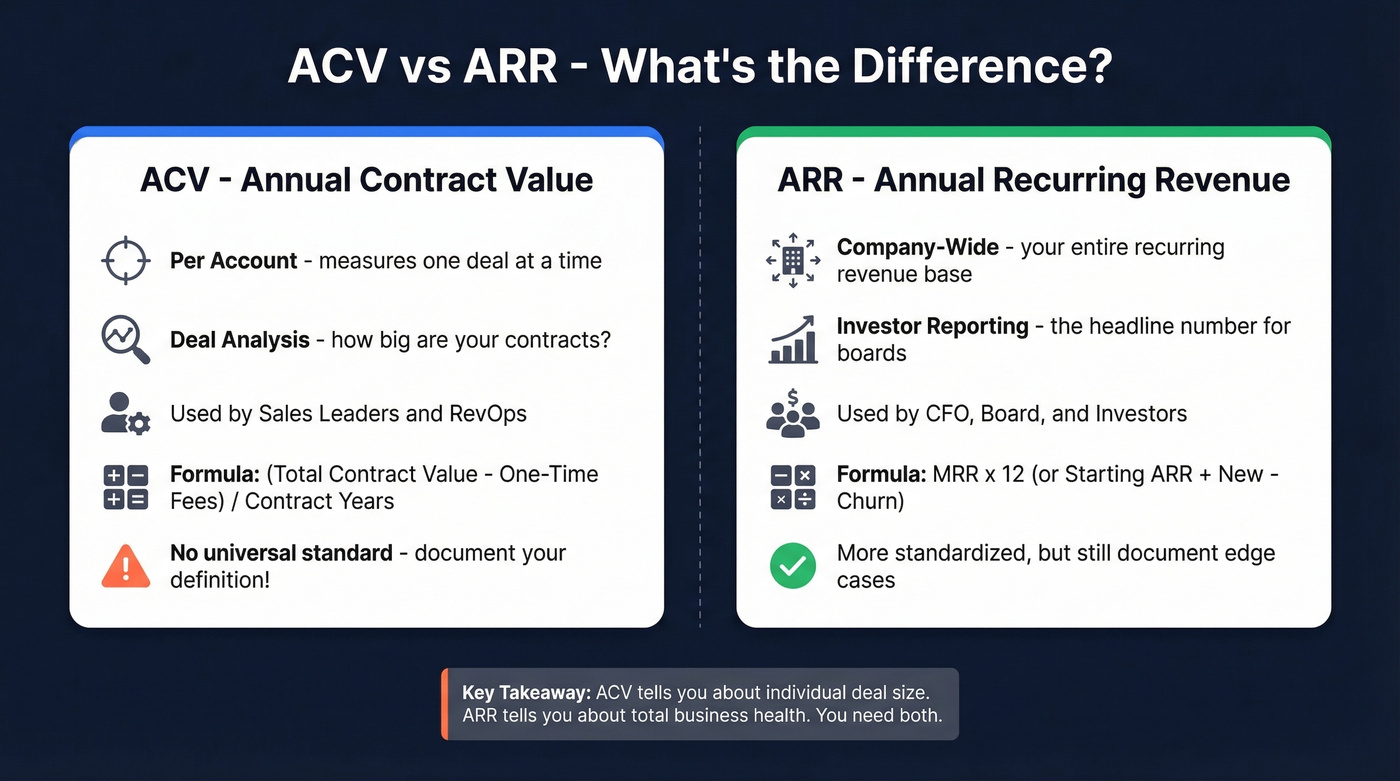
ACV - annual contract value - represents the annualized recurring revenue from a single customer contract, excluding one-time fees. The formula:
ACV = (Total Contract Value - One-Time Fees) / Contract Years
A 3-year contract with $120K in recurring revenue plus a $5K implementation fee? Drop the $5K, divide $120K by 3, and you get $40K ACV.
Here's the thing - ACV has no universal standard. Some companies include setup fees, others don't. We've seen this ambiguity derail board meetings at companies well past Series B, where sales and finance have been quietly using different definitions for months without realizing it. Put your ACV definition in three places: your sales comp plan, your finance reporting policy, and your board deck appendix. Three documents, one definition. Do it before your next board meeting.
What Is ARR?
ARR - annual recurring revenue - measures total predictable subscription revenue across your entire customer base, annualized:
ARR = MRR x 12
Or, broken down by movement:
ARR = Starting ARR + New/Upgrades - Cancellations/Downgrades
ARR excludes one-time fees, professional services, and hardware. If your CFO is counting implementation revenue in ARR, you've got a problem that'll surface during diligence.
One related metric worth knowing: CARR (contracted annual recurring revenue) includes signed contracts that haven't gone live yet. For enterprise SaaS with 90-day implementation cycles, CARR gives you a forward-looking view that standard ARR misses. If your board doesn't know the difference between ARR and CARR, you're leaving committed revenue invisible.
ACV vs ARR at a Glance
| Dimension | ACV | ARR |
|---|---|---|
| Scope | Per account | Company-wide |
| Purpose | Deal analysis | Investor reporting |
| Primary user | Sales leaders | CFO / board |
| Excludes | Varies - document it | One-time fees/services |
| Standardized? | No | More standardized, but still document edge cases |
How Public Companies Define ARR
An analysis of 160+ SEC filings reveals four distinct buckets:
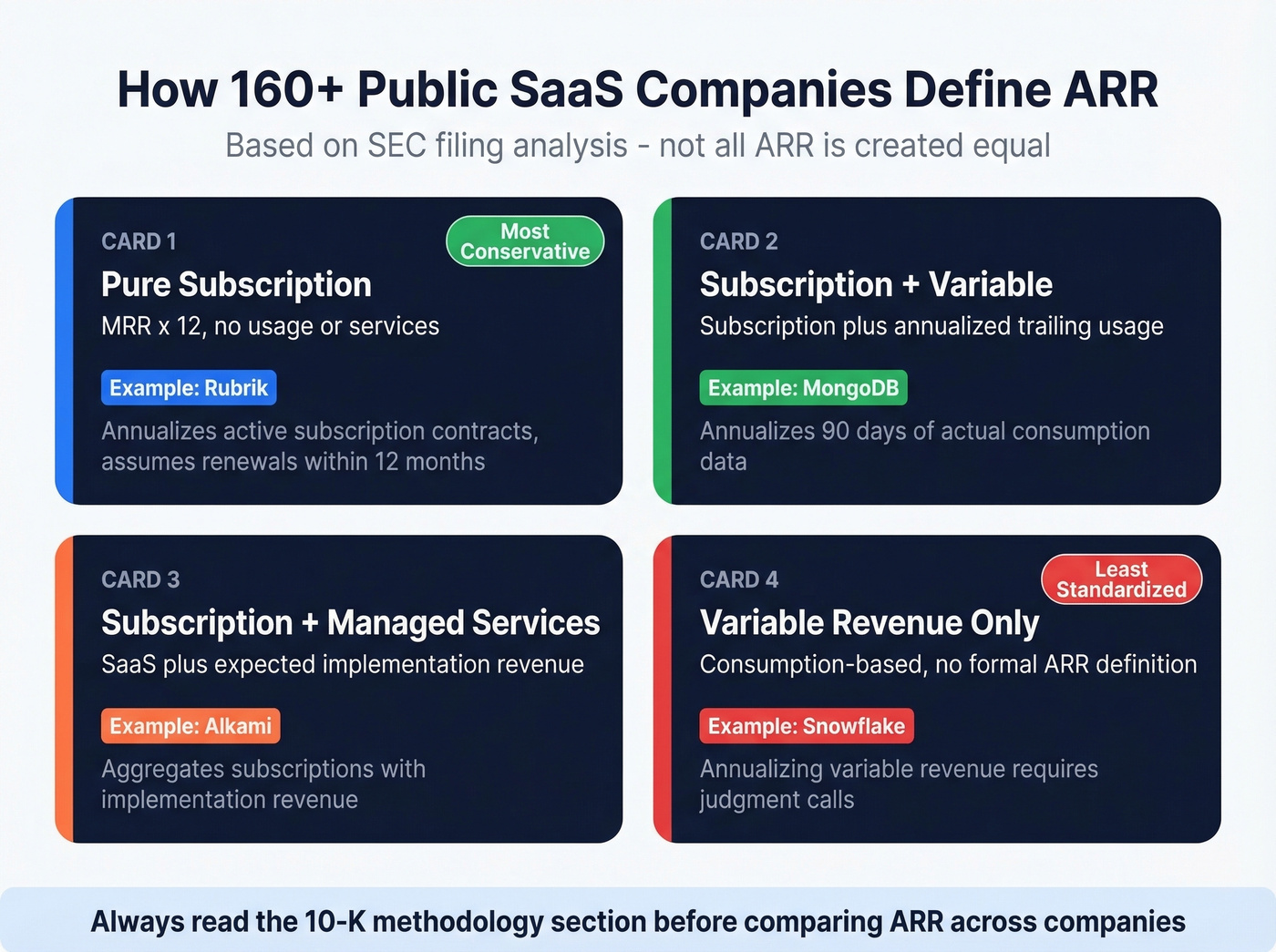
| Bucket | What's Included | Example |
|---|---|---|
| Pure Subscription | MRR x 12, no usage or services | Rubrik annualizes active subscription contracts, assuming renewals within 12 months |
| Subscription + Variable | Subscription plus annualized trailing usage | MongoDB annualizes 90 days of actual consumption |
| Subscription + Managed Services | SaaS plus expected implementation services | Alkami aggregates subscriptions with implementation revenue |
| Variable Revenue Only | Consumption-based, no formal ARR definition | Snowflake - annualizing variable revenue requires judgment calls |
Let's be honest: most people comparing ARR across companies don't read the 10-K methodology section. They should. A "pure subscription" ARR and a "subscription + variable" ARR aren't the same animal, even if the headline numbers look comparable.

Tracking ACV and ARR is pointless if your pipeline leaks at the top. Prospeo's 98% email accuracy and 125M+ verified mobile numbers mean your reps actually reach the decision-makers behind those enterprise contracts - not bounce logs.
Stop measuring ARR you can't grow. Fix your pipeline data first.
SaaS Benchmarks Worth Knowing
Benchmarkit's 2026 report gives you the context most metric guides skip:
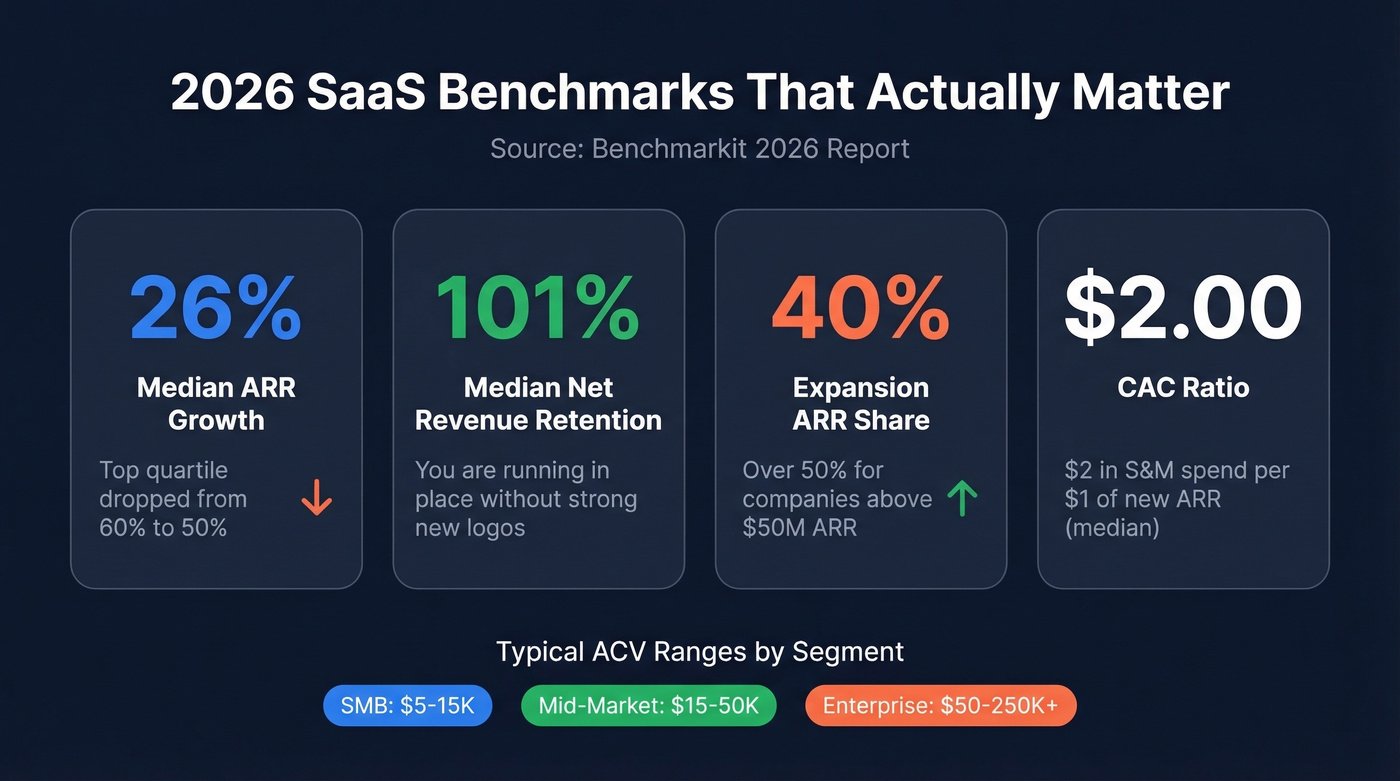
- Median ARR growth rate: 26% (top quartile dropped from 60% to 50%)
- Median net revenue retention: 101%
- Expansion ARR = 40% of total new ARR (over 50% for companies above $50M)
- Median new customer CAC ratio: $2.00 in S&M spend per $1.00 of new ARR
Typical ACV ranges for segmentation: SMB $5-15K, mid-market $15-50K, enterprise $50-250K+. A $10K deal shouldn't get the same sales motion as a $200K one - understanding where your ACV clusters helps you allocate reps and resources without guessing.

A 26% growth rate with 101% NRR means you're running in place unless new logo acquisition is strong. In our experience, this is where most Series A-B companies stall: retention looks fine on paper, but the new business engine isn't producing enough pipeline to move the needle. The math is unforgiving - if you're churning 10% annually and only growing new logos at 15%, you're crawling.
Which Metric to Use, When
Your stage determines your headline metric. Here's the framework from Mercury's overview:
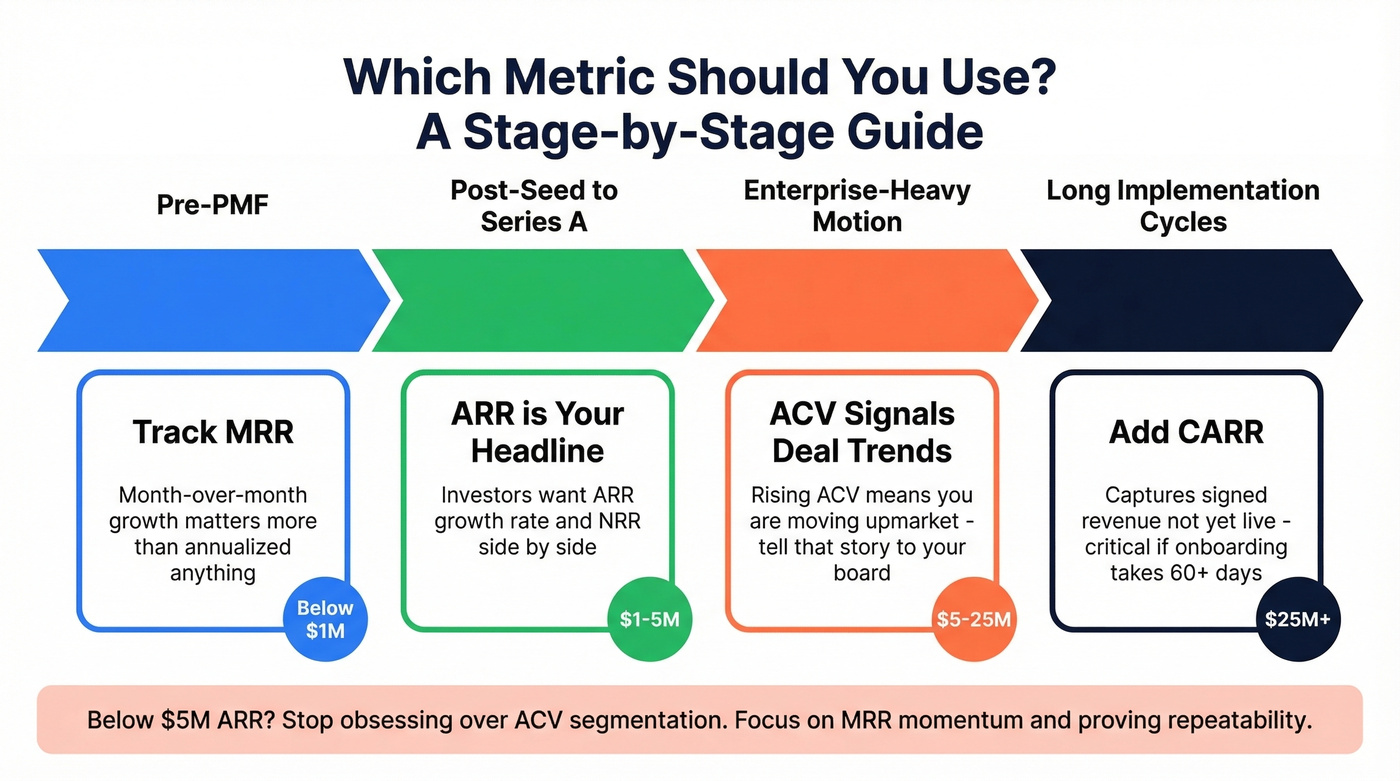
Pre-PMF: Track MRR momentum. Month-over-month growth matters more than annualized anything.
Post-seed to Series A: ARR becomes your headline number. Investors want ARR growth rate and NRR side by side.
Enterprise-heavy motion: ACV signals deal-size trends. If average ACV is climbing, you're moving upmarket - tell that story explicitly in your board narrative, because the raw ARR number won't show the shift.
Long implementation cycles: CARR captures signed revenue that hasn't gone live. Skip this at your peril if onboarding takes 60+ days.
Below $5M ARR, stop obsessing over ACV segmentation entirely. Focus on MRR momentum and proving repeatability. The companies we've watched over-index on ACV analytics at that stage are usually avoiding the harder question of whether their go-to-market actually works.
Mistakes That Destroy Board Credibility
Counting free trials as ARR. Trial conversion runs 15-20%. Treating signups as recurring revenue inflates your number by 4-5x on those cohorts. Your investors will figure it out.
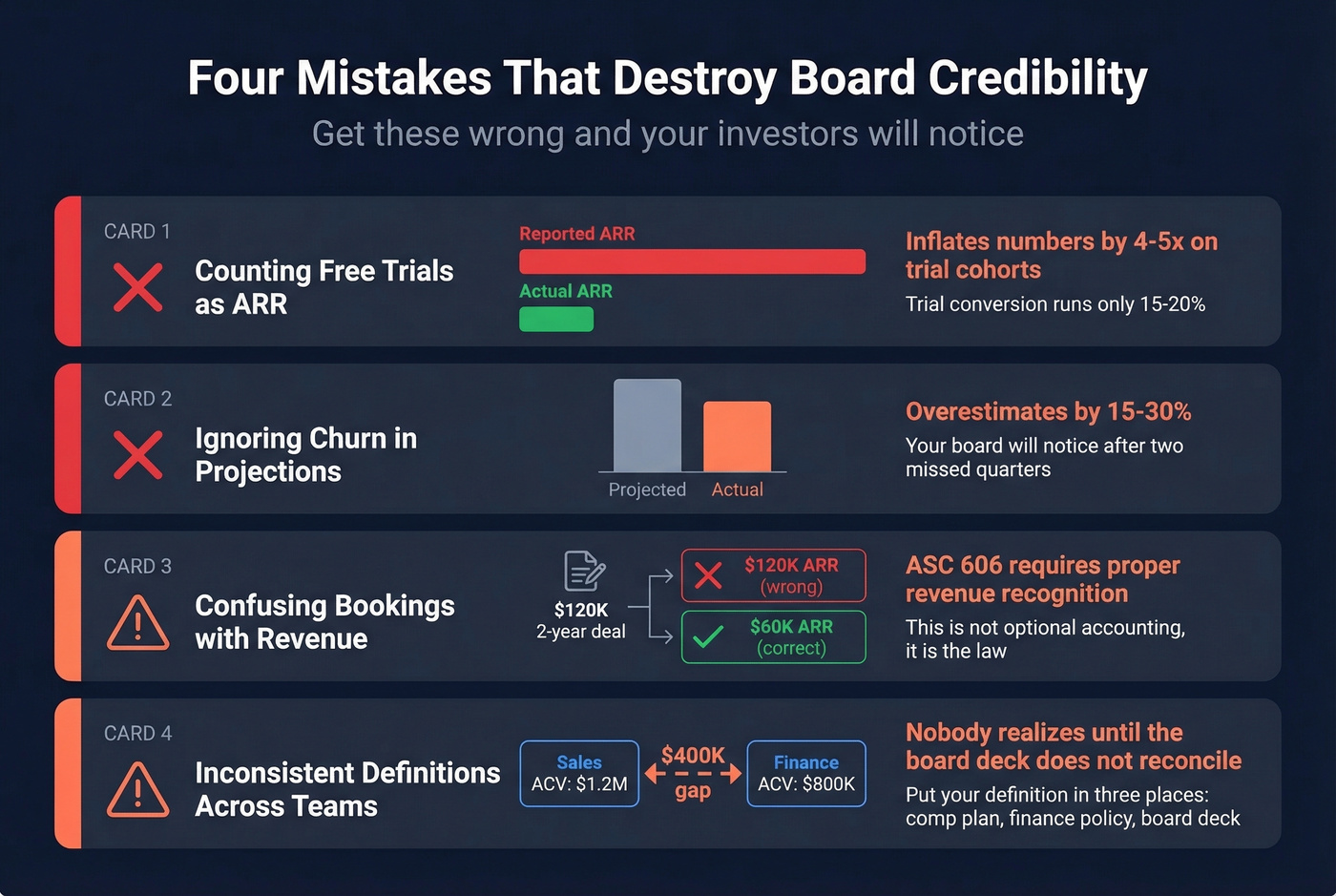
Ignoring churn in projections. Companies that skip churn in ARR forecasts overestimate by 15-30%. Your board will notice when actuals miss by that margin two quarters running.
Confusing bookings with revenue. A $120K two-year contract is $60K ARR, not $120K. ASC 606 requires revenue recognition as performance obligations are fulfilled - this isn't optional accounting, it's the law.
Inconsistent definitions across teams. Sales includes setup fees in ACV, finance doesn't. Nobody realizes it until the board deck doesn't reconcile and someone has to explain a $400K gap in front of your lead investor. We've watched this happen. It's not fun.
Growing the ARR Number That Matters
All these metrics are academic if your pipeline is thin. ARR growth depends on reaching the right buyers with the right message - and that starts with contact data that doesn't bounce. Prospeo's 98% email accuracy and 7-day data refresh cycle mean your outbound actually lands with decision-makers instead of leaking at the top of the funnel. If you're trying to diagnose where revenue is stalling, start with pipeline health and the sales pipeline challenges that typically cause it.
Companies using Prospeo book 26% more meetings than ZoomInfo users and 35% more than Apollo - at $0.01 per email with no annual contract. When your ACV depends on reaching the right buyers, stale data from providers refreshing every 6 weeks isn't going to cut it. Prospeo refreshes every 7 days.
Your next ARR milestone starts with data that actually connects.
FAQ
Does ACV include one-time fees?
Most SaaS companies exclude setup and implementation fees from ACV, counting only recurring value. There's no universal rule - document your policy and apply it consistently across sales comp and finance reporting.
Can ARR include usage-based revenue?
Yes. MongoDB annualizes trailing 90 days of actual usage within ARR. Disclose your methodology clearly so investors understand what's subscription versus consumption-based.
How does ACV relate to TAM sizing?
Multiply your target account count by average ACV to estimate the serviceable portion of your total addressable market. This bottom-up approach gives investors a more credible TAM figure than top-down industry reports.
What's the difference between ARR and CARR?
ARR counts live, billing contracts. CARR includes signed contracts that haven't activated yet - critical for enterprise SaaS where implementation stretches 60-120 days. Report both if your sales cycle involves long onboarding.
How do I build pipeline that actually grows ARR?
Start with verified contact data so outbound doesn't leak at the top. From there, tools like HubSpot or Salesforce track how that pipeline converts to recognized recurring revenue. The gap between "leads generated" and "ARR recognized" is where most growth teams lose visibility.