

How to Ask for the Sale Without Freezing Up
You just finished a great demo. The prospect's nodding. They said "this looks really good" twice. And then - silence. You know you should ask for the sale, but the words won't come. That 10-second gap between "any questions?" and actually requesting the deal is where pipeline goes to die.
The average B2B win rate hovers around 21%, and the average deal takes 84 days to close across 8 meaningful touchpoints. Four out of five deals don't close - and a big chunk of those losses aren't because the product was wrong. Nobody asked.
What You Need (Quick Version)
Three closing questions that work at any deal stage:
- "What would need to be true for you to move forward?"
- "Who else needs to weigh in before this gets approved?"
- "What's your timeline for solving this?"
The single biggest reason deals die isn't your close - it's your qualification. If you haven't confirmed the pain is real, the budget exists, and the decision-maker's in the room, no closing line will save you.
The transition from "here's the price" to "do we have a deal?" is simpler than you think: "It looks like our solution is a strong fit. Let's talk details." That's it. Closing is a system, not a sentence - and knowing what to say starts with knowing what to ask long before the final conversation.
Why Closing Is Harder in 2026
Buyers don't need you the way they used to. 96% of prospects research companies and products before engaging with a sales rep, and 71% prefer independent research over talking to anyone in sales. By the time you get on a call, they've already formed opinions about your product, your competitors, and your pricing.
The cycle's getting longer - 57% of sales pros confirm it - and reps spend 60% of their time on non-selling tasks. Meanwhile, 73% of B2B buyers actively dodge sellers who send irrelevant outreach. You've got less time, more competition, and a buyer who doesn't want to hear from you. Sellers who partner with AI sales tools are 3.7x more likely to meet quota, which tells you how much the baseline has shifted.
Here's the thing: an analysis of 1M+ B2B sales calls found that winning and losing closing calls look almost identical. Same talk/listen ratio, same number of questions, same interactivity. The difference isn't what happens on the closing call - it's what happened in every conversation before it. The close is built across the entire deal, not in one magic moment.
And here's the part nobody talks about: your brain processes sales rejection the same way it processes physical pain. That freeze-up you feel before requesting the commitment isn't weakness. It's neurobiology. Knowing that makes it easier to push through.
The Real Reason You're Not Closing
Most sales leaders blame closing skills when deals stall. They're wrong. As Membrain's analysis of 20 common deal-killers shows, deals die from qualification failures, not closing failures.
Think about the last five deals you lost. They fell into one of three buckets: the buyer chose a competitor, the buyer did nothing, or the buyer solved the problem internally. In all three cases, the root cause traces back to something that went wrong long before you asked for the signature. Close rates vary by industry - finance averages 19%, software 22%, industrial 27% - but the pattern holds everywhere.
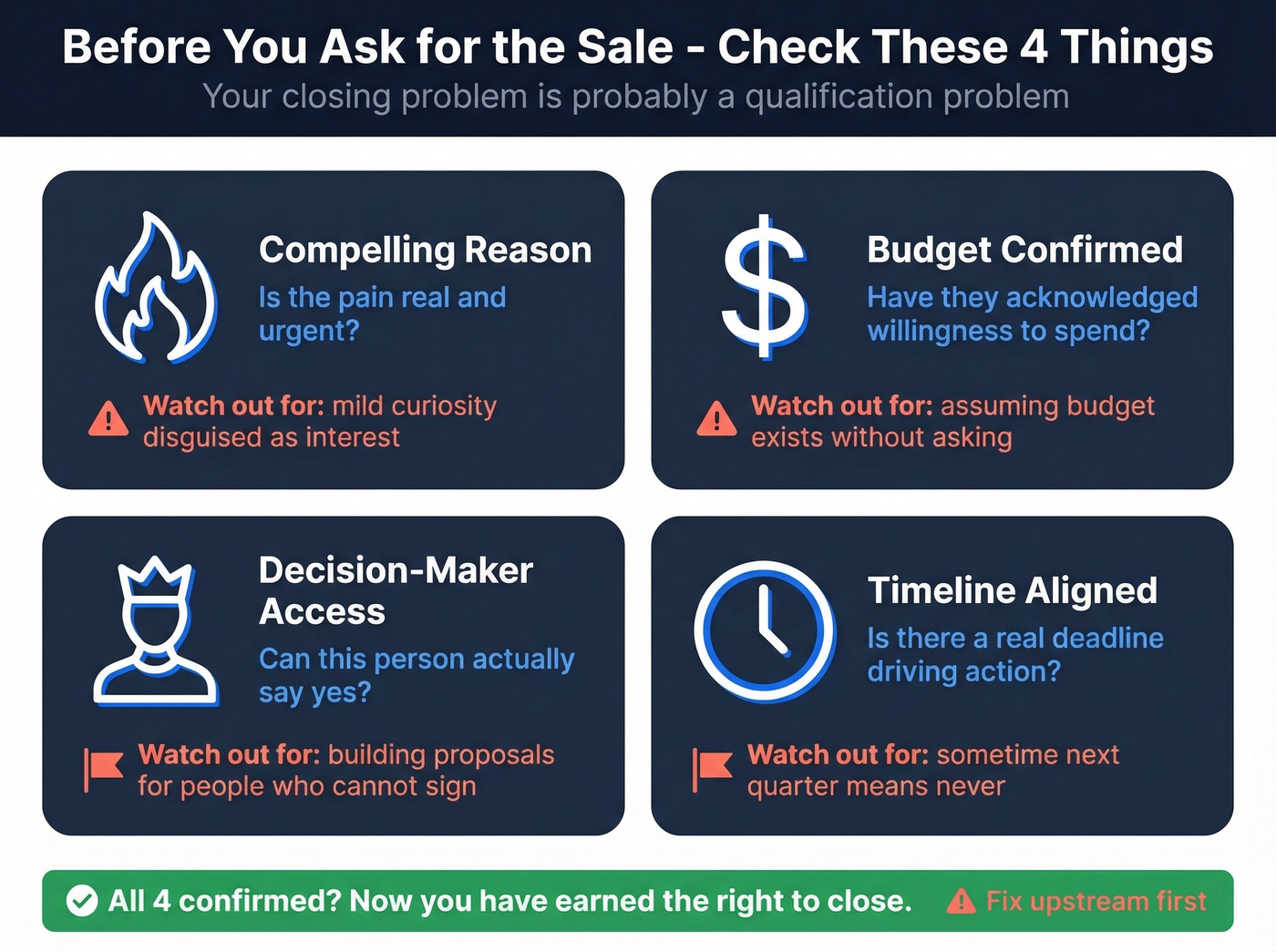
Some coaches say you should "earn the right" to ask for the sale. That's backwards. You earned the right when the prospect booked the meeting. The real question is whether you've confirmed these four things:
- Compelling reason confirmed? Does the prospect have a real, urgent problem - or just mild curiosity?
- Budget confirmed? Have they acknowledged willingness to spend, or are you assuming?
- Decision-maker access? Are you talking to someone who can say yes, or someone who can only say no?
- Timeline aligned? Is there a real deadline driving action, or is "sometime next quarter" code for never?
If any of those four are shaky, your closing problem is actually a qualification problem. Fix it upstream.
5 Stages of Closing a Deal
Stop thinking of closing as a single moment. The framework that's worked best in our experience breaks it into five stages of micro-agreements, each building toward the final commitment - a model popularized by 30 Minutes to President's Club that maps closing questions to where you actually are in the deal.
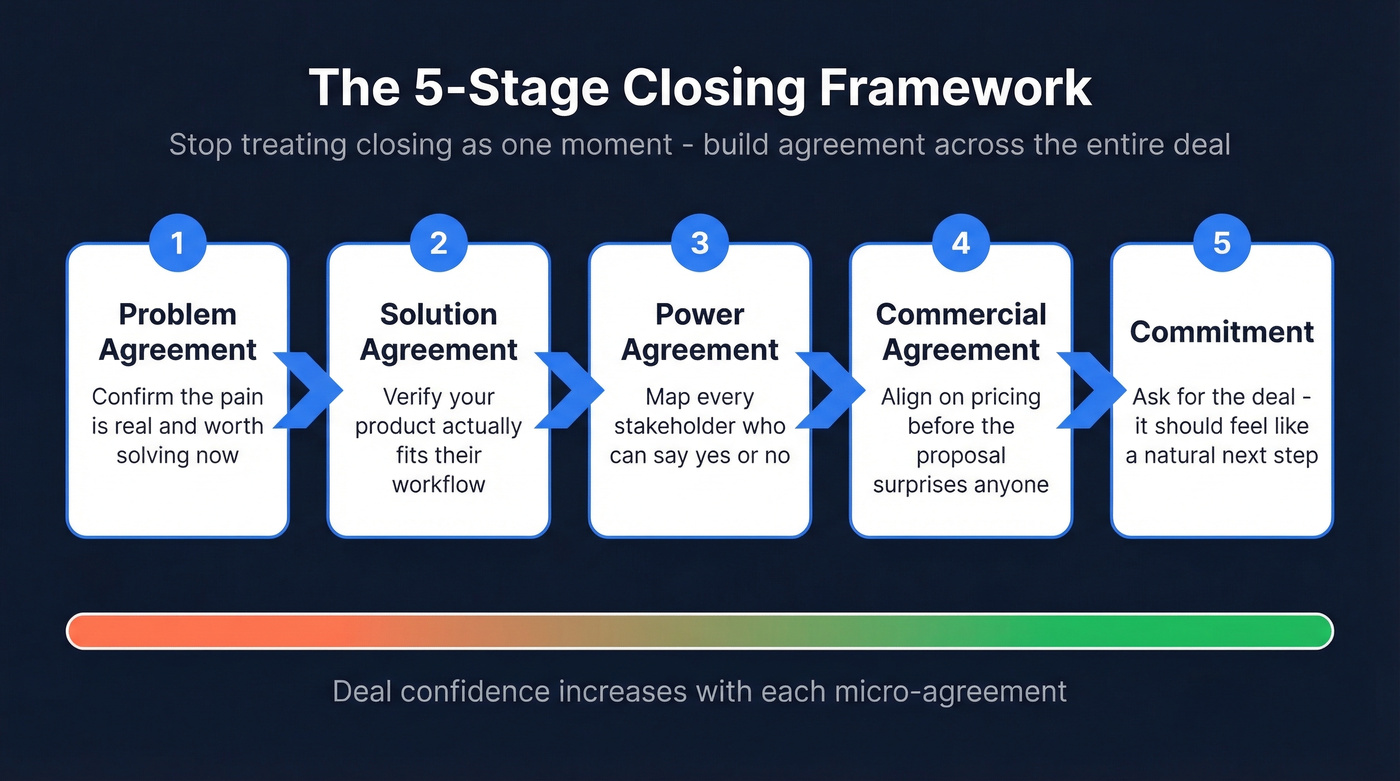
Problem Agreement
Before you can sell anything, the prospect needs to admit the problem is real and worth solving. This is where loss aversion works in your favor - people are twice as motivated to avoid a loss as they are to pursue a gain. Frame the cost of inaction, not just the benefit of your solution.
- "How is this problem affecting your team's ability to hit targets right now?"
- "What happens if you don't solve this in the next 90 days?"
Solution Agreement
Now confirm your solution actually fits. Don't assume - ask:
- "Based on what you've seen, does this approach solve the core issue we discussed?"
- "Is there anything about how this works that doesn't align with your workflow?"
Power Agreement
This is where deals quietly die. Modern B2B purchases involve 8-13 stakeholders on average. Single-threaded deals over $50K are a red flag - if you're only talking to one person, you're one "let me check with my boss" away from losing everything. We've watched reps build perfect proposals for champions who couldn't sign a napkin, let alone a contract.
- "Who else needs to weigh in before this gets approved?"
- "Can we get your CFO/VP on the next call to address the budget side directly?"
Commercial Agreement
Even at the proposal stage, 47% of deals still die. That's why you check price alignment early and often - not as a surprise at the end.
- "If we can align on pricing, is there anything else that would prevent us from moving forward?"
- "Is price the last open question, or are there other factors in play?"
Commitment
By now, you've built agreement at every stage, so the commitment feels like a natural next step - not a pressure tactic:
- "Let's talk details - what does your procurement process look like?"
- "We're aligned on the problem, the solution, and the budget. Should I send over the agreement?"
Three universal questions that work at any stage: "What would need to be true for you to move forward?" / "Who else needs to weigh in?" / "What's your timeline for solving this?" Memorize these. They'll carry you through 80% of deal conversations.

You confirmed the pain, the budget, and the decision-maker - but your email bounced. 35% of reps say closing is the hardest part of sales. It shouldn't be reaching the right person. Prospeo gives you 98% verified emails and 125M+ direct dials so you're asking for the sale face-to-face, not chasing dead contacts.
Stop losing deals before the conversation even starts.
Closing Techniques That Work (With Scripts)
35% of salespeople say closing is the hardest part of the sales process. Part of the problem is that most reps only know one or two techniques. Here are eight, along with the exact words to close a sale:
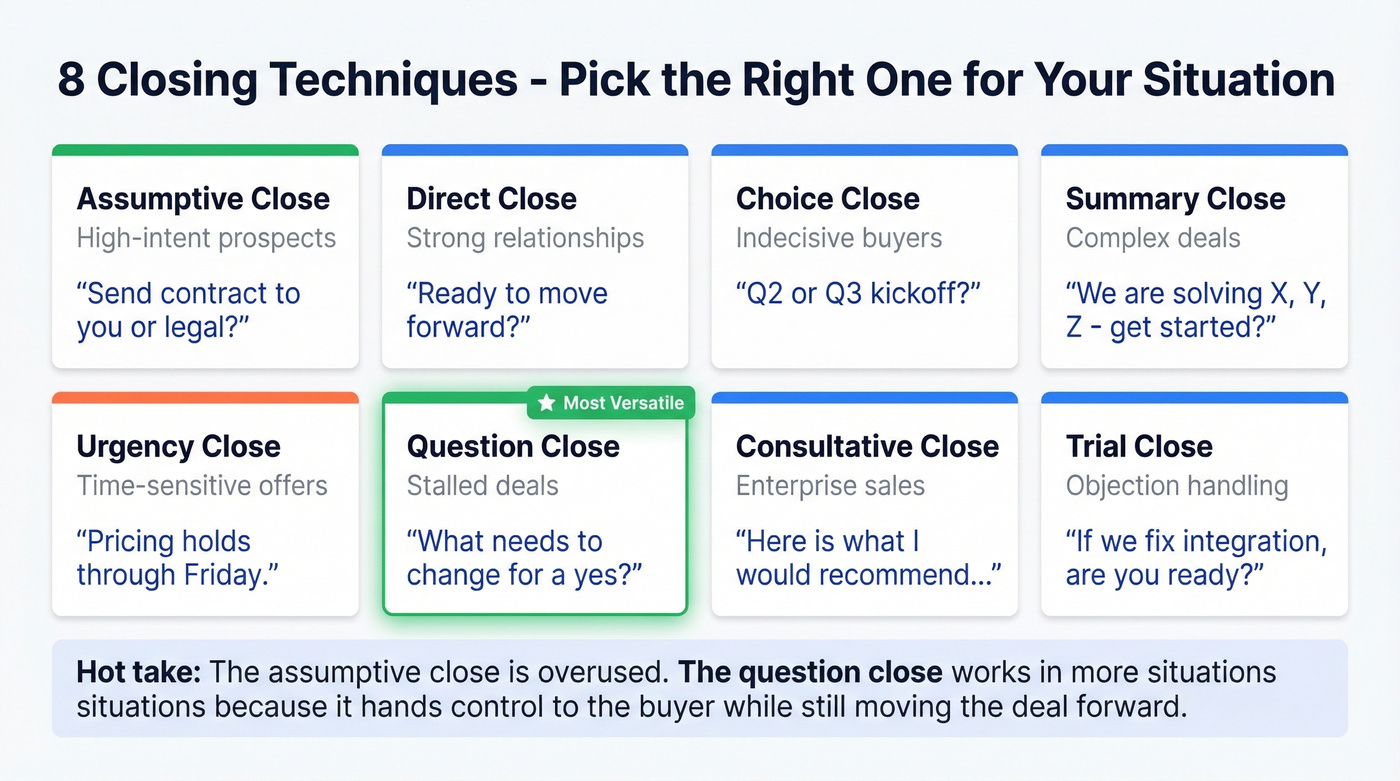
| Technique | When to Use | Quick Script |
|---|---|---|
| Assumptive | High-intent prospects | "Send contract to you or legal?" |
| Direct | Strong relationships | "Ready to move forward?" |
| Choice | Indecisive buyers | "Q2 or Q3 kickoff?" |
| Summary | Complex deals | "We're solving X, Y, Z - get started?" |
| Urgency | Time-sensitive offers | "Pricing holds through Friday." |
| Question | Stalled deals | "What needs to change for a yes?" |
| Consultative | Enterprise sales | "Here's what I'd recommend..." |
| Trial | Objection handling | "If we fix integration, are you ready?" |
Hot take: The assumptive close is the most overused technique in sales. If you haven't built genuine agreement through the stages above, assuming the close just makes you sound presumptuous. The question close - "What would need to change for this to be a yes?" - works in more situations because it hands control to the buyer while still moving the deal forward.
The gap most reps struggle with isn't the technique - it's the transition. The phrases that boost close rates aren't flashy; they're simple bridges from value to action:
- "Let's talk details." Then move into stakeholders, timeline, and procurement.
- "Let me go over what you've told me so far." A structured recap that naturally leads to "so, are we doing this?"
- "It looks like our solution is a strong fit - here are two reasons why, and here's the next step."
How to Close by Channel
On a Call
Keep your intro under 10 seconds and aim to talk only 30-40% of the time. When it's time to close, don't bury the ask in filler:
"Based on our conversation, I think we're a strong fit. I'd like to send over a proposal this afternoon - does that work, or is there something we should address first?"
Over Email
Prospects only open 9% of sales emails. But the ones that land deliver $38 for every $1 invested. The math works - if your emails actually reach the inbox. Before you send a closing email, verify the address. Any verification tool beats sending blind.
If you need more options, use these sales follow-up templates to keep momentum without sounding pushy.
Template 1 - The Direct Ask:
Subject: Next steps on [Project Name]
"Hi [Name], we covered [key pain point] and [solution fit] on our last call. I've attached a proposal with two options. Which works better - and can we get 15 minutes Thursday to finalize?"
Template 2 - The Recap Close:
Subject: Quick summary + next step
"[Name], here's what we've aligned on: [problem], [solution], [timeline]. The last piece is your sign-off. Want me to send the agreement today?"
In Person or on Video
The assumptive close works best face-to-face because you can read body language in real time. If they're leaning in, nodding, asking implementation questions - they've already decided. Don't overthink it:
"I can tell this resonates. Let's get the paperwork moving - I'll have the agreement in your inbox by end of day."
What to Do When They Don't Say Yes
Most deals don't close on the first ask. 80% of sales require at least five follow-up attempts, and 70% of sales emails need a follow-up to get any reply at all. Reaching executives takes around 9 touches compared to 4 for lower-level contacts. Yet most reps quit after one or two tries.
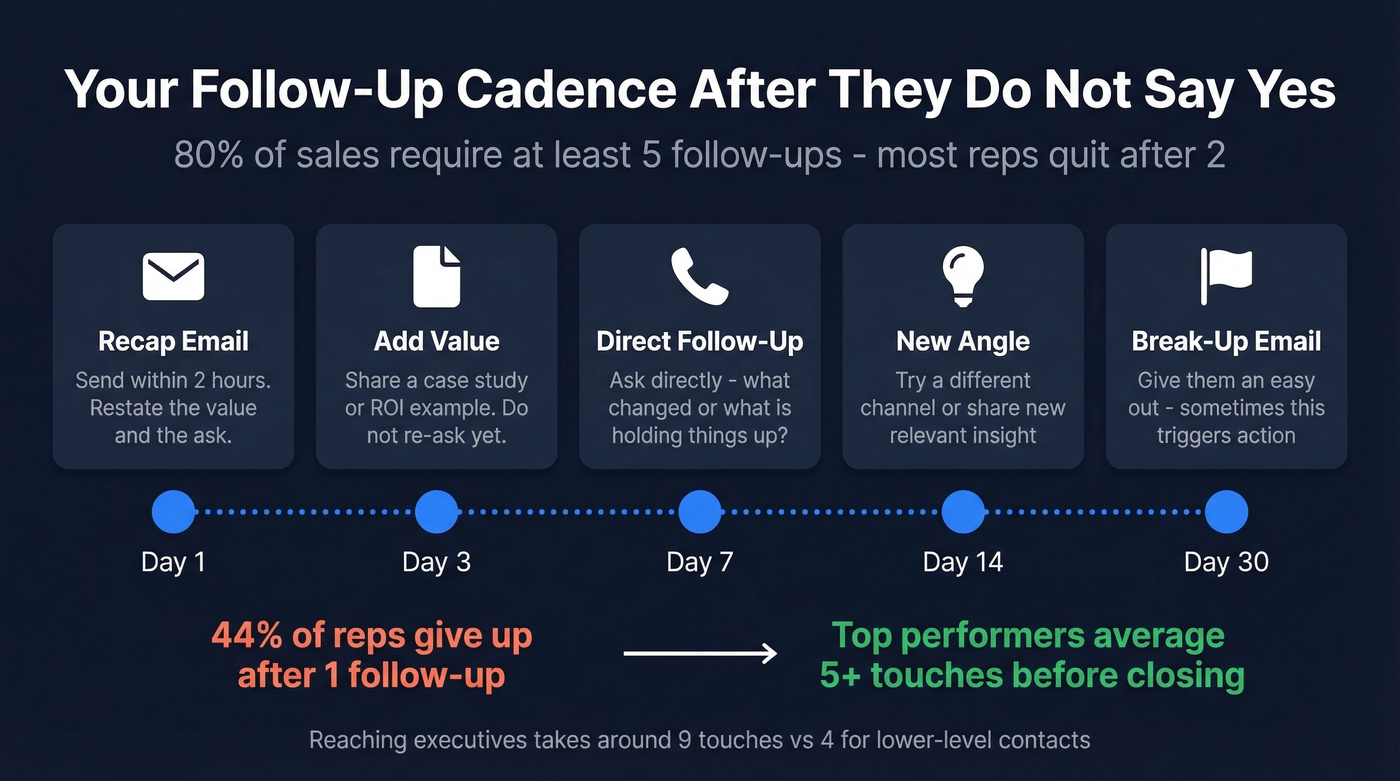
Here's a cadence that works:
- Day 1: Recap email within 2 hours. Restate the value and the ask.
- Day 3: Share a relevant case study or ROI example. Don't re-ask - add value.
- Day 7: Direct follow-up. "Any questions from the proposal?"
- Day 14: New angle - a competitor insight, relevant article, or time-sensitive update.
- Day 21+: The honest check-in. "Is this still a priority, or should I check back next quarter?"
If you want a deeper system, this guide on the importance of follow-up in sales breaks down what to send and when.
Timing matters more than you think. Deals closed within 50 days have a 47% win rate. After 50 days, that drops to 20% or lower. Every week you let a deal drift, your odds crater.
Mistakes That Kill the Close
Not asking at all. This is the number-one mistake. If you don't ask, the answer is always no. There are no magic words that replace actually requesting the commitment.
Asking too early. Jumping to "so, are we doing this?" before you've established value makes you sound desperate. Build the micro-agreements first.
Asking too late. 47% win rate within 50 days, 20% after. Waiting for the "perfect moment" is how deals die of old age.
Asking the wrong person. With 8-13 stakeholders in a typical B2B deal, you need to multi-thread early. If you're only talking to a champion who can't sign, you're not closing - you're hoping. I once spent six weeks building a proposal for a director who, it turned out, needed three levels of approval above him. That deal died on a Tuesday morning email that said "we've decided to hold off." Multi-thread or lose.
Using bad data to reach the right person. Your closing email bounced. Your call went to a disconnected number. The deal didn't die because of your close - it died because your data was wrong. Prospeo verifies emails and phone numbers in real time so your ask actually reaches the decision-maker.
If you're tightening the whole motion, these steps to close a sale help you standardize what happens before the final ask.
Modern B2B deals involve 8-13 stakeholders. Single-threading kills pipeline. Prospeo's 30+ search filters - including department headcount, job changes, and buyer intent - let you map every decision-maker in the account so you never build a perfect proposal for someone who can't sign.
Multi-thread every deal with contacts that actually connect.
FAQ
What's the best way to ask for the sale without being pushy?
Use a question, not a statement. "What would need to be true for you to move forward?" lets the prospect lead while still advancing the deal. Pushy means telling them to buy; consultative means asking what's stopping them. Pair this with the micro-agreement framework above for best results.
How many times should you follow up after the initial ask?
At least five times. 80% of sales require 5+ follow-ups, yet most reps quit after two. Space touches at days 1, 3, 7, 14, and 21 - leading with new value each time, not the same repeated request.
What do you say when they say "I need to think about it"?
Ask what specifically they need to think about: "Totally fair - is it the pricing, the timeline, or something else?" This surfaces the real objection hiding behind the polite stall. In most cases, "I need to think about it" means there's an unresolved concern they haven't voiced yet.
How do you reach the actual decision-maker?
Multi-thread early by asking "who else needs to weigh in?" at discovery, not at close. Use a tool like Prospeo to find verified emails and direct dials for every stakeholder in the buying committee - waiting until the end to discover you're talking to the wrong person is how deals slip to next quarter.
How to ask for the sale if the prospect goes silent?
Silence after a proposal is normal, not a rejection. Follow the five-touch cadence above, leading with new value each time rather than repeating the same request. On the final touch, give the prospect an easy out: "Is this still a priority, or should I circle back next quarter?" That honest question often restarts stalled conversations because it removes pressure while still moving toward a decision.