

The Importance of Follow-Up in Sales (And Why Most Advice Gets It Wrong)
You've seen the stat a hundred times: "80% of sales require five follow-ups." It's plastered across every sales blog, every LinkedIn carousel, every onboarding deck. There's just one problem - a study of 16.5 million cold emails across 93 business domains points the other way. Reply rates peak on the very first email at 8.4%, then decline with every subsequent follow-up. Once you send 4+ emails in a sequence, unsubscribe rates triple and spam complaint rates more than triple.
The importance of follow-up in sales isn't in question. But the conventional wisdom about how to do it is dead wrong.
What 2026 Follow-Up Statistics Actually Show
The 16.5M-email dataset - cold emails sent between January and December 2024 - gives us the clearest picture of follow-up performance available today:
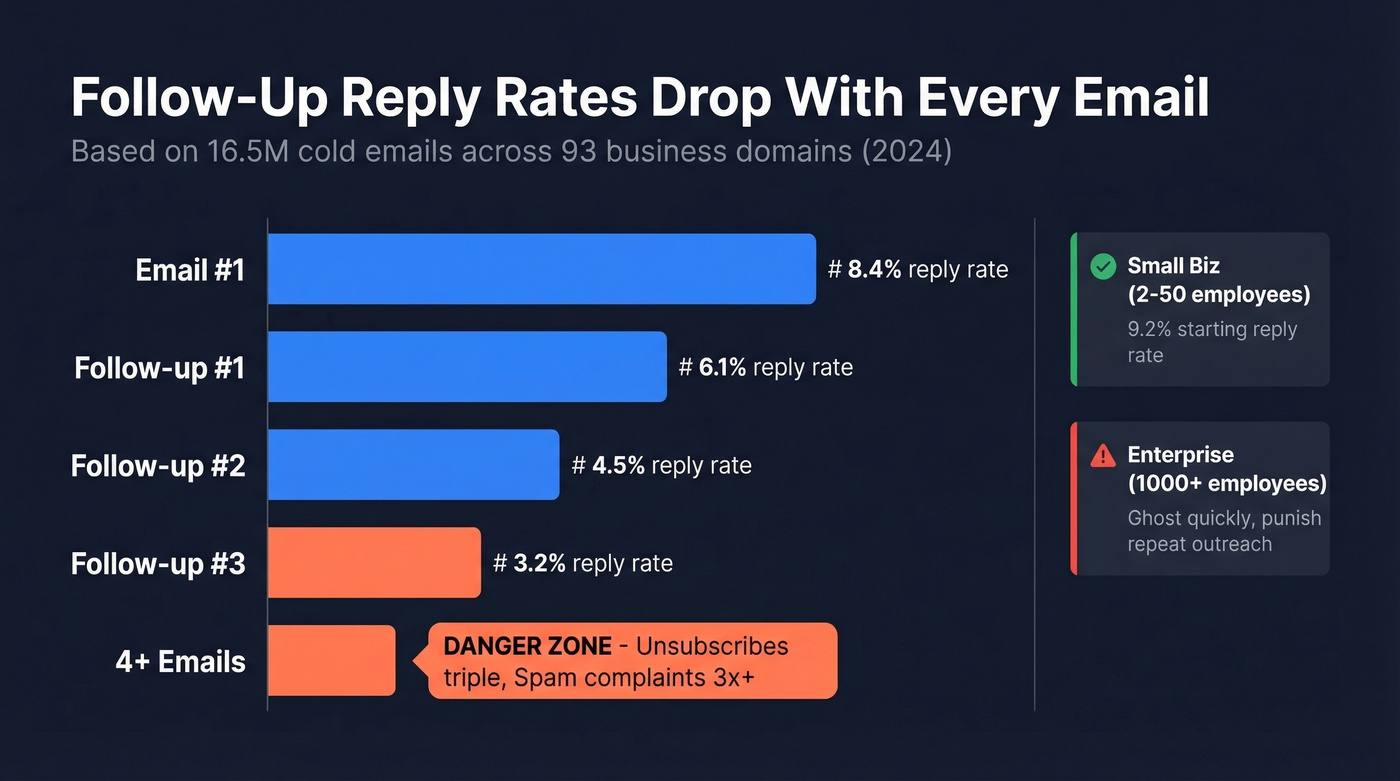
- Best reply rate happens on email #1 (8.4%).
- Performance steadily declines with each follow-up.
- 4+ emails in a sequence is where risk spikes - unsubscribe rates triple; spam complaints more than triple.
That 4+ threshold is the danger zone. You stop getting fewer replies and start actively training spam filters to bury your future emails.
Company size matters more than most reps realize. Small businesses (2-50 employees) start at a 9.2% reply rate, dip on the first follow-up to 8.0%, then rebound on the second to 8.4%. Enterprise contacts (1,000+ employees) ghost quickly and punish repeated outreach. We've seen this firsthand: the enterprise VP who ignores your second email isn't coming back on the fifth.
The founder persona is particularly interesting. Reply rates peak on the second follow-up at 6.94%, then drop to 5.75% on the third and 3.01% by the fourth. Founders are busy enough that a well-timed nudge helps, but a third and fourth nudge reads as desperation.
Here's the thing: the old "80% of sales require five follow-ups" stat, still cited everywhere, comes from an era before inbox fatigue hit critical mass. If your average deal size sits below five figures, you almost certainly don't need five follow-ups - you need two great ones. The 2026 playbook is fewer, better touches.
Why Follow-Up Builds (or Destroys) Trust
A 2010 study in the European Journal of Marketing tested what makes buyers trust salespeople. Two factors increased trust: customer orientation and demonstrated expertise. One factor destroyed it: selling orientation.
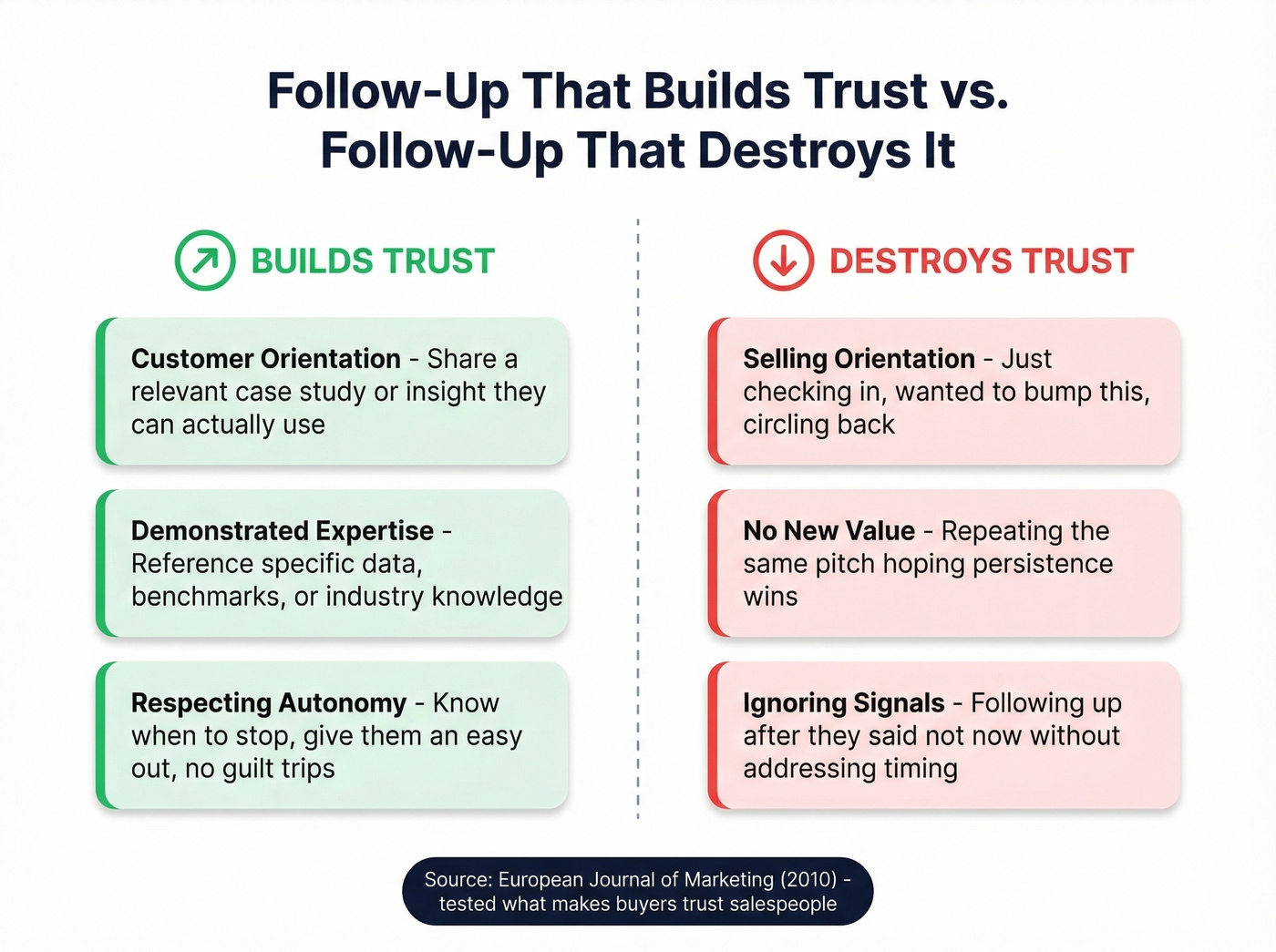
This maps perfectly to why "just checking in" fails. That phrase signals you're following up because you want the deal, not because you have something useful to offer. A follow-up that shares a relevant case study or a new data point signals customer orientation - it builds trust instead of eroding it. And respecting a prospect's autonomy, knowing when to stop, is itself a trust signal.
Understanding why follow-up matters goes beyond persistence. It's about proving you're worth the prospect's time every single time you show up in their inbox.

Fewer follow-ups only works if your first email reaches the right person. Bad data forces extra touches that spike spam complaints and kill your domain. Prospeo's 98% verified emails and 7-day data refresh mean your opening email lands - so you need fewer follow-ups, not more.
Stop sending follow-up #5 to an inbox that never existed.
The Optimal Follow-Up Cadence
Email-Only: 6 Touches Over 3 Weeks
Yesware's analysis of 10 million email threads identified the cadence that generates the most replies:
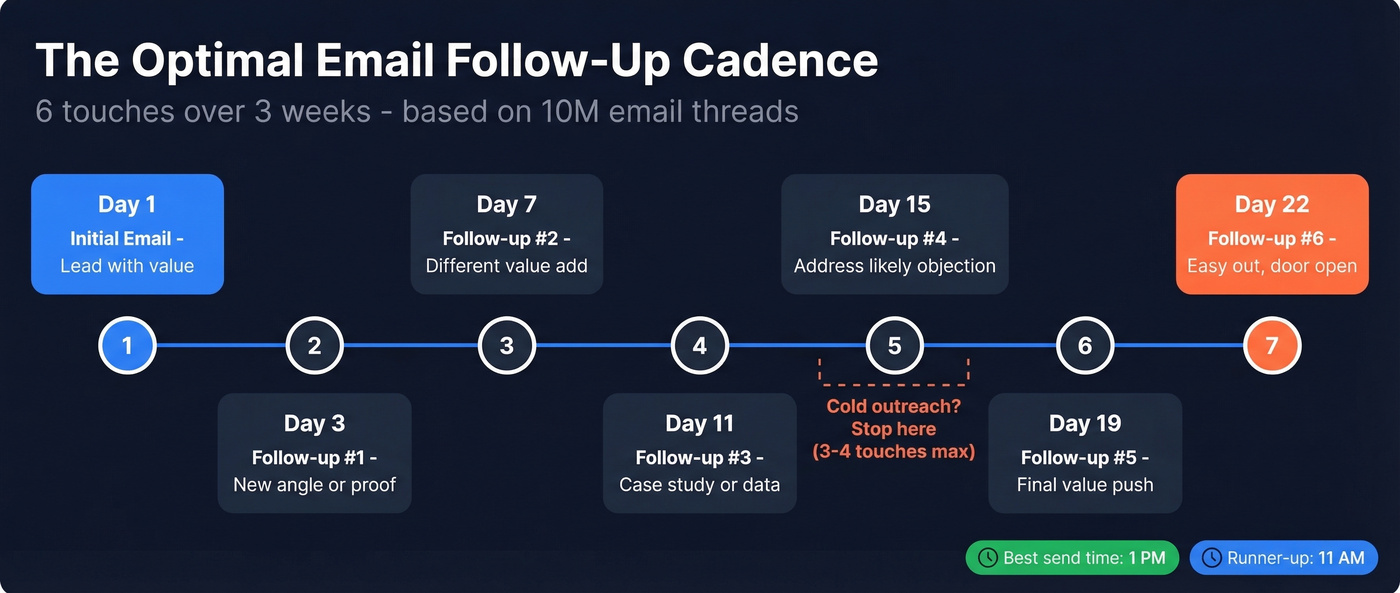
| Touch | Day | Notes |
|---|---|---|
| Initial email | Day 1 | Lead with value |
| Follow-up #1 | Day 3 | New angle or proof |
| Follow-up #2 | Day 7 | Different value add |
| Follow-up #3 | Day 11 | Case study or data |
| Follow-up #4 | Day 15 | Address likely objection |
| Follow-up #5 | Day 19 | Final value push |
| Follow-up #6 | Day 22 | Easy out, door open |
Best send time: 1 PM consistently outperforms every other slot, with 11 AM as a strong second. Use your CRM to set reminders - the cadence only works if you actually stick to it.
A quick note on this framework versus the 16.5M-email data: Yesware's analysis includes warm and inbound threads, not just cold outreach, which is why six touches still shows positive returns in their dataset. For pure cold email, we'd trim this to three or four touches max and invest the saved effort into better targeting.
Multi-Channel: 8 Touches Over 12 Days
For teams running more than email, Sybill's framework compresses the timeline. The key insight: timing to a trigger - a job change, a funding round, a relevant content post - beats timing to a day of the week.
| Day | Channel | Action |
|---|---|---|
| 1 | Initial outreach | |
| 2 | Phone | Warm call referencing email |
| 3 | New angle, short | |
| 5 | Social | Engage on their content |
| 7 | Share asset or case study | |
| 9 | Phone | Second call attempt |
| 11 | Address likely objection | |
| 12 | Breakup |
The multi-channel approach works because it meets prospects where they are. The 16.5M-email study found that a message plus a profile visit reached an 11.87% reply rate - higher than any email-only sequence. Highspot's guidance aligns: inbound leads warrant 8-12 touchpoints over 10-15 business days, while cold outreach performs best at 6-8 touchpoints over 2-3 weeks.
Templates That Actually Get Replies
Let's tackle the three follow-up moments that trip reps up most - starting with the one everyone asks about: "How do I follow up after sending a quote without sounding desperate?"
No-Response Follow-Up (3-5 Days After Initial Outreach)
Subject: [Original subject line]
Hi [Name],
Since I reached out, [Company] published a case study showing how [similar company] cut [specific metric] by 30% in one quarter. Thought it'd be relevant given [specific detail from their business].
Worth a 15-minute call this week?
You're not "bumping" anything. You're delivering a new proof point that didn't exist in the first email.
Post-Demo Follow-Up (Within 24 Hours)
Skip the full template. Think of this as a checklist - your post-demo follow-up needs exactly four things:
- Reference two specific pain points they mentioned - proves you listened
- One sentence on how you'd address each, or a link to a relevant resource
- A concrete next step with a date - "I'll send the proposal by Thursday"
- A specific time for the next call - not "let's connect soon"
Send post-demo follow-ups within 24 hours and post-call follow-ups within 2 hours, per Outreach's recommendation. Wait 48 hours and the conversation details fade for both of you.
Breakup Email (After Final Touchpoint)
Before (what most reps send): "Hi [Name], I've tried reaching out several times. I'd love to connect when you have a chance."
After (what actually works): "Hi [Name], I've reached out a few times and haven't heard back - totally fine. I'll close out your file on my end. If things change, just reply to this thread and I'll pick it right back up."
The breakup email works because it removes pressure. It signals you respect their time while leaving the door open. The consensus on r/sales is that breakup emails often generate more replies than any other message in the sequence - precisely because they don't ask for anything.
Five Mistakes That Kill Reply Rates
1. "Just bumping this" with no new value. Instead of "Wanted to make sure you saw my last email," try "Since we last spoke, [Company] published results showing [specific outcome] - thought it'd be relevant." If you don't have something new, you don't have a follow-up. You have spam.
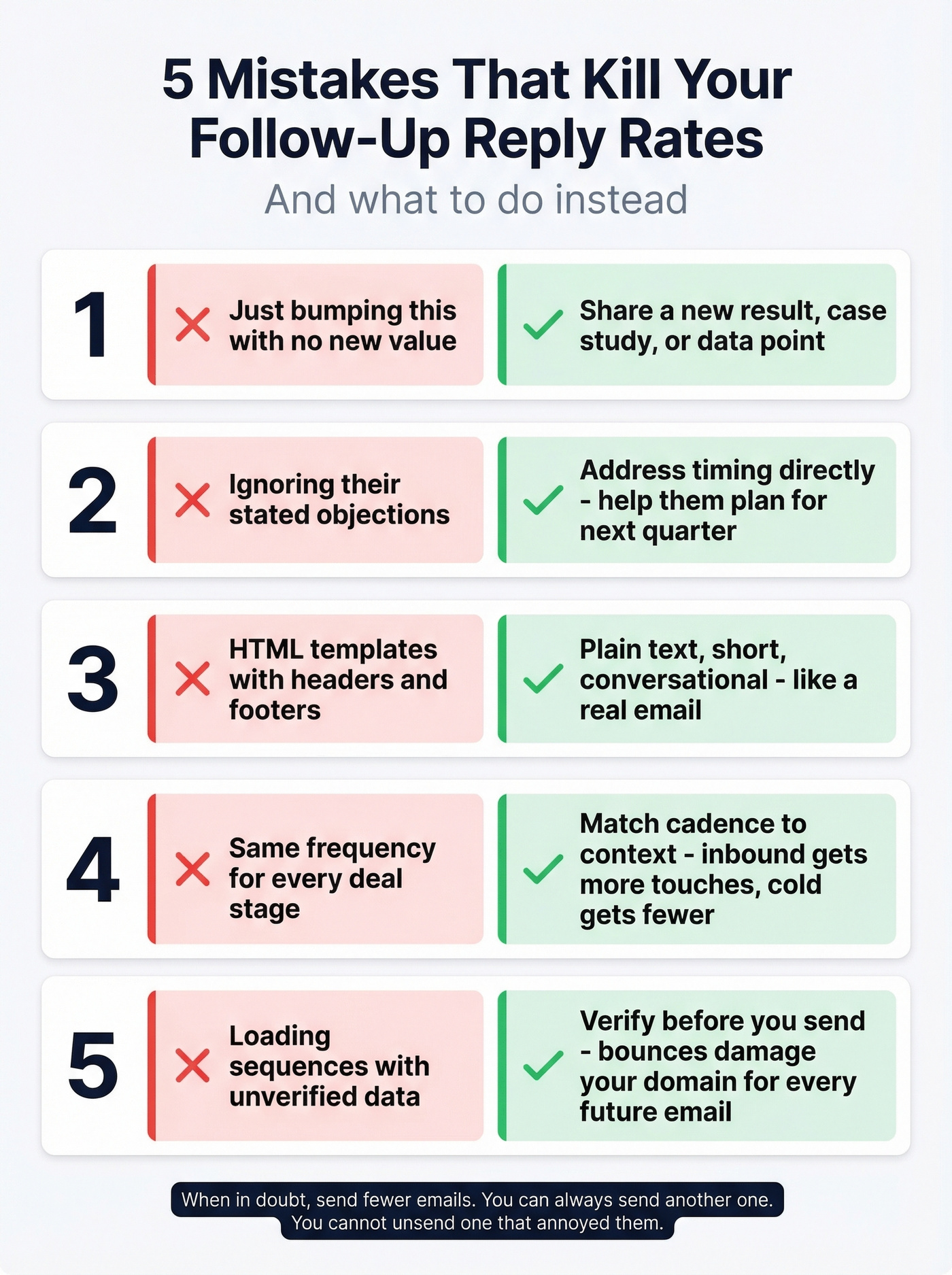
2. Ignoring stated objections. If they said "not now," your next follow-up needs to address timing directly. "I know Q1 budgets are locked - here's what teams typically do to get this into Q2 planning" beats pretending they never responded.
3. Follow-ups that don't look like real emails. Plain text, short, conversational. HTML templates with headers and footers scream "mass email." Your follow-up should look like something you'd actually type to a colleague.
4. Wrong frequency for the deal stage. Too fast burns trust, too slow loses momentum. Inbound leads can handle more touchpoints in a shorter window than cold prospects. Match cadence to context - and if you're unsure, err on the side of fewer touches. You can always send another email. You can't unsend one that annoyed them.
5. Following up with bad data. This is the mistake nobody talks about. Bounced emails don't just lose that prospect - they damage your sender reputation and reduce inbox placement for every future email in the sequence. Bad phone numbers turn productive call blocks into wasted time. Before loading your next sequence, verify your list. Prospeo's 5-step verification catches invalid addresses, spam traps, and honeypots before they torch your domain, and its 7-day refresh cycle means your data stays clean even across multi-week sequences.
If you want more plug-and-play options, start with these sales follow-up templates and adapt them to your ICP.
The data is clear: trigger-based timing beats calendar-based cadences. Prospeo tracks job changes, funding rounds, and buyer intent across 15,000 topics - so your follow-up arrives when prospects are actually in-market, not just next on your sequence.
Replace "just checking in" with perfect timing.
FAQ
How many follow-ups should I send?
Two to three for most outbound sequences. The 16.5M-email study shows 4+ emails in a sequence triples unsubscribes and more than triples spam complaints. Warm leads after a demo can handle a tighter cadence than cold prospects, but even then, every message needs to earn its spot.
What's the best time to send a follow-up email?
1 PM outperforms every other slot, with 11 AM as a strong second. Tuesday and Thursday tend to be the strongest days. Avoid the 1-2 PM window for phone follow-ups - it's often a weak window for connect rates.
How do I follow up without being annoying?
Every follow-up must deliver something new - a case study, a data point, a resource they haven't seen. If you don't have anything new, wait until you do. Customer-oriented behavior builds trust; selling-oriented behavior destroys it. Add value or stay quiet.
Should I use email, phone, or social?
All three. Multi-channel cadences outperform single-channel every time. A social message plus a profile visit combo reached 11.87% reply rates - higher than email alone. Mix channels across a 2-3 week window for best results.
Does contact data quality affect follow-up results?
Absolutely. Bounced emails damage sender reputation and reduce deliverability for all future sends, not just the ones that bounced. Verify data before loading any cadence, and re-verify if your campaign runs longer than a week. One of our customers, Snyk, dropped their bounce rate from 35-40% to under 5% after switching to verified data - and saw AE-sourced pipeline jump 180%.