

AtData vs ZoomInfo: An Apples-to-Oranges Comparison
Your marketing ops lead wants AtData to clean a 500,000-record email list before the next campaign. Your sales VP wants ZoomInfo so reps can pull org charts and intent signals. They're both right - and that's exactly why this comparison is confusing. AtData vs ZoomInfo isn't a head-to-head so much as a category clarification, with a pricing reality check thrown in.
30-Second Verdict
AtData is for high-volume list hygiene, identity matching, and deliverability protection. It's not a prospecting database. Expect roughly $0.006-$0.01 per email at scale, plus subscriptions.
ZoomInfo is for enterprise sales intelligence: org charts, intent, and a full prospecting workflow. Real contracts commonly land around $15k-$45k/year.
Here's the thing: if your average deal size doesn't justify five-figure tooling and you're not running ABM, ZoomInfo is usually overkill. You'll pay for modules you won't touch.
Why This Comparison Is Tricky
A leads database answers who to contact. Sales intelligence answers why, when, and how to contact them. AtData is neither - it's email intelligence: verification, enrichment, and identity signals.
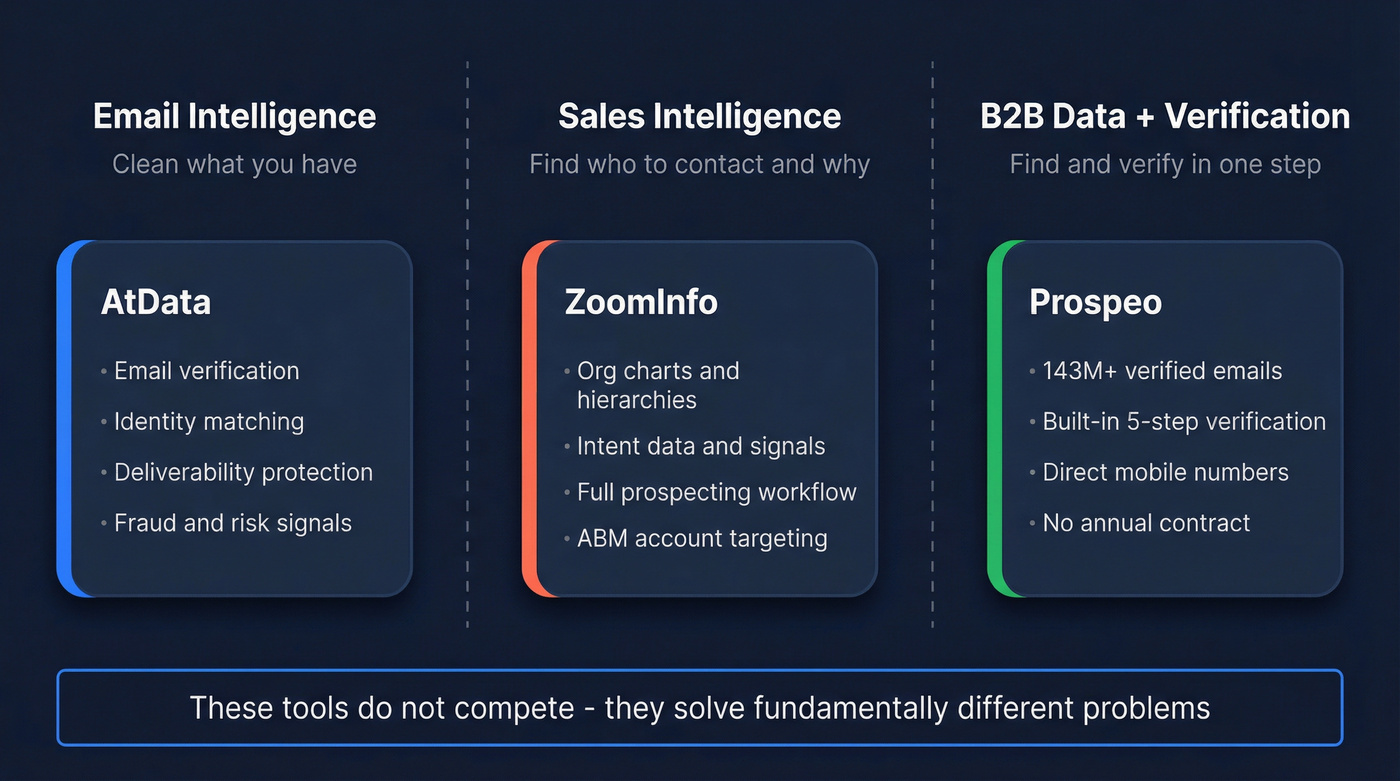
Experian's acquisition of AtData in early 2026 confirmed what was already true: AtData's trajectory is identity resolution and fraud prevention, not sales prospecting. These tools don't compete. They barely overlap.
AtData at a Glance
AtData is built for teams that already have data and need it cleaner, safer, and more usable at scale. If you're managing millions of records, it handles email hygiene, identity signals, and risk-oriented workflows - not sales prospecting.
Use this if: you're doing batch verification and suppression before campaigns, improving deliverability, or matching identities across systems. SafeToSend is the flagship for list cleaning, and AtData's broader suite includes SafeToTrust, List Guard, and Website Visitor ID for identity and risk workflows. G2 reviewers rate it 4.4/5 (26 reviews) and consistently call out deliverability gains and responsive support.

Skip this if: you're trying to find new prospects. We've seen teams waste weeks trying to force AtData into a prospecting role - it's the wrong tool, and you'll end up buying a database anyway. Some reviewers also mention onboarding friction: the UI takes a minute to learn, and one G2 reviewer reported a 34% US address validation failure rate.

AtData verifies emails you already have. ZoomInfo charges $15K+ for contacts you still need to verify. Prospeo gives you both: 143M+ verified emails at 98% accuracy with built-in 5-step verification - catch-all handling, spam-trap removal, honeypot filtering. All for ~$0.01/email, no contract.
Stop paying two vendors for what one platform does better.
ZoomInfo at a Glance
ZoomInfo is the default enterprise sales intelligence platform: broad, integrated, and designed to run a full outbound motion from one place. When it's implemented well, it's a machine.
Use this if: you have a 20+ seat sales org, you're doing ABM, and you'll actually use the platform depth - org charts, intent, workflows, and governance. In our experience, ZoomInfo's biggest advantage is operational: leadership can standardize how reps source accounts and contacts instead of everyone freelancing in spreadsheets.
Skip this if: you're price-sensitive or you only need emails and numbers. Cost is the #1 complaint on Reddit, and it's usually tied to paying for modules you don't use. On r/SalesOperations, one buyer described ZoomInfo data as "in flux" - reps couldn't find certain contacts, and when they could, accuracy was inconsistent. Another user said the Chrome extension "didn't work for a business quarter," which is brutal when your reps live in the browser.
Data quality isn't magic either. In a 6-week head-to-head test shared on Reddit, one user measured ZoomInfo accuracy at roughly 75% - better than Apollo's 65%, but below the 88% achieved with waterfall enrichment. That gap matters when you're sending thousands of touches and protecting domain reputation.
Feature Comparison
| AtData | ZoomInfo | Prospeo | |
|---|---|---|---|
| Primary function | Email verification | Sales intelligence | B2B data + verification |
| Data you get | Hygiene + identity | Contacts + intent | Contacts + verified email/mobile |
| Database scale | 10B+ email addresses | Large B2B contact database | 300M+ profiles |
| Starting price | ~$0.006-$0.01/input | ~$14,995/year | Free (75 emails/mo) |
| Typical annual | ~$3k-$5k for 500k inputs | ~$15k-$45k+ | Credit-based, no contract |
| Free trial | 100 verifications | Demo only | 75 emails/month |
| Integrations | API | Salesforce, HubSpot, native | Salesforce, HubSpot, Lemlist, Clay, Zapier |
| Data freshness | Real-time verification | Not real-time verification | 7-day refresh cycle |
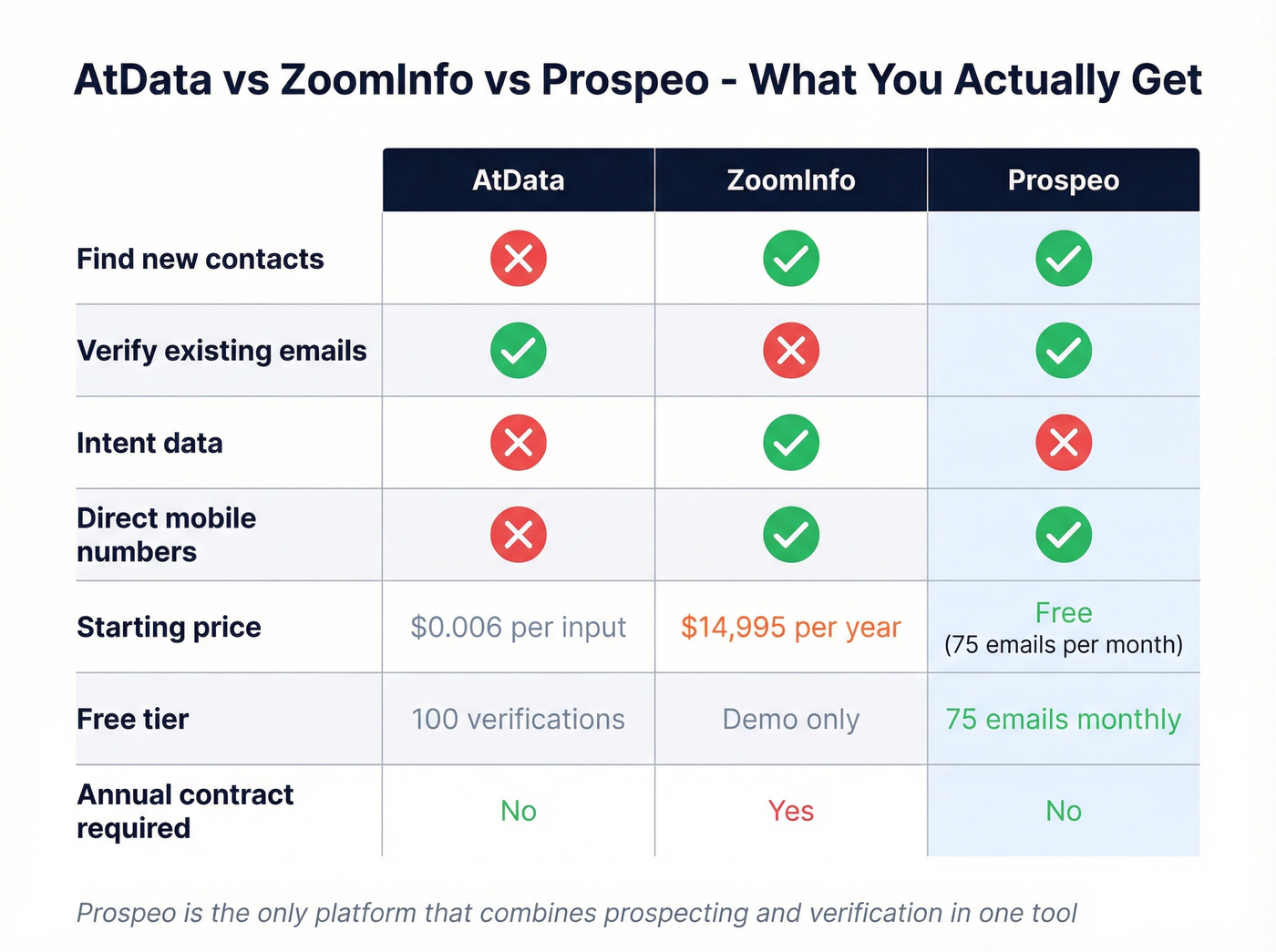
The clean takeaway: AtData wins on email hygiene. ZoomInfo wins on enterprise sales intelligence. Prospeo wins on value-per-dollar for outbound teams that need accurate, fresh contact data without contracts.
Pricing Breakdown
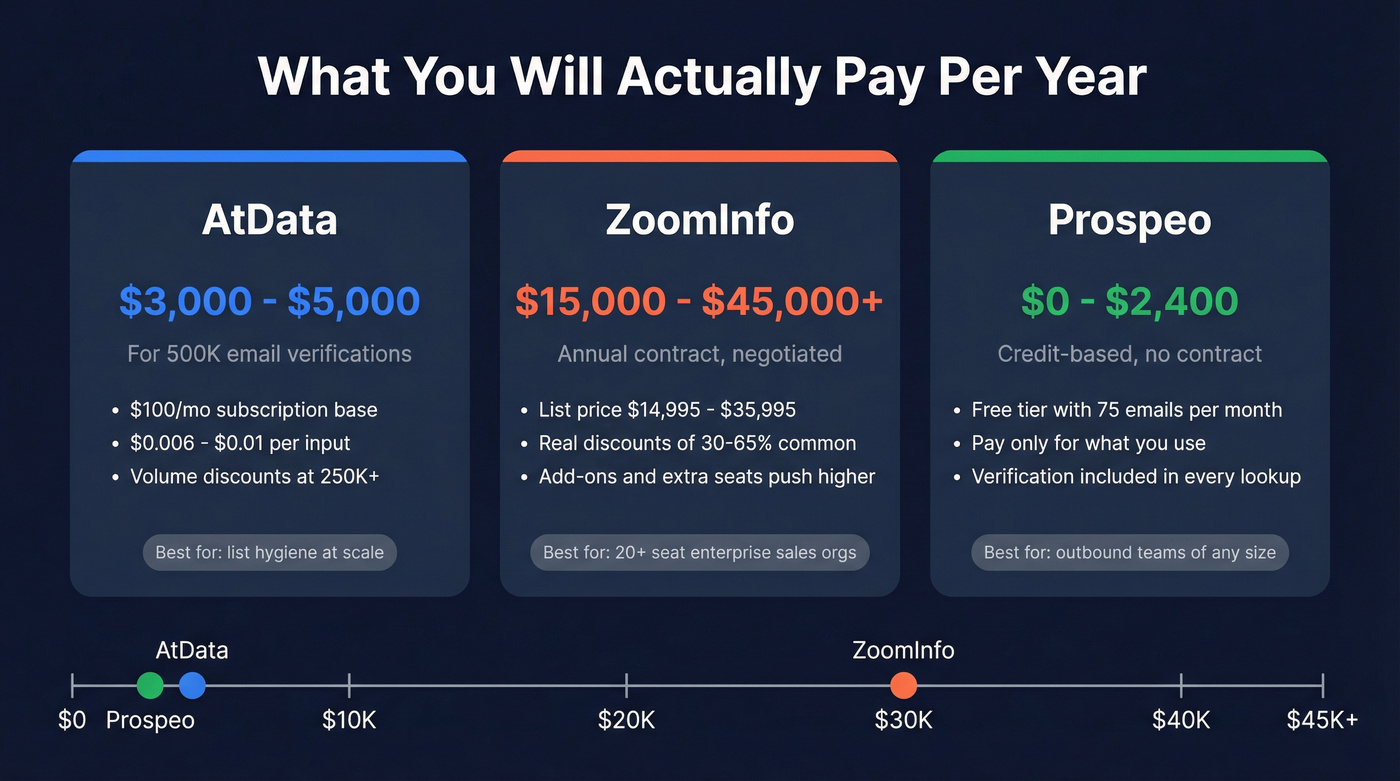
AtData pricing is volume-driven for batch verification. Here are the per-input tiers that matter:
| Volume | Per Input |
|---|---|
| 25,000+ | $0.010 |
| 100,000+ | $0.009 |
| 250,000+ | $0.008 |
| 500,000+ | $0.006 |
There's also a $100/month subscription starting point and 100 free verifications to test with.
ZoomInfo pricing is annual and negotiated. Public list prices start around $14,995/year and climb to $35,995/year for higher tiers, but real-world discounts of 30-65% are common. One Reddit user shared a concrete example: $17,500/year for Advanced+, with renewal options of $10k/1yr or $25k/2yr. Add-ons and extra seats push totals up fast.
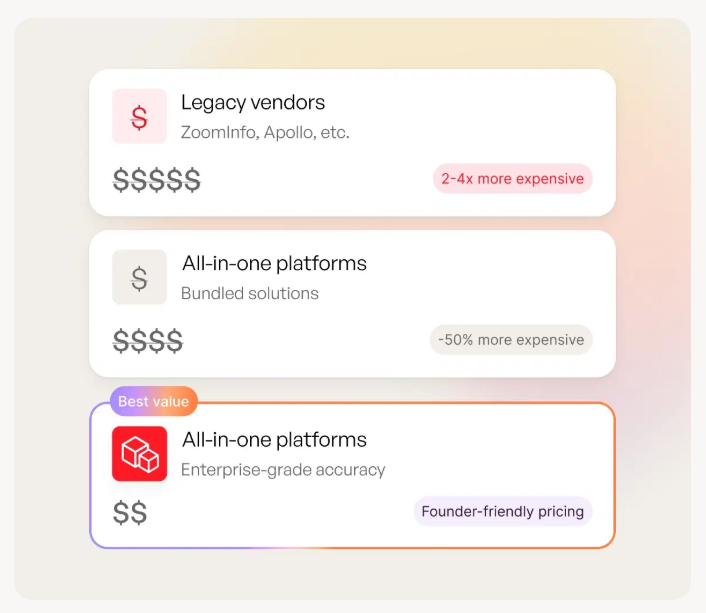
For teams that need both prospecting and verification without separate contracts, Prospeo's credit-based model collapses the stack. No annual commitment, no sales calls - just self-serve access to 143M+ verified emails and 125M+ verified mobile numbers.
When You'd Use Both Together
Most teams don't need both. But when you do, the workflow is straightforward - and it's the part nobody explains clearly.
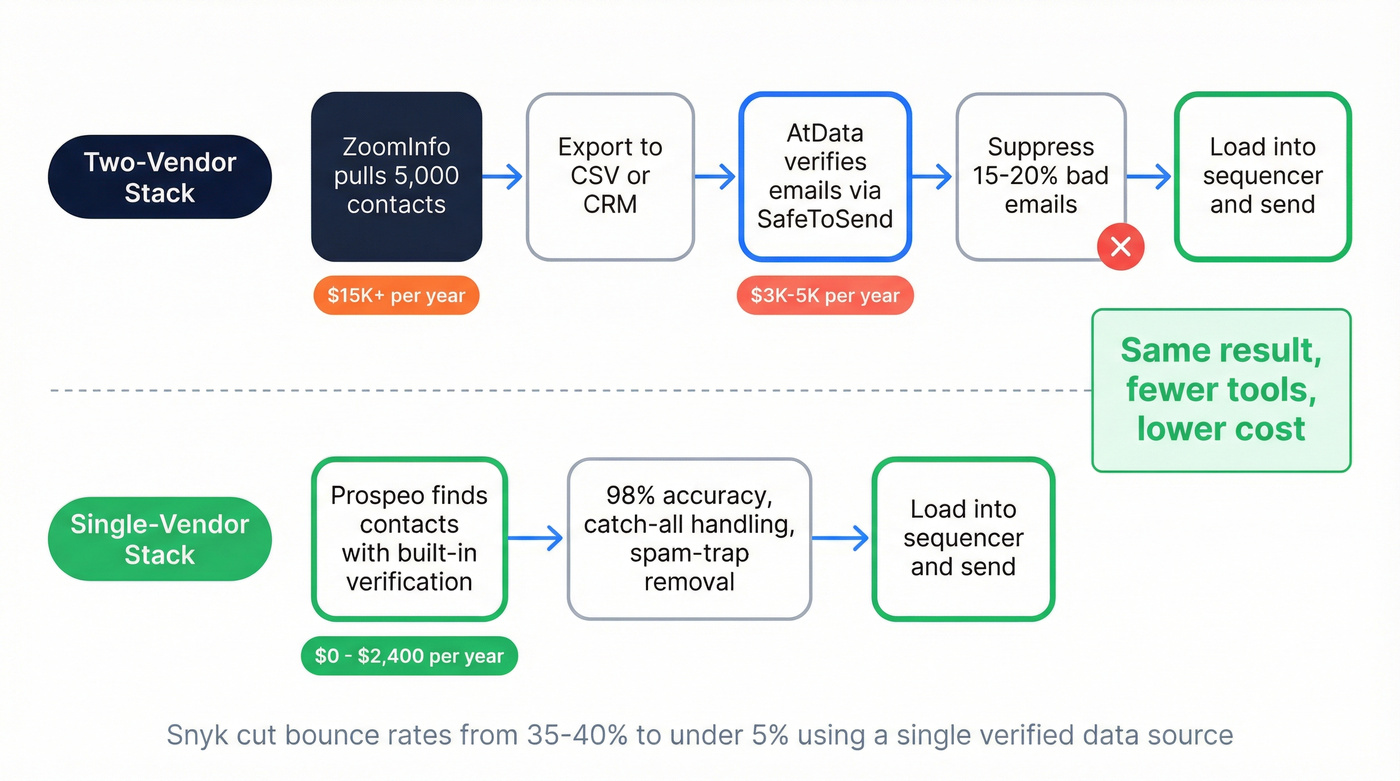
Let's walk through a practical example we've seen work well. ZoomInfo pulls 5,000 contacts for a target account list with titles, departments, and locations. AtData verifies the exported emails and flags risky or undeliverable addresses. You suppress 15-20% of bad emails before loading into your sequencer, protecting deliverability and saving reps from dead-end follow-ups.
If you're running high-volume outbound, this "database to verification to suppress to sequence" loop is worth real money. It's also the cleanest way to justify AtData to marketing ops while sales keeps ZoomInfo.
An alternative for smaller teams: skip the two-vendor stack entirely. Prospeo's 5-step verification process - catch-all handling, spam-trap removal, honeypot filtering - means the emails you pull are already verified at 98% accuracy. Teams like Snyk cut bounce rates from 35-40% to under 5% and added 200+ new opportunities per month after switching.
FAQ
Can AtData replace ZoomInfo?
No. AtData cleans and verifies emails you already have. ZoomInfo helps you find new contacts and adds sales intelligence like org charts and intent data. They serve different teams and solve different problems.
Can you use AtData and ZoomInfo together?
Yes. The standard workflow is exporting contacts from ZoomInfo, running them through AtData's SafeToSend to flag undeliverable addresses, then suppressing risky emails before sequencing. This protects domain reputation without changing your prospecting motion.
Is ZoomInfo worth it for small teams?
For most teams under 15 reps with deal sizes below $20k, ZoomInfo's $15k+ annual minimum is hard to justify. Self-serve platforms deliver verified emails and direct dials at a fraction of the cost, with no contracts and transparent pricing.
Snyk's 50 AEs cut bounce rates from 35-40% to under 5% and generated 200+ new opportunities per month - without stacking a separate verification tool on top. Prospeo's 7-day data refresh and proprietary verification mean the contacts you pull are already clean.
Collapse your AtData + ZoomInfo stack into one self-serve platform.