

Attio vs Twenty: An Honest Comparison for 2026
Attio is the better CRM today. Twenty is the more interesting bet on tomorrow.
This distinction matters because these two tools solve the same problem from completely different directions. Attio gives you a polished, Notion-like CRM that's ready to run right now - no setup headaches, no Docker containers, no YAML files. Twenty gives you an open-source platform you can self-host, fork, and bend to your will, as long as you're comfortable with earlier-stage software and the occasional rough edge.
In the Attio vs Twenty debate, the answer almost always comes down to one question: do you need it to work perfectly today, or do you want to own the code?
30-second verdict:
- Pick Attio if you want a production-ready CRM with a beautiful UI, workflow automation, and zero DevOps overhead.
- Pick Twenty if you're technical, care about data ownership, and can tolerate missing features while the project matures.
- Skip both if your real bottleneck isn't CRM - it's finding verified contact data to fill the pipeline in the first place.
Attio and Twenty at a Glance
| | Attio | Twenty | |---|---|---| | Founded | 2019, UK | 2023, US | | Deployment | SaaS only | SaaS + self-hosted | | Open source | No | Yes (AGPL-3.0) | | G2 rating | 4.4/5 (284 reviews) | Near-zero third-party reviews | | GitHub stars | N/A | 40.6k GitHub stars | | Contributors | N/A | 603 | | Latest release | N/A | v1.18.0 (Feb 19, 2026) |
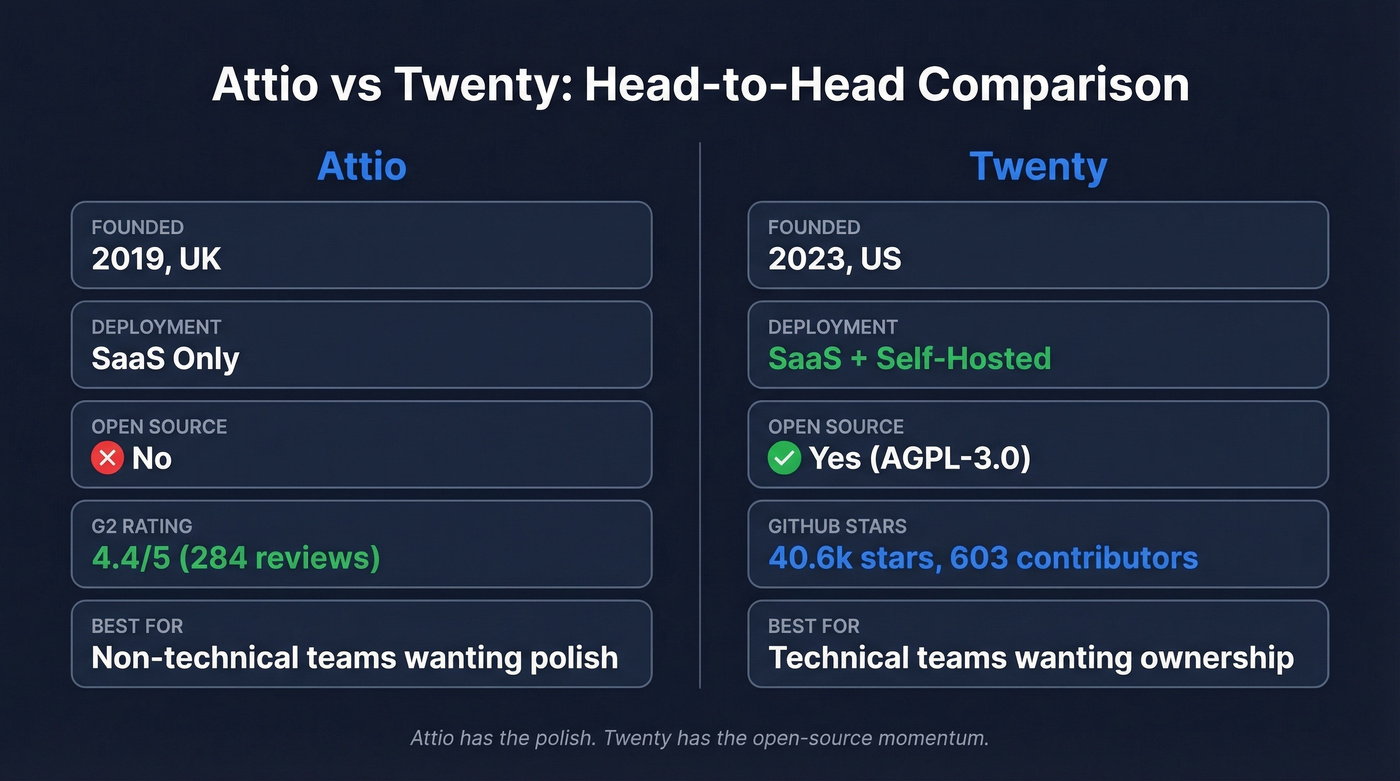
Attio has the review volume and polish you'd expect from a four-year head start. Twenty has the open-source traction - 40.6k GitHub stars and 603 contributors - that signals serious developer interest, even if enterprise adoption is still early.
Pricing Compared
This is where the gap gets dramatic.
Attio pricing
| Plan | Monthly | Annual (per month) | Records | Objects |
|---|---|---|---|---|
| Free | $0 (3 seats max) | - | 50,000 | 3 |
| Plus | $36/user | $29/user | 250,000 | 5 |
| Pro | $86/user | $69/user | 1,000,000 | 12+ custom |
| Enterprise | Custom | Custom | Custom | Unlimited |
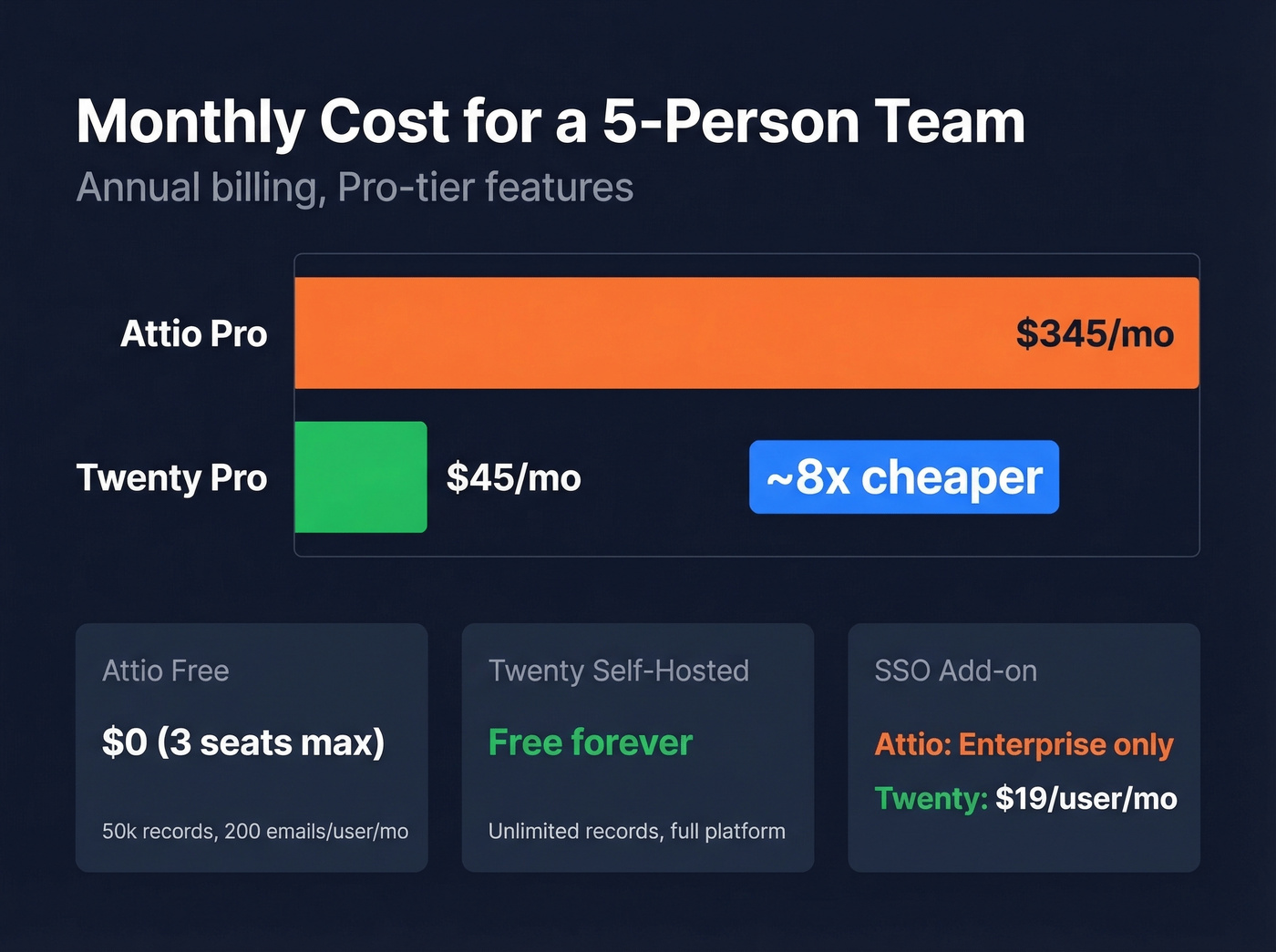
Attio's pricing page is unusually transparent, which we appreciate. But costs add up fast. A 5-person team on Pro runs $345/mo on annual billing, or $430/mo month-to-month. The Free plan caps email sends at 200/user/month; Plus bumps that to 1,000.
The real kicker is mailbox sync. Free and Plus get one mailbox per user. Pro gets two. One Reddit user put it bluntly - syncing 3+ email accounts costs $150+/month on Attio. Another reported they could only share email subject lines with teammates, not full threads, on their plan. For a startup trying to keep costs lean, these constraints sting.
Twenty pricing
| Plan | Price | Key inclusions |
|---|---|---|
| Self-hosted | Free | Unlimited records, full platform |
| Pro (cloud) | $9/user/mo (billed annually) | Custom objects, API/webhooks, email integration |
| Organization | $19/user/mo | SAML/OIDC SSO, priority support |
A 5-person team on Twenty Pro: $45/mo. That's roughly 8x cheaper than Attio Pro. In our experience, this pricing gap is the single biggest factor for early-stage teams choosing between the two. The self-hosted option is completely free, and SSO comes included in Twenty's Organization plan - on self-hosted instances, SSO is typically treated as an enterprise feature, which is a frustrating gap for security-conscious teams.
Features That Actually Matter
| Capability | Attio | Twenty |
|---|---|---|
| Custom objects | Yes (capped by plan) | Yes |
| Workflow automation | Sequences on Pro+ | Basic (no conditions/loops) |
| Integrations | 8 native + 5,000+ via Zapier | API/webhooks-first |
| Email/calendar sync | Sync accounts capped by plan | Mailbox + calendar sync |
| AI features | Limited | AI features/agents + dashboards |
| Self-hosting | No | Yes (Docker Compose + cloud guides) |
| Mobile app | - | No mobile app |
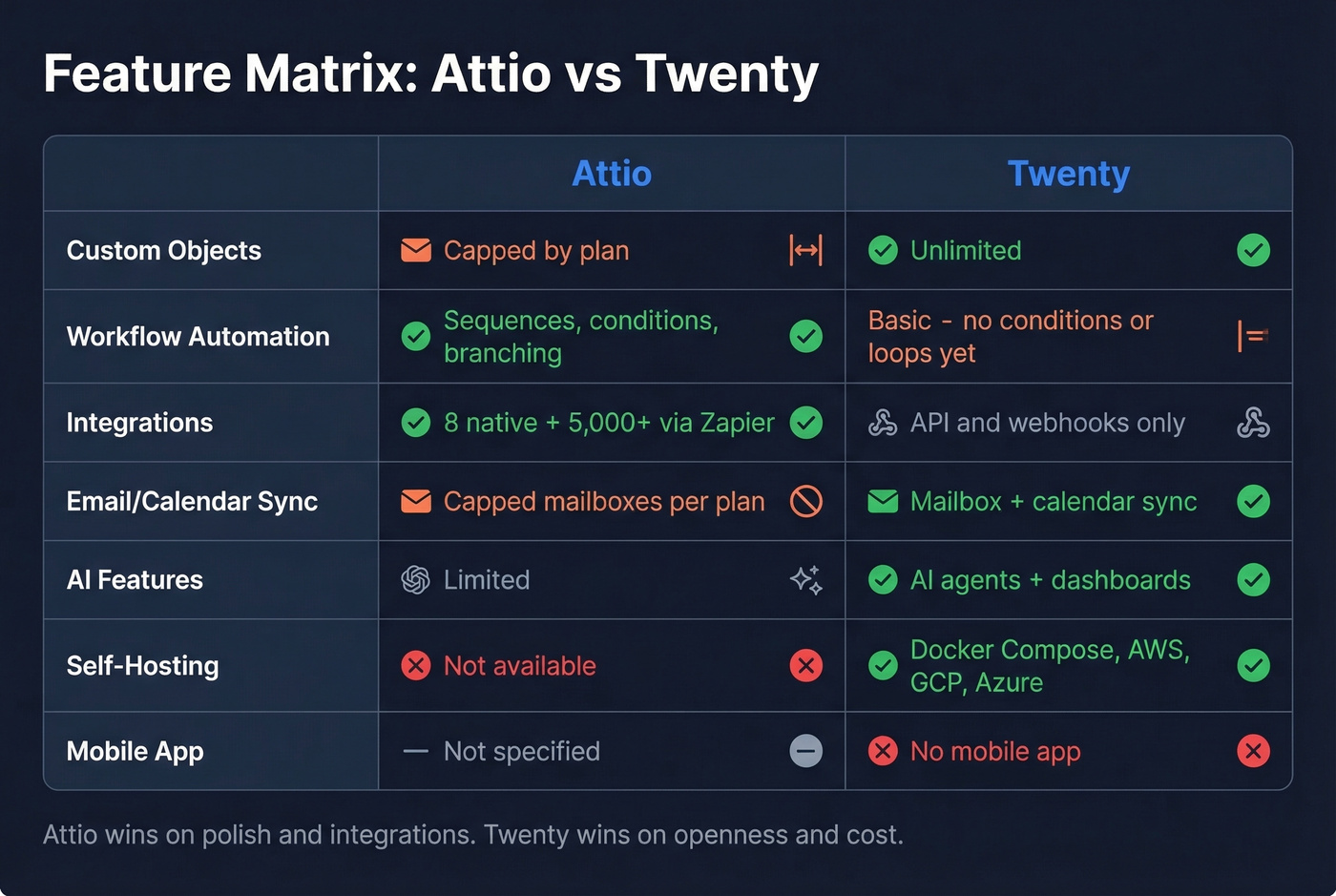
We've tested both UIs side by side, and Attio's polish is immediately obvious. The workflow builder handles real business logic - email sequences, conditional branching, the works. Twenty's workflow engine has triggers and actions covering record CRUD, HTTP requests, and serverless JS, but as of early 2026, it still lacks conditions and foreach loops. That's a meaningful gap for anything beyond simple automations.
On integrations, Attio's ecosystem is significantly larger. Between first-party connectors and Zapier, non-technical teams get real flexibility without writing code. Twenty leans heavily on its API and webhooks - powerful for developers, but more build-it-yourself work for everyone else.
Here's the thing: Twenty's CTO has been candid about where the product stands. On Hacker News, a team member acknowledged they've done "probably just 10% of what is needed to really get to Salesforce." That honesty is rare, and frankly, it makes me trust the project more than most vendor positioning. The CTO has also signaled that later in 2026, developers will be able to extend Twenty as code and build directly on top of it, which could change the calculus significantly for technical teams evaluating their long-term CRM stack.

Attio vs Twenty is a UI and pricing debate. Neither solves the real problem: finding verified contacts to fill your pipeline. Prospeo gives you 300M+ profiles with 98% email accuracy at $0.01/lead - and pushes them straight into your CRM via native HubSpot, Salesforce, or API integrations.
Stop debating CRMs. Start filling them with data that converts.
Self-Hosting and Data Ownership
If data ownership matters to your org - regulatory compliance, data residency, or just philosophical preference - Twenty is the only option here. Attio is SaaS-only with no self-hosting path.
If you're weighing this against other stacks, it's worth comparing HubSpot alternatives too.
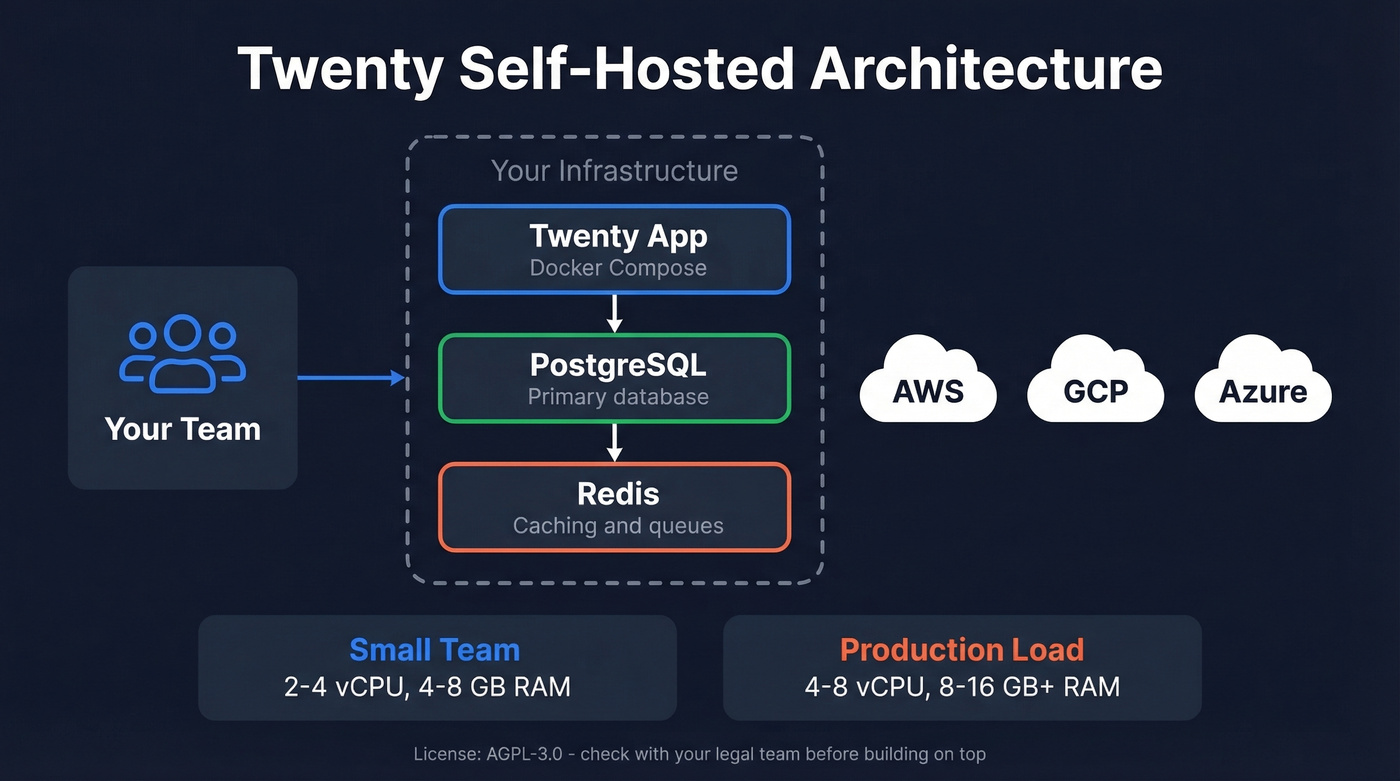
Twenty deploys via Docker Compose and supports infrastructure on AWS, GCP, or Azure. A small team can typically run it on a 2-4 vCPU / 4-8GB RAM VM with Postgres and Redis. Production teams handling heavier email sync and workflow loads should size up to 8-16GB+.
One thing to flag: Twenty uses an AGPL-3.0 license, which some OSS evaluators flag as a "contaminant license." If your legal team is particular about open-source licensing, get their sign-off before building on top of it.
Maturity and Ecosystem
Attio has the maturity advantage, full stop. Its 284 G2 reviews - 63% five-star - come overwhelmingly from small businesses, and the praise centers on ease of use, quick setup, and customizability. The recurring complaints? Limited integrations and weak reporting. Both are real but manageable for most sub-50-person teams.
Twenty has near-zero third-party review presence. Its credibility proxy is GitHub: 40.6k stars, 603 contributors, and 10,921 commits across 59 releases. The consensus on r/CRM is that Twenty is hackable, easy to install, and has high code quality - but there's no mobile app, and the codebase is large enough to intimidate casual contributors. For agencies or consultancies managing multiple client accounts, the lack of multi-tenancy support is a dealbreaker right now.
If you're building a repeatable outbound motion, strong pipeline management matters more than most CRM feature checklists.
Who Should Pick Which
Pick Attio if...
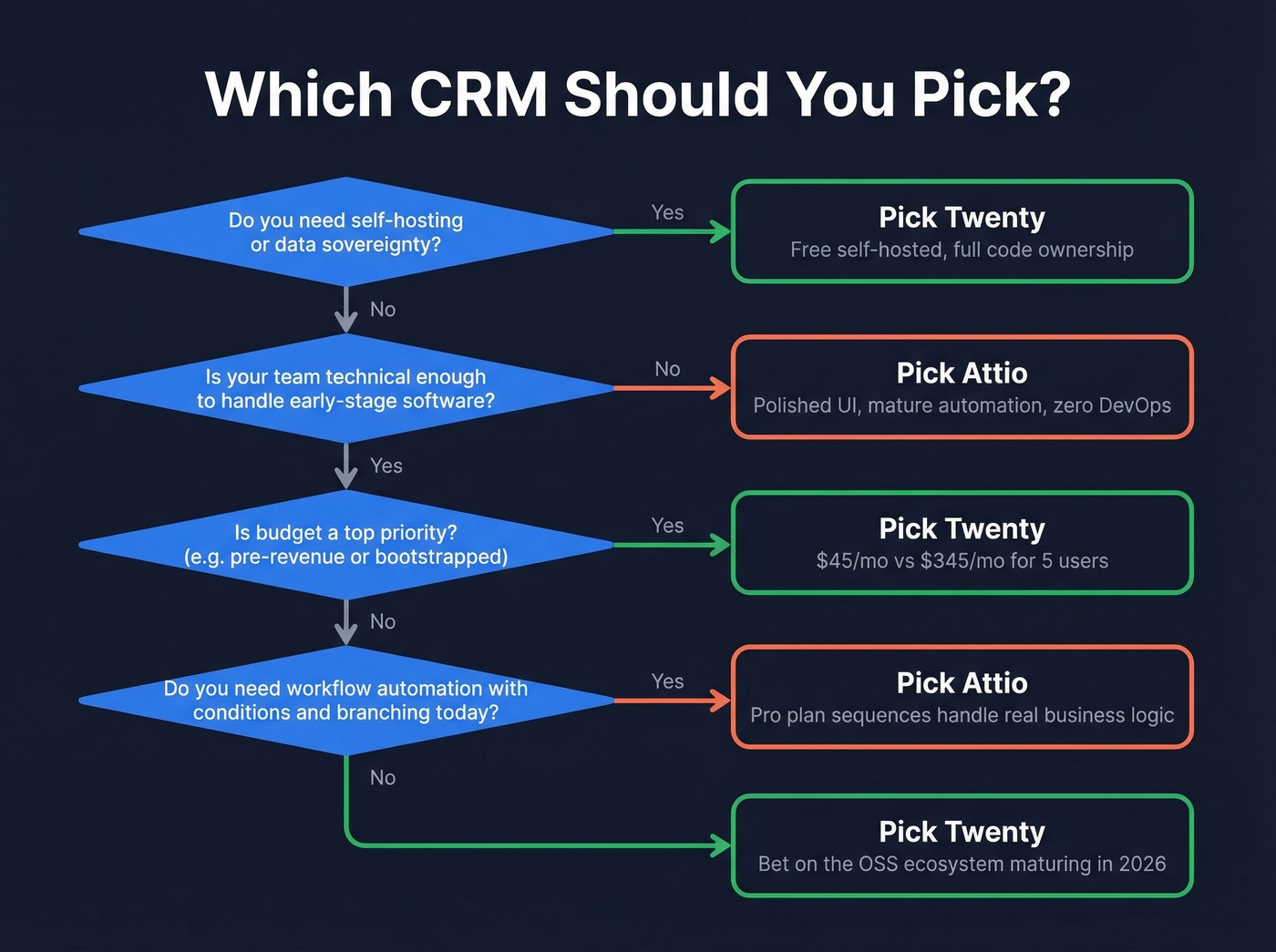
You want a CRM that works out of the box today. Your team is under 10 people, you don't need self-hosting, and you're willing to pay for polish. The Notion-like UI means low onboarding friction, and the workflow automation on Pro is genuinely useful for outbound sequences. If your deal size is comfortably five figures and you need reliable email sequences now, Attio earns its price.
If you're also evaluating other pipeline CRMs, see our breakdown of the best CRM for sales pipeline.
Pick Twenty if...
You're a technical team that values data sovereignty and doesn't mind getting your hands dirty. The $45/mo vs $345/mo gap for a 5-person team is hard to ignore when you're pre-revenue or bootstrapped. You're betting on a maturing OSS ecosystem and comfortable with a product that's still filling in gaps like conditional workflows and mobile access.
If you're pairing Twenty with outbound, you'll likely also want a dedicated sales intelligence platform to source accounts and contacts.
The Missing Piece: Contact Data
Let's be honest - neither Attio nor Twenty includes a B2B contact database. They're both excellent at organizing your pipeline, but neither one fills it. That's a different job entirely, and it's where most early-stage teams actually get stuck.
If you're running outbound, this matters more than most CRM feature debates. Better data protects deliverability, reduces bounce, and makes your sequences look "smart" because you're not emailing the wrong people.
If you're trying to scale this systematically, start with proven outbound prospecting strategy fundamentals.
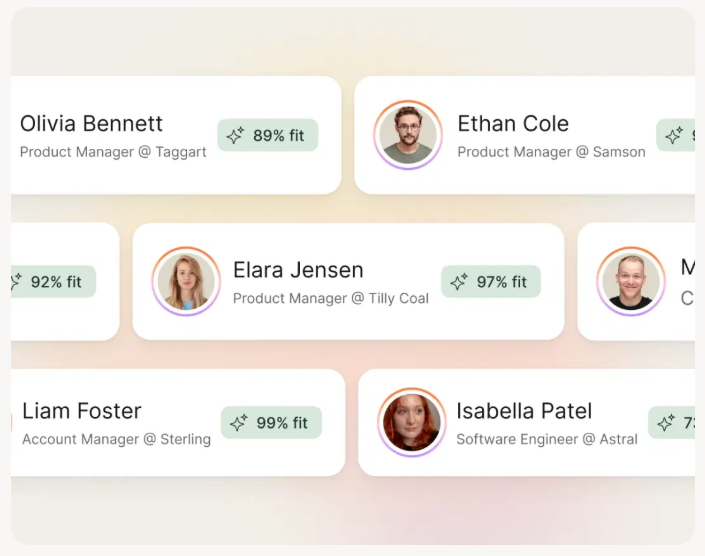
Whether you pick Attio's polished workflows or Twenty's self-hosted flexibility, empty pipelines kill deals. Prospeo's 143M+ verified emails refresh every 7 days - not every 6 weeks - so your CRM never runs on stale data. Layer in buyer intent from 15,000 Bombora topics to reach prospects already in-market.
Your CRM needs fresh, verified data. Prospeo delivers it weekly.
FAQ
Is Twenty CRM production-ready?
Twenty is usable for core CRM workflows in 2026, but expect gaps: the workflow engine still lacks conditions/loops and there's no mobile app. With 40.6k GitHub stars and frequent releases (v1.18.0 shipped Feb 19, 2026), it's best suited for technical teams that can own deployment and maintenance themselves.
Can I self-host Attio?
No. Attio is SaaS-only, so there's no self-hosting option today. If you need on-prem deployment, data residency control, or stricter compliance requirements, Twenty is the practical choice between these two.
What's a good way to add verified contacts to either CRM?
Don't rely on your CRM to "magically" provide leads - use a dedicated data platform. Prospeo gives you 300M+ professional profiles, 143M+ verified emails, and 125M+ verified mobile numbers with real-time verification at 98% accuracy and a 7-day refresh cycle. Push contacts into either CRM via API or CSV.
Attio vs Twenty - which should you choose?
For most teams, it comes down to a simple tradeoff: Attio is the safer pick when you want a polished CRM with mature automation right now, while Twenty is the better fit when self-hosting, code ownership, and cost control matter more than a fully finished feature set.