

The 12 Best Sales Intelligence Platforms for 2026
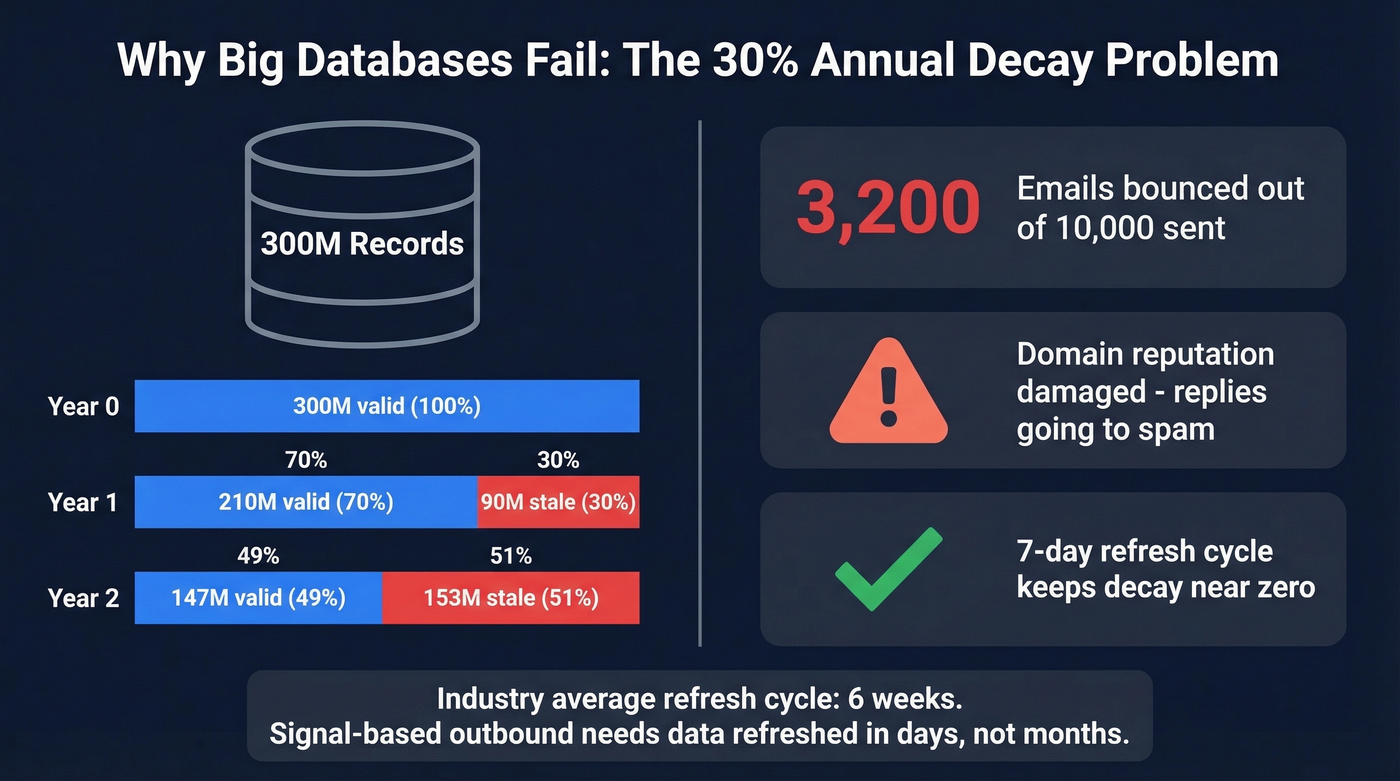
Your SDR team just launched a 10,000-contact sequence. By Friday, 3,200 emails have bounced, your domain reputation is tanking, and the VP of Sales wants to know why the "verified" list you bought last quarter is sending replies to spam. That's what happens when your sales intelligence platform serves stale data in a market where B2B contact data decays at roughly 30% per year](https://www.mordorintelligence.com/industry-reports/sales-intelligence-market).
The sales intelligence market hit $4.42 billion in 2025 and is projected to reach $9.15 billion by 2031, growing at a 12.89% CAGR. Grand View Research tells a similar story - $6.68 billion by 2030 at 10.8% CAGR. That's a lot of money chasing a simple promise: give reps better data so they book more meetings. But "better data" means different things depending on your team size, budget, and ICP.
We've tested most of these tools in production environments. Here are the 12 worth your time.
Our Picks at a Glance
| Use Case | Pick | Why |
|---|---|---|
| Data accuracy & freshness | Prospeo | 98% email accuracy, 7-day refresh |
| All-in-one for SMBs | Apollo.io | Free tier + sequencing + data |
| European data & compliance | Cognism | GDPR-first, phone-verified mobiles |
| Enterprise ABM & intent | 6sense | Account-level buying signals |
| Conversation intelligence | Gong | Call recording + deal forecasting |
| Best free starting point | Apollo.io | 50 AI credits, 2 sequences, $0 |
What Is Sales Intelligence?
The definition is straightforward: a sales intelligence platform aggregates and analyzes data about your prospects and their companies so reps know who to call, when to call, and what to say. The reality involves five distinct data layers working together.
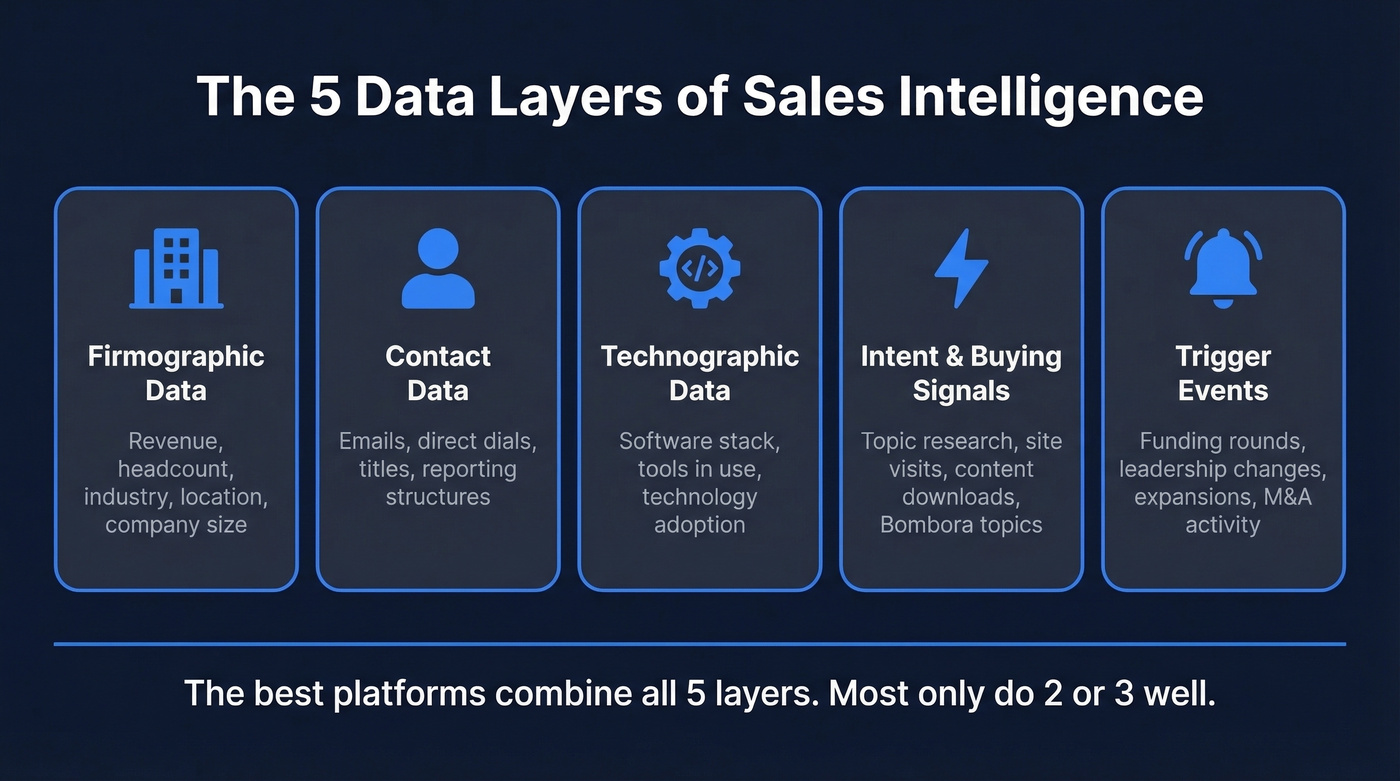
Firmographic data tells you about the company - revenue, headcount, industry, location. Contact data gives you the people - emails, direct dials, titles, reporting structures. Technographic data reveals what software they're running, which matters a lot if you're selling into a specific tech stack.
Intent and buying signals are where things get interesting. First-party intent tracks who's visiting your site and downloading your content, while third-party intent - usually powered by Bombora or similar providers - surfaces companies actively researching topics related to what you sell. Trigger events like funding rounds, leadership changes, expansions, and M&A create natural openings for outreach. The best platforms combine all five layers. Most only do two or three well.
Why Big Databases Aren't Enough
A 300-million-record database sounds impressive until you realize that 30% annual decay means roughly 90 million of those records go stale over a year. Stale emails bounce. Stale phone numbers waste rep time. And the contacts that are still valid? Everyone else has them too.
The takeaway from this r/b2bmarketing thread is blunt: big databases like Apollo and ZoomInfo can actually hurt deliverability because reps are blasting the same overused contacts from shared pools. Generic inboxes slip through, reply rates crater. One popular stack pattern from that thread: a professional-profile research tool for manual signals, Clay for personalization, Instantly for sending, plus an intent tool for weekly warm leads.
The shift is toward signal-based outbound - tighter ICP definition combined with timing signals like job changes, funding rounds, hiring surges, and intent spikes. Database size matters less than how fresh the data is and whether you're reaching the right person at the right moment. That's what B2B sales intelligence means in practice: not just having contacts, but knowing which ones are worth reaching out to right now.
Here's the thing: if your average deal size is under $10K, you probably don't need a $30K+ enterprise suite. A focused data enrichment workflow paired with a good sequencer will outperform a bloated platform you'll only use 20% of.

You just read why 30% annual data decay makes big databases a liability. Prospeo's 7-day refresh cycle and 98% email accuracy mean your reps reach real buyers - not dead inboxes. At $0.01/email, you get enterprise-grade sales intelligence without the enterprise contract.
Stop blasting stale contacts. Start with 75 free verified emails today.
How We Evaluated
No independent accuracy benchmark exists across all vendors - anyone who tells you otherwise is selling something. We evaluated based on G2 user sentiment, published refresh frequencies, and our own testing:
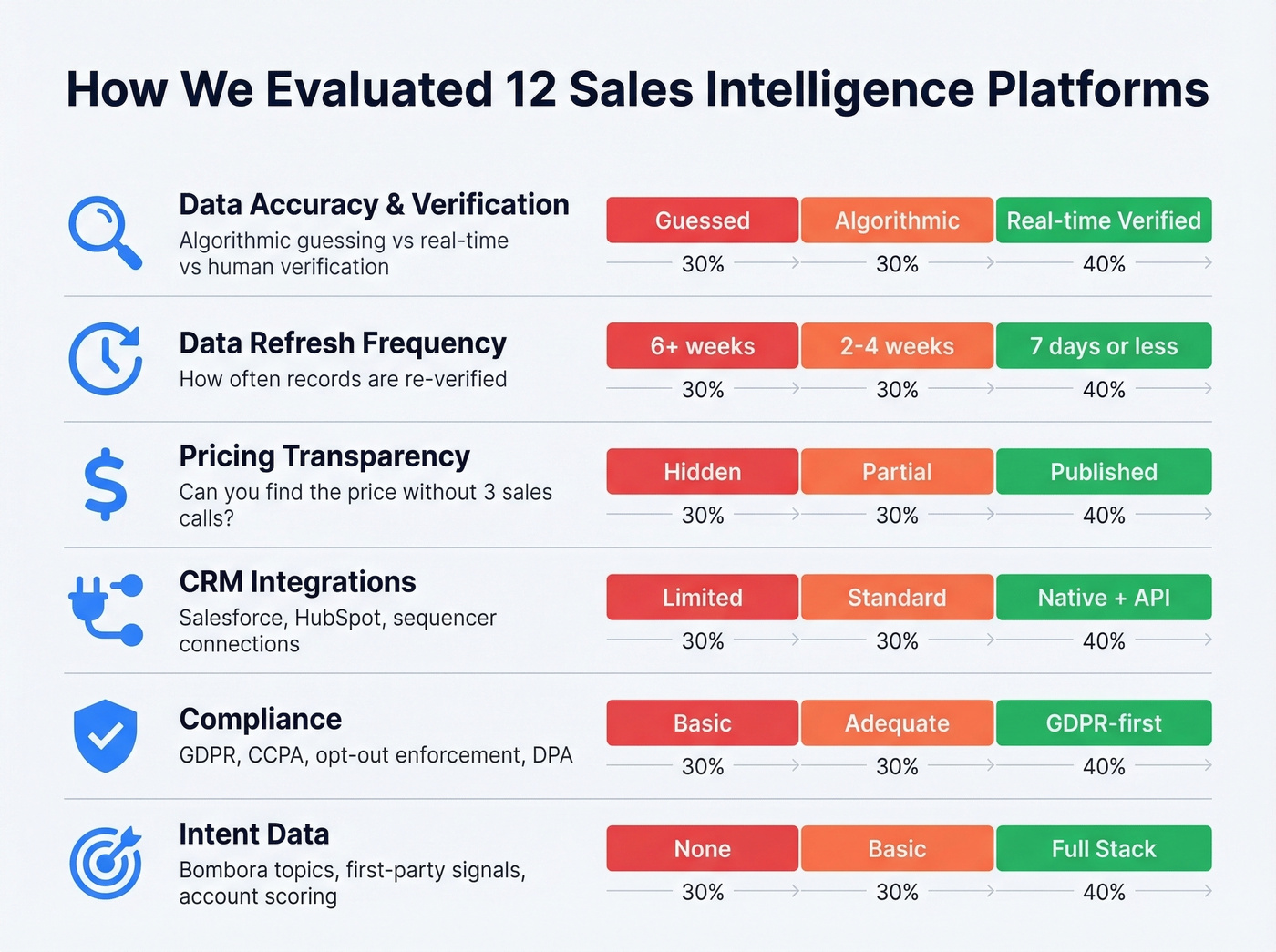
- Data accuracy & verification method - Algorithmic guessing vs. real-time verification vs. human verification produce very different results
- Data refresh frequency - A 7-day cycle and a 6-week cycle aren't in the same league
- Pricing transparency - Can you find the price on the website, or do you need three sales calls and an NDA?
- CRM integrations - Salesforce, HubSpot, and sequencer connections are table stakes
- Compliance - GDPR and CCPA handling, opt-out enforcement, DPA availability
- Intent data - Bombora topics, first-party signals, account-level scoring
The 12 Best Sales Intelligence Platforms
1. Prospeo - Best for Accuracy & Freshness
Prospeo's database covers 300M+ professional profiles, 143M+ verified emails, and 125M+ verified mobile numbers - all refreshed on a 7-day cycle. The 98% email accuracy rate comes from a proprietary 5-step verification process with catch-all handling, spam-trap removal, and honeypot filtering. That weekly refresh is worth emphasizing: the industry average sits around six weeks, which means most databases are already decaying by the time you download your list.

The 30+ search filters go deep: buyer intent across 15,000 Bombora topics, technographics, job changes, headcount growth, funding signals, and department-level headcount. The Chrome extension works on company websites and professional profiles for one-click prospecting. Data enrichment returns 50+ data points per contact, and the API delivers a 92% match rate with native integrations into Salesforce, HubSpot, Smartlead, Instantly, Lemlist, Clay, Zapier, and Make.
If you want to sanity-check verification claims, compare workflows against an email bounce rate baseline and a real email deliverability guide before you scale volume.
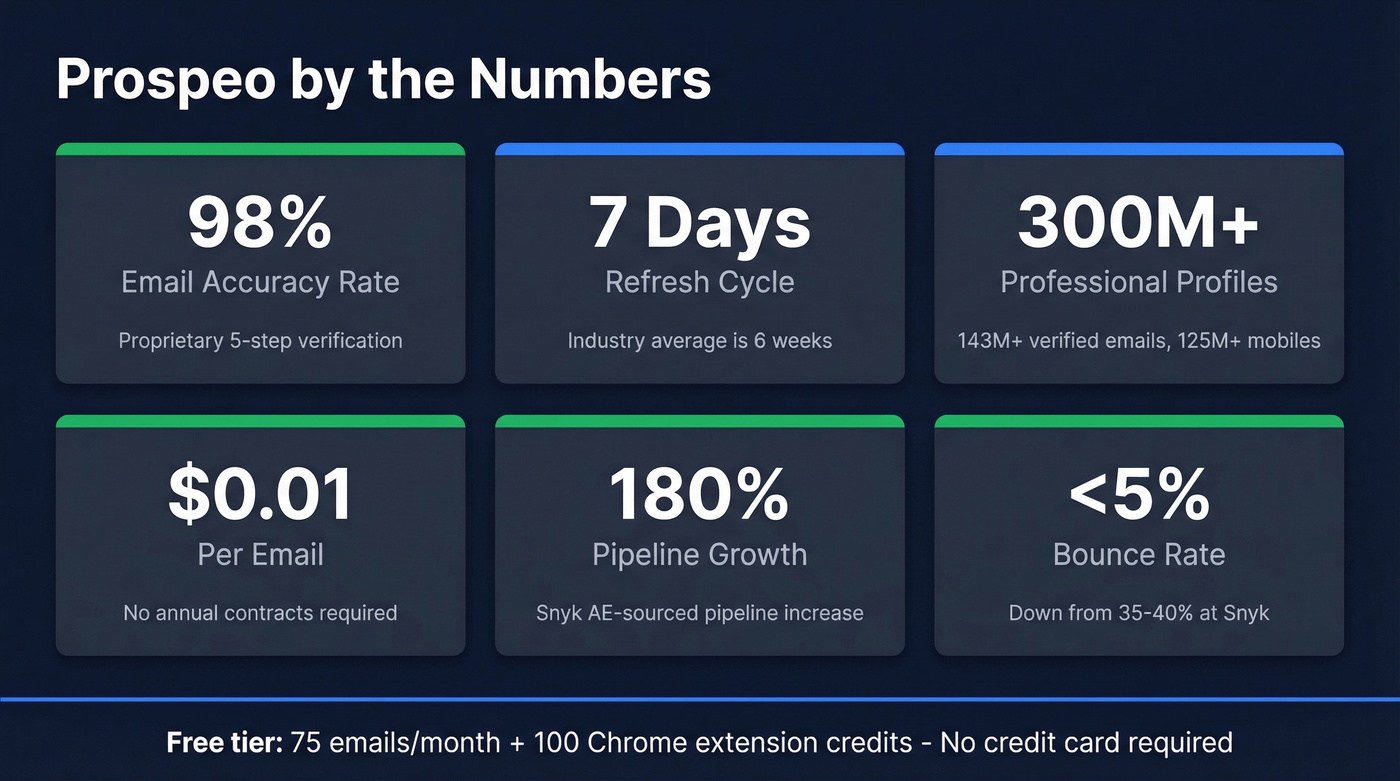
Real results: Snyk's 50 AEs reduced bounce rates from 35-40% to under 5%, and AE-sourced pipeline jumped 180%. Stack Optimize built from $0 to $1M ARR with client deliverability above 94% and zero domain flags.
Prospeo focuses on data accuracy rather than bundling a dialer or sequencer - most teams already have Outreach, Salesloft, or Instantly for that. Pair them together for the best results.
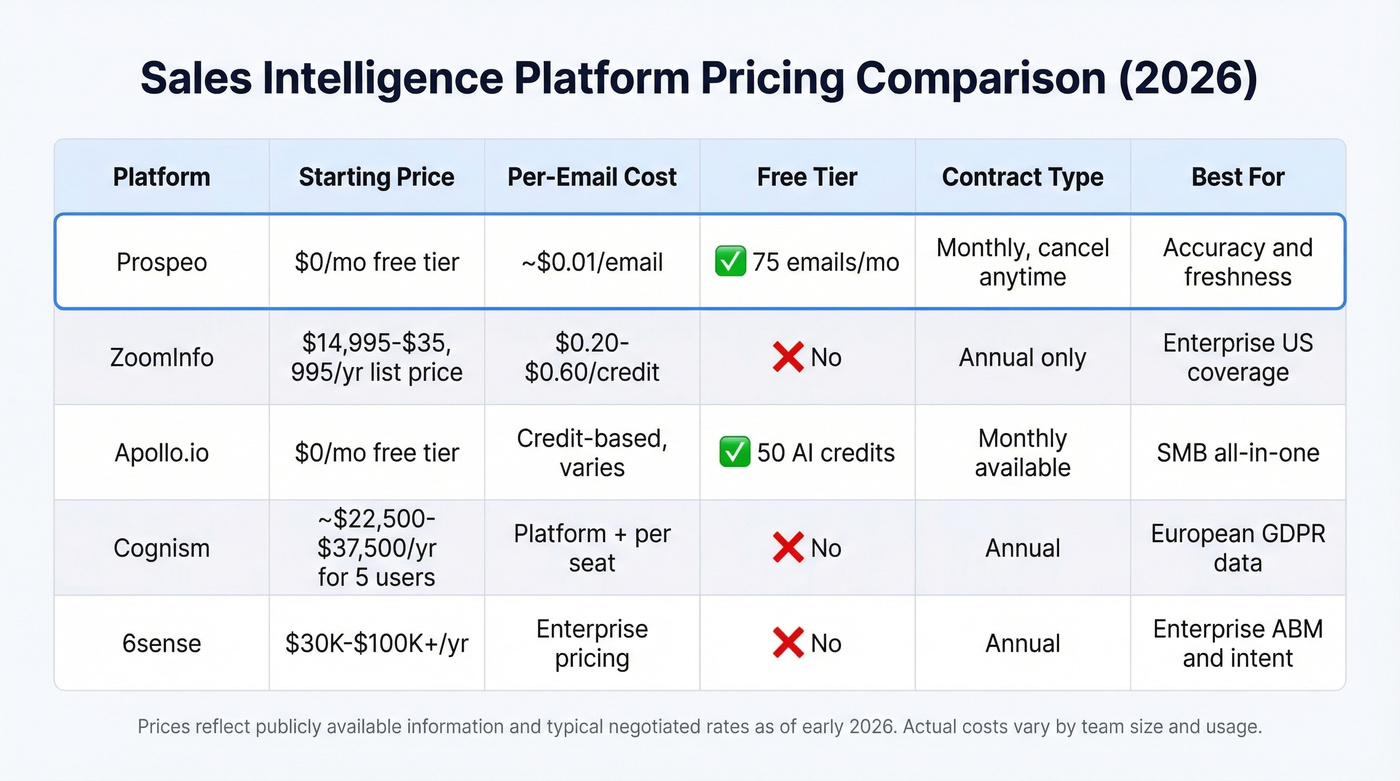
Pricing: ~$0.01/email. Free tier gives you 75 emails/month plus 100 Chrome extension credits/month. No contracts, cancel anytime.
Signal-based outbound only works when the data behind it is fresh. Prospeo combines 15,000 Bombora intent topics, technographics, job changes, and funding signals - all on a weekly refresh. Snyk's 50 AEs cut bounce rates from 35% to under 5% and grew pipeline 180%.
Layer intent signals on verified data - the way sales intelligence should work.
2. ZoomInfo - The Enterprise Default
ZoomInfo is the platform everyone benchmarks against - 9,031 G2 reviews at 4.5/5 stars don't happen by accident. Its US coverage is among the deepest in the category, and the platform breadth covering intent, workflow automation, and org charts makes it a legitimate all-in-one for large sales orgs. Pros:
- Deep US B2B database, especially for enterprise accounts
- Intent data, technographics, and org charts in one platform
- Strong Salesforce and HubSpot integrations
Cons:
- The #1 complaint on Reddit and G2 is price - and paying for modules you don't use
- List pricing runs $14,995-$35,995/yr by tier, but 30-65% discounts are standard with negotiation; a typical mid-market contract lands at $15K-$40K
- Credit unit costs range from $0.60 down to $0.20 at high volumes
- Annual contracts only, with 10-20% renewal uplifts, $2,500 per additional user, and $9,995 for Global Data
- G2's own sentiment summary flags "inaccurate/outdated data" as a recurring complaint
Look, ZoomInfo is still the safe enterprise pick. But if you're a mid-market team, negotiate hard - and run a data quality test before signing a multi-year deal. (If you want a framework, use an anchor in negotiation approach and define your walk away point before the first call.)
3. Apollo.io - Best Free Tier for SMBs
Use this if you're an early-stage team that needs data, sequencing, and a dialer in one tool without writing a five-figure check. Apollo's free plan includes 50 AI credits and 2 sequences - enough to validate outbound before committing budget.
Skip this if you're scaling past 10 reps and need predictable costs. Apollo uses hybrid pricing: a per-user monthly fee plus usage credits consumed on reveals, exports, mobile numbers, enrichment, and AI research. Credits don't roll over between billing cycles, which means you're either under-using or triggering overages. Waterfall enrichment adds cost variability depending on your ICP and geography.
Paid tiers: Basic from $49/user/mo, Professional from $79/user/mo, Organization from $119/user/mo with a minimum of 3 seats. The all-in-one value is real - just monitor your credit consumption weekly.
If you're building your outbound motion from scratch, pair this with a few proven sales prospecting techniques so the tool doesn't become the strategy.
4. Cognism - Best for European Data
Use this if you're selling into EMEA and need GDPR-compliant data with verified phone numbers. Cognism's Diamond Data feature delivers phone-verified mobile numbers with up to an 87% connect rate. Their GDPR-first approach means opt-out enforcement is baked in, not bolted on.
Skip this if your ICP is primarily US-based - ZoomInfo's North American coverage is deeper. Cognism's pricing model is a platform fee plus per-seat licensing: Grow runs ~$15K platform + ~$1,500/user/yr, Elevate runs ~$25K platform + ~$2,500/user/yr. A 5-person team lands at $22,500-$37,500/yr. Onboarding typically runs $500-$5K, intent topics cost $75-$400 each, and "unlimited" access comes with fair-use limits of roughly 2,000 records per user per month. Expect 10-15% renewal increases annually.
For European data quality, nobody else comes close.
5. 6sense - Best for Enterprise ABM & Intent
6sense isn't a contact database - it's an account-level intelligence tool that identifies which companies are in-market before they fill out a form. With 70% of B2B organizations now running ABM programs, account-based intelligence has moved from nice-to-have to infrastructure. Buying-committee intelligence, intent scoring, and ABM orchestration are the core value props.
Pricing runs $30K-$100K+/yr depending on scope. This is the right tool for multi-touch, multi-channel ABM campaigns at enterprise scale. If you just need emails and phone numbers, it's overkill - you'll be paying for an aircraft carrier when you need a speedboat.
6. Lusha - Quick Enrichment
Lusha is the tool you install when you need a phone number in 10 seconds. One-click Chrome extension, 1 credit per email, 10 credits per phone number. Free plan available, Pro at ~$22.45/mo, Premium at ~$52.45/mo with up to 40% annual discounts.
Best for ad-hoc lookups and individual rep workflows. You'll outgrow it when you need team-wide prospecting at scale, but for quick enrichment it's hard to beat on simplicity.
7. Lead411 - Best Unlimited Plans
For teams tired of credit games and surprise overages, Lead411's unlimited model is the most refreshing pricing structure in the category. The higher tier removes credit anxiety entirely, and trigger-event alerts for funding, hiring, and expansion signals add real prospecting value. Pricing starts at $49/month with a free 7-day trial.
The database isn't as deep as ZoomInfo's, and it's best suited for mid-market teams rather than enterprise-scale operations. But if predictable costs matter more than maximum coverage, Lead411 deserves a serious look.
8. Gong - Best Conversation Intelligence
Call recording, AI-powered deal analysis, and pipeline forecasting - Gong gives revenue leaders visibility into what's actually happening in deals, not just what reps report in Salesforce. It's a different category than contact data, but it's increasingly part of the modern revenue intelligence stack.
Pricing is quote-only and commonly sold as a per-user license plus a platform fee. No free tier. The ROI case is strong if you have enough call volume to generate meaningful insights, but Gong is a complement to a data platform, not a replacement.
9. Demandbase - ABM at Scale
Combines account identification, intent data, and advertising in one enterprise platform. Expect pricing around $30K-$100K+/yr. If you're running ABM across display, web personalization, and sales simultaneously, it's a serious contender. For everyone else, too much platform.
10. Kaspr - Budget Option for Europe
Chrome-extension-first approach targeting European SMBs with GDPR compliance. Free plan available, paid from $49/user/mo. Think of it as Lusha for Europe - quick, lightweight, affordable. It won't replace a full prospecting stack, but it fills a gap for teams that need occasional European contact lookups without a five-figure commitment.
11. RocketReach - Recruiting & Agency BD
Plans from ~$49-$249/mo. Excels at filtering by team size, growth signals, and decision-maker roles. One recruiter on Reddit called it "works like a charm" for client prospecting. Strong for recruiting and agency business development, less suited for high-volume outbound sales teams.
12. HubSpot Sales Hub - CRM-Native Intelligence
If you're already a HubSpot shop, Sales Hub adds sales enablement features without another vendor. Free tier available, Starter at $20/seat/mo, Professional at $100/seat/mo, Enterprise at $150/seat/mo. The data isn't as deep as dedicated prospecting tools, but zero integration effort is a real advantage for teams that don't want to manage another vendor relationship.
What These Platforms Actually Cost
Half these vendors won't publish pricing, which tells you something. Let's break down the three pricing models that dominate: credit-based where you pay per contact revealed, seat-based with a flat fee per user, and hybrid combining both. Credit-based sounds cheaper until heavy prospecting burns through credits fast. Seat-based is predictable but expensive at scale. Hybrid gives you the worst of both if you're not careful.
| Tool | Starting Price | Typical Annual Cost | Model | Free Tier |
|---|---|---|---|---|
| Prospeo | ~$0.01/email | $500-$3K/yr | Credit-based | 75 emails/mo |
| ZoomInfo | $14,995/yr list | $15K-$40K | Seat + credits | No |
| Apollo.io | $49/user/mo | $3K-$15K | Hybrid | Yes |
| Cognism | ~$15K platform | $22.5K-$37.5K | Platform + seat | No |
| 6sense | Contact sales | $30K-$100K+ | Quote-based | No |
| Lusha | ~$22.45/mo | $270-$630 | Credit-based | Yes |
| Lead411 | $49/mo | $600-$5K | Seat-based | 7-day trial |
| Gong | Quote-only | $12K-$50K+ | Seat-based | No |
| Demandbase | Quote-only | $30K-$100K+ | Quote-based | No |
| Kaspr | $49/user/mo | $600-$950 | Credit-based | Yes |
| RocketReach | ~$49/mo | $600-$3K | Tier-based | Limited |
| HubSpot Sales | $20/seat/mo | $240-$1,800 | Seat-based | Yes |
How to Choose by Team Size
Your team size determines which tradeoffs matter most.
Solo founder or startup (1-3 reps): Start with a free tier. You need verified emails and basic company data, not a $30K platform. Validate your ICP before spending anything. Apollo's free plan is the most feature-rich at zero cost; Prospeo's free tier gives you the most accurate data at 98% email verification.
SMB (5-20 reps): You need reliable prospecting data at predictable costs. Apollo Professional is the best all-in-one value, but watch for non-rolling credits. For teams prioritizing deliverability, a dedicated data enrichment workflow paired with your existing sequencer keeps bounce rates low without overpaying for bundled features you won't use.
Mid-market (20-100 reps): Cognism for EMEA-heavy ICPs, ZoomInfo if you negotiate hard - push for 40%+ discount on list price. At this scale, the data enrichment API becomes more valuable than manual prospecting tools. We've found that raising your team's ability to act on data - not just collect it - matters as much as the vendor you choose.
Enterprise (100+ reps): ZoomInfo, 6sense, or Demandbase for the platform. Layer a verification step before loading sequences - in our experience, teams cut bounce rates in half by running exports through real-time verification before outreach. The extra step takes minutes and saves weeks of domain reputation recovery.
FAQ
What's the difference between sales intelligence and a CRM?
A CRM stores existing relationships and deal history. A sales intelligence platform finds new prospects by layering contact data, firmographics, intent signals, and trigger events on top of your CRM to surface who to reach out to and when. They're complementary - one manages pipeline, the other fills it.
Is sales intelligence worth it for small teams?
Yes. Free tiers from Apollo and Prospeo give solo founders access to verified emails and company data without enterprise contracts. Even 75 free verified emails per month can generate enough pipeline to justify upgrading later. Start free, validate your ICP, then scale spend.
How accurate is B2B contact data?
It varies wildly. Contact data decays at ~30% per year, so accuracy depends almost entirely on refresh frequency. A 7-day cycle produces far better results than a 6-week cycle. Don't trust accuracy claims that aren't tied to a specific verification methodology - ask vendors to explain exactly how they verify, not just what percentage they claim.
Can I use multiple tools together?
Many teams layer a contact data provider for emails and phones with an intent tool for timing signals and push everything through CRM integrations. The key is avoiding duplicate spend - don't pay two vendors for the same email database. A common stack we see working well: a verified contact provider for data, Bombora-powered intent for timing, and Instantly or Salesloft for sequencing.
What should I ask during a demo?
Lead with data refresh frequency, credit expiration policies, and renewal pricing - ask for a written cap on annual increases. Then dig into regional coverage for your specific ICP, whether accuracy claims are independently verified, and what happens when you exceed fair-use limits. These five questions save you from the most common buyer regrets.
Start with a free tier, test data quality against your actual ICP, and scale from there. The best sales intelligence platform is the one that gives your reps accurate data at a price that doesn't make your CFO flinch - everything else is noise.