

Pipeline Management: The Operational Playbook Every Generic Guide Skips
You've got 43 active deals in the CRM. Your manager wants 4x coverage. But you know - really know - that maybe 8 of those deals are going anywhere. The rest are ghosts: stalled conversations, prospects who vanished after the demo, a deal that's been "in negotiation" since last summer. That's pipeline theater, and 63% of sales managers admit their org does a poor job managing it.
It's getting worse. Sales cycles are 21% longer than they were in 2020 and still climbing, which means your pipeline needs to work harder just to stay even. Yet companies with actively managed pipelines see 28% more revenue growth year over year. The gap between teams that manage deal flow well and teams that wing it has never been wider.
Here's the thing: this is a data quality and discipline problem, not a CRM problem. You need weighted coverage ratios (not raw totals), a velocity formula you actually calculate, and a weekly review that challenges pipeline health instead of collecting status updates.
What Is Pipeline Management?
Pipeline management is the practice of tracking, analyzing, and optimizing every active deal from first qualified conversation to closed-won or closed-lost. It's how you turn a messy spreadsheet of "opportunities" into a reliable revenue forecast.
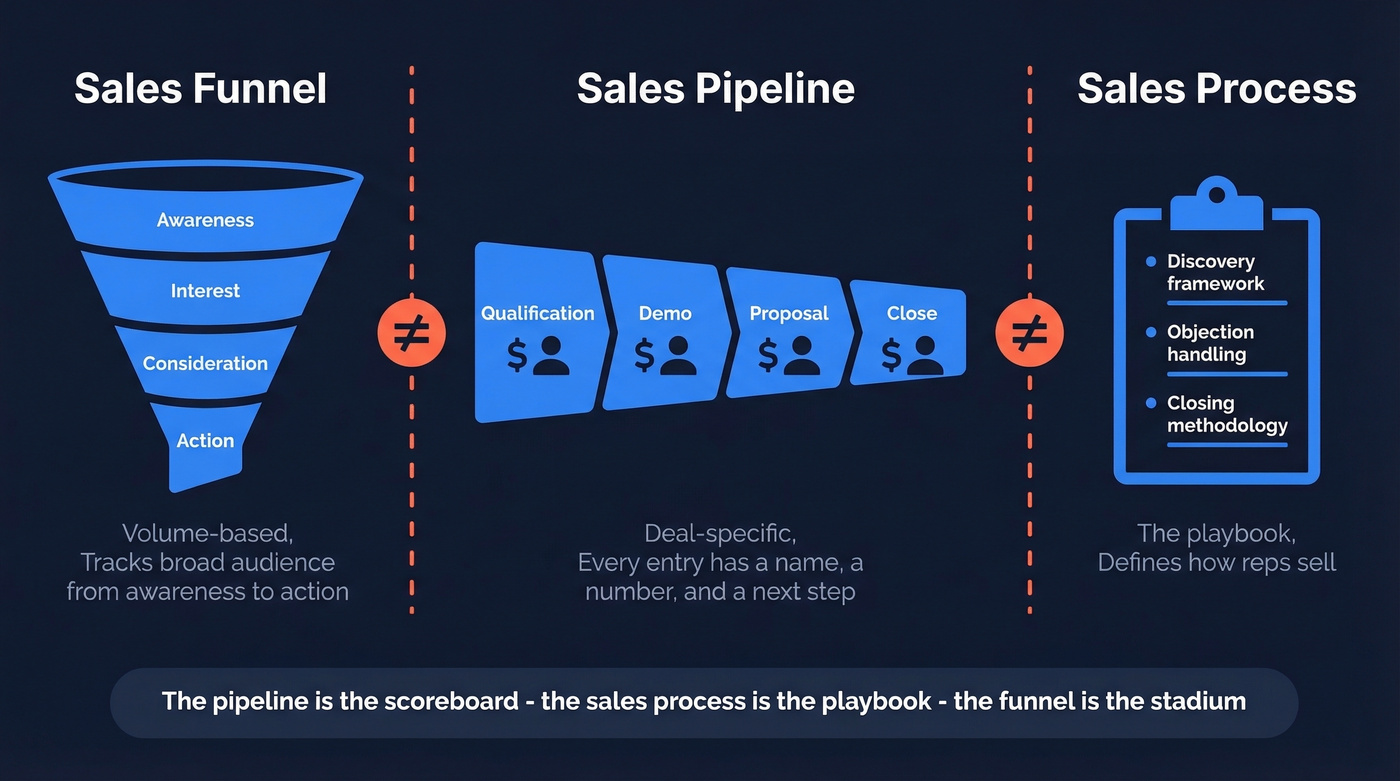
Most guides blur this distinction: your pipeline isn't your funnel. A funnel is volume-based - it tracks conversion from awareness to interest to action across a broad audience. A pipeline tracks specific deals with specific dollar amounts at specific stages. Every deal in your pipeline should have a name, a number, and a next step. If it doesn't, it's not a pipeline opportunity. It's a marketing lead that wandered into the wrong report.
And it isn't your sales process either. Your sales process defines how reps sell. Pipeline management measures whether it's working and where it's breaking down. Think of the sales process as the playbook and the pipeline as the scoreboard.
Stages by Sales Motion
Stage count should expand with deal complexity and buying committee size. A two-call SMB close doesn't need seven stages. An enterprise deal with 7.2 average stakeholders absolutely does.
| Sales Motion | Stages | Typical Flow |
|---|---|---|
| SaaS / Mid-Market | 5 | Lead → Qualification → Demo → Proposal → Close |
| Enterprise | 7 | Lead → Qualification → Needs Analysis → Solution Presentation → Proposal → Negotiation → Close |
| Consultative | 7 | Lead → Qualification → Needs Analysis → Solution Design → Proposal → Negotiation → Close |
| SMB / Transactional | 4-5 | Lead → Qualification → Proposal → Close |
The critical rule: each stage needs objective, customer-action-based exit criteria. "Rep sent proposal" isn't an exit criterion. "Prospect confirmed budget and timeline in writing" is. If a stage doesn't change your probability estimate, merge it with the one before it.
Industry context matters just as much as sales motion. A manufacturing pipeline often needs a "Technical Validation" stage between Demo and Proposal to account for engineering sign-off. Financial services pipelines typically require a "Compliance Review" before Close. Healthcare deals sometimes add a "Clinical Evaluation" stage that stretches weeks. Your stage design should reflect the buying process your customers actually follow, not a template you downloaded.
Enterprise and SMB pipelines aren't just different in length - they're structurally different. Enterprise deals run 6-18 months with buying committees of 6-13 participants. SMB deals close in 30-90 days, often with a single decision-maker. And 75% of B2B buyers now prefer a rep-free experience early in the process, which means your early stages need to be defined by buyer actions, not rep activities like "sent intro email."
Metrics That Actually Matter
Every sales guide tells you to "track your metrics." Almost none give you the formulas.
Pipeline Velocity
Sales velocity tells you how much revenue your pipeline generates per day. It's the single most useful metric because it combines four variables into one number:
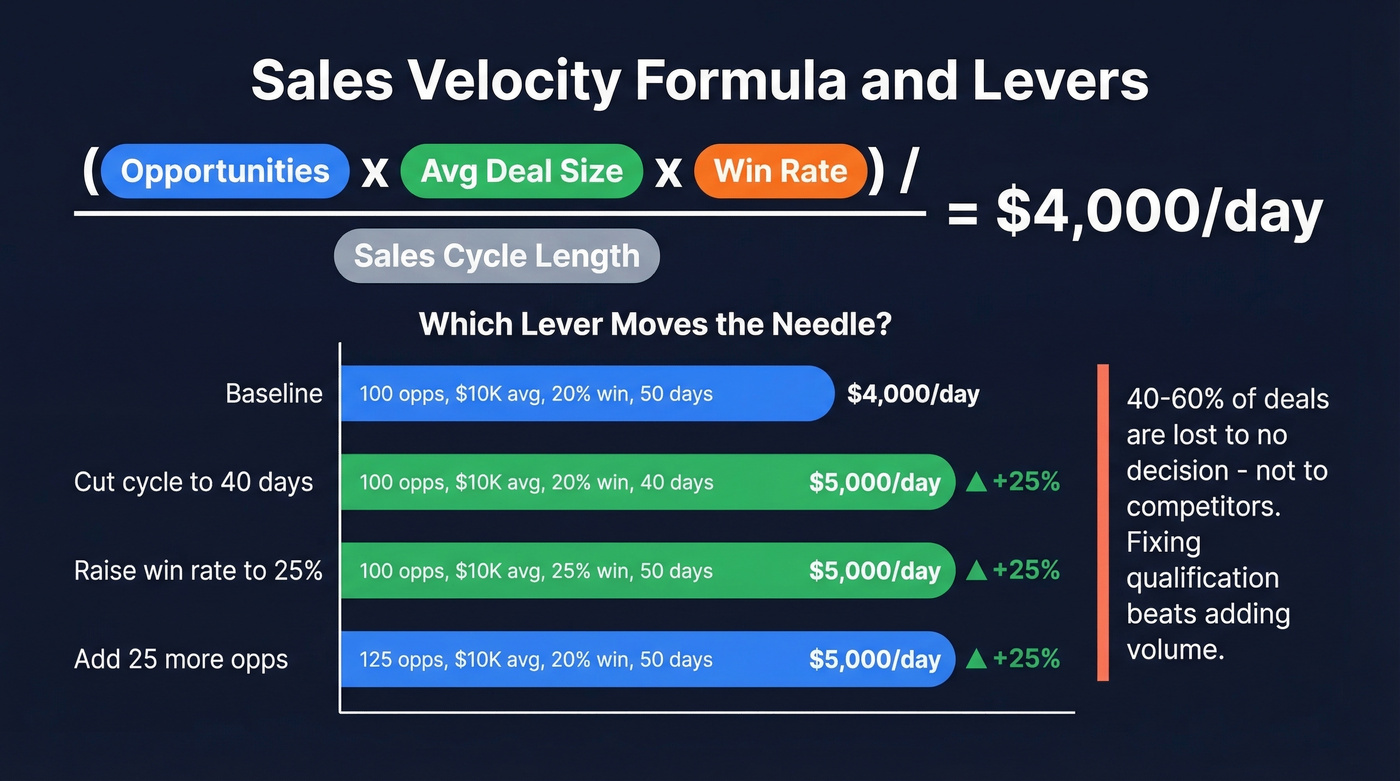
Sales Velocity = (Opportunities x Avg Deal Size x Win Rate) / Sales Cycle Length
Say you've got 100 qualified opportunities, a $10,000 average deal size, a 20% win rate, and a 50-day average cycle. That's (100 x $10,000 x 0.20) / 50 = $4,000/day in pipeline-generated revenue.
The power of this formula is that it shows you exactly which lever to pull. Shortening your cycle from 50 to 40 days - with everything else constant - jumps velocity to $5,000/day. Improving win rate from 20% to 25% gets you there too. Most teams obsess over adding more opportunities when improving win rate or shortening cycle length would move the needle faster.
One stat worth internalizing: 40-60% of deals are lost to "no decision." That's not a competitor problem. It's a qualification and urgency problem. Every "no decision" loss drags down your win rate and inflates your cycle length simultaneously.

Weighted vs. Unweighted Coverage
We see this constantly: a rep reports $2.1M in pipeline against a $500K quota. Manager sees 4.2x coverage and relaxes. But when you weight by stage probability, that $2.1M is really $800K - and half of it won't close this quarter.
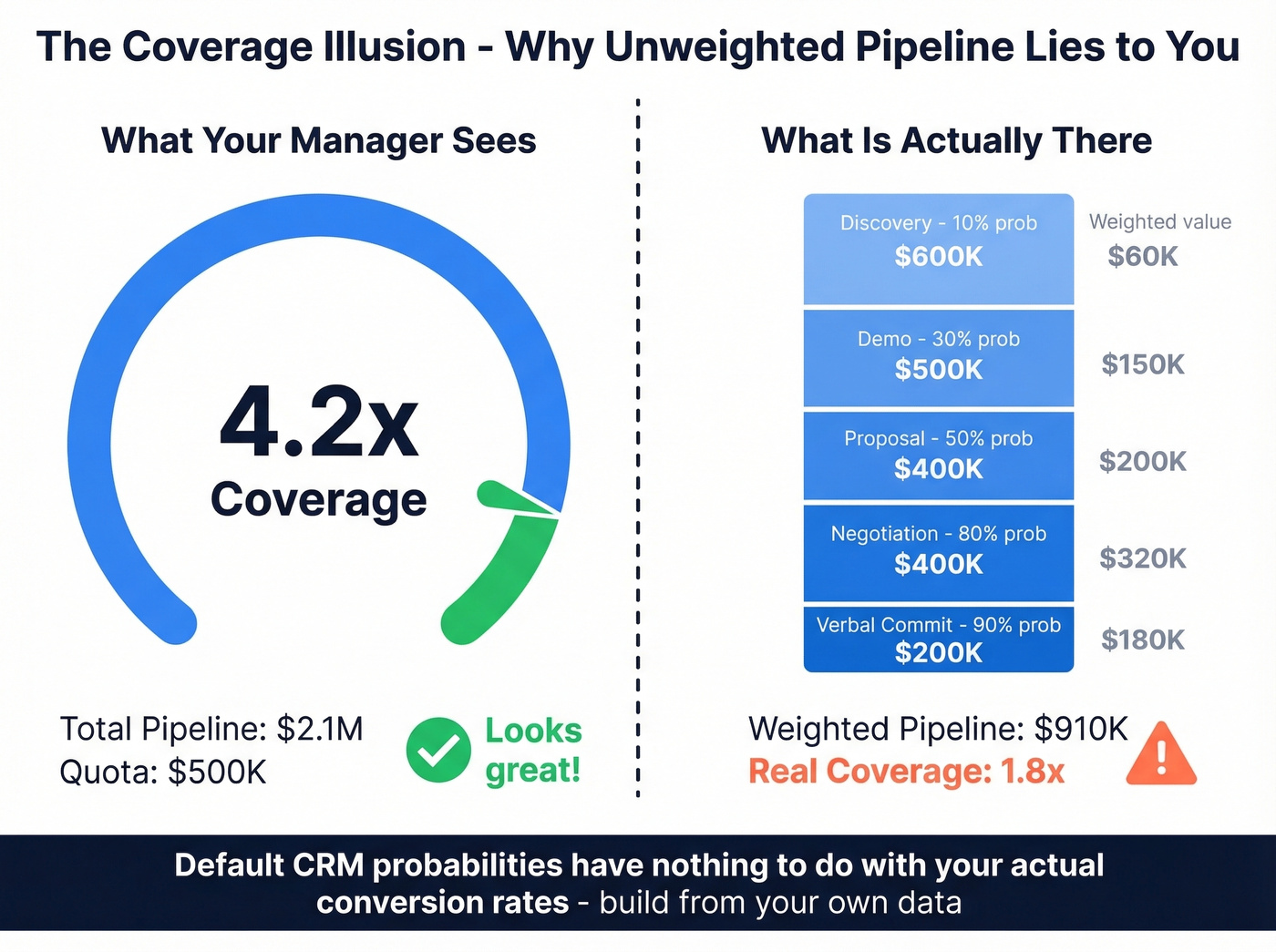
Unweighted coverage is a vanity metric. Weighted coverage uses stage-based probabilities grounded in your actual historical conversion rates. Typical probability ranges:
- Discovery: 10-15%
- Demo / Evaluation: ~30%
- Proposal: ~50%
- Negotiation / Contract: ~80%
- Verbal Commit: 90-95%
The formula: Weighted Pipeline = Sum of (Deal Value x Stage Probability). Then: Coverage Ratio = Weighted Pipeline / Quota Target.
Context matters enormously here. An SMB team with a 45-day cycle and 40% win rate can be fine at 1.5-2x weighted coverage. An enterprise team with a 12-month cycle and 15% win rate needs 4-5x weighted. Using the same coverage target for both is how forecasts blow up.
Other Metrics Worth Tracking
Beyond velocity and weighted coverage, keep an eye on stage conversion rates (where deals stall tells you where reps need coaching), average deal size (trending down often signals discounting problems), win rate by rep and segment, and lead response time. Don't track all of these weekly. Velocity and weighted coverage are your weekly pulse. The rest are monthly or quarterly diagnostic tools.
2026 Benchmarks
Benchmarks are only useful if they're specific to your segment.
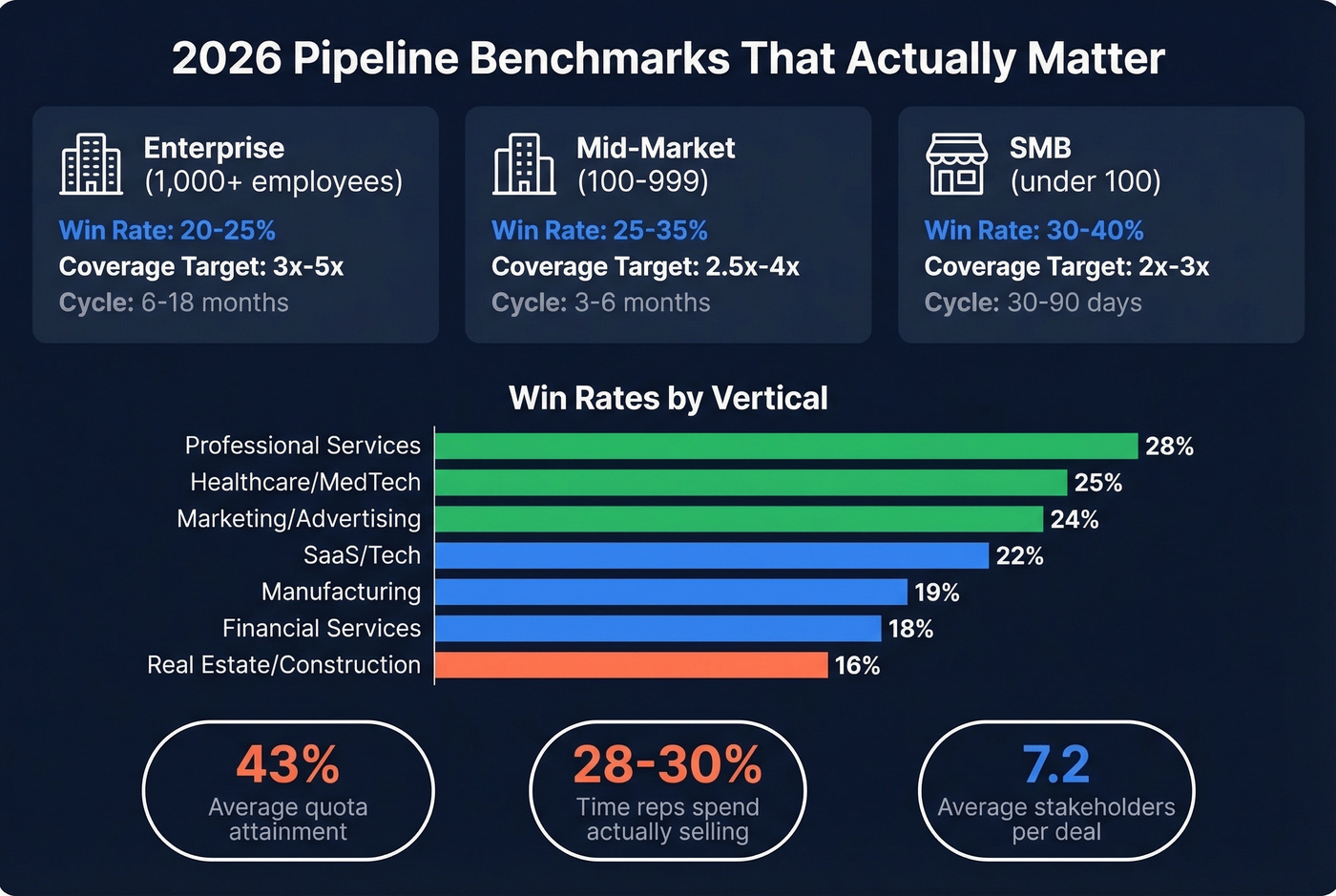
Coverage Ratios by Segment
| Segment | Win Rate | Target Coverage (Unweighted) |
|---|---|---|
| Enterprise (1,000+) | 20-25% | 3x-5x |
| Mid-Market (100-999) | 25-35% | 2.5x-4x |
| SMB (<100) | 30-40% | 2x-3x |
Win Rates by Vertical
| Vertical | Win Rate |
|---|---|
| Professional Services | 28% |
| Healthcare / MedTech | 25% |
| Marketing / Advertising | 24% |
| SaaS / Tech | 22% |
| Manufacturing | 19% |
| Financial Services | 18% |
| Real Estate / Construction | 16% |
Some broader numbers that should inform your planning: average quota attainment sits at 43% in 2026. Reps spend just 28-30% of their time actually selling - the rest goes to admin, internal meetings, and CRM updates. Buying committees average 7.2 stakeholders, which means multi-threading isn't optional anymore.
Let's be honest: if your average deal is under $15K and your team is under 20 reps, you probably don't need 5x coverage or seven stages. You need five clean stages, 2.5x weighted coverage, and reps who actually follow up. The obsession with enterprise-grade frameworks at SMB scale creates more busywork than revenue.
Below 2x coverage is a red flag regardless of segment. Above 5x, you're likely carrying zombie deals that inflate the number without contributing to revenue. The simple math: 1 / win rate gives you the minimum unweighted coverage you need.

40-60% of deals lost to "no decision" starts with bad contact data - wrong emails, dead phone numbers, outdated titles. Prospeo's 300M+ profiles refresh every 7 days with 98% email accuracy, so every deal in your pipeline is attached to a real, reachable buyer.
Stop managing ghosts. Fill your pipeline with verified contacts.
Five Problems Killing Your Forecast
Non-Opportunities
Reps log opportunities after a single discovery call to hit activity metrics. The fix: remove anything that doesn't have a second meeting scheduled within two weeks of the first. If the prospect won't commit to a follow-up, it's not an opportunity. It's a conversation.
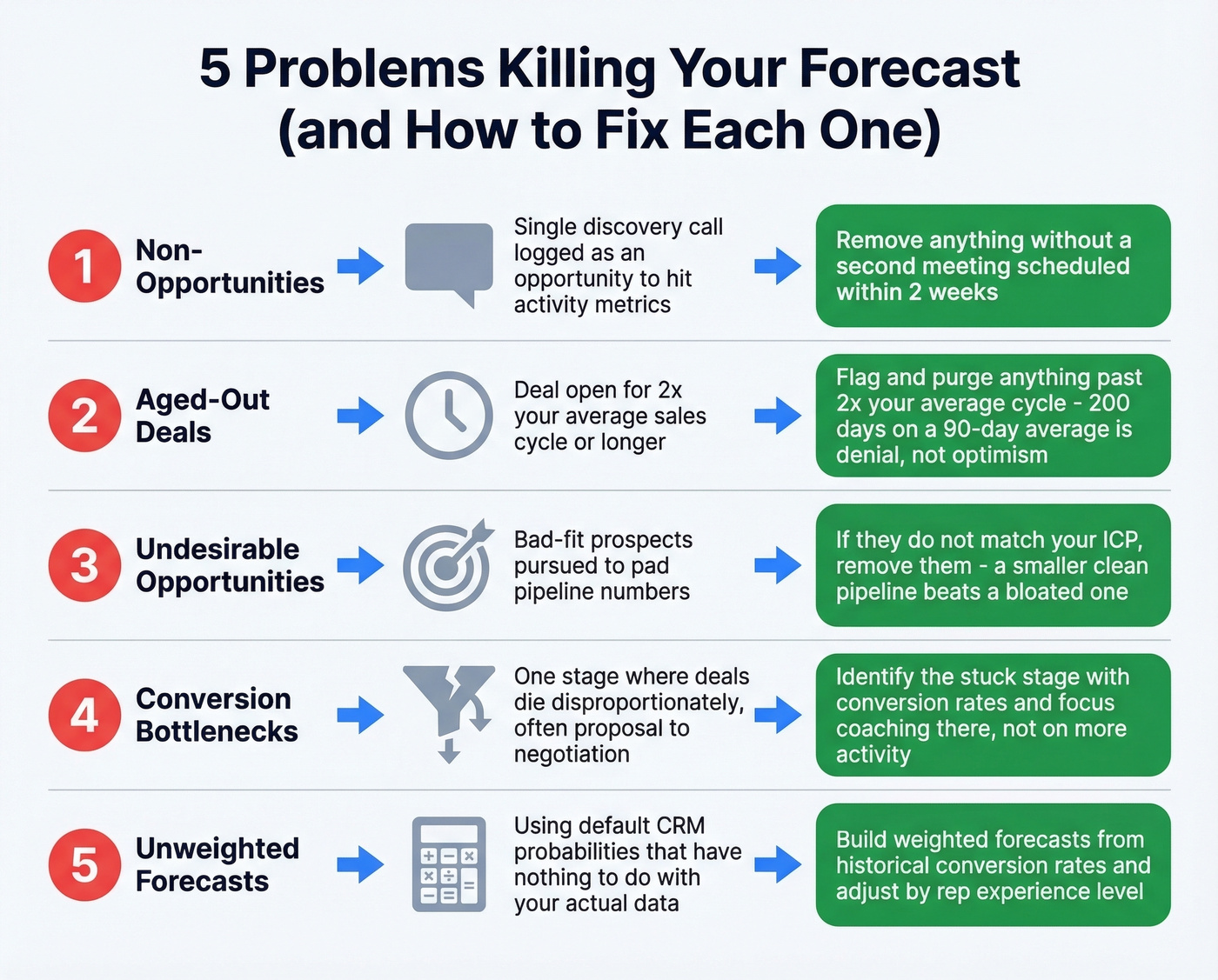
Aged-Out Deals
Flag anything sitting at more than 2x your average sales cycle. If your average cycle is 90 days and a deal has been open for 200 days, it's almost certainly dead. One example from The Sales Blog described a deal nearly five years old against a 90-day average cycle. That's not optimism; it's denial.
Undesirable Opportunities
Desperate reps pursue bad-fit clients to pad their numbers. These deals either never close or close and churn within months. If the prospect doesn't match your ICP, remove it. A smaller, cleaner pipeline beats a bloated one every time.
Conversion Bottlenecks
Look at your stage-to-stage conversion rates. There's almost always one stage where deals die disproportionately - often the second meeting or the proposal-to-negotiation handoff. That's where coaching should focus, not on "more activity."
Unweighted Forecasts
Don't use default CRM stage percentages. Salesforce's out-of-the-box probability assignments have nothing to do with your actual conversion rates. Build weighted forecasts from your historical data, and adjust by rep - your top closer and your newest hire don't carry the same probability at the proposal stage.
Pipeline inflation is systemic and political. A Reddit thread on r/sales described a rep using different task labels - "Final Decision" for weak deals, "Close" for real ones - so managers wouldn't notice the dead weight. When reps are gaming the system to survive reviews, the problem isn't the rep. It's the review.
How to Run a Pipeline Review
A pipeline review is an execution meeting. Not a status check. Not a forecasting meeting. It exists to assess health, surface risks, and make sure deal flow supports your targets.
We've found a five-pillar framework works best:
Qualification. Is this deal real? Has the prospect confirmed budget, authority, need, and timeline through their actions - not just the rep's notes? Has the rep met the economic buyer?
Coverage. Does the rep's weighted pipeline support their quota for this period? If not, what's the plan to generate net-new qualified opportunities - not recycle dead ones?
Next Steps. Every deal needs a buyer-committed next step with a date. "They said they'd get back to us" isn't a next step. "CFO review scheduled for Thursday at 2pm" is. If a deal hasn't advanced in 30 days with no clear next step, it needs reassessment.
Forecast Accuracy. Challenge slipping close dates. If a deal has been pushed three times, the rep's close date is fiction. Adjust accordingly.
Sales Execution. Is the rep multi-threading across the buying committee? Do they have a plan to expand the footprint? What senior-level meetings have happened?
Run execution reviews weekly. Reserve quarterly reviews for strategic analysis - segment trends, win/loss patterns, and coverage trajectory. The weekly cadence keeps deals honest. The quarterly cadence keeps strategy honest.
Fix Your Data Before Your Process
Your pipeline can't be accurate if your contact data isn't. Bad emails, wrong phone numbers, and outdated job titles don't just hurt outbound - they inflate your deal flow with opportunities built on unreachable contacts.
The math is brutal. 80% of deals require 5+ touches, but 44% of reps give up after one. When that first touch bounces - and double-digit bounce rates are common with unverified data - you've wasted the most critical contact attempt in an already-tight sequence.
Prospeo addresses this at the foundation level. With 98% email accuracy and a 7-day data refresh cycle (the industry average is six weeks), reps aren't sending sequences into the void. CRM enrichment returns 50+ data points per contact, so records reflect reality instead of last quarter's org chart. The proof point: Snyk's 50-person AE team dropped bounce rates from 35-40% to under 5% after switching, and AE-sourced pipeline jumped 180% - generating 200+ new opportunities per month.
Pipeline velocity depends on reaching the right stakeholders fast. Prospeo gives you 125M+ verified mobile numbers with a 30% pickup rate and 30+ filters - buyer intent, job changes, department headcount - so you qualify deals with real decision-makers, not gatekeepers.
Shorten your sales cycle by reaching decision-makers directly.
Tools Compared
A common scaling moment: you've outgrown spreadsheets, but a heavyweight enterprise CRM feels like overkill. Here are solid options across different needs and budgets.
| Tool | Starting Price | Free Tier? | Best For |
|---|---|---|---|
| Prospeo | ~$0.01/email | Yes (75 emails/mo) | Data quality + enrichment |
| HubSpot Sales Hub | ~$15/user/mo | Yes (limited) | Teams starting from zero |
| Pipedrive | ~$14/user/mo | No | SMBs wanting a visual pipeline |
| Salesforce | ~$25/user/mo | No | Enterprise / complex orgs |
| monday CRM | ~$12/seat/mo | No | Visual workflow teams |
| Freshsales | ~$9/user/mo | Yes | Budget-conscious teams |
| Close | ~$29/user/mo | No | Inside sales teams |
| Zoho CRM | ~$14/user/mo | Yes (limited) | All-in-one suite users |
Prospeo isn't a CRM - it's the data layer that makes your CRM trustworthy. At roughly $0.01 per email with 98% accuracy, it integrates natively with Salesforce, HubSpot, Smartlead, Instantly, and Clay. The 75-email free tier lets you validate the accuracy before committing. For teams whose pipeline problems trace back to bad contact data, start here.
HubSpot Sales Hub is the obvious starting point if you're building from zero. The free CRM is genuinely useful, and Starter at ~$15/user/mo is reasonable. The catch: higher tiers jump to ~$90/user/mo (Professional) and ~$150/user/mo (Enterprise). Teams often outgrow the free tier fast once they need automation or advanced reporting.
Pipedrive is a strong pure-play tool for smaller teams. Visual, intuitive, does one thing well. Starting at ~$14/user/mo, it's affordable - though add-ons for email tracking and automation push the effective cost higher than the sticker price suggests.
Don't underestimate the total cost of Salesforce Sales Cloud. The per-seat entry price is only part of the budget - plan for implementation, admin time, and often consultants if you want a clean rollout. Worth it for complex orgs with multiple pipelines, territories, and reporting needs. Skip it if you're a 10-person team.
The remaining tools fill specific niches. monday CRM (~$12/seat/mo) works for teams that think visually and want deal tracking embedded in broader project workflows. Freshsales (~$9/user/mo) is the budget pick with capable AI scoring via Freddy - and AI-powered deal scoring is becoming table stakes across the category, with most major CRMs now offering some form of predictive health analysis. Close (~$29/user/mo) is purpose-built for inside sales running high-volume phone and email outreach. Zoho CRM (~$14/user/mo) makes sense if you're already in the Zoho ecosystem.
If you're evaluating add-ons beyond a CRM, compare sales forecasting solutions and data enrichment services before you commit to a bigger platform.
FAQ
How many stages should my pipeline have?
SaaS and SMB teams typically need 4-5 stages; enterprise and consultative sales require 6-7. Each stage needs objective, customer-action-based exit criteria that change your probability estimate. If two adjacent stages carry the same win probability, merge them - stage count should reflect deal complexity, not internal process vanity.
What's a good coverage ratio?
Unweighted coverage of 3x-5x is the standard benchmark, but weight by stage probability instead. An SMB team with a 40% win rate needs only 1.5-2x weighted coverage, while an enterprise team at 15% win rate needs 4-5x weighted. Below 2x unweighted is a red flag in any segment. Formula: Weighted Pipeline / Quota Target.
How do I keep reps from inflating the pipeline?
Set objective exit criteria based on customer actions, not rep activities. Auto-flag deals sitting at more than 2x your average cycle length and remove anything without a buyer-committed next step after 30 days. Stop rewarding volume over quality in reviews - that's the root cause of inflation in most orgs.
What tools help with pipeline data accuracy?
Prospeo is the strongest option for contact-level accuracy - 98% email verification, 50+ enrichment data points, and a 7-day refresh cycle versus the six-week industry average. Pair it with your CRM so enriched data flows directly into deal records. Clean contact data eliminates phantom opportunities built on unreachable prospects.
Pipeline management isn't about having the most deals or the fanciest CRM. It's about knowing which deals are real, which are dead, and having the data quality to tell the difference. Everything else is theater.