


Augment Code: Pricing, Reviews, and Honest Pros & Cons
You just opened your Augment Code usage dashboard and watched 51,072 credits vanish in a single day. That's not a hypothetical - it's a real user's experience that ended with a cancellation. With 85% of developers now using AI coding tools, understanding what you're signing up for matters before you commit. The question isn't whether to adopt an AI assistant. It's whether Augment will punish you for actually using it.
30-Second Verdict
Augment's Context Engine indexes up to 500,000 files across dozens of repos - nothing else in the AI coding space touches that scale. But the credit system burns fast, the 2025 pricing migration eroded trust, and moderate users feel penalized. At $60/mo per dev per developer on the Standard plan, it's worth it only if you work across large codebases and actively optimize model selection. For everyone else, Copilot Pro at $10/month is the smarter starting point.
Augment Code Pricing in 2026
Here's the full tier structure as of early 2026:
| Plan | Price | Credits | Users |
|---|---|---|---|
| Trial | $0 | 30,000 | 1 |
| Indie | $20/mo | 40,000 | 1 |
| Standard | $60/mo per dev | 130,000 | Up to 20 |
| Max | $200/mo per dev | 450,000 | Up to 20 |
| Enterprise | Custom | Custom | Unlimited |
When you exhaust your monthly pool, auto top-up kicks in at $15 per 24,000 credits. Credits are pooled at the team level, so a 20-dev Standard team gets 2.6M credits/month total. Enterprise adds SOC 2 Type II, ISO 42001, SSO/OIDC/SCIM, volume-based annual discounts, and compliance options like CMEK.
The sticker price isn't the real question, though. Credit velocity is. A single small task on Sonnet 4.5 costs 293 credits. A medium task runs 860. A complex task eats 4,261 - that's 3.3% of your entire Standard plan budget in one shot.
How Credits Actually Work
Not all models cost the same, and this is where most users get burned.
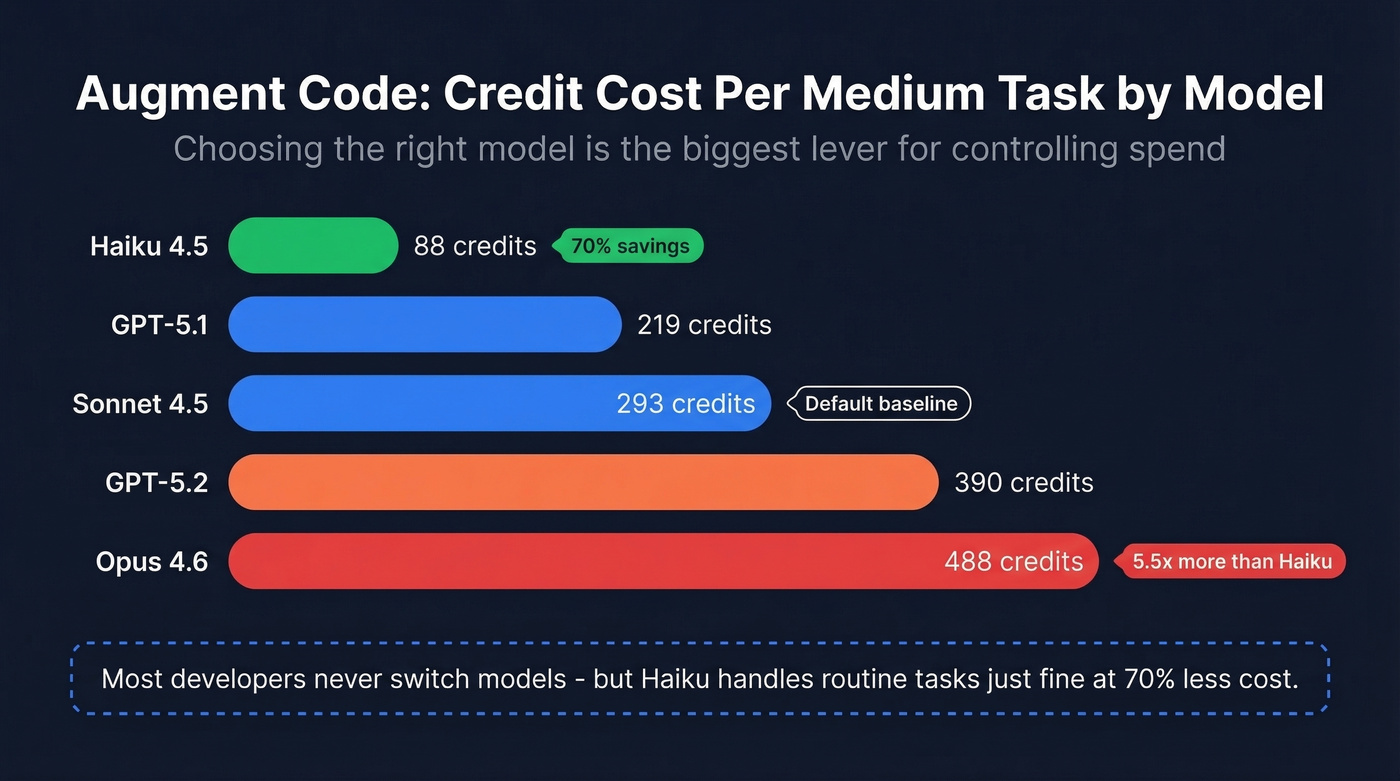
| Model | Credits (Medium Task) | Cost vs Sonnet 4.5 |
|---|---|---|
| Haiku 4.5 | 88 | 30% |
| GPT-5.1 | 219 | 75% |
| Sonnet 4.5 | 293 | Baseline |
| GPT-5.2 | 390 | 133% |
| Opus 4.6 | 488 | 167% |
Haiku 4.5 costs 70% less than Sonnet 4.5 and handles routine tasks fine. Augment should default to it. They don't. If you're not manually switching models for simpler tasks, you're lighting credits on fire.
In our testing, model selection is the single biggest lever for controlling spend - and most developers never touch it. Plan credits reset each billing cycle with no rollover. Purchased top-up credits stay valid for 12 months, which is the one saving grace if you want to stockpile during lighter months.

Credit systems that punish usage are a red flag - in dev tools and in B2B data. Prospeo charges ~$0.01 per verified email with 98% accuracy, no auto top-ups, and no contracts. 15,000+ companies trust it because the pricing is exactly what it looks like.
Stop paying for data anxiety. Pay for data that works.
Honest Pros and Cons
Pros:
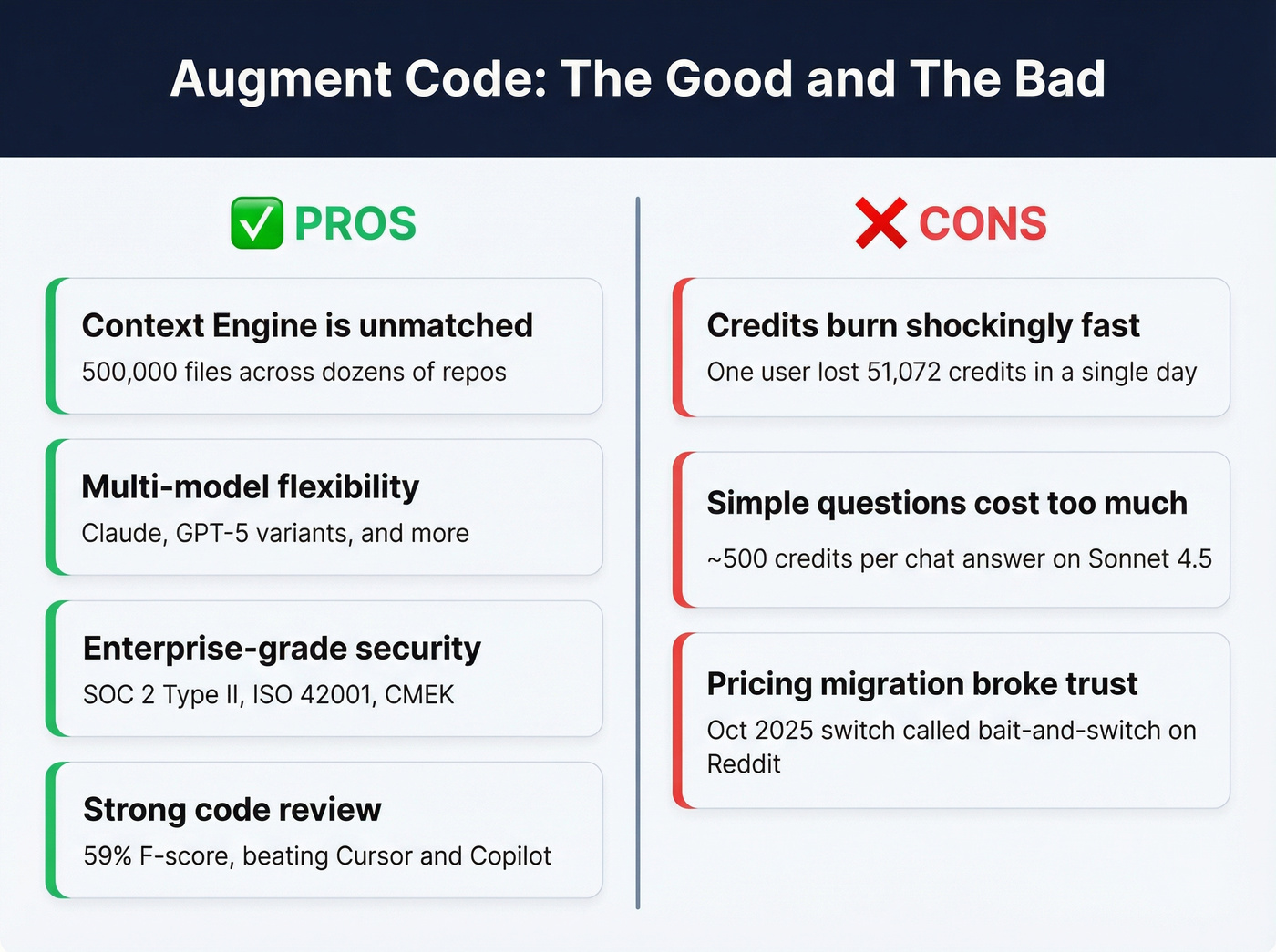
- Context Engine is unmatched. Indexes up to 500,000 files across dozens of repos. Cursor caps at roughly 50,000.
- Multi-model flexibility. Switch between Claude, GPT-5 variants, and others to optimize credit spend per task.
- Enterprise-grade security. SOC 2 Type II, ISO 42001, CMEK option. Paid plans exclude your data from AI training.
- Strong code review. Augment's published benchmark across 50 real-world PRs scored 59% F-score, ahead of Cursor Bugbot at 49%, CodeRabbit at 39%, and GitHub Copilot at 25%. Vendor-run, but the methodology and data are open-sourced.
Cons:
- Credits burn shockingly fast. One user reported 51,072 credits consumed in a single day and cancelled shortly after.
- Simple questions aren't cheap. A normal chat question on Sonnet 4.5 can cost ~500 credits per answer, which discourages the iteration that makes AI assistants valuable in the first place.
- Pricing migration damaged trust. The October 2025 switch from messages to credits hit legacy users hard. Dev Legacy at $30/month converted to just 56,000 credits while the $50 Dev plan got 96,000. Augment offered one month of free credits as a sweetener, but r/AugmentCodeAI threads still use "bait-and-switch."
What Users Say in Reviews
We've tracked the review landscape since the October 2025 pricing change, and the signals are polarized. G2 shows 2.8/5 from just 2 reviews - one furious 1-star about pricing, one glowing 5-star about workflow integration. Gartner Peer Insights shows 4.8/5 from 40 ratings.
The consistent thread everywhere: users love the context understanding. The #1 complaint is cost.
That's a product with a genuine technical edge undermined by a pricing model that feels adversarial. Let's be honest - when your users are afraid to ask questions because each one costs 500 credits, something's broken in the incentive structure.
How Augment Compares to Copilot and Cursor
| Feature | Augment | Copilot | Cursor |
|---|---|---|---|
| Free tier | 30K trial | $0 (50 req/mo) | $0 (Hobby) |
| Entry paid | $20/mo | $10/mo (Pro) | $20/mo (Pro) |
| Mid tier | $60/mo | $39/mo (Pro+) | $60/mo (Pro+) |
| Top tier | $200/mo | - | $200/mo (Ultra) |
| Context scale | 500K files | 64K tokens | ~50K files |
| Best for | Large codebases | Budget-conscious devs | Tab completion + ecosystem |
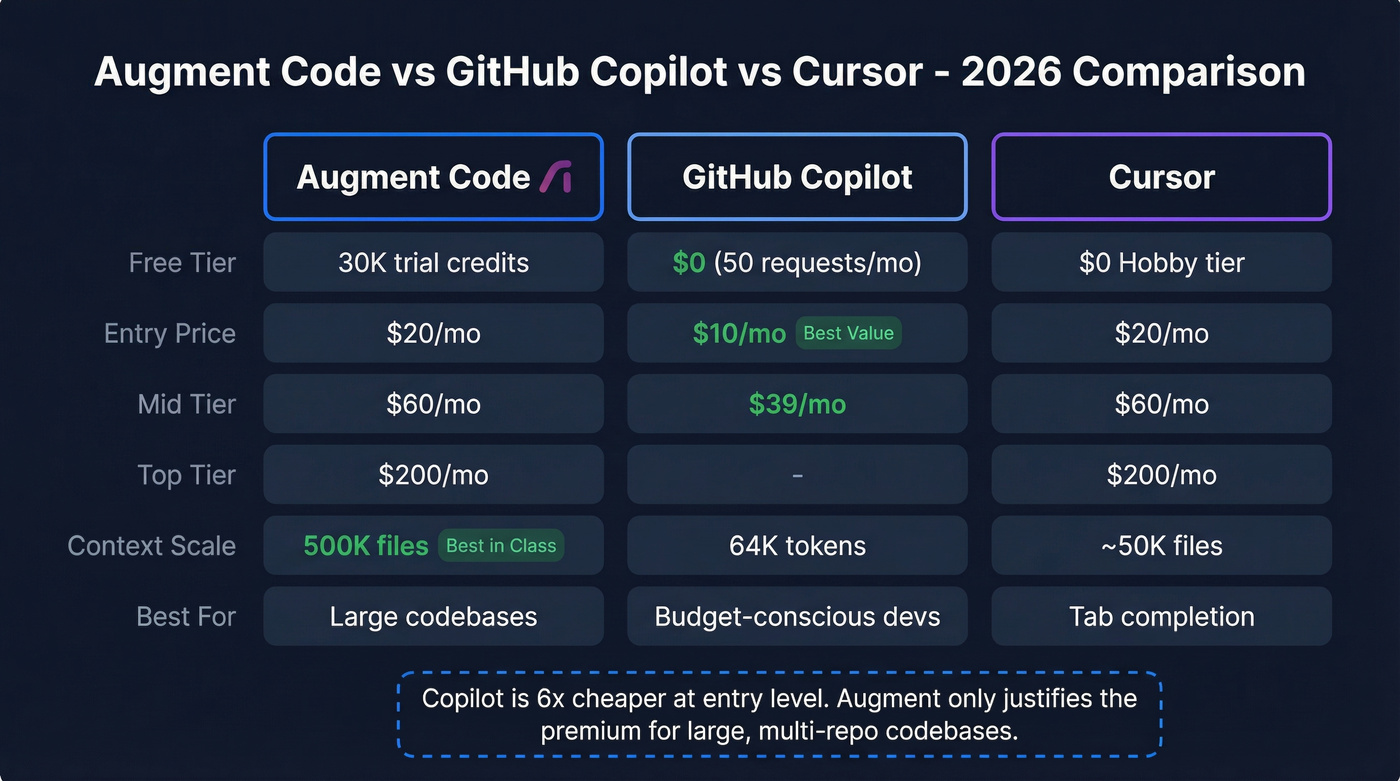
Augment and Cursor line up closely on individual tiers. Cursor also has a $40/user Teams plan. The bigger difference is Augment's context engine versus Cursor's broader ecosystem and tab-completion polish. Worth noting: Cursor faced its own pricing controversy in June 2025, making usage-based models a sore point across the entire category. One Reddit user said Augment was "following Cursor's footsteps."
Here's the thing: Copilot is 6x cheaper at entry level and good enough for most individual developers. If your codebase fits in 64K tokens of context, you probably don't need Augment-level tooling, and you're overpaying for capability you won't use.
The flat-rate alternative departing users keep recommending on r/AugmentCodeAI? Claude Code Max. No credits, no burn anxiety - just a monthly fee.
Who Should Buy (And Who Shouldn't)
Buy if you work across large or legacy codebases with dozens of repos, need enterprise compliance, and will actively manage model selection. Teams that treat model-switching as a habit rather than an afterthought get real value here.
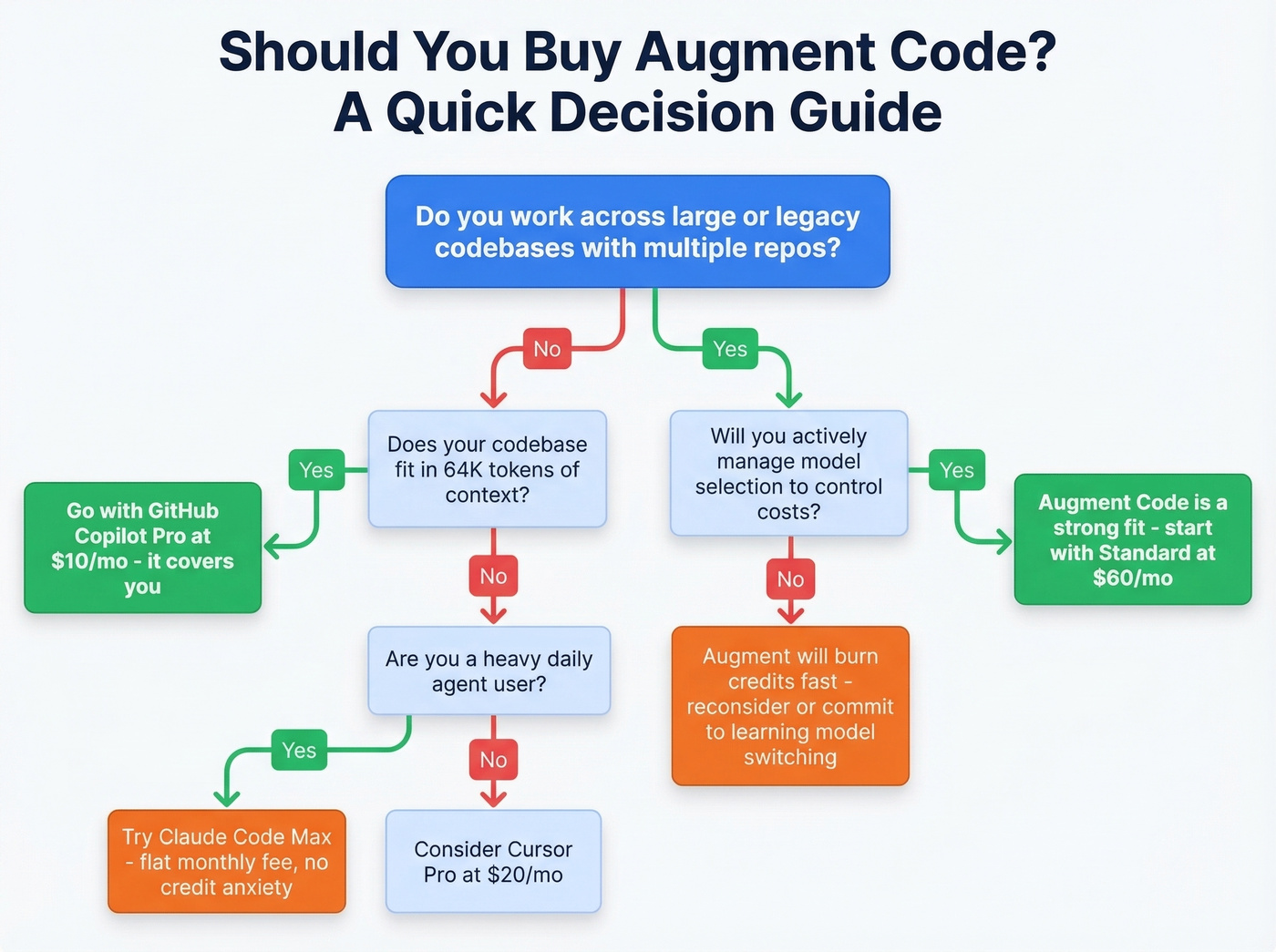
Skip if you're a budget-conscious solo dev - Copilot Pro at $10/month covers you. Also skip if you're a heavy daily agent user who won't optimize models; a flat monthly plan like Claude Code Max eliminates the anxiety entirely. And if the pricing history is a trust dealbreaker for you, that's a perfectly valid reason to walk away.

The same evaluation logic applies to any tool purchase in your stack - scrutinize credit systems, check real user feedback, and compare alternatives head-to-head. For sales teams evaluating B2B data providers with similar rigor, tools like Prospeo offer 98% verified emails and 125M+ mobile numbers with transparent, no-contract pricing and a free tier.
If you're building outbound alongside dev tooling decisions, it also helps to keep your sales prospecting techniques and lead generation workflow tight so spend stays predictable.
You just evaluated Augment's credit tiers, model costs, and hidden overages. Apply that same rigor to your sales stack. Prospeo delivers 143M+ verified emails and 125M+ mobile numbers on transparent per-credit pricing - with a free tier and zero annual lock-in.
Evaluate Prospeo the way you just evaluated Augment. The pricing holds up.
FAQ
Does Augment Code have a free plan?
New users get a 30,000-credit trial that requires a valid credit card. There's no permanent free tier - once trial credits are gone, you need a paid plan starting at $20/month on Indie.
Do Augment Code credits roll over?
No. Plan credits reset each billing cycle with zero rollover. Purchased top-up credits ($15 per 24,000) stay valid for 12 months, so stockpiling during light months is possible but only with extra spend.
Is Augment Code cheaper than Cursor?
Individual tiers are nearly identical - both offer $20, $60, and $200 plans. Cursor adds a $40/user Teams tier. The real cost difference comes from credit consumption patterns, not sticker price. Augment's context engine justifies the spend only for large, multi-repo codebases.
Why did Augment Code switch to credits?
One extreme user on the $250 Max plan was approaching $15,000/month in infrastructure cost to Augment. Credits cap per-user costs, but the change frustrated moderate users who felt penalized for someone else's heavy usage. The consensus on r/AugmentCodeAI is that the rollout was handled poorly, even if the underlying economics made sense.