

Average Cost Per Acquisition: 2026 Benchmarks, Formula & How to Lower Yours
Your CFO just asked what it costs to acquire a customer. You pulled three different numbers from three different dashboards, and none of them matched. The problem isn't your math - average cost per acquisition means different things depending on who's measuring it, what they're counting, and which channels they're including.
The quick version: B2B customer acquisition cost ranges from $86 in eCommerce to $1,143 in Education depending on industry, and CAC jumped 40-60% between 2023 and 2025 across 939 B2B companies. The fastest lever to bring yours down isn't ad optimization - it's fixing your data quality before you touch a single campaign setting.
What Is Cost Per Acquisition?
Cost per acquisition is simple math: total campaign spend / number of acquisitions. Where it gets messy is defining "acquisition."
CPA measures the cost of a specific campaign-level action - a signup, a demo request, a free trial start. It's not CAC (customer acquisition cost), which is the fully loaded cost to acquire a paying customer including sales salaries, tooling, and overhead. And it's not CPL (cost per lead), which only counts the initial capture.
CPL gets someone into your funnel. CPA measures a meaningful conversion. CAC tells you what a paying customer actually cost. Most benchmark data blends these terms, so watch what's being measured in any table you reference.
Benchmarks by Industry
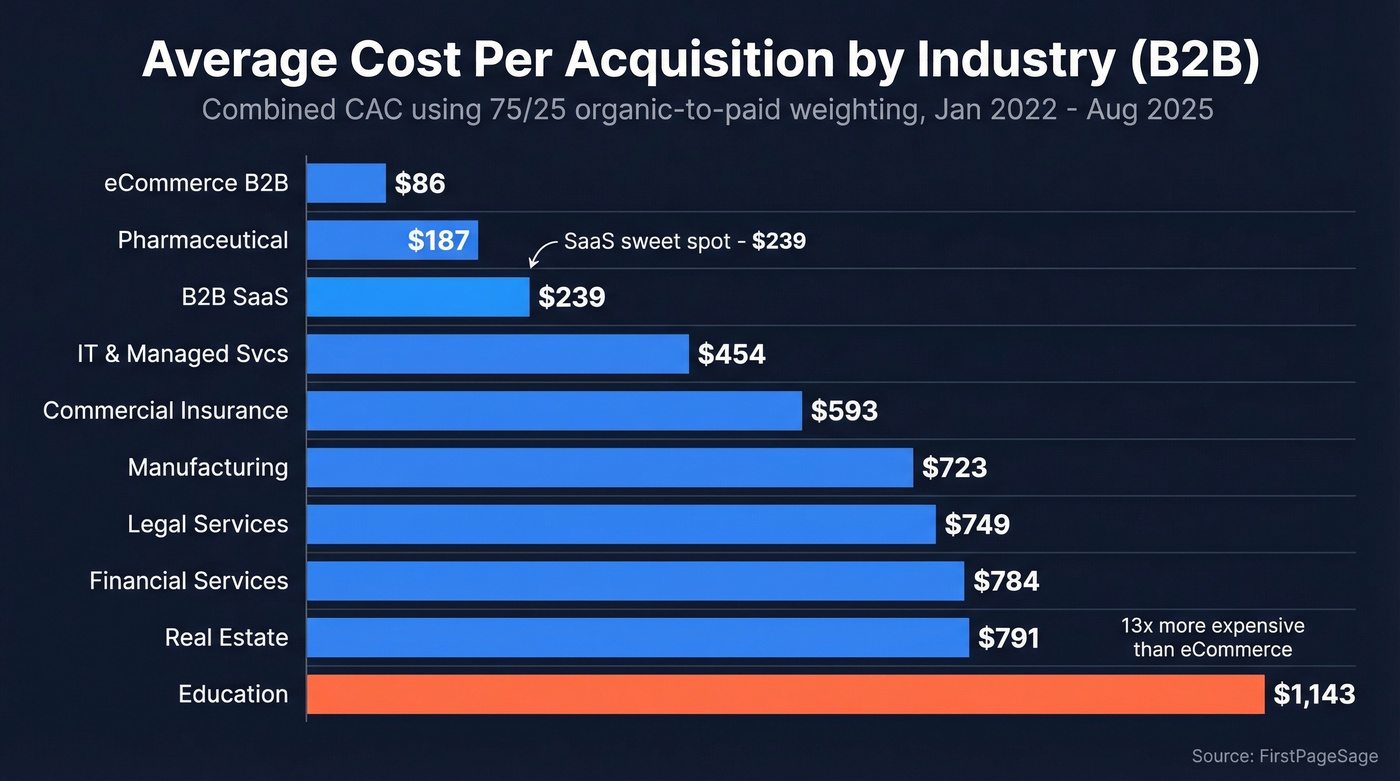
One of the most useful B2B datasets comes from FirstPageSage, covering client analytics from January 2022 through August 2025. Their combined CAC uses a 75/25 organic-to-inorganic weighting - if you're running mostly paid, your numbers will lean closer to the inorganic column.
| Industry | Organic CAC | Paid CAC | Combined CAC |
|---|---|---|---|
| B2B SaaS | $205 | $341 | $239 |
| eCommerce (B2B) | $87 | $81 | $86 |
| Pharmaceutical | $196 | $160 | $187 |
| IT & Managed Svcs | $325 | $840 | $454 |
| Commercial Insurance | $590 | $600 | $593 |
| Manufacturing | $662 | $905 | $723 |
| Legal Services | $584 | $1,245 | $749 |
| Financial Services | $644 | $1,202 | $784 |
| Real Estate | $660 | $1,185 | $791 |
| Education | $862 | $1,985 | $1,143 |
An eCommerce B2B company acquiring customers at $86 is playing a completely different game than an education company at $1,143. That's why "what's a good CPA?" is unanswerable without industry context.
B2B vs B2C Costs
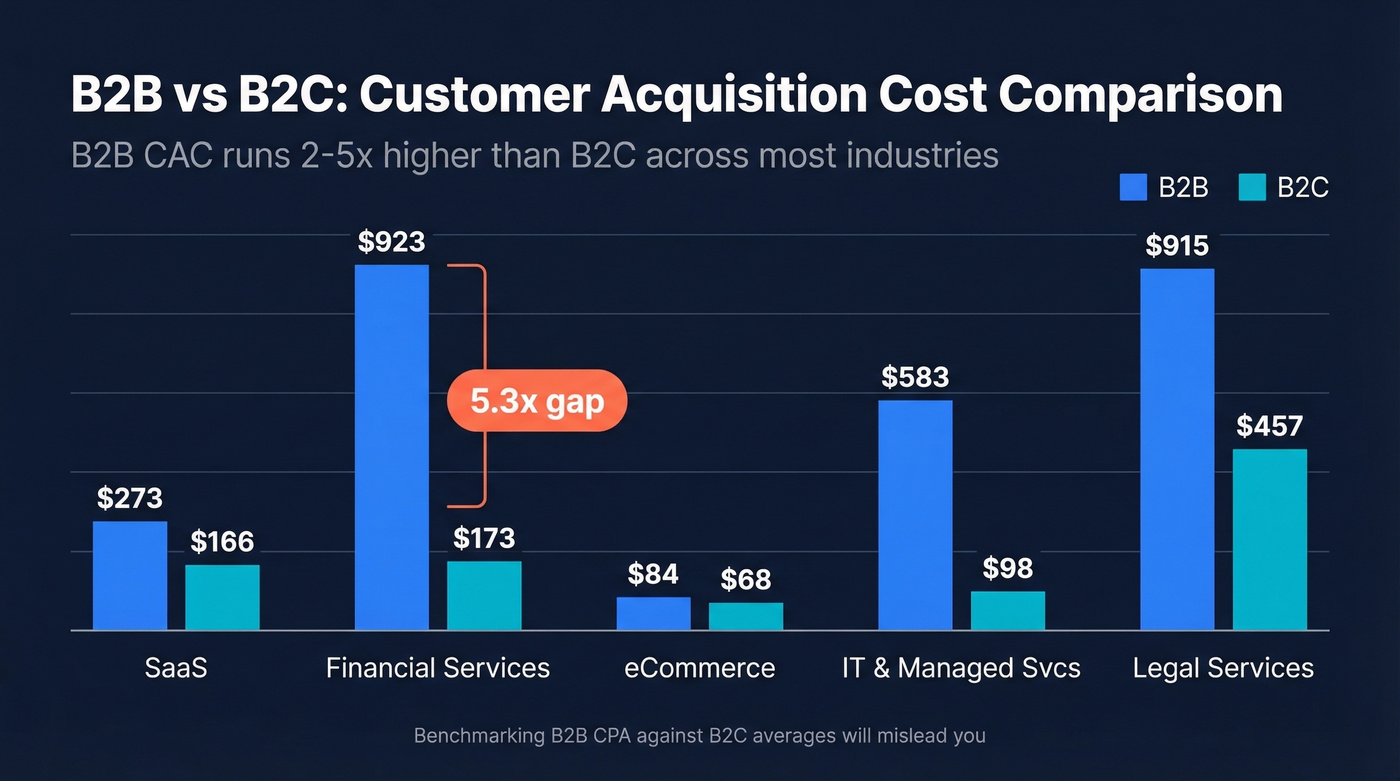
B2B CAC typically runs 2-5x higher than B2C, especially in sectors with long sales cycles and multi-stakeholder buying committees.
| Industry | B2B CAC | B2C CAC |
|---|---|---|
| SaaS | $273 | $166 |
| Financial Services | $923 | $173 |
| eCommerce | $84 | $68 |
| IT & Managed Svcs | $583 | $98 |
| Legal Services | $915 | $457 |
Financial services is the standout: $923 B2B versus $173 B2C - a 5.3x gap reflecting the reality of selling to institutional buyers with procurement layers, compliance reviews, and six-month evaluation cycles. If you're benchmarking your B2B CPA against B2C averages, you're setting yourself up for a panic that isn't warranted.

B2B acquisition costs jumped 40-60% since 2023. The fastest way to fight back isn't ad optimization - it's eliminating wasted spend on bad data. Prospeo's 98% verified emails and 7-day data refresh mean your outbound actually reaches real buyers, not dead inboxes inflating your CPA.
Stop paying $1,980 per acquisition when 35% of your emails bounce.
CPA by Marketing Channel
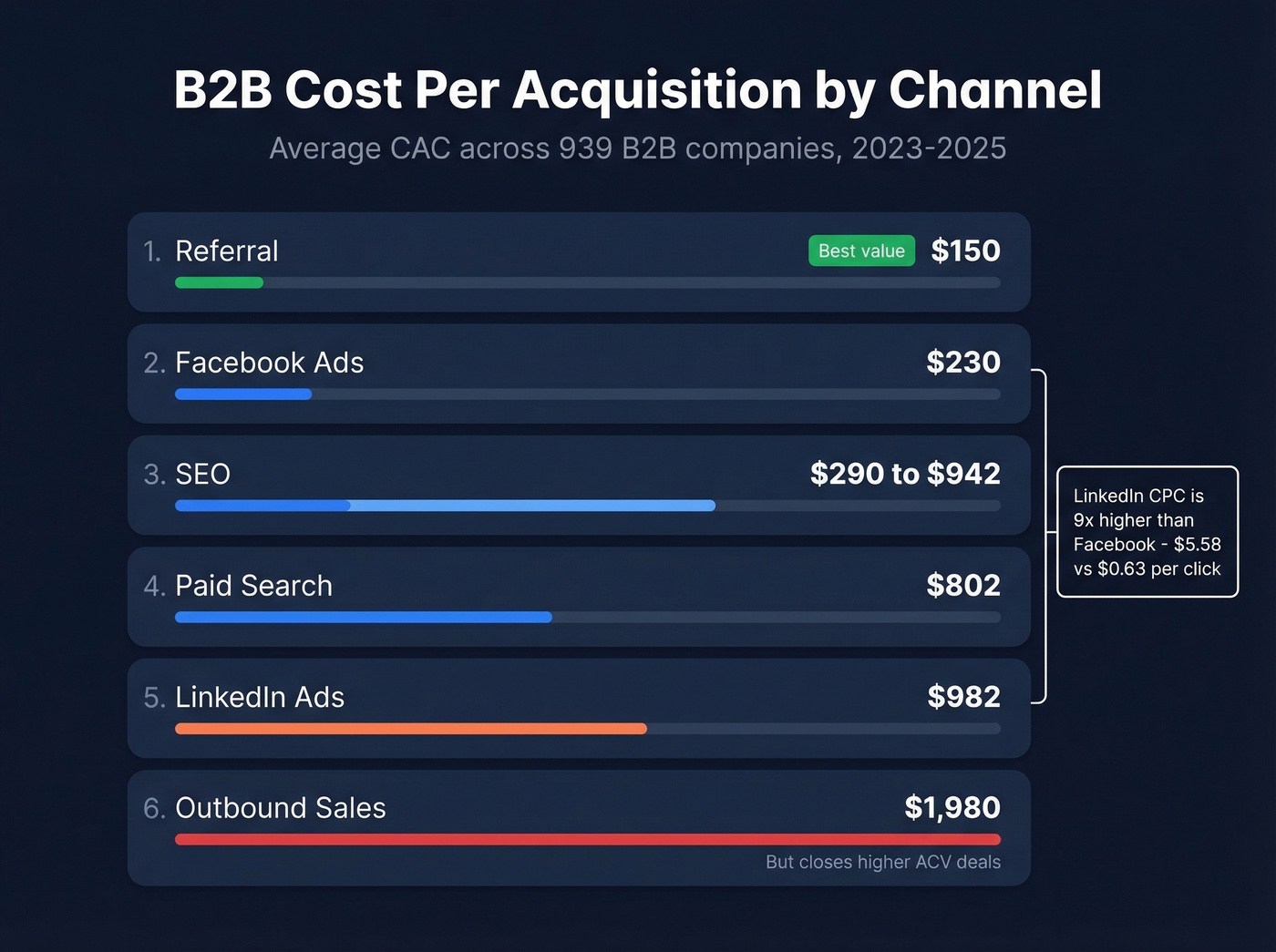
Channel costs vary by an order of magnitude. These B2B benchmarks come from Phoenix Strategy Group's analysis of 939 companies.
| Channel | Avg B2B CAC |
|---|---|
| Referral | $150 |
| Facebook Ads | $230 |
| SEO | $290-$942 |
| Paid Search | $802 |
| LinkedIn Ads | $982 |
| Outbound Sales | $1,980 |
Platform CPCs explain a lot of the spread. Google Search averages $2.69 per click, Facebook runs $0.63, and LinkedIn charges $5.58. When your cost-per-click is 9x higher on LinkedIn than Facebook, your CPA reflects that - even if LinkedIn's lead quality is better.
Outbound at $1,980 looks expensive on paper. But in our experience, outbound-sourced deals close at higher ACVs that justify the per-customer spend. A $1,980 CAC on a $50K deal is a very different story than a $230 Facebook CAC on a $500 self-serve signup.
What's a Good CPA Target?
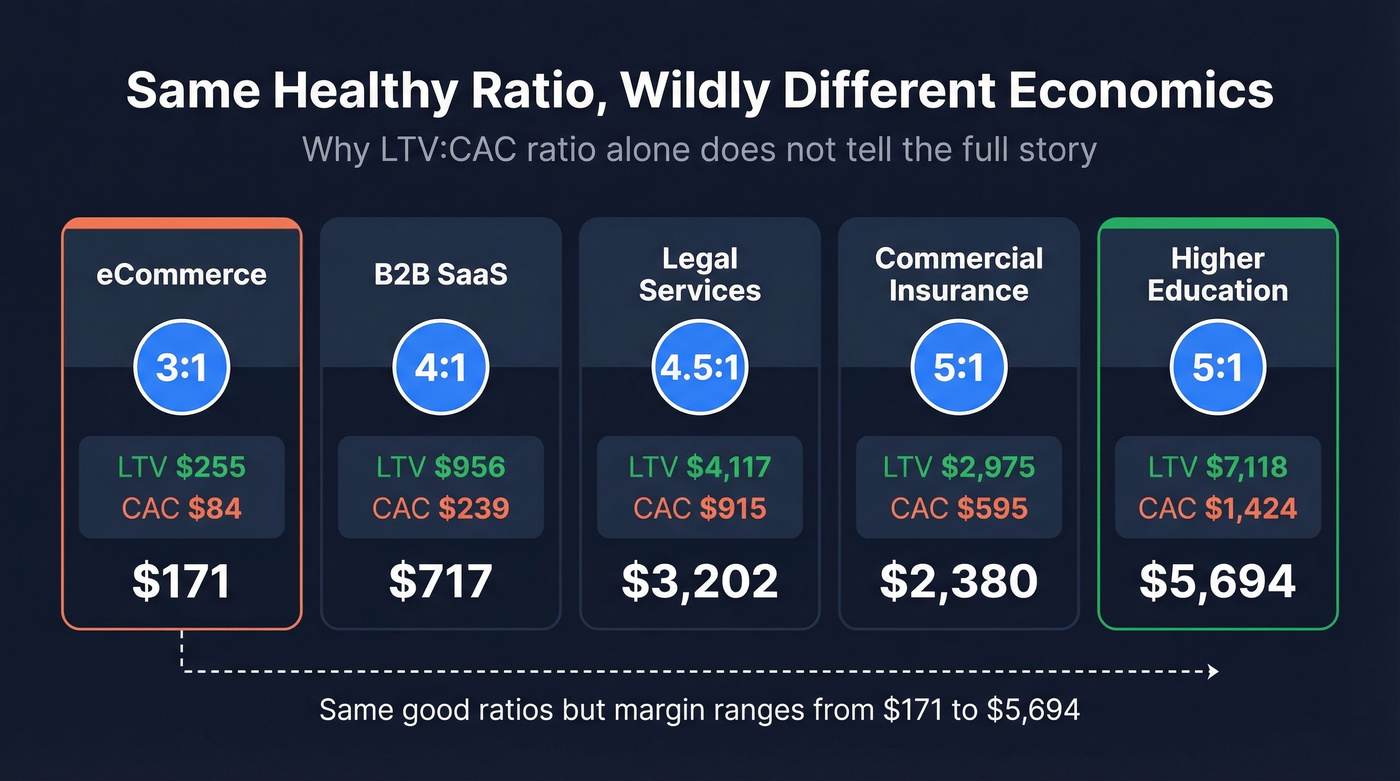
A good acquisition cost is one that makes money. The 3:1 LTV:CAC ratio gets thrown around as gospel, but let's be honest - it means wildly different things at different scales.
| Industry | LTV | CAC | Ratio |
|---|---|---|---|
| B2B SaaS | $956 | $239 | 4:1 |
| Commercial Insurance | $2,975 | $595 | 5:1 |
| eCommerce | $255 | $84 | 3:1 |
| Legal Services | $4,117 | $915 | 4.5:1 |
| Higher Education | $7,118 | $1,424 | 5:1 |
A 3:1 ratio at $255 LTV means you've got $171 of margin to work with. A 5:1 ratio at $7,118 LTV gives you $5,694. Same "healthy" ratio, wildly different economics. Measure your CPA against your own LTV, not against an industry average.
Watch the other direction too. A suspiciously low CPA often signals you're under-investing in growth and leaving revenue on the table. If your annual contract value is $50K and your CPA is $200, you're almost certainly not spending enough.
Why Costs Keep Rising
A ProfitWell study of 700 subscription businesses found CAC increased 60-75% between 2014 and 2019. More recently, Phoenix Strategy Group's data shows CAC jumped another 40-60% between 2023 and 2025 across 939 B2B companies.
Three forces are stacking up: more advertisers competing for the same inventory, privacy regulations fragmenting attribution, and CPCs increasing for 87% of industries in the latest WordStream analysis of 16,000+ campaigns. The consensus on r/ecommerce and r/PPC echoes the same theme - ad costs feel out of control, and the platforms keep finding new ways to extract budget.
One overlooked CPA inflator that drives us crazy: bad prospect data. When 20-35% of outbound emails bounce, every single send inflates your acquisition cost. We've watched teams pour money into sequences that were essentially shouting into a void of dead inboxes.
How to Reduce Your CPA
Fix your data first. This is the highest-leverage move most teams skip. If your outbound list has a 20-35% bounce rate, you're burning budget on emails that never arrive. We've seen teams cut effective CPA by 30-40% just by cleaning contact lists before launching. One company, Meritt, dropped their bounce rate from 35% to under 4% using Prospeo's real-time verification and tripled pipeline from $100K to $300K per week. Not an ad optimization - a data quality fix.

Tighten audience targeting. Broad targeting is the default CPA killer. Every impression served to someone outside your ICP is wasted spend. Use firmographic and intent filters to narrow before you scale.
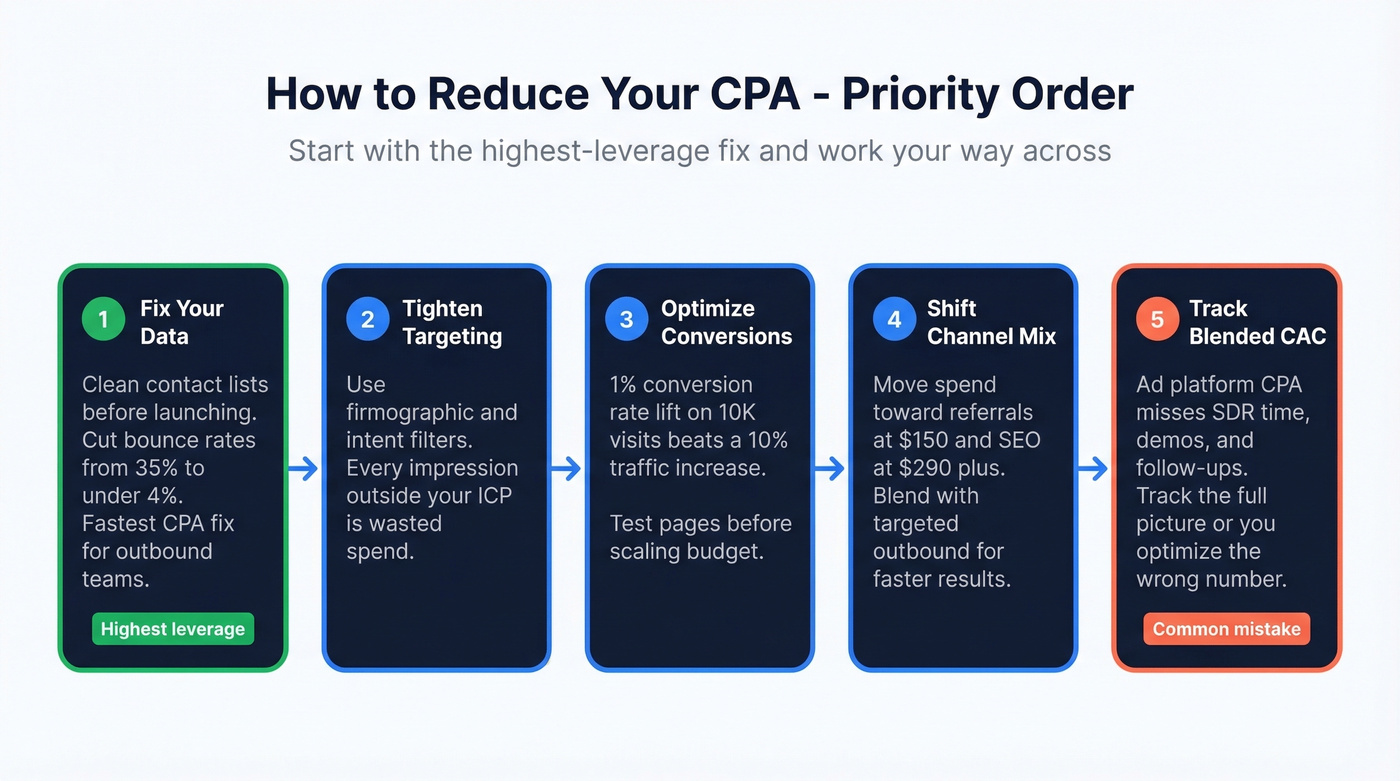
Optimize conversion rates, not traffic. A 1% conversion rate improvement on a page getting 10,000 visits per month beats a 10% traffic increase at the same conversion rate. Test landing pages before increasing ad budgets.
Shift spend toward lower-CAC channels. Referral programs at $150 CAC and SEO at $290+ are dramatically cheaper than paid search at $802. The payback period is longer, but the unit economics are better. For teams that can't wait 6-12 months for SEO to compound, blending referral programs with targeted outbound is a strong middle ground.
Track blended CAC, not ad-platform CPA. Your Google Ads dashboard doesn't show the SDR time, the sales engineer demo, or the three follow-up calls. Skip this metric in isolation - track the full picture or you'll optimize the wrong number.
Meritt dropped their bounce rate from 35% to under 4% and tripled pipeline to $300K/week - without changing a single ad campaign. When your contact data is 98% accurate at $0.01 per email, your effective CPA drops before you touch your ad budget.
Cut your cost per acquisition by fixing the data layer first.
FAQ
What's a good cost per acquisition for B2B SaaS?
The combined B2B SaaS CAC benchmark is $239, with a 4:1 LTV:CAC ratio ($956 LTV). "Good" depends on deal size - $239 is excellent at a $5,000 ACV and unsustainable at $400. Measure CPA against your own unit economics, not industry averages alone.
What's the difference between CPA and CAC?
CPA measures the cost of a specific campaign-level action like a signup or demo request. CAC measures the fully loaded cost to acquire a paying customer across your entire business - including sales salaries, tooling, and overhead. Most benchmarks blend the two, so always check what's being counted.
How does bad data increase acquisition costs?
Bounced emails and wrong phone numbers waste outbound budget on prospects who never see your message. If 30% of your list bounces, you're paying for 30% more sends with zero return. Real-time email verification eliminates that waste before sequences launch, which is why it's the single fastest CPA fix for outbound-heavy teams.
Can you lower CPA without cutting ad spend?
Yes. Improving landing page conversion rates by even 1% often outperforms a 10% traffic increase. Tightening ICP targeting, cleaning contact data, and shifting budget toward lower-CAC channels like referrals ($150 avg) or SEO ($290+) all reduce acquisition costs without reducing total investment.