

Average Email Bounce Rate: Real Benchmarks, Not Guesswork
Your last campaign bounced 6.2%. Your ESP fired off a warning. Now you're wondering whether that's normal or whether you're about to lose sending privileges.
The average email bounce rate across industries sits around 2.48%, based on WebFX's cross-industry benchmark table. Depending on the source and calculation method, you'll see numbers ranging from 0.19% in best-case industries up to 10.68% in broader roundup figures. The spread is wide, and methodology explains most of it.
The quick version: Under 2% is healthy. Between 2-5% needs attention. Above 5% is an emergency. The single highest-impact fix is verifying your list before every send.
What Counts as a Good Bounce Rate?
The formula: (bounced emails / sent emails) x 100 = bounce rate. But "good" depends on which type you're measuring.
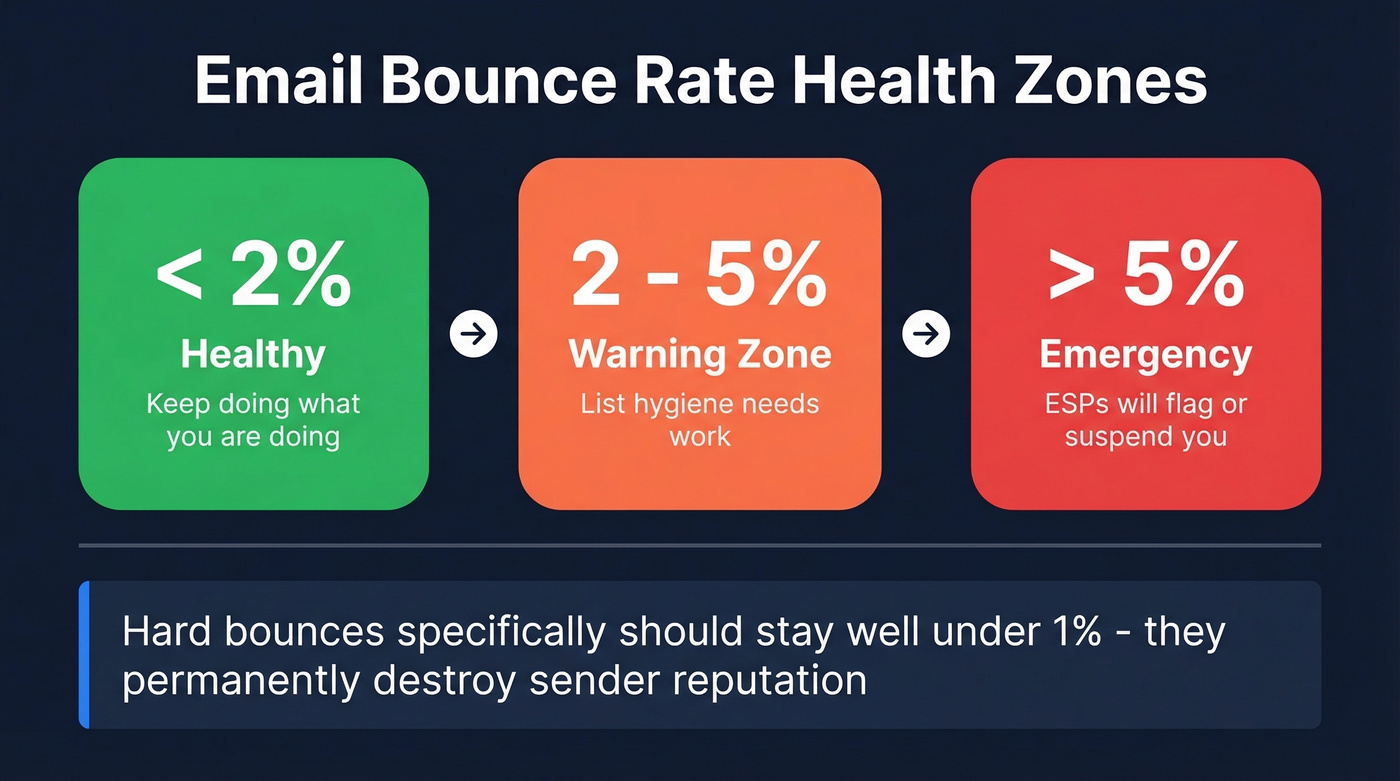
- Under 2% - Healthy. Keep doing what you're doing.
- 2-5% - Yellow zone. Your list hygiene needs work.
- Above 5% - Red zone. ESPs will flag you. Fix this before your next send.
Here's the thing: total bounce rate matters less than hard bounce rate. Hard bounces - permanent delivery failures - destroy your sender reputation. Keep hard bounces well under 1%, and never let them drift anywhere near 5%.
Soft bounces are temporary and less damaging, but they still count against you if they pile up. Whether you're measuring hard bounces, soft bounces, or both combined changes the answer to "what's acceptable" entirely.
Bounce Rate Benchmarks by Industry
Benchmarks vary by source. Here's a consolidated view from WebFX's cross-industry analysis:
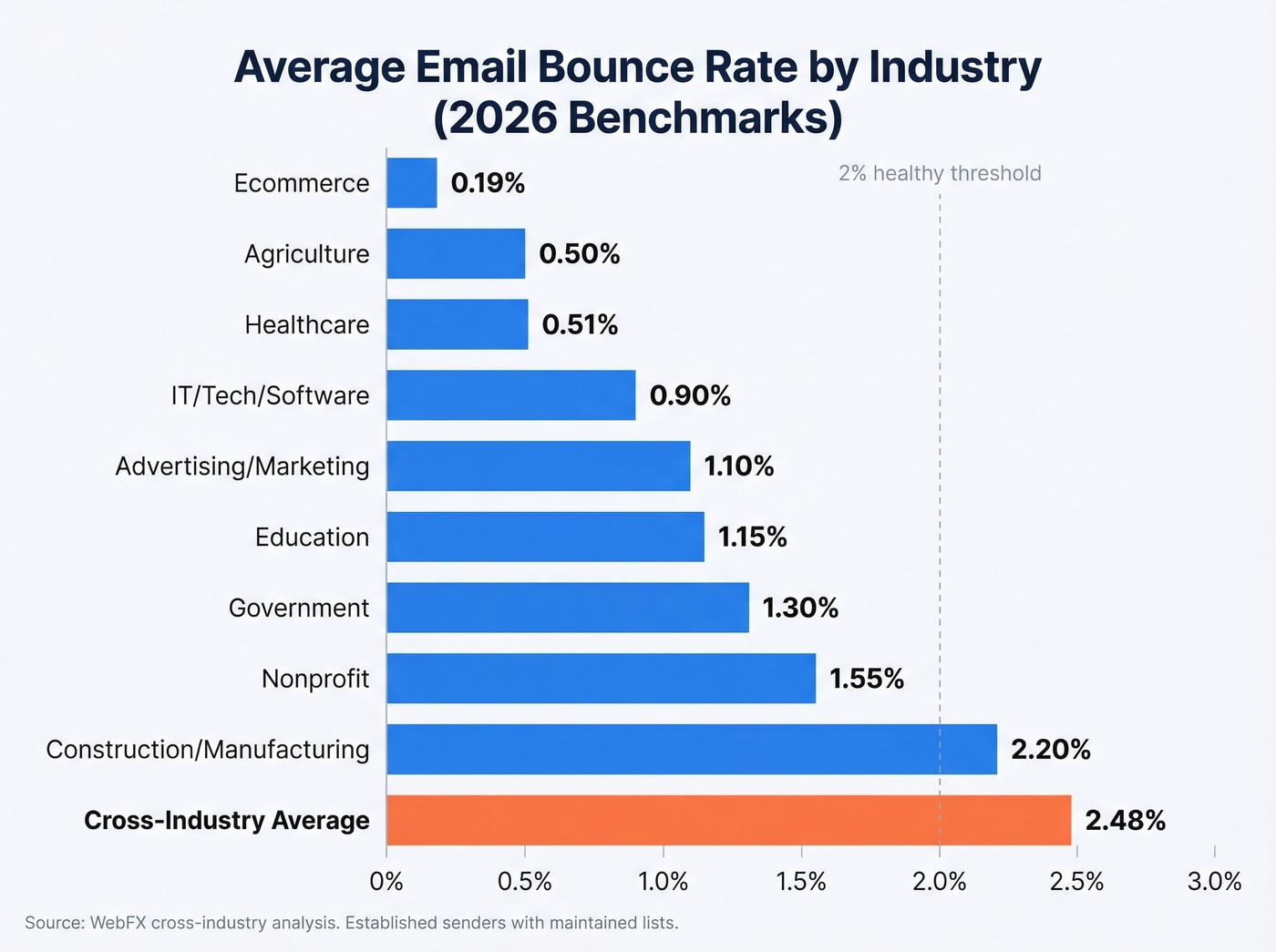
| Industry | Bounce Rate |
|---|---|
| Ecommerce | 0.19% |
| Agriculture | 0.50% |
| Healthcare | 0.51% |
| IT / Tech / Software | 0.90% |
| Advertising / Marketing | 1.10% |
| Education | 1.15% |
| Government | 1.30% |
| Nonprofit | 1.55% |
| Construction / Manufacturing | 2.20% |
| Cross-industry average | 2.48% |
These numbers skew low because they're drawn from established senders with maintained lists. If you're newer or running cold outreach, expect higher figures.
Why Benchmark Sources Disagree
The spread comes down to methodology.
Mailchimp's approach is transparent: it scanned billions of emails delivered through its system and calculated averages by industry, only including tracked campaigns sent to at least 1,000 subscribers. That data was last updated in December 2023. Some benchmark roundups show much higher cross-industry bounce rates - like 10.68% - because they include a broader mix of senders and list quality. That's why the numbers marketers see in their own dashboards often differ from published benchmarks.
For context, MailerLite's benchmark report covering December 2024 through November 2025 analyzed 3.6 million campaigns from 181,000 approved accounts and uses median values rather than means, which reduces outlier distortion. That report focuses on opens and clicks rather than bounce rates specifically, but it illustrates how much methodology shapes the final number.
The methodology is the benchmark. Always check what's behind the number.
Hard Bounces vs Soft Bounces
Hard bounces are permanent. The address doesn't exist, the domain is dead, or the server explicitly rejected your message. SMTP code 5xx signals a hard bounce - 550 typically means "invalid address." Remove these immediately.
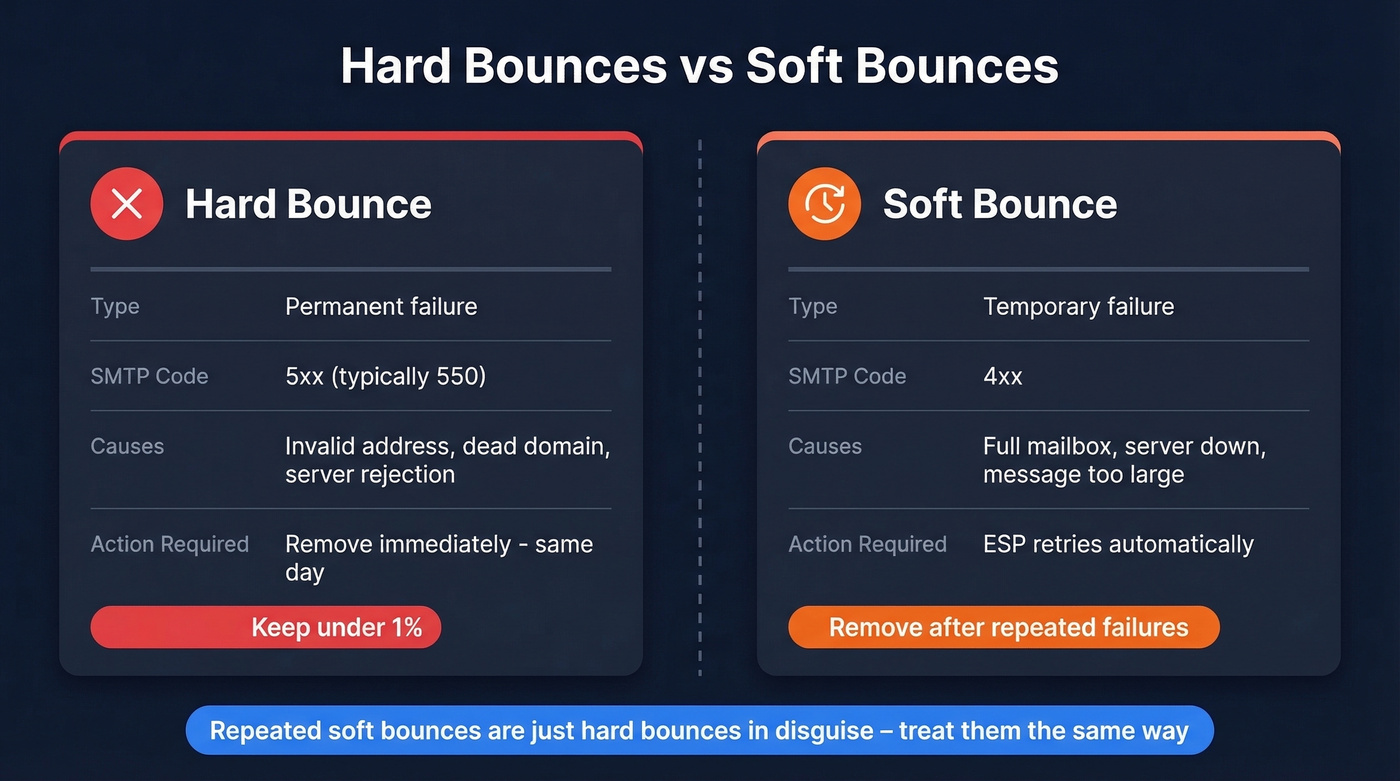
Soft bounces are temporary: full mailbox, server down, message too large. SMTP code 4xx covers these. Your ESP retries automatically. But if a contact keeps soft bouncing repeatedly, treat it as a hard bounce and remove it. Repeated soft bounces are just hard bounces in disguise.

Hard bounces destroy sender reputation. Prospeo's 5-step verification - with catch-all handling, spam-trap removal, and honeypot filtering - delivers 98% email accuracy. Teams using Prospeo cut bounce rates from 35%+ to under 4%.
Stop guessing which addresses are dead. Verify before you send.
Cold Email Bounce Rates
Cold outreach is a different animal entirely.
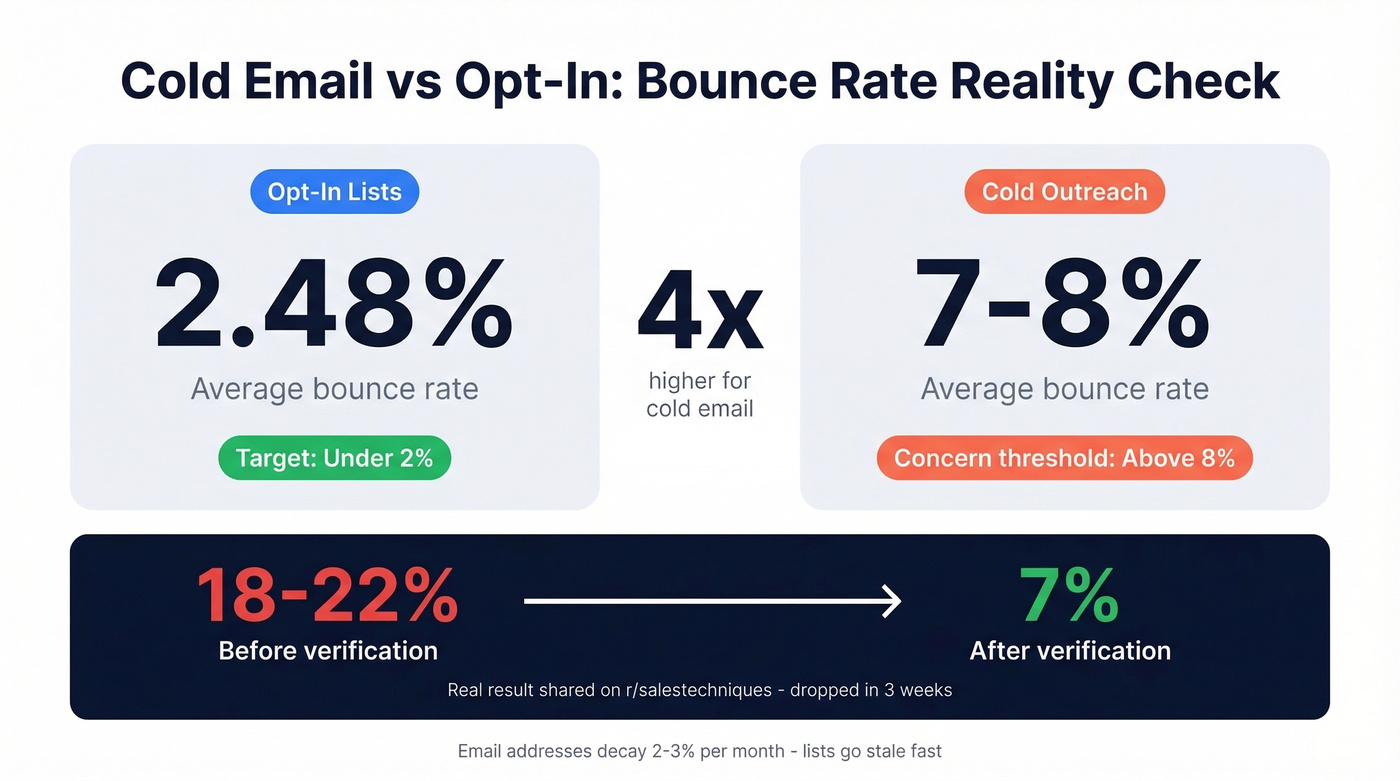
Cold emails average a 7-8% bounce rate - roughly 4x the opt-in benchmark. The "keep it under 2%" advice you see everywhere is calibrated for opt-in lists, so what's acceptable depends heavily on whether you're sending to subscribers or prospects. Cold emailers shouldn't panic at 5-6%, but anything above 8% means your data source is the problem, not your sending infrastructure. Email addresses decay 2-3% per month, so lists go stale fast.
One practitioner on r/salestechniques shared a telling case: they started at 18-22% bounce rates, implemented a verification workflow, and dropped to 7% within three weeks. Their call connect rate jumped from 12% to 19% as a downstream effect - cleaner data improved everything, not just email.
We've seen the same pattern across our own customer base. The core principle holds: tools with frequent data refresh keep verified contacts verified as people change jobs and domains expire.
What Happens When Bounces Spike
ESPs don't just warn you. They cut you off. Exceeding safe thresholds triggers automated enforcement systems that can shut down your campaigns mid-send.
HubSpot can suspend marketing email sending when its deliverability protection system detects 5% hard bounces, 0.1% spam reports, or 3% unsubscribes on a monthly basis. Google and Yahoo's sender requirements emphasize SPF/DKIM/DMARC authentication, spam complaints under 0.3%, one-click unsubscribe, and honoring unsubscribes within two days. For bulk senders pushing 5,000+ emails per day, DMARC isn't optional.
Hit these thresholds and your sending infrastructure goes dark - sometimes permanently for that domain. Most teams don't realize they've crossed the line until the suspension email lands.
How to Reduce Your Bounce Rate
Ranked by impact:
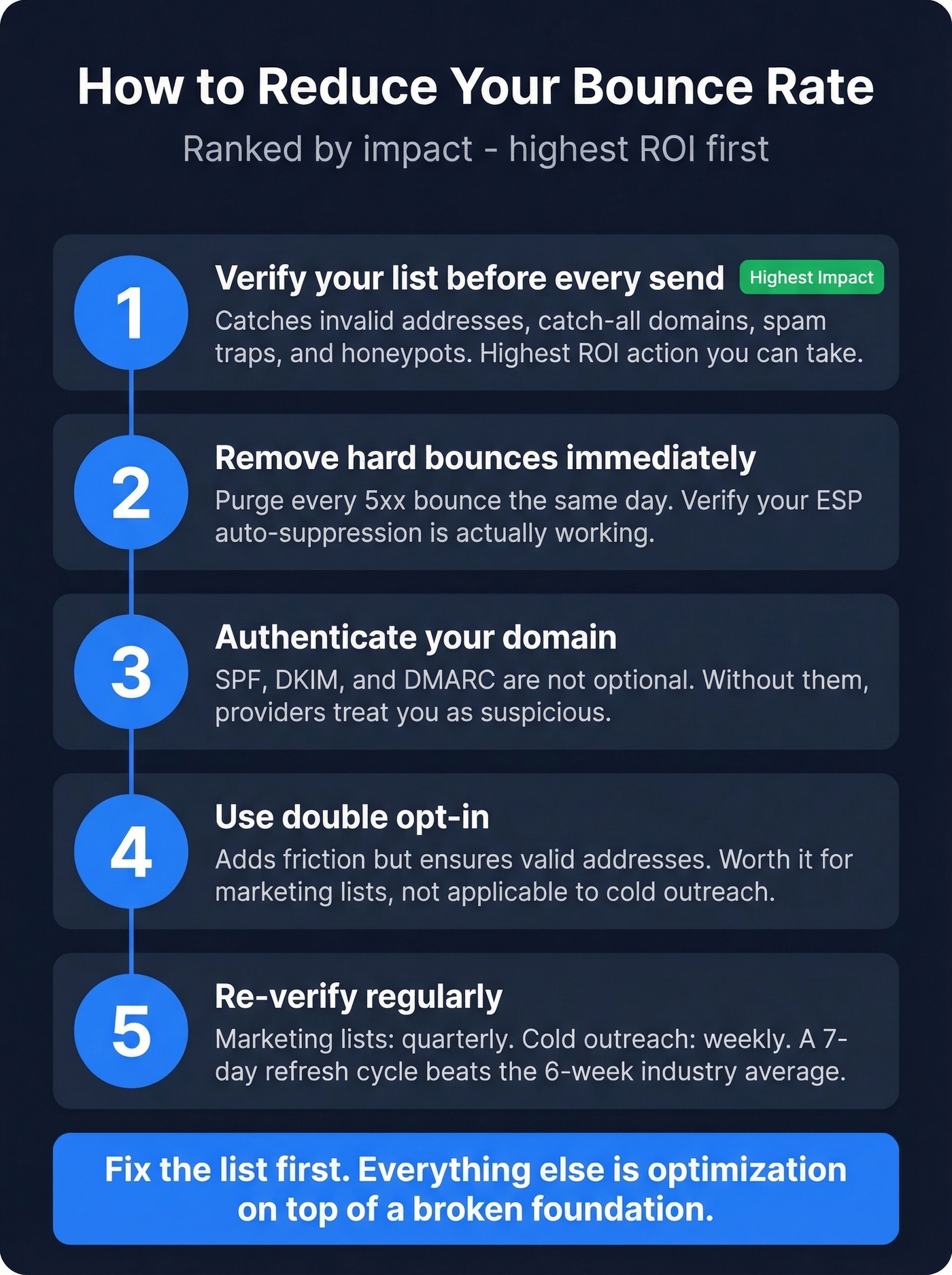
1. Verify your list before every send. This is the single highest-ROI action you can take. Prospeo's 5-step verification catches invalid addresses, catch-all domains, spam traps, and honeypots with 98% accuracy. Teams like Meritt and Snyk saw bounce rates drop from 35%+ to under 5% after switching to pre-send verification.

2. Remove hard bounces immediately. After every campaign, purge every 5xx bounce the same day. Most ESPs auto-suppress hard bounces, but verify this is actually happening in your settings.
3. Authenticate your domain. SPF, DKIM, and DMARC aren't optional anymore. Without them, inbox providers treat you as suspicious before they even look at your deliverability metrics. (If you need a quick check, start with DMARC and your SPF record.)
4. Use double opt-in. It adds friction. It also ensures the address is valid and the subscriber actually wants your emails. The tradeoff is worth it for marketing lists, though obviously it doesn't apply to cold outreach.
5. Re-verify regularly. For marketing lists, quarterly. For cold outreach, weekly. A 7-day data refresh cycle - versus the 6-week industry average - is the difference between maintaining healthy deliverability and drifting into double digits.
Let's be honest: most teams obsess over subject lines and send times while sitting on a list that's 15% dead addresses. Fix the list first. Everything else is optimization on top of a broken foundation.
Email addresses decay 2-3% per month. Most providers refresh every 6 weeks - by then, your list is already stale. Prospeo refreshes every 7 days, so the contacts you pull today are still valid next week.
Weekly data refresh is why Prospeo users stay under 2% bounce rates.
FAQ
What's a good email bounce rate?
Under 2% is healthy for opt-in campaigns. Between 2-5% needs list hygiene work. Above 5% is critical - most ESPs will flag or suspend your account. Hard bounces specifically should stay well under 1%.
Why is my cold email bounce rate so high?
Cold emails average 7-8% bounces because contact data decays 2-3% per month and recipients didn't opt in. Verify every address before sending and re-verify weekly. Data platforms with a 7-day refresh cycle keep lists current between sends.
Does email verification actually reduce bounces?
Yes - it's the single highest-impact fix for deliverability. Snyk cut bounce rates from 35-40% to under 5% after implementing pre-send verification with Prospeo. No amount of domain warming compensates for sending to addresses that don't exist.