

Average Sales Cycle Length: 2026 Benchmarks and How to Shorten It
An enterprise AE on r/sales put it perfectly: leadership told him cycles run 3-6 months, but in his territory, deals consistently take 9-12 months. That gap between what leadership says and what reps actually experience is the whole problem with "average sales cycle" as a metric. Most teams report a single number that hides more than it reveals.
This article gives you the real benchmarks, the formula that actually works, and five tactics with quantified impact - not generic advice like "qualify better."
The Quick Version
- The median B2B SaaS sales cycle is 84 days - but yours depends on ACV tier (14-30 days for SMB, 180+ for enterprise).
- Stop reporting a single average. Use median + P75 + P90 by segment. Your mean is lying to you.
- Three highest-impact tactics: multi-thread every deal (2.4x faster), use mutual action plans (-20-30% cycle time), send proposals within 24 hours of demos (35% faster close).
What Is Sales Cycle Length?
Average sales cycle length measures the number of days from first meaningful contact (or opportunity creation) to closed-won, averaged across won deals. The formula:
Sales cycle length = (sum of days-to-close for each closed-won deal) / (number of closed-won deals).
Forecasting accuracy, headcount planning, and coaching all depend on knowing how long deals actually take. But here's a threshold most teams don't track: opportunities closed within 50 days carry a 47% win rate, while deals that drag past that mark drop to roughly 20%. Every extra week in your pipeline isn't just slow - it's actively killing conversion.
That's why cycle length tracking should be a core part of your revenue operations cadence, not a quarterly afterthought.
2026 Benchmarks by ACV and Industry
The median B2B SaaS sales cycle is 84 days, based on a dataset of 939 SaaS companies. Digital Bloom's aggregation of 40+ benchmark studies landed on the same 84-day median and identified an "optimal" range of 46-75 days.
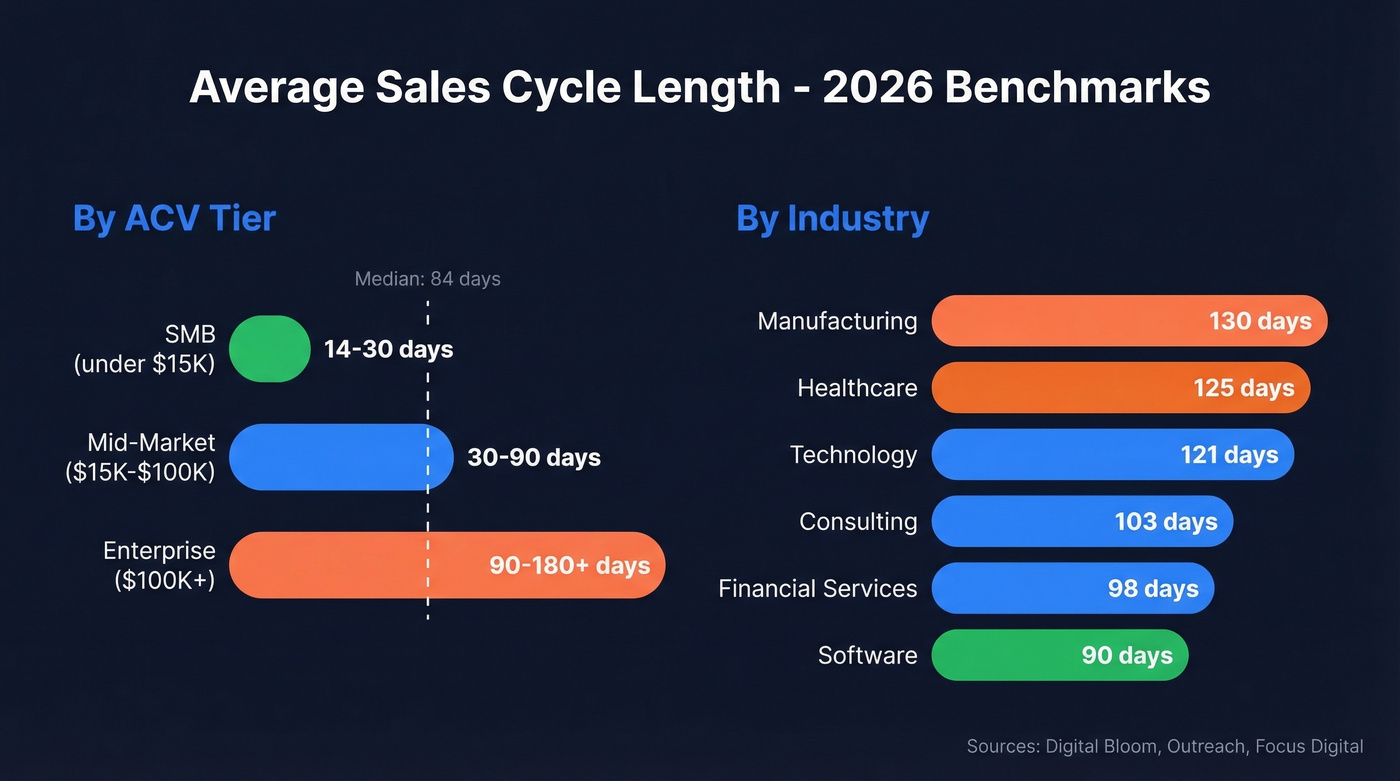
A single median across all deal sizes is almost useless for planning, though. Here's what the data looks like segmented by ACV:
| Segment | ACV Range | Typical Cycle Length |
|---|---|---|
| SMB | < $15K | 14-30 days |
| Mid-Market | $15K-$100K | 30-90 days |
| Enterprise | > $100K | 90-180+ days |
34% of revenue teams report a cycle of 1-2 full quarters, making that the most common time frame across the Outreach dataset. If your mid-market deals consistently close in under 60 days, you're outperforming most peers. Enterprise deals stretching past 180 days? Not unusual - but there's room to improve.
Outside SaaS, cycle length varies significantly by industry. Here are 2026 benchmarks from Focus Digital:
- Software: 90 days
- Manufacturing: 130 days
- Healthcare: 125 days
- Consulting: 103 days
- Technology: 121 days
- Financial Services: 98 days
Don't benchmark your motion against a company selling into a totally different buying environment. Use benchmarks relevant to your industry and deal size, or you're just generating noise.

Deals with 3+ engaged contacts close 2.4x faster - but only if you can actually reach them. Prospeo gives you verified emails (98% accuracy) and direct dials (125M+ mobiles) for every stakeholder on the buying committee. Map the full 6.8-person committee in minutes, not days.
Stop losing weeks hunting for contact data that should take seconds.
Why Cycles Keep Getting Longer
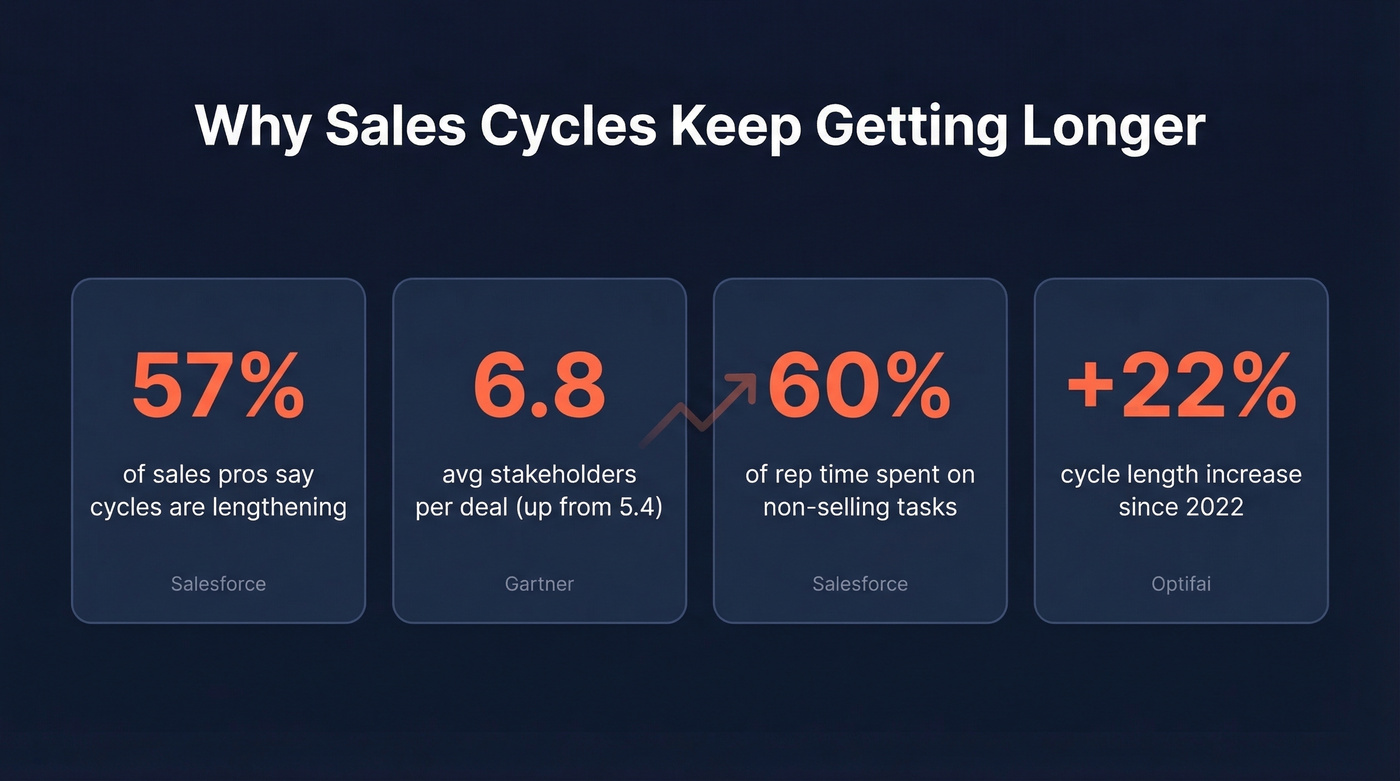
Three independent sources confirm the trend. 57% of sales professionals say cycles are lengthening per Salesforce's State of Sales report. A RAIN Group study found 43% of sales leaders report increases, while only 16% say cycles have shortened. And Optifai's dataset shows cycles have grown 22% since 2022.
The Kondo benchmark report puts it in starker terms: the average B2B sales cycle hit 6.5 months in 2023, up from 4.9 months in 2019.
The root causes aren't mysterious. The average B2B deal now involves 6.8 stakeholders, up from 5.4 in 2020 - and some reports cite even higher numbers for enterprise buying committees. Security and vendor risk assessments add 2-4 weeks to the typical cycle. Reps spend 60% of their time on non-selling tasks - admin, data entry, internal meetings - which means deals sit idle while sellers do everything except sell.
Your Single-Number Average Is Lying
Let's be honest: if you're reporting a single mean, you're overstating your cycle length and making bad forecasting decisions because of it.
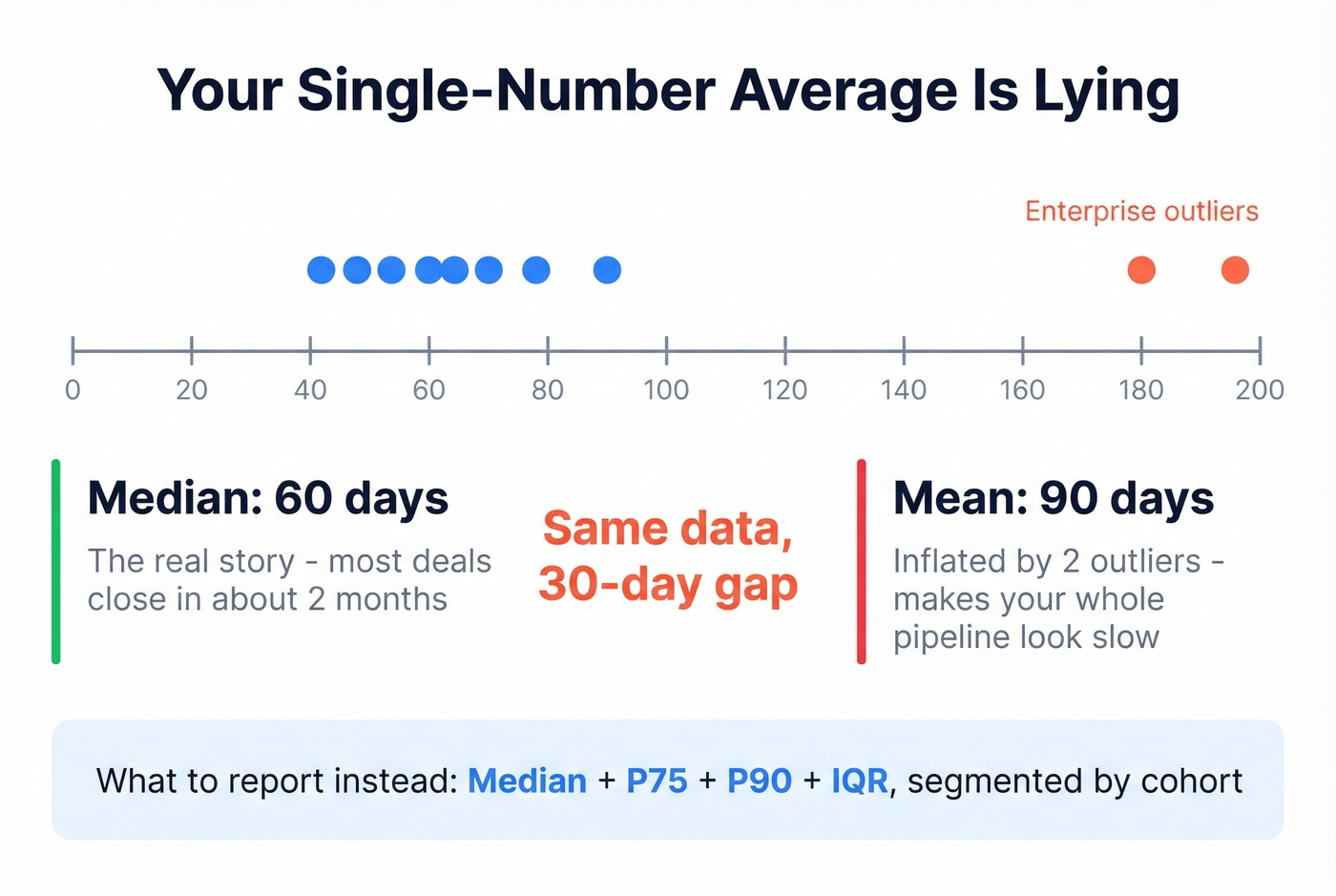
Imagine 10 closed deals. Eight close between 40 and 80 days, but two enterprise outliers take 180+ days each. Your median is 60 days. Your mean is 90 days. Same data, wildly different stories - and the mean makes your entire pipeline look slower than it actually is.
The Umbrex framework recommends reporting median + P75 + P90 + interquartile range instead of a single number. Cohort by opportunity entry date, and exclude in-flight deals entirely - they create right-censoring bias that inflates your averages. Then run a stage-history analysis: compute days-in-stage for each pipeline phase to find where deals actually stall.
Here's the finding that should change how you think about this: HockeyStack analyzed 54 B2B SaaS companies and found deal size explains only 26.8% of cycle length variance (R-squared = 0.268). Process complexity and stakeholder count matter far more than the dollar amount on the contract. Teams that obsess over ACV-based benchmarks while ignoring their internal bottlenecks are optimizing the wrong variable.
Where Time Actually Accumulates
We've seen teams run pipeline reviews focused on total cycle length when the real problem is a single stage eating 40% of the timeline. Here's the stage-level breakdown from Optifai's CRM timestamp analysis:
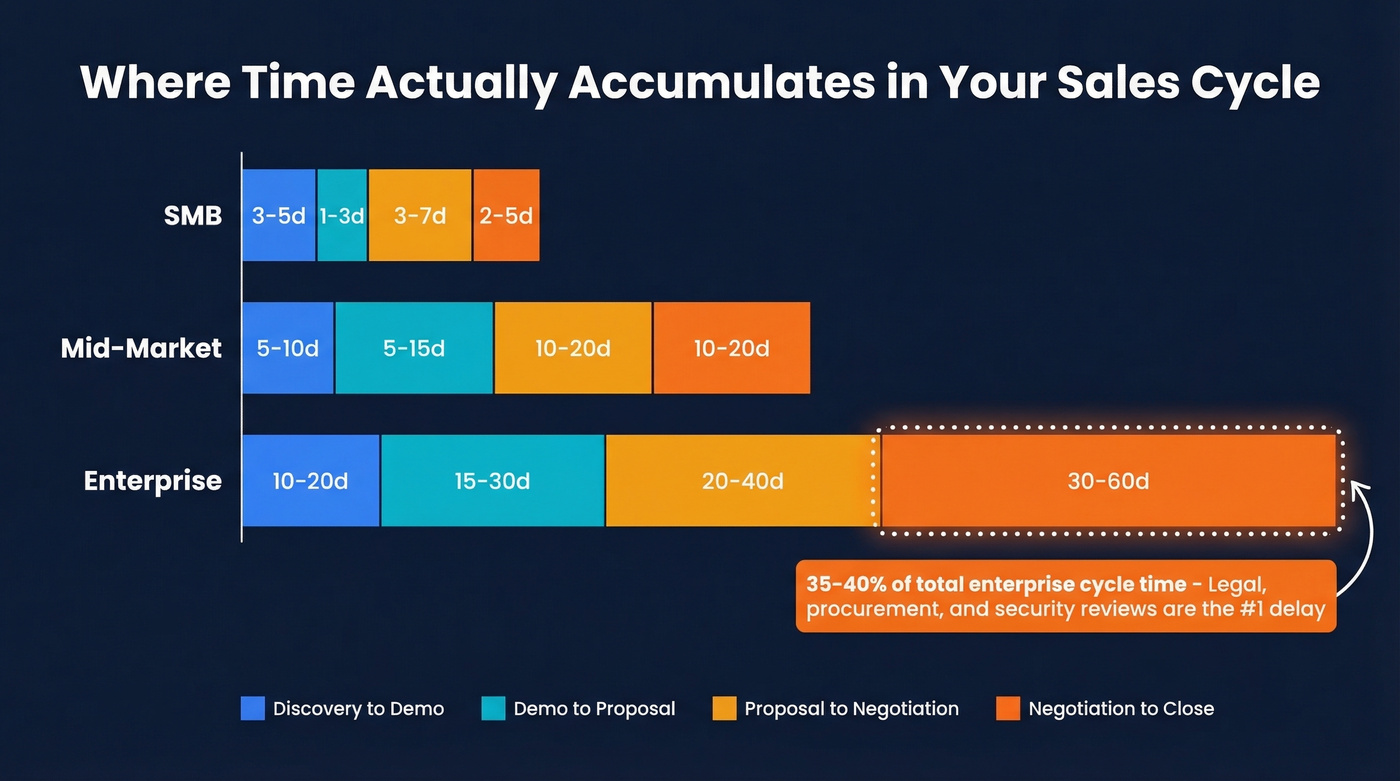
| Stage | SMB | Mid-Market | Enterprise |
|---|---|---|---|
| Discovery to Demo | 3-5 days | 5-10 days | 10-20 days |
| Demo to Proposal | 1-3 days | 5-15 days | 15-30 days |
| Proposal to Negotiation | 3-7 days | 10-20 days | 20-40 days |
| Negotiation to Close | 2-5 days | 10-20 days | 30-60 days |
Negotiation to Close accounts for 35-40% of total enterprise cycle time. Legal review, procurement workflows, and security questionnaires are the #1 delay - not discovery, not demos.
If you're trying to compress your enterprise timeline, start at the end of the pipeline, not the beginning. Getting mutual NDAs and security documentation ready before the negotiation stage even begins can shave weeks off this phase.
Here's our hot take: Most sales leaders pour coaching hours into discovery and demo skills. That's fine for win rates, but it barely moves cycle length. The biggest time savings come from the unglamorous work - pre-staging legal docs, pre-filling security questionnaires, and having procurement contacts mapped before you ever send a proposal. If your deals take too long, your problem is probably legal, not sales.
How to Shorten Your Average Sales Cycle
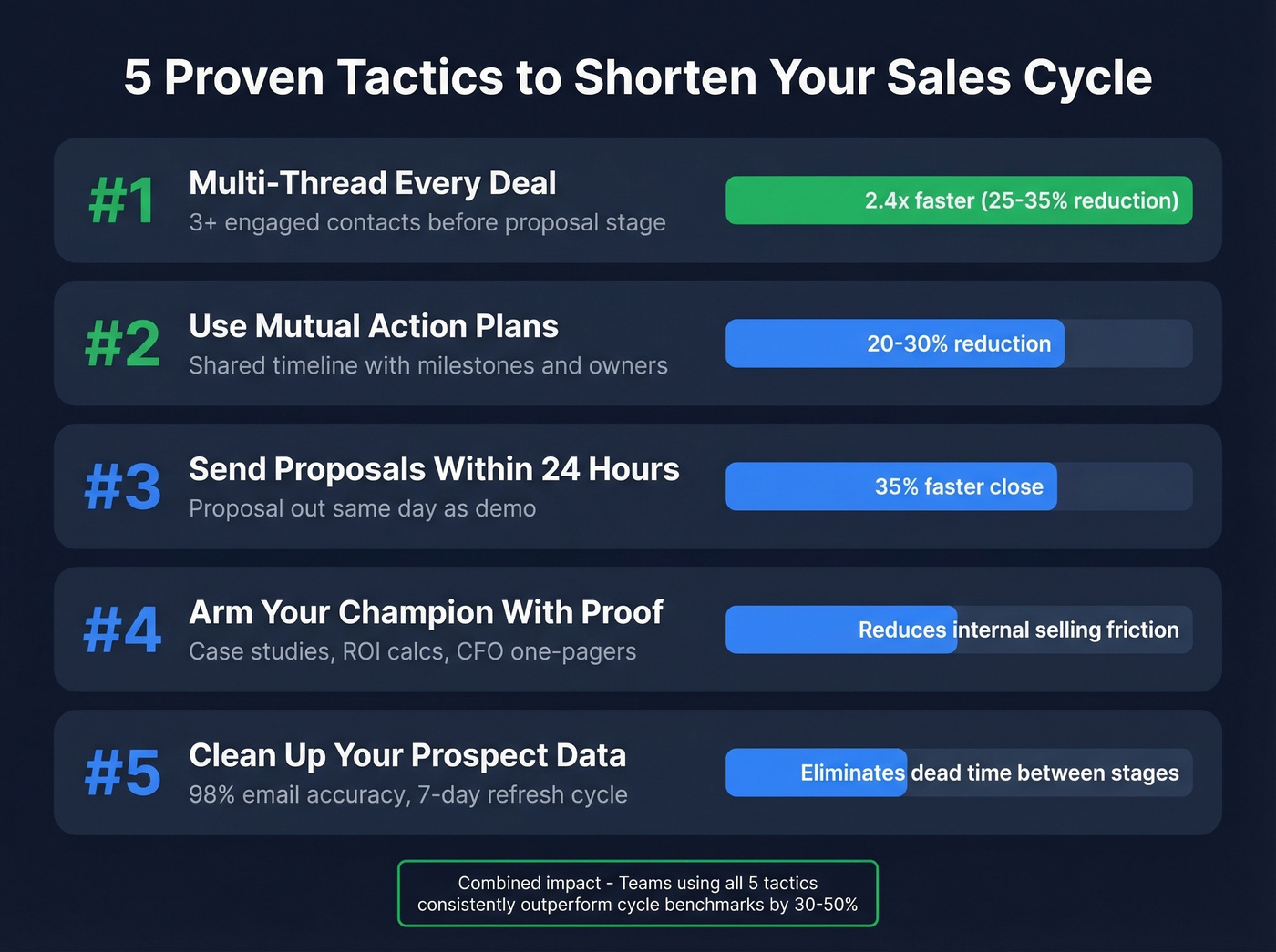
Generic advice is useless without numbers. Here are five tactics with quantified impact, ranked by how much time they actually save.
1. Multi-Thread Every Deal
Deals with three or more engaged contacts close 2.4x faster, with cycle-time reductions of 25-35%. Single-threaded deals die in procurement because your one champion goes on vacation, changes roles, or loses internal momentum. Get at least three contacts engaged before you hit the proposal stage. This is the single highest-leverage move you can make.
2. Use Mutual Action Plans
Shared timelines with clear milestones and owner assignments reduce cycle time by 20-30%. The plan doesn't need to be complex - a shared doc with dates, deliverables, and named stakeholders on both sides is enough. The act of co-creating the timeline creates commitment. It also gives you a non-awkward reason to follow up: "Hey, we're two days past the security review milestone - what's blocking it?"
3. Send Proposals Within 24 Hours
Deals where proposals go out within a day of the demo close 35% faster. Every day of delay is a day for momentum to die, for competitors to get a meeting, and for your champion's enthusiasm to cool. We've run bake-offs where the fastest proposal sender won deals against objectively better products - simply because they kept the energy alive.
4. Arm Your Champion With Proof
Internal selling friction is the hidden cycle killer. Your champion has to sell your solution to 5-6 other stakeholders who never attended your demo. Give them ammunition: case studies specific to their industry, ROI calculators pre-filled with their numbers, and one-page summaries designed for CFO-level skim reading. Every piece of proof you provide is a meeting your champion doesn't have to schedule to build consensus.
Skip this if you're selling sub-$5K deals with a single decision-maker. For anything with a buying committee, it's non-negotiable.
5. Clean Up Your Prospect Data
Every bounced email is a follow-up that never happened. Every dead phone number is a conversation that didn't occur. Those invisible gaps add days - sometimes weeks - to your cycle because reps are chasing contacts who'll never receive the outreach.
Prospeo eliminates that dead time with 98% email accuracy and a 7-day data refresh cycle, so reps reach real people on the first attempt. Meritt tripled their pipeline from $100K to $300K/week after switching - bounce rate dropped from 35% to under 4%, directly compressing their outreach-to-meeting timeline.

Your reps spend 60% of their time on non-selling tasks - and stale contact data makes it worse. Prospeo's 7-day refresh cycle means every email and phone number is current, so reps connect on the first attempt instead of chasing bounces. At $0.01 per email, compressing your sales cycle has never been cheaper.
Cut the dead time between stages with data that actually connects.
FAQ
How do you calculate sales cycle length?
Sum the number of days from first contact (or opportunity creation) to close for all won deals, then divide by the number of won deals. The mean gets skewed by outliers, so use median instead - and report median + P75 + P90 by segment for accurate forecasting. Geckoboard's KPI guide walks through the standard calculation.
What's a good cycle length for B2B SaaS?
The median across 939 SaaS companies is 84 days, with an optimal range of 46-75 days. For SMB deals under $15K ACV, aim for 14-30 days. Mid-market should target 30-90 days. Enterprise deals over $100K routinely run 90-180+ days. Compare against benchmarks for your specific ACV tier, not a single industry-wide figure.
Why is my sales cycle getting longer?
More stakeholders per deal (6.8 today vs 5.4 in 2020), added security and compliance reviews that tack on 2-4 weeks, and reps spending 60% of their time on non-selling tasks. Bad contact data compounds the problem - reps waste days chasing bounced emails and disconnected numbers. Fixing data quality with tools like Prospeo alongside mutual action plans addresses both the outreach gap and the internal coordination drag simultaneously.