

B2B APIs: Types, Integration & Data Enrichment Guide (2026)
B2B contact data decays at roughly 2.1% per month. That's a quarter of your database going stale every year. The APIs connecting your systems to partners, vendors, and data providers aren't just plumbing - they're the difference between a pipeline that converts and one that quietly rots.
What Are B2B APIs?
A B2B API is any application programming interface that connects systems across separate organizations. Not internal microservices talking to each other, but your company's software exchanging data with a partner's, a vendor's, or a customer's systems. That cross-organizational boundary is what makes them distinct: authentication is stricter, compliance requirements are heavier, and data format standardization matters far more than it does for internal service calls.
The term covers a wide range of technology. Product integrations where a SaaS platform exposes an API so customers can connect it to their CRM. Partner integrations where two businesses exchange purchase orders, invoices, or enrichment data through APIs, EDI, or flat files. Any business data API that enables this cross-company exchange falls under the umbrella.
In practice, the category splits into four lanes: commerce, data and enrichment, integration and EDI, and payments. Each serves a different buyer with different problems. A supply chain team evaluating EDI modernization has almost nothing in common with a RevOps lead shopping for an enrichment API - but both land on the same search results.
What You Need (Quick Version)
Your next step depends on what you're actually building:
- Commerce integrations (storefronts, catalogs, order management) - jump to The Four Types
- Replacing or modernizing EDI - jump to B2B APIs vs EDI
- Data enrichment API (contact data, firmographics, intent signals) - jump to The Enrichment Layer
- Shipping an integration fast - jump to Integration Best Practices
The Four Types
Not all business-to-business interfaces solve the same problem. They split cleanly:
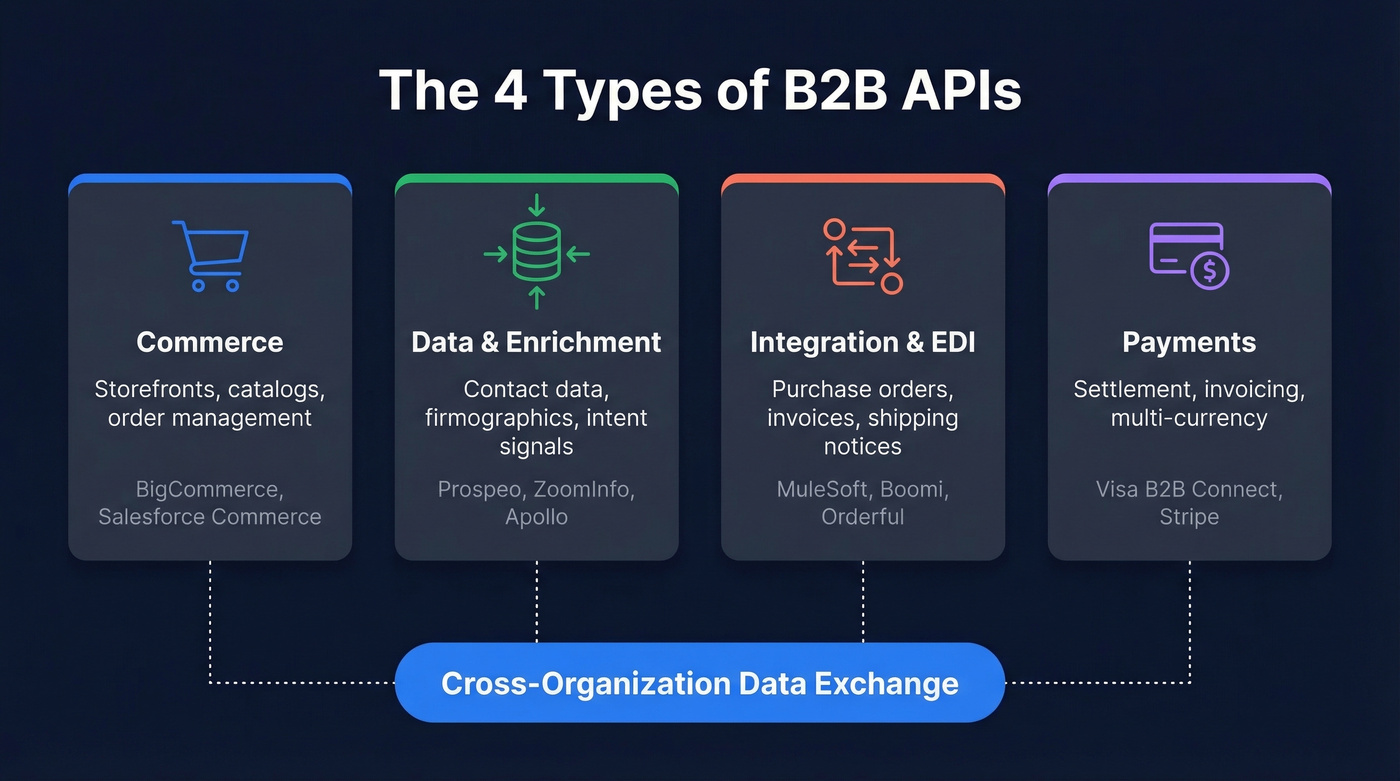
| Category | What It Does | Key Players |
|---|---|---|
| Commerce | Storefront, catalog, order mgmt | BigCommerce, Salesforce Commerce |
| Integration & EDI | Cross-org data exchange | MuleSoft, Boomi, Orderful |
| Payments | B2B settlement and invoicing | Visa B2B Connect, Stripe |
Commerce APIs
Commerce APIs power the transactional backbone of B2B e-commerce - product catalogs, pricing rules, order management, and fulfillment workflows. Platforms like BigCommerce and Salesforce Commerce Cloud expose REST APIs that let partners programmatically manage inventory, sync orders, and push pricing updates across channels. If you're building a B2B storefront, this is your starting point.
Data & Enrichment APIs
These are the APIs that sales, marketing, and RevOps teams care about most. A data enrichment API takes a name, email, domain, or company identifier and returns verified contact details, firmographics, technographics, and sometimes intent signals. The data enrichment market sits at roughly $2.9B and is growing 10-12% through 2030. We dig into this category in detail below because, frankly, it's where most of our readers' budgets are going.
Integration & EDI APIs
Integration APIs and EDI platforms handle the structured exchange of business documents - purchase orders, invoices, advance shipping notices - between trading partners. MuleSoft and Boomi offer broad iPaaS capabilities with pre-built connectors. Orderful takes a more modern, API-first approach to EDI specifically. These platforms are the backbone of cross-company data exchange for supply chain and logistics operations.
Payments APIs
B2B payments are notoriously complex. Net terms, multi-currency invoicing, compliance across jurisdictions - it adds up fast. Payments APIs like Visa B2B Connect and Stripe handle cross-border settlement, reconciliation, and the metadata-heavy workflows that make B2B payments distinct from consumer transactions.
B2B APIs vs EDI
The "should we replace EDI with APIs?" debate has been running for a decade. Let's be honest: the answer is probably not entirely.
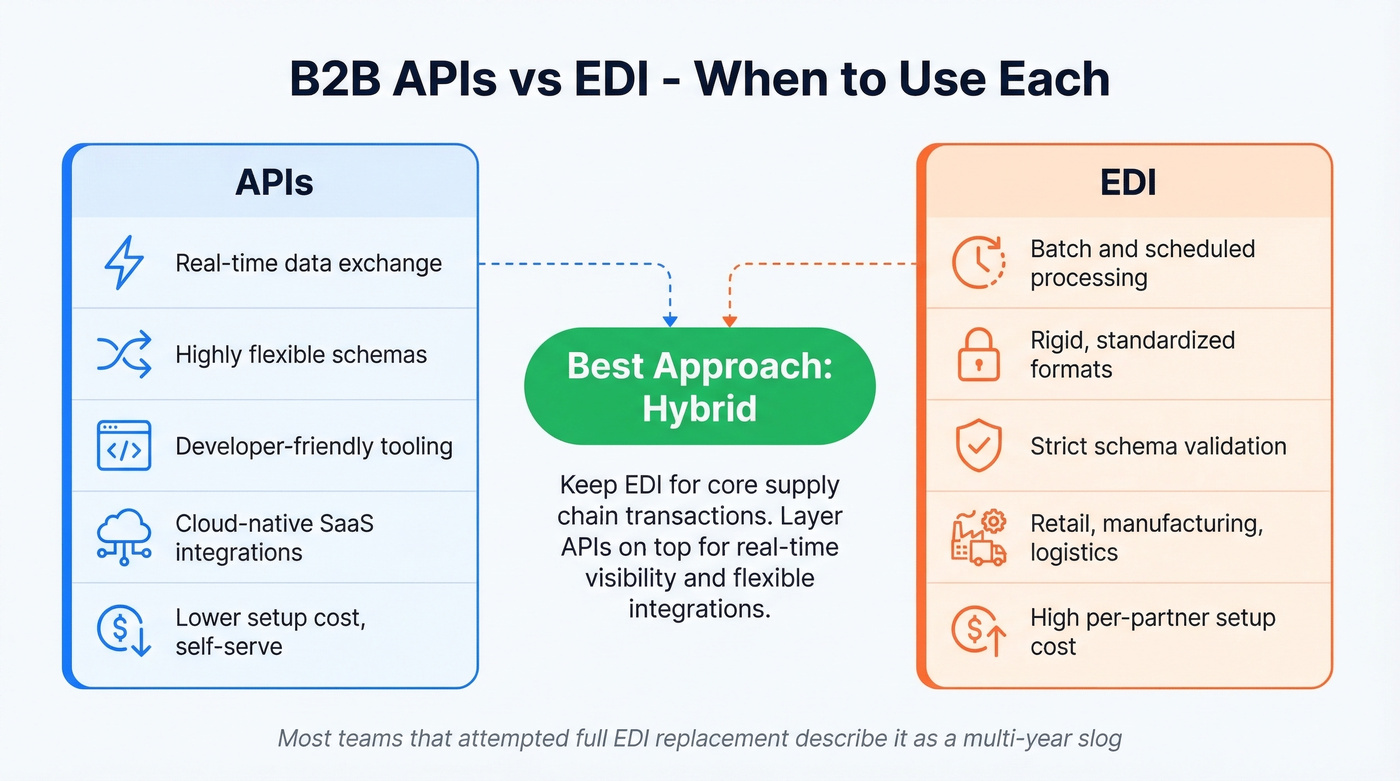
| Dimension | EDI | APIs |
|---|---|---|
| Speed | Batch (scheduled) | Real-time |
| Flexibility | Rigid, standardized | Highly flexible |
| Validation | Strict schema enforcement | Developer-dependent |
| Dominance | Retail, mfg, logistics | Cloud-native SaaS |
| Setup cost | High (per partner) | Lower (self-serve) |
EDI's strength is its rigidity. Strict validation, standardized document formats, and decades of partner compliance make it the backbone of retail and manufacturing supply chains. That's not changing anytime soon.
APIs win on speed and flexibility. Real-time data exchange, cloud-native architecture, and developer-friendly tooling make them the obvious choice for modern SaaS integrations. But scaling API-based partner networks introduces its own chaos - heterogeneity across REST, SOAP, and GraphQL, versioning nightmares, and the operational burden of managing hundreds of endpoints with different auth mechanisms.
The pragmatic move is hybrid. Keep EDI for core transactions where partners already comply. Layer APIs on top for real-time visibility, analytics, and the flexible integrations that EDI can't handle gracefully. We've talked to teams that attempted full EDI replacement and most describe it as a multi-year slog they wish they'd scoped differently. The consensus on r/supplychain echoes this - hybrid is the path of least regret.

Most enrichment APIs refresh data every 6 weeks - by then, a quarter of your contacts are already stale. Prospeo's enrichment API returns 50+ data points per call at a 92% match rate, refreshed every 7 days. At $0.01 per lead with no contracts, it's the API your pipeline actually deserves.
Stop enriching with data that's already decaying. Start with 75 free lookups.
The Enrichment Layer
Poor data quality costs the average organization $12.9M per year, per Gartner's research on data quality. With contact data decaying at ~2.1% per month, you should expect roughly 22-25% of a B2B contact database to go stale over a year without continuous re-enrichment. Data enrichment APIs aren't optional - they're infrastructure.
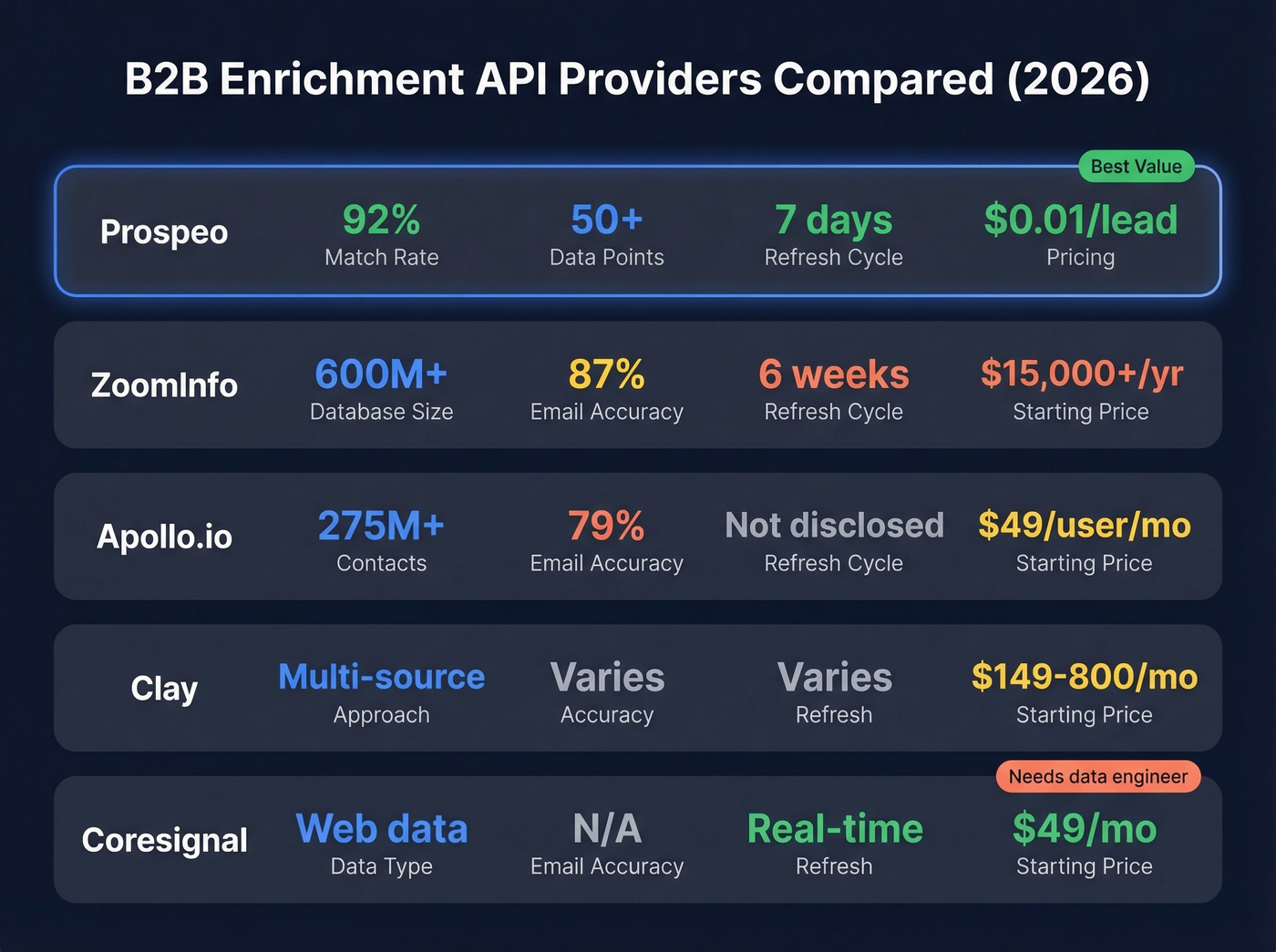
Here's the thing: choosing the right provider is one of the highest-impact decisions a RevOps team makes all year. The market has matured significantly, and the differences between providers are real.
| Tool | Database | Email Accuracy | Refresh | Starting Price |
|---|---|---|---|---|
| ZoomInfo | 600M+ profiles | ~87% | ~6 weeks | ~$15,000/yr |
| Apollo.io | 275M+ contacts | ~79% | Not disclosed | $49/user/mo |
| Clay | Multi-source aggregator | Varies | Varies | $149/mo |
| Coresignal | Web data APIs | N/A | Real time | $49/mo |
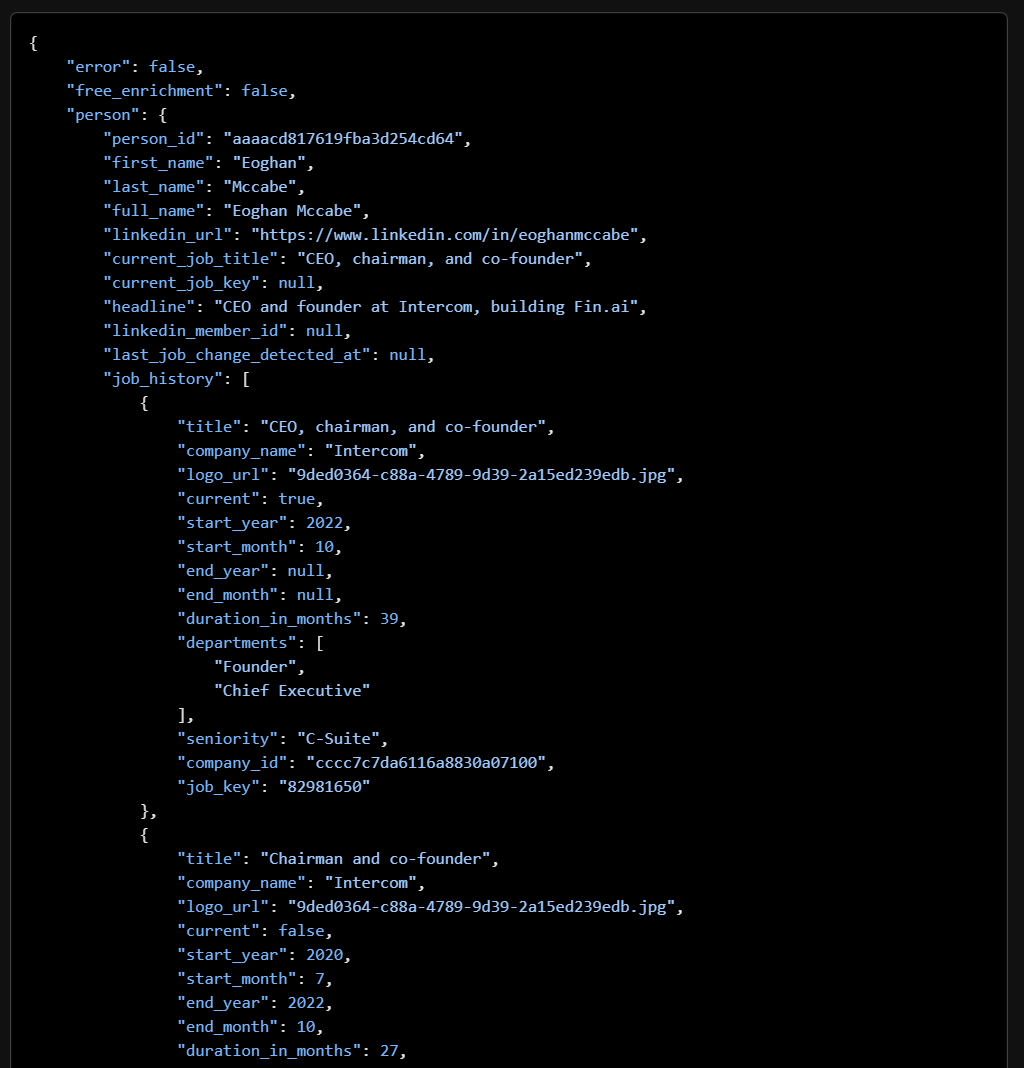
Prospeo returns 50+ data points per enrichment call with a 92% match rate. The 7-day refresh cycle is the standout differentiator - most competitors refresh around every six weeks, which means data is already aging by the time you pull it. At $0.01 per lead with no annual contracts, it's the most transparent pricing model in the category. Snyk's 50-person AE team cut bounce rates from 35-40% to under 5% after switching, and their AE-sourced pipeline jumped 180%. That kind of accuracy gap compounds fast across thousands of outbound touches.
ZoomInfo has the largest raw database at 600M+ profiles and remains the default for large enterprises that need the full GTM platform - intent, chat, workflow automation. But starting at ~$15,000/year with mid-market contracts running $25-60k, it's expensive if you primarily need accurate contact data. If your deal sizes are under $10k, you're almost certainly overpaying.
Apollo offers a generous free tier and 275M+ contacts, but ~79% email accuracy means higher bounce rates on cold outbound. Plans run $49-$119/user/month, with monthly billing ~20% higher than annual. Credits expire each billing cycle, which catches teams off guard.
Clay is the aggregator play - it waterfalls across multiple data providers for complex enrichment workflows. Powerful for teams that want to chain multiple sources together, but credit consumption adds up fast at $149-$800/month.
Coresignal is built for data engineering teams, not sales teams. It's a web data API product with real-time updates and multiple export formats (JSON/JSONL/CSV) starting at $49/month - but it typically requires significant downstream processing before it's usable for outbound or CRM enrichment. Skip this one if you don't have a data engineer on staff.
Snyk's 50-person AE team plugged Prospeo's enrichment API into their workflow and watched bounce rates drop from 35-40% to under 5%. AE-sourced pipeline jumped 180%. That's what 98% email accuracy and a 7-day refresh cycle do at scale - across thousands of API calls, the accuracy gap compounds.
See what 92% match rates and $0.01 per lead look like in your stack.
Security & Authentication
Here's a frustration we hear constantly: teams invest heavily in SAML and OIDC for single sign-on on the UI side, then leave their API authentication as an afterthought. That blind spot is how breaches happen. The Peloton API incident is a cautionary example of what happens when endpoints are left too open.
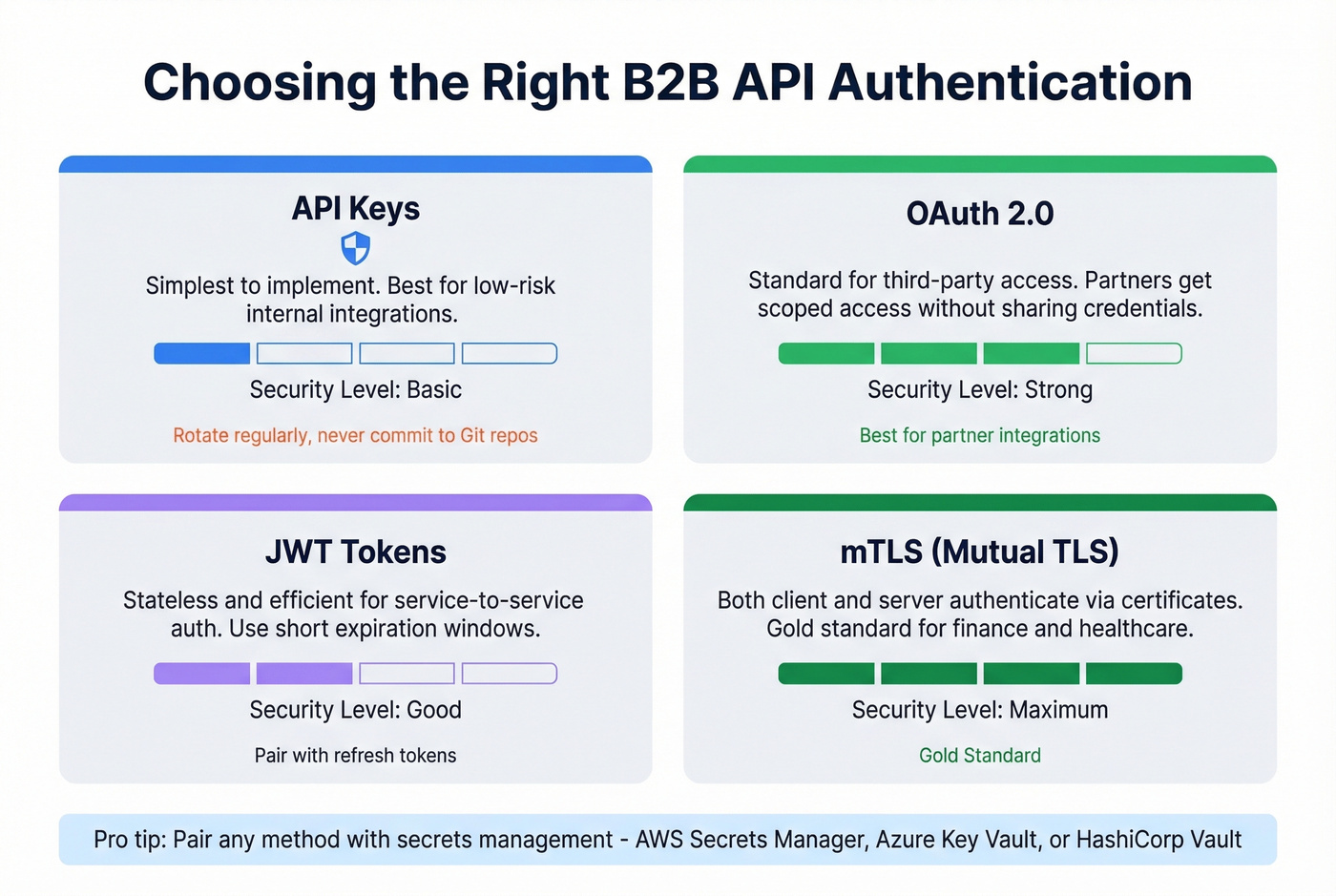
Four authentication methods dominate:
- API keys - simplest to implement, fine for low-risk internal integrations. Rotate regularly and never commit them to a Git repository.
- OAuth 2.0 - the standard for third-party access delegation. Use it when partners need scoped access without sharing credentials.
- JWT (JSON Web Tokens) - stateless and efficient for microservice-to-microservice auth. Pair with short expiration windows and refresh tokens.
- mTLS (Mutual TLS) - both client and server authenticate each other via certificates. The gold standard for high-security data exchange in financial services and healthcare.
Beyond choosing an auth method, invest in secrets management. AWS Secrets Manager, Azure Key Vault, or HashiCorp Vault should handle key storage, rotation, and access control. We've seen teams lose weeks to incident response over leaked keys that proper secrets management would have prevented entirely.
Integration Best Practices
71% of teams take 3 or more weeks to ship a single integration. That's not a technology problem - it's a process problem. Six practices consistently compress that timeline:
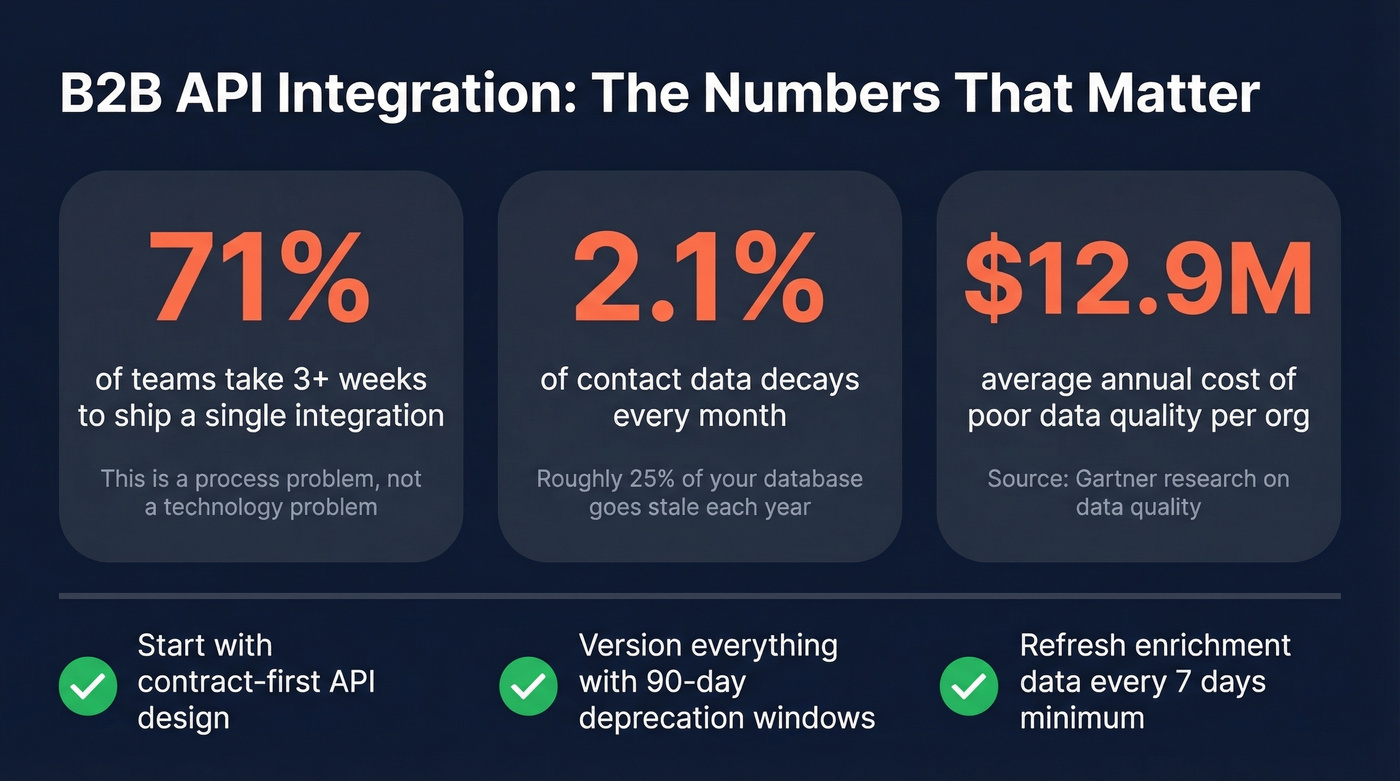
1. Start with contract-first design. Define your API schema before writing a line of code. OpenAPI specs shared with partners upfront eliminate the back-and-forth that eats weeks.
2. Version everything. Breaking changes are the #1 source of partner frustration. Use semantic versioning, deprecate gracefully, and give partners at least 90 days before sunsetting an endpoint.
3. Adopt canonical data models. When five partners all represent "customer" differently, a standardized internal object model saves you from writing five different transformation layers. This one change alone has saved our team more debugging hours than any other architectural decision.
4. Build observability from day one. Log full request and response bodies, redacting sensitive fields. Real-time monitoring lets you trace a failed transaction to its root cause in minutes instead of hours.
5. Handle errors like they're inevitable. Implement retries with exponential backoff, dead-letter queues for failed messages, and alerting that fires before your partner notices something broke. Because they will break.
6. Respect pagination and rate limits. Use cursor-based pagination for stability with changing datasets - offset-based pagination is simpler but prone to duplicates when records shift between pages. Build client-side queuing to stay within rate limits without dropping requests.
Common Pitfalls
Schema drift breaks pipelines. Your partner updates their API response format without telling you. Your ETL job fails silently and you're missing data for three days before anyone notices. Fix: implement schema validation and subscribe to partner changelogs.
Leaked API keys cause security incidents. Teams hardcode API keys in config files that end up in public GitHub repos. It happens more often than anyone admits. Fix: use a secrets manager, enforce rotation policies, and scan repositories for exposed credentials automatically.
Silent failures create data gaps. An API returns a 200 status code but with an empty payload. Your system logs it as a success. This is maddening to debug after the fact. Fix: validate response content, not just HTTP status codes, and implement alerting thresholds for anomalous response patterns.
Rate-limit throttling drops requests. You're enriching 50,000 contacts and hitting the provider's rate limit after 1,000 calls. Fix: implement client-side queuing, cache responses for duplicate lookups, and batch requests where the API supports it.
How to Choose the Right Provider
Documentation quality and self-serve onboarding matter more than most teams expect - because they determine whether you can get to a working proof of concept in days instead of weeks. Six criteria that actually matter:
- Unified gateway - does the platform centralize auth, permissions, and traffic management, or are you stitching that together yourself?
- Pre-built connectors - how many of your existing systems have native integrations?
- Real-time monitoring - can you see error rates and latency without building custom dashboards?
- Scalability - will it handle your volume in 18 months, not just today?
- Security and compliance - encryption, audit logs, SOC 2, GDPR - whatever your industry requires.
- Ease of use - can your team manage integrations without dedicated middleware engineers?
For data enrichment APIs specifically, data freshness is the single most important criterion. A database with 600M profiles that refreshes every six weeks is less useful than one with 300M profiles refreshed weekly - because the 300M are actually current. Any sales intelligence API integration is only as good as the data it returns.
The right B2B API isn't the one with the biggest feature list. It's the one that fits your workflow, stays within budget, and doesn't require a three-month implementation project. Start with a proof of concept against real data, measure match rates and accuracy yourself, and make the call based on what you observe - not what the vendor's slide deck promises.
FAQ
What's the difference between a B2B API and a regular API?
A B2B API connects systems across separate organizations - partners, vendors, customers - rather than internal services within one company. This cross-organizational boundary means stricter authentication (OAuth 2.0, mTLS), heavier compliance obligations (GDPR, SOC 2), and more rigid data format standardization. Internal APIs can afford to be loose; cross-company interfaces can't.
Is EDI being replaced by APIs?
Not fully. Most enterprises run a hybrid model. EDI dominates retail, manufacturing, and logistics because of decades of partner compliance and strict validation standards. APIs handle real-time data exchange and flexible integrations that EDI handles poorly. Full EDI replacement is rare and usually more disruptive than expected.
How much does a data enrichment API cost?
Self-serve providers like Prospeo start at $0.01 per lead with no contracts and 75 free credits to test. Mid-market enterprise platforms like ZoomInfo typically run $15,000-$60,000/year with annual commitments. Aggregators like Clay charge $149-$800/month based on credit volume. Per-lead pricing works best for teams with variable volume.
What's a good free option for B2B data enrichment?
Prospeo offers 75 free email credits plus 100 Chrome extension credits monthly - enough to validate accuracy before committing. Apollo has a free tier with 275M+ contacts but ~79% email accuracy. For most outbound teams, a free tier with 98% verified emails and a 7-day refresh cycle delivers the best accuracy-to-cost ratio out of the box.