

B2B Buyer Persona Research: The Practitioner's Playbook for 2026
The VP asks for "updated personas" because pipeline's soft and messaging feels generic. Two weeks later, you've got a slide deck full of demographic trivia and stock photos - and nobody uses it.
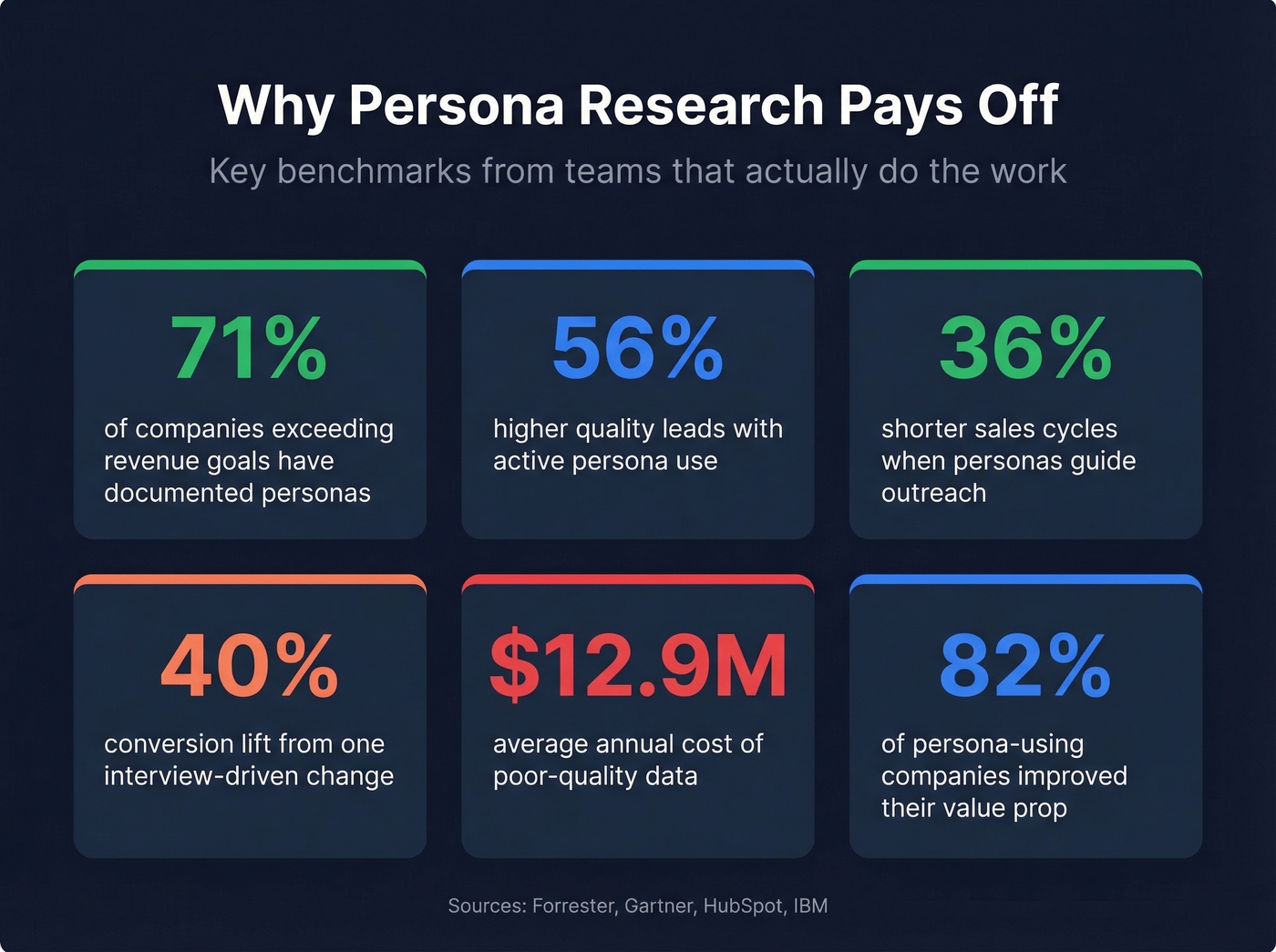
The consensus on r/b2bmarketing has a name for this: fairytale personas. B2C-style profiles copy-pasted into B2B, built without customer conversations, then left to collect dust. Only 44% of B2B marketers even use buyer personas, which tells you how often these projects fail to stick. And yet, 71% of companies exceeding revenue goals have documented, actively maintained personas. The gap between "we have personas" and "our personas drive decisions" is where pipeline lives.
Let's do it the way practitioners actually do.
What You Need (Quick Version)
- Interview 8-12 people per persona. That's the practical saturation range where patterns stop changing and you're not just collecting anecdotes.
- Build 1-3 primary personas max. More than that creates collateral chaos and nobody can operationalize it.
- Organize around JTBD, not demographics. The jobs-to-be-done framework, popularized by Clayton Christensen, reframes persona research around what buyers are trying to accomplish - not who they are on paper. Start from the job they're hiring your product to do, then layer in context.
Persona vs. ICP vs. Target Audience
| Concept | Definition | Scope | Use case |
|---|---|---|---|
| ICP | Best-fit company profile | Company-level | Targeting + routing |
| Persona | Individual buyer archetype | Person-level | Messaging + objections |
| Target audience | Broad segment | Market-level | Positioning + budget |
ICP tells you which accounts are worth pursuing. Personas tell you who inside those accounts you need to persuade. Target audience is the wide net you use for category messaging, not sales execution.

Persona research built on incomplete CRM data produces fairytale personas. Prospeo's enrichment fills the gaps - 50+ data points per contact, 92% match rate, and 30+ filters including buyer intent, technographics, headcount growth, and funding.
Stop building personas on bad data. Start with clean, enriched records.
The Research Process Step by Step
Map the Buying Committee First
Most persona work fails because it pretends one "decision maker" exists. Forrester's State of Business Buying report found the average B2B purchase involves 13 stakeholders, and roughly 89% of decisions cross departments. Gartner puts buying groups at 6-10 decision makers, each arriving with 4-5 pieces of independent research they trust more than your pitch deck. Buyers spend just 17% of their purchasing time meeting with vendors - the rest is independent research, peer conversations, and internal deliberation. Your persona needs to account for what they're reading when you're not in the room.
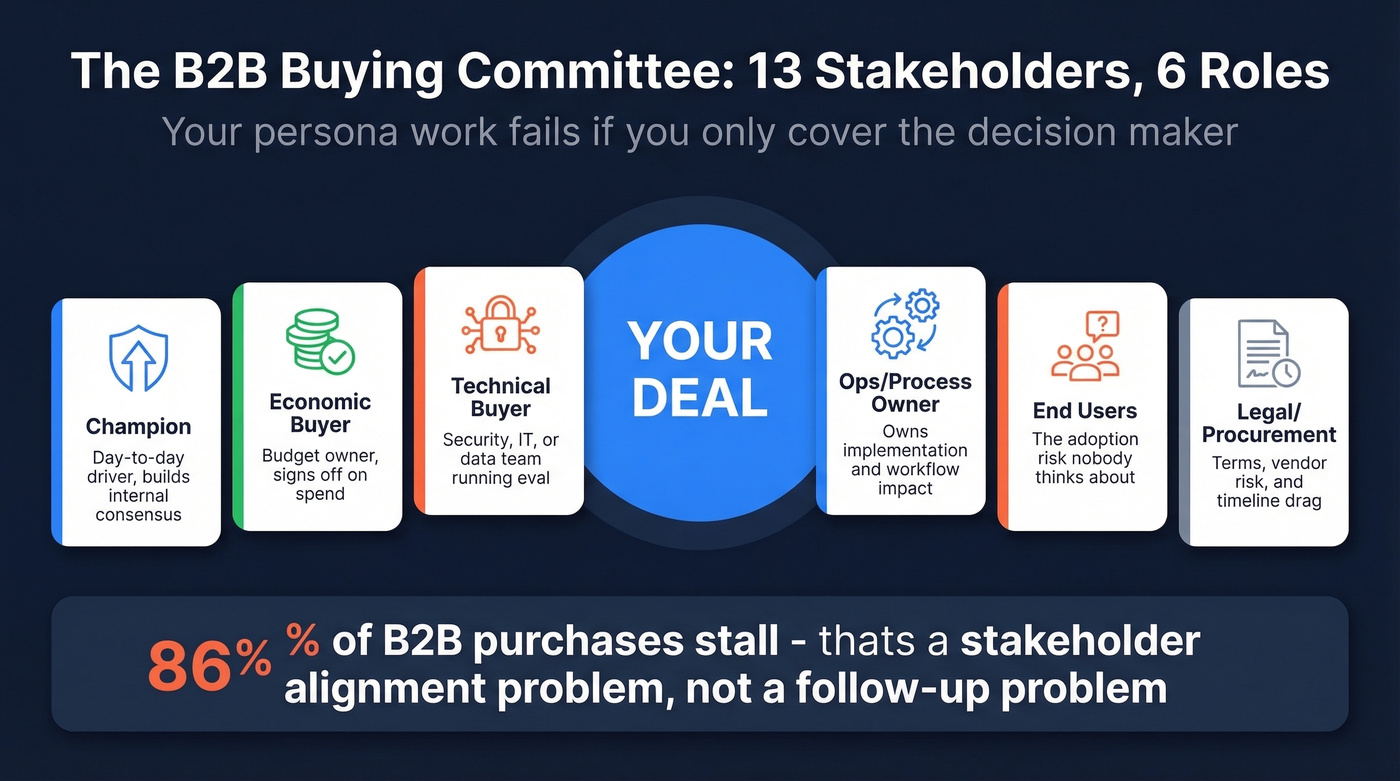
Here's the thing: 86% of B2B purchases stall at some point. That's not a sales follow-up problem. It's a stakeholder alignment problem.
Condense the buying committee into roles you can actually work with:
- Champion - the day-to-day driver who builds internal consensus
- Economic buyer - budget owner who signs off on spend
- Technical buyer - security, IT, or data team running evaluation
- Ops/process owner - owns implementation and workflow impact
- End users - the adoption risk nobody thinks about until onboarding
- Legal/procurement - terms, vendor risk, and timeline drag
If your personas only cover the decision maker, you're missing 12 people who can kill the deal.
Gather Internal Data First
Do the desk work before scheduling interviews. Interviews tell you "why," but internal data tells you where to look.
This checklist actually moves the needle:
- CRM slices - segment by deal size, sales cycle length, win rate, churn, expansion
- Win/loss notes - pull 20-30 recent decisions and tag the real reasons, not the polite ones
- Sales call recordings - listen for repeated objections and "we went with X because..." moments
- Product and website analytics - which pages correlate with pipeline, which features correlate with retention
- Data enrichment - fix missing firmographics and technographics so your patterns aren't built on junk data
Poor-quality data costs organizations $12.9M per year on average. It quietly wrecks persona work because you end up "discovering" patterns that are just incomplete fields. Clean your CRM before you interview anyone. We use Prospeo's B2B database to cross-check firmographic assumptions - the 30+ search filters cover buyer intent, technographics, job changes, headcount growth, department headcount, funding, and revenue, and CRM enrichment returns 50+ data points per contact.

Run Buyer Interviews
Analytics tells you what happened. Interviews tell you why. HubSpot documented a case where interview feedback led to changing an asset type and headline, producing a 40% conversion lift in a single campaign. Benchmarks commonly cited in persona research include 56% higher quality leads and 36% shorter sales cycles when teams build and use personas consistently. The ROI on this work is real, and it compounds.
This interview mix works in practice:
- 5-7 current customers who've been with you over 12 months and spend above your average. You want the buyers who proved value, not the newest logos.
- 2-3 lost prospects from the last 90 days. In our experience, the best insights come from lost prospects - they'll tell you things current customers won't.
Sample size: 8-12 interviews per persona segment. Below that, you're at the mercy of outliers. Above that, you're usually repeating themes.
One tip that sounds soft but matters: don't skip the small talk. People won't reveal the real political dynamics of a buying committee until they trust you for five minutes.
A JTBD-first question bank:
- "What was happening in the business that made you start looking?" (trigger + context)
- "What did you try before us, and why didn't it work?" (alternatives + failure modes)
- "Walk me through the last 2 weeks before you bought." (actual journey, not the one on your website)
- "What nearly stopped the purchase?" (risk, procurement, internal blockers)
- "Who else weighed in, and what did each person care about?" (committee map)
The Buyer Persona Institute offers a deeper framework for structuring these conversations around buying decisions rather than demographics - worth reviewing if you're building this muscle for the first time.
Document and Activate
The doc isn't the deliverable. Behavior change is.
Include this:
- JTBD - primary and secondary jobs
- Buying committee role - champion vs. approver vs. evaluator
- Pain points and constraints - time, risk, compliance, headcount
- Decision criteria - what "good" looks like
- Objections - the real ones, not the polished versions
- Information sources - peers, communities, analysts, internal SMEs
- Buying triggers - events that create urgency
Skip this:
- Demographics as the headline - demographics describe the person, not the decision
- "Likes podcasts" filler
- Over-personal bio fluff
- Cute names like "Marketing Mary" - they introduce bias and make teams treat personas like characters instead of decision patterns
If your average deal size is under $15k, you probably don't need more than one persona. Build it well, operationalize it, and add a second only when pipeline data proves a genuinely different buying motion exists. Most teams create three personas and activate zero.
Also build a negative persona - who you should stop targeting because they never convert or churn fast. It protects sales time and ad spend. Selling Signals' template set includes a dedicated negative persona format, one of the few resources that treats disqualification as a first-class output.
For documentation, HubSpot Make My Persona is genuinely useful - free, fast, and exports clean PDFs.
Activation is where most persona projects die. Reddit threads on r/ProductMarketing are full of teams drowning in duplicative assets nobody reads. Here's how to avoid that:
- Assign a persona owner - a PMM or RevOps lead, not "everyone"
- Embed the persona into campaign briefs and sales plays
- Add a quarterly review to your GTM calendar
- Refresh every 6-12 months so it doesn't drift
- Get creative with activation - some teams embed persona cards directly into CRM record views, run role-play exercises at sales kickoffs, or send "persona emails" that simulate how each buyer thinks about a purchase decision
Mapping a 13-person buying committee means knowing who's actually inside target accounts - titles, departments, seniority, and verified contact data. Prospeo's database covers 300M+ profiles with 98% email accuracy, refreshed every 7 days.
Find every stakeholder in the buying committee, not just the decision maker.
B2B Persona Example (JTBD Format)
Persona: VP of Operations (200-500 employee SaaS) JTBD: "Standardize processes across teams so we can scale without breaking delivery." Buying committee role: Champion + co-evaluator (needs Finance + IT/security sign-off) Pain points: Tool sprawl, manual reporting, inconsistent handoffs, audit risk Decision criteria: Time-to-value under 60 days, integration fit, security posture, admin workload Objections: "This will create more work for my team," "We'll never get adoption," "Security will block it" Information sources: Peer operators, operator communities, internal IT/security, vendor comparisons Buying triggers: New funding, headcount spike, failed implementation of a prior tool, upcoming audit
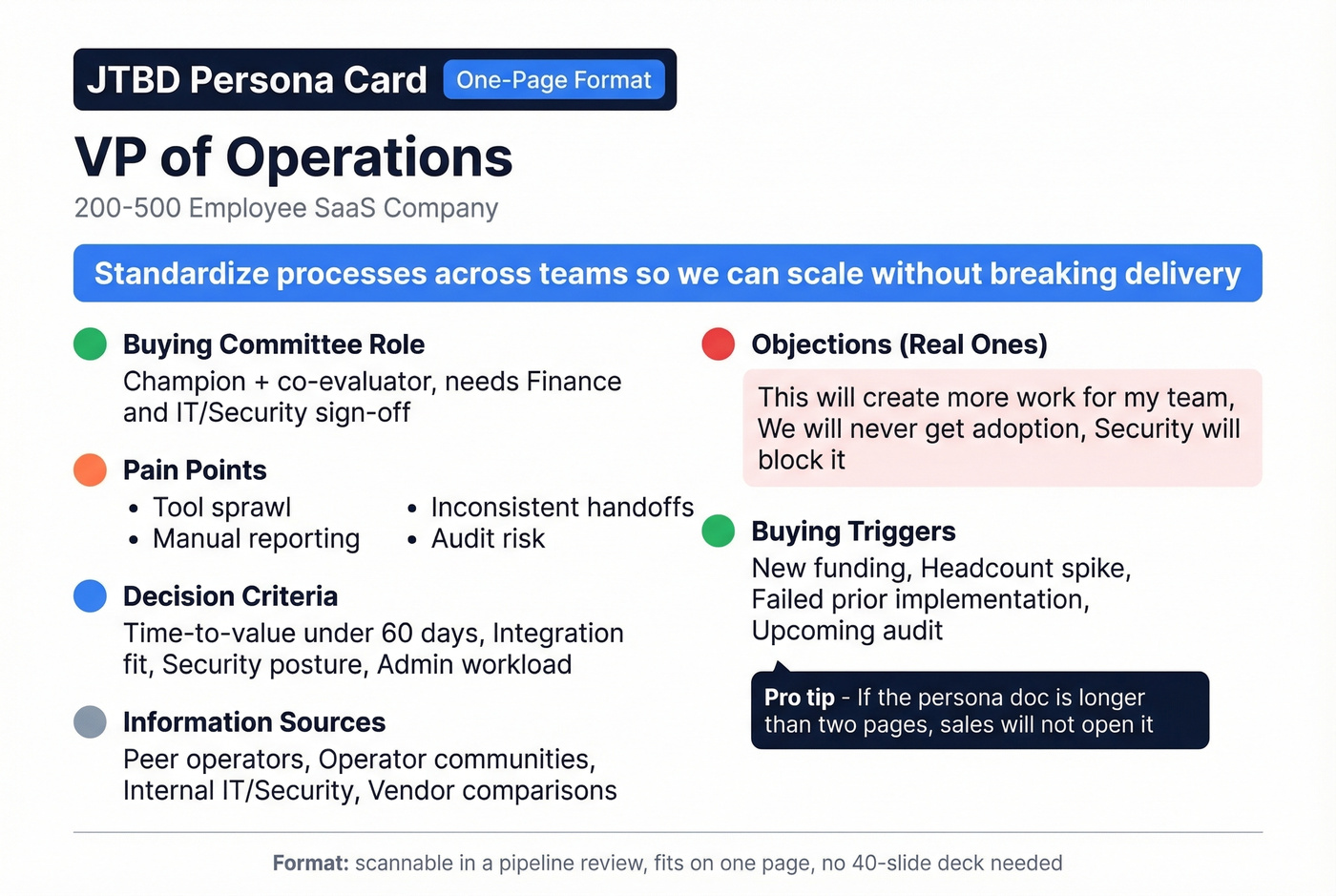
We've used this exact format for our own GTM work. It fits on one page, it's scannable in a pipeline review, and it doesn't require a 40-slide deck to explain. That last point matters more than people think - if the persona doc is longer than two pages, sales won't open it.
FAQ
How many buyer personas do I need?
Most B2B companies need 1-3 primary personas to start. More than that creates collateral chaos and nobody keeps messaging consistent. 82% of companies using buyer personas improved their value proposition. Begin with the persona tied to your highest-revenue segment, then add new ones only when interviews and pipeline data prove a distinct buying motion.
How often should I update personas?
Every 6-12 months, or sooner when your market shifts through a new competitor, product pivot, or economic change. Layer in intent data to keep personas alive between formal refreshes - tools tracking intent topics via Bombora let you see which segments are surging on specific themes and adjust messaging before the next scheduled review.
What's a negative buyer persona?
A negative persona profiles who you should stop targeting because they don't convert, churn quickly, or create high support burden. It protects sales time and ad spend. A data platform with firmographic and technographic filters can turn qualitative "bad fit" instincts into repeatable exclusion rules you apply to every campaign.
How do I validate personas with real data?
Don't treat persona creation as a one-time research project. After building initial personas from interviews, validate them against CRM data: do your actual closed-won deals match the profile? Cross-reference firmographics, deal velocity, and expansion revenue. If the data contradicts your interviews, trust the data and adjust. CRM enrichment tools that return 50+ data points per contact make this comparison fast and repeatable.