

B2B Customer Journey Touchpoints: What 2026 Data Actually Shows
Ninety-two percent of B2B buyers already have at least one vendor in mind before they start evaluating options. Among solo decision-makers, 63% begin with a single vendor picked out. That's from Forrester's Buyers' Journey Survey, and it should change how you think about B2B customer journey touchpoints entirely. If the deal is half-decided before the buyer picks up the phone, obsessing over late-stage interactions is solving the wrong problem.
One practitioner on r/SaaS captured the frustration well - they couldn't map the journey across email, organic, paid, events, and G2 reviews because no single team had the full picture. That's the real challenge. Not adding more touchpoints, but understanding the ones that already exist.
The Short Version
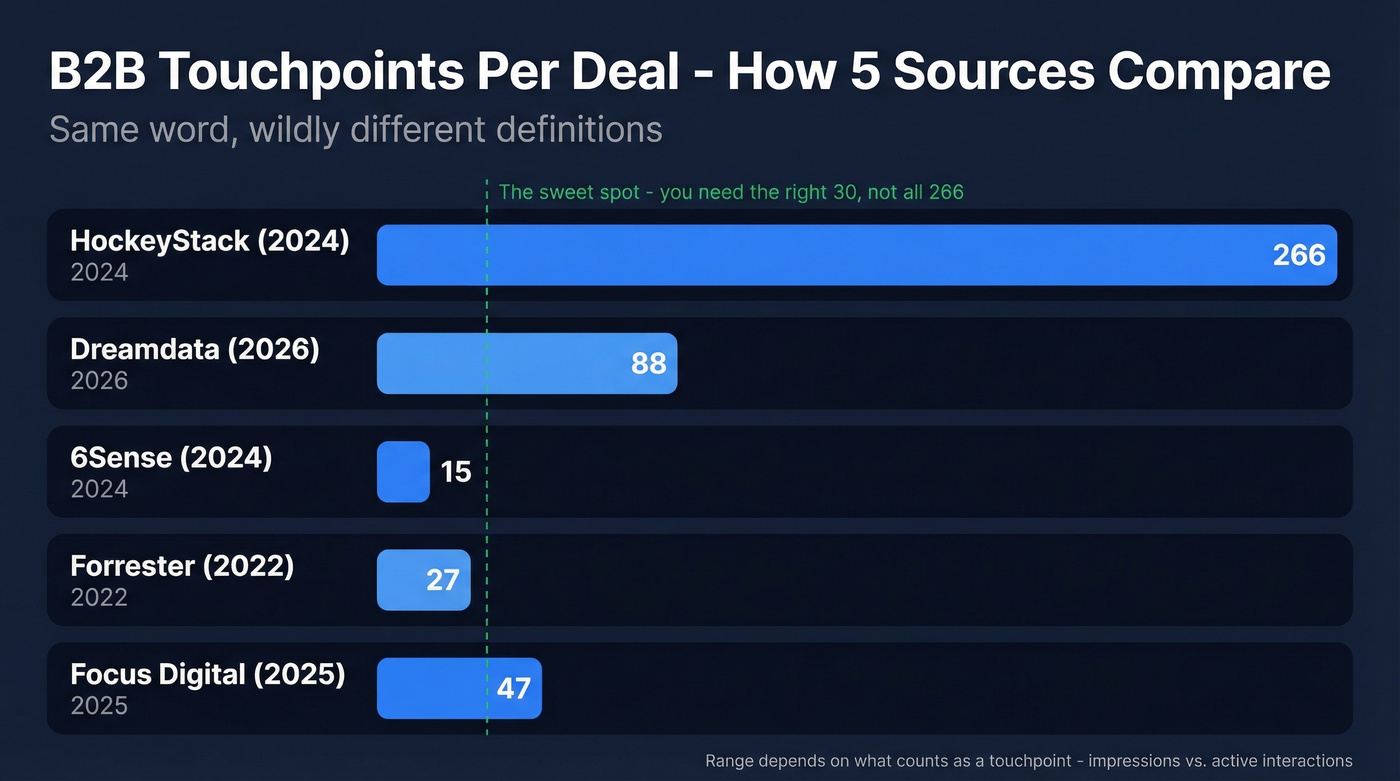
Benchmarks range wildly: 88 touchpoints (Dreamdata) to 266 (HockeyStack), depending on definition. For $100K+ deals, expect roughly 47-417 interactions across different methodologies. 92% of buyers start with at least one vendor in mind, which means early-stage touchpoints aren't "awareness" - they're decisive. Stop chasing more touchpoints. Make the ones you control actually land.
What Are B2B Buyer Journey Touchpoints?
A touchpoint is any interaction - direct or indirect - where a buyer engages with your brand between first awareness and post-sale advocacy. Clicks, calls, demos, support tickets, every email in between.
The B2C version is simpler: one buyer, a few sessions, a purchase. B2B buying journeys involve committees of 6-10 people, cycles measured in months, and a mix of channels you control and channels you don't. InfiniGrow's framework calls these uncontrolled touchpoints the "shadowy bits" - G2 reviews, analyst reports, Slack conversations between peers. You can't orchestrate them, but they shape the deal as much as your outbound sequences do.
2026 Benchmarks: How Many Touchpoints Per Deal?
The honest answer: it depends entirely on who's counting and what they're counting.
| Source | Year | Sample | Avg Touchpoints | Cycle Length |
|---|---|---|---|---|
| HockeyStack | 2024 | 150 B2B SaaS cos | 266 | Not reported |
| Dreamdata | 2026 | LinkedIn Ads benchmarks | 88 | 272 days |
| 6Sense | 2024 | 900 B2B buyers | 15 interactions | Not reported |
| Forrester | 2022 | Survey (2021 deals) | 27 (15 digital + 12 human) | Not reported |
| Focus Digital | 2025 | Not disclosed | 28.87 avg; 46.89 for $100K+ | Not reported |
Why the massive range? HockeyStack tracks impressions separately and counts touchpoints broadly - ad clicks, email opens, webinar registrations, organic visits. 6Sense counts only active buying-group interactions. They're measuring different things and calling them the same word.
HockeyStack also breaks this down by stage: 71 touchpoints to MQL, 96 from MQL to SQL, and 99 from SQL to close. Touchpoint volume actually increases as deals progress, which runs counter to how most teams think about the funnel. For $100K+ ACV deals, their data shows roughly 5,500 impressions and 417 touchpoints. Focus Digital, using a narrower definition, reports about 47 interactions for similar deal sizes. Either way, the trend line is going up: touchpoints increased 19.8% from 2023 to 2024.
Here's the thing: you don't need 266 touchpoints. You need the right 30. A tightly sequenced outbound campaign with verified contacts and relevant messaging will outperform a sprawling, unfocused presence across dozens of channels every time.
5 Journey Stages and Key Touchpoints
Awareness: Where Deals Are Already Decided
This stage isn't introductory - it's decisive. Forrester found that 41% of buyers already have a single preferred vendor before formal evaluation begins. Even first-time buyers enter with a preferred vendor 48% of the time. If you're not in the consideration set before the RFP drops, you're fighting uphill.
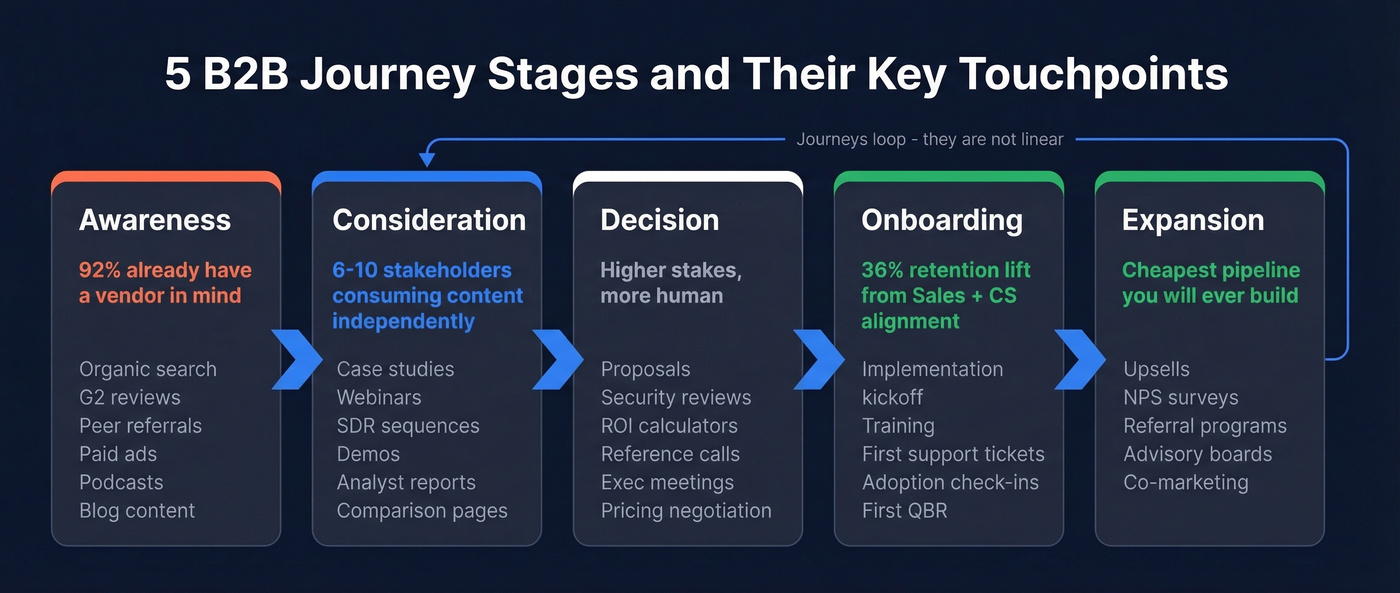
Picture a Head of IT at a mid-market company. Before requesting a demo, they've already gone through a long chain of early interactions: organic search, a G2 review, a paid ad, a blog post, a peer recommendation, a webinar, a pricing page visit, an SDR email. Branded search, paid ads, industry events, review sites, peer word-of-mouth, and podcast appearances all live here - and by the time they fill out a form, the shortlist is already set.
Consideration: Where Committees Form
This is where 6-10 stakeholders start consuming content independently across different channels. Case studies, webinars, live demos, SDR outreach sequences, product comparison pages, analyst reports, and demo requests all cluster here.
Data quality matters most at this stage. A bounced email or wrong phone number means a planned touchpoint never happens. We've watched teams lose deals not because their messaging was off, but because half their outreach hit dead inboxes. Prospeo's 98% email accuracy and 7-day data refresh cycle close the gap between "planned outreach" and "actual outreach" at exactly the moment it counts.
Decision
The buying committee narrows to a shortlist and touchpoints become higher-stakes and more human. Formal proposals, security reviews, champion enablement materials like internal decks and ROI calculators, AE calls, executive alignment meetings, pricing negotiations, reference calls - everything converges.
We've seen deals stall here not because of product fit, but because the champion couldn't sell internally. Give them the ammunition.
Onboarding & Adoption
Most journey maps stop at "closed-won." That's a mistake.
Aligning Sales and Customer Success yields a 36% improvement in retention, and retention touchpoints are where expansion revenue lives. The sequence matters: implementation kickoff, training sessions, first support tickets, product adoption check-ins, first QBR, ongoing health score monitoring. Each handoff is a potential drop-off point, and the teams that map these transitions explicitly are the ones that keep net revenue retention above 100%.
Expansion & Advocacy
The cheapest pipeline you'll ever build comes from customers who already trust you. Upsell conversations, NPS surveys, referral programs, customer advisory boards, community engagement, and co-marketing like joint webinars and case studies all feed this stage. Treat these touchpoints with the same rigor you give top-of-funnel - they compound.

You don't need 266 touchpoints - you need the right 30 to actually land. Prospeo's 98% email accuracy and 7-day data refresh mean every planned outreach becomes a real interaction, not a bounce. At $0.01 per email, bad data stops killing your journey.
Stop losing deals to dead inboxes. Start reaching real buyers.
The Self-Serve Shift
The journey isn't getting more complex - your visibility is getting worse. Buyers are doing more research independently, and the touchpoints have moved where you can't see them.
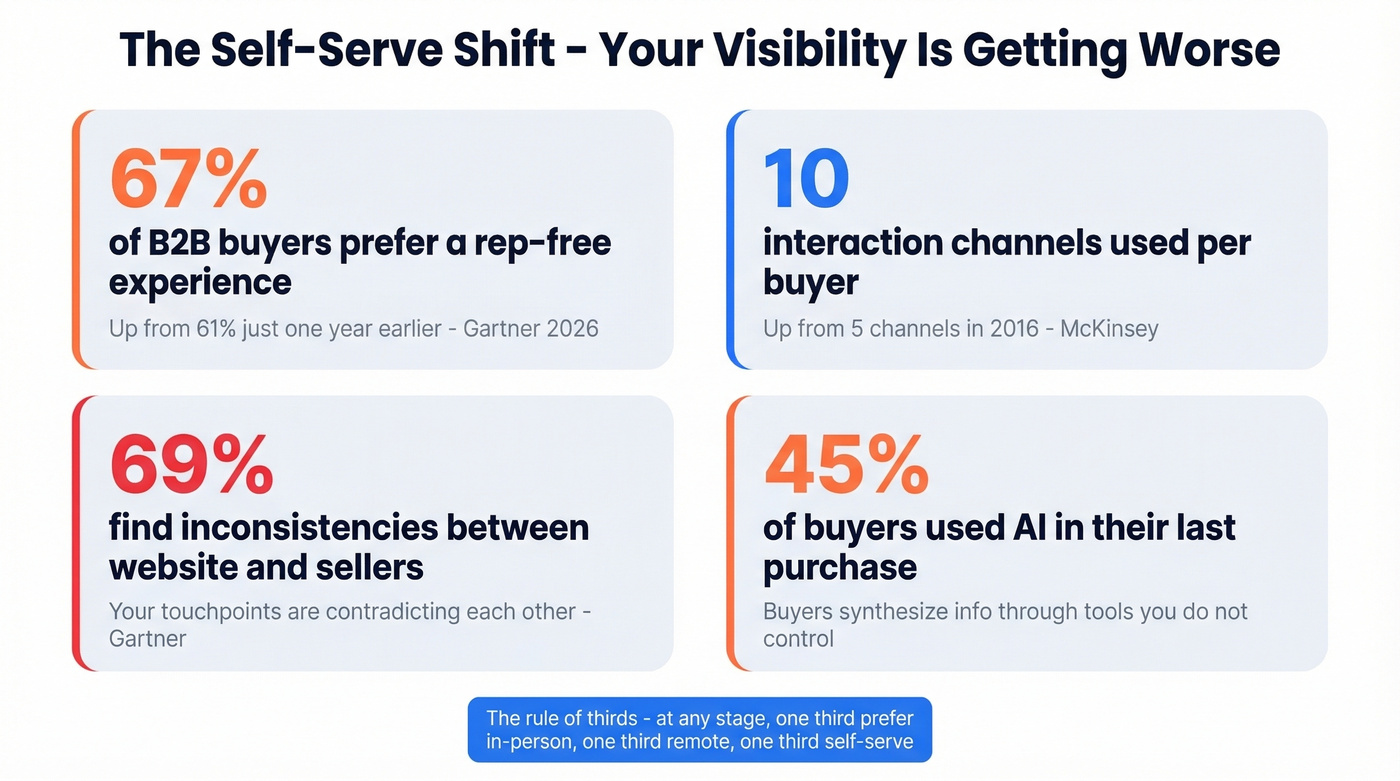
Gartner's latest survey (fielded August-September 2025) found that 67% of B2B buyers prefer a rep-free buying experience - up from 61% just a year earlier. 45% reported using AI during a recent purchase, meaning buyers are synthesizing vendor information through tools you don't control. And 69% of buyers report inconsistencies between what they find on vendor websites and what sellers tell them, which means your touchpoints are actively contradicting each other.
McKinsey's B2B Pulse survey reinforces this with the "rule of thirds": at any buying stage, roughly a third of buyers prefer in-person, a third prefer remote, and a third prefer digital self-serve. Buyers now use an average of 10 interaction channels - up from 5 in 2016. Your journey map needs to account for channels you don't own: review sites, peer communities, AI-generated summaries. These are touchpoints whether you planned them or not.
How to Map Your Touchpoints
Gartner found that 82% of organizations have created journey maps, but only 47% use them effectively. The gap isn't in the mapping - it's in the operationalizing.
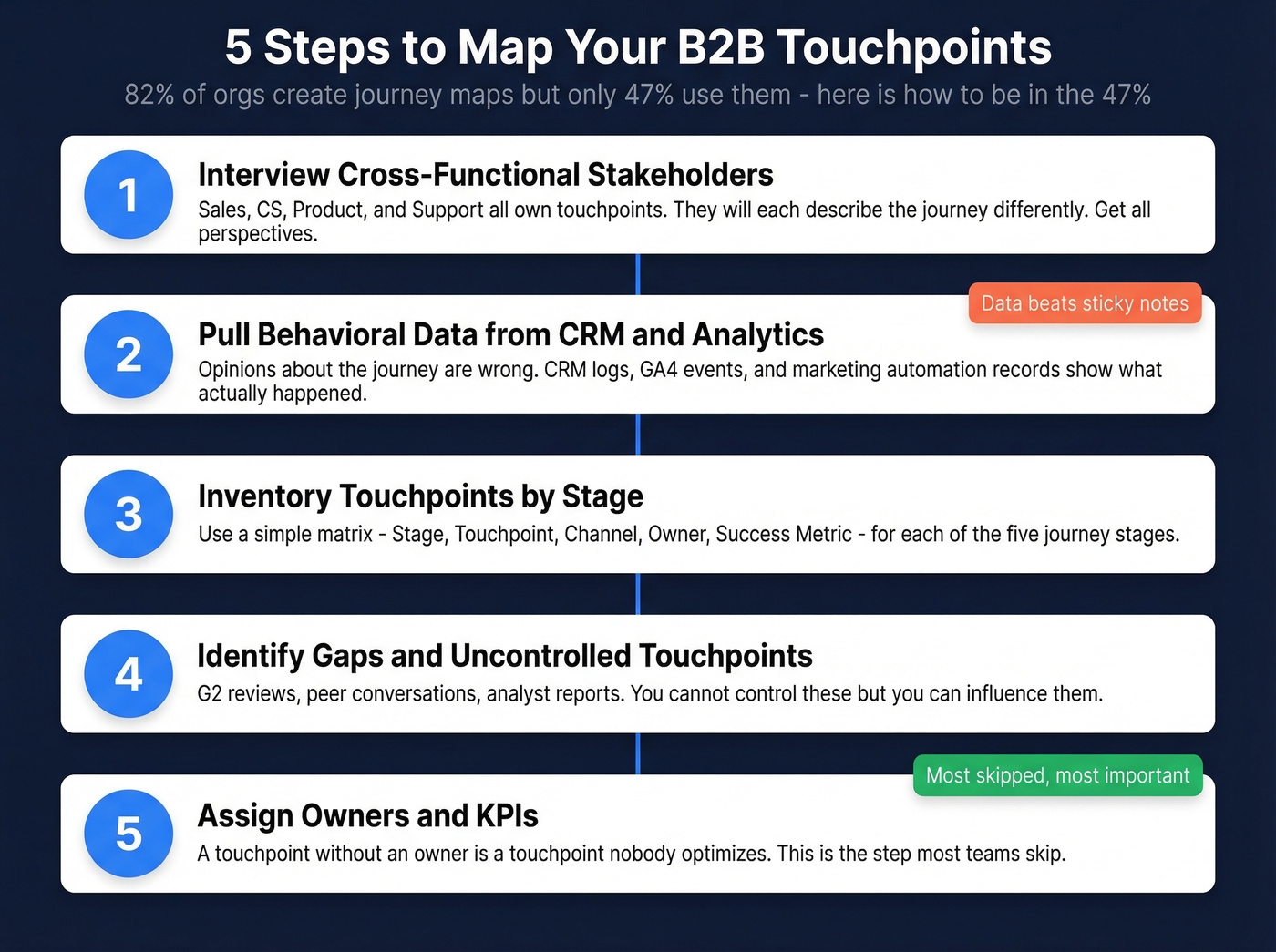
Step 1: Interview cross-functional stakeholders. Not just marketing. Sales, CS, product, and support all own touchpoints, and they'll each describe the journey differently.
Step 2: Pull behavioral data from CRM and analytics. Opinions about the journey are wrong. CRM activity logs, GA4 event data, and marketing automation records show what actually happened.
Step 3: Inventory touchpoints by stage. Use a simple matrix - Stage, Touchpoint, Channel, Owner, Success Metric - for each of the five stages above.
Step 4: Identify gaps and uncontrolled touchpoints. G2 reviews, peer conversations, analyst reports. You can't control these, but you can influence them through better product, proactive review generation, and analyst briefings.
Step 5: Assign owners and KPIs. A touchpoint without an owner is a touchpoint nobody optimizes. This sounds obvious, but in our experience it's the step most teams skip.
Journey Mapping Mistakes to Avoid
Building on opinions instead of data. The 82%-create-but-47%-use stat exists because most maps are built in conference rooms with sticky notes and assumptions, not CRM data. Let's be honest - if your last journey mapping exercise was a whiteboard session with no data pull, the map is fiction.
Assuming the journey is linear. Real B2B journeys loop. A buyer in "decision" stage circles back to "consideration" when a new stakeholder joins. ABM practitioners have known this for years - account-level journey mapping often looks more like a hub-and-spoke than a funnel.
Ignoring post-sale stages. The 36% retention improvement from Sales+CS alignment doesn't happen by accident. If your map ends at closed-won, you're leaving expansion revenue on the table.
Never revisiting. New product launch? Pricing restructure? Your journey map from six months ago is already stale. Treat it as a living document or skip the exercise entirely.
Attribution Models That Work
Single-touch attribution is the default in most CRMs, and it's misleading. Here are the multi-touch models worth considering:
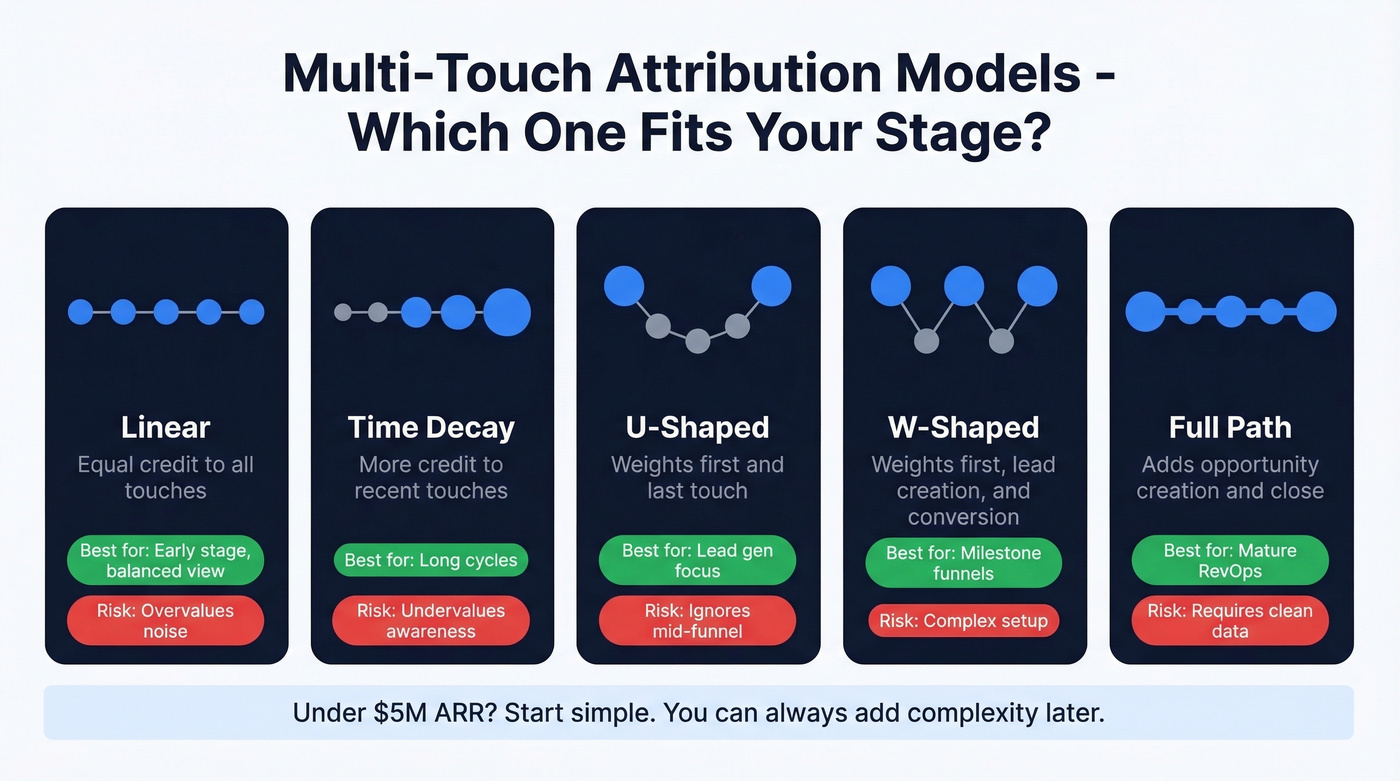
| Model | How It Works | Best For | Limitation |
|---|---|---|---|
| Linear | Equal credit to all touches | Early-stage, balanced view | Overvalues noise touches |
| Time-Decay | More credit to recent touches | Long cycles, late-stage focus | Undervalues awareness |
| U-Shaped | Weights first + last touch | Lead-gen emphasis | Ignores mid-funnel |
| W-Shaped | Weights first + lead creation + conversion | Milestone-driven funnels | Complex to implement |
| Full-Path | Adds opportunity creation + close | Mature RevOps teams | Requires clean data |
For teams under $5M ARR, start with U-shaped. It captures the bookends and it's better than last-click by a mile. Enterprise deals with 6+ month cycles? Move to W-shaped or full-path - but only if your CRM data is clean enough to support it. If you're not sure whether your data is clean enough, it isn't.
Make Your Touchpoints Land
73% of B2B buyers actively avoid suppliers who send irrelevant outreach. Your journey map is only as good as the data feeding it. If emails bounce, phone numbers are disconnected, or you're reaching someone who left the company three months ago, your carefully planned touchpoints never happen.
Before you optimize a single interaction, verify your contact database. The cost of stale data isn't just bounced emails - it's wasted SDR time, damaged domain reputation, and deals that never start.
With 6-10 stakeholders per deal, one wrong number or bounced email breaks the touchpoint chain at the worst possible moment. Prospeo gives you 300M+ verified profiles with 125M+ direct dials so your consideration-stage outreach actually reaches the full buying committee.
Cover the entire buying committee - not just the one contact who replied.
FAQ
How many touchpoints close a B2B deal?
Benchmarks range from 15 active interactions to 266 total touchpoints, depending on whether you count impressions or engagement. For deals over $100K, expect roughly 47-417 interactions. The number rises every year - up 19.8% from 2023 to 2024.
What's the difference between a touchpoint and an impression?
A touchpoint is any interaction where a buyer actively engages - a click, a call, a demo request. An impression is passive exposure like seeing an ad without clicking. HockeyStack reports both; most other studies count only active interactions, which explains the wide variance in benchmarks.
What tools help map B2B buyer journey touchpoints?
Start with a spreadsheet or Miro for the map itself. Layer in your CRM for behavioral data and GA4 for digital interactions. Attribution platforms like HockeyStack or Dreamdata help once you're ready to measure cross-channel impact. For outreach verification, tools like Prospeo ensure the contacts you're reaching are current so planned touchpoints actually happen.
Which buyer interactions matter most before formal evaluation?
The interactions that happen before formal evaluation are the most decisive - 92% of buyers already have a vendor in mind at that point. Branded search, G2 reviews, peer recommendations, and early SDR outreach shape the shortlist. After that, champion enablement materials and onboarding handoffs carry the highest impact on revenue.