

ABM Strategy Is an Operating System, Not a Campaign
Sales hands you a list of "priority accounts" that changes every week. Marketing builds a microsite for a company that's no longer in the pipeline by the time it launches. The SDR team is cold-calling contacts who left the company six months ago. That's not an ABM strategy - that's chaos with a budget line.
81.5% of B2B marketers rate ABM as a strategic priority, and 74% plan to increase their ABM budgets this year. Yet 44% of teams say the biggest obstacle is collaboration between sales and marketing - not technology, not budget, not content. The teams that win treat their program as an operating system: repeatable plays, shared accountability, and a data foundation that actually keeps up.
What You Need Before Anything Else
Three things. Get these right first:
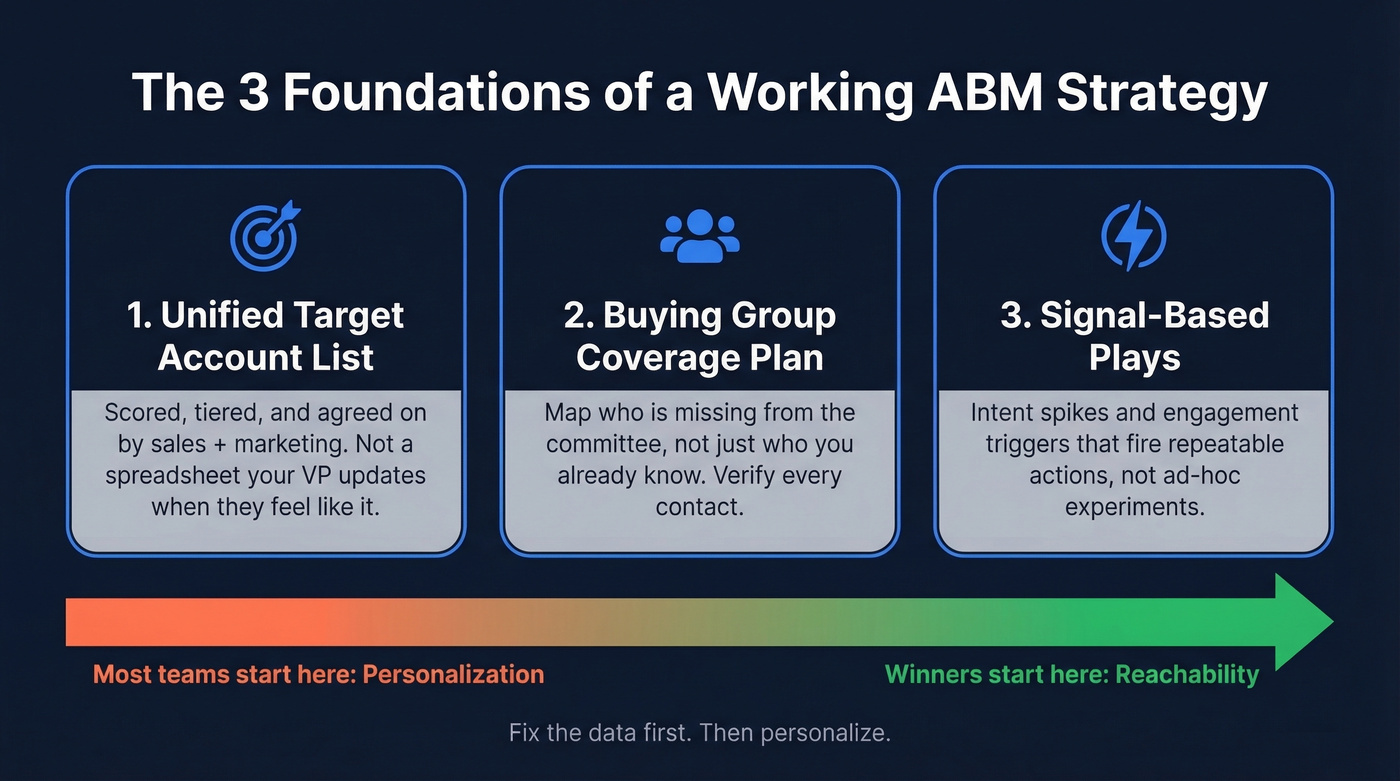
- A unified target account list with a scoring model and tiering thresholds - not a spreadsheet your VP of Sales updates when they feel like it
- A buying-group coverage plan that maps who's missing, not just who you already know
- Signal-based plays - intent spikes and engagement triggers that fire repeatable actions, not ad-hoc experiments
Most guides on account-based marketing obsess over personalization. The real lever is reachability. If your contact data is wrong - stale emails, disconnected numbers, missing stakeholders - your beautifully personalized microsite never reaches the buying committee. Fix the data first. Then personalize. This mindset separates programs that produce pipeline from those that produce slide decks.
ABM vs. Demand Gen
Some practitioners argue ABM is just competent B2B marketing with a name - and they're partly right. The difference is the system. An account-based marketing strategy forces you to agree on accounts, coordinate across teams, and measure what actually matters. Demand gen doesn't require that discipline.
Use ABM when:
- Your sales cycle runs 3+ months with 6-10 decision-makers per deal
- You're selling into a niche ICP where volume-based lead gen produces mostly noise
- Your LTV:CAC ratio is 3:1 or higher, meaning each won account justifies concentrated spend
Stick with demand gen when:
- Your market is broad and your product is self-serve or low-touch
- Deals close in under 30 days with one or two stakeholders
- You don't have the sales alignment or data infrastructure to support account-level plays
So who should use account-based marketing? Companies with high-value, complex deals and identifiable buying committees. If your average contract value is under $10K and closes in a single call, the concentrated approach will cost more than it returns.
Most mature teams run a hybrid. Demand gen fills the top of funnel and catches accounts you haven't identified yet. ABM concentrates resources on the accounts that actually matter. They're different gears, not competing strategies.
Account Selection: The Foundation
The scoring model is where your program lives or dies. We've seen pilots stall because sales picked "random priority accounts" with no data backing - just gut feel and relationship history. The fix is a unified list built from CRM data, intent signals, and technographic fit, scored and tiered so everyone agrees on where to focus.
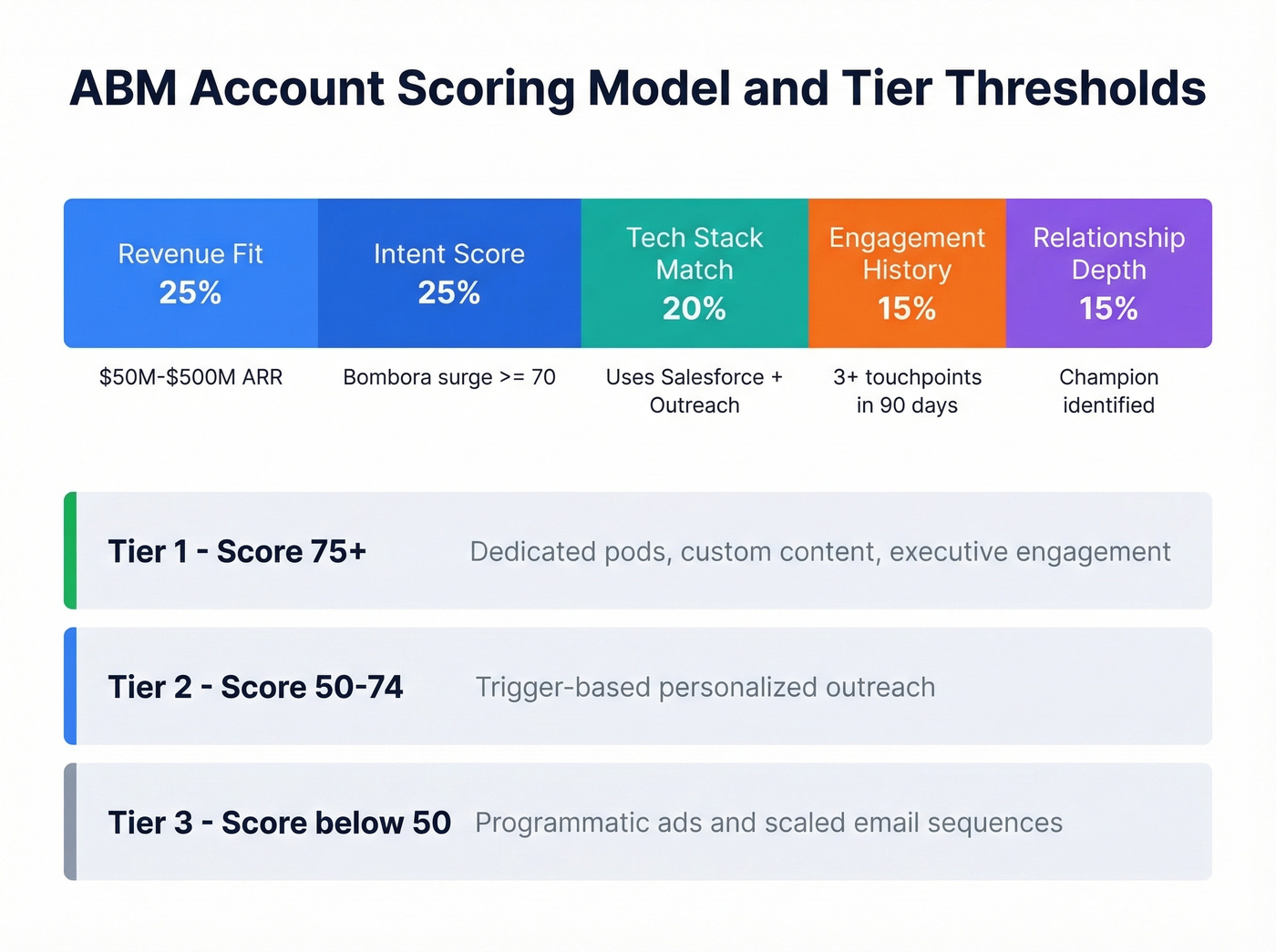
| Signal | Weight | Example Threshold |
|---|---|---|
| Revenue fit | 25% | $50M-$500M ARR |
| Tech stack match | 20% | Uses Salesforce + Outreach |
| Intent score | 25% | Bombora surge >= 70 |
| Engagement history | 15% | 3+ touchpoints in 90 days |
| Relationship depth | 15% | Existing champion identified |
Accounts scoring above 75 go into Tier 1 - dedicated pods, custom content, executive engagement. Scores between 50-74 land in Tier 2 with trigger-based personalized outreach. Everything below 50 gets Tier 3 treatment: programmatic ads and scaled email sequences.
GoodShape used exactly this kind of disciplined account selection and engaged 80% of their 337 target accounts. A tight, well-researched list outperforms a bloated one every time.

Buying Group Mapping
According to Gartner, B2B buyers spend only 17% of their time meeting with suppliers. The rest is internal research, committee discussions, and vendor comparisons you'll never see - the dark funnel that influences deals without leaving a trace in your CRM.
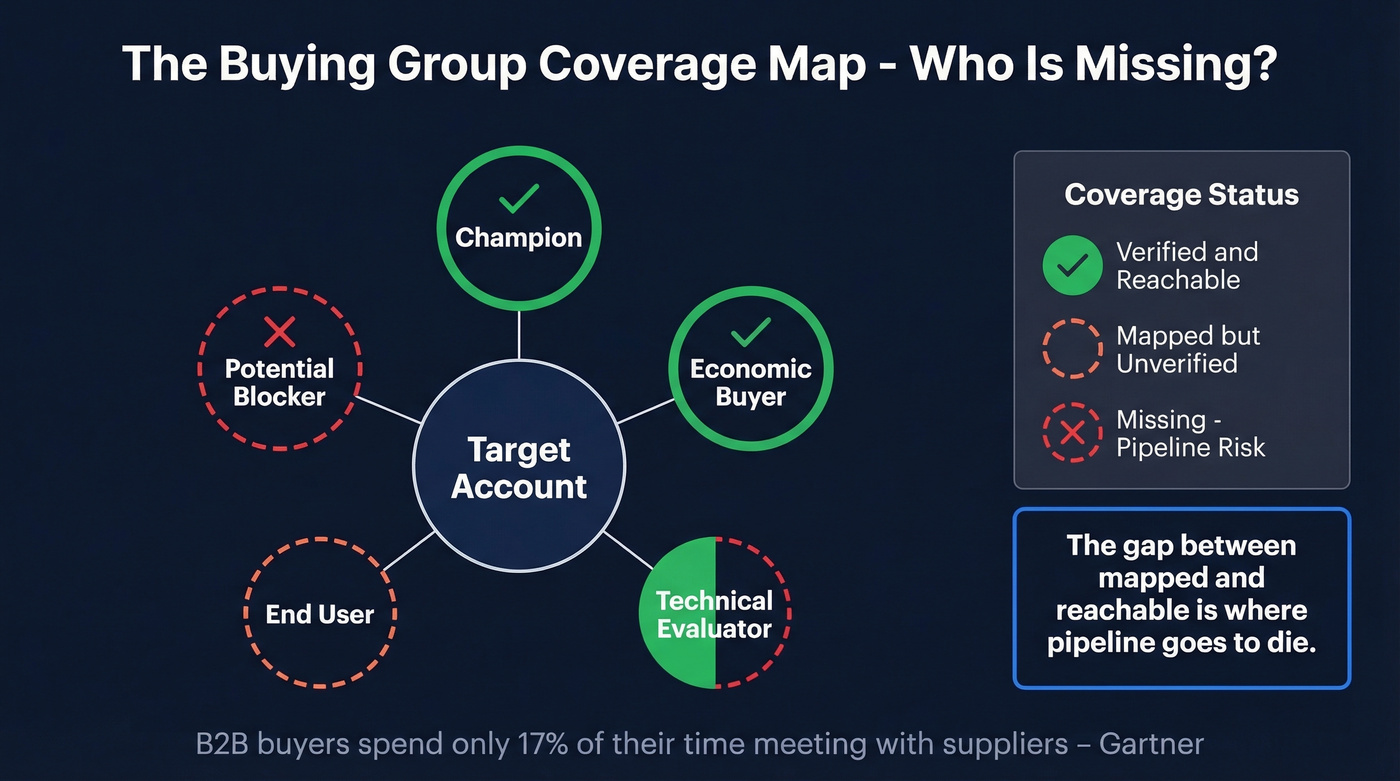
Your window to influence is tiny. If you're only reaching one or two contacts at an account, you're missing the committee entirely.
The operating question isn't "how many contacts do we have?" It's "who is missing?"
| Role | Tier 1 Target | Tier 2 Target | Tier 3 Target |
|---|---|---|---|
| Champion | 1-2 verified | 1 verified | Optional |
| Economic buyer | 1 verified | 1 verified | Programmatic only |
| Technical evaluator | 1-2 verified | 1 verified | Programmatic only |
| Potential blocker | 1 identified | Optional | Skip |
| End user | 2-3 verified | 1-2 verified | Programmatic only |
Here's the thing: your buying-group map is only useful if you can actually reach every person on it. This is where most programs quietly fail - the map looks great in a slide deck, but half the emails bounce and the phone numbers are disconnected. In our experience, the gap between "mapped" and "reachable" is where pipeline goes to die. A B2B data platform with verified emails and mobile numbers, refreshed on a weekly cycle, closes that gap. Map the committee, verify every contact, then run your plays.

Your ABM buying-group map is worthless if half the contacts bounce. Prospeo gives you 98% verified emails and 125M+ mobile numbers refreshed every 7 days - so every stakeholder on your committee map is actually reachable. Layer in intent data across 15,000 Bombora topics to time your plays perfectly.
Close the gap between "mapped" and "reachable" in minutes.
Signals, Intent, and Timing
Intent data breaks into three tiers. First-party signals - your website visits, email engagement, demo requests - are the most accurate and real-time. Second-party data comes from partner sites, review platforms, and events. Third-party intent, aggregated across the web by providers like Bombora, gives you the earliest warning that an account is researching your category.
The mistake most teams make is monitoring intent without operationalizing it. Here's what operationalized intent looks like in practice:
- Weekly hot-accounts pull every Monday - surface accounts with intent surges across your target topics
- Committee-in-motion alerts - when three or more people at the same account research related topics, that's a buying committee moving; escalate immediately
- Re-engagement triggers - an account that went dark three months ago and suddenly starts researching again deserves fresh content, not the same sequence they ignored
- Competitive displacement plays - accounts visiting comparison pages or researching competitor-specific terms get targeted ads and direct outreach positioning your differentiation
AI is accelerating all of this. Dynamic account lists that re-score and re-tier automatically based on real-time intent aren't experimental anymore - they're table stakes for teams running serious programs in 2026. Expect 6-12 months of tuning before your models stabilize, but the payoff is a list that updates itself.
Stack engagement scoring on top, with decay built in. A webinar attendance from last week matters more than a whitepaper download from three months ago. Without decay, your scoring model fills up with stale signals and everything looks "engaged." If you want a cleaner way to operationalize this, start with identifying buying signals and a simple scoring rubric.
The Plays Library
Every play needs a tier, a trigger, and a channel:
| Tier | Trigger | Channel | Example Play |
|---|---|---|---|
| 1:Many | Fits ICP, no intent | Programmatic ads, scaled email | Industry-specific ad sequence + nurture |
| 1:Few | Intent surge on 2+ topics | Personalized email + microsite | "We built this for [Company]" microsite |
| 1:Few | Job change at target account | Direct outreach | New VP gets a tailored intro sequence |
| 1:1 | Open opp, expansion signal | Executive engagement + direct mail | CFO gets a handwritten note + ROI model |
| 1:1 | Competitor evaluation detected | Multi-channel blitz | Comparison content + SDR call + ad retarget |
Buyers don't live in one channel, and neither should your plays. The best account-based selling examples combine email, ads, direct mail, phone, and social touches orchestrated around the same account narrative - not scattered across disconnected campaigns. If you're building the outbound side, borrow a few proven sales prospecting techniques to keep the motion consistent across reps.
The pod structure matters. For Tier 1 accounts, an AE, SDR, and ABM manager work as a unit - hunting in packs. They share context, coordinate timing, and avoid the classic problem of marketing sending an email the same day sales makes a cold call with a completely different message. 73% of teams with strong sales-marketing alignment hit their ABM targets. Misaligned teams rarely do.
One underrated channel: print and direct mail. For your top 20 accounts, a $50 direct mail piece triggered by an engagement score threshold has outsized impact when every competitor is running the same programmatic ads. Skip this if your deal sizes don't justify the unit economics, but for enterprise plays, it's a genuine differentiator. If you want a deeper breakdown of formats and timing, see direct mail for lead generation. Don't overlook cross-sell opportunities either - existing customers showing intent on adjacent product categories are some of the highest-conversion targets you'll find.
Measurement That Survives the Attribution Apocalypse
Stop measuring MQLs for ABM. A webinar signup from a target account isn't a "marketing qualified lead" - it's one signal from one person in a buying committee of eight. The metric that matters is account-stage movement: how many target accounts moved from "aware" to "interested" to "considering" to "selecting" to "closed won" this quarter.
Measure these:
- Account-stage progression (% of Tier 1 accounts advancing per quarter)
- Buying-group coverage (% of committee roles with verified contacts)
- Engagement score trends with decay
- Deal velocity for ABM-touched accounts vs. non-ABM
Stop measuring these:
- MQLs from target accounts
- Individual contact-level attribution
- Ad impressions or email opens in isolation
Let's be honest about why ABM reporting breaks - and why it's not your fault. Cookies disappear thanks to Safari ITP and ad blockers. Redirect chains strip UTM parameters. LinkedIn's attribution window caps at 90 days. Then marketing gets blamed for "no ROI" on a program that actually influenced $2M in pipeline. The teams that get attribution right focus on account progression and buying-group coverage - those metrics survive when everything else crumbles.
AVEVA proved this works at scale. Their program generated PS7M in pipeline and won Forrester's B2B Program of the Year - not by chasing MQLs, but by tracking account-stage movement and buying-group coverage across their entire target list.
The 90-Day Rollout Plan
| Phase | Timeline | Actions | |---|---|---|---| | Foundation | Weeks 1-2 | Define ICP + scoring model; build unified target list; map buying groups for Tier 1 | | Pilot | Month 1 | Launch 1:few plays for 10-20 Tier 1 accounts; assign pods; set up weekly hot-accounts review | | Optimize | Month 2 | Tune intent signals; add channels like direct mail and retargeting; expand to Tier 2 accounts | | Scale | Month 3 | Add 1:many programmatic; formalize pod structure; run first quarterly review with sales |
A practitioner who rebuilt their program on this timeline reported 100% reach of target accounts, 56% engagement signals, 63% meeting-to-opportunity conversion, and 17% of new opportunity goals closed within 90 days. The biggest unlock wasn't new tech - it was sales and marketing finally agreeing on the same list and the same definitions. The consensus on r/b2bmarketing echoes this: alignment problems kill more ABM programs than bad tooling ever will.
BlueBotics did something similar with a marketing team of one: they built 160 new relationships, achieved 100% engagement from their 12 one-to-few accounts, and generated PS4M+ in opportunities. You don't need a massive team. You need a system.
Start small. Ten accounts is enough for a pilot. Launching an ABM strategy doesn't require perfection - it requires a clear account-based sales framework, a verified contact list, and the discipline to run the same plays consistently before you optimize. If you need a tighter definition of the sales motion, use these account-based selling best practices as your baseline.
Tooling and Budget
| Category | Examples | Annual Cost | Implementation | Best For |
|---|---|---|---|---|
| ABM suites | Demandbase, 6sense | $50K-$150K+ | 3-6 months | Enterprise, full-stack ABM |
| Ad-first ABM | RollWorks | $15K-$40K/year | 6-12 weeks | Mid-market, programmatic focus |
| Data + enrichment | Prospeo | Free tier available; paid from ~$39/mo | Same day | Verified contacts + intent signals |
| Orchestration | HubSpot, Marketo | $10K-$50K/year | 4-8 weeks | Workflow automation |
When evaluating tools, Directive's framework nails the six pillars: data coverage, intent detection, personalization, measurement, integrations, and team fit. Operational benchmarks to aim for: 90%+ account matches within 24 hours and less than 5% unknown touches. If you're comparing vendors, start with a shortlist of data enrichment services before you commit to a full ABM suite.
I'll say it plainly: you don't need a $100K ABM suite to start. We've tested stacks at every price point, and the pattern is clear - data quality underneath matters more than the platform on top. Pair a solid data and enrichment tool with your existing CRM and a sequencing tool, and you've got a functional account-based marketing program for under $1,000/month. The Demandbase 2024 ABM Benchmark found top marketers achieving 81% higher ROI with ABM, but ROI depends on execution, not platform spend. Build on a stack you can actually maintain, not one that requires a dedicated ops team just to keep the lights on.
Stop running ABM plays on stale data. Prospeo's 30+ search filters - including buyer intent, technographics, headcount growth, and funding - let you build and tier your target account list the way this guide recommends. At $0.01 per email, you get enterprise-grade account selection without the enterprise price tag.
Build your scored target account list in one search, not one quarter.
FAQ
How long does it take to see results from ABM?
Most teams see measurable account engagement within 30-60 days of launching a pilot, with pipeline impact appearing around 90 days. One practitioner hit 63% meeting-to-opportunity conversion and closed 17% of new opportunity goals within 90 days by unifying their target list and running signal-based plays.
What's the minimum team size needed?
You can run a successful program with a single marketer. BlueBotics generated PS4M+ in opportunities with one person managing 12 one-to-few accounts. Tier your accounts - run 1:1 plays for 10-20, automate 1:many for the rest - and adopt a pod structure as you scale.
How do you build a reachable buying group without enterprise tools?
Use a B2B data platform to search by company, job title, department, and intent signals. With 300M+ profiles and 98% verified email accuracy, Prospeo lets you map an entire buying committee in minutes. Export directly to your CRM or sequencer and start running plays the same day.
What are the highest-impact ABM use cases?
New logo acquisition for enterprise deals, pipeline acceleration for stalled opportunities, customer expansion and cross-sell plays, and competitive displacement campaigns deliver the strongest returns. CSMs who map stakeholders and track engagement signals also retain and expand accounts more effectively than those relying on reactive support.
How does account-based selling differ from traditional prospecting?
Account-based selling flips the funnel: instead of casting a wide net and qualifying down, sales teams start with a defined list of high-fit accounts and penetrate the buying committee systematically. Every touchpoint - from the first cold call to the executive dinner - is coordinated around a shared account plan, concentrating effort where win rates and deal sizes are highest.