

The B2B Demand Generation Funnel That Actually Converts
Your CMO wants to know why 2,000 MQLs turned into 12 opportunities last quarter. The answer isn't that marketing failed - it's that your demand generation funnel wasn't built for the reality of 266 touchpoints between first impression and closed-won. The model isn't broken. Your measurement of it is.
The fix: replace TOFU/MOFU/BOFU with a three-level demand model mapped to real time horizons, accept that your funnel breaks at the handoff and the data layer, and focus on 3-5 programs you actually measure instead of 50 tactics you can't attribute.
Why Traditional Funnels Fail
The Ehrenberg-Bass "95/5 rule" gets thrown around constantly - 95% of your market isn't buying right now. It's directionally correct but lazily applied. NetLine's buyer-level intent data shows 7.6% are ready to decide this quarter, with another 7.6% in the 3-6 month window. That's 15.2% "soon." Changes how you plan, doesn't it?
The average B2B buying cycle runs 10.1 months, and 61% of that journey happens before a buyer ever contacts you. Another benchmark worth sitting with: 92% of buyers start with at least one vendor already in mind. If you're not shaping preference during those invisible months, you're not in the game - you're catching scraps. For $100K+ ACV deals, the math gets worse: 417 touchpoints and 5,500 impressions before close.
A Better Framework: Three Levels
Generic TOFU/MOFU/BOFU labels tell you nothing about buyer psychology or timing. Here's a model that maps demand to what the buyer actually wants at each stage.
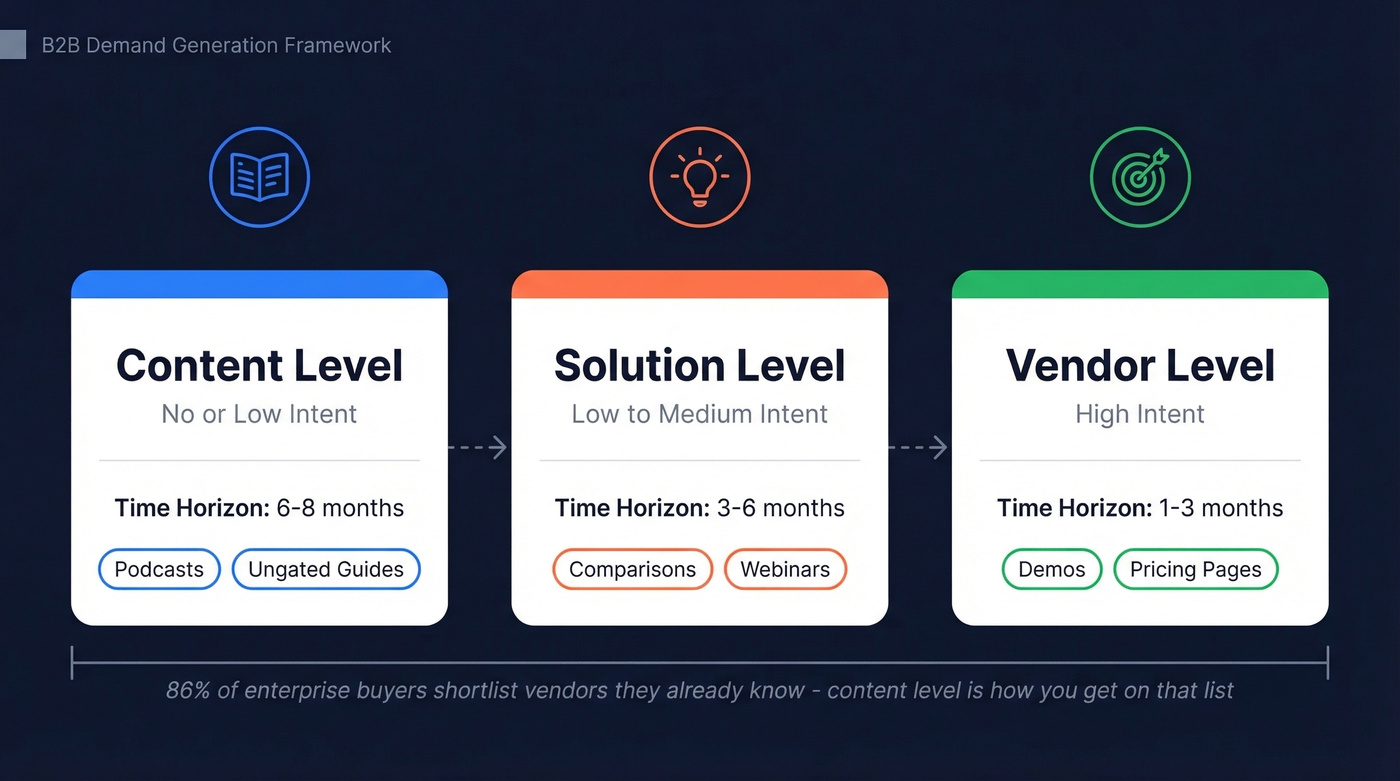
| Level | Buyer Intent | Time Horizon | Tactics |
|---|---|---|---|
| Content | None/low | 6-8 months | Podcasts, ungated guides |
| Solution | Low/medium | 3-6 months | Comparisons, webinars |
| Vendor | High | 1-3 months | Demos, pricing pages |
This forces you to plan programs with a 6-8 month payoff window for content-level demand, instead of expecting gated ebooks to produce pipeline next quarter. 86% of enterprise buyers shortlist vendors they'd heard of before starting research. Content-level demand is how you get on that list. Cognism famously needed 500 content MQLs to close one deal versus 25 inbound demos - that's the math on gated content as a vanity metric.
One shift we're seeing from the best teams: measuring at the account level rather than individual MQLs. Contact-level scoring misses the buying committee entirely.
Channel Mix That Moves the Needle
HockeyStack analyzed 1.5M+ contacts across 50+ B2B SaaS companies and found it takes 54 touchpoints after first website visit to generate an MQL. Here's where those touchpoints happen:
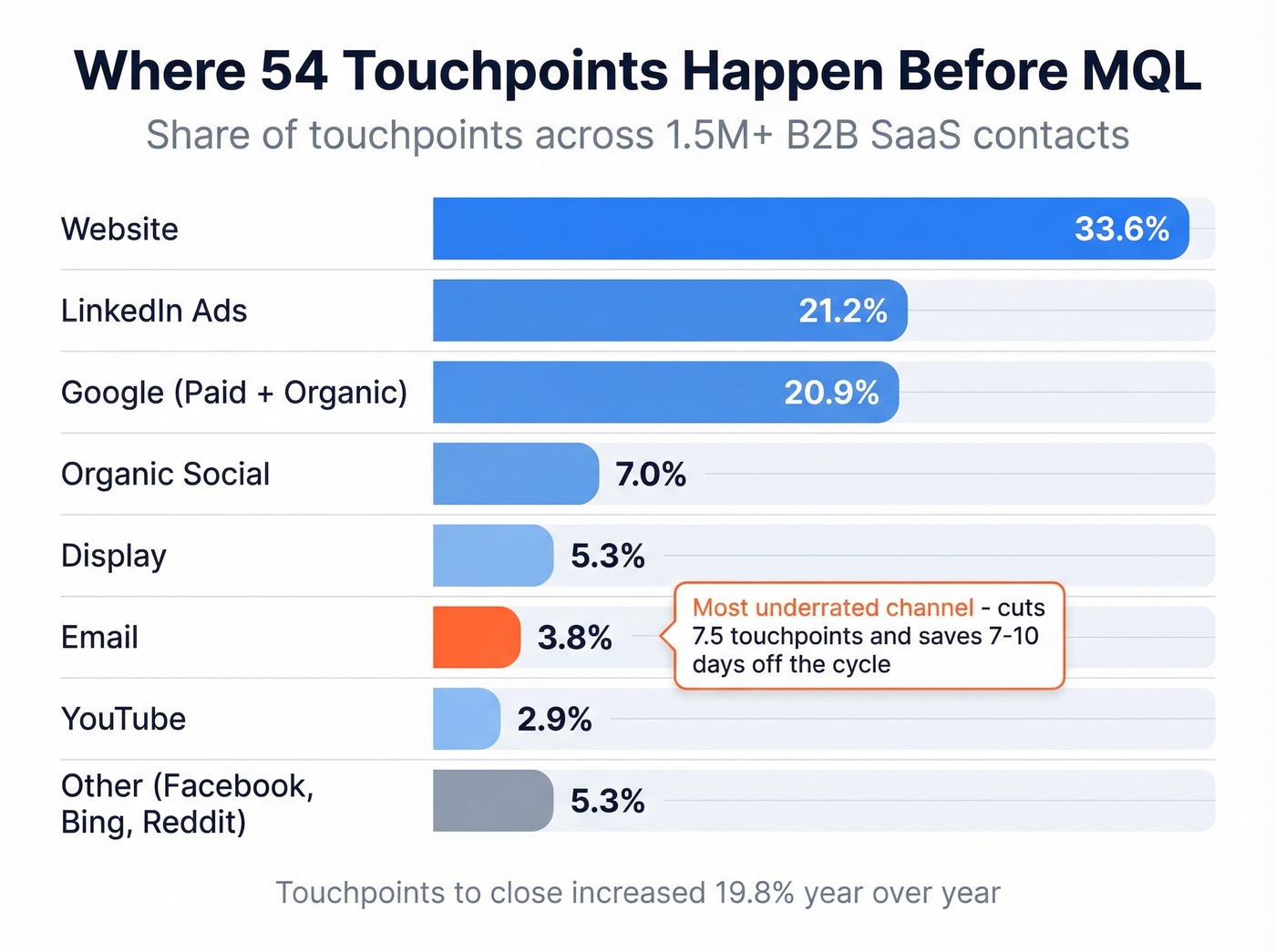
| Channel | Share of Touchpoints |
|---|---|
| Website | 33.6% |
| LinkedIn Ads | 21.2% |
| Google (paid + organic) | 20.9% |
| Organic Social | 7.0% |
| Display | 5.3% |
| 3.8% | |
| YouTube | 2.9% |
| Other (Facebook, Bing, Reddit) | 5.3% |
The mix matters less than what shortens the cycle. Email marketing cuts the average by 7.5 touchpoints and shaves 7-10 days off the timeline, making it the most underrated channel in demand gen. YouTube remarketing reduces touchpoints by 7.1, though done poorly it actually adds 4. And the whole journey is getting harder: touchpoints to close increased 19.8% year-over-year.

Email cuts 7.5 touchpoints off the buying cycle - but only if your emails actually land. Prospeo delivers 98% email accuracy on a 7-day refresh cycle, so every demand signal you generate reaches a real inbox instead of dying at the handoff.
Stop losing pipeline to bounced emails at $0.01 per verified contact.
Stage Conversion Benchmarks
Once someone enters your measured funnel, First Page Sage's B2B SaaS benchmarks provide a useful baseline:
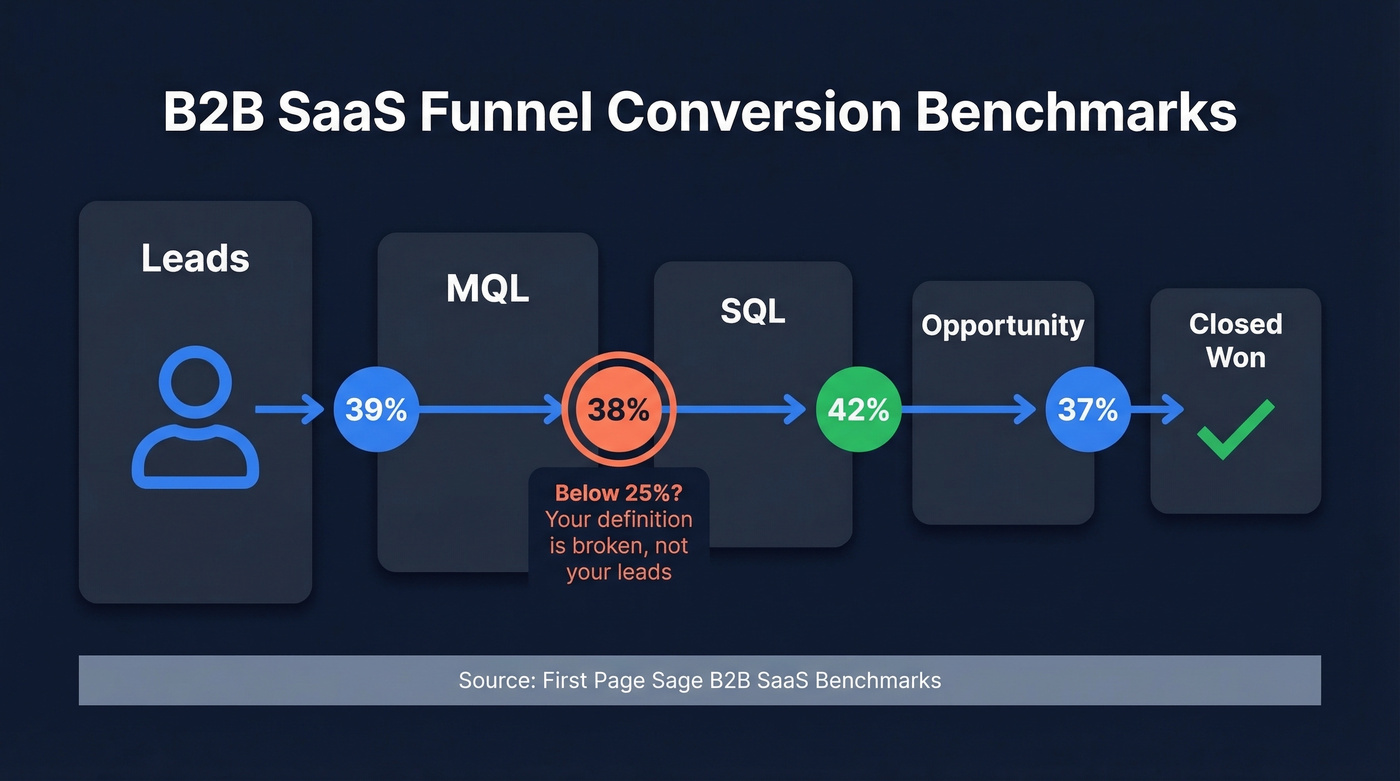
| Stage | Conversion Rate |
|---|---|
| Lead to MQL | 39% |
| MQL to SQL | 38% |
| SQL to Opportunity | 42% |
| SQL to Closed Won | 37% |
If your MQL-to-SQL rate is below 25%, the problem is definition alignment between marketing and sales, not lead quality. We've audited dozens of funnels, and this is the single most common failure - two teams using the same acronym to mean completely different things. Get in a room, write down what "qualified" means, and don't leave until both sides agree.
Five Ways Your Funnel Breaks
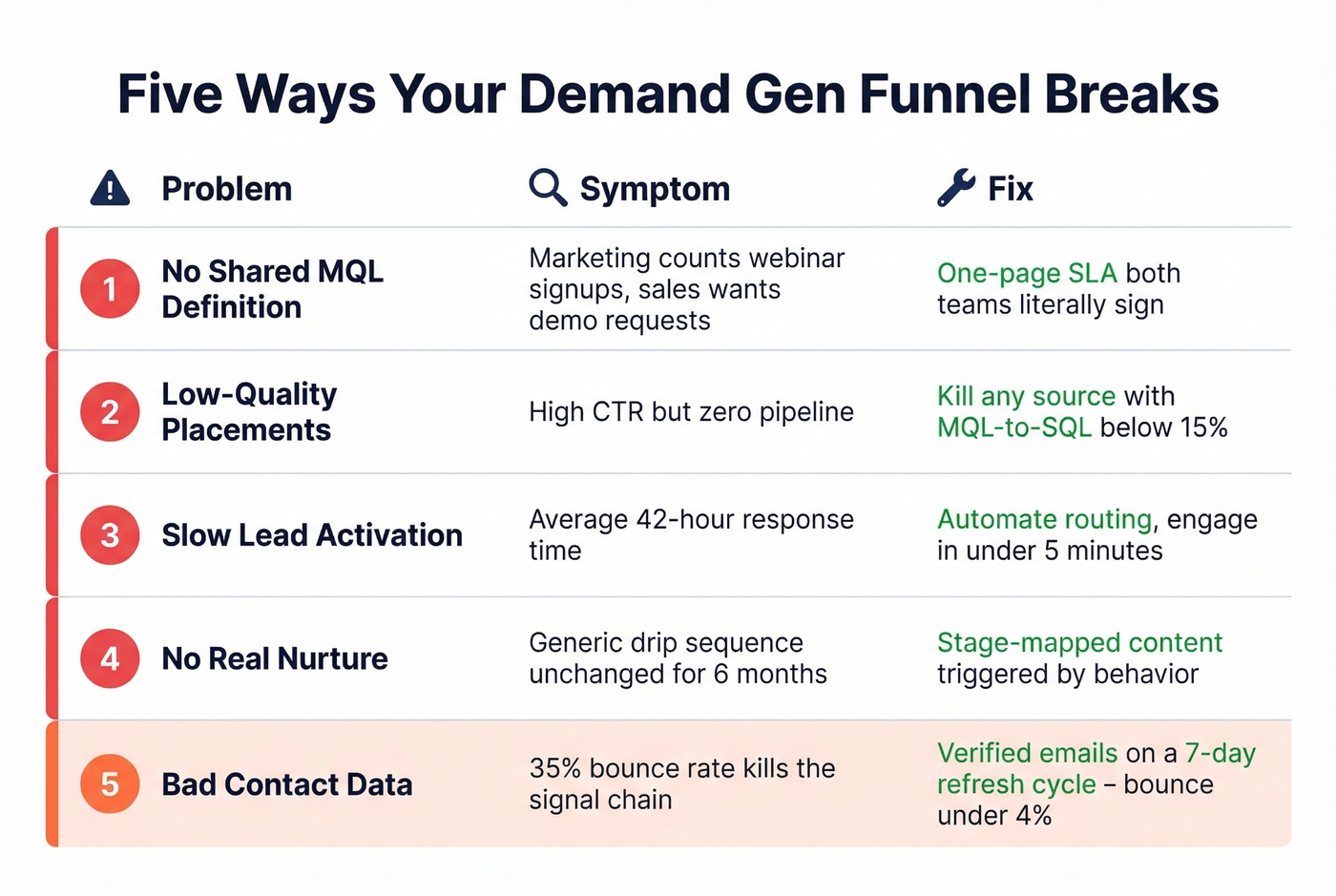
No shared MQL definition. Marketing counts a webinar registrant. Sales wants a demo request. Fix this with a one-page SLA that both teams sign - literally sign - with scoring thresholds and response time commitments.
| Problem | Symptom | Fix |
|---|---|---|
| Low-quality placements | High CTR, zero pipeline | Kill any source with MQL-to-SQL below 15%, regardless of CPL |
| Fragmented attribution | CRM says one thing, MAP says another | Pick one source of truth. Reconcile quarterly, not daily. |
Let's be honest: we've seen teams argue about dashboards for months instead of just shipping campaigns. Don't be that team.
Slow lead activation. Average lead response time is 42 hours. Top teams engage in under 5 minutes. Automate routing, and make sure reps have working contact data when the lead hits their queue - a bounced first email kills the entire signal chain.
No real nurture after capture. Most teams dump MQLs into a generic drip sequence and call it nurture. Real nurture means content mapped to buying stage, triggered by behavior, and refreshed regularly. If your nurture sequence hasn't been updated in six months, it's probably doing more harm than good.
Bad contact data killing conversion. This is the failure mode nobody in the demand gen conversation talks about enough. You generate the signal, route the lead, and the rep's first email bounces. One of our customers, Meritt, ran a 35% bounce rate before switching their data layer - pipeline was stuck at $100K/week. After moving to Prospeo's verified emails with a 7-day refresh cycle, bounce rates dropped under 4% and pipeline tripled to $300K/week.

Here's the thing: if your deal size is under $25K, you probably don't need a six-figure intent platform. You need accurate contact data and a fast follow-up process. Most funnel problems aren't signal problems - they're execution problems.
Measuring the Dark Funnel
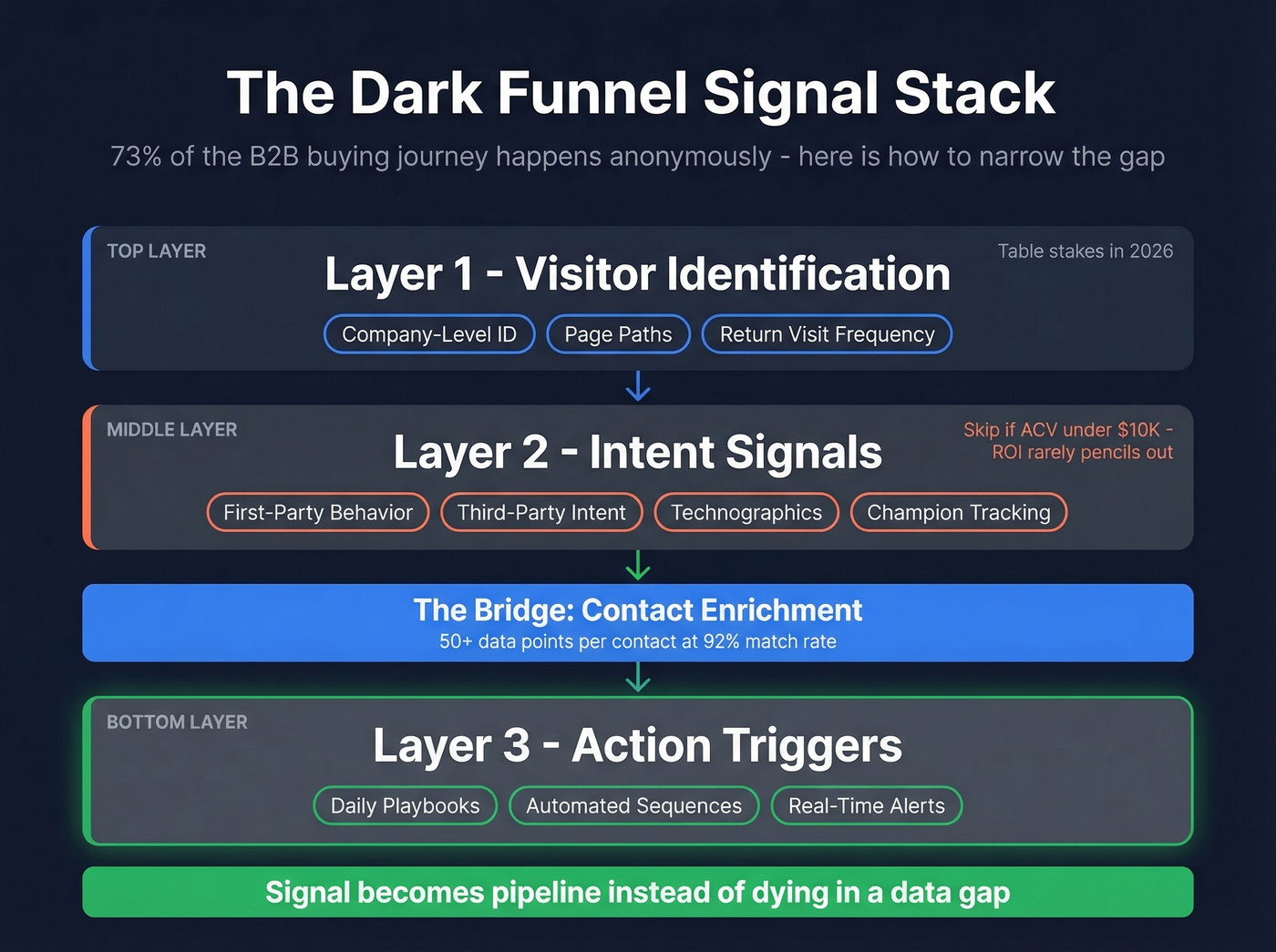
73% of the B2B buying journey happens anonymously. You can't measure what you can't see, but you can build a signal stack that narrows the gap.
The "funnels are dead" crowd is loud on every B2B marketing subreddit and Slack community, but nobody's proposed a better model for tracking buyer progression. The funnel isn't dead. It just has a dark layer you need to account for.
Layer 1 - Visitor identification. Company-level ID, page paths, return visit frequency. This is table stakes in 2026.
Layer 2 - Intent signals. First-party behavior layered with third-party intent data, technographics, and champion tracking. Skip this if your ACV is under $10K - the ROI on intent platforms rarely pencils out at that deal size, and you're better off investing in faster follow-up and better outbound lists.
Layer 3 - Action triggers. Prioritized daily playbooks, automated sequences, real-time alerts. The bridge between signal and action is enrichment: when you identify an account showing intent, you need verified contact data for the right buyers immediately, not next week. Prospeo's enrichment API returns 50+ data points per contact at a 92% match rate, turning intent signals into pipeline instead of letting them die in a data gap.
Meritt's funnel was generating signals just fine - 35% bounce rates were killing them at activation. After switching to Prospeo's verified data, bounce dropped under 4% and pipeline tripled to $300K/week. Same team, same funnel, better data layer.
Your demand gen funnel is only as good as the contact data feeding it.
FAQ
What's the difference between demand generation and lead generation?
Lead gen captures known intent through forms and gated content. Demand gen creates preference before buyers enter the market, so you're already shortlisted when they do. Think of lead gen as a subset of demand gen - the capture mechanism, not the strategy.
How long does a demand gen funnel take to produce results?
Content-level programs need 6-8 months to influence pipeline. High-intent capture - demo requests, bottom-funnel paid search - can show results in 1-3 months. Most teams underinvest in the 6-month horizon and over-index on short-term tactics that produce MQLs but not revenue.
What tools do you need to run a demand gen funnel?
At minimum: a CRM, marketing automation, an intent data source, a visitor identification tool, and a data verification layer to ensure contact data doesn't kill conversion at the handoff. Five tools, not fifteen - stack simplicity beats feature bloat every time.