

B2B Email in 2026: Everything That Actually Works
A RevOps lead we know ran a 10,000-email cold campaign last quarter with a "verified" list from a well-known provider. Bounce rate hit 35%. Two sending domains got flagged within a week. The copy was fine - the data was garbage.
That's the state of B2B email right now: the channel works better than ever, but only if your infrastructure and data quality can keep up.
Why B2B Email Still Wins
Email quietly outperforms every other B2B channel on ROI, and it's not close. The 36:1 return that Litmus reports makes paid social look like a rounding error. B2B buyers are roughly 57% through their purchase decision before they ever talk to a sales rep - a widely cited CEB/Gartner finding that still holds - which means email, both cold outreach and nurture sequences, is how you show up during that invisible evaluation window.
The old playbook of blasting 10,000 contacts at 0.5% reply rates is dead. Practitioners on r/ColdEmailMasters now run 500 highly targeted emails at 8-12% reply rates. Same pipeline output, zero domain damage.
Here's the thing: if your average deal size sits below $10K, you probably don't need ZoomInfo-level data spend. A $39/month sending tool plus verified emails at $0.01 each will outperform a $25K/year platform with stale contacts every single time.
| Cold Outreach | Opt-In Marketing | Spam | |
|---|---|---|---|
| Legal basis | Legitimate interest | Consent/opt-in | None |
| Audience | ICP-matched prospects | Subscribers | Purchased/scraped lists |
| Key metric | Reply rate | Click rate | Complaint rate |
| Typical tools | Instantly, Smartlead | HubSpot, Mailchimp | Don't |
2026 Benchmarks Worth Knowing
Most benchmark articles recycle 2023 data. Here's what's current.
Cold outreach benchmarks:
| Metric | 2026 Benchmark |
|---|---|
| Open rate | ~27.7% |
| Reply rate | ~3.43% (down from 5.1%) |
| Never reach inbox | ~17% |
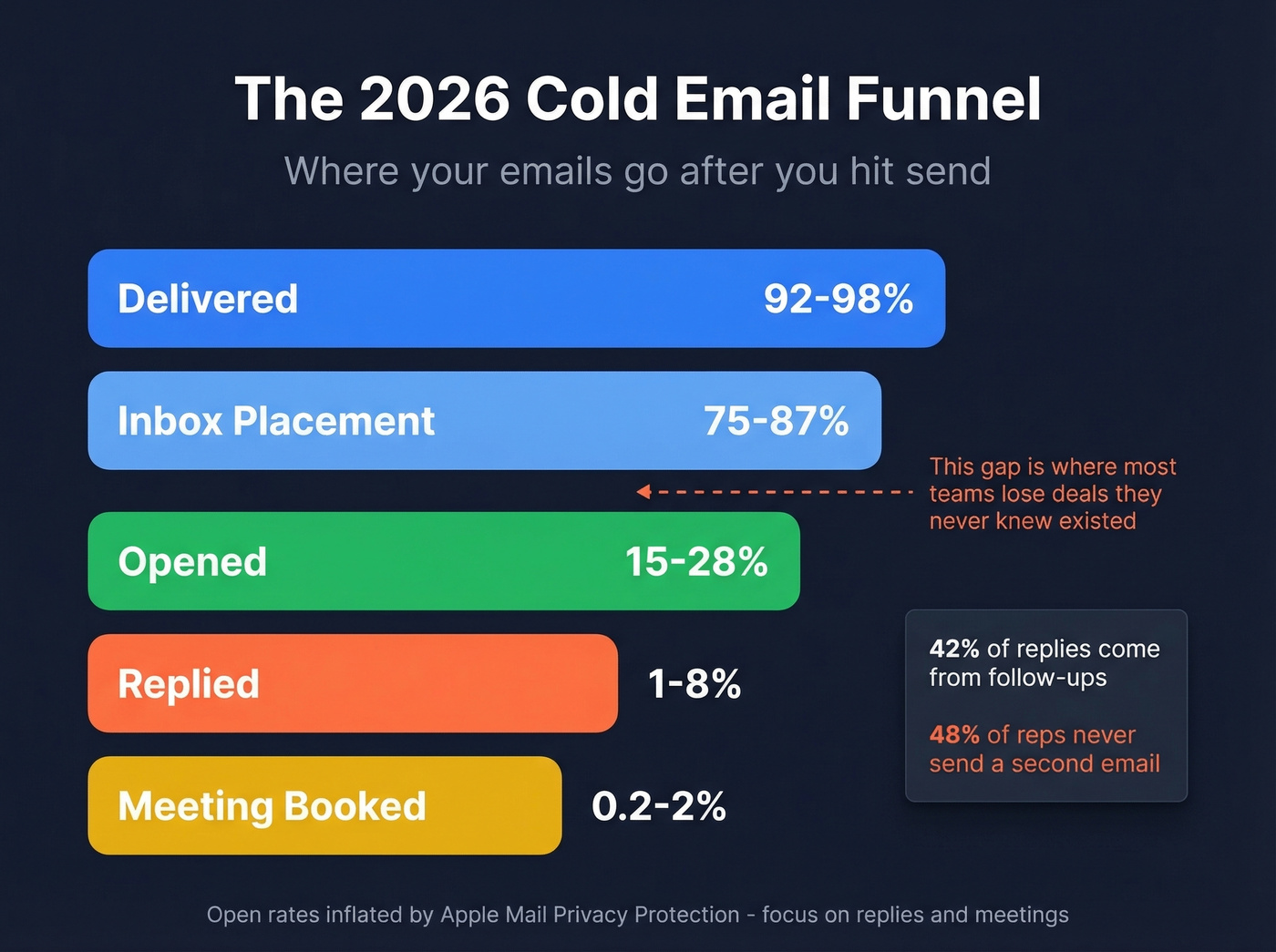
| Replies from follow-ups | 42% |
| Meeting conversion | 0.2-2% |
Marketing email benchmarks (latest Mailchimp data):
| Metric | Benchmark |
|---|---|
| Open rate | 35.63% |
| Click rate | 2.62% |
| Unsubscribe rate | 0.22% |
A caveat on open rates: Apple Mail Privacy Protection pre-loads tracking pixels, inflating numbers across the board. Click and reply rates are the metrics that actually matter now.
Separately, Klaviyo's ecommerce data shows automated flows generating 41% of email revenue from just 5.3% of sends. The principle applies to B2B too, even if the exact numbers skew toward ecommerce. Invest in triggered sequences over batch campaigns.
Deliverability: What Changed
2025 was a bloodbath for deliverability. 2026 hasn't recovered.
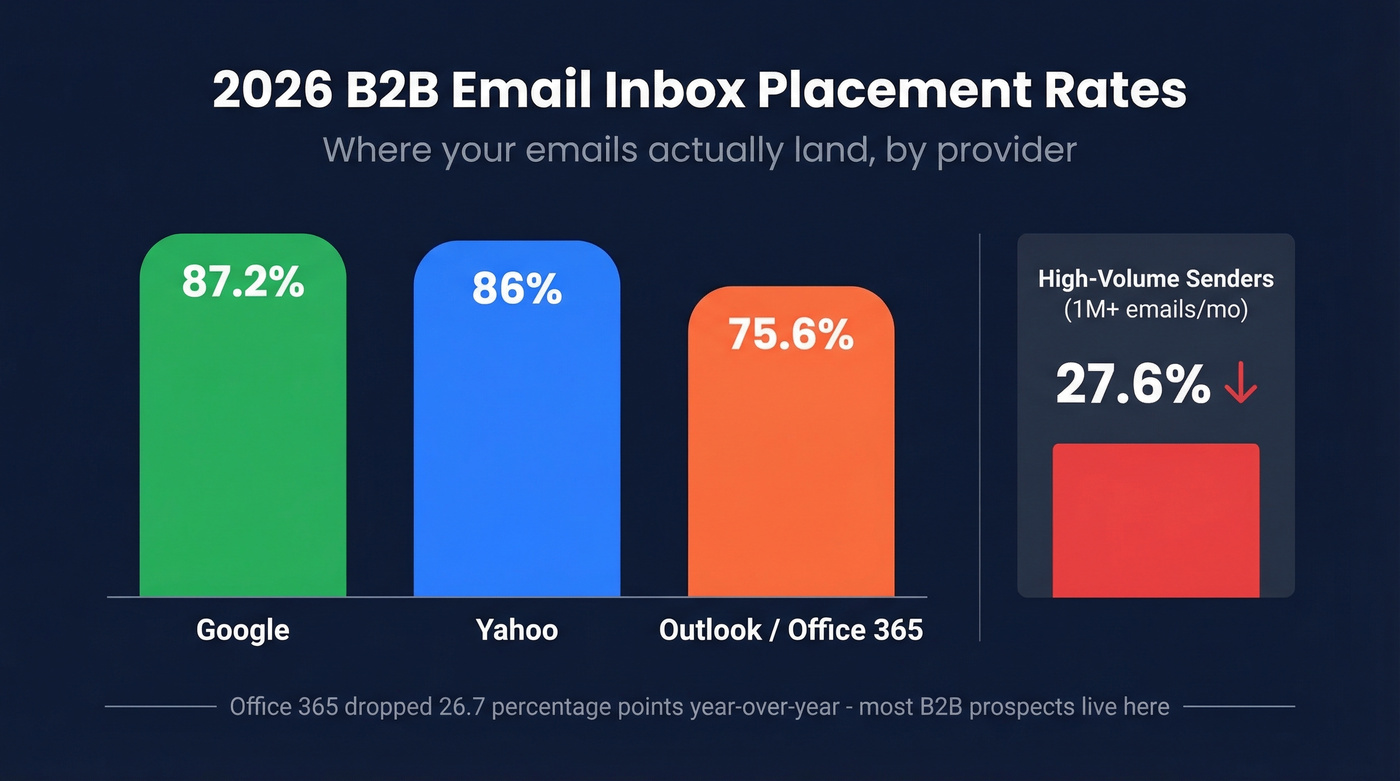
Office 365 inbox placement dropped 26.7 percentage points year-over-year. Current inbox placement rates: Google 87.2%, Yahoo 86%, Outlook 75.6%. If your prospects live in Microsoft inboxes - and most B2B prospects do - this matters enormously. High-volume senders got hit hardest, with those sending 1M+ emails per month seeing inbox placement crater to roughly 27.6%.
The cold outreach funnel in 2026 breaks down like this: delivery sits at 92-98% (the server accepts it), inbox placement at 75-87% (lands in primary, not spam), opens at 15-28%, replies at 1-8%, and meetings at 0.2-2%. That gap between "delivered" and "inbox" is where most teams lose deals they never knew existed.
Only 7.6% of domains enforce DMARC with quarantine or reject policies. That means 92% of senders leave the door open for spoofing and deliverability penalties. The fix works, though - full authentication plus proper warmup restores 85-95% inbox placement.
Google and Yahoo's bulk sender rules now require SPF + DKIM authentication, a published DMARC record, one-click unsubscribe for marketing emails, and a complaint rate under 0.3%. These aren't suggestions. They're enforcement thresholds.

That 35% bounce rate from the intro? It's a data problem, not a sending problem. Prospeo's 5-step verification with catch-all handling, spam-trap removal, and honeypot filtering delivers 98% email accuracy - refreshed every 7 days, not every 6 weeks.
Stop burning domains. Start with data that actually verifies.
Cold Email Infrastructure Playbook
This is what separates teams who get replies from teams who get blacklisted. One practitioner on Reddit documented sending 40,000+ cold emails in a single month with 90%+ deliverability and 3-6% reply rates.
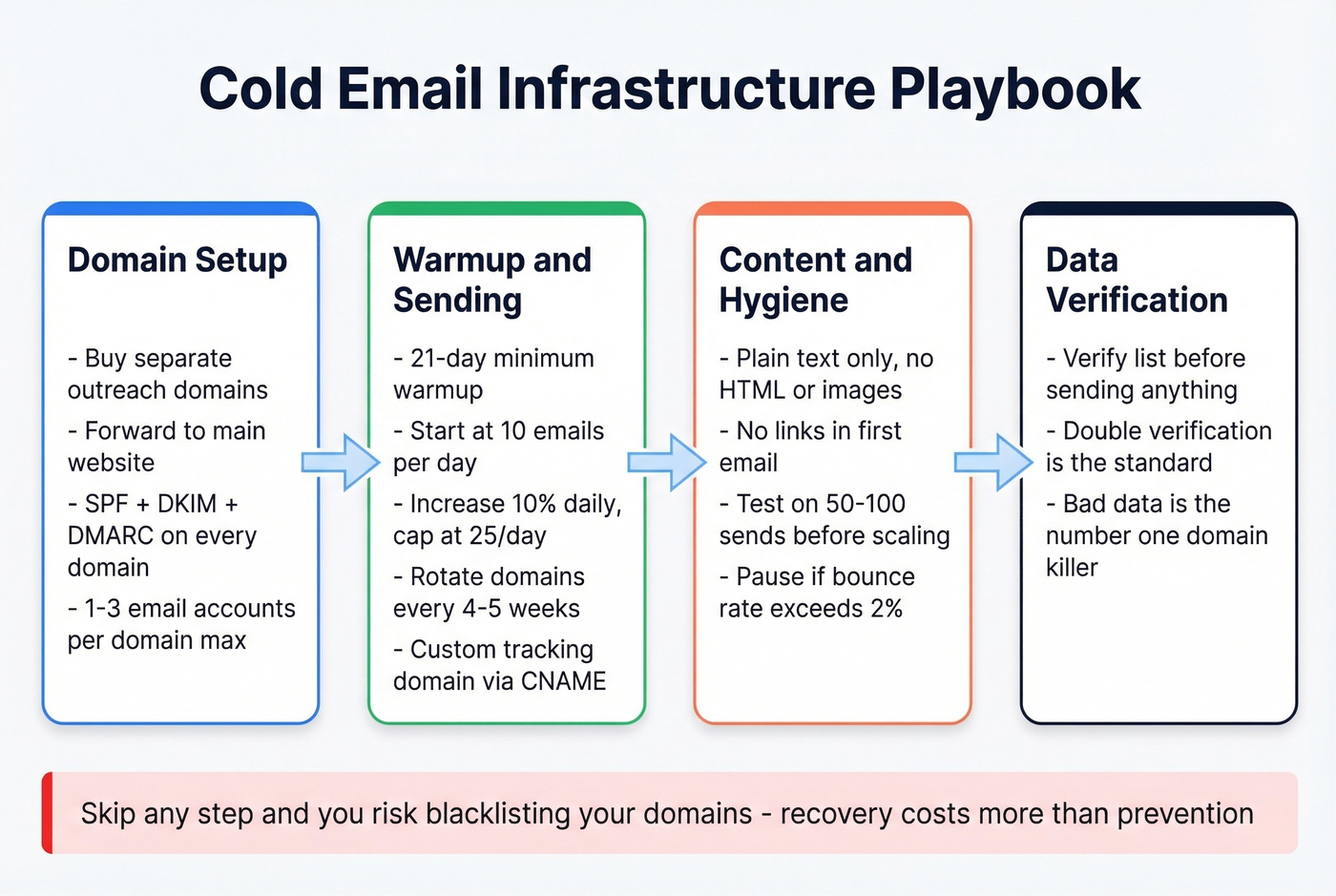
Domain setup: Never send from your main domain. Buy separate outreach domains and forward them to your main website. Set up SPF, DKIM, and DMARC on every sending domain immediately. Run 1-3 email accounts per domain - more than that and you're asking for trouble.
Warmup and sending: Minimum 21-day warmup period. We've seen domains get flagged at day 15 when they ramp too fast. Start at 10 emails per account per day, increase roughly 10% daily, and cap at 25/day once warmed. Rotate domains every 4-5 weeks and keep spare warmed domains ready. Set up a custom tracking domain via CNAME to avoid shared-domain risk.
Content and hygiene: Plain text only - no HTML templates, no images, no tracking pixels in cold outreach. No links in the first email; save the URL for follow-ups. Test every template on 50-100 sends before scaling. Pause immediately if bounce rate exceeds 2% or complaints approach 0.3%.
Data verification isn't optional. Run your list through a verification tool before sending a single message. Bad data is the #1 domain killer, and double verification - running your list through two tools - is the standard among serious operators. In our experience, teams that skip this step end up spending more on domain recovery than they would've spent on verification in the first place.
B2B Email Tools and Pricing
There are too many tools in this space. Most teams only need two or three working together. Let's break down the ones that matter.
Prospeo
Prospeo covers 300M+ professional profiles with 143M+ verified emails, and the 98% email accuracy rate is the highest in production. The proprietary email-finding infrastructure runs a 5-step verification process that handles catch-all domains, removes spam traps, and filters honeypots. Data refreshes every 7 days, compared to the 6-week industry average.

The results back it up: teams book 26% more meetings compared to ZoomInfo and 35% more compared to Apollo. Snyk's 50-person AE team went from 35-40% bounce rates to under 5% after switching, with AE-sourced pipeline up 180%. Pricing runs $0.01 per email, with a free tier of 75 emails plus 100 Chrome extension credits per month. No contracts, no sales calls, self-serve onboarding.
Apollo
Skip Apollo if data quality is your top priority. Pick it if you want prospecting and sequencing in one platform without stitching tools together. The database covers 260M+ contacts across 70M+ companies, and the built-in sequencer means you don't need a separate sending tool for basic outreach. The free tier is genuinely usable - limited credits, but enough to test workflows.
Paid plans run $49-$99/mo per user. In head-to-head comparisons, Apollo's email data bounced at noticeably higher rates than specialized verification tools. It's a great all-in-one for SMB teams, but pair it with a verification layer if you're sending at volume.
ZoomInfo
The elephant in the room: a mid-market contract runs $15,000-$40,000/year, and pricing requires a sales call. The #1 complaint on Reddit? Paying for modules you don't use.
ZoomInfo is the enterprise default for a reason - 500M+ verified contacts, 100M+ companies, deep intent data, and a workflow suite covering everything from prospecting to conversation intelligence. The newer MCP integration lets AI agents pull data directly, which matters for teams building automated workflows. But if you're spending $20K/year on data and still seeing massive bounce rates, the tool is the problem, not your copy.
Pricing at a Glance
| Tool | Starting Price | Free Tier | Best For |
|---|---|---|---|
| Prospeo | $0.01/email | 75 emails/mo | Verified data with 98% accuracy |
| Apollo | $49/mo per user | Yes (limited) | All-in-one prospecting + sequencing |
| ZoomInfo | ~$15K/year | No | Enterprise workflow automation |
| Hunter.io | $49/mo | 25 searches/mo | Quick domain email lookups |
| Instantly | ~$30/mo | No | Multi-inbox sending + warmup |
| Lusha | $29/mo per user | 5 credits/mo | Fast phone number lookups |
| UpLead | $99/mo | Trial available | Mid-market prospecting with 95% accuracy guarantee |
| Snov.io | ~$30-75/mo | Limited free | Combined email finding and drip sequences |
| Seamless.AI | ~$147/mo per user | Limited free | Real-time contact search with AI list building |
| Smartlead | ~$39/mo | No | Multi-inbox sending with advanced rotation and warmup |
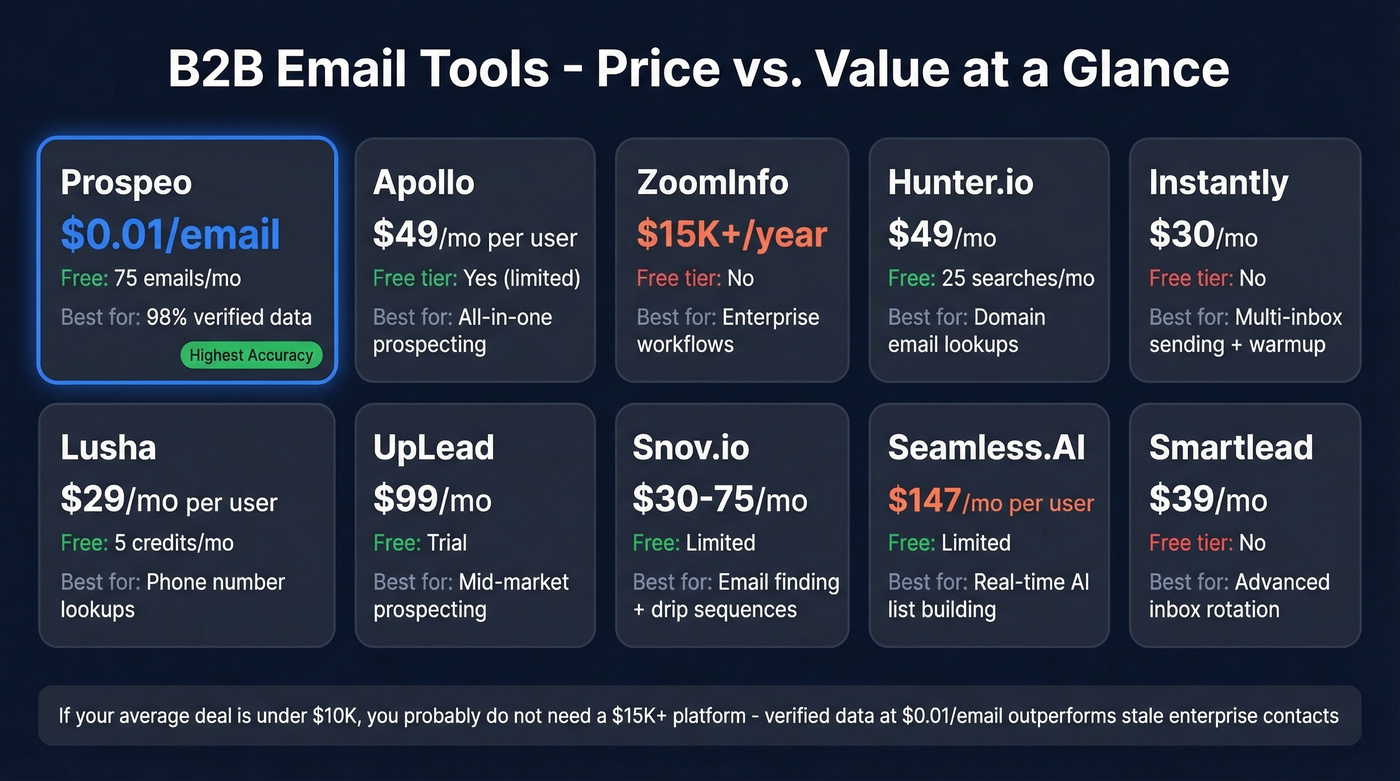
At $0.01 per verified email, double verification costs less than a single flagged domain. Prospeo's proprietary infrastructure helped Snyk cut bounce rates from 35-40% to under 5% across 50 AEs - with pipeline up 180%.
Build your next cold campaign on 143M+ verified emails.
Writing Emails That Get Replies
Infrastructure gets your message to the inbox. Copy gets the reply.
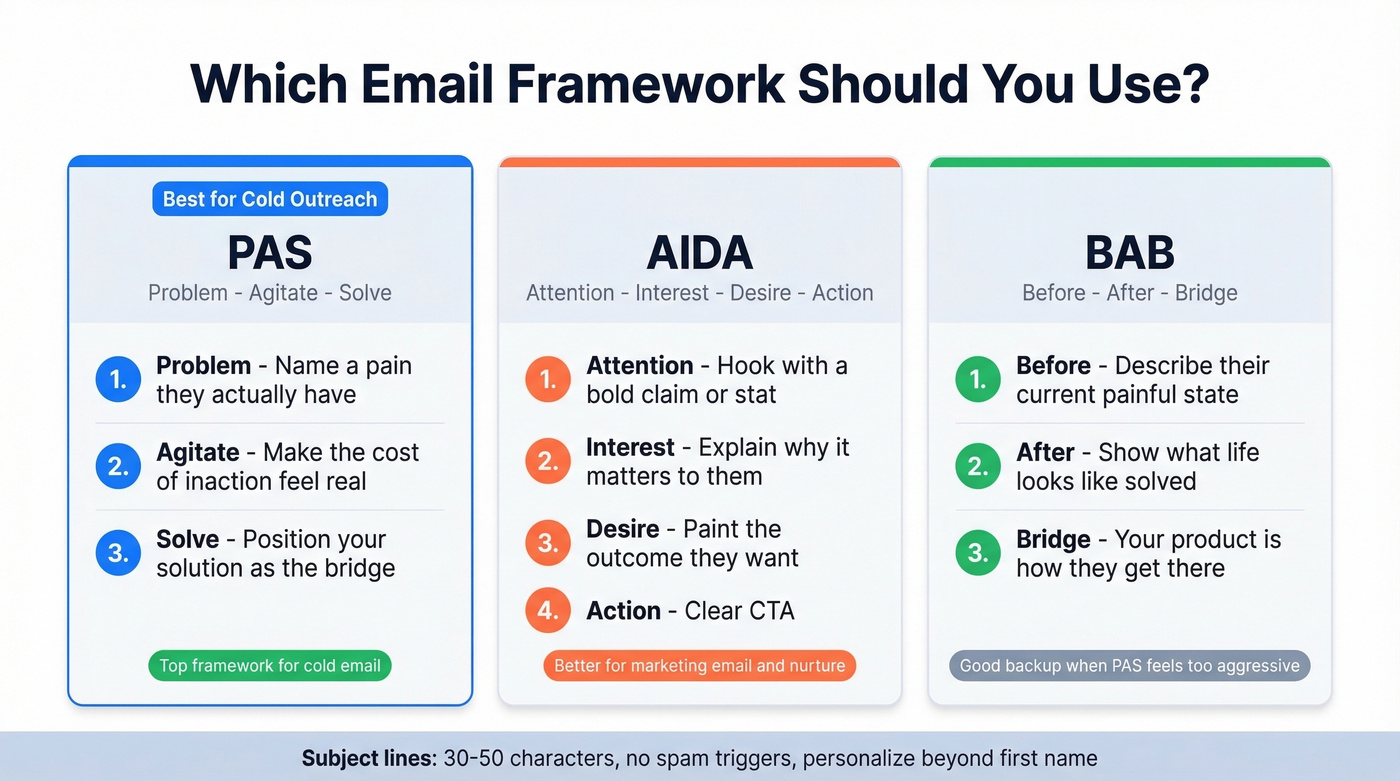
PAS (Problem-Agitate-Solve) is the top framework for cold outreach. Lead with a problem the prospect actually has, agitate the cost of not solving it, then offer your solution as the bridge. It works because it mirrors how people make decisions - they don't act until the pain feels real. AIDA works better for marketing email and longer nurture sequences. BAB (Before-After-Bridge) is a solid backup when PAS feels too aggressive for your audience.
Subject lines should run 30-50 characters. Avoid spam triggers like "free," "urgent," and "act now." Personalize beyond {first_name} - reference a specific company initiative, tech stack choice, or recent hire.
48% of reps never send a second email, but 42% of all replies come from follow-up messages. If you're running a single-touch sequence, you're leaving almost half your potential replies on the table. Three to five touches over 10-14 days is the sweet spot. We've tested shorter and longer cadences, and anything beyond five touches in two weeks starts generating complaints without meaningful lift.
Design for the first 350-400 pixels - that's what shows before the scroll on most phones. Keep cold emails under 120 words. 61.9% of email users read messages on mobile devices.
AI, Compliance, and Common Mistakes
64% of marketers now use AI in their email workflows - 50% for personalization, 41% for subject line optimization. The numbers back it up: AI-personalized campaigns drive a 41% average revenue increase. eBay's partnership with Phrasee delivered +15.8% opens and +31% clicks through AI-generated subject lines. But AI personalization works best layered on top of clean, segmented data. An AI-written email sent to the wrong person is still a waste.
Compliance essentials: GDPR allows cold B2B outreach under legitimate interest when the message is relevant to the recipient's professional role. CAN-SPAM requires a physical address in your signature. CCPA gives California residents the right to request data deletion - honor these alongside GDPR requests. Beyond the legal minimums, include full company details in your signature, link to your privacy policy, honor opt-outs within 24 hours, and be prepared to answer "what data do you have on me?" requests.
The biggest performance killer? No segmentation. Sending the same message to a VP of Engineering and a Marketing Director is lazy and it shows in your reply rates. Beyond that: weak subject lines, emails over 200 words, ignoring mobile rendering, and never A/B testing. If your bounce rate is above 5%, your data provider is the problem, not your copy.
FAQ
Is cold B2B email legal in 2026?
Yes. Cold B2B email is legal under GDPR's legitimate interest basis and under CAN-SPAM. Outreach must be relevant to the recipient's professional role, your company must be identified in the signature, and you must honor opt-out requests immediately. Broken infrastructure - not the act of cold emailing - triggers spam complaints and legal risk.
What's a good cold email reply rate?
The 2026 average sits at 3.43%. Anything above 5% is solid; above 10% is excellent. Reply rates depend more on data quality and targeting than copywriting - clean lists with tight ICP filtering consistently outperform clever templates sent to bad data. Fix the list before you rewrite the email.
What's the cheapest way to find verified B2B emails?
Prospeo offers 75 free verified emails per month plus 100 Chrome extension credits - no contract required. Paid plans run $0.01 per email. Apollo and Hunter also have free tiers, though with lower verification accuracy. For teams sending at any real volume, the cost of verification is trivial compared to the cost of burning a domain on bad data.
How often should I verify my contact list?
Re-verify every 30 days minimum. B2B contacts decay at roughly 2-3% per month due to job changes and company turnover. Some tools refresh data every 7 days automatically, but if you're working from static CSVs or older CRM exports, run verification before every campaign launch to keep bounces under 2%.