

How to Build a B2B Marketing Campaign That Actually Generates Pipeline
Only [12% of B2B marketers](https://contentmarketinginstitute.com/b2b-research/b2b-content-marketing-trends-research) rate their campaigns as highly effective. That means 88% are running a B2B marketing campaign that ranges from underwhelming to actively wasting money - and 54% of CMOs can't even prove marketing's impact on revenue.
The gap isn't creativity. It's structure. Most campaigns fail because they start with channels instead of customers, measure impressions instead of pipeline, and launch on dirty data that tanks deliverability before the first sequence finishes.
The Short Version
- Define your ICP with data, not assumptions. Only 5% of brands are considered unique by buyers. Your positioning has to be razor-sharp or you're invisible.
- Budget 7-12% of projected revenue, split 60-80% demand gen, 10-20% brand, 10-20% nurture. Apply the 70/20/10 rule: 70% proven channels, 20% promising, 10% experiments.
- Verify your contact data before launch. A 20-35% bounce rate tanks your domain reputation and kills ROI before your campaign gets a fair shot.
What Is a B2B Marketing Campaign?
A B2B marketing campaign is a coordinated, time-bound effort to move target accounts from awareness to pipeline. It differs from one-off tactics because every touchpoint - ads, emails, content, events - is orchestrated around a single objective and measured against revenue outcomes.
The average B2B buyer engages in 62+ touchpoints before signing, across roughly 10 channels. Buyers spend just 17% of their buying time meeting suppliers. The rest is research, internal consensus-building, and comparing you to competitors you've never heard of. McKinsey's "rule of thirds" captures the new reality: one-third of buyers prefer in-person interactions, one-third prefer remote, and one-third want digital self-serve with no rep involved.
That's the fundamental difference from B2C. You're not convincing one person to click "buy." You're managing a multi-month, multi-stakeholder journey where 80% of interactions happen digitally, and your campaign has to work across all of those touchpoints or it doesn't work at all.
The 6-Phase Campaign Strategy
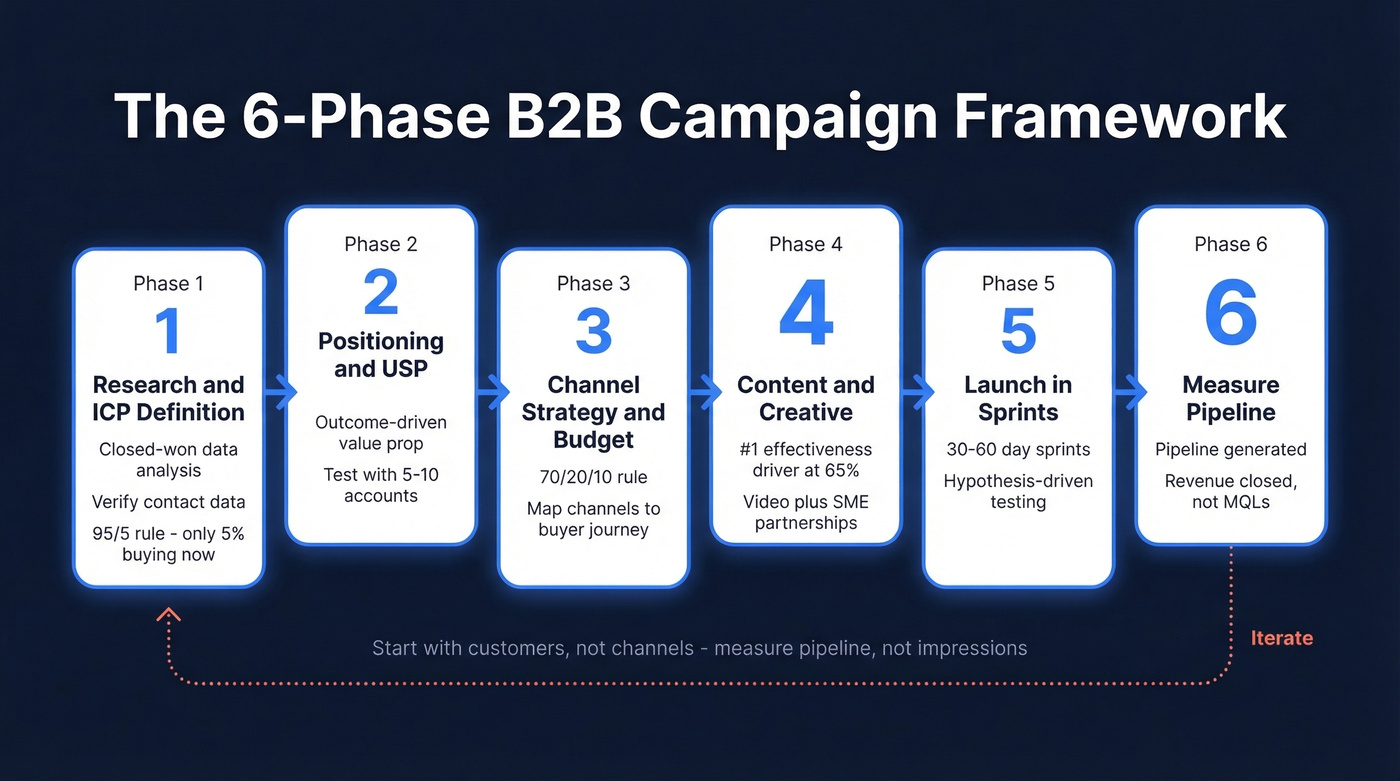
Most campaign guides tell you to "pick your channels" in step one. That's backwards. Channels are step three. A solid B2B marketing campaign strategy starts with research and ends with pipeline measurement - everything in between flows from those bookends.
Phase 1: Research and ICP Definition
Start with who you're targeting and whether your data is clean. Only 52% of B2B companies have a clearly defined differentiating value proposition - half the market is running campaigns without knowing who they're for.
Here's an insight most guides skip: the Ehrenberg-Bass Institute's 95/5 rule shows that only 5% of your total addressable market is actively buying at any given time. That means 95% of your campaign audience isn't ready to buy today. Your ICP definition needs to account for both in-market buyers and the much larger group you're building awareness with for later.
Build your ICP from closed-won data, not assumptions. Map job titles, company size, tech stack, and buying triggers. With 80% of interactions happening digitally, your prospect list is your campaign's foundation - verify it before anything else.
Phase 2: Positioning and USP
With only 5% of brands perceived as unique, your USP can't be "we're the leading provider of innovative solutions." It needs to be specific, outcome-driven, and verifiable. Something like "reduce defects by 35% within 60 days - verifiable on your production line."
Test your positioning with 5-10 target accounts before building creative. If they can't repeat your value prop back to you, it's not clear enough.
Phase 3: Channel Strategy and Budget
94% of marketers diversified their channel mix last year. Single-channel campaigns simply don't work in B2B anymore, and an integrated approach that coordinates messaging across paid, owned, and earned channels consistently outperforms siloed efforts.
Map channels to buyer journey stages, not to what's trendy. Paid search and LinkedIn for demand capture. Content and events for demand creation. Email and retargeting for nurture. 45% of top-performing teams allocate 10-20% of their budget to testing new channels - follow their lead.
Phase 4: Content and Creative
Content quality is the #1 driver of campaign effectiveness at 65%, beating team skills (53%), sales alignment (45%), and tech/tools (43%). No amount of automation fixes mediocre content.
Here's the thing: brands combining video with creator and SME partnerships are 2.2x more likely to be trusted and 1.8x more likely to be well known. That's not a marginal lift. With 94% of B2B buyers saying trust is the key factor in purchasing decisions, video and expert partnerships aren't optional anymore - they're table stakes for any serious B2B marketing campaign in 2026. Build one flagship piece of content per campaign sprint, then repurpose it into derivative assets like blog posts, social clips, and email sequences to maximize ROI per creative dollar.
Phase 5: Launch in Sprints
Don't run a campaign for six months and then measure it. Run 30-60 day sprints with hypothesis-driven testing. "We believe [channel X] will generate [Y SQLs] at [Z CPL] because [reason]." Test it. Measure it. Adjust.
Multi-touch attribution drives 15-30% improvement in marketing efficiency and 25% better budget allocation. You can't optimize what you can't attribute.
Phase 6: Measure Pipeline, Not Impressions
The average B2B close rate is 29%. Win rate sits around 21%. And 84% of reps missed quota last year.
If your campaign metrics stop at MQLs, you have no idea whether marketing is actually helping. Tie every campaign to pipeline generated, opportunities influenced, and revenue closed. Impressions and clicks are diagnostic - they tell you why something worked. They're not the outcome.
How to Budget a B2B Campaign
Global ad spend topped $1T in 2026, but most B2B companies allocate just 7-12% of projected revenue to marketing. The Gartner 2026 CMO Spend Survey pegs the average at 7.7%, down from 9.5% in 2022. Budgets are tighter, which makes allocation more critical than ever.
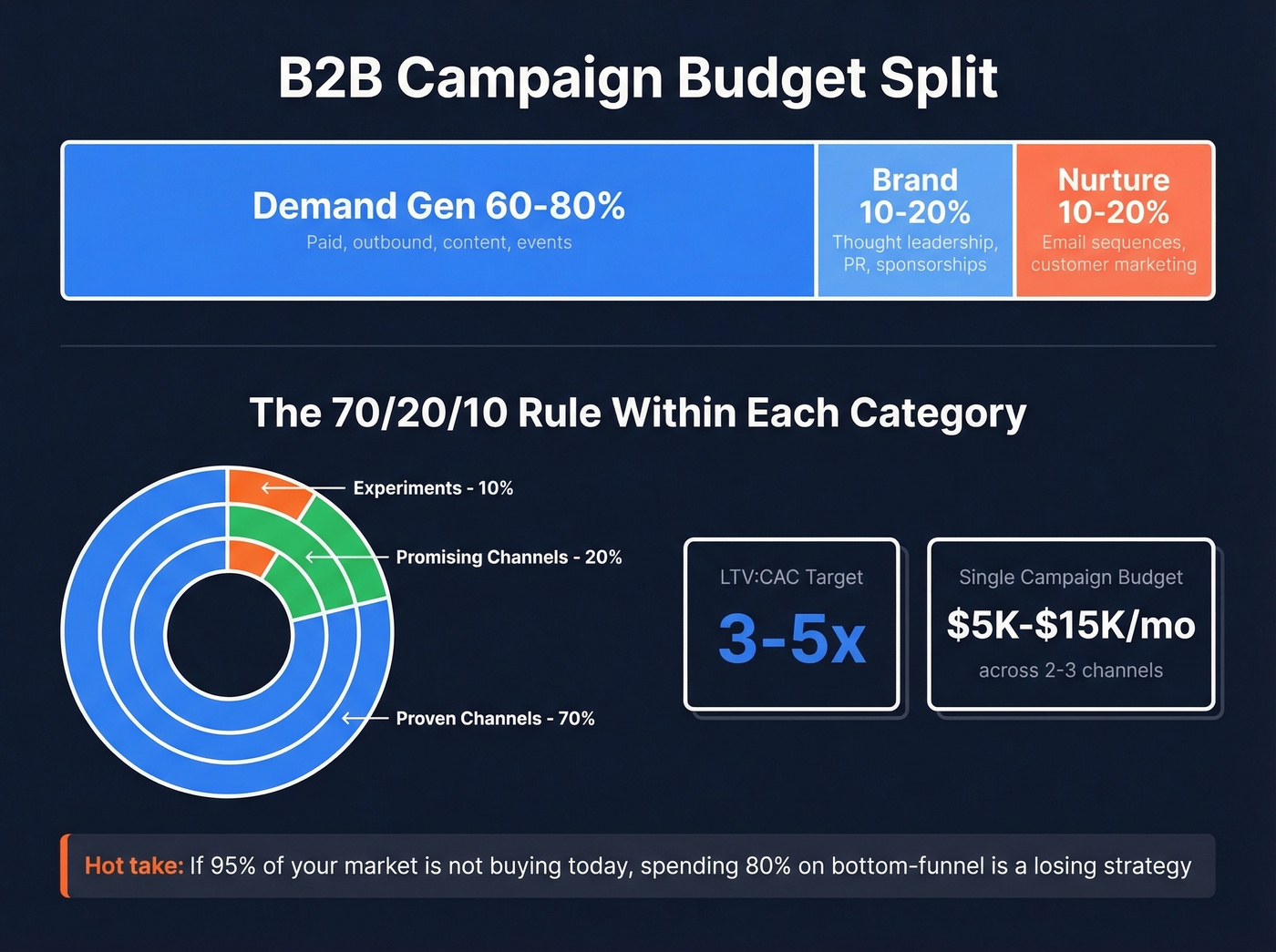
| Category | % of Budget | Covers |
|---|---|---|
| Demand gen | 60-80% | Paid, outbound, content, events |
| Brand awareness | 10-20% | Thought leadership, PR, sponsorships |
| Nurture / retention | 10-20% | Email sequences, customer marketing |
Within each category, apply the 70/20/10 rule: 70% to proven channels, 20% to promising ones, 10% to experiments. Use a LTV:CAC ratio of 3-5x as your planning guardrail - if your customer lifetime value isn't at least 3x your acquisition cost, the campaign economics don't work regardless of how clever the creative is.
For a single campaign, budget $5K-$15K/month across 2-3 channels to generate statistically significant data.
Let's be honest about something most B2B marketing teams get wrong: they underspend on brand and overspend on bottom-funnel demand gen. If 95% of your market isn't buying today, allocating 80% of budget to capture the 5% who are is a losing long-term strategy. The companies winning in 2026 are the ones who flipped that ratio closer to 50/50.

The article says it: a 20-35% bounce rate tanks your domain and kills campaign ROI before you start. Prospeo's 5-step verification delivers 98% email accuracy on 300M+ profiles - refreshed every 7 days, not 6 weeks. Layer in buyer intent across 15,000 topics so your campaign hits the 5% actively buying.
Launch your next B2B campaign on data that won't destroy your sender reputation.
Paid Channel Benchmarks (2026)
Here's what you should actually expect from paid channels. These numbers come from aggregate B2B PPC data and represent mid-market averages - your mileage will vary by industry and deal size, but they're a solid baseline.
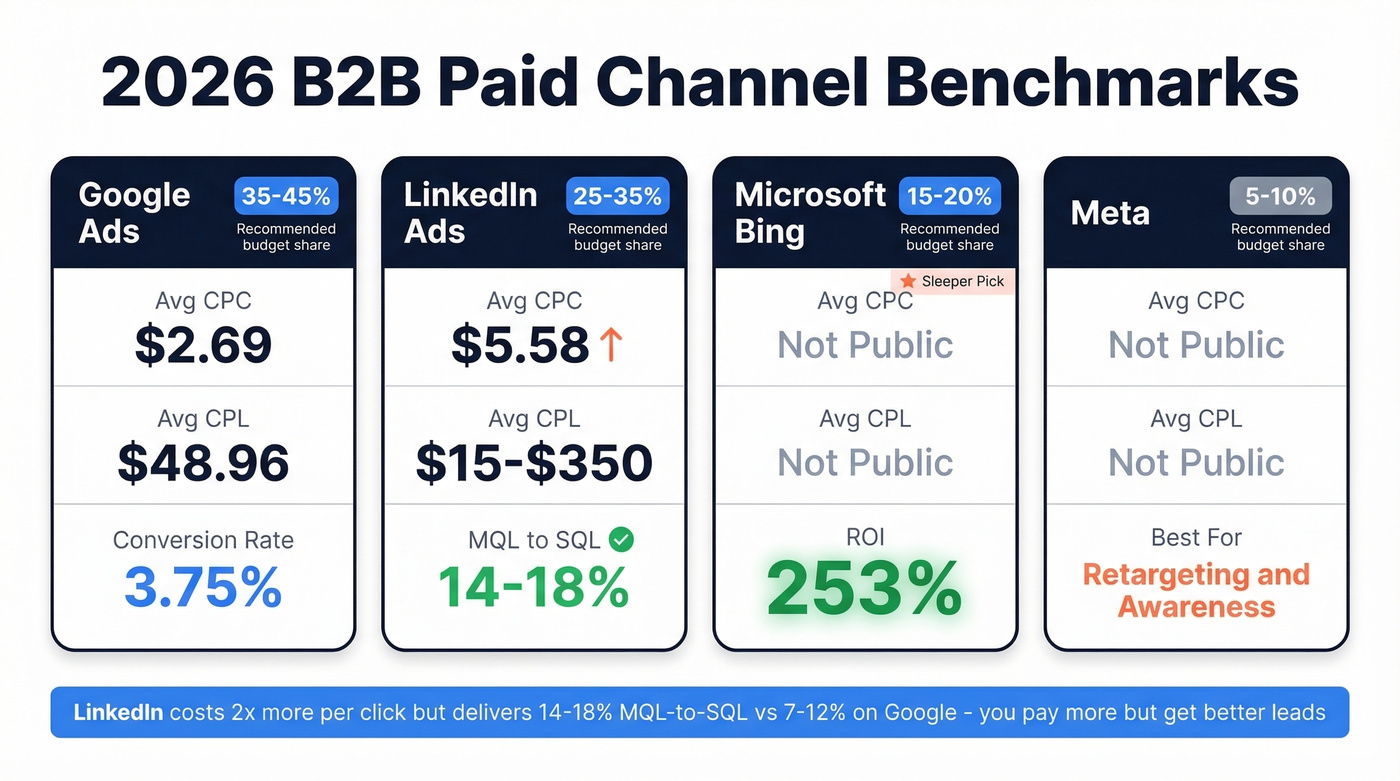
| Platform | Avg CPC | Avg CPL | Key Metric | Budget Share |
|---|---|---|---|---|
| Google Ads | $2.69 | $48.96 | 3.75% conversion | 35-45% |
| LinkedIn Ads | $5.58 | $15-$350 | 14-18% MQL-to-SQL | 25-35% |
| Microsoft/Bing | Not public | Not public | 253% ROI (highest) | 15-20% |
| Meta | Not public | Not public | Retargeting/awareness | 5-10% |
LinkedIn's CPC is about 2x Google's, but the MQL-to-SQL conversion rate is significantly higher at 14-18% vs 7-12%. You pay more per click but get better-qualified leads. Microsoft Bing is the sleeper - 253% ROI makes it the highest-performing B2B PPC platform, and most teams ignore it entirely. In our experience, teams that shift even 15% of Google budget to Bing see measurable ROI improvement within one sprint.
Campaign Examples With Real Numbers
SAP "Inspire the Future": Generated EUR924.4M in pipeline and EUR266.15M in projected revenue, with 48% higher engagement than SAP's other social campaigns. The key was combining thought leadership content with clear pipeline attribution - every touchpoint tracked to revenue.
Drift's Category Creation: Drift built an entire category around conversational marketing, combining content, events, and product-led growth to go from startup to $100M+ ARR. The lesson: own the narrative before you try to capture demand.

Mistakes That Kill Campaign Performance
We've watched these five sink the most pipeline across teams we've worked with:
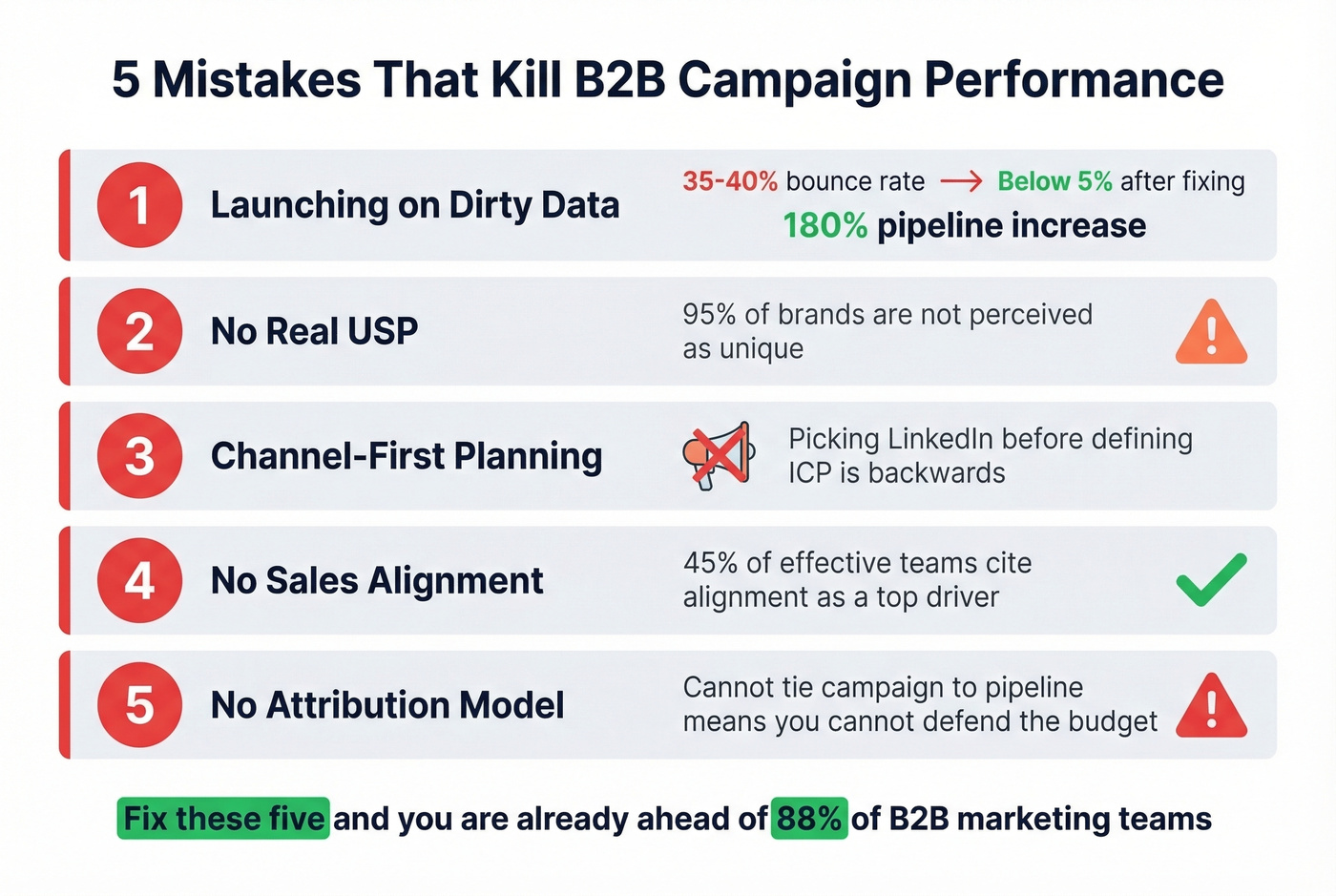
Launching on dirty data. Snyk's 50-person AE team was prospecting with 35-40% bounce rates. After fixing their data layer, bounces dropped below 5% and AE-sourced pipeline jumped 180%. Skip this step at your own risk.
No real USP. If 95% of brands aren't perceived as unique, "leading provider" isn't positioning. It's wallpaper.
Channel-first planning. Picking LinkedIn Ads before defining your ICP is like booking a venue before knowing how many guests are coming.
No sales alignment. 45% of effective teams cite sales alignment as a top driver. Running marketing and sales in silos guarantees wasted spend and finger-pointing when pipeline stalls.
No attribution model. If you can't tie a campaign to pipeline, you can't defend the budget. And if you can't defend the budget, you lose it.
The Campaign Tech Stack
The dominant mid-market stack is HubSpot + LinkedIn Ads + Google Analytics, with 28.5% adoption. The average B2B org runs 12-20 tools, and the #1 pain point is data integration - 65.7% of teams struggle with it.
Every tool downstream - your CRM, sequencer, attribution platform - inherits whatever data quality problems exist at the source. Companies using predictive analytics at the data layer are 2.9x more likely to report revenue growth above their industry average.
| Layer | Tools | Annual Cost |
|---|---|---|
| CRM | Salesforce, HubSpot | SMB: $300-$5K/yr - Mid-market: $15K-$43K/yr |
| Marketing automation | HubSpot, Marketo | $10K-$43K/yr |
| Analytics | GA4, Mixpanel | Free-$10K/yr |
| Data and verification | Prospeo, ZoomInfo, Apollo | Free-$10K+/yr |
| Intent data | Bombora, standalone platforms | $10K-$50K/yr |
| Paid channels | Google, LinkedIn, Bing | Variable |
You just read that 62+ touchpoints drive a B2B deal - and 80% happen digitally. That means your outbound list is your campaign's foundation. Prospeo gives you 30+ filters including intent signals, tech stack, and headcount growth to build hyper-targeted lists at $0.01 per verified email. No contracts. No sales calls.
Stop budgeting for campaigns built on dirty data. Start with contacts that connect.
FAQ
How long does a B2B marketing campaign take to show results?
Most campaigns need 60-90 days minimum to generate meaningful pipeline data. The average B2B sales cycle runs 1-3 months, with complex enterprise deals exceeding 5 months. Run 30-60 day sprints and measure pipeline contribution, not just lead volume.
What's a realistic budget for a first campaign?
Allocate 7-12% of projected revenue to marketing overall. For a single campaign, budget $5K-$15K per month across 2-3 channels. Underfunding is worse than not running one - you'll draw false conclusions from insufficient data.
Why do B2B campaigns fail even with good creative?
Bad contact data is the most common silent killer. If 20-35% of your emails bounce, your domain reputation degrades and deliverability drops with every send. Verifying prospect data before launch keeps bounce rates under 4%, which is the threshold where deliverability stays healthy.
How do I build a B2B marketing campaign strategy from scratch?
Start with the 6-phase framework: research your ICP, nail your positioning, choose channels based on buyer journey stage, create high-quality content, launch in 30-60 day sprints, and measure pipeline - not vanity metrics. The biggest mistake first-timers make is skipping ICP research and jumping straight to ad spend.