

What Is a Good LTV to CAC Ratio? (And Why 3:1 Isn't the Full Answer)
Your board deck says 4:1. Your CFO says you've got 8 months of runway. Both numbers are technically correct, and they're telling completely different stories about your business health.
So what is a good LTV to CAC ratio? The standard answer - 3:1 - works as a starting point, but it's about as useful as saying a healthy BMI is 22 without knowing your age, activity level, or goals. Always use gross-margin-adjusted LTV, not revenue LTV. And pair the ratio with CAC payback period, a metric that matters far more operationally than the ratio itself.
What Is the LTV:CAC Ratio?
LTV:CAC measures how much lifetime value a customer generates relative to what it cost to acquire them:
LTV:CAC = Customer Lifetime Value / Customer Acquisition Cost
The key is what goes into each side. LTV should be gross-margin-adjusted - not raw revenue. Use this SaaS-friendly formula: Cohort ACV x Subscription Gross Margin % / (1 - GRR). CAC includes all sales and marketing costs - salaries, tools, overhead, commissions - not just ad spend.
If your gross-margin-adjusted LTV is $900 and your fully loaded CAC is $300, you're at 3:1. Whether that's good depends entirely on context. You can also flip the question - what's a good CAC to LTV ratio - and the math is the same, just inverted: you'd want 1:3 or lower.
Healthy Ratio Targets by Stage
Every guide quotes 3:1 and stops. Here's the nuance they skip.
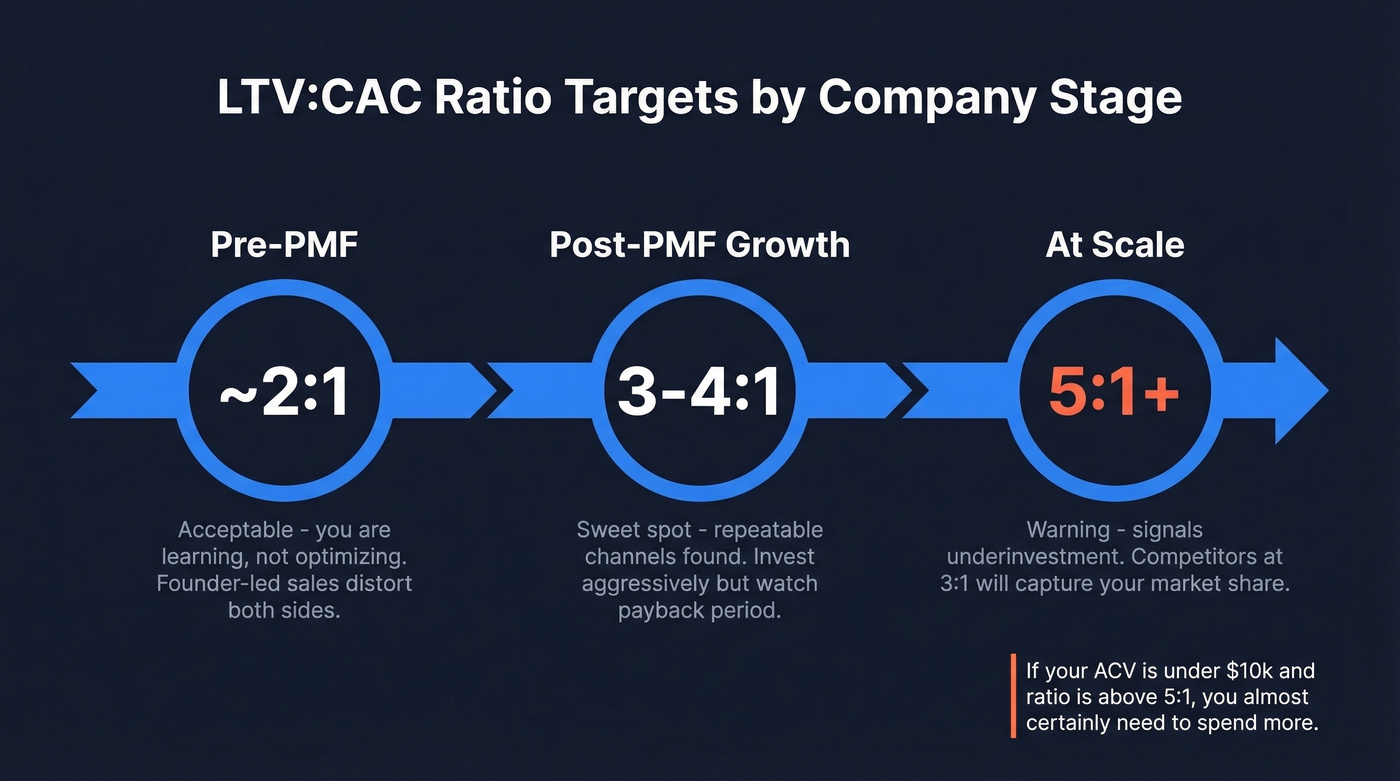
Pre-product-market fit: ~2:1 is acceptable. You're learning, not optimizing. Founder-led sales and relationship-driven early customers distort both sides of the equation. As forentrepreneurs.com warns, calculating this metric before you have a repeatable, scalable growth process is actively dangerous - you'll make investment decisions on numbers that won't hold.
Post-PMF growth: 3-4:1 sweet spot. You've found repeatable acquisition channels. This is where the ratio becomes a real steering metric. Invest aggressively, but watch payback.
At scale: beyond 5:1 signals underinvestment. We've watched founders celebrate a "beautiful" 7:1 ratio on r/SaaS while competitors scaling at 3:1 captured their market share. If your ratio is consistently above 5:1, you're leaving growth on the table.
Here's the thing: if your average deal size is under $10k and your ratio is above 5:1, you almost certainly need to spend more, not less. Efficiency is a luxury for companies that have already won their category.
Industry Benchmarks for 2026
The First Page Sage benchmark dataset covers 29 industries, with each benchmark based on a 3-year average compiled between 2019 and 2024. Their data skews B2B (74%), organic channels (68%), and midsize-plus companies, so early-stage startups will likely see lower ratios.
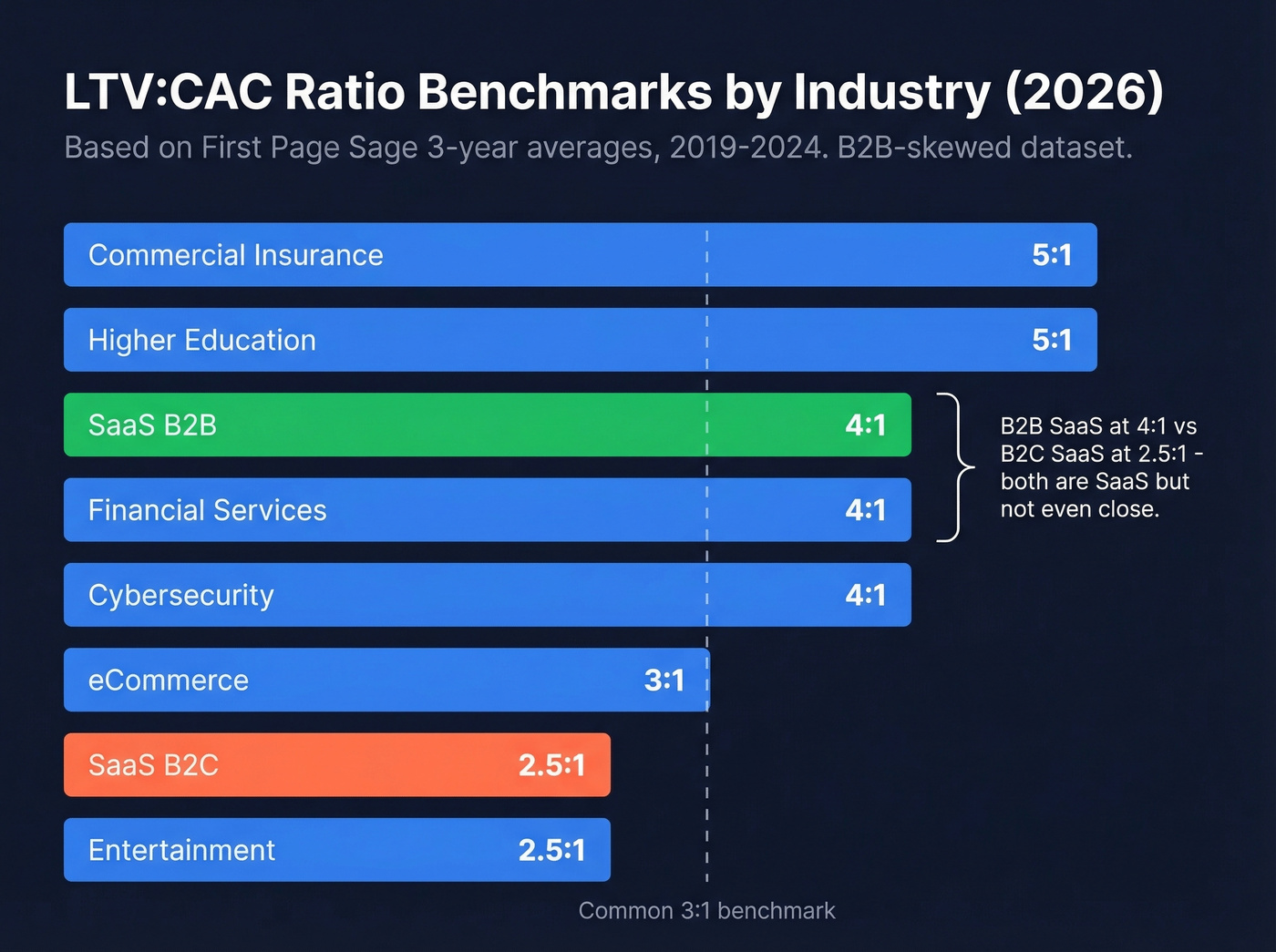
| Industry | Avg LTV | Avg CAC | Ratio |
|---|---|---|---|
| Commercial Insurance | $2,975 | $595 | 5:1 |
| Higher Education | $7,118 | $1,424 | 5:1 |
| SaaS (B2B) | $956 | $239 | 4:1 |
| Financial Services | $3,136 | $784 | 4:1 |
| Cybersecurity | $1,548 | $387 | 4:1 |
| eCommerce | $255 | $84 | 3:1 |
| SaaS (B2C) | $583 | $233 | 2.5:1 |
| Entertainment | $823 | $329 | 2.5:1 |
B2B SaaS at 4:1 and B2C SaaS at 2.5:1 aren't even close - and they're both "SaaS." Your industry benchmark matters more than the generic 3:1 rule. You can also reverse the formula for budgeting: if your target ratio is 3:1 and your LTV is $900, your maximum allowable CAC is $300.

Every bounced email and wrong number inflates your CAC without generating pipeline. Prospeo delivers 98% email accuracy and 125M+ verified mobiles - so your reps spend time closing, not chasing dead leads. At $0.01 per email, your acquisition costs drop while LTV stays the same.
Fix the CAC side of your ratio with data that actually connects.
How to Calculate It Correctly
Three mistakes we see constantly.
Revenue LTV is a vanity metric. If your gross margins are 70%, your "real" LTV is 30% lower than the number in your deck. The SaaS CFO formula - Cohort ACV x Subscription GM% / (1 - GRR) - is the right starting point. For later-stage companies, applying a discount rate (8-15% depending on maturity) gives an even more conservative and honest number.
CAC means all sales and marketing costs. Salaries, tools, overhead, commissions - everything. B2B SaaS organic CAC averages $205 vs $341 for inorganic - a 66% premium. If you're blending channels without tracking this split, you don't actually know your CAC.
Align your time windows. Calculating LTV on a 3-year cohort and CAC on last quarter's spend gives you a number that means nothing. Match the periods or the ratio is fiction.
Why Payback Period Matters More
Let's be honest: in our experience, payback period is the metric that actually changes decisions. The consensus on r/SaaS backs this up - a 2:1 ratio with 6-month payback beats a 5:1 ratio with 36-month payback every single time. Long payback ties up cash, constrains reinvestment, and kills compounding growth, even when the ratio looks gorgeous on a slide.
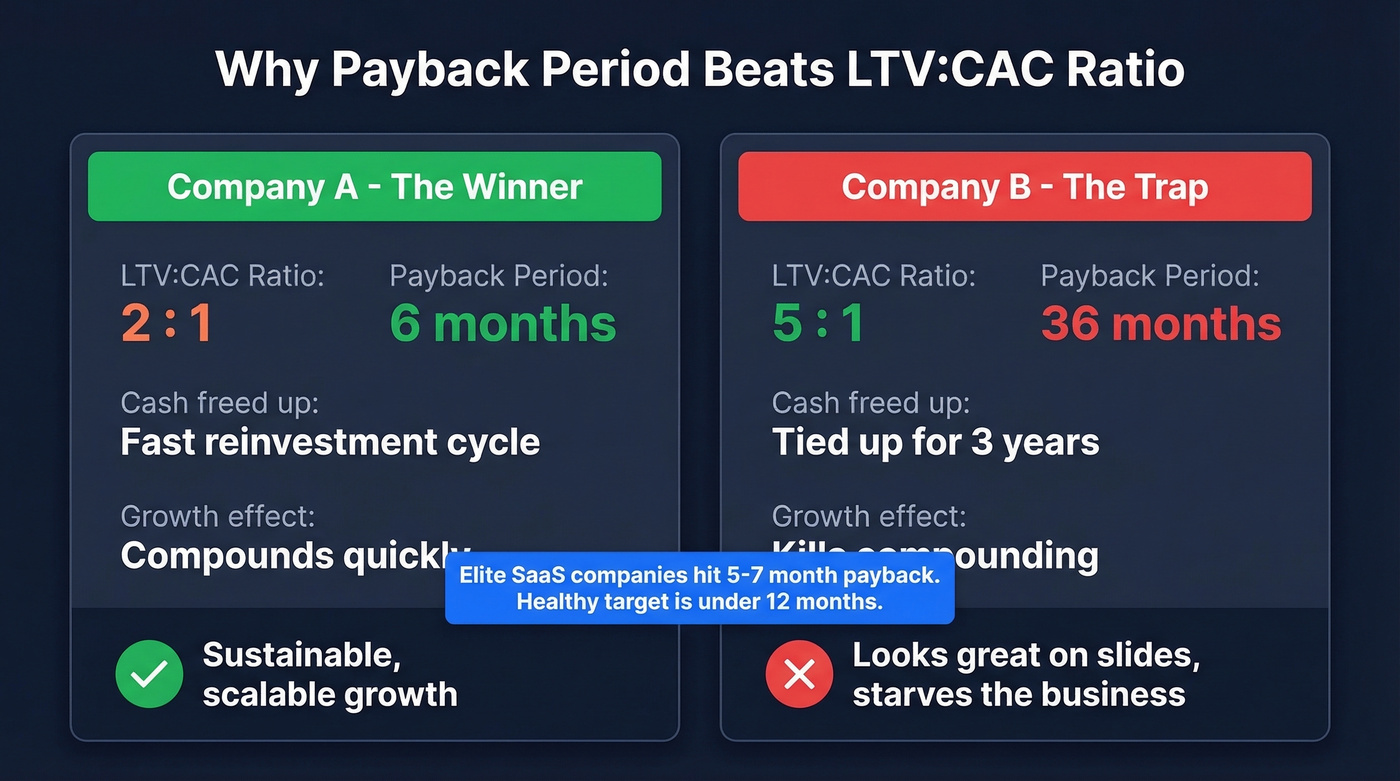
Healthy payback is 12 months or less. Elite SaaS companies hit 5-7 months per Bessemer's State of the Cloud data.
Benchmarkit's 2025 benchmark report shows the median New CAC Ratio rose 14% year-over-year to $2.00 of sales and marketing spend per $1 of New ARR. But expansion ARR now accounts for 40% of total new ARR, up 5 points year-over-year. If your LTV calculation ignores expansion revenue, you're understating the real value of your customer base. Gross retention rates are also slipping - median GRR fell from 90% to 88% over three years - which means your LTV assumptions from last year are probably already stale.
Why Investors Care
Improving LTV:CAC from 2x to 3x can nearly triple your valuation, per a16z's analysis of 60+ public consumer internet companies.
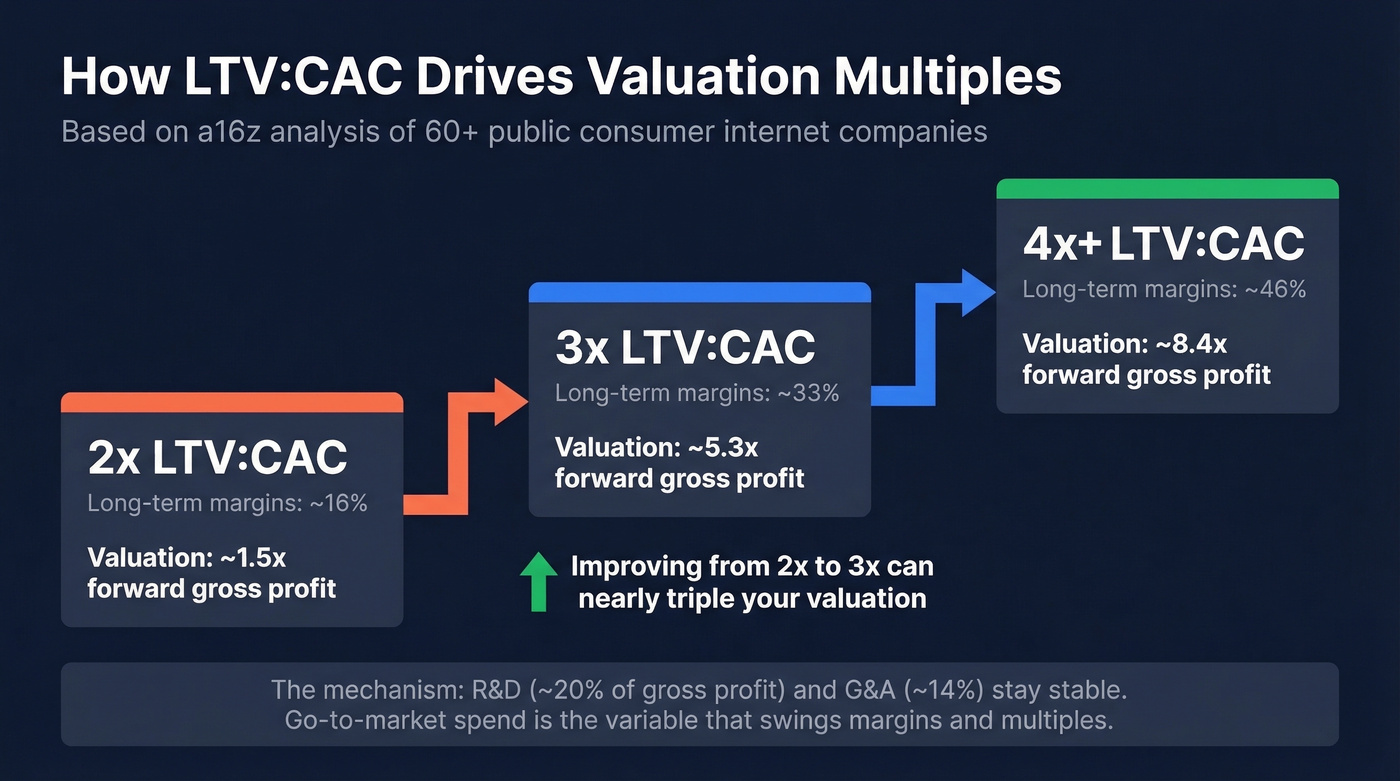
The mechanism is sales and marketing efficiency. R&D (~20% of gross profit) and G&A (~14%) stay relatively stable across companies. Go-to-market spend is the variable that swings long-term operating margins - and margins drive multiples. The a16z data maps it clearly: 16% long-term margins yield ~1.5x forward gross profit multiples, 33% margins yield ~5.3x, and 46% margins yield ~8.4x.
The ratio isn't just a health metric. It's a valuation lever.
How to Improve Your Ratio
Two levers, and most teams only pull one.
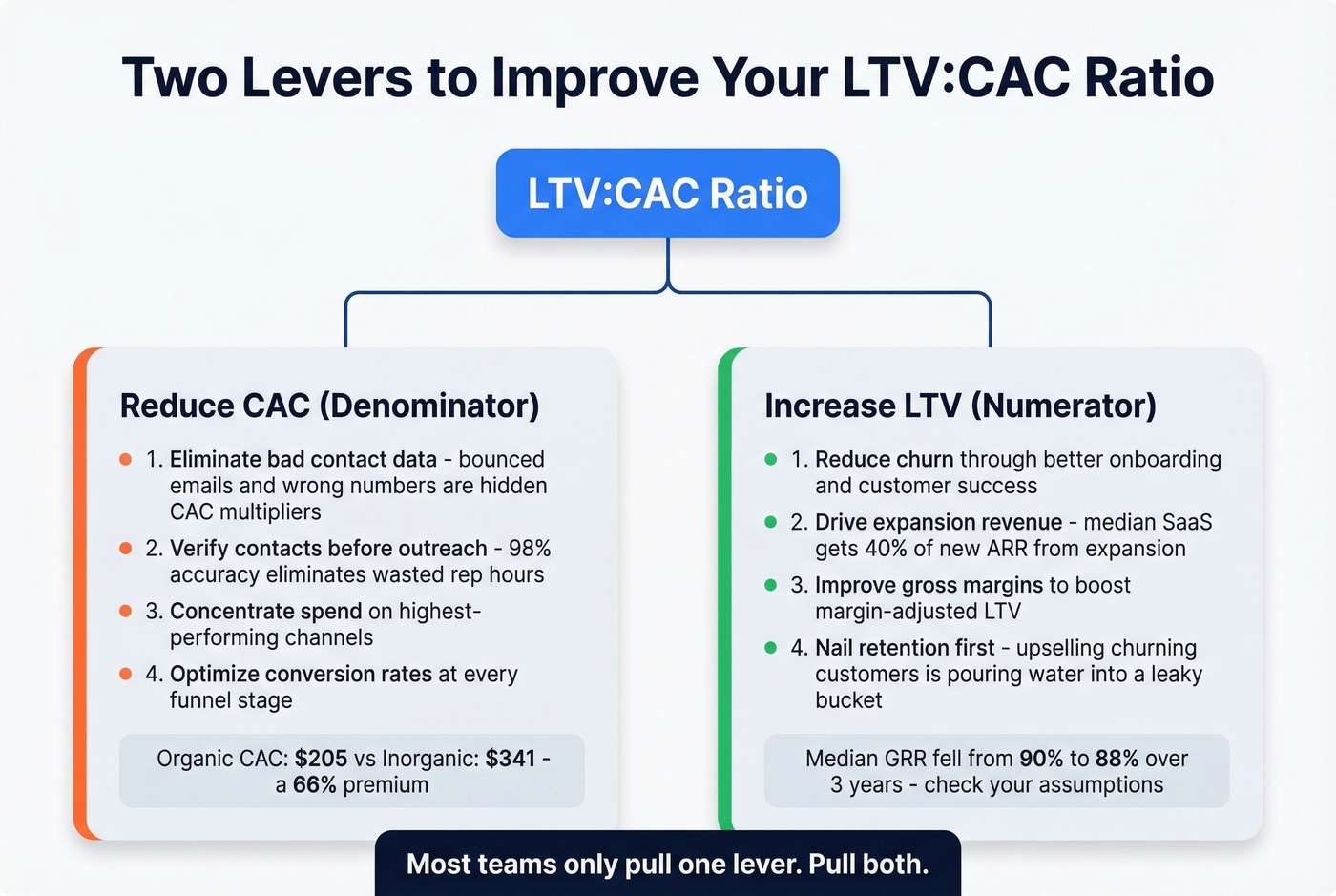
Reduce CAC
The fastest win isn't cutting budget - it's eliminating waste. Bad contact data is a hidden CAC multiplier. Every bounced email, every wrong number, every hour a rep spends chasing dead leads inflates your acquisition cost without generating pipeline. We've seen teams cut their effective CAC by 20-30% just by switching to verified contact data with tools like Prospeo, where 98% email accuracy and a 7-day data refresh cycle keep reps focused on conversations instead of dead ends. Beyond data quality, concentrate spend on your highest-performing channels and optimize conversion rates at every funnel stage.
Increase LTV
Reduce churn through better onboarding and customer success. Drive expansion revenue - remember, median SaaS companies now generate 40% of new ARR from expansion. That's LTV growth without touching CAC. Skip this lever if you haven't nailed retention first; upselling churning customers is pouring water into a leaky bucket. If you need a tighter retention model, start with churn analysis and a clear definition of what is churn.
Teams using Prospeo book 26% more meetings than ZoomInfo and 35% more than Apollo - because verified data eliminates the waste that kills payback period. With a 7-day refresh cycle, your contact data never goes stale and your LTV:CAC math stays honest.
Shrink your payback period from months to weeks.
FAQ
What is a good LTV to CAC ratio for investors?
Most investors look for at least 3:1, but context matters. A 3:1 ratio with sub-12-month payback and strong gross margins is far more compelling than a 5:1 ratio built on shaky retention assumptions. Stage, industry, and cash efficiency all factor in.
Can your LTV:CAC ratio be too high?
Yes. A ratio above 5:1 often signals underinvestment in growth. Competitors scaling aggressively at 3:1 will capture market share while you optimize for efficiency you don't need yet. If you're consistently above 5:1, reinvest.
How do you reduce CAC without cutting pipeline?
Focus on data quality and channel efficiency. Verify contact data before outreach to eliminate wasted spend on bounced emails and wrong numbers - without reducing volume. Then double down on the channels with the lowest blended CAC rather than spreading budget thin across everything.