

B2B Partner Programs: Benchmarks, Failure Modes, and How to Build One That Works
Your VP of Sales just came back from a conference where three prospects said they heard about you from the same consulting firm. Nobody paid that firm a dime. Nobody tracked the referrals. Nobody knows how many deals that firm actually influenced last quarter. That's the moment most companies decide they need a partner program - and it's also the moment most companies start building one wrong.
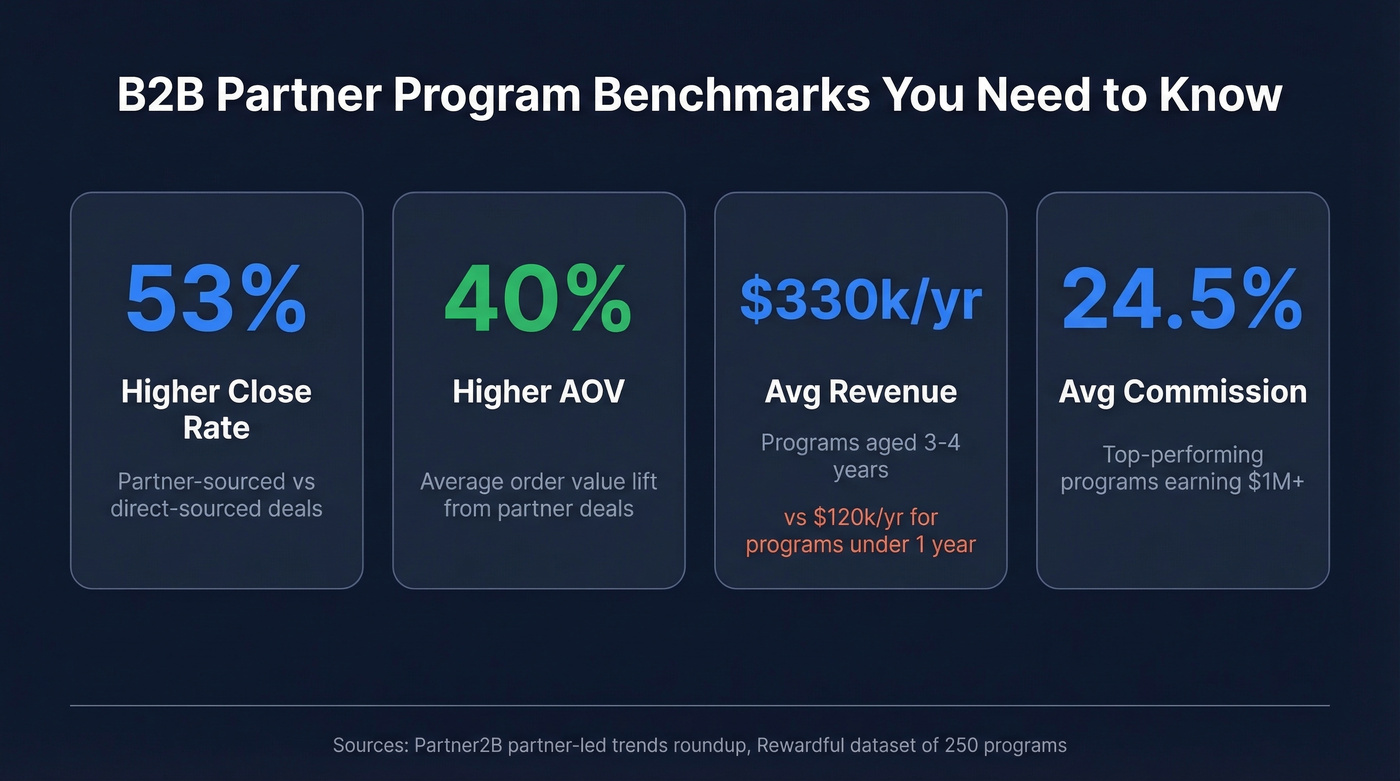
Partner-sourced deals close 53% more often and carry 40% higher AOV than direct-sourced deals, per Partner2B's partner-led trends roundup. The economics behind B2B partner programs are real. But the execution gap between "we have a partner page on our website" and "partners drive 30% of revenue" is enormous. Let's close it.
What You Need (Quick Version)
- Don't launch a partner program unless your product already converts via word-of-mouth, you have a clear ICP, retention is strong, and you have someone dedicated to managing it full-time. "Set it and forget it" is the most common failure mode.
- Start with referral partners (lowest friction), pay 5-15% of first-year contract value, and add mid-funnel incentives for long sales cycles.
- Expect 1-2 years before meaningful revenue contribution. Programs aged 3-4 years average $330k/year; under 1 year averages $120k.
- The #1 killer is attribution opacity. If partners can't see deal status and payout timelines in a dashboard, they stop sending you deals.
What Is a B2B Partner Program?
A B2B partner program is a structured framework where external companies - consultants, agencies, resellers, tech vendors, system integrators - help you sell, implement, or extend your product in exchange for compensation. It's not the same as a channel program, which is one motion within a partner program, or an ecosystem, which is the broader network of interconnected partnerships.
The distinction matters because modern partnerships are fluid. One partner can simultaneously act as an integration partner, referral source, reseller, and service provider. Rigid categorization breaks down fast. The best programs in 2026 design around motions, not labels.
Types of Partners Worth Recruiting
Referral Partners
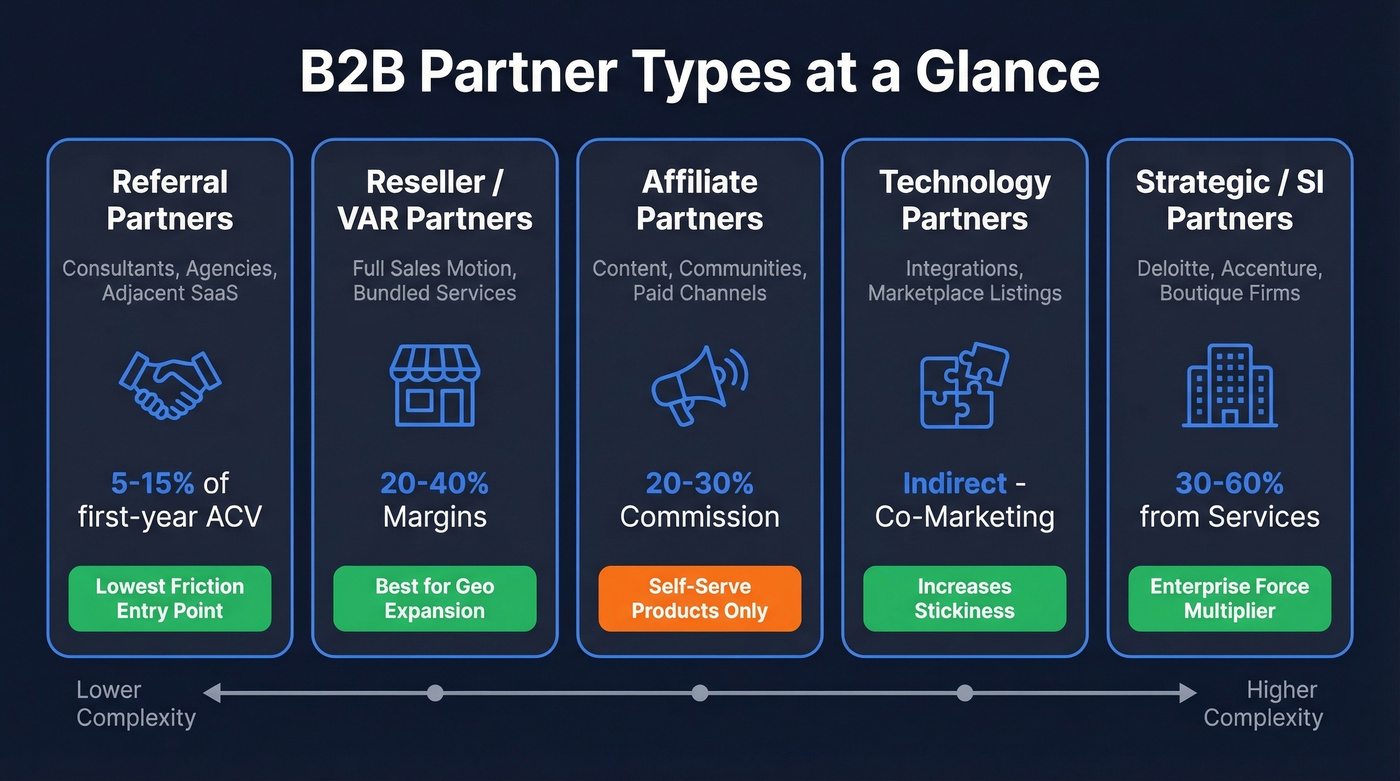
Use this if your product has strong word-of-mouth and you want the lowest-friction entry point into partnerships. Consultants, agencies, and adjacent SaaS companies who already talk to your ICP are ideal. Typical compensation runs 5-15% of first-year contract value.
Skip this if you don't have a clear ICP or your sales cycle is so long that referral partners lose patience before seeing a payout.
Here's the thing we've learned the hard way: the biggest source of referral partner churn isn't low commissions - it's ambiguity around what counts as a "qualified referral." Define it upfront. A qualified referral means the prospect matches your ICP, hasn't been in your pipeline for 90+ days, and the partner submits it through your registration process. Give partners real-time status updates via a dashboard, and resolve disputes within 14 days.
Reseller and VAR Programs
Resellers take on the full sales motion and typically earn 20-40% margins. They need deal registration, enablement, and MDF support. Value-added reseller programs work especially well when partners bundle your product with their own services - implementation, training, ongoing support - creating a combined offering that's more compelling than your product alone. This model shines when you're expanding into new geographies or verticals where local expertise matters more than your brand.
Don't go this route if you haven't nailed your own sales motion yet. Resellers amplify what works. They don't fix what's broken. We've seen companies launch reseller programs before they had a repeatable close process, and the result is always the same: frustrated partners, low conversion, and a damaged reputation in the channel.
Affiliate Partners
Affiliates drive traffic and leads through content, communities, and paid channels. Commission ranges of 20-30% are standard for SaaS affiliates. In a Rewardful-powered dataset of 250 programs, the $1M+ segment averaged 24.5% commission rates.
This model works when the path from click to conversion is short. If your average deal requires a 45-minute demo and a 3-month procurement cycle, affiliates will struggle. Self-serve products with transparent pricing are the sweet spot.
Technology Partners
Technology partnerships are less about commissions and more about co-marketing, shared customers, and marketplace listings. The economics are indirect but powerful: integrations increase product stickiness, expand use cases, and create more reasons for customers to standardize on your tool. If your product integrates with other tools in your buyer's stack, this is a no-brainer motion to build alongside referral or reseller tracks.
Strategic / SI Partners
System integrators and strategic consultancies like Deloitte, Accenture, or boutique firms make 30-60% of their profit from services, not your commissions. Design your program around their profitability, not just yours. If you're selling into enterprise accounts where implementation complexity is high, SIs are your force multiplier - but only if you give them a services practice to build around your product. SIs often become the single largest source of pipeline because they already sit inside the accounts you're trying to reach.
Commission Structures That Work
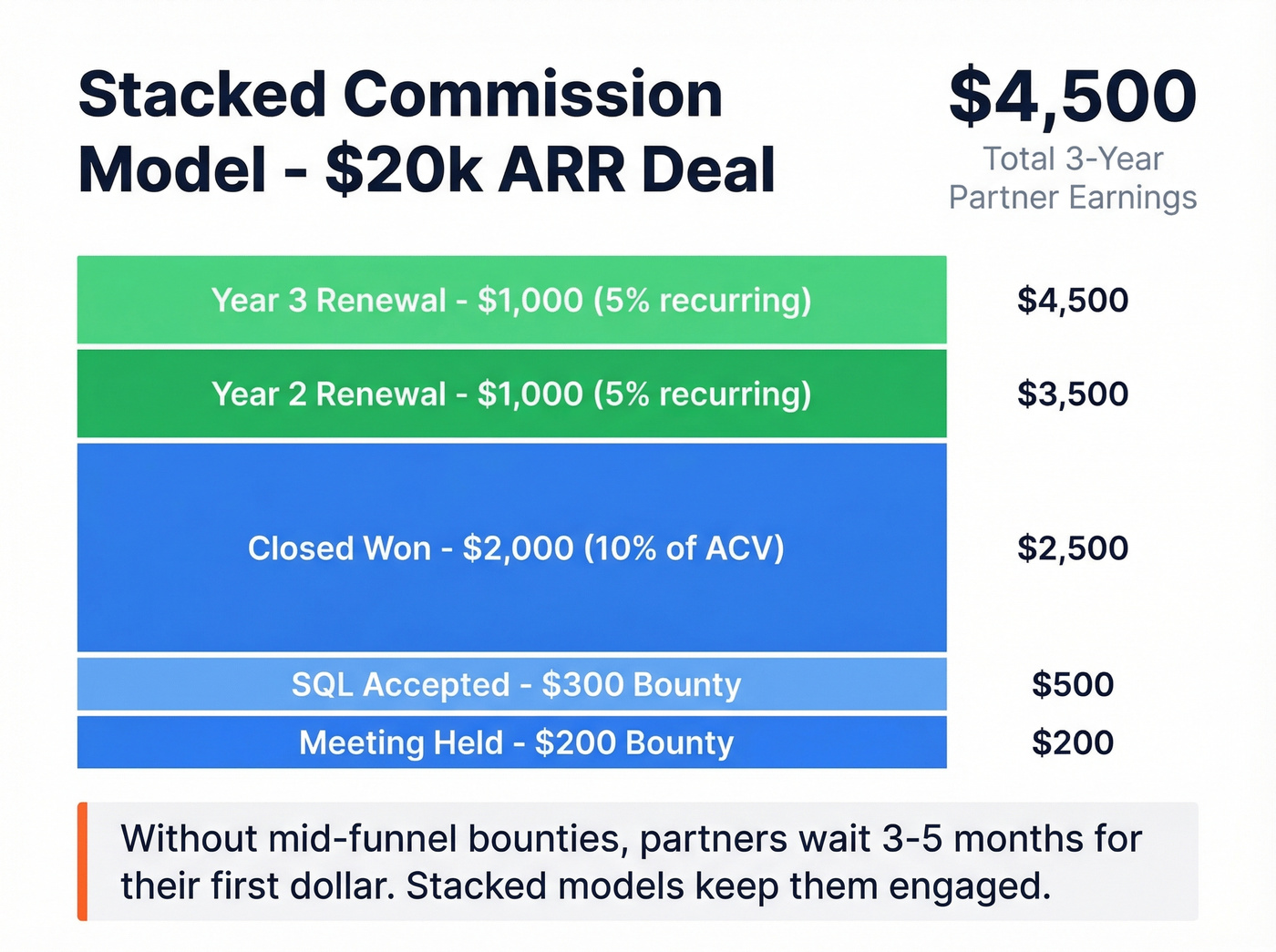
The biggest mistake in commission design: paying only on closed deals when your sales cycle runs 3-5 months. Partners disengage long before the check arrives.
| Model | Best For | Typical Range |
|---|---|---|
| Revenue share (CPS) | Short sales cycles, self-serve | 20-30% of first-year value |
| Per-lead (CPL) | Long cycles, mid-funnel engagement | $50-$500/qualified lead |
| Per-click (CPC) | Content/community affiliates | $0.50-$5/click |
| Tiered recurring | Retention-focused programs | 20% base, scaling to 30%+ |
| Stacked (CPS + CPL) | Complex B2B, 3-5 mo. cycles | Varies by funnel stage |
A note on CPC: most programs shouldn't lead with it. The economics only work when you have high-volume content partners driving top-of-funnel traffic to a self-serve product. For everything else, stacked models win.
Practical Commission Triggers
Don't limit payouts to closed-won. Here's a menu of triggers that keep partners engaged across the full funnel:
- Meeting held - $50-$200 bounty
- SQL accepted - $100-$500 bounty
- Opportunity created - percentage of projected deal value
- Proposal sent - milestone bonus
- Closed-won - revenue share (10-30%)
- Renewal - recurring commission (5-15%)
Example Calculation
A $20k ARR deal with a 10% first-year referral commission pays $2,000. Stack a $200 SQL bounty on top, and the partner earns $2,200 total. Add a 5% renewal commission and that's another $1,000 in year two. Now the partner has a reason to stay engaged post-sale.
Pipedrive's affiliate program is a good structural reference: 20% commission for new affiliates, rising to 30% after 2-5 paying referrals, with a 90-day cookie window. Simple, transparent, and progressive. That's what partners want.
How to Build a Partner Program (7 Steps)
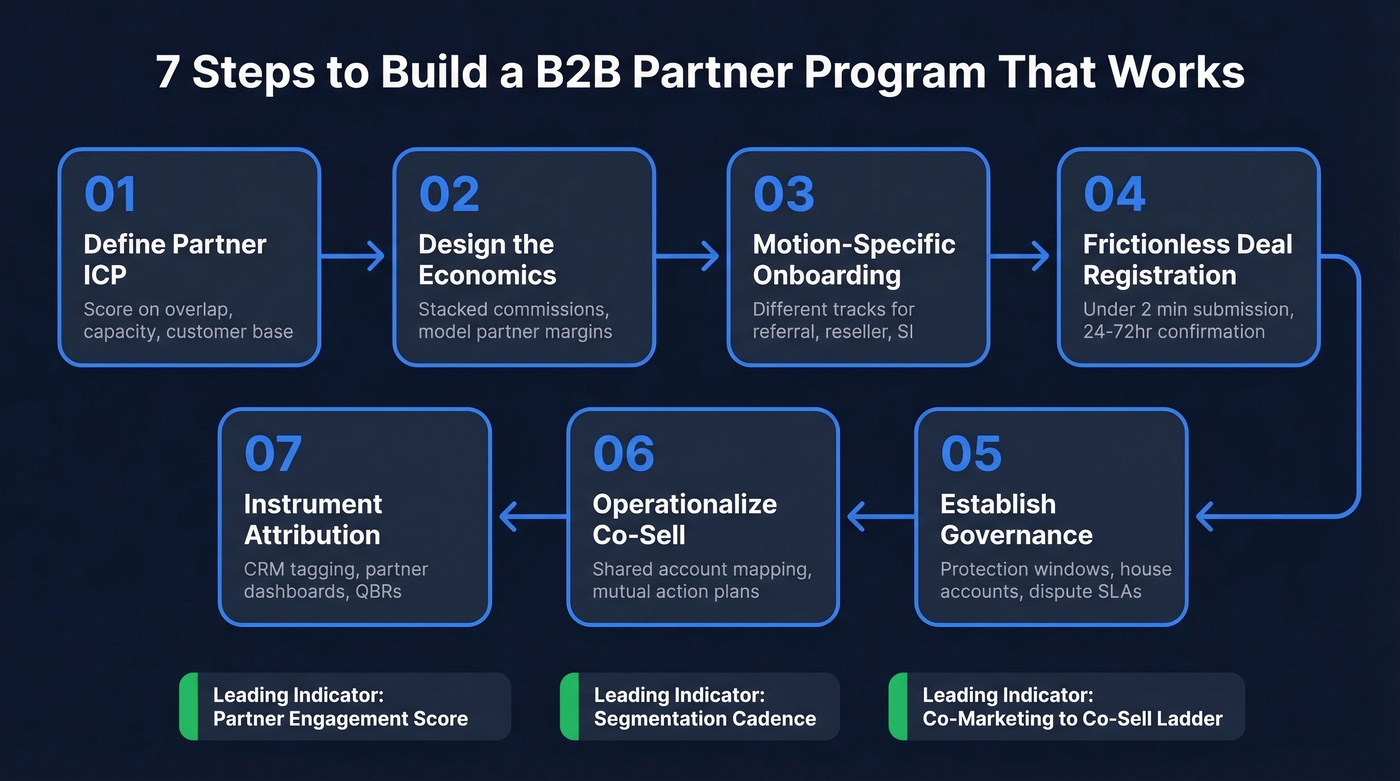
This build sequence draws from Introw's 2026 operating playbook and compresses it into seven actionable steps. Three leading indicators to track throughout: partner engagement scoring, segmentation cadence, and the co-marketing-to-co-sell ladder.
Step 1. Define Your Partner ICP
Not every company that wants to partner is worth partnering with. Define the profile: what industries do they serve, what's their customer overlap with yours, and what motion - referral, resell, integrate - makes sense? A consulting firm with 200 SMB clients in your vertical is worth more than a random agency with 5,000 followers. Score potential partners on ICP overlap, sales capacity, and existing customer base before onboarding.
Step 2. Design the Economics
Start with referral commissions at 5-15% of first-year contract value. For a reseller track, model the partner's total economics - not just your commission rate. Partners who make 5% net margin on a $100k deal are earning $5k. That's not enough to prioritize you over a competitor. Use the stacked model and trigger menu above to keep partners engaged across the full cycle.
Step 3. Build Motion-Specific Onboarding
A referral partner needs a different onboarding than a reseller or SI. Don't dump everyone into the same portal with the same 45-minute video. Automate the first 30 days with motion-specific sequences: referral partners get a deal submission walkthrough, resellers get sales enablement and pricing tools, SI partners get implementation certification paths.
Step 4. Make Deal Registration Frictionless
If submitting a deal takes more than 2 minutes, you'll lose partners. Single-step forms, mobile-friendly submission, and automated confirmation within 24-72 hours. Disputes should resolve within 7-14 days. In our experience, the fastest way to kill a partner relationship is making them wait a week for deal approval while a competitor confirms in 24 hours.
Step 5. Establish Governance Rules
This is the step most programs skip - and it's the one that causes the most damage at scale. Define these upfront:
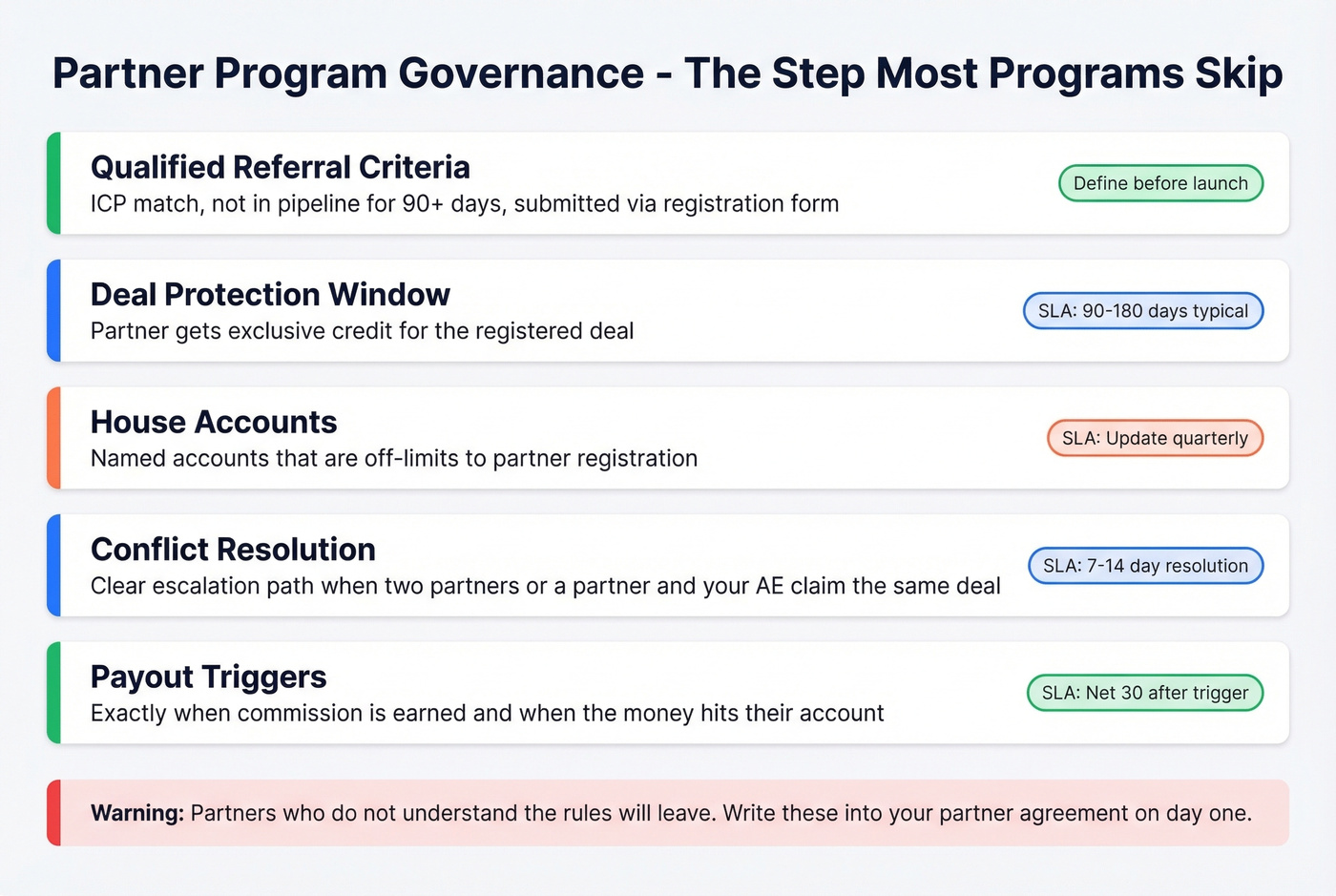
- Qualified referral criteria - ICP match, not in pipeline for 90+ days, submitted via registration
- Deal protection window - typically 90-180 days from registration
- House accounts - which accounts are off-limits to partners
- Conflict resolution - escalation path, SLA for resolution (7-14 days)
- Payout triggers - exactly when commission is earned and paid
Write these into your partner agreement. Partners who understand the rules play by them. Partners who don't understand the rules leave.
Step 6. Operationalize Co-Sell
Co-sell is where partner programs graduate from referral fees to real revenue impact. Run shared account mapping quarterly using tools like Crossbeam or Reveal, define partner-to-AE routing rules in your CRM, set mutual action plans with SLAs for response times, and track co-sell pipeline separately from partner-sourced pipeline. Every co-sell opportunity needs an owner on both sides and a shared close plan. Without this structure, co-sell devolves into "I introduced you to someone" with no accountability.
Step 7. Instrument Attribution
If attribution doesn't live in your CRM, partner impact goes unmeasured. Tag every partner-sourced and partner-influenced opportunity. Track first touch, last touch, and multi-touch. Partners who can't see their pipeline and payout timeline in a dashboard will stop sending you deals.
Quarterly business reviews with top partners should include pipeline data, conversion rates, payout history, and co-marketing ROI. Segment partners by performance and personalize the cadence - your top 10 partners deserve a different conversation than the long tail.
Arm Partners With Real Enablement
Enablement goes beyond product training decks. Partners need sales playbooks, competitive battle cards, case studies, and - critically - accurate prospect data. Partners can only sell if they're reaching the right people. Bad data kills partner confidence faster than low commissions. Arm your partners with verified contact lists from a tool like Prospeo, which offers 143M+ verified emails at 98% accuracy on a 7-day refresh cycle with 30+ search filters including buyer intent and technographics, and they'll actually use them.

Partner-sourced deals close 53% more often - but only when partners can actually reach the prospects they refer. Prospeo gives your partners access to 300M+ profiles with 98% verified emails and 125M+ direct dials, so every referral starts with real contact data instead of guesswork.
Arm your partners with data that converts at $0.01 per email.
Partner Marketing: Recruitment and Visibility
You can build the best program in the world, and it won't matter if nobody knows it exists. Recruitment is an ongoing motion, not a launch-day activity.
Build a discoverable partner page. Create a dedicated landing page optimized for "[your product] partner program" with clear benefits, commission structure, and a one-click application. Treat it like a product page, not an afterthought.
Go outbound to agencies and consultancies. Your best referral partners are already advising your ICP. Identify consulting firms, agencies, and fractional executives in your vertical and pitch them directly. A personalized email explaining the economics beats a generic "join our partner program" page every time.
Use marketplace listings. If you're in the Salesforce AppExchange, HubSpot, or cloud marketplace ecosystems, your listing is a partner recruitment channel. Partners discover vendors through marketplace searches - make sure your listing is optimized and links to your program.
Run co-marketing to attract partners. Joint webinars, co-authored content, and shared case studies with existing partners signal to prospective partners that your program is active and invested. Nobody wants to join a ghost town.
Create a partner locator. Once you have 20+ active partners, a searchable directory on your site drives inbound interest from both customers who want local implementation help and prospective partners who see an active ecosystem.
Benchmarks - What Good Looks Like
An analysis of 250 Rewardful-powered affiliate programs generated $68.4M in the last 12 months. The segment breakdown tells the real story.
The maturity curve is steep. 6% of programs earned $1M+ annually, averaging 24.5% commission. 40.8% earned under $100k. Programs under 1 year averaged $120k in annual sales; programs aged 3-4 years averaged $330k. Most partner programs are small - design for long-tail automation from day one.
Top segment stats: The highest-earning programs combined aggressive commission rates with mature operational infrastructure - automated onboarding, real-time dashboards, and dedicated partner managers. The bottom 40% shared a common trait: manual processes and no dedicated headcount.
Case study proof points: Apollo's partner program contributed 10% of total company revenue in 2 years, starting with a one-person team and scaling to nearly 4,000 partners. Glide's program drives 30% of total revenue. Freshworks saw a 300% increase in qualified sign-ups through partnerships. Jungle Scout's affiliate program delivers 30% of net new annual revenue.
The pattern is clear: partner programs compound. Year one is infrastructure. Year two is traction. Year three is material revenue contribution.
Hot take: If your average contract value is under $10k and your product isn't self-serve, you probably don't need a formal partner program yet. You need a referral bonus and a spreadsheet. Programs with sub-$10k deals struggle to offer commissions large enough to motivate partners, and the operational overhead eats into the economics. Get your ACV up or your sales motion to self-serve first, then formalize.
Five Mistakes That Kill Programs
1. "Set it and forget it" mentality. Programs need dedicated headcount. A consistent theme in practitioner threads on r/b2bmarketing: without a dedicated owner, programs stall within months. We've seen it ourselves - the programs that work have at least one full-time person whose entire job is partner success.
2. Attribution opacity. Partners left in the dark on deal status and payout timelines disengage fast. If they can't log in and see where their deals stand, they'll assume you're not tracking them. Build the dashboard before you recruit the first partner.
3. Process friction. 30% of partners sell a competitor's product when the vendor's process is too complicated. Every unnecessary step in deal registration is a defection risk. We've seen programs stall when deal registration takes longer than a day - and competitors confirm in hours.
4. Expecting partners to market for you. Only 1 in 100 partners can execute effective marketing campaigns. Provide co-marketing assets, templates, and budgets - or accept that most partners will only refer, not promote.
5. Ignoring partner profitability. Partners make 30-60% of their profit from services, not your commissions. If you're only offering discounts on your product, you're losing to competitors who help partners build a services practice around theirs.
Tools to Run Your Program
| Tool | Starting Price | Best For |
|---|---|---|
| Tracknow | $79/mo | Early-stage, <50 partners |
| Kiflo PRM | $249/mo | SMB referral + reseller |
| Introw | From ~$329/mo; free plan available | Co-sell operationalization |
| Everflow | $750/mo | Performance + affiliate |
| PartnerStack | ~$10k-$60k/yr | Mid-market scaling |
| impact.com | ~$30k-$100k+/yr | Multi-channel, enterprise |
Under 50 partners? Start with Tracknow or Kiflo and a well-structured CRM workflow. Scaling past 100? PartnerStack or impact.com for automation, marketplace listings, and multi-track management. For co-sell specifically, Introw's free plan lets you test shared account mapping before committing to their paid tier.
Building a Partner Ecosystem in 2026
Three trends are reshaping how B2B partner programs operate this year.
Ecosystem convergence is the big one. Linear partner programs are giving way to networked value models where MSPs, ISVs, SIs, and hyperscalers form multi-partner coalitions around shared accounts. The old "vendor -> partner -> customer" chain is becoming a web. Companies that invest in partner ecosystem sales - treating the entire network as a revenue engine rather than a collection of bilateral deals - are pulling ahead.
Agentic AI is automating the operational grind: onboarding sequences, deal routing, qualification scoring, and in-workflow enablement. Programs that used to need 3 partner managers can run leaner with AI handling the long tail. The risk is over-automating high-touch relationships. Your top 20 partners still need a human.
Cloud marketplace gravity is pulling co-sell and procurement into platform-native transaction paths. If you're not thinking about how your partner program intersects with AWS, Azure, or GCP marketplace motions, you're already behind.
If You Do One Thing This Week
Audit your existing informal partnerships. Find the three companies that have sent you the most referrals in the last 12 months - even if nobody tracked them. Call those people. Ask what would make them send more. Build your B2B partner programs around their answers, not a template. In our experience, the fastest win is a referral motion with ruthless clarity on payout triggers and a 48-hour deal confirmation SLA.
The fastest way to kill a partner program is bad data - bounced emails, wrong numbers, wasted effort. Prospeo's 7-day data refresh and 5-step verification mean your resellers and referral partners never burn their reputation on stale contacts. 15,000+ companies already trust it.
Stop losing partners to bad data. Fix it in one switch.
FAQ
How long until a partner program generates meaningful revenue?
Expect 1-2 years minimum before partnerships become a material revenue channel. Programs under 1 year average $120k in annual partner-sourced sales; at 3-4 years, that number climbs to $330k. Apollo hit 10% of total revenue in 2 years - and that's considered fast.
What's a competitive commission rate?
Referral partners typically earn 5-15% of first-year contract value. Resellers operate on 20-40% margins. Affiliate programs often run 20-30%, with top-performing programs ($1M+ annually) averaging 24.5%. Start at 20% and tier up based on volume.
Do I need a PRM tool to manage partners?
Not initially. Start with CRM workflows and a spreadsheet when you're under 50 partners. Add a PRM like Tracknow ($79/mo) or Kiflo ($249/mo) when manual tracking becomes a bottleneck - usually around 30-50 active partners.
How do I prevent channel conflict?
Define qualified referral criteria, set deal protection windows (90-180 days), designate house accounts, and publish a clear conflict resolution process with a 7-14 day SLA. Write all of this into your partner agreement before you recruit your first partner.
What tools help partners with prospecting data?
Prospeo provides 143M+ verified emails at 98% accuracy with a 7-day refresh cycle, plus 30+ search filters including buyer intent and technographics. At ~$0.01 per email with a free tier, it's a low-cost way to arm partners with reliable contact data so they can actually reach your shared ICP.