

Partner Selling: How to Build a Program That Actually Generates Revenue
Your CEO just walked out of a board meeting and dropped this on your desk: "We need a partner channel. Figure it out." You've got a quarter to show pipeline, no dedicated headcount, and a vague sense that "partnerships" means different things to different people. Meanwhile, your reps spend 60% of their time on non-selling tasks, and 57% of sales professionals say the [cycle is getting longer](https://www.salesforce.com/sales/state-of-sales/). CAC climbed 40-60% between 2023 and 2025. Direct-only isn't scaling anymore.
This is how to build a partner selling program that actually moves numbers.
The Short Version
- Start with referral partners. Jake Atwood (The Channel Builder) estimates 90%+ of channel partnerships are referral-based. Don't overcomplicate it.
- Pick five great partners, not fifty mediocre ones. Depth beats breadth every time.
- Equip them with verified prospect data, a campaign-in-a-box, and a clear commission structure. If they can't prospect on day one, they won't prospect on day thirty.
- Measure partner-sourced pipeline, not partner count. Vanity metrics kill programs.
- Know the economics. Referral programs can run around ~$150 CAC vs. $802 for paid search. Partner-sourced deals also show 53% higher close rates. That's not a marginal improvement - it's a different business model.
What Is Partner Selling?
Partner selling is the practice of generating revenue through external companies - partners - who refer, resell, co-sell, or otherwise bring your product to their customers. It's not just "channel sales," though channel is a subset. The strategy spans referral programs, reseller networks, affiliate motions, co-selling with hyperscalers, and strategic alliances with systems integrators.
The distinction from direct sales matters. In direct, your reps own the entire cycle. In a partner-led motion, you're tapping into someone else's relationships, credibility, and customer access to reach buyers you'd never reach alone - or reach them faster and cheaper than your direct team could.
The scale is hard to overstate. 95% of Microsoft's revenue flows through its partners. 58% of revenue for top-performing companies comes from partners. Mature partner programs generate 28% of total company revenue on average, compared to 18% for businesses still treating partnerships as a side project. For many organizations, this isn't a side channel. It's the primary growth engine.
The Economic Case for Partners
Let's talk numbers, because this is where the conversation gets interesting.
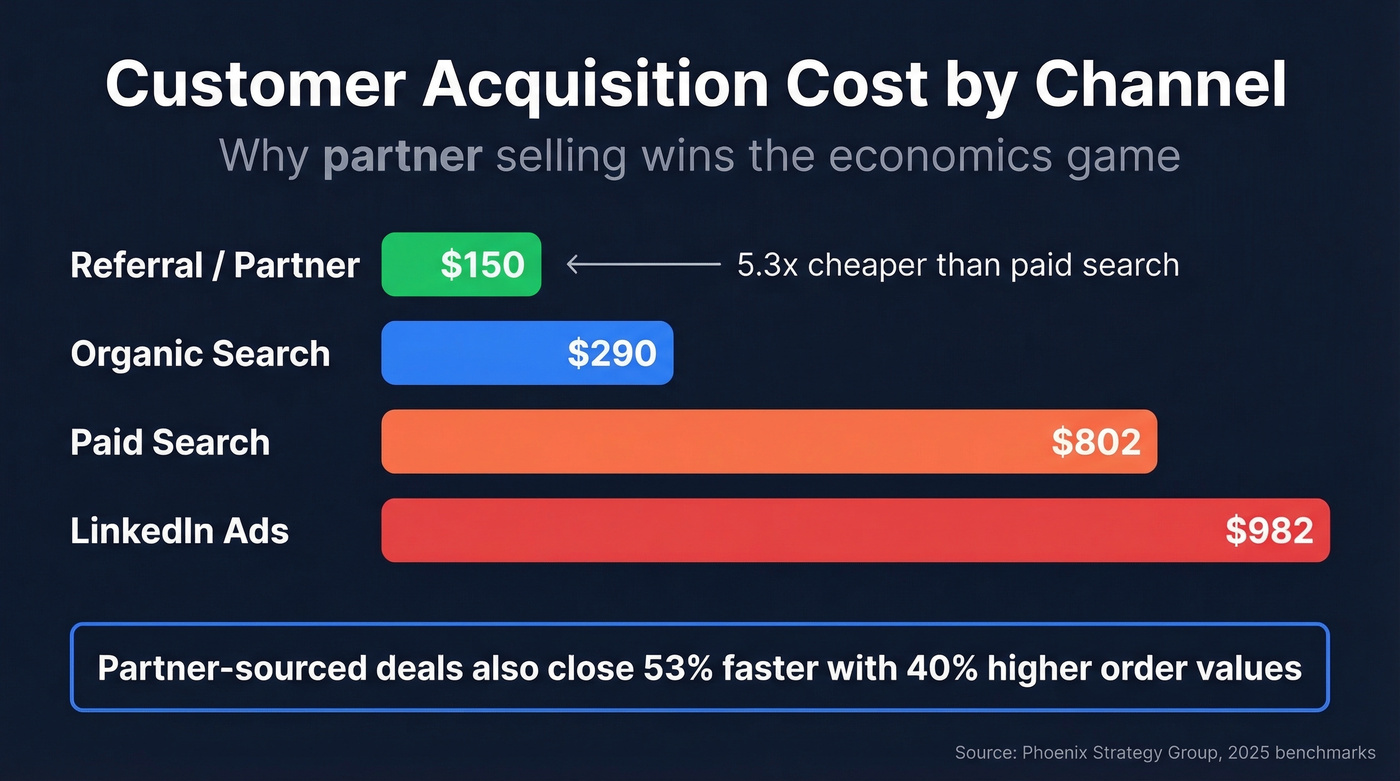
| Channel | Average CAC |
|---|---|
| Referral/Partner | $150 |
| Organic Search | $290 |
| Paid Search | $802 |
| LinkedIn Ads | $982 |
That $150 referral CAC isn't a typo. When a trusted partner introduces your product to a buyer who already has a problem you solve, the trust transfer collapses the sales cycle. You skip the awareness stage, the credibility-building stage, and often the competitive evaluation stage entirely.
The downstream metrics tell the same story. Partner-sourced deals show 40% higher average order values, 53% higher close rates, and 46% faster conversion from opportunity to close. And 72% of companies with mature partner programs report lower overall CAC. Shorter cycles mean reps can work more deals per quarter, and the compounding effect on pipeline velocity is real.
These numbers don't mean the motion is easy. They mean it's efficient when it works. The gap between "we have partners" and "partners generate pipeline" is where most programs die. The rest of this guide closes that gap.
Partner Selling Models Compared
Picking the wrong model for your stage and product is one of the fastest ways to waste six months.
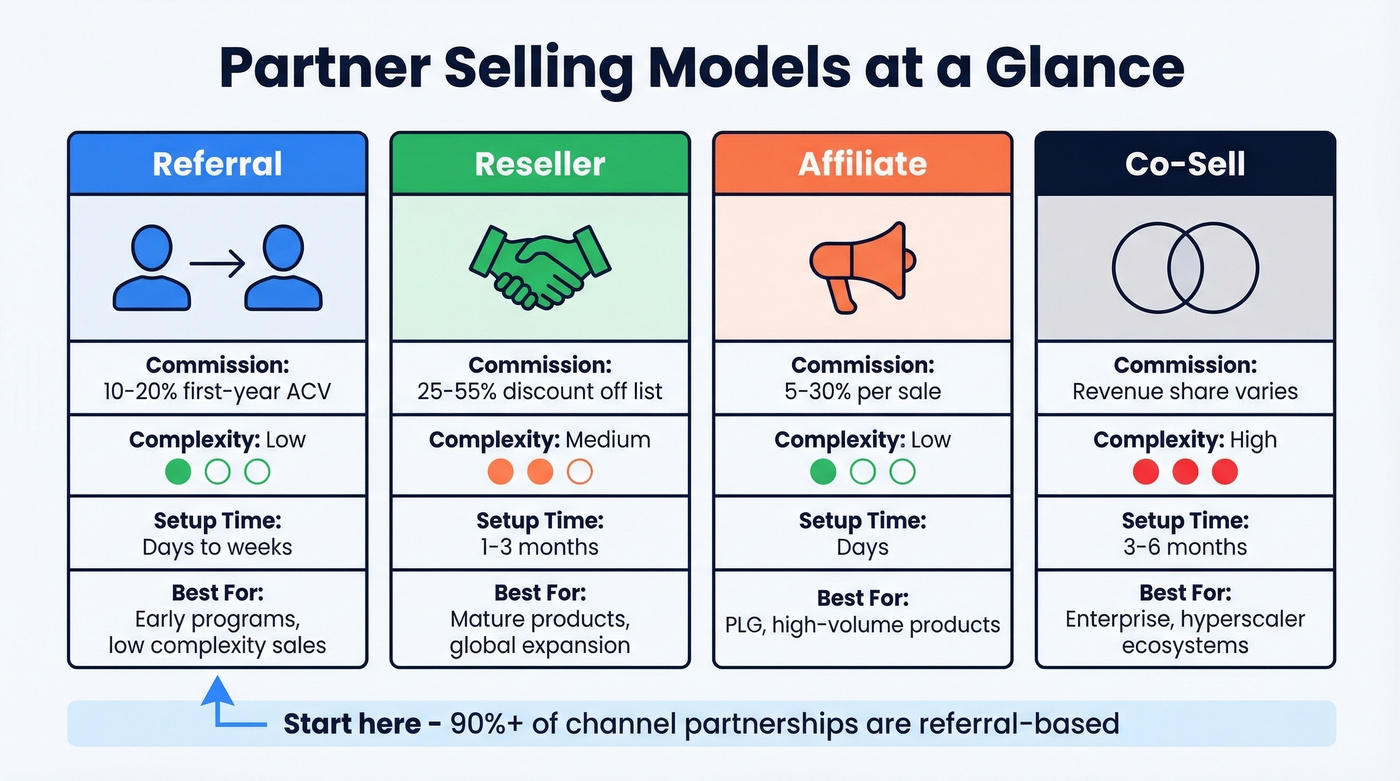
| Model | How It Works | Typical Commission | Pros | Cons | Best For |
|---|---|---|---|---|---|
| Referral | Partner sends leads, you close | 10-20% first-year ACV | Fast setup, clean economics | Partners go stale without motivation | Early programs, low complexity |
| Reseller | Partner sells and closes | 25-55% discount off list | Massive reach without headcount | Poorly trained reps create support debt | Mature products, global reach |
| Affiliate | Partner promotes to audience | 5-30% per sale | High volume, low touch | Limited control over brand messaging | PLG, high-volume products |
| Co-Sell | Joint selling with partner | Revenue share varies | Bidirectional trust, larger deals | Requires real coordination and patience | Enterprise, hyperscaler ecosystems |
Referral Partners
This is where you start. A referral partner sends you a qualified lead, you close it, and they earn a commission. Unbounce pays 20% lifetime commission. Gusto offers $200 gift cards to both parties and saw a 30% increase in signups from the program. Jake Atwood estimates that 90%+ of channel partnerships are referral-based - and for good reason. The model works with minimal infrastructure.
The catch: referral partners go stale without ongoing motivation. You can't just sign them and forget them.
Reseller Partners
Resellers are your second sales team. They source leads and close deals, taking a larger share of revenue in exchange. ActiveCampaign offers resellers 25-55% discounts on plans based on account volume. The upside is massive reach without proportional headcount. The downside is real - poorly trained resellers create customer satisfaction problems that land on your support team.
Don't launch a reseller program until your product is mature enough that someone outside your company can sell it without hand-holding on every deal.
Affiliate Partners
Affiliates promote your product to their audience via content, sponsorships, or paid placements. DigitalOcean's program gives new customers a $200 credit and pays referrers $25 after the referred customer spends their first $25. It's a volume play - great for product-led growth motions where the product sells itself after a trial. The tradeoff is control: you're trusting someone else with your brand messaging, and bad affiliates can damage positioning fast.
Skip this model if your product requires a consultative sale or has an ACV above $50K. The economics won't work.
Co-Selling
Co-selling is the heavyweight model: two companies jointly pursuing complementary solutions to shared customers. Don't confuse it with cross-selling, which is an intra-company expansion motion. Co-selling is inter-company - two organizations jointly pursuing shared prospects.
The numbers are striking. AWS Marketplace co-selling yields 65% higher close rates and 51% faster average revenue growth. Google Cloud reported a 200% increase in co-sell bookings in H1 2023, a trend that's only accelerated since. Contentsquare's marketplace co-sell opportunities are 81% larger and close 11% faster, with a 106% increase in ACV. Microsoft requires $100K in Marketplace Billed Sales for Azure IP co-sell eligibility - this isn't a beginner motion.
Co-selling works because the trust transfer is bidirectional. Both companies bring credibility, relationships, and account intelligence. But it requires shared account planning and a willingness to invest before seeing returns. The consensus on r/sales threads about co-selling is pretty consistent: the first six months feel like you're pushing a boulder uphill, and then the flywheel kicks in.

Your partners can't generate pipeline without verified prospect data. Prospeo gives you 300M+ profiles with 98% email accuracy and 125M+ verified mobiles - the campaign-in-a-box your referral and reseller partners actually need to close deals.
Stop signing partners and leaving them empty-handed. Give them data that converts.
How to Build the Program
Every guide tells you to "align goals and communicate regularly." Let's talk about what that actually looks like when you're one person with a Notion doc and a mandate.
Pick the Right Five Partners
This will save you a year: five great partners will outperform fifty mediocre ones. Score potential partners across three dimensions - revenue impact (do they sell to your ICP?), strategic integrations (does their product complement yours?), and co-marketing reach (can they actually drive awareness?). If a partner scores low on all three, they're a distraction.
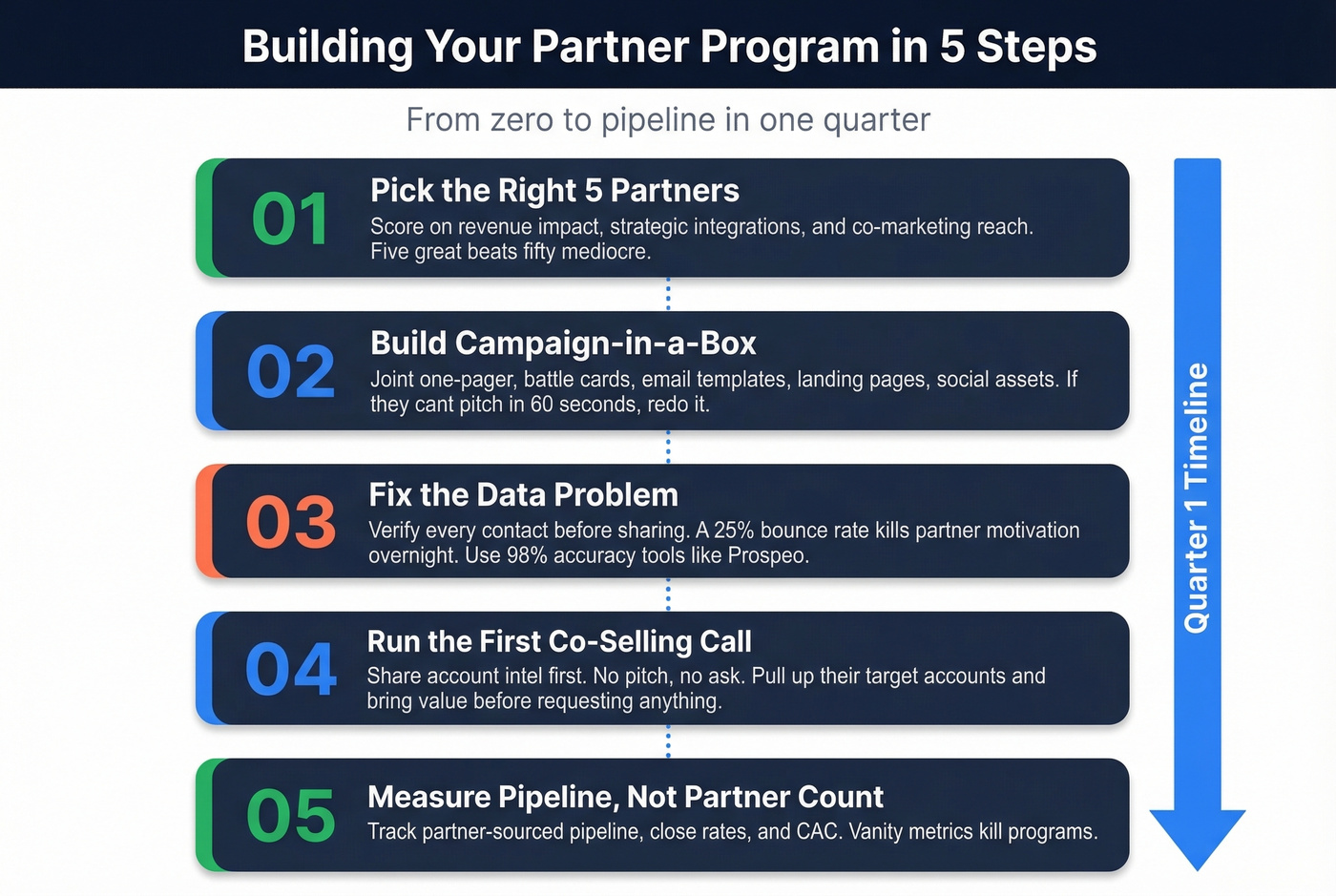
We've seen teams sign 40 partners in Q1 and generate zero pipeline by Q3. The problem isn't the model - it's the math. You can't enable 40 partners with one partnerships hire. Pick five. Go deep.
Enable Them to Actually Sell
Partners don't fail because they're lazy. They fail because you handed them a logo and a login and called it enablement.
Build a campaign-in-a-box: joint one-pager, landing page template, webinar speaker brief, sales battle cards, customer quotes, email templates, and social assets. If a partner rep can't pitch your product in 60 seconds after reading your materials, your materials aren't good enough. The 5-step framework from Partner Playbooks that works for small teams: Map the market, get buy-in, build a joint value proposition, deliver the campaign-in-a-box, run retros and iterate.
Solve the Data Quality Problem
Here's the thing nobody writes about: the #1 reason partner programs underperform is that the data you hand your partners is garbage. Stale CRM exports with bounced emails and disconnected phone numbers. Your partner rep tries to prospect, gets a 25% bounce rate, burns their domain reputation, and quietly stops trying. You never hear about it. They just go silent.
Before you share any prospect list with a partner, run it through a verification tool. Prospeo's 98% email accuracy and 7-day data refresh cycle means the contacts you hand over actually connect, and its native Salesforce and HubSpot integrations eliminate the stale-CSV problem that kills partner outreach before it starts. (If you want to go deeper on vendors, see data enrichment services and lead enrichment.)
Co-Selling Tactical Playbook
The first call between your rep and a partner rep sets the tone for the entire relationship. I've watched three programs die because the CEO handshake never reached the sales floor - and the first rep-to-rep call devolved into an awkward lead request.
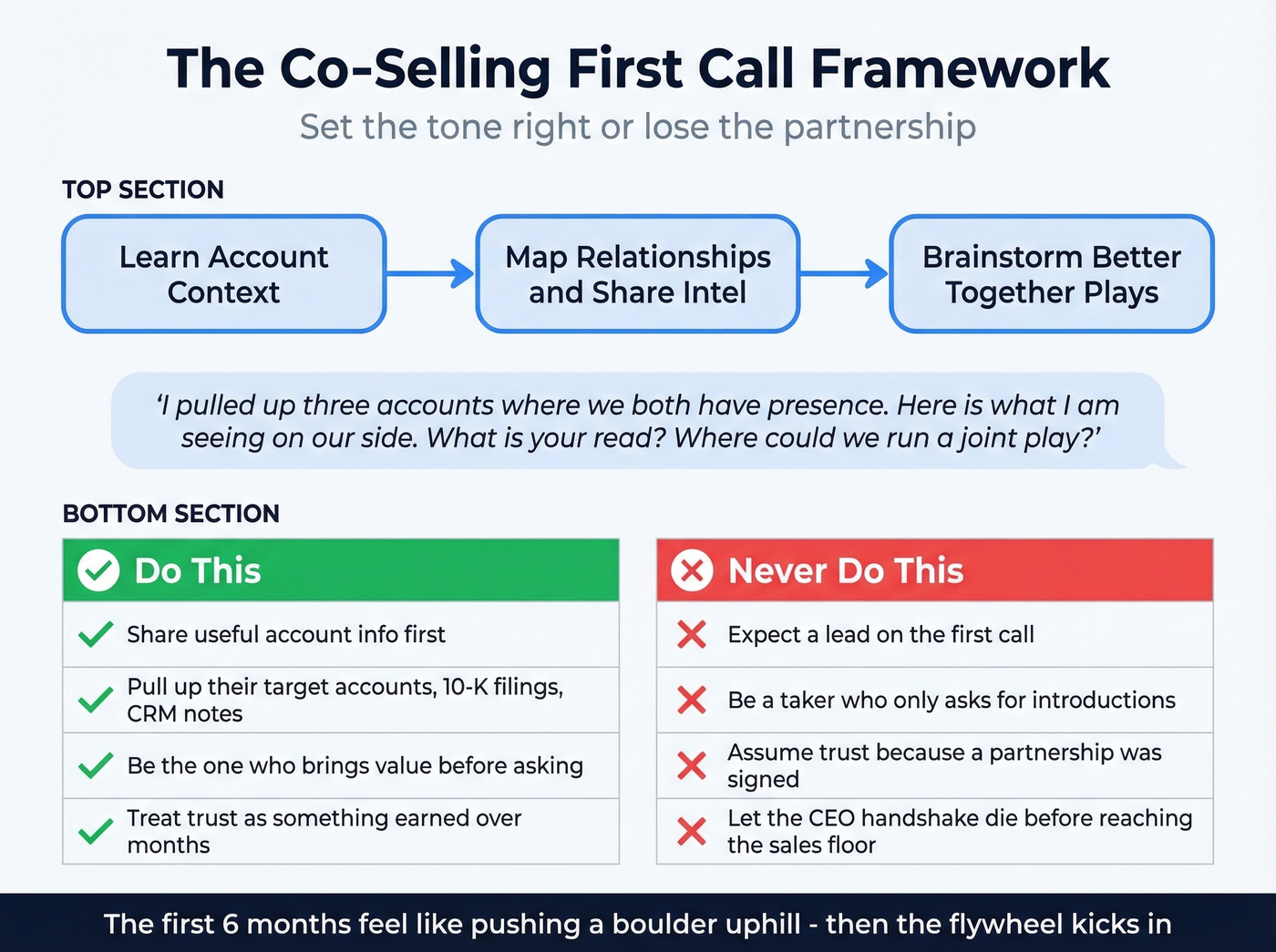
The purpose of that first co-selling call is simple: learn account context, map relationships, share intelligence, and brainstorm "better together" plays. The best move? Be first to share useful account information. Pull up their target account's recent press, 10-K filings, or CRM notes and bring something to the table before you ask for anything.
A rough script: "I pulled up three accounts where we both have presence. Here's what I'm seeing on our side - [share intel]. What's your read? Where do you think we could run a joint play?" No pitch. No ask. Just value.
The anti-patterns are predictable: don't expect a lead on the first call, don't be a taker, and don't assume trust just because your companies signed a partnership agreement. Trust is built 1:1, between humans, over time.
Partner Agreement Essentials
Most companies either over-invest in legal before validating the opportunity, or they handshake-deal their way into a mess. Your agreement needs to cover scope and exclusivity (with a revocation clause if targets aren't met), deal registration rules, performance obligations, payment structure and timing, IP rights, confidentiality and data protection, termination and exit terms, and dispute resolution.
Don't spend three months on legal before you've validated that the partnership generates pipeline. Use a lightweight agreement for the pilot phase, then formalize once the motion works.
Mistakes That Kill Programs
60-65% of strategic partnerships fail. The patterns are predictable.
- Building in a back room. You spend months designing the perfect program before talking to a single potential partner. Sign one partner, run a 90-day pilot, learn, then build around what worked.
- Letting direct reps manage partners. Your AEs are coin-operated closers. They'll poach partner deals or ignore partner reps entirely. Dedicate at least one person - even part-time - to partner management.
- CEO handshake without sales floor buy-in. The agreement means nothing if partner reps don't know you exist. Train and enable their frontline sellers directly.
- Over-investing in single-opportunity partners. One deal doesn't make a partnership. Evaluate on repeatable pipeline potential.
- Unrealistic revenue timelines. Referral programs can produce leads in 30-60 days. Reseller and co-sell motions take 6-12 months. Plan accordingly.
- Managing with a stick, no support. Threatening to cut partners while giving them zero enablement is a guaranteed way to kill the program.
Real talk: If your average deal size is under $10K, you probably don't need a co-sell motion at all. Stick with referral and affiliate partners until the deal size justifies the coordination overhead. Most companies jump to co-selling too early because it sounds impressive, then burn six months on joint account planning for deals that don't move the needle.
The Tech Stack You Actually Need
You don't need PRM software until you have 20+ active partners. Before that, a CRM, a shared workspace, and a good data platform will do more for your program than a $1,500/month PRM you're not ready to use.
| Tool | Starting Price | Best For |
|---|---|---|
| Prospeo | Free (75 emails/mo); ~$0.01/email | Partner data enrichment & verification |
| Salesforce PRM | $25/user/mo | Enterprise, existing SF orgs |
| Impact.com | ~$30/mo | Affiliate-heavy programs |
| Kiflo | $299-$399/mo | Mid-market, scaling programs |
| PartnerStack | $1,500+/mo | SaaS marketplace ecosystems |
| Channeltivity | $1,399-$1,699/mo | Channel-heavy B2B |
| Impartner | $2,000+/mo | Enterprise partner ecosystems |
The minimum viable stack: your CRM, a shared workspace for co-planning like Notion or Google Docs, and a data platform that ensures your partners prospect with accurate contact information. In our experience, the data layer is where most teams underinvest - and it's the single highest-ROI line item in the partner tech stack. (If you're building outbound motions with partners, pair this with sales prospecting techniques and a clean lead generation workflow.)
Partner-sourced deals close 53% more often - but only when partners reach the right buyers. With 30+ filters including buyer intent, technographics, and headcount growth, Prospeo lets you hand partners pre-built prospect lists at $0.01 per verified email.
Collapse your partners' sales cycle the same way they collapse yours.
FAQ
What's the difference between partner selling and channel sales?
Channel sales is a subset focused on reseller and distributor motions. Partner selling is the broader strategy that spans referral, reseller, affiliate, co-selling, and SI models. Organizations adopting a partner-led approach treat the partner channel as a primary revenue driver, not a supplementary one.
How long before a partner program generates revenue?
Referral programs can produce qualified leads within 30-60 days. Reseller and co-sell motions typically take 6-12 months for repeatable pipeline. Budget at least two quarters before expecting consistent deal flow from non-referral models.
How do I prevent conflict between direct reps and partners?
Enforce deal registration with clear rules, segment territories, and set a hard policy: direct reps never manage partner relationships. Companies that assign a dedicated partner manager - even part-time - see 2-3x more partner-sourced pipeline than those relying on AEs.
What's a typical partner commission rate?
Referral partners earn 10-20% of first-year ACV. Resellers get 25-55% discount off list price. Affiliates earn 5-30% per sale. Structure tiers so top performers earn meaningfully more - flat rates across all partners kill motivation.
How do I make sure partners have accurate prospect data?
Run every list through a verification tool before sharing it. Bounced emails and dead numbers are the silent killer of partner programs - partners won't tell you the data was bad, they'll just stop calling.