

B2B Sales Enablement in 2026: What Actually Works (and What Doesn't)
75% of sales leaders logged into their enablement platform fewer than five times last quarter. Three-quarters of the people who approved the budget barely use the thing. Reps on Reddit describe the reality perfectly: they're "buried in docs, decks, updates" that "doesn't help anyone." B2B sales enablement is a $6+ billion market with an adoption crisis at its core.
Most enablement programs fail because they optimize for content production, not content consumption. The fix isn't complicated - it's a lean charter, measurable KPIs with actual formulas, and a tech stack that prioritizes adoption over features.
What Sales Enablement Actually Means
B2B sales enablement is the ongoing process of equipping revenue teams with the content, training, coaching, tools, and data they need to engage buyers effectively. It's not a department that builds slide decks. It's a function that makes reps better at selling - and measures whether that's actually happening.
The confusion starts when people conflate enablement with sales ops, RevOps, or the newer "revenue enablement" label. They're related but distinct:
| Function | Focus | Primary Goal | Success Measures |
|---|---|---|---|
| Sales Enablement | Rep effectiveness | Better selling skills | Content adoption, win rate |
| Sales Operations | Systems & process | Operational efficiency | Forecast accuracy, CRM health |
| RevOps | Cross-functional alignment | Predictable revenue | Pipeline velocity, tool ROI |
| Revenue Enablement | All revenue teams | Cohesive buyer journey | Full-funnel conversion |
Enablement zeroes in on rep effectiveness through content, training, and coaching. Sales ops handles systems, processes, and data infrastructure. RevOps aligns all revenue teams through shared tech and reporting. Revenue enablement extends the mandate beyond sales to marketing, CS, and product teams.
Where does enablement report? The 2026 Sales Enablement Landscape Report breaks it down: RevOps owns it 39.4% of the time, Sales 25.4%, C-Suite 16.6%, and Marketing just 5.2%. Best practice: report to whoever owns the revenue number.
Why Enablement Matters More in 2026
The Buyer Behavior Shift
A survey of 646 B2B buyers found that 67% prefer a rep-free experience - up from 61% the year before. That's not a blip. It's a structural shift.
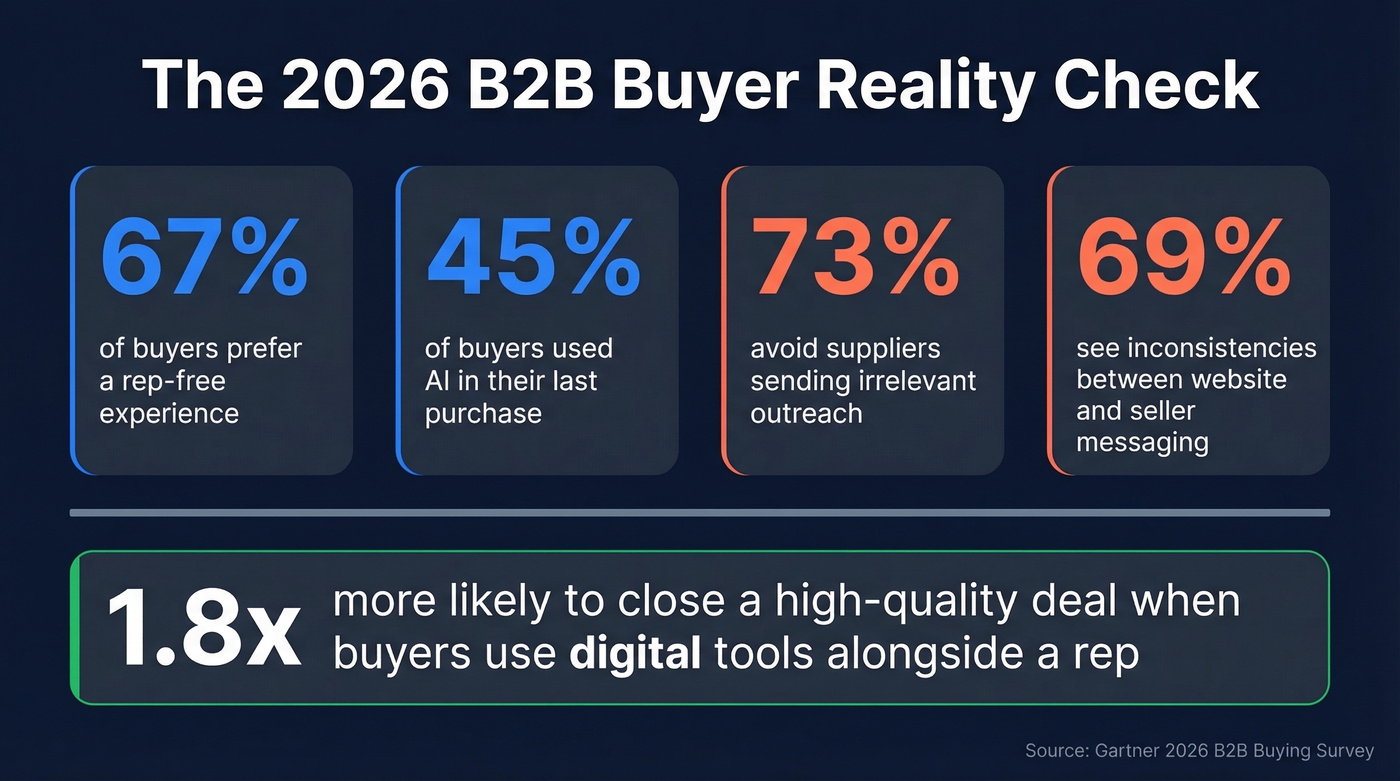
Even more telling: 45% of buyers used AI during a recent purchase, arriving at sales conversations with stronger opinions and sharper comparisons than ever before. 73% actively avoid suppliers who send irrelevant outreach. And 69% report inconsistencies between what a company's website says and what sellers tell them - which means your reps are walking into conversations already behind.
Here's the thing, though. Buyers who use supplier digital tools alongside a sales rep are 1.8x more likely to complete a high-quality deal than those going fully independent. Confident buyers are twice as likely to report a high-quality deal. Enablement's job in 2026 isn't replacing reps. It's making every rep interaction so valuable that buyers choose to engage.
The 2026 Market Shakeup
Seismic acquired Highspot in February 2026, creating a ~$6B combined entity that dominates enterprise enablement. Showpad and Bigtincan merged in October 2025. Gong introduced Gong Enable in early 2026, bringing revenue intelligence and enablement under one roof. Gartner introduced a Magic Quadrant for Revenue Enablement Platforms in November 2025.
Fewer vendors, higher switching costs, more pressure to pick the right platform early.
Core Pillars Every B2B Team Needs
Content Management & Governance
Stop building more content. Start deleting it.
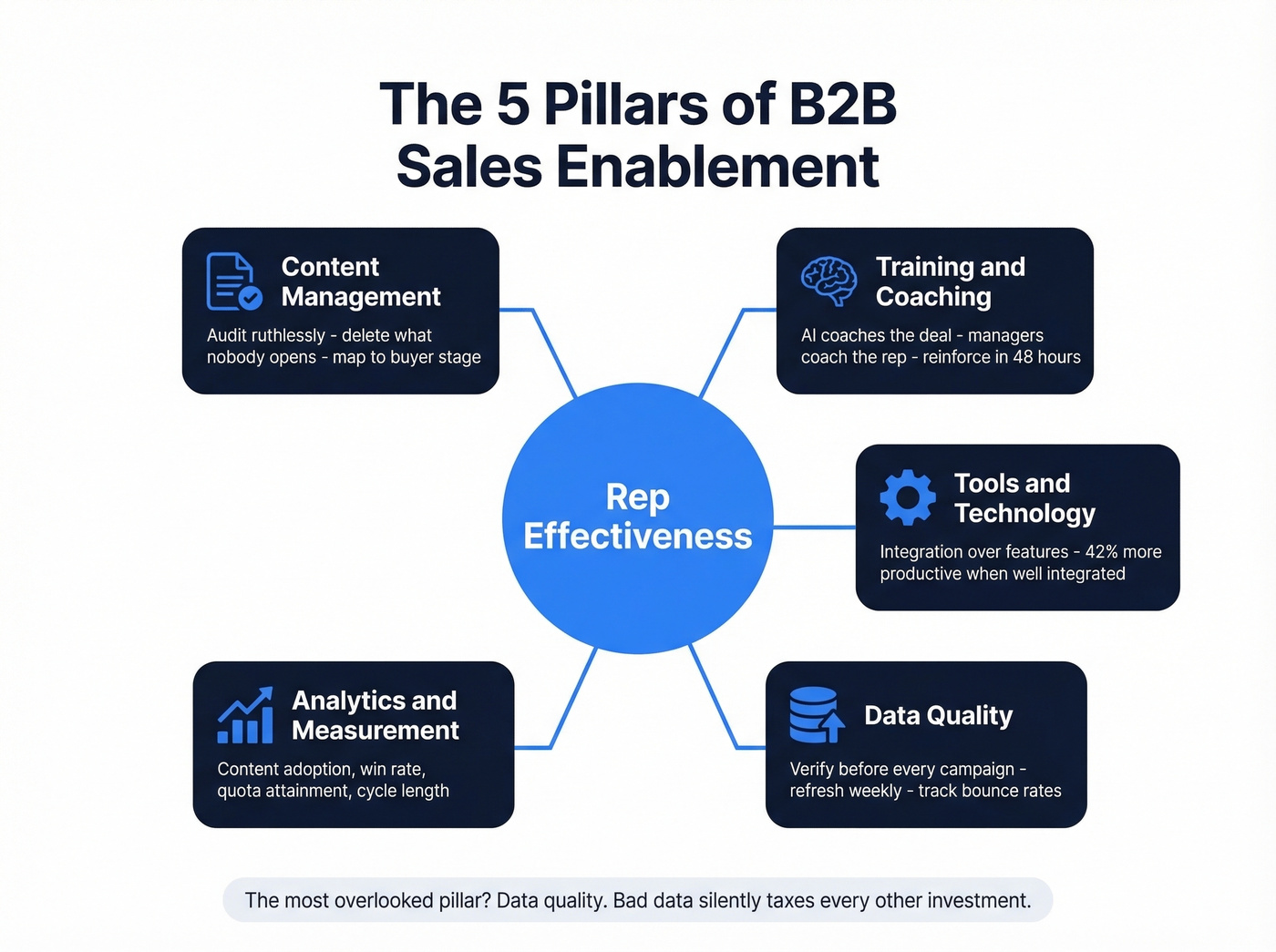
Content overload is the #1 failure mode in enablement programs. Reps can't find the right asset in 30 seconds, so they ignore the library entirely and build their own playbook from whatever's in their inbox. We've seen this pattern at company after company - a beautiful content hub that nobody opens.
- Audit ruthlessly: if a battlecard hasn't been opened in 90 days, kill it
- Keep battlecards short, specific, and mobile-accessible (reps have 30 seconds between appointments, not 30 minutes)
- Update quarterly at minimum
- Map every asset to a specific buying stage and stakeholder persona
The average B2B deal involves 6-10 decision-makers, and each one needs different content. Quality and findability beat volume every time.
Training & Coaching
A 2025 neuroscience study by Dr. Carmen Simon found that sellers receiving AI coach feedback remembered 50% more information after 48 hours than those receiving human feedback alone. Organizations using AI for sales training are 35% more likely to increase average deal size.
The practical split: let your AI coach the deal, let your manager coach the rep. AI excels at consistent reinforcement - reviewing call recordings, flagging missed objection-handling opportunities, drilling product knowledge. Managers excel at motivation, career development, and the judgment calls that algorithms can't replicate. Trying to make AI do both, or managers do both, is how you end up with neither done well.
Tools & Technology
90% of companies have implemented AI in their enablement stack or plan to this year. But tool adoption without integration is just shelfware with a subscription fee. Well-integrated enablement stacks are 42% more likely to increase sales productivity - which means your integration strategy matters more than your feature checklist. Full tech stack breakdown with actual pricing below.
Data Quality
This is the most overlooked pillar. Your program trained the rep, built the battlecard, and scripted the talk track - but if the phone number is dead, none of it matters.
Reps waste hours calling disconnected lines and sending emails that bounce. That's not a sales problem. It's a data problem, and it silently undermines every other enablement investment you've made. One of our customers, Snyk, saw bounce rates of 35-40% before switching their data source - which meant more than a third of their reps' outreach effort was wasted before a conversation even started.
- Verify contact data before every campaign
- Refresh data on a weekly cycle, not monthly or quarterly
- Track bounce rates and connect rates as enablement KPIs
- Treat bad data as a tax on every other enablement investment

Analytics & Measurement
The most common enablement success metrics per the 2026 Landscape Report: content adoption (50%), quota attainment (43.1%), win rate (42.2%), revenue generated (37.9%), and sales cycle length (33.6%). Go beyond vanity metrics by using directional attribution - track which assets appear in closed-won deals, run cohort comparisons between enabled and non-enabled reps, and map content touches to stage progression. Exact formulas below.

Snyk's 50 AEs saw bounce rates drop from 35-40% to under 5% after switching to Prospeo. Every battlecard, training session, and coaching program you build is wasted if reps are dialing dead numbers and bouncing emails. Prospeo's 7-day data refresh and 98% email accuracy ensure your enablement investments actually reach buyers.
Stop enabling reps to contact the wrong people. Start with verified data.
How to Build an Enablement Program
Step 1: Build a charter. Define the mission, scope, ownership, and success criteria in a single document. Example: "Reduce new rep ramp time from 6 months to 3 months while maintaining 85%+ quota attainment." If your charter is longer than one page, it's too long.
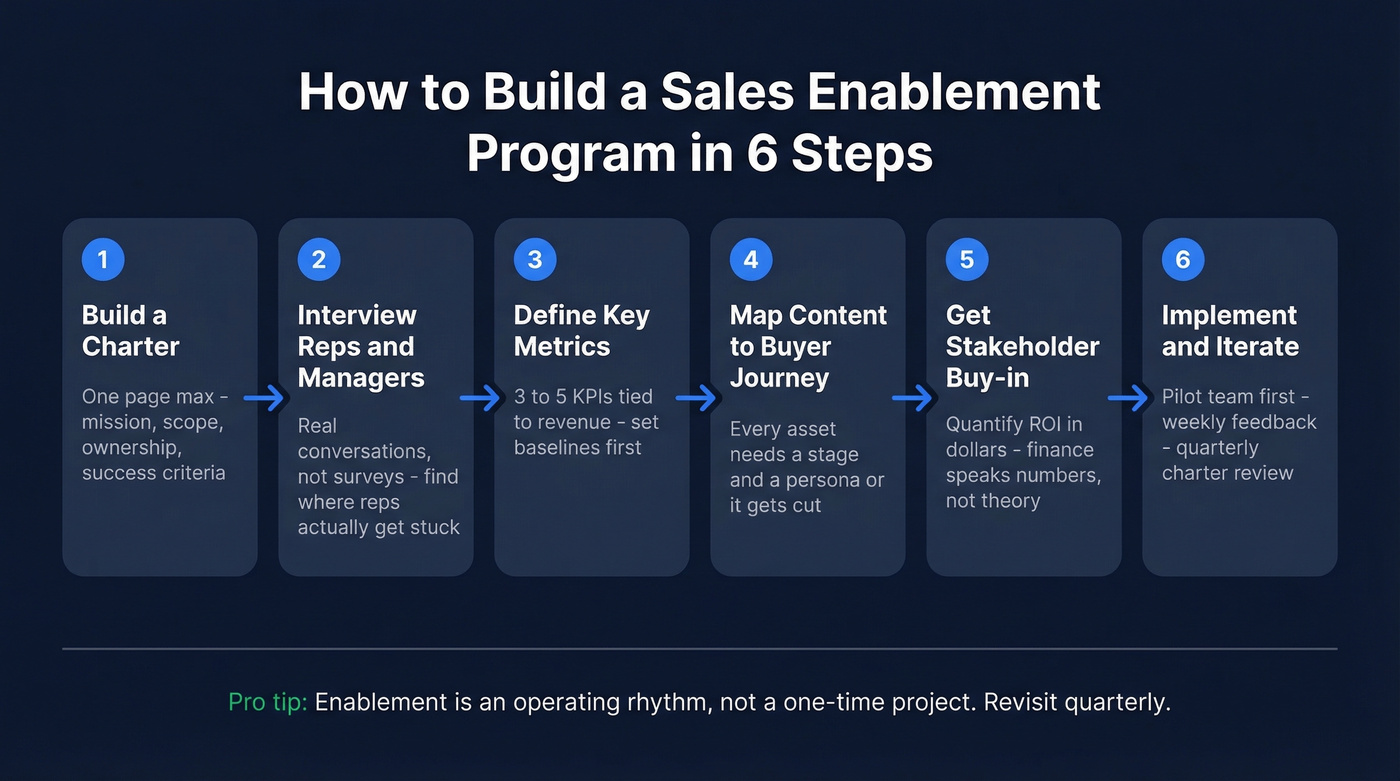
Step 2: Interview managers and reps. Not a survey - actual conversations. Where do reps get stuck? What content do they wish existed? What training actually changed their behavior? Gap discovery from the field beats assumptions from leadership every time.
Step 3: Define key metrics. Pick 3-5 KPIs that tie directly to revenue outcomes. Content adoption, time to productivity, and win rate are the minimum. Set baselines before you change anything.
Step 4: Map content to the buyer journey. Every piece of content should serve a specific buying job at a specific stage. If you can't name the stage and the stakeholder persona, the content doesn't belong in the library.
Step 5: Get stakeholder buy-in. Quantify the ROI of your pilot. "We'll reduce ramp time by 45 days, which means 3 additional selling months per new hire at $X average pipeline per month." Finance speaks numbers, not enablement theory.
Step 6: Implement and iterate. Start with a pilot team. Collect feedback weekly. Roll out in phases. Revisit the charter quarterly. Enablement isn't a project - it's an operating rhythm.
The Enablement Tech Stack in 2026
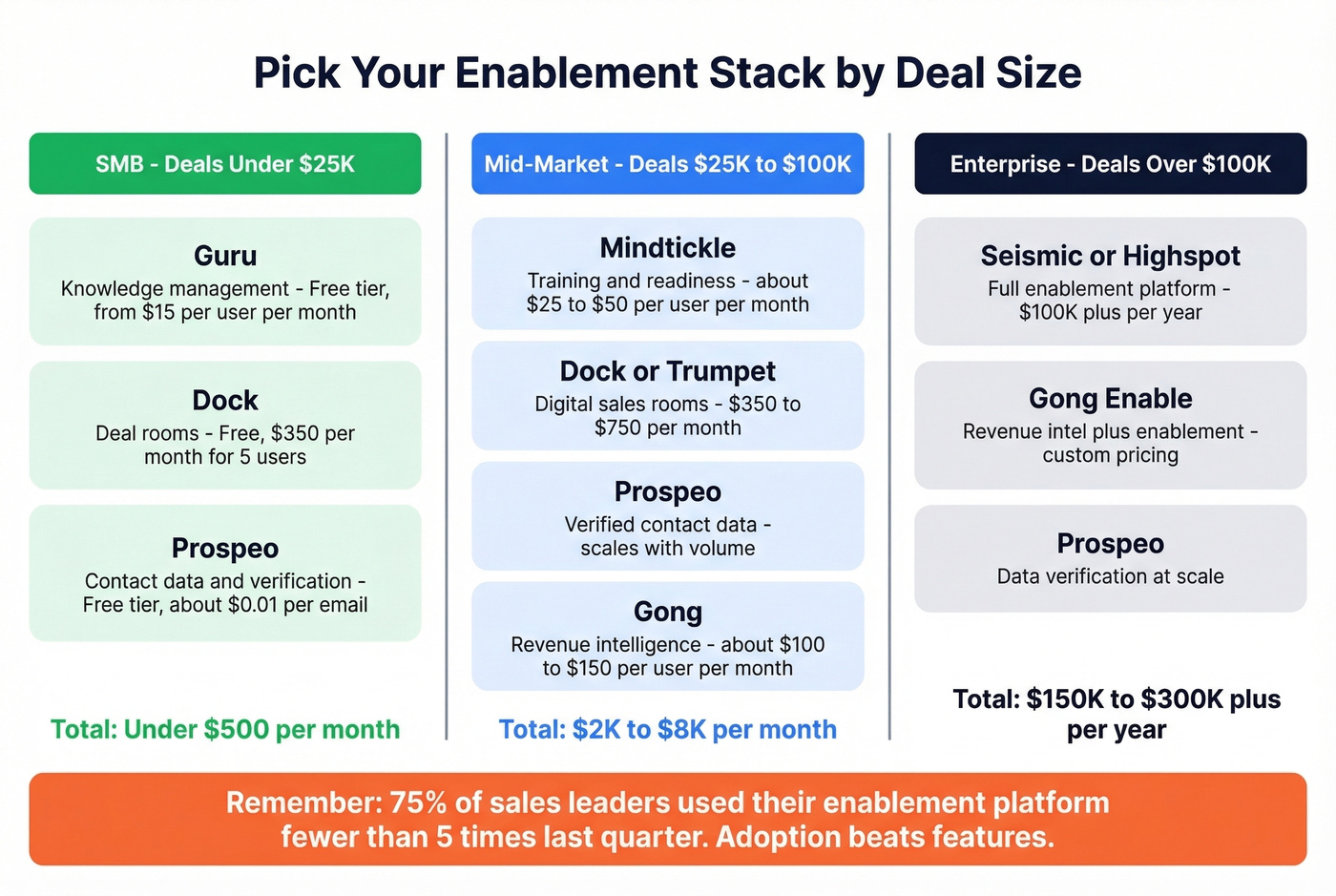
Vendor pricing pages are deliberately opaque. Here's what the market actually looks like.
| Platform | Best For | Pricing |
|---|---|---|
| Prospeo | Contact data & verification | Free tier; ~$0.01/email |
| Seismic | Enterprise content + enablement | ~$40-75/user/mo; $100K+/yr typical |
| Highspot | Enterprise enablement platform | ~$91K/yr enterprise avg |
| Gong (Gong Enable) | Revenue intel + enablement | ~$100-150/user/mo |
| Showpad / Bigtincan | Enterprise content mgmt | Custom; ~$30K-$80K+/yr |
| Mindtickle | Training & readiness | ~$25-50/user/mo (custom) |
| Dock | Mid-market deal rooms | Free; $350/mo (5 users); $750/mo (10) |
| Guru | Knowledge management | Free tier; from $15/user/mo |
| Salesmotion | SMB enablement | From $85/mo |
Let's be honest: if your average deal size is under $25K, you probably don't need a $100K+ enterprise enablement platform. A combination of Guru for knowledge management, Dock for deal rooms, and Prospeo for verified contact data will outperform a bloated all-in-one that your reps never log into. The 75% non-adoption stat from the intro? That's almost always an enterprise platform problem, not an enablement concept problem.
Digital Sales Rooms
If your reps are still sending Google Drive links, you're leaving engagement data on the table. Nearly 50% of high-performing organizations are investing in digital sales rooms. Based on practitioner feedback on Reddit:
Trumpet has the cleanest buyer UX but limited mutual action plan support. Aligned is the strongest for MAPs and engagement signals - overkill for transactional deals, essential for enterprise. Accord excels at document collaboration with solid CRM integrations. DealHub offers strong engagement tracking but feels heavy for small teams. Dock is the lightweight option - buyers find the format familiar, though engagement tracking is more basic.
The common thread across all the Reddit feedback: buyer engagement signals and mutual action plans are the features practitioners actually value. Everything else is nice-to-have.
Data quality is the foundation pillar your enablement program is missing. Prospeo gives your reps 125M+ verified mobile numbers with a 30% pickup rate and 143M+ verified emails - refreshed every 7 days, not every 6 weeks. At $0.01 per email, it costs less than the rep time wasted on a single bounced outreach sequence.
Give your reps contacts that actually connect. Free tier, no contract.
Enablement Metrics That Matter
Here are the KPI formulas you can copy straight into your dashboard:
Time to Productivity = Days to train + Days to onboard + Days of shadow experience + Days of hands-on experience. Benchmark: under 90 days for mid-market SaaS.
Content Effectiveness = (Closed deals influenced by content / Total deals) x 100. Below 30%? Your content library isn't connected to revenue.
Sales Cycle Length = Total days to close all deals / Number of closed deals. Track pre- and post-enablement launch to prove impact.
Win Rate = (Deals won / Total opportunities) x 100. Companies with mature enablement programs consistently report higher win rates - in our experience, even a 3-5 percentage point lift pays for the entire program.
Quota Attainment = (Reps achieving quota / Total reps) x 100. Industry benchmarks put average B2B quota attainment around 47%. If your enablement program pushes that above 55%, you've justified the investment.
Revenue per Rep = Total revenue / Number of reps. The ultimate lagging indicator. If this isn't trending up, something upstream is broken.
Common Enablement Mistakes
Do this: Measure content usage, not content creation. Track which assets reps actually open, share, and close deals with. Not this: Celebrate publishing 50 new battlecards this quarter while adoption sits at 12%.
Do this: Monitor platform login frequency and feature adoption weekly. Not this: Assume the 75% who never log in are "just busy."
Do this: Reinforce training with AI-driven coaching loops at 24- and 48-hour intervals. Not this: Run a one-day SKO workshop and call it enablement.
Do this: Verify your contact data before every campaign. Dead numbers and bounced emails waste every dollar you spent on training. Not this: Blame reps for low connect rates when the data layer is rotten.
Skip the enablement platform entirely if you don't have someone dedicated to running it. A $100K platform with no owner is worse than a shared Google Drive with a champion who keeps it organized. We've watched teams burn through two renewal cycles before admitting this.
Real talk: your VP of Sales just asked you to prove enablement ROI, and you realize you can't. That's the most common mistake of all - building a program without the measurement infrastructure to defend it. Tie every enablement activity to pipeline and closed-won revenue from day one.
FAQ
What's the difference between B2B and B2C enablement?
B2B enablement supports longer sales cycles with 6-10 decision-makers, requiring content mapped to specific buying jobs and stakeholder roles. B2C enablement targets shorter cycles driven by emotional triggers and broader content. The tooling, measurement frameworks, and content strategies are fundamentally different - don't try to adapt a B2C playbook for B2B.
Who should enablement report to?
RevOps owns it 39.4% of the time, Sales 25.4%, and C-Suite 16.6%. The right answer depends on your org, but the principle is simple: enablement should report to whoever owns the revenue number. That alignment ensures priorities match business outcomes.
How do you measure enablement ROI?
Start with three formulas: win rate lift (pre- vs. post-enablement), time to productivity reduction (new hire ramp days saved x average pipeline per month), and revenue per rep change over time. If you can't draw a line from an enablement initiative to a dollar amount, the initiative needs better measurement - or better design.
What's the best data tool for enablement teams on a budget?
Prospeo offers a free tier with 75 verified emails per month and transparent credit-based pricing at ~$0.01 per lead. Its 7-day data refresh cycle and 98% email accuracy mean reps reach live prospects instead of bouncing off stale records. For teams where deal sizes don't justify six-figure data contracts, it's the strongest option we've found.