

B2B Sales Orchestration: The Framework Your Sales Team Actually Needs
Reps spend 28-30% of their time actually selling. The rest vanishes into CRM updates, internal meetings, and toggling between tools that don't talk to each other. One mid-market SaaS RevOps team we spoke with mapped their entire stack and found they were burning $14,200/month across seven tools - and spending 20+ hours a week just keeping data synced.
That's not a sales motion. That's expensive busywork.
What You Need (Quick Version)
Sales orchestration is the intelligence layer that decides who gets what outreach when - it's not the tool that sends the email. Most teams don't need an $80k/year platform. They need four or five integrated tools and clean data. Start with the framework below, then decide whether to build or buy.
What Is Sales Orchestration?
Here's the practitioner definition that actually matters: orchestration is the decision layer, not the execution layer. Marketing automation handles the mechanics of sending - scheduling, nurturing, time-delay triggers. Orchestration sits above all of that and determines which accounts should receive any motion at all, and when, based on real behavioral signals from multiple sources.
A concrete example makes this click. A prospect fills out your demo form at 2:00 PM. Without orchestration, that lead sits in a queue until someone checks HubSpot. With orchestration, the form submission triggers enrichment - company data, tech stack, verified contact info - and routes the lead to the right rep via Slack by 2:03 PM, complete with a research brief. The rep calls within minutes instead of hours.
Practitioners on r/b2bmarketing put it bluntly: vendors who bolt on an intent data tab and rebrand as "orchestration" aren't fooling anyone. Real intelligent sales orchestration designs end-to-end journeys, not individual sends.
Orchestration vs. Engagement vs. Intelligence
These three layers get conflated constantly, so let's break them down.
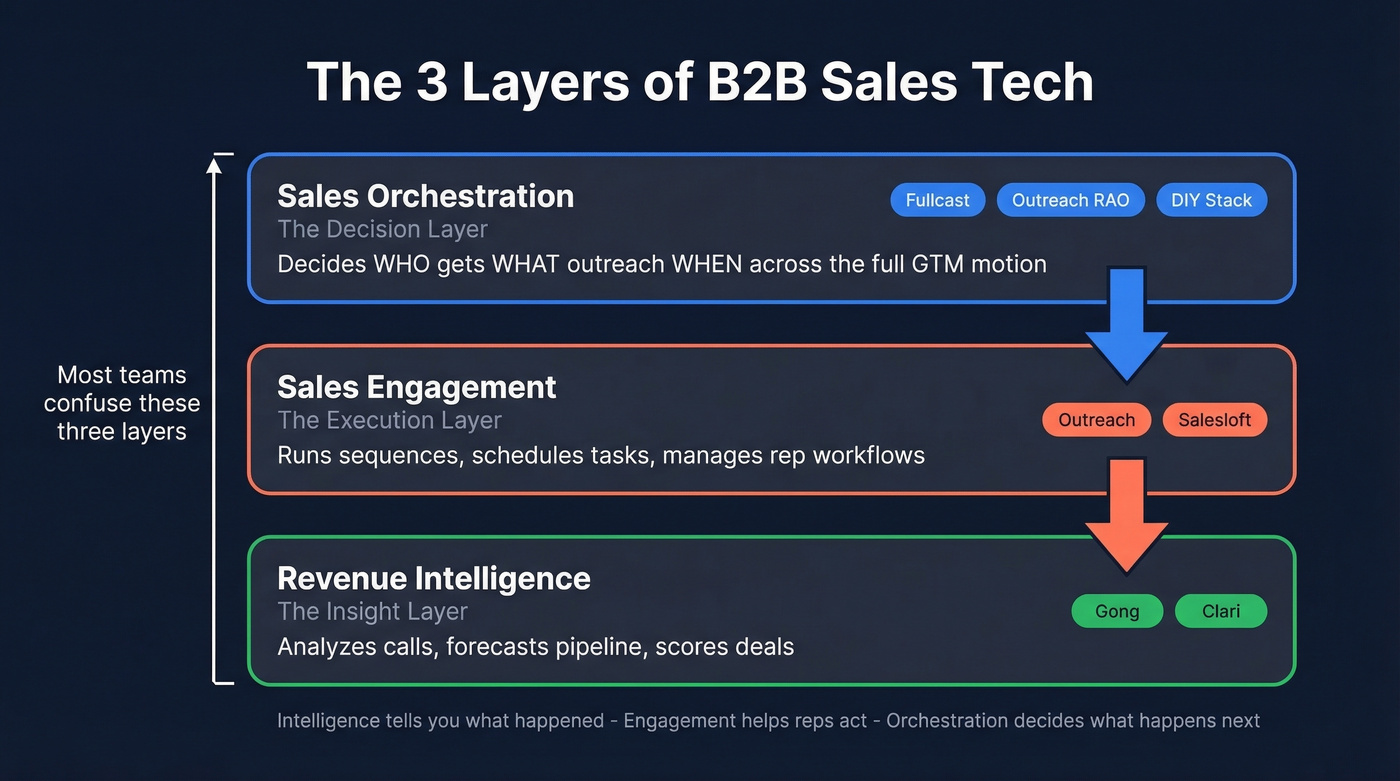
| Layer | What It Does | Example Tools | Limitation |
|---|---|---|---|
| Revenue Intelligence | Analyzes pipeline and deals | Gong, Clari | Insight, not action |
| Sales Engagement | Executes sequences and tasks | Outreach, Salesloft | Orchestrates tasks, not systems |
| Sales Orchestration | Decides who/what/when across the full motion | Fullcast, Outreach (RAO), DIY stack | Requires clean data |
Intelligence tells you what happened. Engagement helps reps execute tasks. Orchestration determines what happens next and ensures it happens across your entire GTM motion.
Why Sales Teams Need It Now
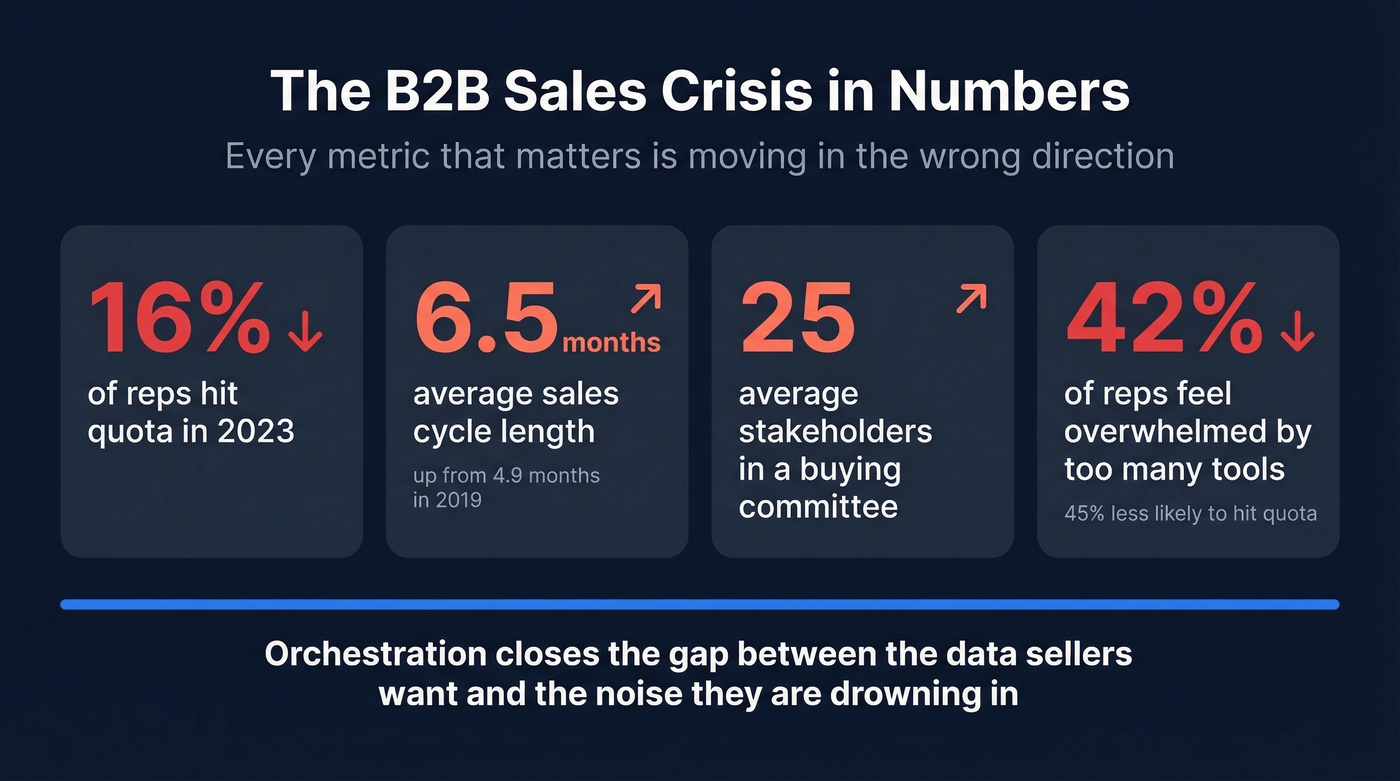
Only 16% of reps hit quota in 2023. Sales cycles have stretched to 6.5 months, up from 4.9 in 2019. Buying committees now average 25 stakeholders. Every metric that matters is moving in the wrong direction, and the revenue orchestration platform market is growing at 15.3% CAGR through 2033 because teams are desperate for a fix.
Gartner formalized the category in 2025 with a Magic Quadrant for Revenue Action Orchestration Platforms, naming Outreach a Leader. Their research found 78% of sellers are willing to use data-driven insights, yet 58% feel their current systems deliver unnecessary information. That gap is exactly what orchestration closes.
And here's the kicker: 42% of sales reps feel overwhelmed by too many tools, and overwhelmed sellers are 45% less likely to hit quota. The stack isn't helping - it's actively hurting. Orchestration turns that chaos into a coordinated motion where signals trigger actions and reps focus on conversations, not syncing.

Your orchestration is only as good as your data. Prospeo delivers 98% email accuracy, 125M+ verified mobiles, and a 7-day refresh cycle - so every signal-response play lands on a real person, not a dead inbox.
Stop orchestrating bounces. Start with data that actually connects.
The Signal-Response Play
The mental model is simple: signal in, response out.
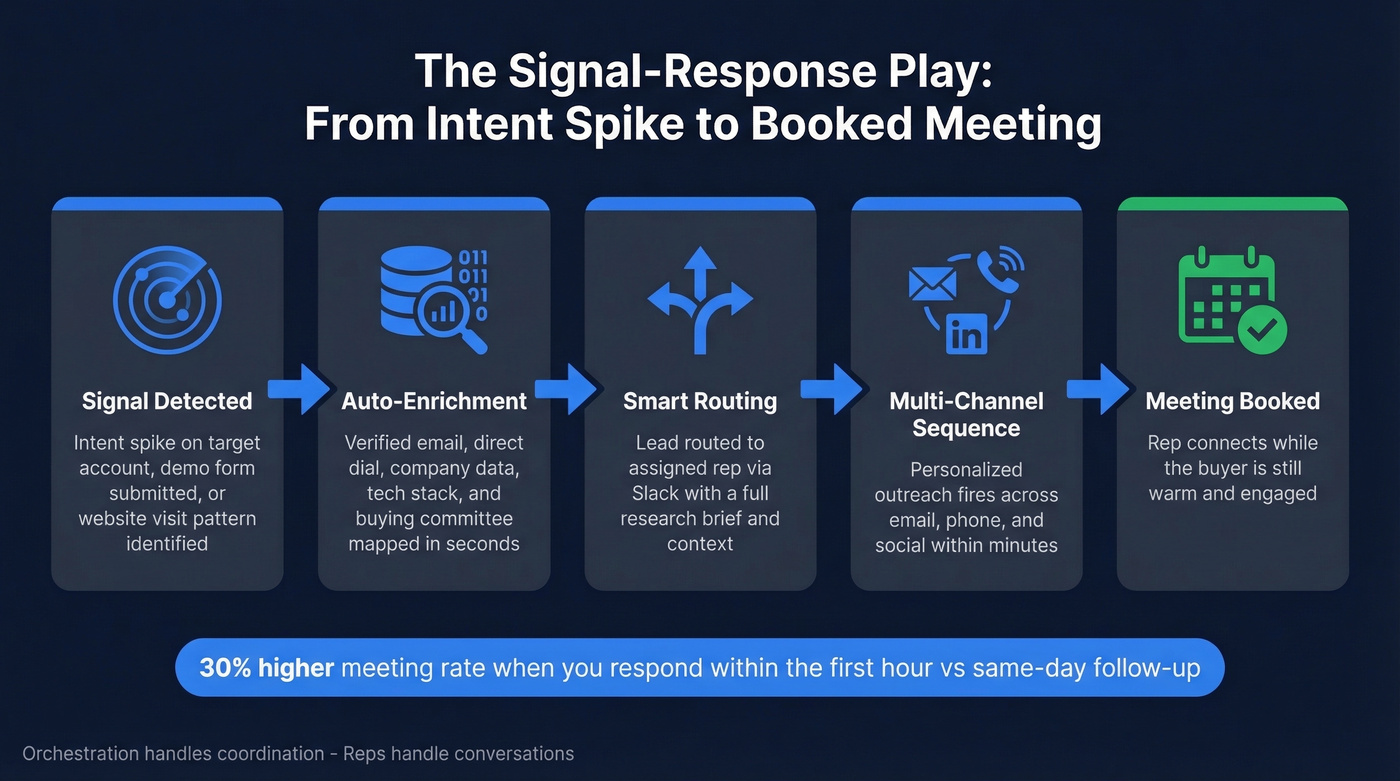
An intent spike gets detected on a target account. That signal triggers enrichment - verified email, direct dial, firmographic and technographic context. The enriched lead routes to the assigned rep through Slack. A personalized multi-channel sequence fires within minutes. Acting within the first hour produces roughly 30% higher chance of booking a meeting versus same-day follow-up.
The orchestration layer makes that speed possible. No human is manually checking intent dashboards, looking up contacts, and building sequences in real time. The system handles coordination; the rep handles the conversation. This is where account-based sales workflows shine: the signal-response loop ensures every high-value account gets timely, relevant touches instead of generic batch outreach.
Data Quality: The Foundation Nobody Talks About
We've seen teams burn through entire outreach sequences before realizing half their contacts were dead. Orchestration without clean data is coordinated failure at scale.
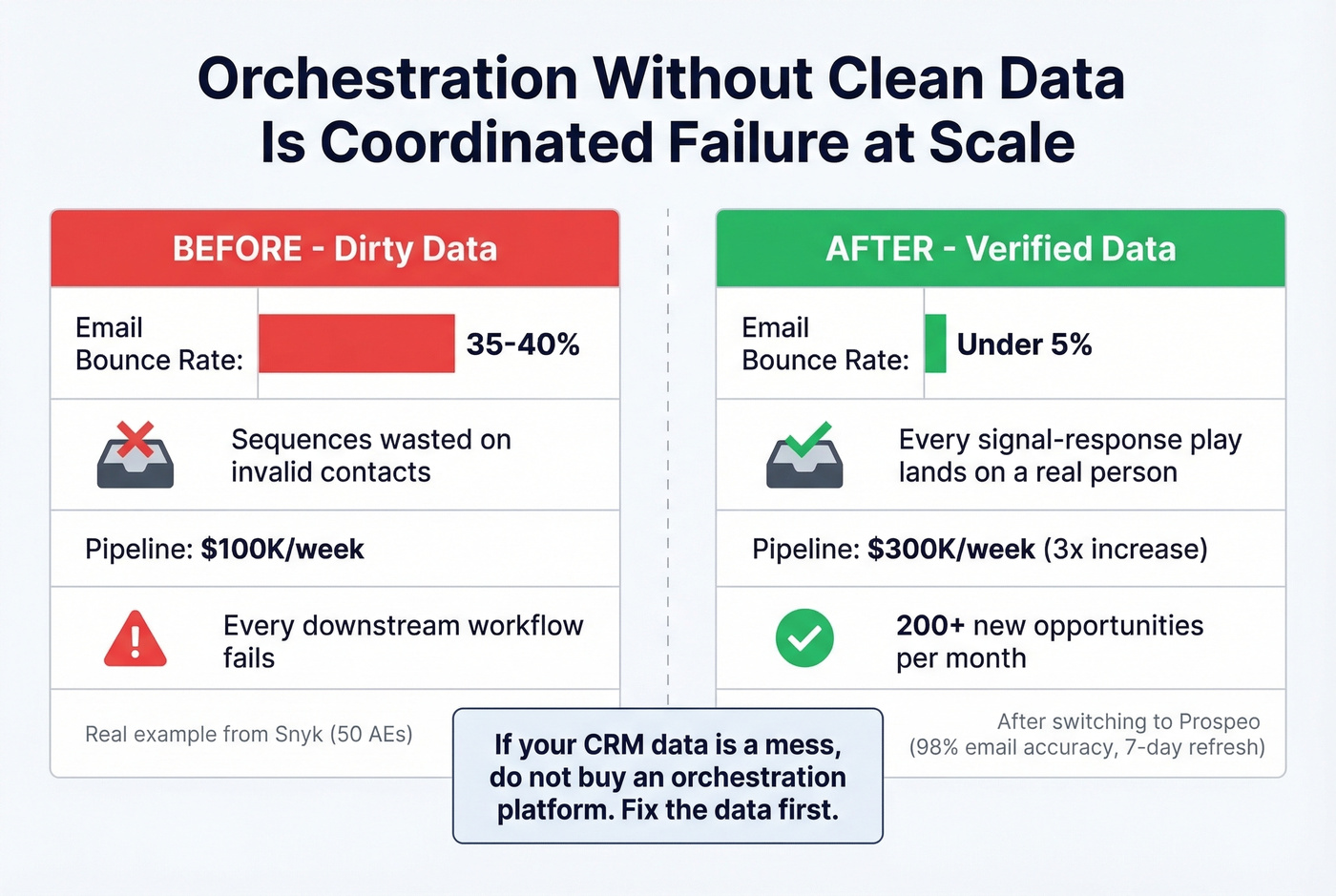
Every article on this topic talks about workflows and signals and AI. Almost none mention that if 35% of your emails bounce, your signal-response plays are dead on arrival.
Snyk's team of 50 AEs was running bounce rates of 35-40%. After switching their data layer to Prospeo - 98% email accuracy, 125M+ verified mobile numbers, 7-day data refresh cycle - bounces dropped under 5%, and they generated 200+ new opportunities per month. Meritt saw similar results: pipeline tripled from $100K to $300K/week after fixing their data foundation.
If your CRM data is a mess, don't buy an orchestration platform. You'll just automate garbage at scale. Fix the data first.
Build vs. Buy Your Stack
The enterprise platform vendors will tell you their $80k solution is the only path. It's not. Reddit threads on r/SaaS consistently confirm the pricing floors - every vendor quoted $50k minimum, with most landing at $80-100k once features were added.
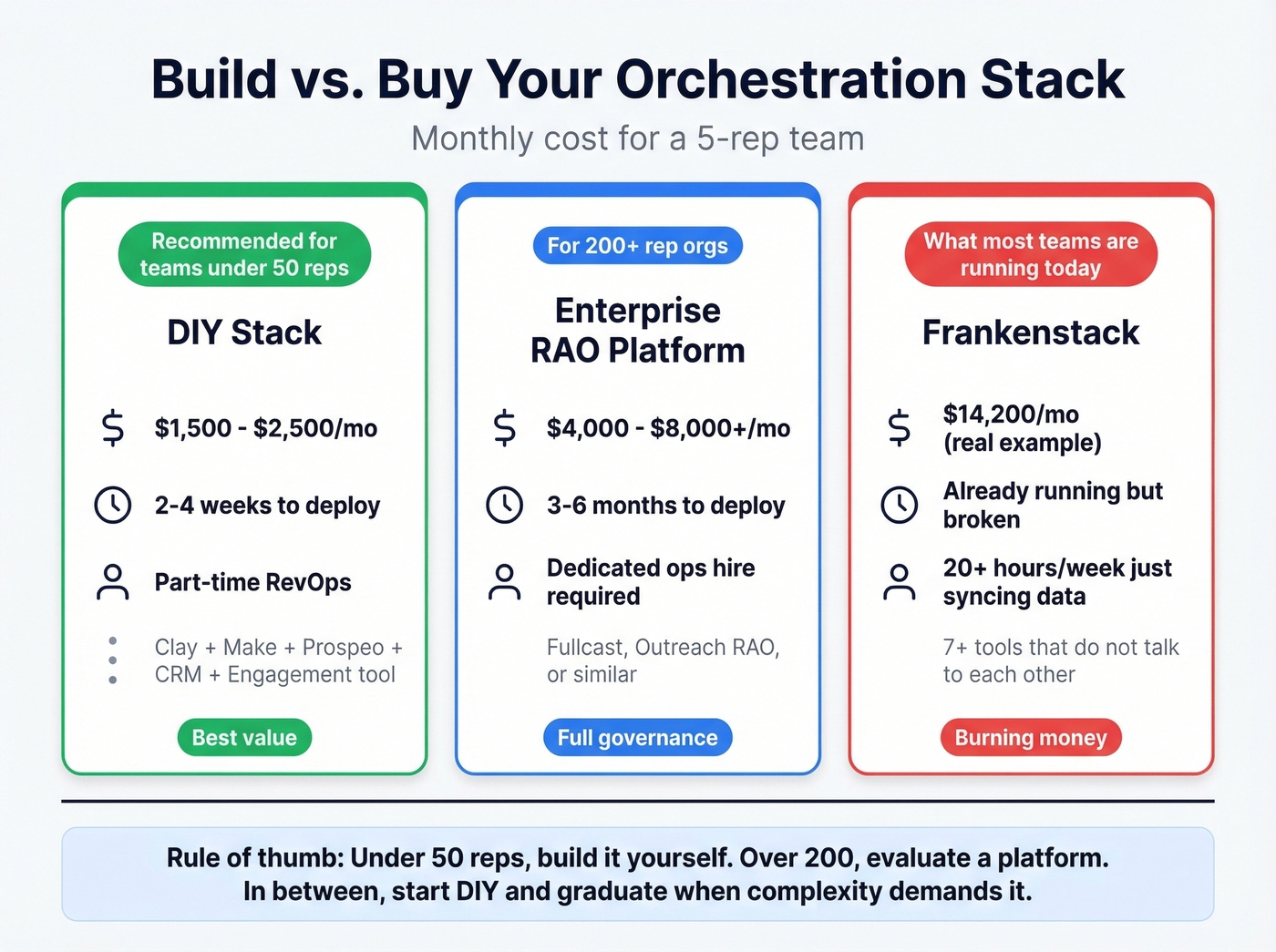
Go enterprise platform if you're running 200+ reps and need territory management, commission tracking, and centralized governance. Expect a 3-6 month implementation and a dedicated ops hire.
Build a DIY stack if you're under 50 reps. In our experience, the DIY path pays for itself within the first quarter - especially for teams running account-based selling workflows that need flexibility over rigid platform logic.
| Approach | Monthly Cost (5-rep team) | Implementation | Ongoing Ops |
|---|---|---|---|
| Enterprise RAO platform | $4,000-8,000+ | 3-6 months | Dedicated ops hire |
| DIY stack (Clay + Make + Prospeo + CRM + engagement) | ~$1,500-2,500 | 2-4 weeks | Part-time RevOps |
| Frankenstack (7+ uncoordinated tools) | $14,200 (example) | Already running | 20+ hrs/week syncing |
That RevOps team from the intro? After consolidating to five integrated tools, their 20+ hours of weekly syncing dropped to five. The rule of thumb: under 50 reps, build. Over 200, evaluate a platform. In between, start DIY and graduate when the complexity demands it.
One more position I'll stake out: Salesloft and Outreach are excellent engagement tools, but calling them orchestration platforms is a stretch. They orchestrate tasks, not systems. If you need full-stack coordination, you're either buying a dedicated RAO platform or building the logic yourself with something like Clay, Make, and a solid data provider wired together.
Skip the enterprise platform entirely if you're a team of 10 running outbound for the first time. You'll spend six months implementing something you could've built in two weeks with a no-code automation tool and clean contact data.
Building a DIY orchestration stack? Prospeo plugs into Clay, Make, HubSpot, Salesforce, and every major engagement tool - at $0.01/email with 92% API match rates. No $80k platform required.
Clean data, native integrations, no contracts. The foundation your stack is missing.
What's Next: AI Agents in 2026
Gartner projects 40% of enterprise applications will feature AI agents by end of 2026, up from less than 5% in 2025. The shift moves from rules-based automation - if X then Y - to agents that perceive signals, reason about optimal actions, and recommend multi-step workflows autonomously.
Fragmented systems cost companies 20-30% of revenue in lost efficiency. The teams that consolidate their data and workflow layers now will be positioned to actually benefit from agentic AI, rather than bolting it onto a broken stack. B2B sales orchestration is evolving from human-designed playbooks to agent-assisted decision-making, but the foundation stays the same: clean data, integrated systems, and clear routing logic.
FAQ
What's the difference between sales orchestration and sales automation?
Automation executes individual tasks - send an email, update a CRM field, log a call. Orchestration is the intelligence layer that decides which tasks to trigger, for which accounts, based on real-time signals. Automation is a component of orchestration, not a synonym for it.
Do small teams need an enterprise orchestration platform?
No. Teams under 50 reps can build a DIY stack - Clay for enrichment logic, Make for automation, a verified data provider for contacts, a CRM, and an engagement tool - for under $2,500/month. It deploys in 2-4 weeks versus 3-6 months for enterprise platforms.
Why does data quality matter so much for orchestration?
Orchestration workflows route leads and trigger outreach based on contact data. If emails bounce at 35%+ or phone numbers are dead, every downstream step fails regardless of how sophisticated your workflows are. Teams like Snyk cut bounces from 40% to under 5% by switching to verified data - that's the difference between coordinated failure and real pipeline growth.
How do account-based workflows fit into orchestration?
Account-based workflows are orchestration's natural use case. Instead of treating leads as individuals, the system coordinates multi-threaded outreach across an entire buying committee - routing intent signals, personalizing touches by role, and ensuring every stakeholder at a target account receives the right message at the right time.