

B2B Telesales: A Data-Backed Playbook for 2026
A rep on r/salestechniques posted about making 200+ cold calls a day and hearing "not interested" 97% of the time. Their exact words: "If I even get one real prospect in a day, that's a win." That's not a motivation problem - it's a list problem. The biggest lever in B2B telesales isn't call volume.
It's calling the right people with the right data, at the right time, with a script that leaves room for an actual conversation.
Let's break this down like a team that's had to hit a number, not like a team writing theory.
What you need (quick version)
- Telesales isn't telemarketing. Telemarketing opens doors. Telesales closes them. Different skills, different KPIs, different training.
- The #1 lever is data quality, not call volume. If your connect rate's below 3%, you don't have a script problem - you have a list problem.
- Structure beats vibes. Use a real dialer, a flexible script framework, and verified contact data. You'll outperform most teams still grinding through stale spreadsheets.
Telesales vs. telemarketing
Telesales is the closer function. Telemarketing is built around generating interest: awareness campaigns, lead qualification, and appointment setting. Telesales converts that interest into revenue over the phone, which means tighter discovery, sharper objection handling, and a cleaner close.
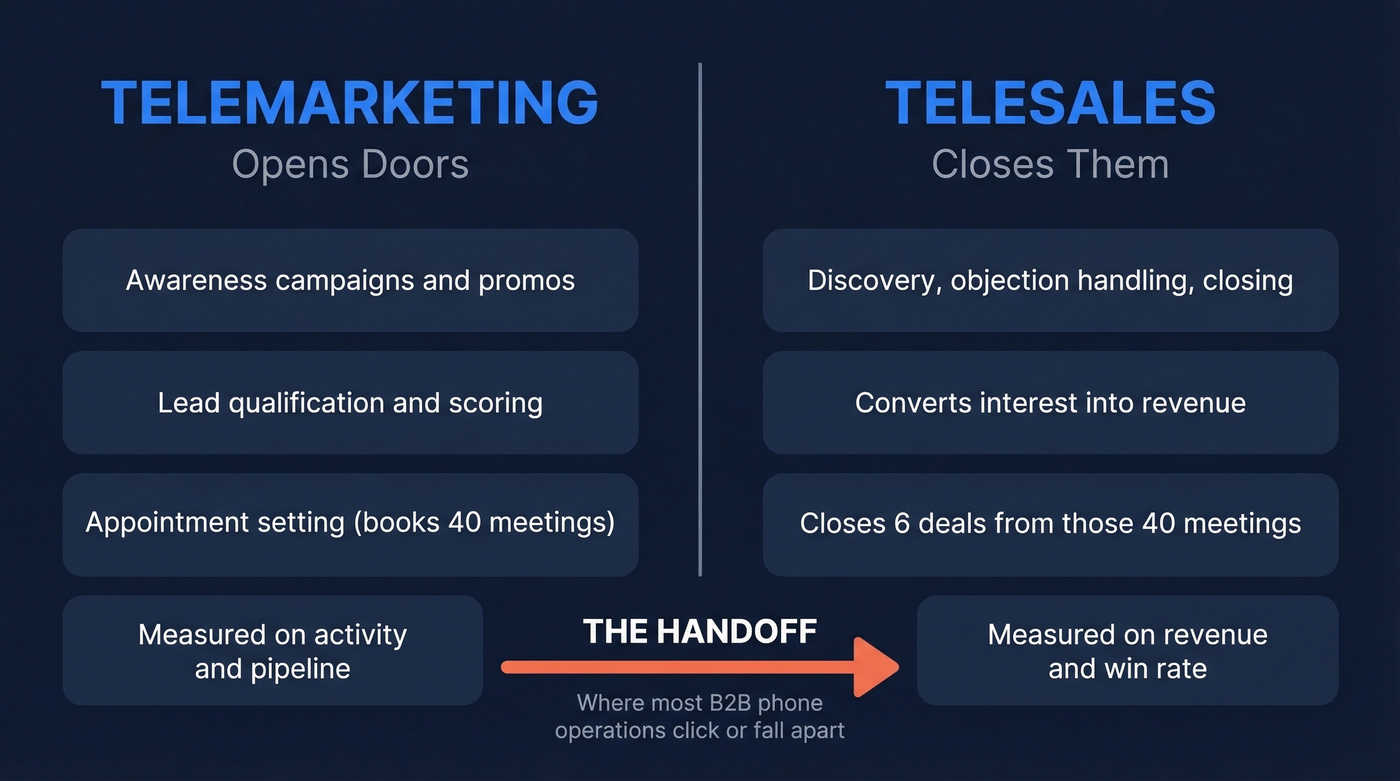
The simplest way to picture it: telemarketing runs an event promo and books 40 meetings. Telesales calls those 40 prospects, handles objections, and closes 6 deals. The handoff between the two is where most B2B phone sales operations either click or fall apart, because the opener's definition of "qualified" rarely matches what the closer needs to actually win.
And telesales isn't only outbound. Inbound teams working demo requests, trial follow-ups, and "contact sales" forms are doing telesales too; the lead came in warm, but the job is still to convert a conversation into a next step with a real timeline.
Confusing the two functions is how companies end up measuring closers on activity metrics and openers on revenue targets, then wondering why nobody hits quota.
Is outbound phone sales still worth it?
Yes - but not the way most teams run it.
HubSpot's survey of 1,400+ sales pros found that phone calls ranked #2 behind in-person meetings as the most effective sales tactic, and they also reported that 57% of C-level execs and VPs prefer phone when they want to understand a product. See HubSpot's breakdown here: https://blog.hubspot.com/marketing/b2b-telemarketing
The catch is that buyers do a ton of homework before they ever talk to you. HubSpot also found 71% of buyers start with self-serve research, which pushes calls into the middle of the funnel: after a signal of fit, intent, or at least curiosity. And outreach works better when it's tailored; Sopro's stats show 81% of decision-makers engage with outreach that's personalized to their company and context: https://sopro.io/resources/blog/cold-outreach-statistics/
Here's the thing: generic dials to a purchased list are how you end up in the 200-calls-a-day trap. You can "work hard" all week and still have nothing to show for it because you weren't actually reaching the right people.
A strong opinion from our side: if your average deal size is under $5k and you're running telesales as a standalone channel, you're probably lighting money on fire. Telesales shines as part of a multichannel cadence - calls layered with email, voicemail, and a couple of social touches across a 2-3 week sequence - because the phone is the fastest way to create urgency once the prospect recognizes themselves in the problem.
Key benchmarks for 2026
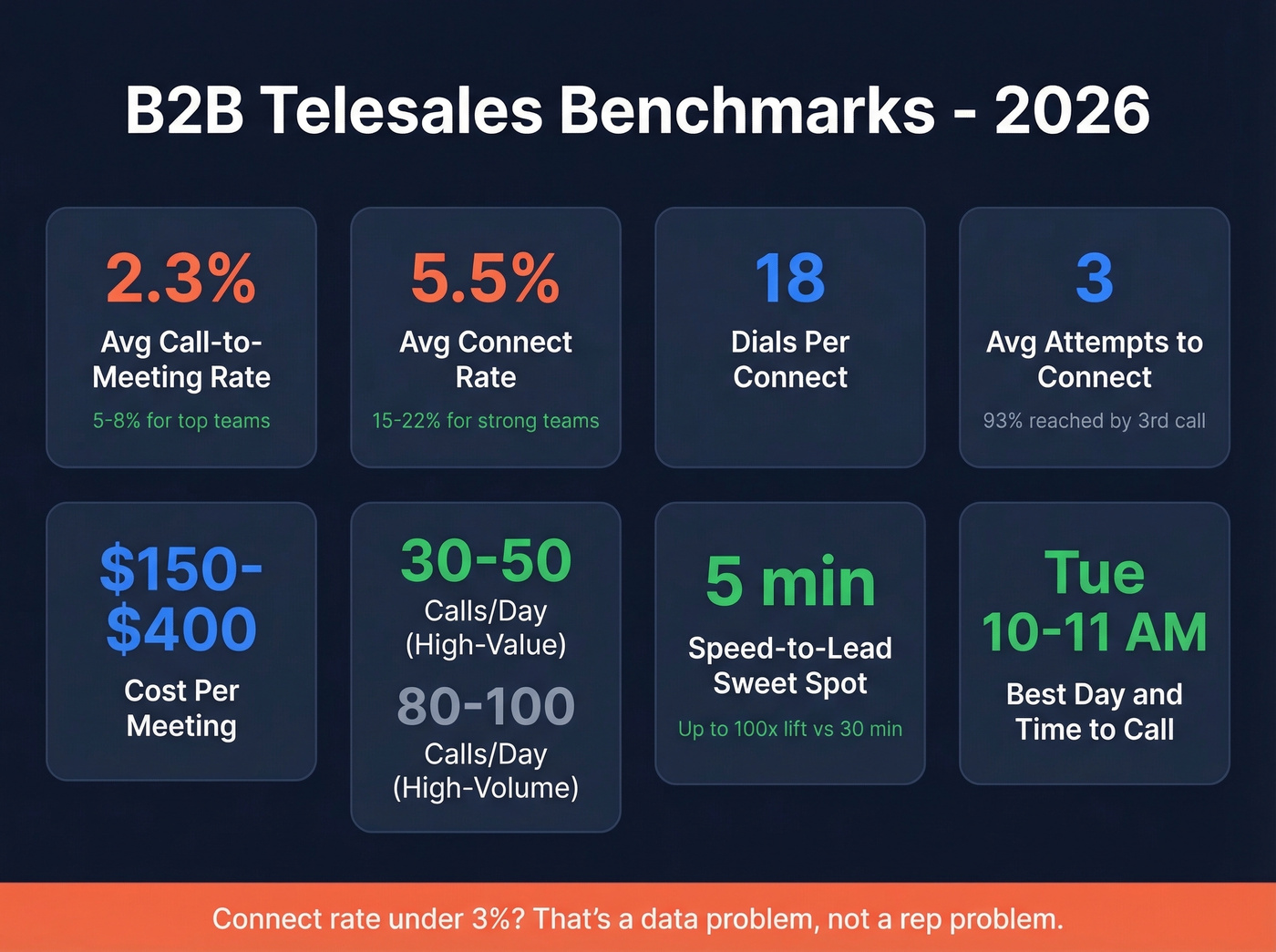
These numbers are directionally consistent across large datasets, and they line up with what we've seen in real teams once you separate "dials" from "conversations." Cognism published a cold calling dataset based on 204,000+ calls here: https://www.cognism.com/blog/cold-calling-statistics
| Metric | Benchmark |
|---|---|
| Call-to-meeting rate | 2.3% avg; 5-8% top teams |
| Connect rate | 5.5% avg; 15-22% strong |
| Dials per connect | ~18 |
| Attempts to connect | ~3 avg (93% by 3rd call; 98% by the 5th) |
| Cost per meeting | $150-$400 |
| Calls/day (high-value) | 30-50 |
| Calls/day (high-volume) | 80-100 |
| Lead-to-opportunity | 13-15% |
| Speed-to-lead | 5 min = up to 100x lift |
| Best time | 10-11 AM (also 2-3 PM), Tuesdays |
A connect rate under 3% is a data problem, not a rep problem. Top cold callers can turn 10-15% of real conversations into meetings, but that only happens when they're consistently reaching the right job titles at the right companies.
We've watched teams double connect rate overnight by switching from a 6-week-old list to weekly-refreshed data. Same reps, same scripts, same dialer. Different outcomes.
Speed-to-lead is the other benchmark that deserves to be tattooed on the wall: reaching out within 5 minutes can lift conversion by up to 100x compared to waiting 30 minutes. Most B2B companies still respond in days, not minutes, and it's honestly maddening because it's one of the few advantages you can buy with process instead of headcount.

You read it above: a connect rate under 3% is a data problem. Prospeo refreshes 300M+ profiles every 7 days - not every 6 weeks like most providers. Teams using our verified mobile numbers see a 30% pickup rate, turning the same reps and scripts into a pipeline machine.
Stop burning dials on dead numbers. Start connecting with decision-makers.
Scripts and openers that work
The best telesales script isn't a monologue. It's a framework that keeps you calm, keeps the prospect oriented, and gives you room to react like a human.
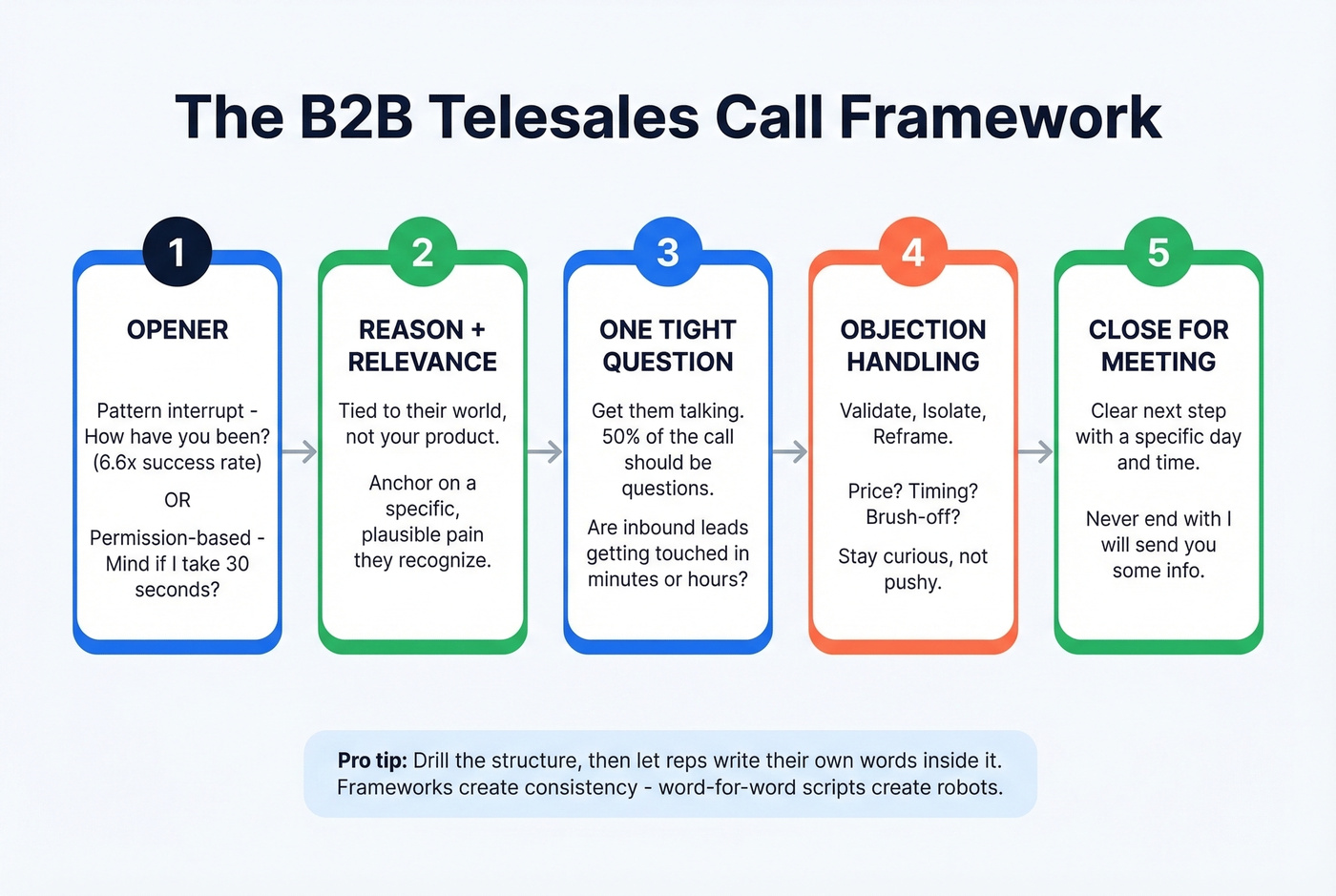
Three openers consistently beat the classic "Hi, this is [name] from [company]" approach:
1) Pattern interrupt Opening with "How've you been?" produced a 6.6x higher success rate in LeadsAtScale's analysis: https://leadsatscale.com/insights/cold-calling-scripts-that-actually-work-templates-b2b-sales/ It works because it doesn't sound like a pitch. It sounds like a person.
2) Reason statement "The reason for my call is..." delivered a 2.1x lift in the same analysis. It signals respect for their time and stops you from rambling.
3) Permission-based "Mind if I take 30 seconds to explain why I called, and you can tell me if it's worth continuing?" This lowers resistance because you're giving control, not trying to steal it.
A simple structure that holds up under pressure:
- Opener
- Reason + relevance (tied to their world, not your product)
- One tight question
- Objection handling
- Close for a meeting with a clear next step
Our team found that reps improve fastest when you drill the structure, then let them write their own words inside it. Word-for-word scripts create robots. Frameworks create consistency.
A scenario we see all the time
You're calling a VP Ops at a 200-person SaaS company. You open with a permission-based line, they give you a skeptical "Sure, go ahead," and you immediately launch into features. They tune out.
Instead, you anchor on a specific, plausible pain: "We work with ops teams that are trying to cut lead response time without hiring another SDR pod. Quick question - are inbound leads getting touched in minutes, or does it drift into hours?" Now you're in their reality, and the conversation has somewhere to go.
Handling the big three objections
Use Validate -> Isolate -> Reframe. It's simple enough to remember mid-call, and it doesn't turn you into an objection-handling machine.
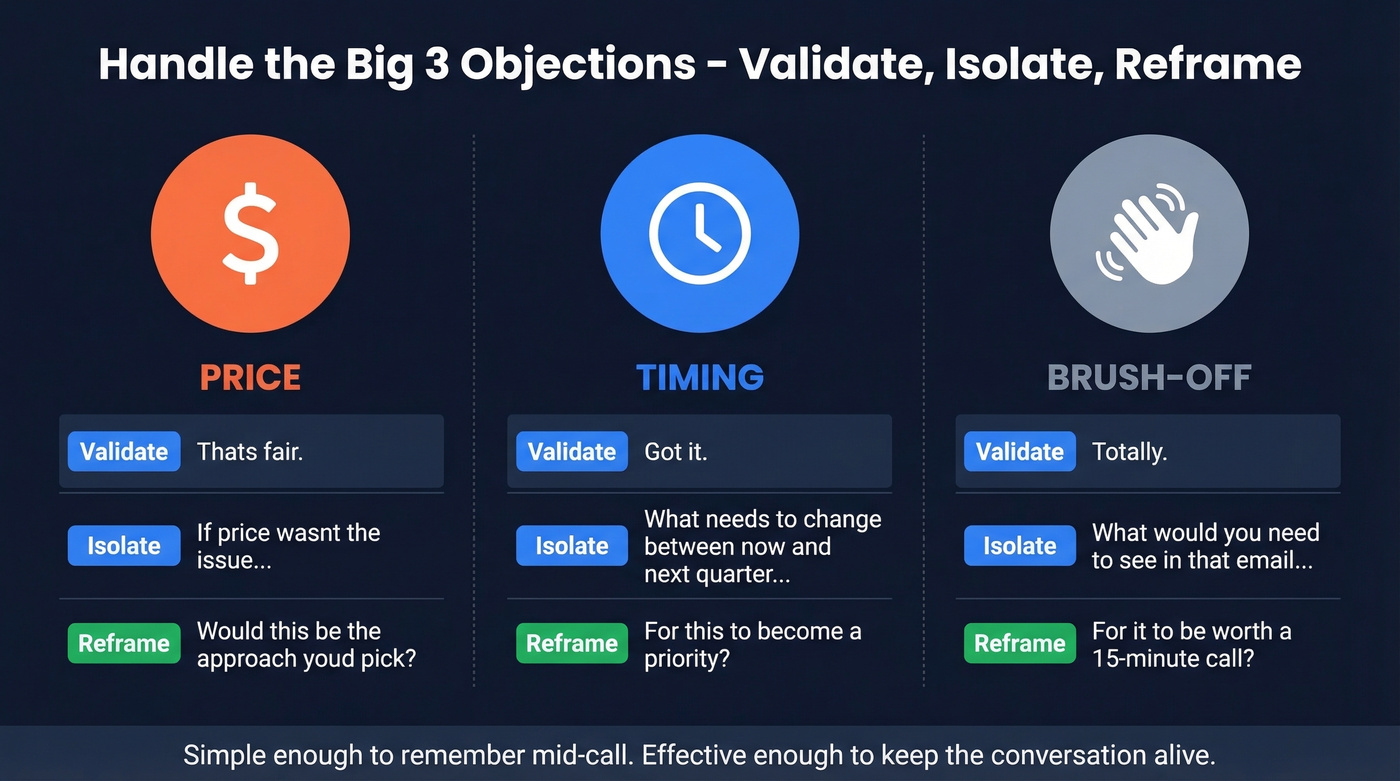
- Price: "That's fair. If price wasn't the issue, would this be the approach you'd pick?"
- Timing: "Got it. What needs to change between now and next quarter for this to be a priority?"
- Brush-off: "Totally. What would you need to see in that email for it to be worth a 15-minute call?"
LAER and LAARC are worth learning too, but this is the one most reps actually use once the call gets messy.
Five mistakes that kill calls
No prep. Spend five minutes finding a trigger, role relevance, and a likely pain. Five minutes of research beats five extra dials every time.
Talking too much. Use the 30-50-20 rule: 30% intro and value prop, 50% questions, 20% confirming next steps. If you're talking more than the prospect, you're pitching, not selling.
Pushy tone. Prospects can hear desperation. Confidence and curiosity beat aggression. One r/sales commenter put it well: "The reps who sound like they don't need the deal are the ones who close it."
Poor qualification. Run MEDDIC or BANT early. If you can't identify the decision-maker, timeline, and budget in the first few minutes, you're having a conversation that won't convert.
Measuring dials instead of conversations. A rep making 40 well-researched calls who connects with 8 decision-makers will outsell the rep making 200 blind dials every single time.
The essential tech stack
Picking a dialer
Skip predictive dialers for B2B. The abandoned call rate creates compliance risk, and that little "telemarketer delay" when the prospect picks up kills trust instantly.
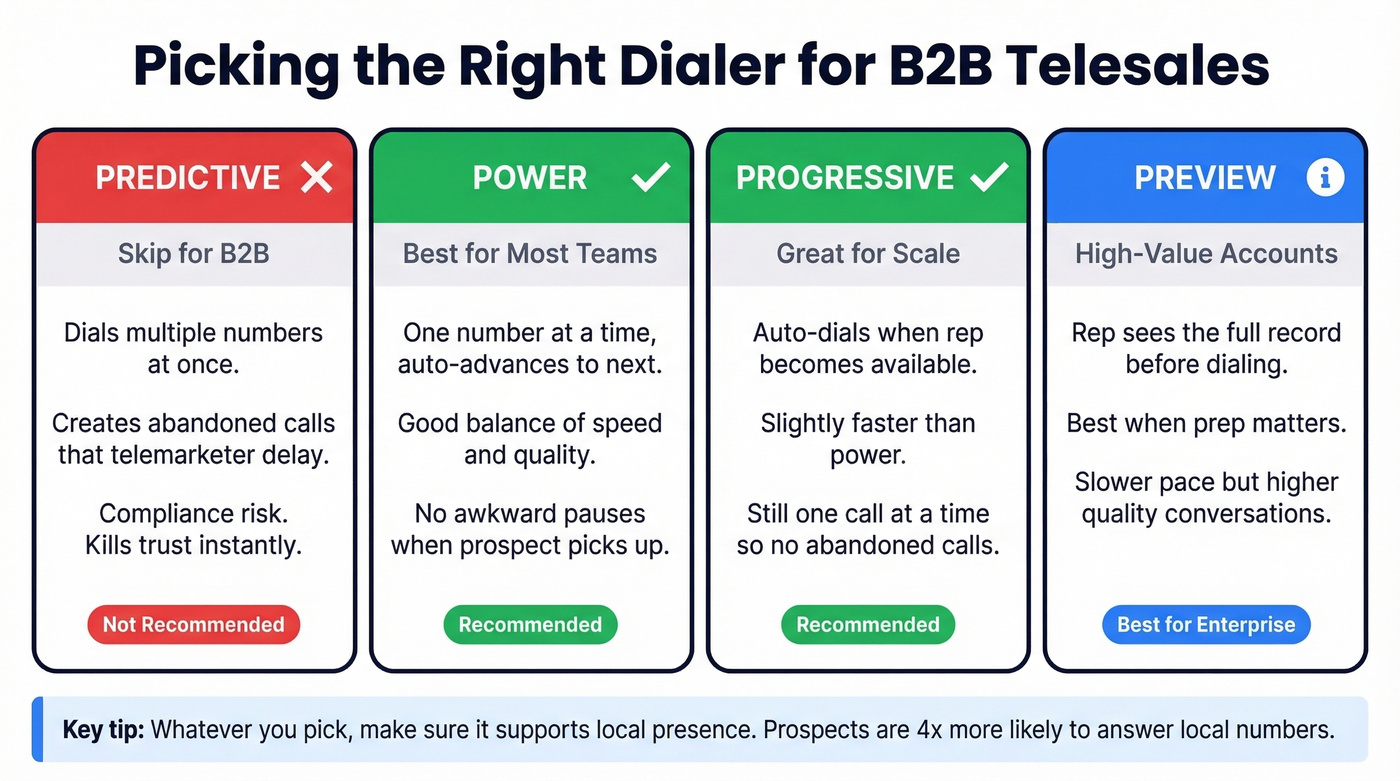
Power dialers (one number at a time, auto-advance) and progressive dialers (auto-dial when a rep becomes available) are the right fit for most outbound phone sales teams. For high-value accounts where prep matters, preview dialers let reps see the record before dialing.
Whatever you pick, make sure it supports local presence. Guideflow reports prospects are 4x more likely to answer local numbers: https://www.guideflow.com/blog/auto-dialer-software
| Dialer | Price/mo | G2 | Best for |
|---|---|---|---|
| OpenPhone | $15/user | 4.7 | Small teams, simplicity |
| Dialpad | $15/user | 4.4 | AI transcription |
| CloudTalk | $19/user | 4.4 | International calling |
| Nextiva | $20/user | 4.5 | All-in-one comms |
| RingCentral | $20/user | 4.3 | Enterprise scale |
| Aircall | $30/license | 4.4 | CRM integrations |
| JustCall | $29/user | 4.3 | SMS + calling |
| Five9 | $159/user | 4.1 | Contact centers |
Under 20 reps? Start with OpenPhone or CloudTalk and get the basics right: clean lists, consistent notes, and a cadence your team can actually follow. You don't need a $159/seat contact center platform to run effective outbound calling.
Data and verification (where most teams bleed money)
Your dialer is only as good as the numbers you feed it. Most B2B telesales teams lose a quiet fortune here: reps burning hours dialing disconnected numbers, wrong departments, and people who left the company six months ago.
This is where tools like Prospeo earn their keep in a very unsexy way. Prospeo gives you 300M+ professional profiles, 143M+ verified emails at 98% accuracy, and 125M+ verified mobile numbers with a 30% pickup rate, all refreshed on a 7-day cycle. That refresh cadence matters more than most teams want to admit, because "good enough" data turns into garbage the moment org charts shift, people change roles, or companies get acquired.
If you're building call lists, use filters that reflect how deals are actually won: job role, seniority, technographics, headcount growth, and intent signals. Prospeo includes 30+ filters and intent data across 15,000 topics, so you're not stuck calling a generic "Operations" list that was scraped who-knows-when.
One negative recommendation: if your "data provider" can't tell you how often records are refreshed, skip it. You'll pay for it in connect rate, rep morale, and churn.
The rep making 200 calls a day for one real prospect doesn't need more grit - they need 125M+ verified direct dials and intent data across 15,000 topics so every call lands on a buyer already researching solutions. At $0.01 per email and 10 credits per mobile, Prospeo costs 90% less than ZoomInfo.
Call fewer numbers, book more meetings. That's what clean data does.
2026 compliance checklist
Telesales compliance isn't optional, and the penalties have teeth.
- TCPA: $500-$1,500 per violation. Covers calling hours (8 AM-9 PM recipient local time), consent requirements, and autodialer restrictions. The FCC's Feb 2024 ruling treats AI-generated voices as an "artificial/prerecorded voice," which means marketing robocalls using AI voice require prior express written consent.
- TSR: Up to $50,120 per violation. The FTC expanded misrepresentation prohibitions to B2B telemarketing. DNC provisions still don't apply to B2B, but deceptive practices do. FTC TSR overview: https://www.ftc.gov/legal-library/browse/rules/telemarketing-sales-rule
- DNC scrubbing: Scrub lists against the National Do Not Call Registry at least every 31 days.
- Consent revocation: Consumers can revoke consent by any reasonable means. Honor revocation within 10 business days. One confirmation text within 5 minutes is allowed, with no marketing content.
If you're running outbound phone sales in 2026 without a compliance checklist, you're gambling with six-figure fines. TIM was fined EUR27.8M by Italy's DPA, and the UK's ICO has issued major penalties for large-scale unsolicited calling; one example is covered here: https://instantly.ai/blog/b2b-cold-calling-legal-guide/
B2B telesales FAQ
What's the difference between telesales and telemarketing?
Telemarketing generates interest and qualifies leads. Telesales converts those leads into revenue over the phone. They need different KPIs and coaching. Many orgs house both under "inside sales," but the day-to-day work is different.
What's a good cold call conversion rate?
Across teams, call-to-meeting averages around 2.3%. Top teams with targeted lists and structured scripts hit 5-8%. If your connect rate's below 3%, fix the list before you rewrite the opener.
How do I improve my connect rate?
Start with verified contact data refreshed weekly. Stale numbers are the fastest way to kill connect rate and rep confidence. Then tighten timing (10-11 AM, Tuesdays) and use local caller ID; prospects are 4x more likely to answer local numbers: https://www.guideflow.com/blog/auto-dialer-software
What makes a great telesales script?
A great script is a flexible framework: a strong opener, a clear reason for the call, relevance tied to the prospect's world, real discovery questions, and a clean close. Reps who can adapt inside that structure outperform reps who sound like they're reading.