

B2B Website Visitor Identification: 10 Best Tools (2026)
97% of your B2B website visitors leave without filling out a form. They browse your pricing page, read a case study, check your integrations - then vanish. The visitor identification market has exploded to $3.55B and is projected to hit $9.99B by 2032, so there's no shortage of tools promising to unmask that anonymous traffic. Most oversell their match rates and undersell their limitations.
We've spent months testing these tools across different traffic profiles, and the gap between marketing claims and real-world performance is wider than you'd expect. Here's what actually works.
Our Picks
| Tool | One-Line Verdict | Starting Price |
|---|---|---|
| Prospeo | Best for turning identified visitors into verified, reachable contacts | Free; ~$0.01/email |
| RB2B | Best person-level identification (US) | Free (150/mo); paid from $79/mo |
| Warmly | Best waterfall approach (global) | Free (500/mo); paid ~$700/mo |
| Leadinfo | Best for EU/GDPR-strict teams | From ~€39/mo |
| 6sense | Best if budget is unlimited | Free (50 credits); enterprise $50K+/yr |
What Is Visitor Identification?
B2B website visitor identification matches anonymous traffic to known companies - and sometimes to individual people. The most common method is IP-to-company matching: your visitor's IP address gets cross-referenced against a database of corporate IP ranges.
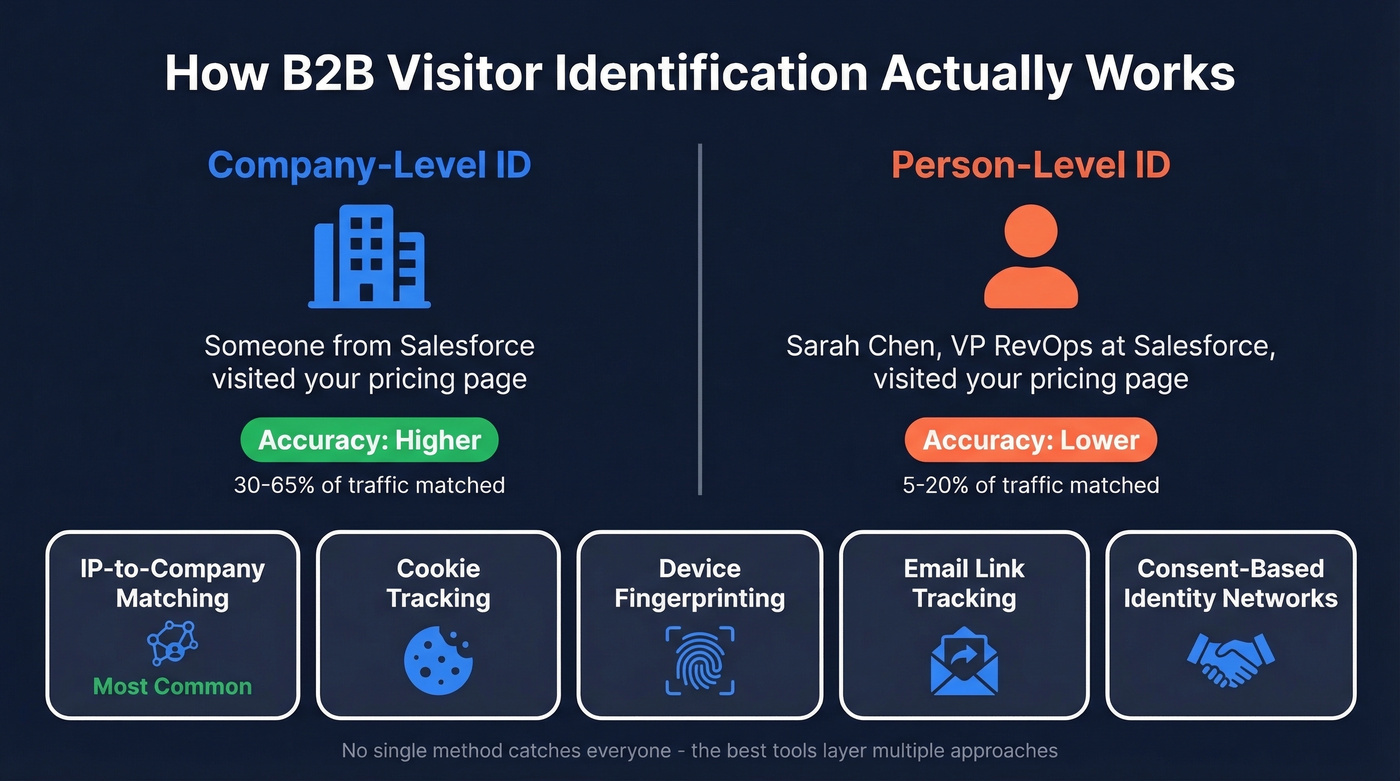
Two distinct levels exist. Company-level identification tells you "someone from Salesforce visited your pricing page." Person-level tries to tell you "Sarah Chen, VP of RevOps at Salesforce, visited your pricing page." That distinction matters enormously for both accuracy and compliance.
Beyond IP matching, tools use cookie-based tracking, device fingerprinting, email link tracking, and consent-based identity networks. IP matching works well on corporate networks but degrades fast when visitors are remote - and with over 60% of knowledge workers now hybrid, that degradation is the norm. No single method identifies everyone. The best tools layer multiple approaches, and the honest ones tell you that upfront.
What Match Rates Should You Actually Expect?
This is where vendors lose credibility. Many claim 60-80% match rates without specifying what they're measuring.
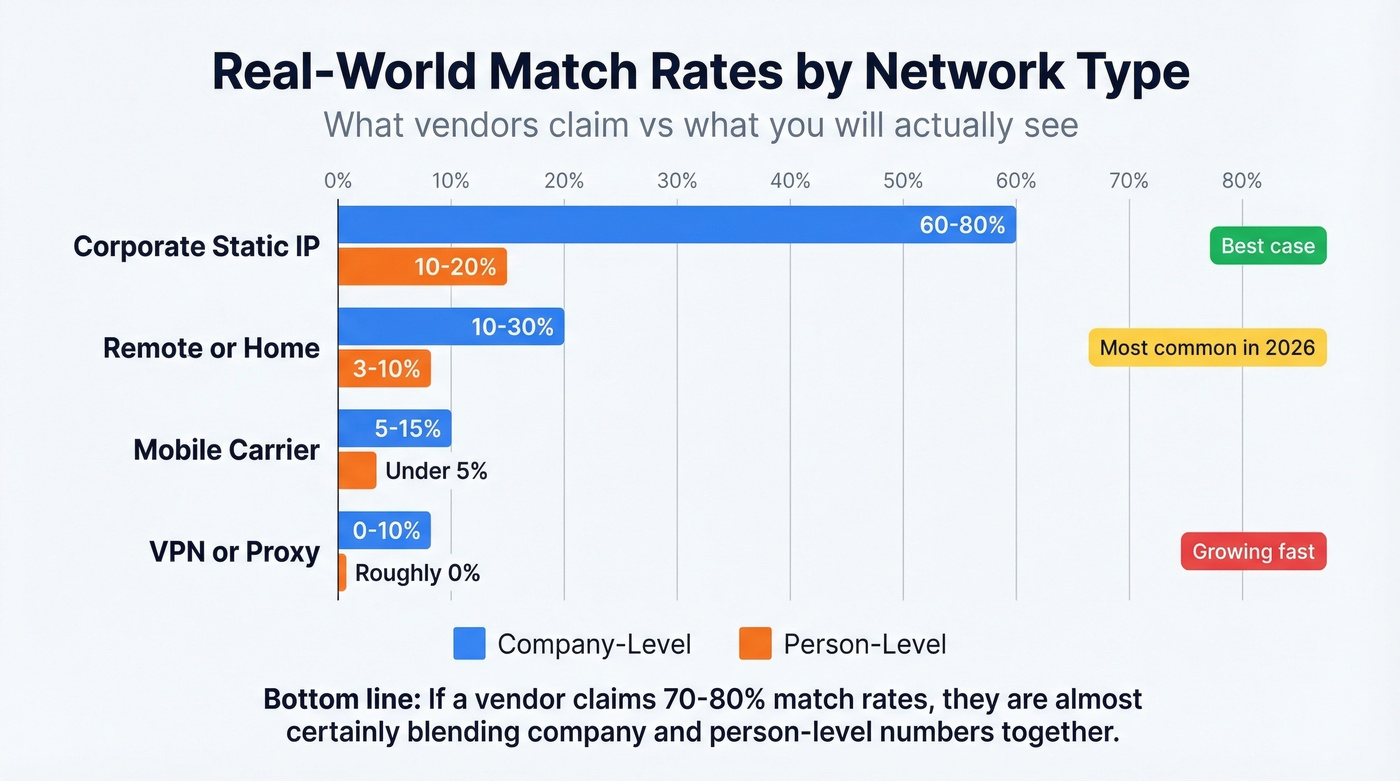
| Network Type | Company-Level Match Rate | Person-Level Match Rate |
|---|---|---|
| Corporate static IP | 60-80% | 10-20% |
| Remote / home | 10-30% | 3-10% |
| Mobile carrier | 5-15% | <5% |
| VPN / proxy | 0-10% | ~0% |
Overall, company-level identification resolves 30-65% of traffic in real-world conditions. Person-level sits at 5-20%. When a vendor claims 70-80%, they're almost always blending company-level and person-level into one number, which is misleading.
RB2B publishes tier-based expectations: its pricing page lists 15-20% on Free/Starter/Pro and 35-45% on Pro+, while its plan comparison guidance puts Starter/Pro around 30-40% on average and Pro+ around 70-80% when Premium Resolution is enabled. That gap between the marketing headline and the entry-level product is significant. ZoomInfo highlights 210M IP-to-Organization pairings, but visitor identification is typically bundled into an enterprise platform starting well above $15K/year - overkill if you just need to know which companies are on your site.
Here's the thing: if your average deal size is under $10K, you probably don't need person-level identification at all. Company-level ID paired with good enrichment will get you further for a fraction of the cost.

Company-level visitor identification is only half the battle. Once you know Salesforce visited your pricing page, you still need verified contact data for the right decision-maker. Prospeo's 300M+ profiles, 98% email accuracy, and 7-day data refresh turn anonymous traffic signals into reachable contacts - at $0.01 per email.
Stop identifying visitors you can't actually reach.
Best Tools to Identify B2B Website Visitors
RB2B - Best Person-Level ID (US)
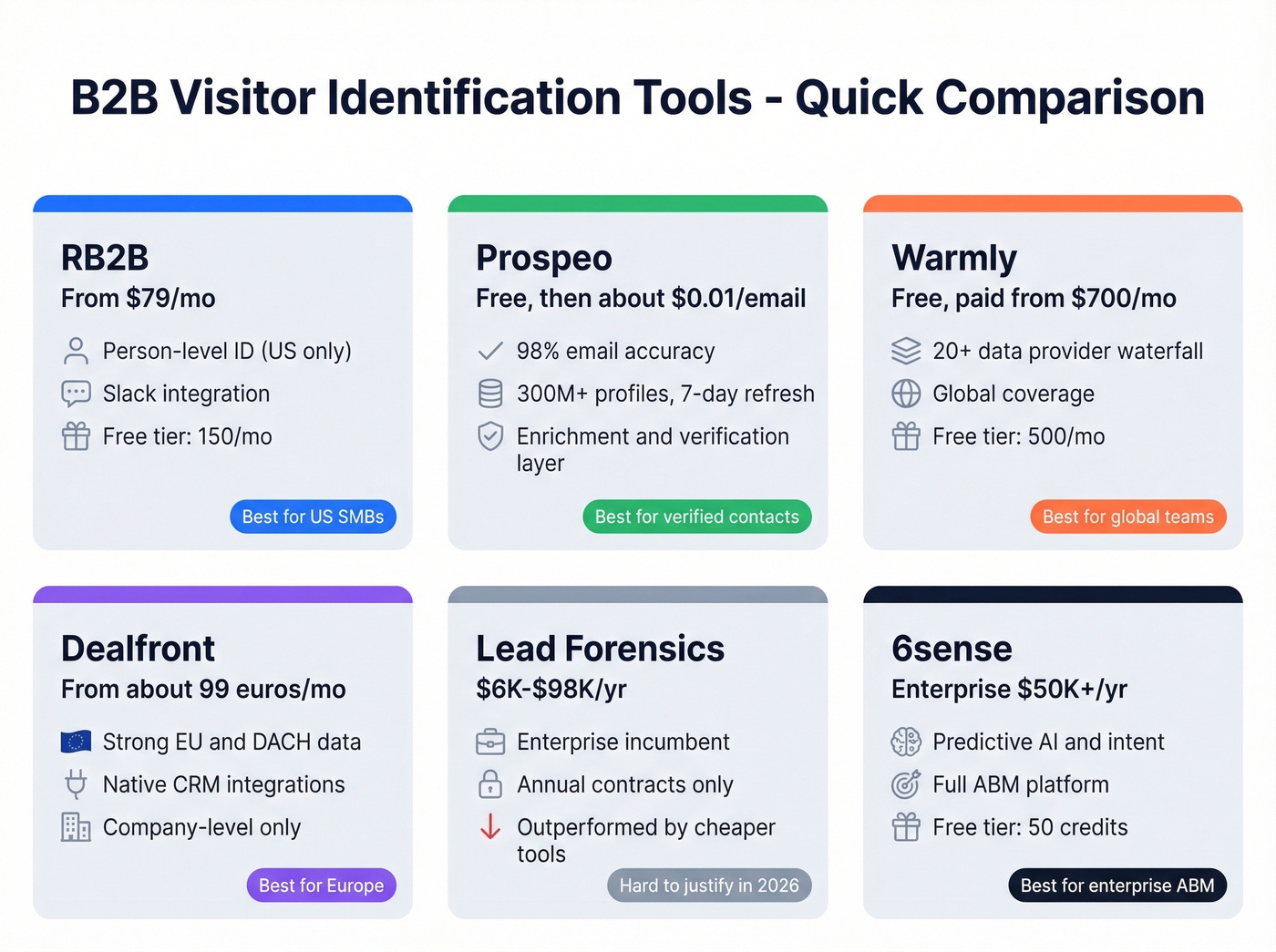
RB2B made person-level identification mainstream for SMBs. Install a pixel, get names and emails pushed straight to Slack. The reality is more nuanced than the pitch.

Four tiers: Free ($0, 150 resolutions/mo, company-level only), Starter ($79/mo, 300 resolutions), Pro (from $149/mo, starts at 600), and Pro+ (from $199/mo, starts at 600 with Premium Resolution). Pro and Pro+ include business emails. Starter doesn't. Overages run $0.45/resolution on Starter and $0.25 on Pro/Pro+.
Lower tiers are US-only for contact-level data.
The consensus on r/sales and r/b2bmarketing is mixed. Users report irrelevant leads - salespeople and non-ICP personas flooding Slack - with ROI "close to zero" in niche verticals. Others flag payment issues with international cards and minimal support. That said, teams selling to US mid-market with high-traffic sites consistently report positive results on Pro+.
Use it if: You sell to US mid-market/enterprise and have budget for Pro+. Skip it if: Your traffic is mostly international, remote, or niche.
Prospeo - Best for Verified Contact Data After Identification
Prospeo isn't a visitor identification pixel - it's the enrichment and verification layer that makes identified visitor data actually useful. Once any tool on this list tells you which companies are visiting, Prospeo finds verified emails and direct mobiles for the right decision-makers at those companies.
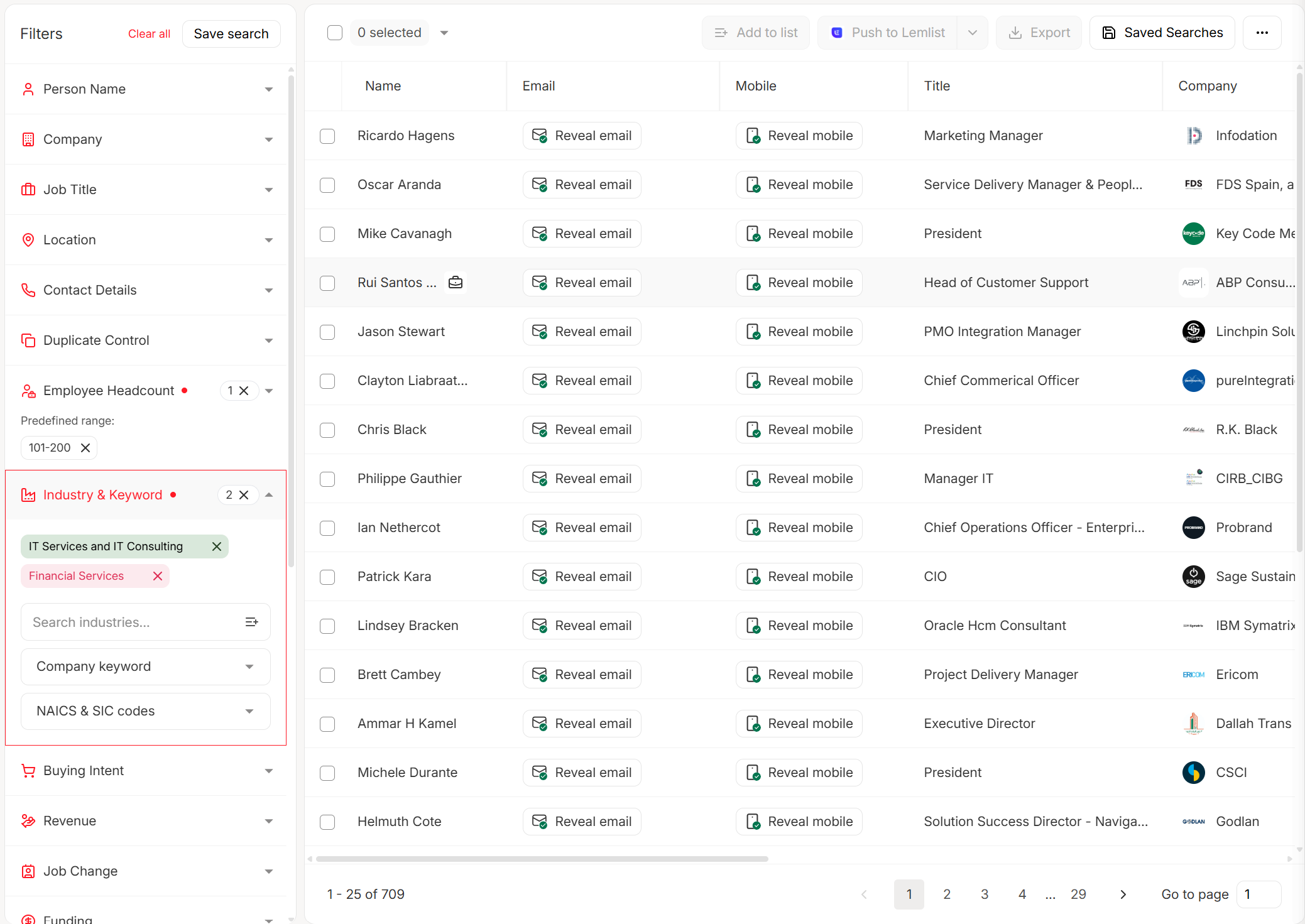
The database covers 300M+ professional profiles with 143M+ verified emails at 98% accuracy and 125M+ verified mobile numbers. Data refreshes every 7 days, compared to the 6-week industry average - which matters when you're reaching out to someone who visited your site yesterday. The API returns 50+ data points per contact at a 92% match rate, and enrichment returns contact data for 83% of leads. Teams using Prospeo for enrichment report bounce rates dropping from 35% to under 4%, which is the difference between a healthy sending domain and a blacklisted one.
Thirty-plus search filters let you zero in on exact decision-makers. Filter by buyer intent across 15,000 Bombora topics, technographics, job changes, and headcount growth. Pricing starts free (75 emails + 100 Chrome extension credits/mo), with paid plans running roughly $0.01 per email. No contracts, no sales calls required.
Use it if: You've got a visitor ID tool generating company-level signals and need verified outreach targets. Best paired with: RB2B or Warmly for identification, then Prospeo for enrichment and verification.
Warmly - Best Waterfall Approach (Global)
Instead of relying on a single data source, Warmly runs a waterfall of 20+ data providers to maximize match rates. This means higher identification rates than any single-source tool, especially for international traffic where US-centric tools fall short.
The free tier is genuinely generous - 500 visitors per month, enough to validate whether visitor identification works for your traffic before committing budget. Paid plans start at roughly $700/mo for the Startup tier.
That price is steep for a startup that just wants to know who's browsing. But the free plan removes the risk entirely, and we've seen the waterfall approach consistently outperform single-provider setups for teams with global traffic.
Use it if: You need global coverage and can justify $700+/mo once validated. Skip it if: You're US-only with tight budget - RB2B's Pro+ gets you person-level data for less.
Dealfront (Leadfeeder) - European Teams' Default
Dealfront, formerly Leadfeeder, is the common default for European B2B teams. Strong EU data coverage and native Salesforce and HubSpot integrations. The free tier includes 100 identified companies with 7-day data retention, and paid plans start from roughly €99/mo on annual billing, scaling by identified companies. Company-level only. If you're selling into DACH or Benelux markets, Dealfront's regional coverage often outperforms US-first tracking tools.
Lead Forensics - The Enterprise Incumbent
The tool your VP of Marketing bought in 2019 and nobody can cancel. Traffic-based pricing with no public numbers - based on Vendr transaction data, expect $6K-$98K/year with an average around $35K. Annual contracts only, with 10-20% renewal increases baked in.
Every cheaper tool on this list now matches its company-level identification capability. Hard to justify the price unless switching costs feel too high.
6sense - Enterprise ABM Powerhouse
Phenomenal if you have $50K+ and a dedicated RevOps team. 6sense bundles predictive AI, intent data, and visitor identification into one platform. There's a free plan with 50 credits/month worth testing. Enterprise contracts typically run $50K-$200K+/year.
For everyone else, it's overkill. You don't need predictive AI to know someone who visited your pricing page three times is interested.
Clearbit / Breeze Intelligence - HubSpot-Native
Now fully absorbed into HubSpot as Breeze Intelligence. Path of least resistance for HubSpot shops, irrelevant for everyone else. Pricing runs on credits inside HubSpot, with plans commonly starting around ~$50/mo and scaling from there. Real-time visitor identification fires within HubSpot workflows, which just works if your stack is already HubSpot-native.
Snitcher, Leadinfo, and Instantly Pixel
Snitcher is a solid entry point for small teams. Company-level identification with Google Analytics integration, free trial, paid plans from ~$39/mo. Nothing fancy, but it works and won't break the budget.
Leadinfo starts at ~€39/mo with EU-hosted servers, company-level only, no cookies. It delivers 35-40% identification rates in Benelux/DACH regions. The most conservative choice for GDPR-strict teams.
Instantly Pixel is free to start with 25 credits, pay-per-resolved-profile after that. Person-level, US-focused. Worth it if you're already running Instantly for outreach - the pixel feeds identified contacts directly into sequences. Not worth adopting standalone.
Pricing Comparison
| Tool | Starting Price | Typical Match Rate | Best For |
|---|---|---|---|
| RB2B | Free; paid from $79/mo | 15-80% (tier-dependent) | US person-level ID |
| Prospeo | Free; ~$0.01/email | 98% email accuracy | Verified contacts after ID |
| Warmly | Free; paid ~$700/mo | Varies (waterfall) | Global coverage |
| Dealfront | Free; paid from ~€99/mo | 30-50% | European B2B teams |
| Lead Forensics | ~$6K-$98K/yr | 30-50% | Enterprise, high traffic |
| 6sense | Free; enterprise $50K+/yr | N/A (bundled) | Enterprise ABM |
| Clearbit/Breeze | From ~$50/mo (credit-based) | N/A (enrichment) | HubSpot-native teams |
| Snitcher | From ~$39/mo | 20-40% | SMBs testing visitor ID |
| Leadinfo | From ~€39/mo | 35-40% (EU) | EU-hosted, GDPR-strict |
| Instantly Pixel | Free (25 credits) | Varies | Instantly users |
Turning Visitors Into Booked Meetings
Identification alone doesn't book meetings. Here's the workflow that converts.
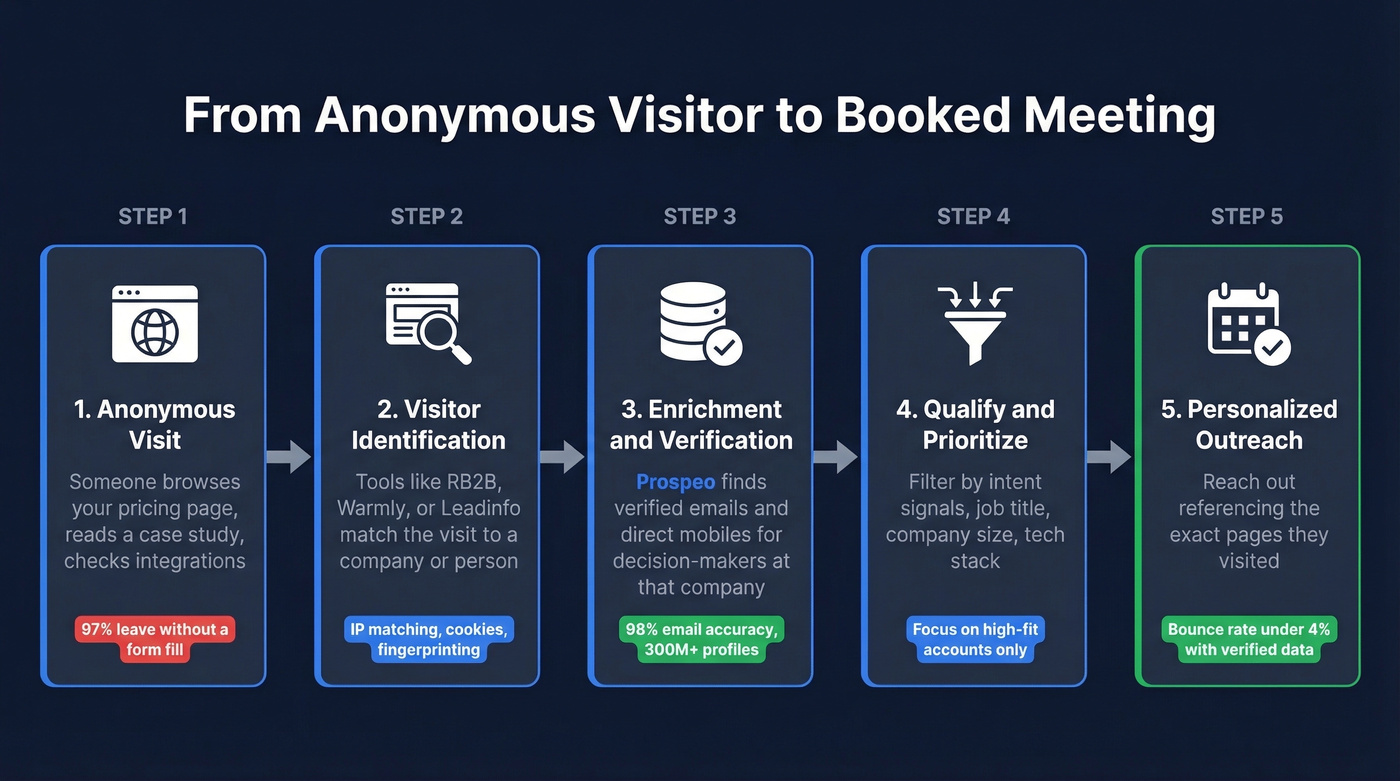
Step 1: Install a visitor ID pixel. RB2B for US person-level, Warmly for global waterfall, Dealfront for EU. The pixel surfaces the companies your sales team actually wants to sell to - not just logs traffic.
Step 2: Enrich and verify. Pipe identified companies into an enrichment tool via API. Filter by buyer intent, job title, and company size to focus on ICP-fit contacts only. You need verified emails and direct dials for the decision-makers who matter - not just a company name on a dashboard.
Step 3: Trigger outreach. In our experience, the teams that see the fastest results automate this chain - visitor ID fires a webhook, enrichment runs in Clay or Zapier, and verified contacts land in a sequencer within hours of the site visit. Timing matters: a prospect who visited your pricing page this morning is far more receptive than one you email next week.
Let's be honest - you don't need a $30K platform. A $99/mo pixel paired with $0.01/email verification will outperform an enterprise suite running on stale data.
Bad enrichment data kills the visitor ID workflow. Teams using Prospeo after identification cut bounce rates from 35% to under 4% - protecting their sending domains while tripling pipeline. Layer 30+ filters including buyer intent across 15,000 topics to find exactly the right person at every identified company.
Identify the company, then reach the decision-maker with 98% accuracy.
Is Visitor Identification Legal?
The most common question on Reddit about this category: "How is this legal?"
Company-level identification is legally safe under both GDPR and CCPA. You're matching an IP address to a company name - no personal data exposed. Person-level is a gray area. In the US, it operates under CCPA and is broadly permissible with proper disclosure. In the EU, IP addresses qualify as personal data under GDPR, so person-level identification faces real scrutiny.
Quick compliance checklist: clear cookie notices describing tracking behavior, a privacy policy disclosing visitor identification, working opt-out mechanisms, and excluding companies under 5 employees (identifying a 3-person startup effectively identifies individuals). Don't label tracking cookies as "essential" - regulators are watching. For risk-averse legal teams, stick to company-level tools and pair them with an enrichment layer for contact data.
If you need a deeper framework, see our guide to B2B compliance and the checklist for a GDPR compliant database.
FAQ
What's a realistic match rate for visitor identification?
Company-level identification resolves 30-65% of traffic on corporate networks, dropping to 10-30% for remote workers. Person-level ranges from 5-20%. When vendors claim 70-80%, they're blending both methods. Your actual rate depends on your traffic mix - enterprise office traffic performs best.
Can I identify individual people, not just companies?
Yes, but only reliably in the US under CCPA. Tools like RB2B and Warmly offer person-level identification using identity graphs and consent-based networks. In the EU, stick to company-level tools like Dealfront or Leadinfo and enrich separately for verified emails.
How much does B2B website visitor identification cost?
Free tiers exist from RB2B, Warmly, 6sense, and Dealfront. Paid plans range from $39/mo to $200K+/year. Most mid-market teams spend $100-$700/mo on identification alone. Budget for enrichment and verification on top - Prospeo starts free with 75 credits/mo, and paid plans run ~$0.01/email.
Does visitor identification work with VPN and remote traffic?
Poorly. VPN traffic has a 0-10% identification rate. Remote/home networks resolve at 10-30%. If most of your traffic is remote workers, focus on company-level identification and invest in enrichment quality over identification volume.