

BANT Criteria: The Sales Qualification Framework That Still Works in 2026
Your SDR marked the lead as "BANT-qualified." Budget confirmed, decision-maker on the call, timeline of Q2. Two months later, the deal's dead - the prospect ghosted after the third demo, and it turns out the "decision-maker" was actually an analyst doing research.
The BANT criteria gave you a framework. The problem is how your team used it.
BANT isn't a methodology. It's qualification fundamentals with a memorable acronym: Budget, Authority, Need, Timeline. IBM built it in the 1950s, and seven decades later, it's still the fastest way to sort real opportunities from tire-kickers.
The Short Version
BANT evaluates prospects across four dimensions that together determine whether a lead deserves your team's time. A lead is viable if it meets at least three of the four. A 2023 Gartner Digital Markets survey found 52% of salespeople still find BANT reliable, and 41% value its flexibility over more rigid frameworks. It's best suited to SMB and inbound-heavy sales motions with shorter cycles. If your deals are enterprise and high-ACV, use BANT as a pre-filter, then graduate to MEDDIC or MEDDPICC.
Below: a concrete scoring rubric, modern discovery questions, and the mistakes that turn qualification into an interrogation.
What Is BANT? Budget, Authority, Need, Timeline
BANT is a sales qualification framework that evaluates prospects across four dimensions - Budget (can they pay), Authority (can they decide), Need (do they have a problem you solve), and Timeline (when are they buying). IBM created it in the 1950s to help sales teams stop wasting time on unqualified leads, and the acronym has become shorthand across sales organizations worldwide for the minimum bar a prospect should clear.
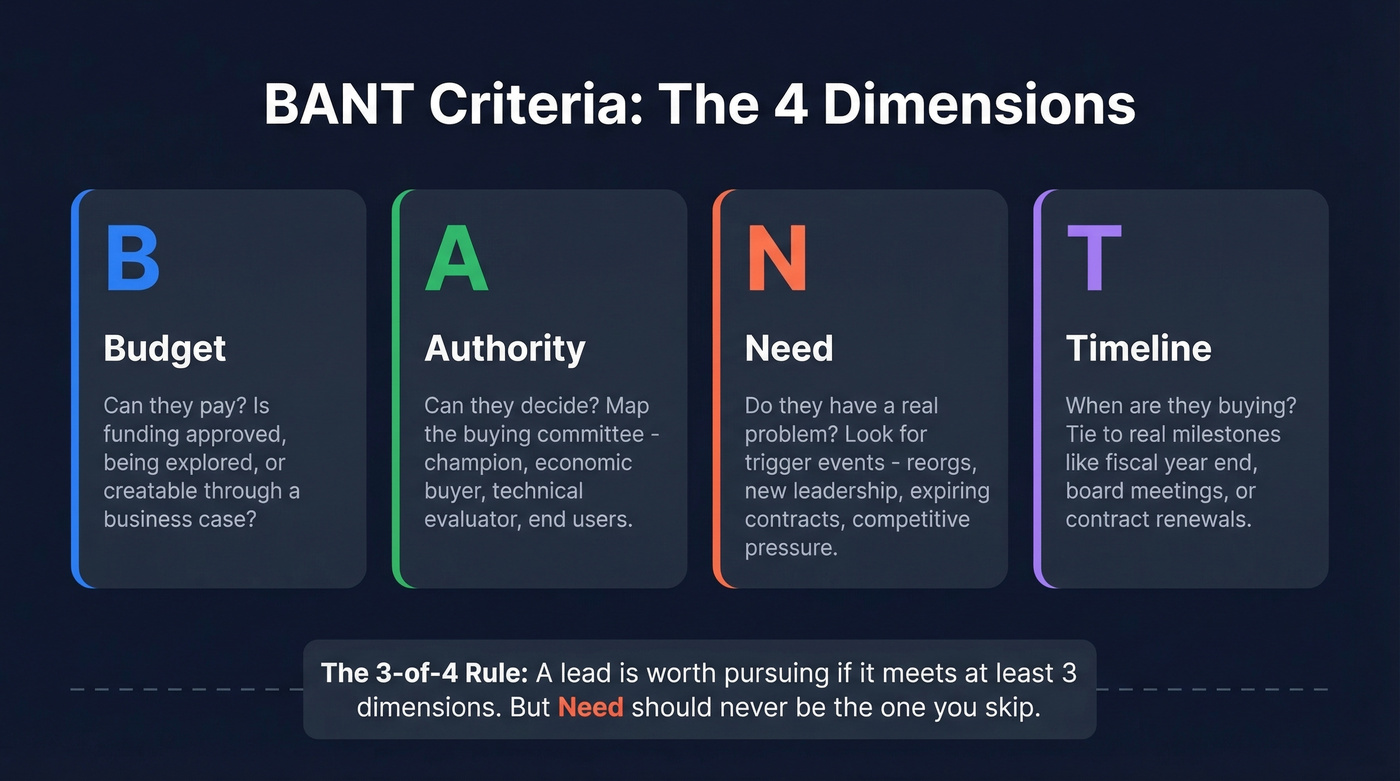
The standard heuristic is "3 of 4." If a prospect meets three of the four dimensions, they're worth pursuing. Two or fewer? Nurture. That said, which three matters - a prospect with Budget, Authority, and Timeline but no real Need is a waste of everyone's time.
A common take on r/sales is that most sales methodologies - Sandler, Challenger, MEDDIC, BANT - boil down to the same fundamentals. BANT just happens to be the version that's easiest to teach and hardest to overcomplicate.
The Four Dimensions Explained
Budget
Budget isn't "do they have money sitting in a line item." In 2026, budget often gets created after the business case. A prospect who already has approved budget for your category? In complex deals, that can actually be a red flag - it often means they're evaluating competitors and you're late.
Ask "How are decisions like this typically funded at your company?" and "What's the cost of not solving this problem over the next 12 months?" Cost-of-inaction framing beats asking "what's your budget?" directly every time. One in three buyers cite higher-than-expected total cost of ownership as a top regret driver, so help them think about TCO early, not just sticker price.
Budget is often the hardest dimension to confirm early. Lead with Need.
Authority
Here's the mistake we see constantly: a rep finds "the decision-maker," single-threads the entire deal, and then loses it when their champion goes on vacation the week of the decision. Modern B2B buying groups include 6-10+ stakeholders. Authority isn't a name - it's a map. You need the economic buyer, the technical evaluator, the end user, and a champion who'll sell internally when you're not in the room.
The best discovery question: "Walk me through how your team typically evaluates and approves a purchase like this." If your contact describes a process, you're in good shape. If they say "I make the decision," that answer is almost always incomplete. Multi-thread or lose the deal to internal politics you never saw coming.
Need
There's a gap between "yeah, we've been thinking about this" and "our current vendor's contract expires in 90 days and we can't renew." You want the second one.
Strong discovery questions here:
- "What changed that made this a priority now?"
- "What happens if you don't solve this in the next quarter?"
Listen for a trigger event - reorgs, new leadership, competitive pressure, regulatory changes. No trigger means no urgency. And no urgency means no timeline.
The mistake that kills deals? Skipping pre-call research. If you've done your ICP homework, you should suspect the need before the call and validate it in conversation, not discover it from scratch.
Timeline
Most reps ask "When are you looking to buy?" and get a made-up answer. Early-stage prospects genuinely don't know, and forced answers create bad data in your CRM. Your manager forecasts Q3 because that's what the prospect said under pressure. Q3 comes and goes. Qualification turns into fiction.
Instead, tie timeline to milestones: "Is there a specific event or deadline driving this evaluation?" or "When does your current contract come up for renewal?" Concrete milestones like "end of fiscal year" or "before the board meeting in March" are useful. "Sometime next year" is not.
That same Gartner Digital Markets survey found 36% of salespeople say BANT helps them plan a sales timeline - but only when the timeline data is real, not manufactured.
BANT Qualification Scoring Rubric
Most articles tell you to "qualify leads." None give you a scoring model. We've used this rubric across multiple teams to get consistent qualification across reps - score each dimension on a 1-to-5 scale.
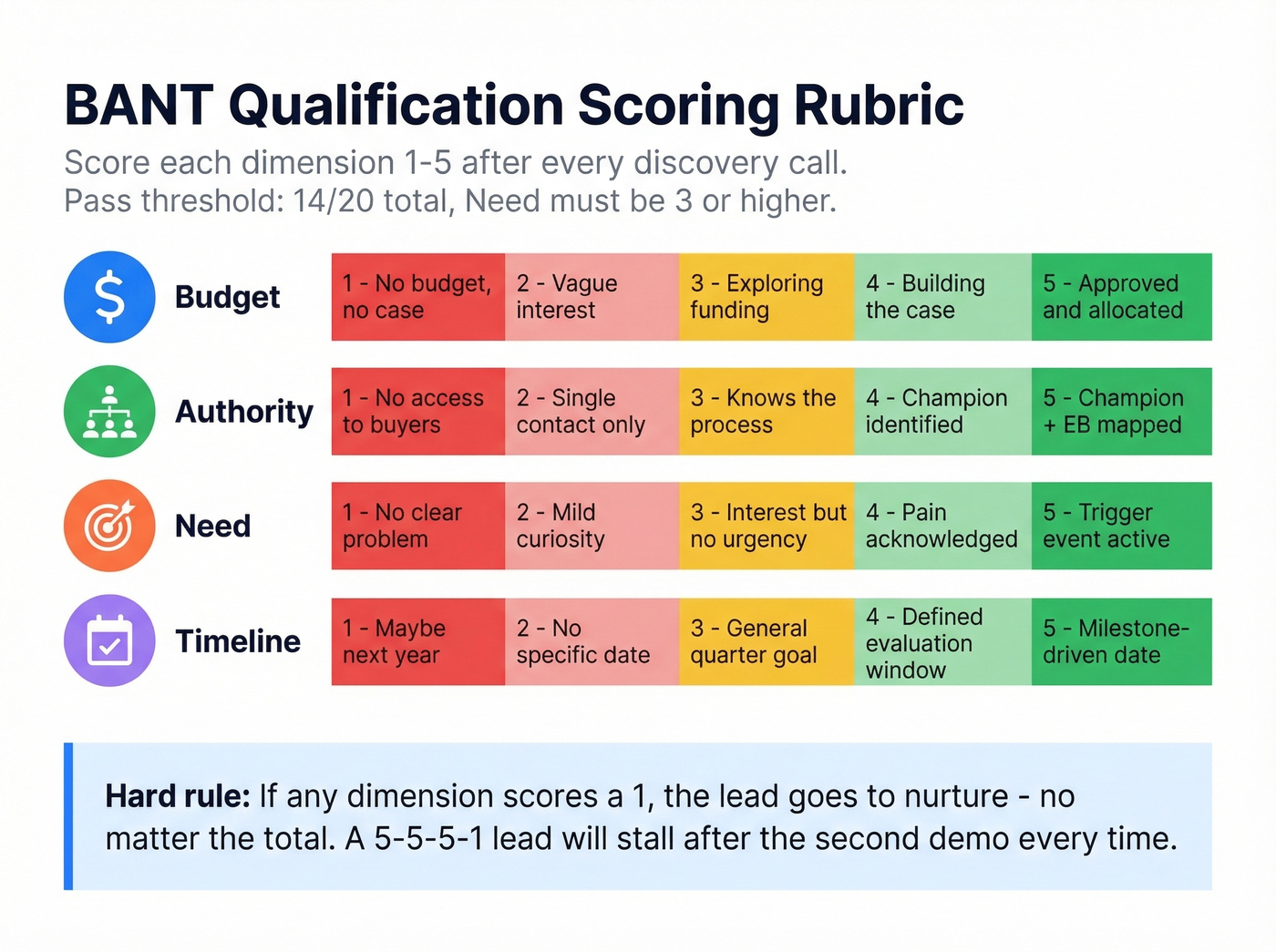
| Dimension | 1 (Unqualified) | 3 (Developing) | 5 (Strong) |
|---|---|---|---|
| Budget | No budget, no case | Exploring funding | Approved & allocated |
| Authority | No access to buyers | Knows the process | Champion + EB mapped |
| Need | No clear problem | Interest, no urgency | Trigger event active |
| Timeline | "Maybe next year" | General quarter goal | Milestone-driven date |
Pass threshold: Total score of 14/20 or higher, AND Need must be at least 3. If any single dimension scores a 1, the lead needs nurture regardless of total score. A prospect with a 5 in Budget, Authority, and Timeline but a 1 in Need will stall after the second demo every time.
Score after every discovery call. Log it in your CRM. Review it weekly. This turns qualification from a vibe check into a repeatable process.

Your BANT scoring rubric is only as good as the contacts feeding it. If your reps are qualifying leads with outdated emails and wrong phone numbers, every score is fiction. Prospeo delivers 98% email accuracy and 125M+ verified mobiles on a 7-day refresh cycle - so your team qualifies real buyers, not ghosts.
Stop scoring leads you can't actually reach.
How to Apply BANT in 2026
Qualification isn't a call script. It's a four-step flow that works best as a loop across multiple touches, not a one-time gate.
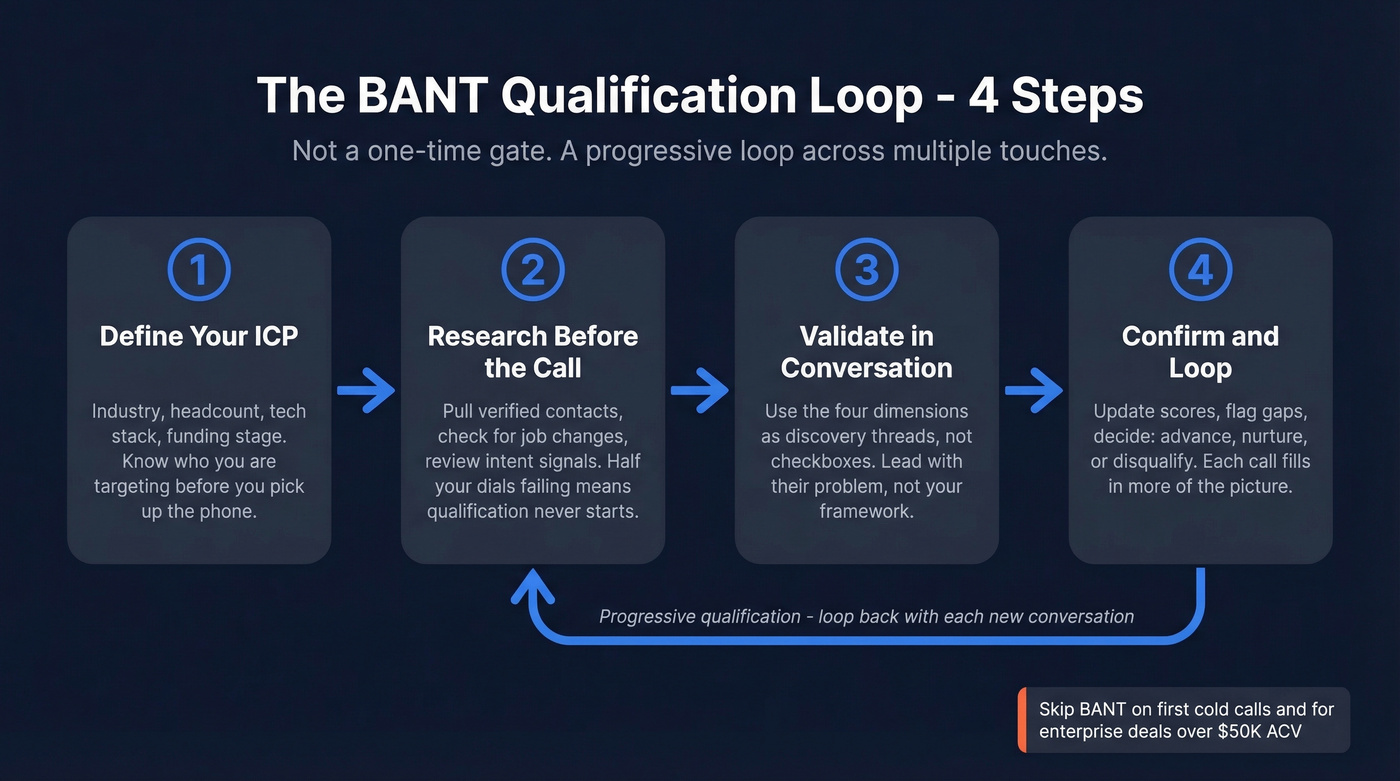
Step 1: Define your ICP. Know which companies and roles you're targeting before you touch a phone. Industry, headcount, tech stack, funding stage - get specific.
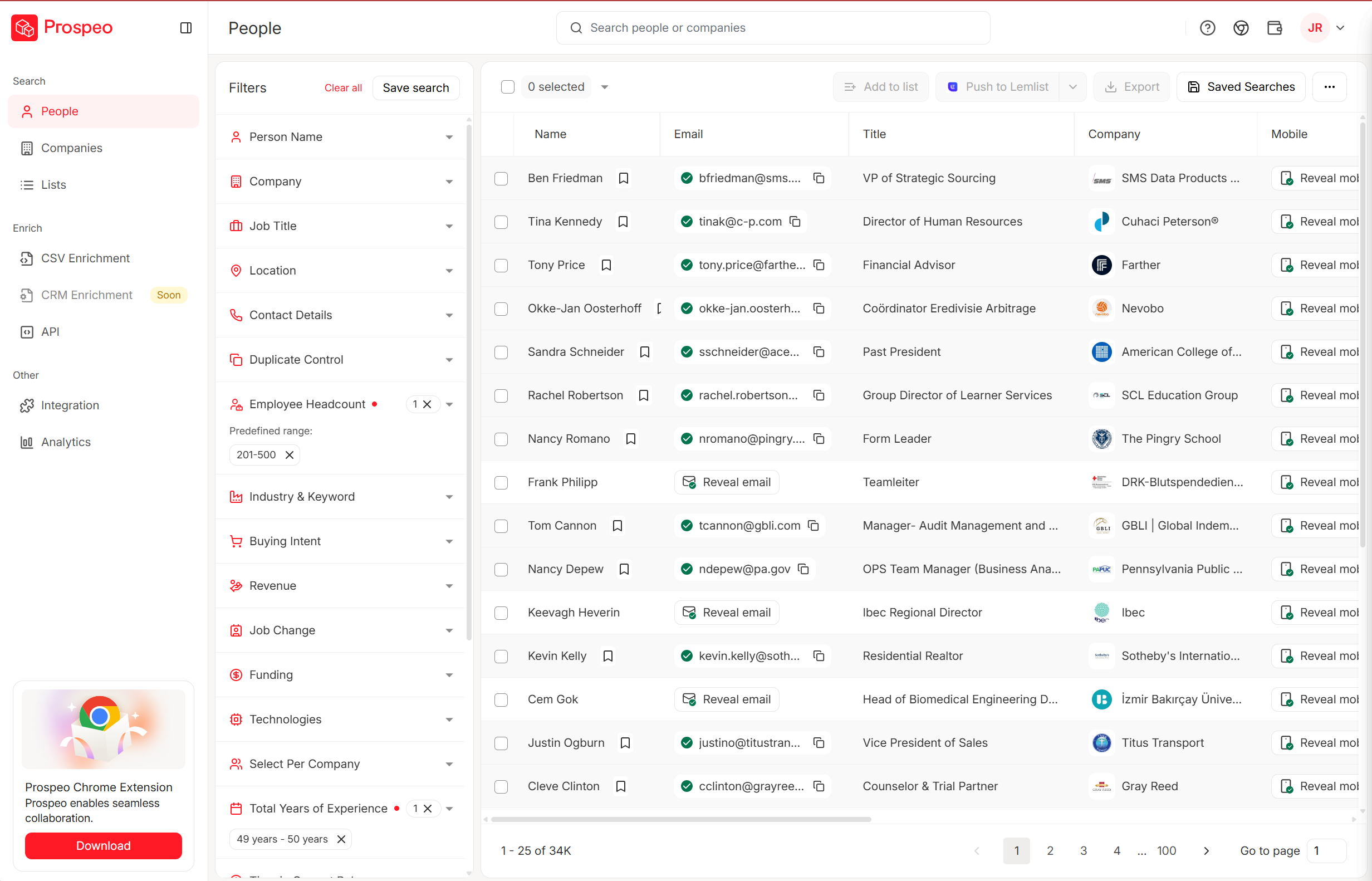
Step 2: Research accounts before the call. This is where most teams fail. Pull verified contact data, check for job changes, and review intent signals before you dial. If half your dials go to voicemail or wrong numbers, your qualification process never begins. Prospeo verifies emails and phone numbers on a 7-day refresh cycle with 98% email accuracy, so you're reaching the right person - not leaving voicemails for someone who left the company six months ago.
Step 3: Validate in conversation. Use the four dimensions as discovery threads, not checkboxes. You're confirming what you already suspect from research, not interrogating a stranger. Lead with their problem, not your qualification framework. Your goal across the call is to assess budget, authority, needs, and timeline - but in a way that feels like a genuine business conversation, not a form you're filling out.
Step 4: Confirm and loop. Update your scoring rubric. Flag gaps. Decide: advance, nurture, or disqualify. The best teams treat this as progressive qualification - each conversation fills in more of the picture. A prospect might reveal Need on the first call, Authority on the second, and Timeline on the third.
When to skip BANT entirely: On a first cold call where you haven't earned the right to ask qualification questions yet. For enterprise deals north of $50K ACV, use it as a pre-filter, then graduate to MEDDIC or GPCTBA for deeper discovery.
Common Qualification Mistakes
Interrogation mode. Buyer trust in salespeople is notoriously low. Rattling off "What's your budget? Who's the decision-maker? When are you buying?" in sequence confirms every negative stereotype. Discovery should feel like a conversation, not a deposition.
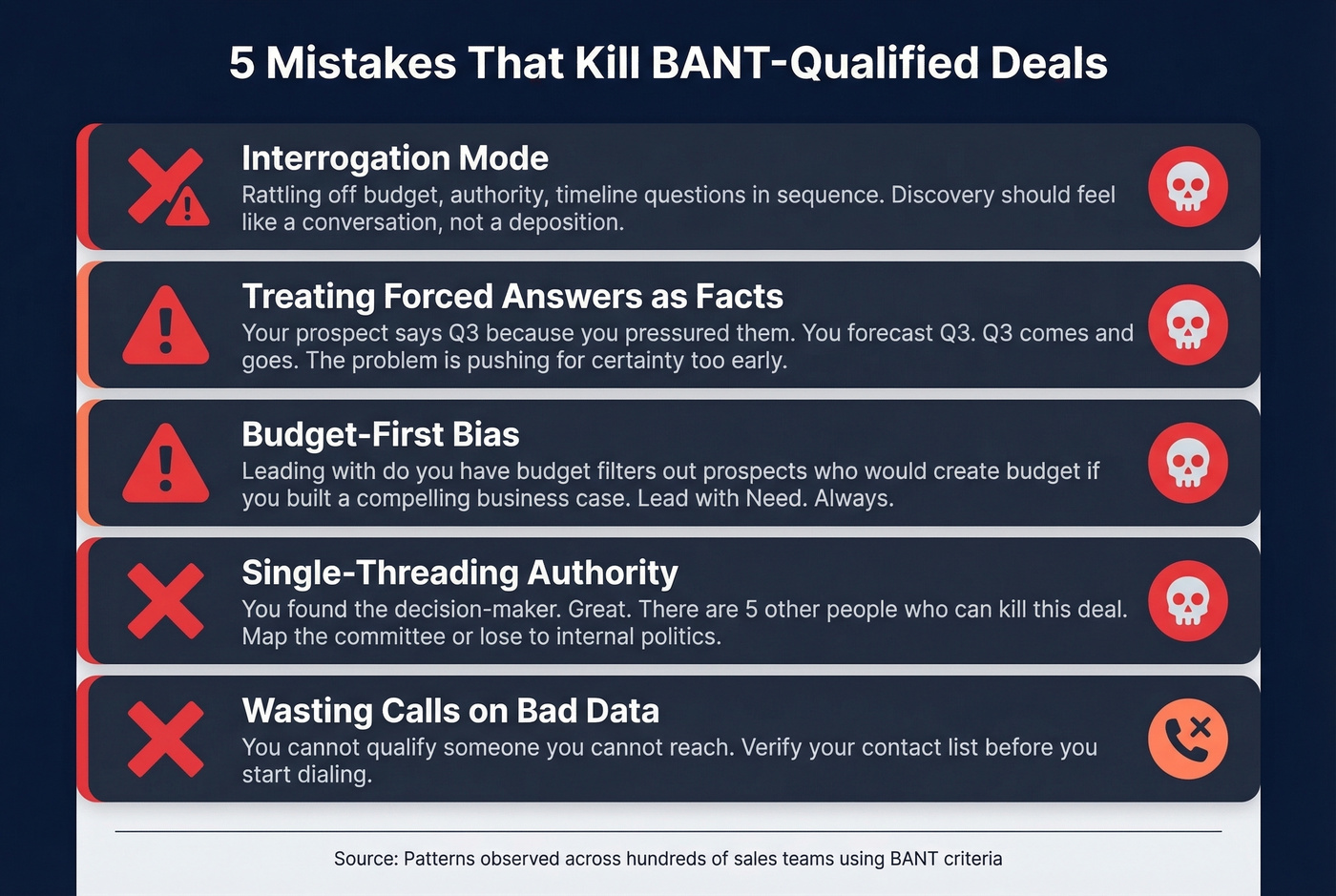
Treating forced answers as facts. Your prospect says "Q3" for timeline because you asked and they felt pressured. You log Q3 in Salesforce. Your manager forecasts it. Q3 comes and goes. We've watched this exact cycle play out at three different companies - the problem is always pushing for certainty too early.
Budget-first bias. Leading with "do you have budget?" filters out prospects who'd create budget if you built a compelling business case. Lead with Need. Always.
Single-threading authority. You found "the decision-maker." Great. There are five other people who can kill this deal. Map the committee or lose to internal politics.
Wasting calls on bad data. Look, you can't qualify someone you can't reach. Run your list through a data enrichment tool before you start dialing. Prospeo's free tier handles 75 emails per month - enough to test the difference clean data makes.
BANT vs Other Frameworks
| Framework | Best For | Key Difference |
|---|---|---|
| BANT | SMB / inbound | Fast, simple, top-of-funnel |
| MEDDIC | Enterprise / high-ACV | Deep, forecast-focused |
| CHAMP | Mid-market | Pain-first, buyer-centric |
| ANUM | Outbound-heavy | Authority-first sequencing |
| FAINT | Budget-flexible deals | Replaces "budget" with "funds" |
| SPICED | CS / expansion | Narrative-driven |
| GPCTBA/C&I | Consultative / HubSpot orgs | Thorough but heavy |
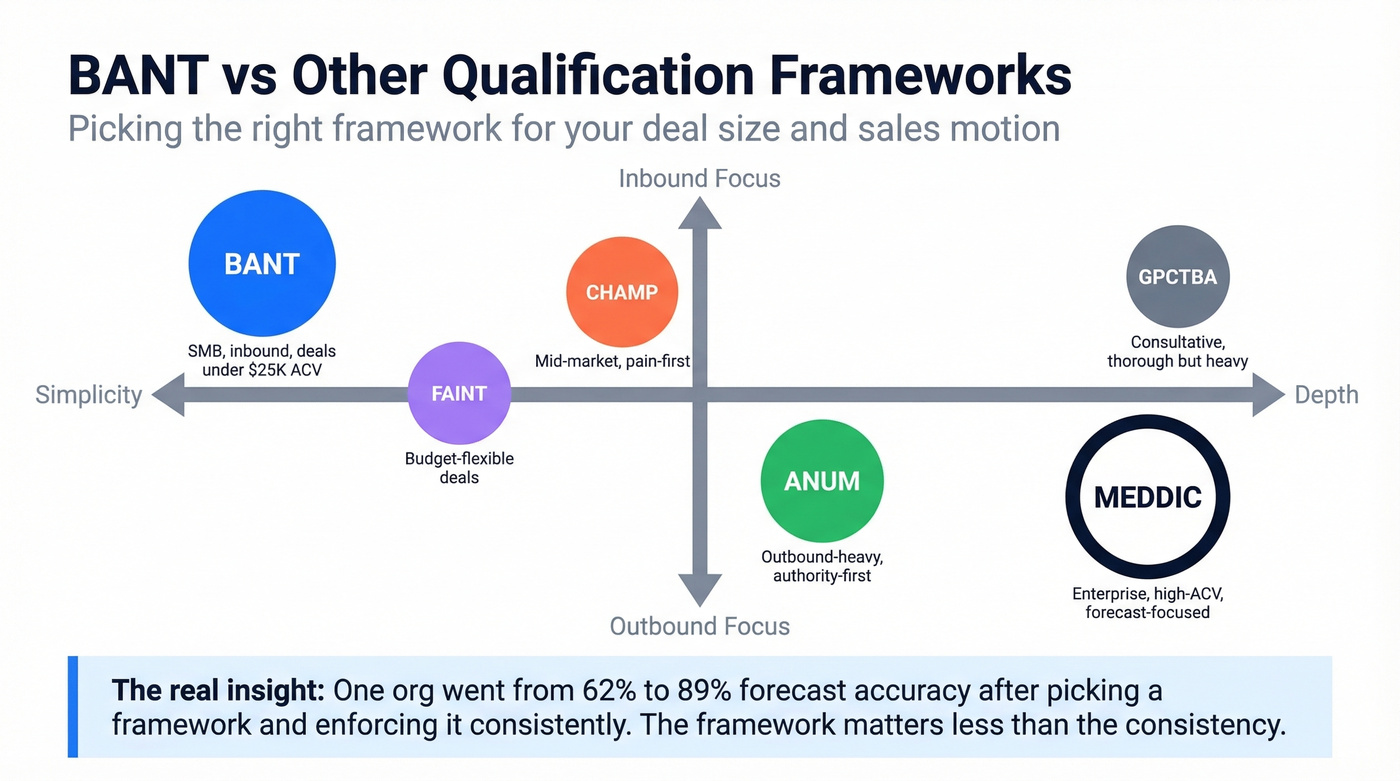
Let's be honest: MEDDIC is overkill for deals under $25K ACV. We've seen teams implement it for $8K annual contracts and spend more time filling out qualification fields than actually selling. BANT handles those deals in a fraction of the time. When all you really need to confirm is budget, authority, need, and timeframe, a lighter framework keeps your reps selling instead of filling out forms.
Skip BANT if you're running complex enterprise cycles with 6+ month timelines and multiple procurement stages. You'll need something heavier.
The real insight from teams that've standardized: forecast accuracy jumps dramatically - one org went from 62% to 89% accuracy after picking a framework and enforcing it consistently. The framework matters less than the consistency.
Does BANT Work? The Numbers
One structured case study from Factors.ai reported +35% qualified leads, -20% sales cycle length, and +40% conversion rates. An enterprise software company saw a 45% increase in marketing ROI after shifting to BANT-qualified lead handoffs. And the forecast accuracy gains are real - structured qualification of any kind beats gut-feel pipeline reviews.
These numbers are implementation-specific. But the pattern holds: any structured qualification beats no qualification. BANT's advantage is speed of adoption. You can train an SDR team on it in a day. Try that with MEDDIC.
FAQ
Is BANT outdated?
No - 52% of salespeople still find it reliable per Gartner's survey data. It's outdated only if you use it as a rigid checklist. For SMB and inbound sales motions with deal sizes under $25K, it remains one of the fastest qualification frameworks available.
What if a prospect meets only 2 of 4 criteria?
Two of four means nurture, not disqualify - unless the missing dimensions are Need and Authority. Someone with budget and a timeline but no real problem and no decision-making power gets deprioritized immediately.
How do I qualify without sounding like an interrogation?
Research before the call, then use discovery to confirm what you already suspect. Lead with the prospect's problem, not your qualification checklist. Reps who do 10 minutes of pre-call research close at significantly higher rates than those who wing it.
What's the difference between BANT and MEDDIC?
BANT covers four dimensions and takes minutes to apply - ideal for deals under $30K ACV. MEDDIC adds Metrics, Economic Buyer, Decision Process, Decision Criteria, Identify Pain, and Champion - six dimensions suited to complex enterprise cycles where forecast accuracy justifies the overhead.
Authority mapping requires multi-threading - and multi-threading requires verified contact data for the entire buying group. Prospeo's 300M+ profiles with 30+ filters let you map economic buyers, champions, and technical evaluators before the first call. At $0.01 per email, building a complete authority map costs less than a cup of coffee.
Map the full buying committee before your next discovery call.