

The 20 Best BANT Questions (+ Scoring Rubric)
Lead qualification is the #1 seller challenge. One team reported forecast accuracy jumping from 62% to 89% after standardizing their qualification framework. Teams without a method chase dead deals for months, staring at a pipeline that looks full while nothing closes.
Here's the thing: the BANT questions aren't the hard part. Knowing what a good answer sounds like - that's where most reps fall apart. Below you'll find the full question set, a scoring rubric we've never seen a competitor publish, and the five discovery questions almost nobody asks.
Just need the questions? Scroll to the categorized list. If your "qualified" deals keep dying, the scoring rubric and the 5 skipped questions are where the real value is.
What Is BANT?
BANT stands for Budget, Authority, Need, and Timeline. IBM developed it in the 1950s. It's old, but 52% of salespeople still find it reliable, and 41% value its flexibility. The framework works best for simpler SMB and transactional deals with high-volume lead qualification. For enterprise deals with 6-10+ stakeholders, layer MEDDIC or MEDDPICC on top.
20 BANT Qualification Questions by Category
Start with Need, not Budget. Budget creates resistance early and kills rapport. The modern flow is Need, then Authority, then Timeline, then Budget - you're building a business case before you talk money.
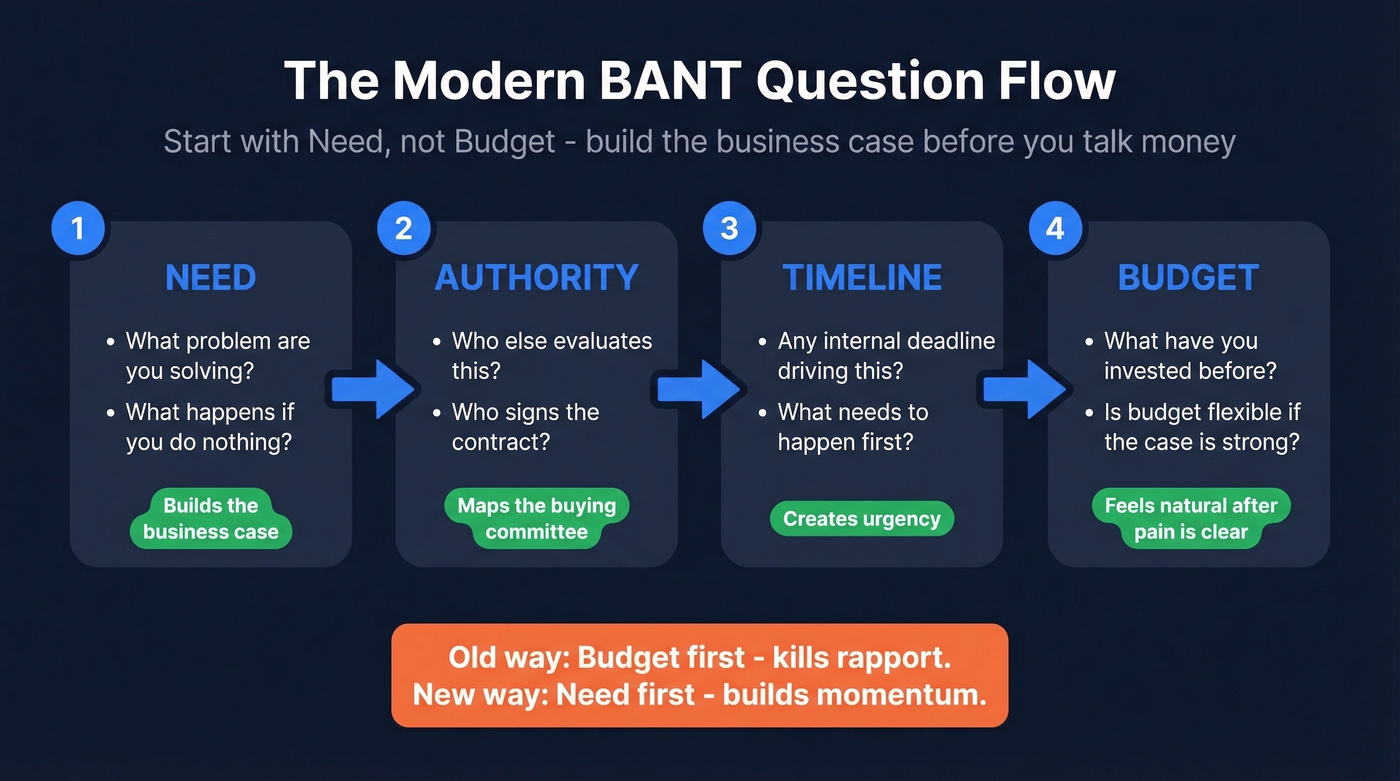
Pick 5-8 per call. Twenty questions in one conversation isn't discovery. It's an interrogation.
Need Questions
"What's the core problem you're trying to solve?" - Listen for "nice to have" vs. "this is breaking our process."
"What happens if you do nothing?" - The single best qualification question. If the answer is "we'll survive," there's no deal.
"Can you walk me through how you're handling this today?" - Current-state mapping reveals pain they haven't articulated yet.
"Have you tried to solve this before? What didn't work?" - Past attempts tell you what they've already ruled out.
"Who feels this pain most on your team?" - This identifies your internal champion.
Authority Questions
"Beyond yourself, who else will be evaluating this?" - Never ask "are you the decision-maker?" Nobody says no to that.
"Who could block this deal even if everyone else is on board?" - Red flag: they can't name anyone. Green light: specific names and roles.
"Is there a formal buying committee or approval process?" - Modern B2B deals involve 6-10+ stakeholders. A single-person answer should make you nervous.
"Who signs the final contract?" - Separates influencers from approvers.
"Has anyone on the team evaluated a similar solution before? What happened?" - Past failures tell you exactly what to avoid.
Timeline Questions
"Is there an internal deadline or event driving this decision?" - Green light: board meeting, fiscal year, product launch. Red flag: "sometime next quarter."
"What needs to happen internally before you can move forward?" - Procurement, legal, security review. These add weeks that reps consistently underestimate.
"If we agreed on everything today, how quickly could you implement?" - Separates buying timeline from implementation timeline.
"What's your ideal go-live date?" - Vague timelines are a nurture signal, not a close signal.
"What other priorities are competing for your team's attention right now?" - Deals closed within 50 days have a 47% win rate; after that, it drops below 20%. If your deal is priority #4, it's not closing this quarter.
Budget Questions
"What have you previously invested in solving this problem?" - Prior spend signals budget precedent.
"Is there a dedicated budget line for this, or would we need to build a business case?" - Both answers are fine, but the sales motion is completely different.
"What's the total cost of the current solution, including internal time?" - 33% of buyers cite higher-than-expected TCO as their top regret.
"How does your team typically evaluate ROI on tools like this?" - A defined process means faster close. "We just kind of decide" means longer.
"If the business case is strong, is budget flexible?" - Separates hard caps from soft caps.
How to Score BANT Answers
A question list without scoring is just a conversation guide. We've watched teams run flawless discovery calls and still lose deals because nobody agreed on what "qualified" meant. This rubric fixes that.
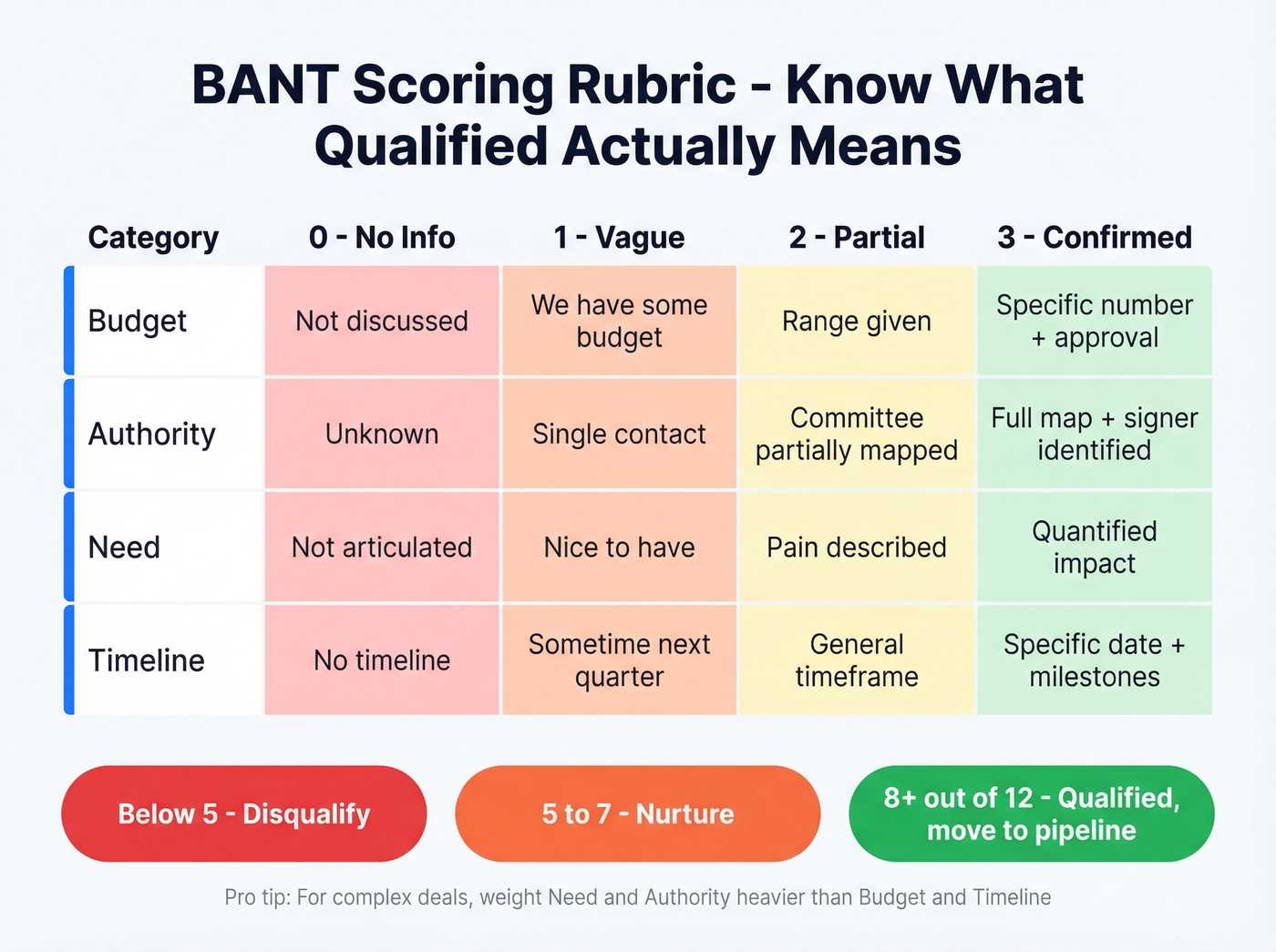
| Category | 0 - No Info | 1 - Vague | 2 - Partial | 3 - Confirmed |
|---|---|---|---|---|
| Budget | Not discussed | "We have some budget" | Range given | Specific number + approval |
| Authority | Unknown | Single contact | Committee partially mapped | Full map + signer ID'd |
| Need | Not articulated | "Nice to have" | Pain described | Quantified impact |
| Timeline | No timeline | "Sometime next quarter" | General timeframe | Specific date + milestones |
8+/12 = qualified, move to pipeline. 5-7 = nurture. Below 5 = disqualify. For complex deals, weight Need and Authority heavier - a 3 on both matters more than a 3 on Budget. In our experience, teams that actually enforce the "below 5 = disqualify" rule see pipeline accuracy improve within a single quarter, because reps stop nursing deals that were never real.

Your BANT scoring means nothing if you're emailing the wrong person. Prospeo gives you 98% verified emails and 125M+ direct dials so your discovery calls actually reach the decision-makers and signers you identified in the Authority step.
Stop qualifying leads you can't even contact.
5 Discovery Questions Reps Forget
A practitioner analysis of 500 discovery calls on r/SaaSSales surfaced five questions that consistently get skipped - and consistently predict deal outcomes:
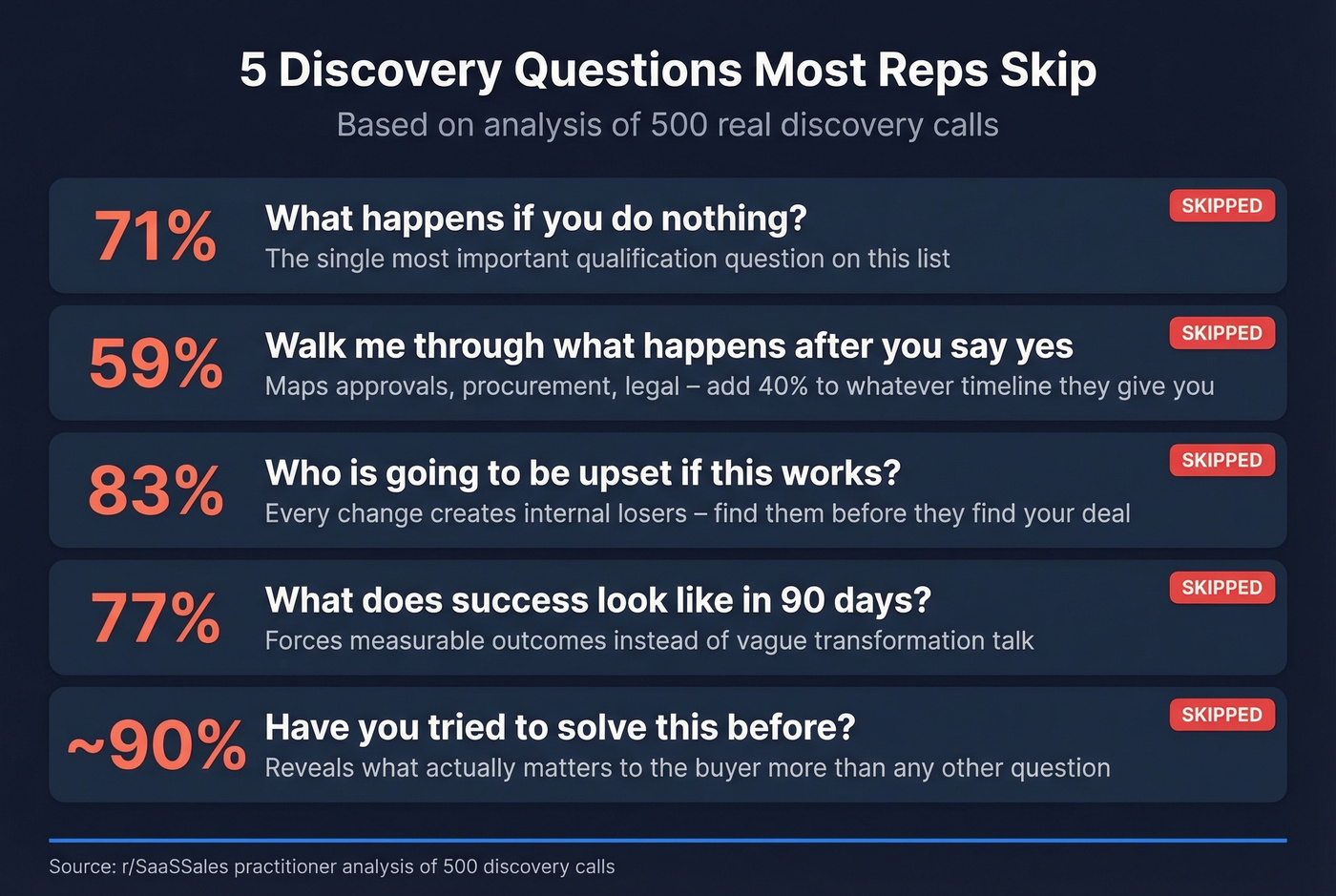
"What happens if you do nothing?" - 71% of reps skip this. It's the most important question on this entire list.
"Walk me through what happens after you say yes." - 59% skip it. This maps the approvals, procurement, and legal steps that stretch deals. The author's rule of thumb: add 40% to whatever timeline you're told.
"Who's going to be upset if this works?" - 83% skip it. Every change creates internal losers. Find them before they find your deal.
"What does success look like in 90 days?" - 77% skip it. Forces measurable outcomes instead of vague language about "transformation."
"Have you tried to solve this before?" - Almost nobody asks, and it reveals what actually matters to the buyer more than any other question.
These questions only matter if you're talking to the right person. Before running discovery, verify your contact data - tools like Prospeo with 98% email accuracy and 125M+ verified mobiles help ensure you're reaching the decision-makers you mapped in the Authority step, not bouncing emails into the void.
Common BANT Mistakes
The biggest mistake is leading with Budget instead of Need. In most modern deals, budget gets created after the business case. If you open with "what's your budget?" you're asking someone to commit money before they've committed to the problem. Start with pain.
Second, reps treat BANT like a robotic checklist. Only 3% of buyers trust salespeople. Running qualification like a survey makes that number worse. Weave questions into conversation with natural transitions: "That's helpful - quick question on timing..." feels different from "Next question: what's your timeline?"
Third, reps assume one decision-maker when 96% of prospects research before talking to a rep. By the time you're on the call, multiple stakeholders already have opinions. Map the committee, not the contact.
Let's be honest: robotic BANT deserves to die. But BANT as a flexible qualification lens is the most underrated tool in sales. A simple framework used by 100% of your team will always beat a complex one used by 30%. If your average deal size is under $25k, you probably don't need MEDDIC - you need consistent qualification done well.
When BANT Isn't Enough
| Framework | Best For | Key Difference |
|---|---|---|
| BANT | SMB / high-velocity | Fast, simple, teachable |
| CHAMP | Mid-market / consultative | Pain-first; starts with Challenges |
| MEDDIC | Enterprise / complex | Champion + paper process mapping |
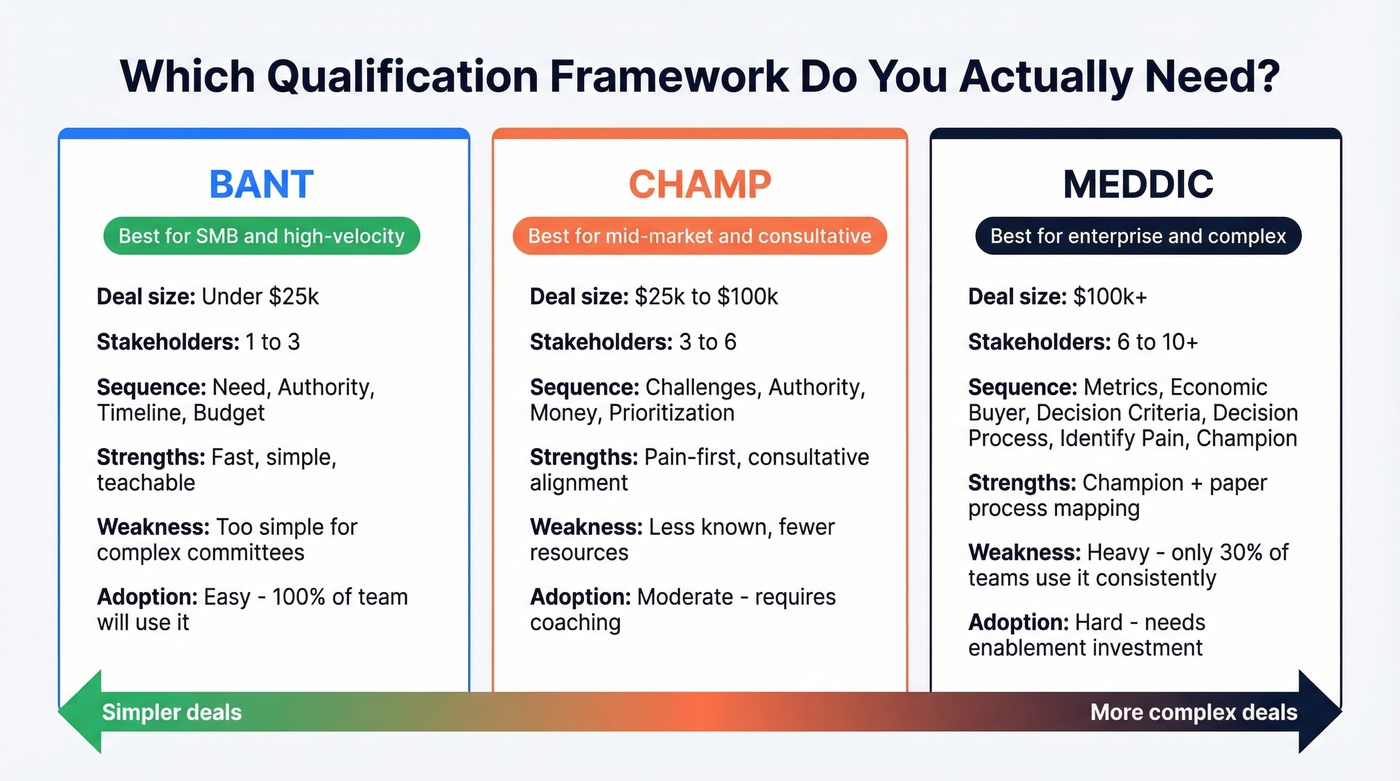
Use BANT for SMB. Layer MEDDIC for enterprise. CHAMP is the underrated middle ground - it flips the sequence to start with challenges, which aligns better with consultative buyers. Skip BANT entirely if you're selling $200k+ enterprise deals with long procurement cycles; the buying committee is too complex and the paper process too long for four simple buckets. Pair your framework with strong ICP criteria so you're qualifying the account and the opportunity at the same time.
You just mapped budget holders, buying committees, and timelines. Now connect with them before the deal window closes. Prospeo's 300M+ profiles with 30+ filters - including job title, seniority, and department - let you build lists that match your BANT-qualified buyer profile exactly.
Reach every stakeholder on the buying committee for $0.01 per email.
FAQ
What order should you ask BANT questions?
Start with Need, not Budget. Build the business case first so the money conversation feels natural. The modern sequence is Need, Authority, Timeline, Budget - this mirrors how buyers actually make decisions, not how sellers wish they did.
Is BANT still effective in 2026?
Yes, for SMB and high-velocity deals where average contract values sit below $25k. For enterprise with 6-10+ stakeholders, layer MEDDIC on top. BANT's strength is simplicity and team-wide adoption; its weakness is depth on complex buying committees.
How do you avoid sounding like a survey during BANT discovery?
Research the prospect beforehand so you skip questions you should already know the answers to. Use natural transitions like "That's helpful - quick question on timing..." instead of reading from a list. Context turns an interrogation into a conversation, and reps who prep see measurably higher conversion.
How do you verify contacts before a BANT discovery call?
Use a B2B data platform to confirm email addresses and direct dials before outreach. Accurate contact data means your discovery call actually reaches the stakeholders you mapped during Authority qualification instead of bouncing into spam folders.