

B2B Lead Qualification: The 2026 Playbook
79% of marketing-generated leads never convert to sales. Let that sink in. Worse, 95% of the time the winning vendor was already on the buyer's Day One shortlist - meaning most of your pipeline is chasing deals that were decided before you showed up. Bad B2B lead qualification doesn't just waste time; it burns cycles on opportunities you were never going to close.
Here's the frustrating part: 37.7% of B2B marketers face pressure to deliver MQLs regardless of quality, and 92% of buyers already start their search with a vendor in mind. The system incentivizes volume over fit, and everyone downstream pays for it.
We've spent years watching teams struggle with this exact problem. The fix isn't complicated, but it does require discipline: pick the right framework for your motion, build a scoring rubric with explicit point values, and - this is the part everyone skips - fix your data quality before you score a single lead. Qualification is theater if 30-40% of your emails bounce.
What Qualifying B2B Leads Actually Requires
An MQL meets marketing criteria: firmographic fit, content engagement, scoring threshold. An SQL has been vetted by a human for budget, authority, need, and timeline. These aren't the same thing, and conflating them is where pipeline leakage starts.
Qualification also isn't scoring (automated point assignment) or validation (verifying contact data is accurate). With 6-10 decision-makers in a typical B2B deal, qualifying the company is only half the job. You need to qualify the buying committee - who has influence, who has veto power, and who's just sitting in meetings because they were cc'd on the original email. Understanding how to vet prospects at both the account level and the contact level is what separates teams that hit quota from teams that chase ghosts.
Which Framework Fits Your Sales Process
| Framework | Best For | Weakness | Use When |
|---|---|---|---|
| BANT | SMB, high-velocity | Misses stakeholder complexity | Short cycles, inbound |
| MEDDIC | Enterprise, high-ACV | Can slow deals if applied rigidly | Multi-stakeholder, long cycles |
| CHAMP | Mid-market consultative | Gets loose without discipline | Pain-led selling |
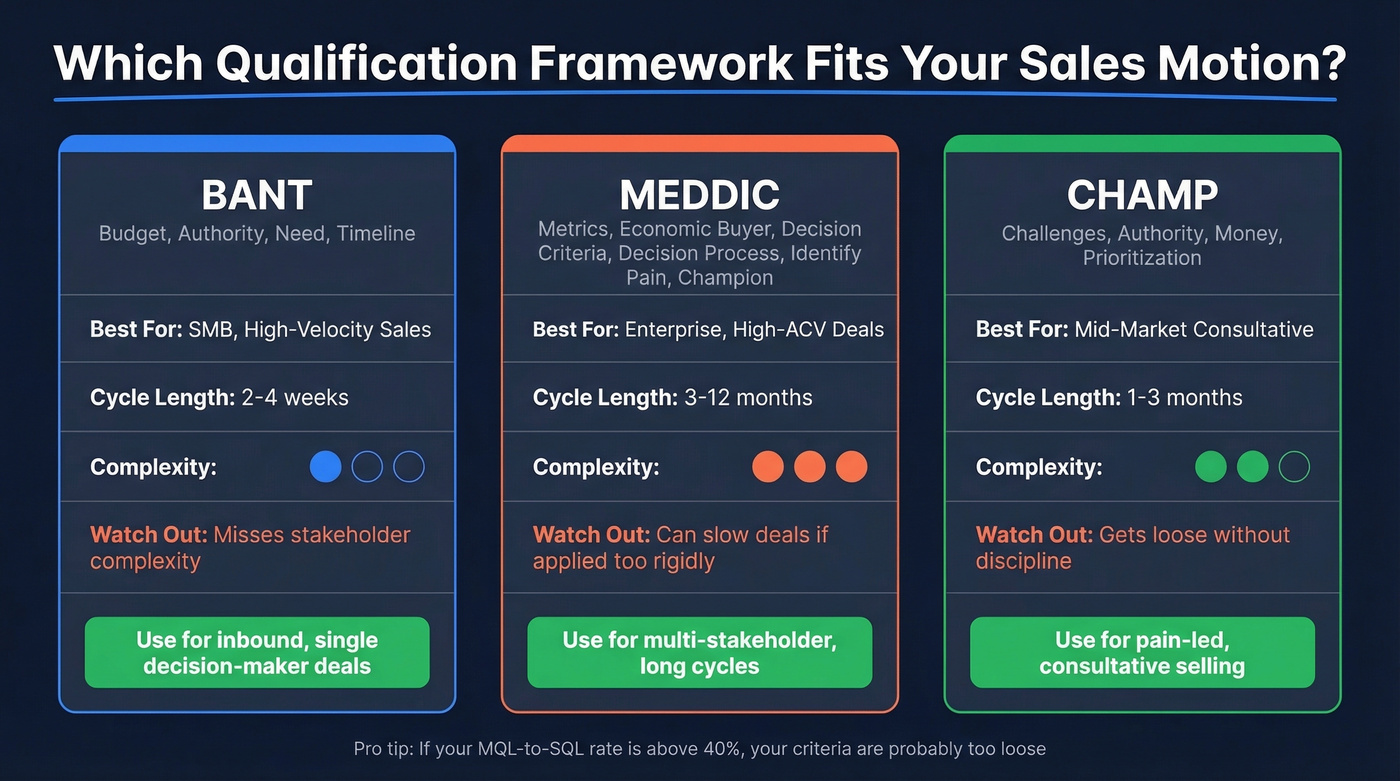
BANT has been around since the 1950s. It works when you're qualifying high volumes of inbound leads with straightforward buying processes - think SMB SaaS with a single decision-maker and a two-week sales cycle. MEDDIC is the enterprise workhorse, forcing you to map the buying committee and understand how decisions actually get made inside organizations where "approved" can mean six different things depending on who you ask.
A 20-year practitioner on r/sales offers a useful addition: don't stop digging at the first stated reason for urgency. Regulatory deadlines, audits, top-down mandates - the real driver is usually the second or third thing they mention. That same practitioner treats "relationship" as a nice-to-have, not a qualification criterion. Win likelihood comes down to fit vs. competitors and solving a critical problem.
Let's be honest: most teams under-qualify because inflated pipelines look better in reviews. If your MQL-to-SQL rate is above ~40%, your criteria are probably too loose. Below 10%, your lead sources or definitions need work.
Conversion Benchmarks by Industry
| Industry | MQL-to-SQL Rate |
|---|---|
| Consumer Electronics | ~21% |
| FinTech | ~19% |
| Automotive | ~18% |
| Cybersecurity (SMB) | ~15-18% |
| Biotech | ~14% |
| Healthcare | ~13% |
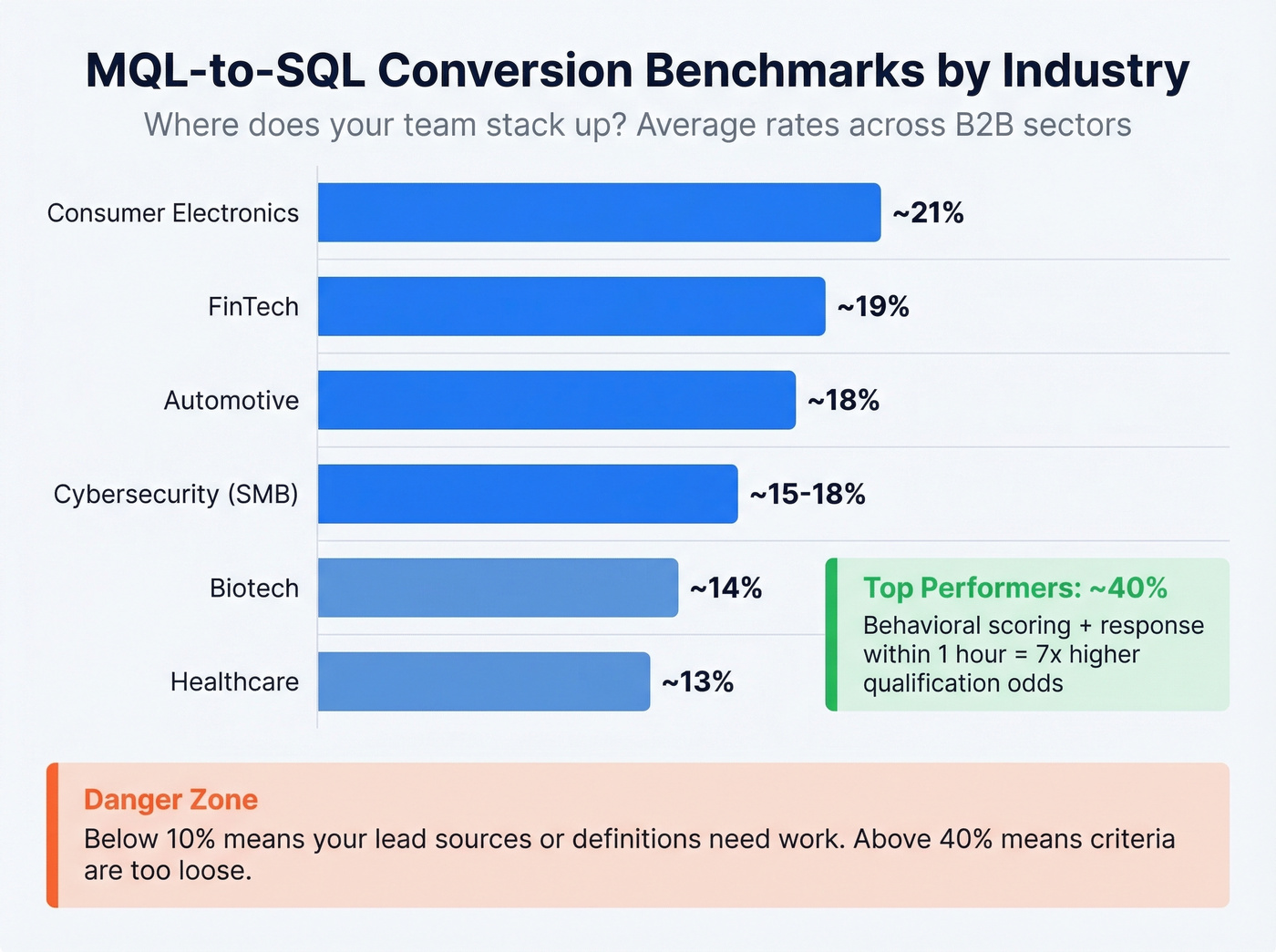
Top performers hit ~40% by combining behavioral scoring with fast follow-up. Responding within one hour gives you 7x higher qualification odds compared to waiting 24 hours. That's not a marginal improvement - it's a different league entirely.
With the average B2B buying cycle at 10.1 months, getting qualification right upfront saves months of wasted effort. The gap between average and top-performing teams almost always comes down to how rigorously they vet leads before passing them to closers.

Your lead scoring rubric is only as good as the data behind it. If 30-40% of your emails bounce, qualification is theater. Prospeo delivers 98% email accuracy on a 7-day refresh cycle with 50+ data points per contact - so every point you assign reflects reality, not stale records.
Score leads on data you can trust, not contacts from six months ago.
Build a Lead Scoring Rubric
Start with a spreadsheet. Assign point values. Iterate based on what actually converts. Don't overthink this - a simple model you use consistently beats a sophisticated one that nobody trusts.
If you want a deeper breakdown of models and pitfalls, see our guide to lead scoring.
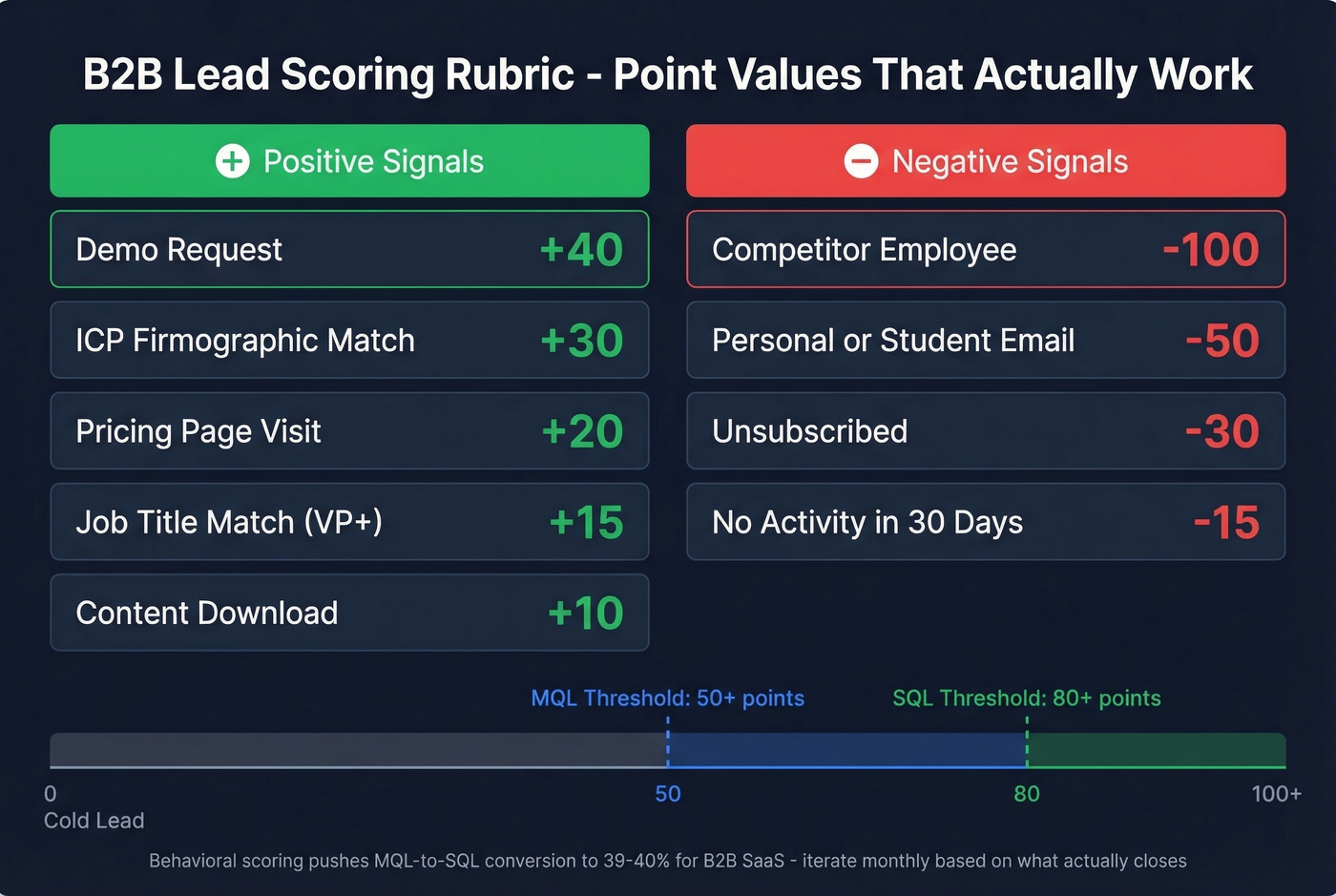
Positive Signals
| Signal | Points |
|---|---|
| ICP firmographic match | +30 |
| Pricing page visit | +20 |
| Demo request | +40 |
| Content download | +10 |
| Job title match (VP+) | +15 |
Negative Signals
| Signal | Points |
|---|---|
| Competitor employee | -100 |
| Personal/student email | -50 |
| No activity in 30 days | -15 |
| Unsubscribed | -30 |
Thresholds: MQL at 50+ points. SQL at 80+ points.
Behavioral scoring can push MQL-to-SQL conversion to ~39-40% for B2B SaaS, compared to significantly lower rates with demographic scoring alone. AI-powered scoring tools are accelerating this - companies using ML-based lead scoring see up to 75% higher conversion rates than rule-based approaches.
But your model is only as good as the data feeding it. In our experience, teams that assign +30 points for ICP fit while running on six-month-old contact records are building on sand. Enrichment tools like Prospeo fill contact and company data gaps with 50+ data points per contact on a 7-day refresh cycle, which matters when a third of your records have gone stale since the last update.

Discovery Questions That Qualify
The best qualification questions aren't interrogation - they're structured curiosity. Start by understanding the problem: ask what's driving the evaluation and how long it's been a priority. Then quantify the impact. How is this affecting revenue or team capacity right now? What happens if nothing changes in six months?
For decision mapping, you need three things: who else weighs in, what the approval process looks like, and whether they've evaluated other solutions. On timeline, push past the surface. Ask what happens if they don't solve this by a specific quarter, and whether a regulatory deadline or internal mandate is driving urgency.
The real driver almost always surfaces on the second or third follow-up question, not the first. If someone says "we're just exploring options," that's not a timeline - it's a polite way of saying you aren't qualified yet.
The Marketing-Sales SLA Nobody Writes
Only ~22% of companies feel marketing and sales are tightly aligned, and 26.7% of B2B marketers say delivering leads is their only metric of success. Aligned organizations grow ~20% per year. Without a shared definition of what constitutes a qualified lead, marketing and sales will always talk past each other.
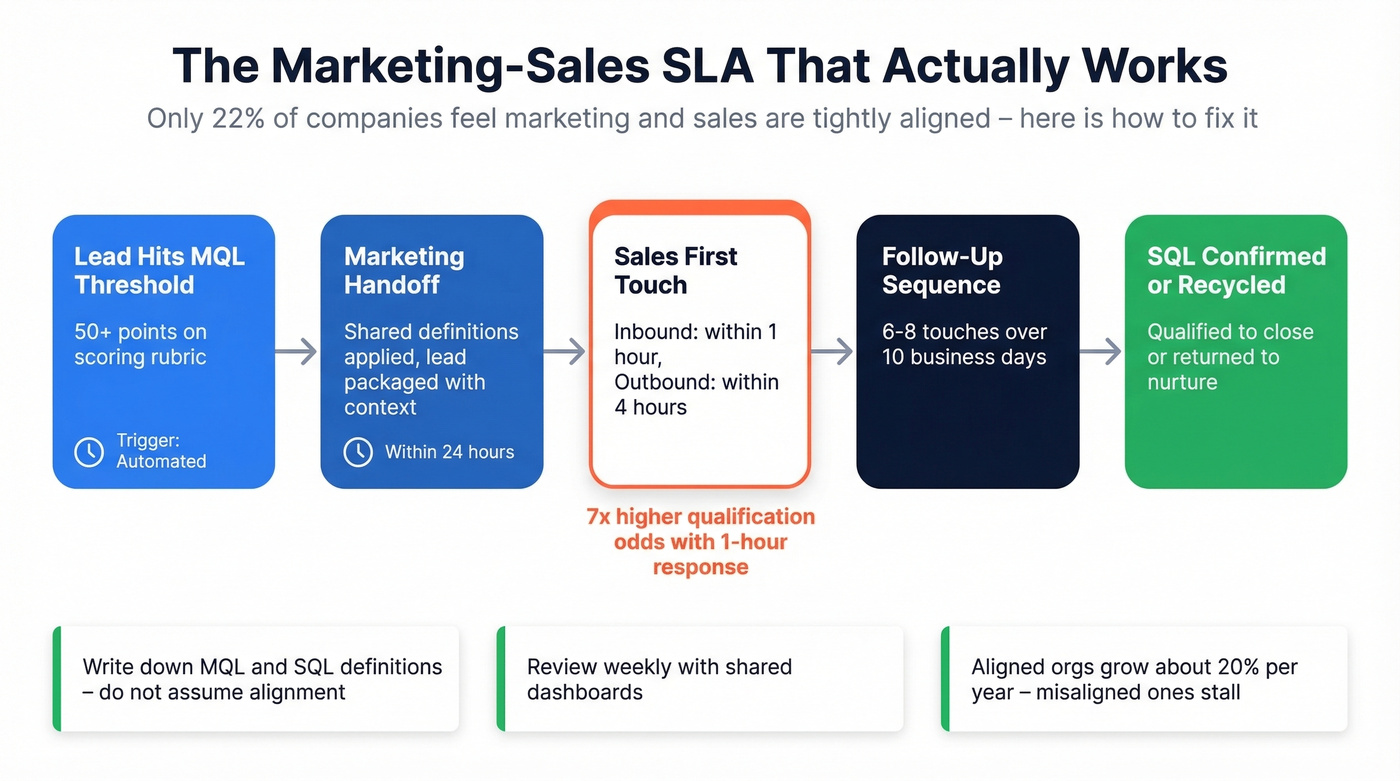
A functional SLA includes:
- Shared definitions for MQL and SQL - written, not assumed
- Marketing handoff within 24 hours of qualification
- Sales first touch within 1 hour for inbound, 4 hours for outbound
- 6-8 follow-up touches over 10 business days
- Weekly review cadence with shared dashboards, including a report on qualified leads for SDRs so reps know exactly what's coming their way
If marketing thinks a content download is an MQL and sales thinks it requires a demo request, you'll never agree on conversion rates. Write the definitions down. Tape them to the wall if you have to.
To operationalize the follow-up side of the SLA, keep a set of follow-up touches ready for reps.
Data Quality - The Step Everyone Skips
Look, your qualification framework is useless if the contact data is wrong. We've seen this play out dozens of times: a team invests weeks building a sophisticated scoring model, then feeds it a database where 35% of the emails bounce.
If you're seeing bounces, start by benchmarking your bounce rate and fixing deliverability at the source.
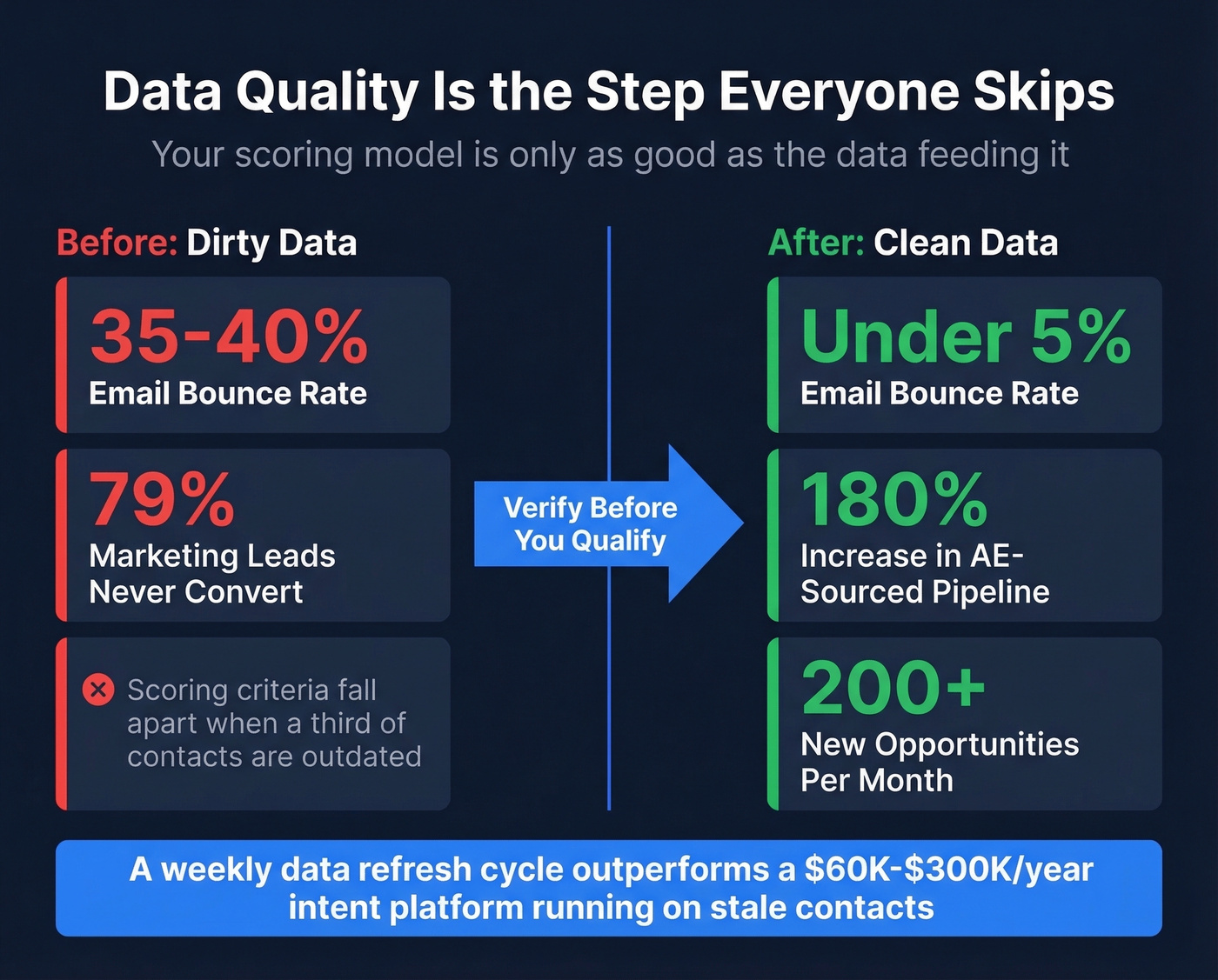
Snyk's 50-person AE team had exactly this problem - 35-40% bounce rates that were torpedoing outbound pipeline. After switching to Prospeo for email verification and enrichment, bounces dropped under 5% and AE-sourced pipeline jumped 180% with 200+ new opportunities per month. That's not a qualification framework change. That's a data quality fix.
Verify before you qualify. A tool that keeps your data clean on a weekly refresh cycle will outperform a $60K-$300K/year intent platform running on stale contacts. Skip this step at your own risk - even the most sophisticated scoring criteria fall apart when a third of your contact records are outdated.
If you’re building a broader outbound motion, pair verification with proven sales prospecting techniques so you’re not just scoring leads - you’re creating them.
Qualifying the buying committee means reaching the right people with verified contact data. Prospeo gives you 143M+ verified emails and 125M+ direct dials across 300M+ profiles - so when you identify the decision-maker, you actually connect with them.
Reach every stakeholder in the buying committee, not just the one who filled out a form.
FAQ
What's the difference between MQL and SQL?
An MQL meets marketing criteria like scoring thresholds and firmographic fit. An SQL has been vetted by sales for real buying signals - budget, authority, need, and timeline. The handoff between the two is where most pipeline leakage happens, and tightening that gap is the highest-leverage fix for most teams.
How many leads should actually qualify?
Industry average MQL-to-SQL conversion runs 12-21%. Above 40% means your criteria are too loose; below 10%, your lead sources or definitions need work. Track this metric monthly. It's the simplest audit of your entire qualification process.
Do I need an expensive tool for lead scoring?
No. Start with a spreadsheet rubric and iterate on what converts. Salesforce Einstein requires $165/user/month minimum, HubSpot's predictive scoring needs Enterprise at $3,600/month, and 6sense contracts run $60K-$300K/year. Clay starts at $185/month. For the data accuracy feeding the model, Prospeo's free tier covers 75 emails per month - enough to test whether clean data improves conversion before committing to enterprise pricing.
What's the fastest way to improve qualification rates?
Focus on speed and data accuracy. Respond to inbound leads within one hour - that alone delivers 7x higher qualification odds. Then verify contact data before scoring. Teams that nail these two basics consistently outperform teams running complex intent models on dirty data.