

Bardeen vs Zapier: Which Automation Tool Wins in 2026?
Most "Bardeen vs Zapier" articles are secretly sales pages for a third product. Lindy, SmythOS, GenFuse AI - they all hijack this keyword to pitch their own platform. Here's an actual answer instead.
Bardeen and Zapier solve fundamentally different problems. Comparing them is like comparing a screwdriver to a drill - both useful, neither interchangeable. The real question isn't which is "better." It's which architecture matches the job you're actually trying to do.
30-Second Verdict
Pick Bardeen if you need to scrape data from websites and push it into spreadsheets or CRMs. It's a Chrome extension that automates browser tasks - clicking, copying, extracting - without needing APIs.
Pick Zapier if you need apps talking to each other reliably in the background. It's cloud-based, API-driven, and runs whether your laptop is open or not.
Skip both if your real problem is finding and verifying B2B contact data. Neither tool is a data platform for sourcing and verifying emails at scale.
How the Architecture Differs
Bardeen is browser-first RPA: a Chrome extension that watches what you do and replicates it. Zapier is cloud iPaaS - API calls running on servers, completely independent of your browser. This distinction drives every other difference.
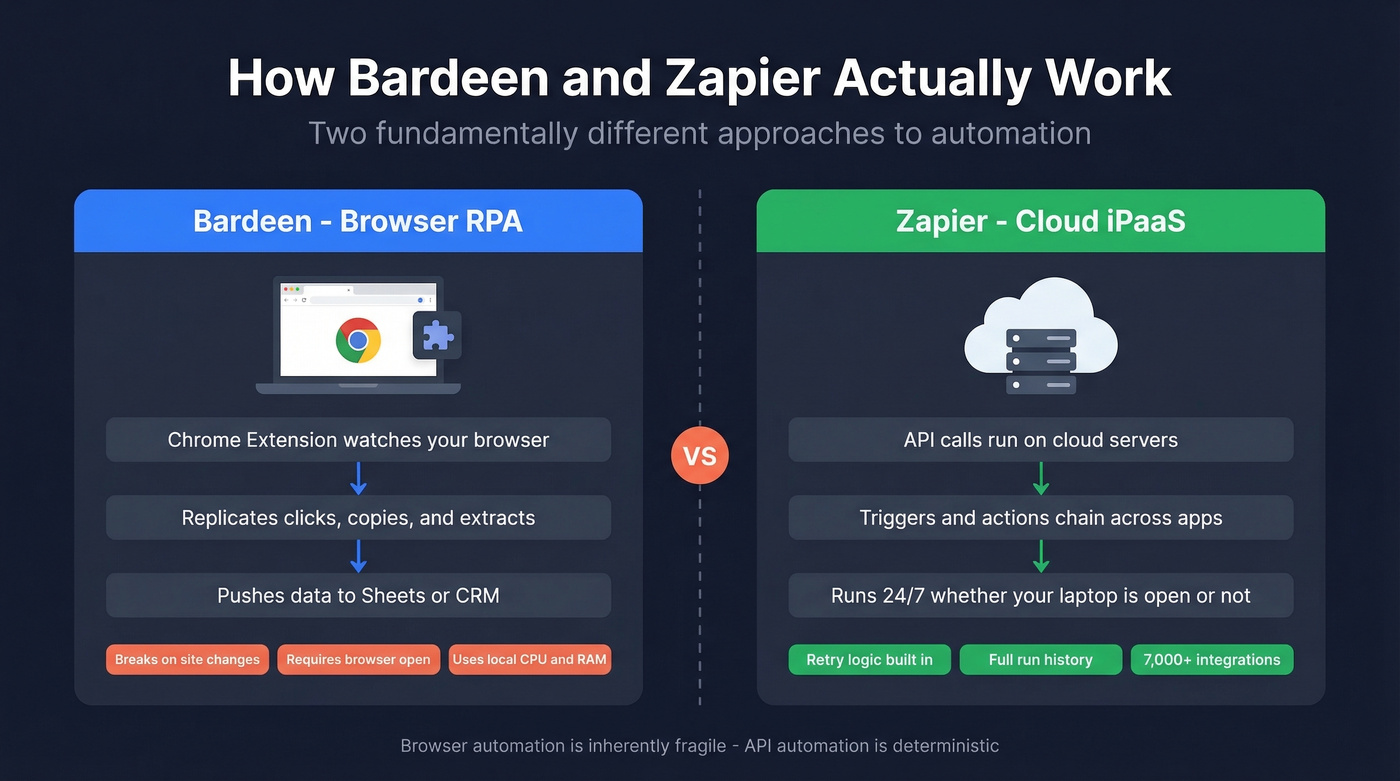
One Reddit user nailed the framing: Bardeen is "Zapier for your browser," useful for repetitive web tasks and saving roughly 20 minutes a day on manual clicking. That tracks with what we've seen.
Here's the thing: browser automation is inherently fragile. When a website updates its layout, your Bardeen playbook breaks. UI drift, CAPTCHAs, session expiry, and popup modals all introduce failure points that don't exist in API-based workflows. In our testing, Bardeen playbooks broke within days of a target site updating its layout - sometimes within hours if the site was actively A/B testing new designs. Zapier runs deterministic API calls with retry logic, error handling, and full run history. It doesn't care what a website looks like.
Use Bardeen if you're scraping sites without APIs and can tolerate occasional breakage. Skip it if you need automations running unattended in production.
Feature Comparison
| Dimension | Bardeen | Zapier |
|---|---|---|
| Execution | Chrome extension | Cloud (API) |
| Best for | Web scraping + browser workflows | Multi-app workflows |
| Integrations | Dozens | 7,000+ |
| Web scraping | Native | Not native |
| AI features | Magic Box (NLP) | AI actions in Zaps |
| Free tier | Yes (credits) | Yes (100 tasks/mo) |
| Paid from | $10/mo | $19.99/mo (billed annually) |
| Reliability | Breaks on site changes | Runs unattended |
| Security | SOC 2 Type II, GDPR, CASA Tier 2/3 | SAML SSO (Team+), admin controls |
The integrations gap is massive. Zapier connects to virtually every SaaS tool on the market, while Bardeen's library is a fraction of that. You'll hit walls fast when chaining together complex multi-app workflows.
If you're building outbound workflows, it also helps to think about where automation sits in your broader sales funnel automation stack.

Automating workflows with bad data is just automating failure faster. Prospeo's 300M+ profiles with 98% verified email accuracy plug the gap Bardeen and Zapier can't fill - verified contact data on a 7-day refresh cycle, at $0.01/email.
Stop automating bounces. Start with data that's actually verified.
Pricing Breakdown
| Plan | Price | What You Get |
|---|---|---|
| Bardeen Free | $0/mo | 100 credits/month |
| Bardeen Basic | $10/mo | +100 credits/month |
| Bardeen Premium | $50/mo | +1,000 credits/month |
| Zapier Free | $0/mo | 100 tasks/mo, single-step Zaps |
| Zapier Professional | From $19.99/mo (billed annually) | Multi-step Zaps, task-based tiers |
| Zapier Team | From $69/mo (billed annually) | 25 users, shared workspaces, SAML SSO |
| Zapier Enterprise | Custom pricing | Custom volumes, dedicated support |
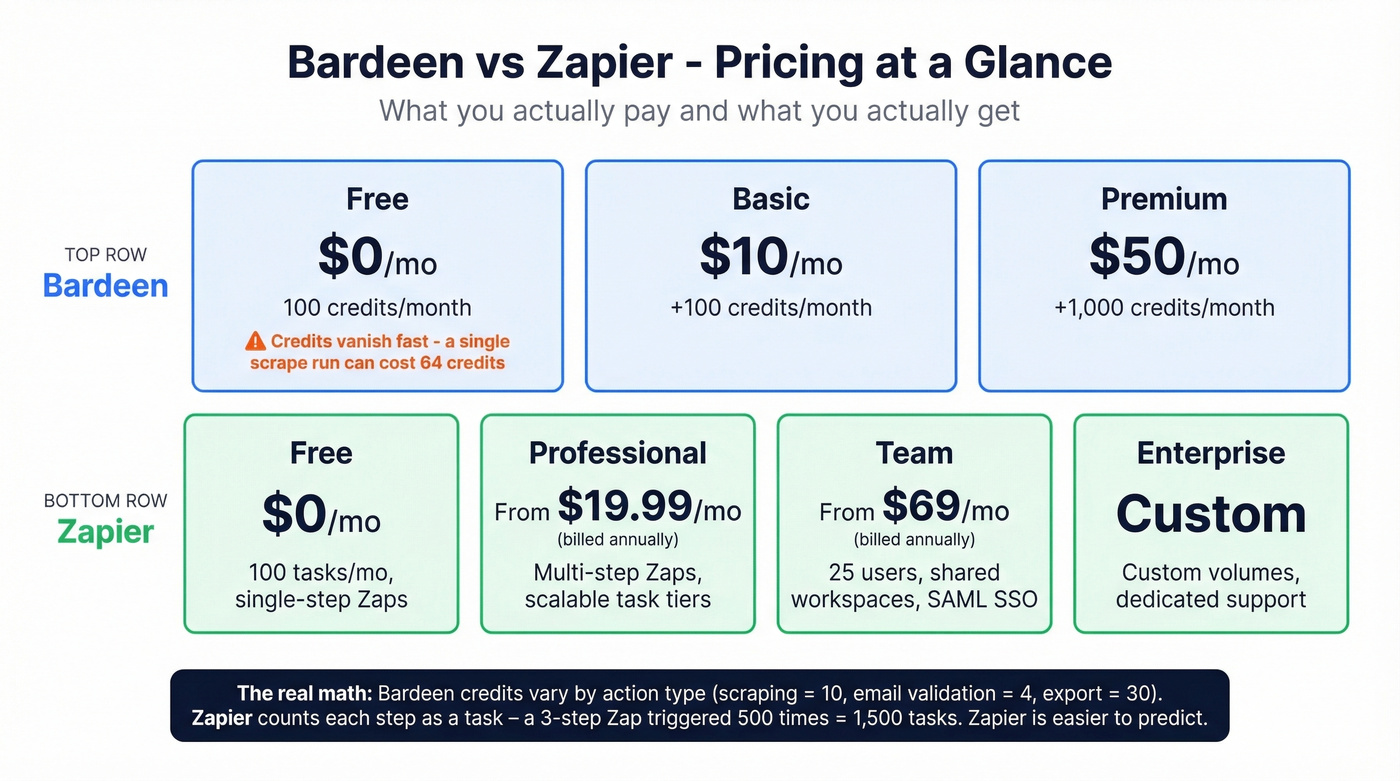
Bardeen's credit system is unnecessarily confusing because costs vary by action type. Scraping search results costs 10 credits, validating an email costs 4, and exporting to a Google Sheet runs 30. They show a sample run totaling 64 credits on their pricing page, which gives you a feel for how fast credits disappear once you combine multiple actions.
Zapier's model is simpler. Each step in a Zap counts as a task, so a 3-step Zap triggered 500 times equals 1,500 tasks - putting you solidly into higher task tiers. At least you can predict the cost before you hit "run." We've seen teams blow through Bardeen's monthly credits in a single afternoon and not realize it until the workflow just stops.
If your deals average under $10k, Zapier's Professional plan at $20/month is almost certainly the better investment. Bardeen's credit math only makes sense when you're scraping data that literally doesn't exist behind an API.
What Users Say
Bardeen holds a 4.8/5 on G2 from 35 reviews. Zapier sits at 4.5/5 from over 1,850 reviews. The rating gap looks favorable for Bardeen until you consider the volume difference - and the fact that Bardeen's G2 profile hasn't been actively maintained in over a year, which likely explains the low review count.
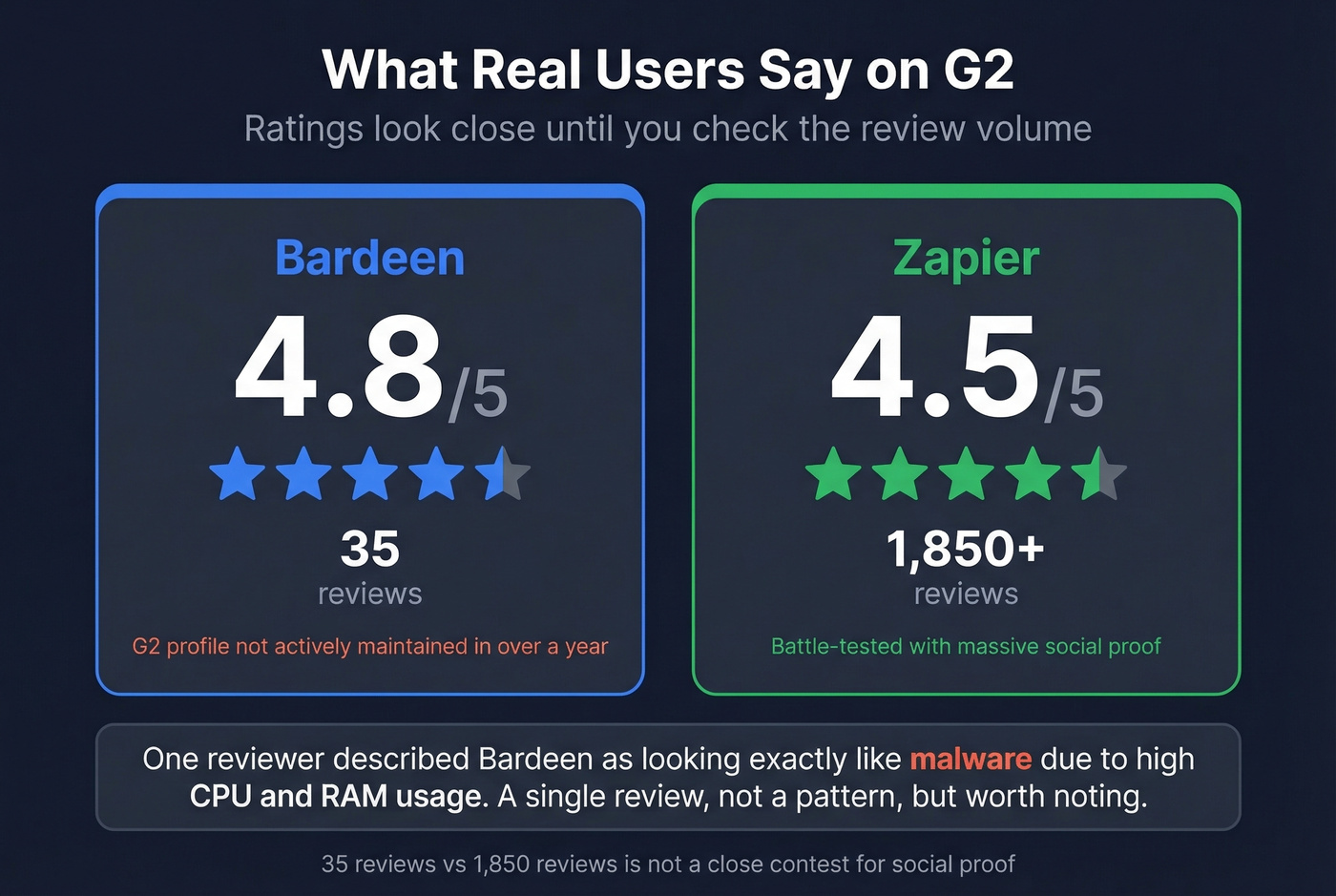
One G2 reviewer described Bardeen as looking "exactly like malware," citing high CPU and RAM usage from the Chrome extension. That's a single review, not a pattern, but it highlights a real tradeoff of browser-based tools eating local resources. Gartner Peer Insights echoes the credit confusion theme, with users flagging glitches alongside praise for the natural-language Magic Box feature.
Let's be honest: 35 reviews vs 1,850 reviews isn't a close contest for social proof. If you're making a purchasing decision for a team, Zapier's track record is far more battle-tested.
The Gap Neither Tool Fills
Neither Bardeen nor Zapier verifies contact data. If 30% of your emails bounce on the first sequence, the automation was pointless - you just burned credits and sender reputation for nothing. (If you're troubleshooting this, start with email bounce rate benchmarks and work backward.)
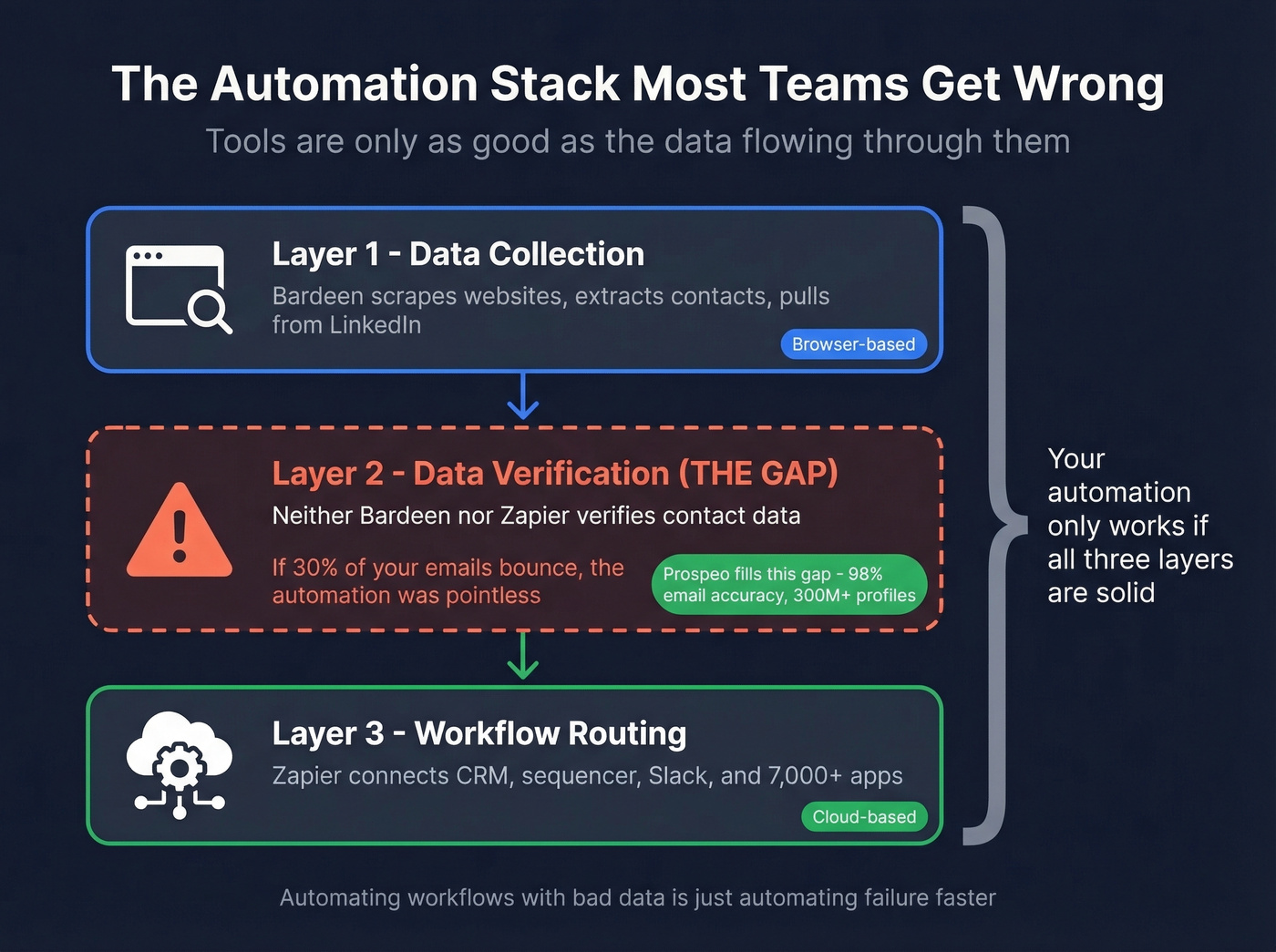
That's where a dedicated B2B data platform comes in. Prospeo gives you 300M+ professional profiles with 98% email accuracy and a 7-day data refresh cycle. The free tier offers 75 verified emails per month, which is enough to audit your automation output before bad data tanks your deliverability. If you're comparing providers, see our breakdown of data enrichment services and B2B company data options. One of our customers, Stack Optimize, built to $1M ARR while keeping client bounce rates under 3% and zero domain flags - that's the kind of data quality that makes automation actually worth running.

Stack Optimize built to $1M ARR with under 3% bounce rates and zero domain flags. Whether you scrape with Bardeen or route with Zapier, the data layer underneath determines if your automation prints pipeline or burns sender reputation.
Audit your automation output with 75 free verified emails - no contract, no sales call.
FAQ
Can I use Bardeen and Zapier together?
Yes, and it's a common pattern. Bardeen scrapes data from websites into Google Sheets, then Zapier picks it up and routes it through your CRM or sequencer. They complement each other - Bardeen handles the browser layer, Zapier handles app-to-app.
Is Bardeen free?
Bardeen offers a free tier with 100 credits/month, but credits deplete fast. Enrichment at 3 credits per row burns through a Basic plan quickly. Paid plans start at $10/mo (Basic) and $50/mo (Premium, 1,000 credits).
How do I verify emails from automation workflows?
Neither tool is built to source and verify B2B contact data at scale. Export your list and run it through a verification service like Prospeo - its 5-step verification process catches spam traps, honeypots, and catch-all domains before bad data reaches your CRM.
Which tool is more reliable for unattended workflows?
Zapier wins decisively. It runs on cloud servers via API calls with built-in retry logic and error handling. Bardeen requires your browser to be open and breaks when target websites change their layout, making it unsuitable for production workflows that need to run 24/7.