

The 90-Day BDR Onboarding Framework That Actually Works
Most BDR onboarding fails because it's a one-week info dump, not a 90-day program. You hand a new rep 15 logins, a product deck, and a "good luck" - then wonder why they're gone in eight months. If you only fix three things, make them these: stretch onboarding to 90 days, certify reps before they go live, and run weekly call reviews.
The Cost of Poor Ramp Programs
The average BDR takes 3.2 months to ramp. At a fully loaded cost of roughly $12K/month, that's about $38,000 invested before a rep hits full speed. Average BDR tenure sits at 14-18 months, so you're getting maybe 10-14 months of real productivity before turnover resets the cycle.
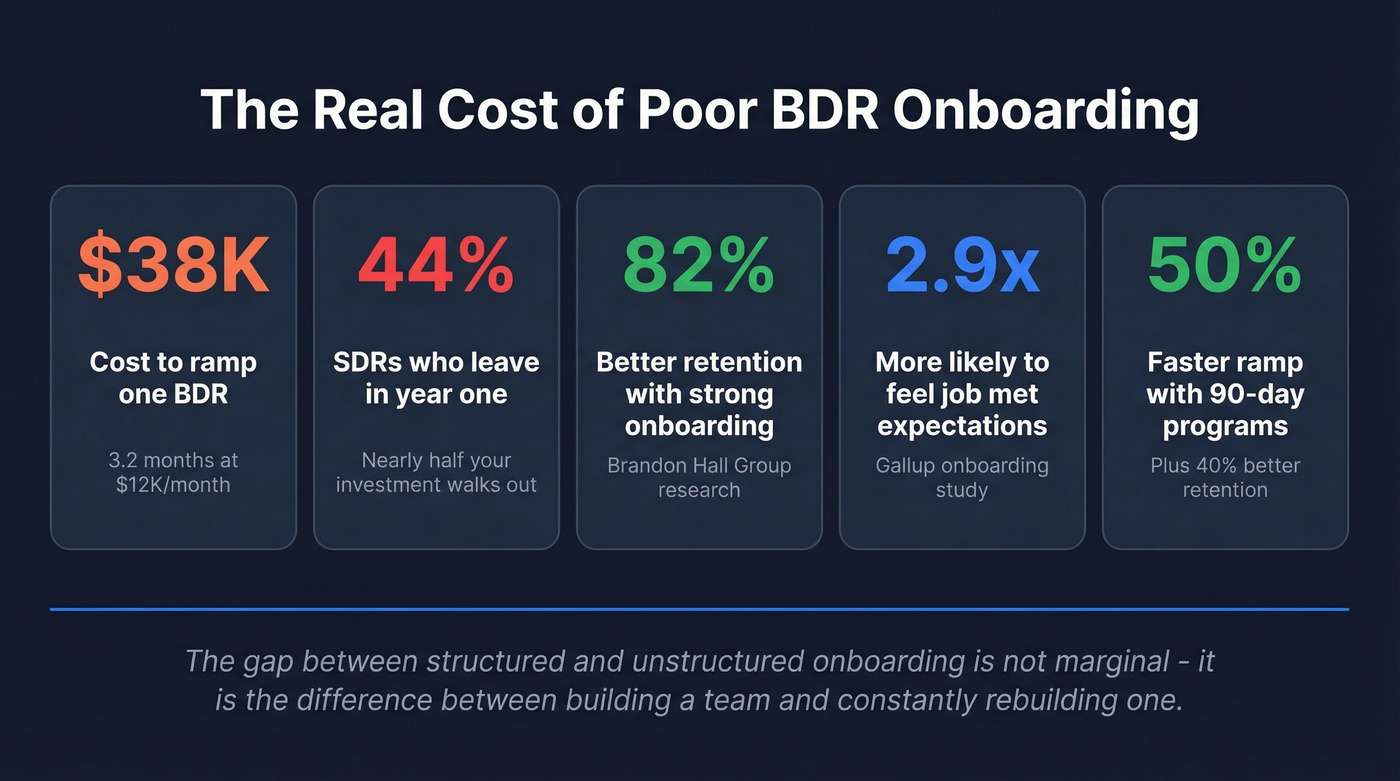
That math gets ugly fast when 44% of SDRs leave within their first year. Brandon Hall Group research found that organizations with strong onboarding improve new-hire retention by 82% and productivity by over 70%. Gallup reports that employees with great onboarding are 2.9x more likely to feel the job met or exceeded expectations. Companies with structured 90-day programs report up to 50% faster ramp times and 40% better retention. The gap between structured and unstructured isn't marginal - it's the difference between building a team and constantly rebuilding one.
The 90-Day Framework in Four Phases
Cramming everything into week one doesn't save time. It just delays the failure. A structured 90-day program produces reps who actually know the product, the buyer, and the tools.
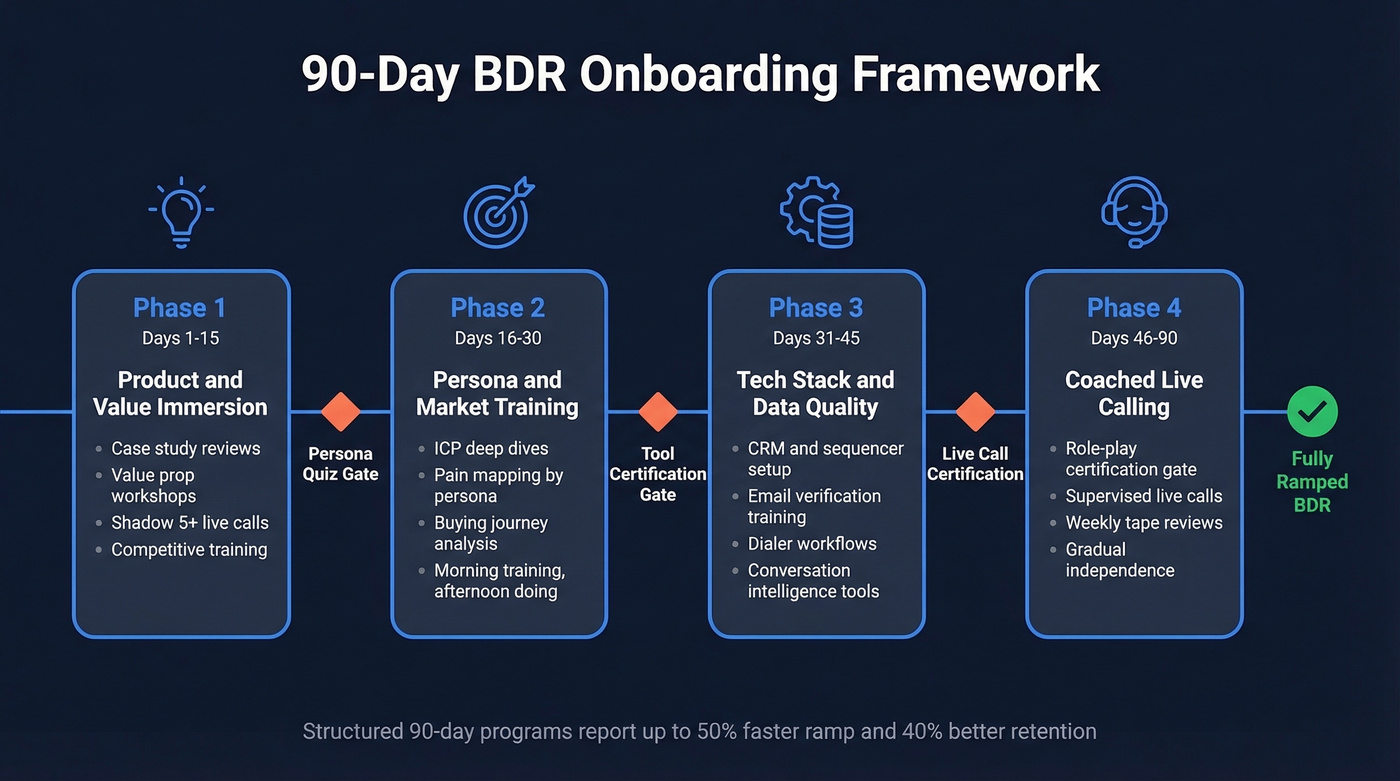
Days 1-15: Product and Value Immersion
Before your new BDR's first morning, the operational groundwork should already be done: employment docs signed, payroll confirmed, devices shipped, CRM and email access provisioned, security and comms norms covered, and a day-one agenda sent with manager intro and team schedule. None of this should happen on day one - it should happen before day one.
The first two weeks are pure absorption. Case study reviews, value prop workshops, competitive training, and call library listening. The goal isn't to make them sell - it's to make them understand why customers buy. Have them sit in on several customer calls before they ever touch a phone. We've found that reps who shadow at least five live calls in their first two weeks ask sharper discovery questions once they go live, because they've heard real objections instead of just reading about them in a slide deck.
Days 16-30: Persona and Market Training
This is where onboarding shifts from "learn the product" to "learn the buyer." Your BDR needs to internalize ICP depth, pain mapping, and the buying journey - not just memorize a persona slide.
The best daily structure borrows from 30MPC's model: training in the morning, doing in the afternoon, homework in the evening. By the end of week three, your rep should articulate the top three pains for each persona without looking at notes. If they can't, they aren't ready for phase three.
Days 31-45: Tech Stack and Data Quality
Here's where most programs fall apart. New reps get a dozen platforms dumped on them in a single afternoon and retain almost nothing. Train tools in this order:
- CRM - Salesforce or HubSpot: logging, pipeline hygiene, activity tracking
- Sequencer - Outreach, Salesloft, or Instantly: cadence building, A/B testing
- Contact data and email verification - list building, verification, bounce prevention
- Dialer - call workflows, voicemail drops, connect tracking
- Conversation intelligence - Gong or Chorus: call review, self-coaching
Email verification deserves its own training module. Even a few percentage points of invalid emails can tank your domain reputation and send every subsequent message to spam. Prospeo is the tool we'd slot in here - 98% email accuracy, a 7-day data refresh cycle, and 125M+ verified mobile numbers mean your new rep starts with clean lists from day one. GreyScout cut BDR ramp time from 8-10 weeks to 4 weeks and dropped bounce rates from 38% to under 4% after switching their contact data workflow.

Days 46-90: Coached Live Calling
The live-calling phase should start heavy on role-play - two to three mock calls per day with different team members. Certification happens before a rep goes live. If a rep can't run a clean discovery call (set an agenda, find one real problem, book next steps), they don't go live. Period.
Then move into supervised live calls on low-risk accounts - inbound demo requests or SMB segments where the stakes are lower. Later in the phase, reps run real discovery calls with a manager listening in and weekly tape reviews. Gradual independence is the goal, not a hard cutover from training to quota.
Let's be honest: most sales leaders think they have a hiring problem when they actually have an onboarding problem. I've seen mediocre candidates outperform "rockstar" hires simply because they got a structured 90-day ramp instead of a sink-or-swim week one. Fix the program before you fix the pipeline.

Bad data is the fastest way to kill a new BDR's confidence. Prospeo gives ramping reps 98% verified emails, 125M+ direct dials, and a 7-day refresh cycle - so their first outbound sequences actually land. GreyScout cut ramp time from 8-10 weeks to 4 weeks after switching.
Stop onboarding reps into a bounced-email graveyard.
BDR Onboarding KPIs and Benchmarks
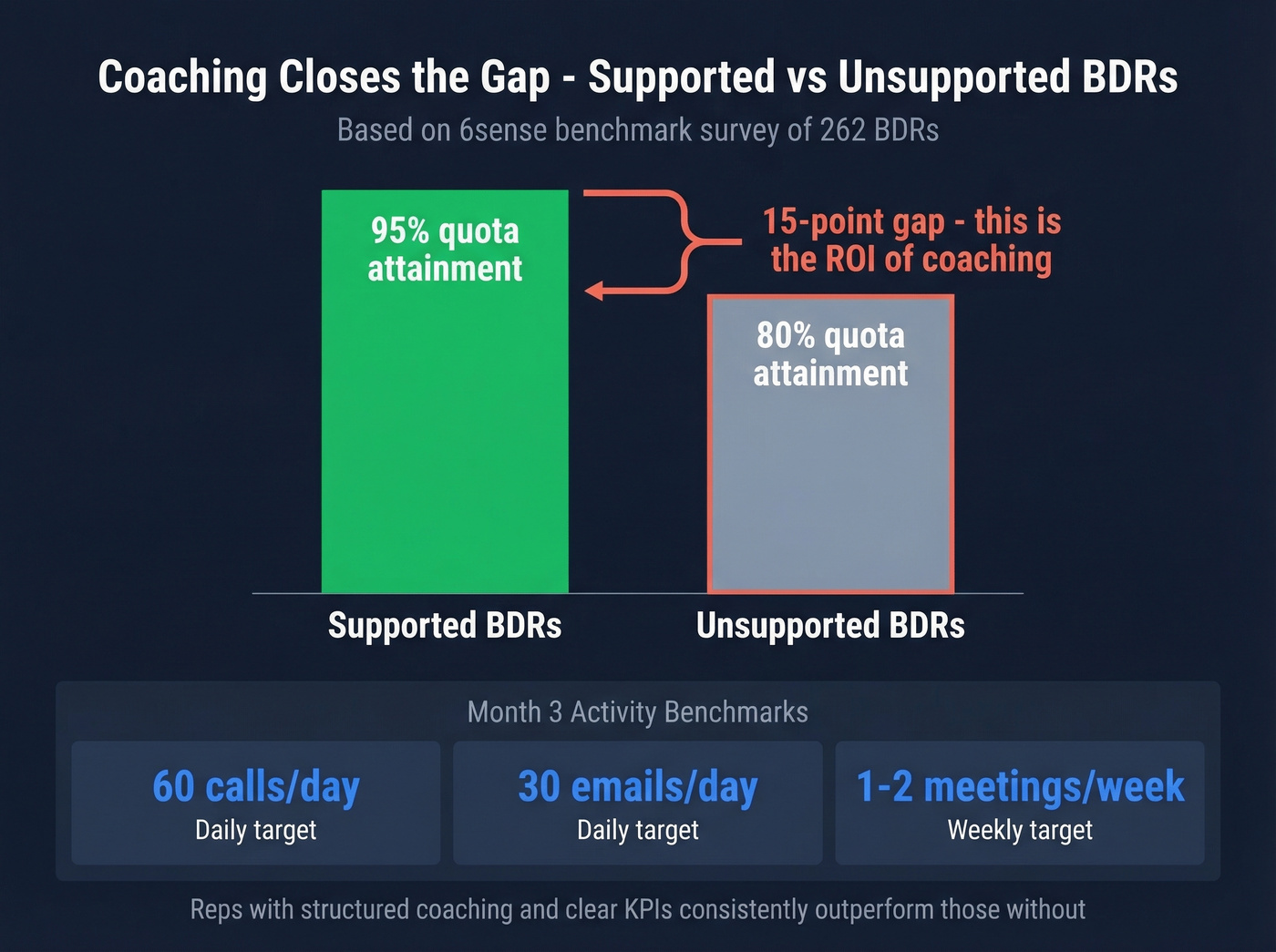
A 6sense benchmark survey of 262 BDRs gives us the clearest picture of what "good" looks like:
| Metric | Benchmark | Source |
|---|---|---|
| Avg quota attainment | 88% | 6sense |
| Supported reps | 95% attainment | 6sense |
| Unsupported reps | 80% attainment | 6sense |
| Attempts per contact | ~21 | 6sense |
| Contacts per account | ~9 | 6sense |
| Avg cadence length | 53 days | 6sense |
| Daily calls (target) | 60 | Industry standard |
| Daily emails (target) | 30 | Industry standard |
| Weekly meetings booked | 1-2 | Industry standard |
That 15-point gap between supported and unsupported reps is the entire ROI argument for coaching. Sixty calls, 30 emails, and 1-2 meetings per week is a typical baseline you'll see echoed across r/sales and most SDR communities. If you aren't investing in structured support during ramp, you're leaving 15% of quota attainment on the table across every new hire.
The Manager's Coaching Rhythm
Gallup found that 42% of voluntary exits were preventable - and 45% of those who left said no manager or leader discussed their satisfaction or performance in the three months before they quit. Onboarding doesn't end at day 30. It barely starts there.
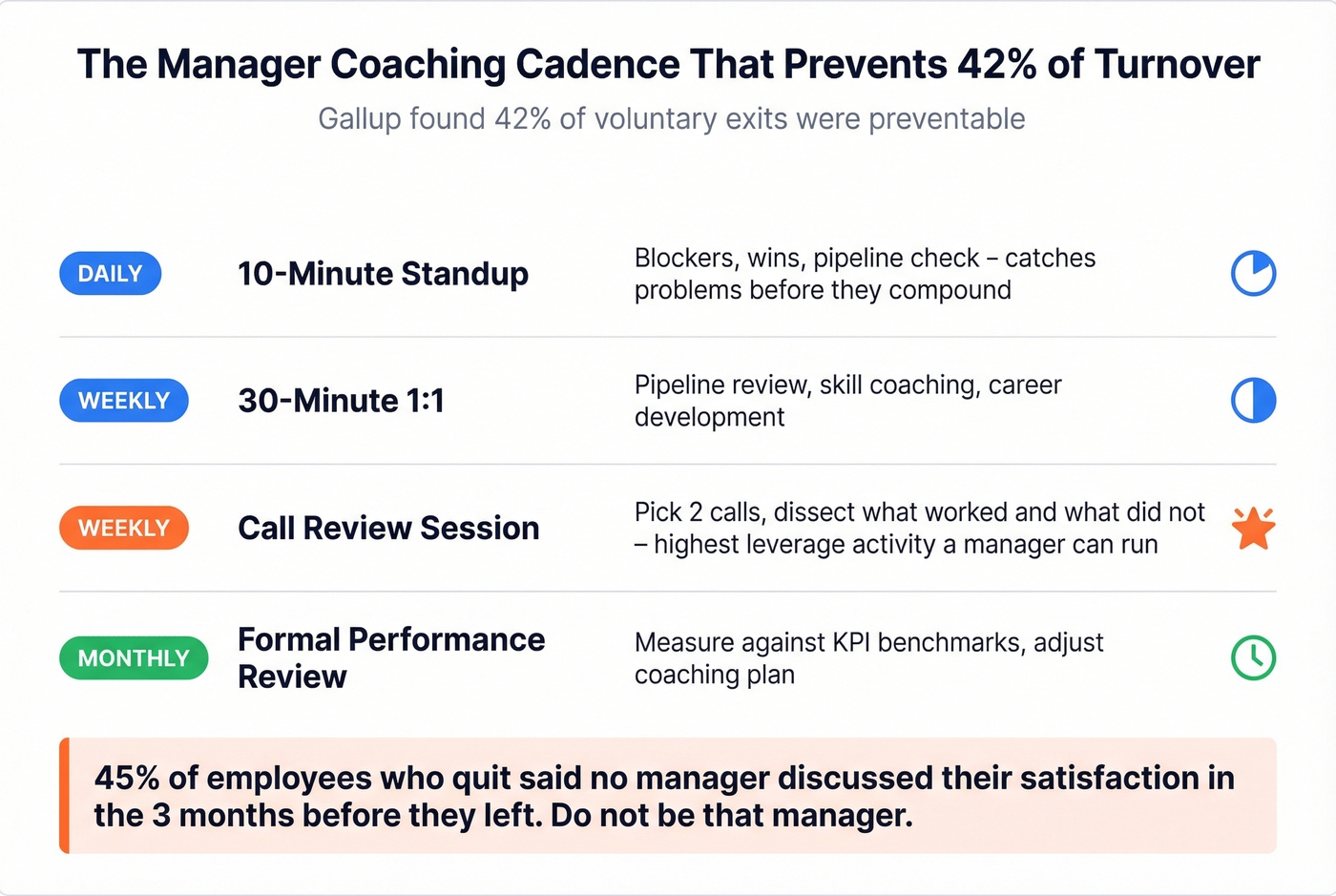
Here's the cadence that works:
- Daily - 10-minute standup: blockers, wins, pipeline check
- Weekly - 30-minute 1:1: pipeline review, skill coaching, career development
- Weekly - Call review session: pick two calls, dissect what worked and what didn't
- Monthly - Formal performance review against KPI benchmarks
The daily standup catches problems before they compound. The weekly call review is where reps actually improve - it's the single highest-leverage activity a manager can run. Skip either one and you'll see it in the numbers within 60 days.
One more thing: treat your onboarding doc as a living asset. Every new hire should improve it. The rep who just finished ramp knows exactly which training module was confusing, which day felt wasted, and which resource was missing. Build a feedback loop where each cohort updates the playbook for the next one.
Five Mistakes That Kill New Rep Productivity
One-week info dump instead of a 90-day program. Cramming everything into five days guarantees your rep retains far less than you think. Spaced repetition beats front-loaded lectures every time.
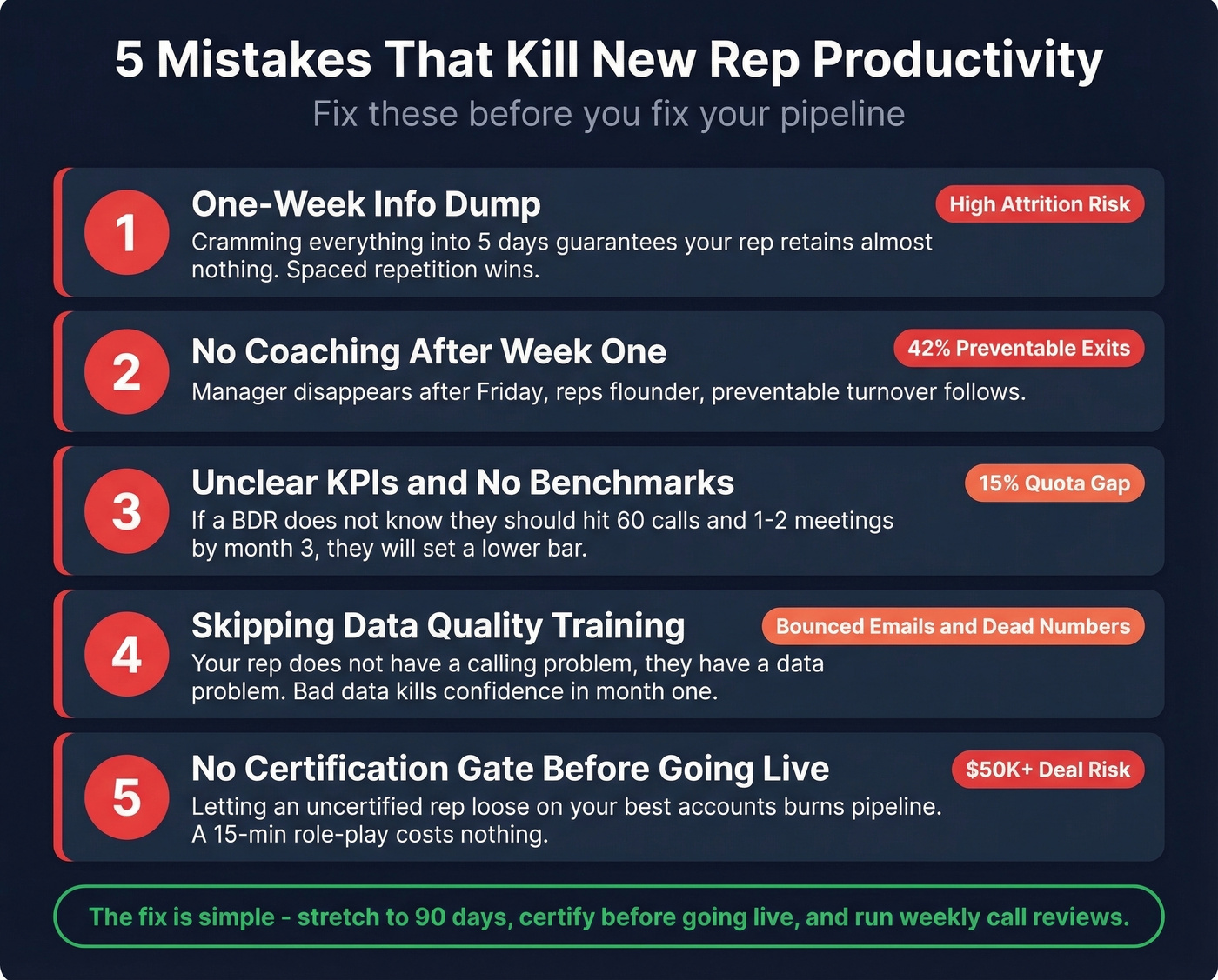
No coaching cadence after week one. The manager disappears after the first Friday, reps flounder, and preventable attrition follows. If you're only doing one 1:1 per month, you've already lost.
Unclear KPIs with no "what good looks like" targets. If a new BDR doesn't know they should hit 60 calls and 1-2 meetings per week by month three, they'll set their own bar - and it'll be lower than yours.
Skipping data quality training. Your rep doesn't have a calling problem - they have a data problem. Verified emails and direct dials from day one prevent reps from burning their first month on bounced emails and disconnected numbers. Skip this if your team already has a mature data ops function, but in our experience, most don't.
No certification gate before going live. Letting an uncertified rep loose on your best accounts is how you burn pipeline. A 15-minute role-play assessment costs nothing. Losing a $50K deal because a green rep fumbled discovery costs everything.
Your 90-day ramp program is only as good as the data your BDRs prospect with. Prospeo's 30+ search filters, intent signals across 15,000 topics, and verified mobiles with a 30% pickup rate mean new reps connect with real buyers faster - not waste weeks chasing dead contacts.
Give every new hire the list quality your top rep wishes they had.
FAQ
How long should BDR onboarding take?
Ninety days minimum. The average BDR takes 3.2 months to ramp, so a one-week crash course just produces reps who wing it and quit within the year. Structure the 90 days into product immersion, persona training, tech stack certification, and coached live calling with clear gates between each phase.
What KPIs should a new BDR hit in their first 90 days?
By month three, target 60 calls per day, 30 emails per day, and 1-2 meetings booked per week. The 6sense benchmark shows supported BDRs hit 95% of quota versus 80% for unsupported reps - pair activity targets with weekly coaching and call reviews to close that gap.
How do I prevent new BDRs from burning through bad data?
Train data quality as a dedicated module in weeks three and four. Use a verified contact data tool with high email accuracy and frequent data refreshes so reps start with clean lists instead of learning on bounced emails and disconnected numbers. Bad data in the first month kills confidence and wastes ramp time.