

Best Lead Generation Companies in 2026: Agencies, Software, and What They Actually Cost
Your VP of Sales just pinged you: "Find a lead gen vendor by Friday." You open ten tabs, and every list mixes agencies charging $10K/month with free Chrome extensions - no pricing, no framework for choosing between them. Here's what those guides get wrong: agencies and software solve fundamentally different problems, and picking the wrong category wastes more money than picking the wrong vendor within it.
This is the breakdown we wish existed when we started evaluating lead gen partners - real pricing, performance benchmarks, and a decision framework that actually helps you pick.
Our Picks (TL;DR)
Top 3 Agencies
| Agency | Best For | Starting Price |
|---|---|---|
| Belkins | Appointment setting at scale | ~$5K/mo retainer |
| Callbox | Enterprise multi-channel | ~$15K-$30K per region |
| Martal Group | Tech/SaaS mid-market | From $3,600/mo |
Top 3 Software
| Software | Best For | Starting Price |
|---|---|---|
| Prospeo | Accurate data, self-serve | Free (75 emails/mo) |
| Apollo | Free-tier prospecting | Free / ~$49-$99/user/mo |
| HubSpot | Inbound-first teams | Free / $15/seat/mo |
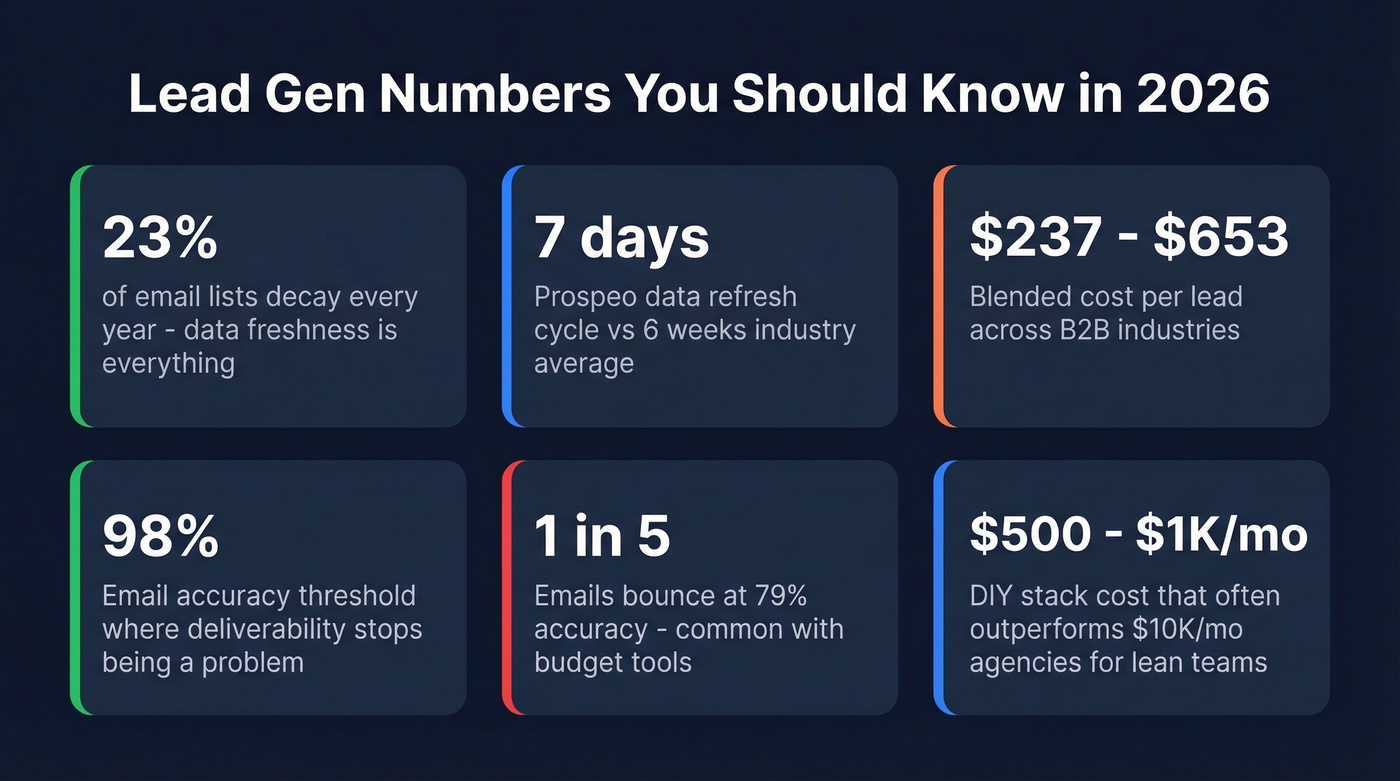
Here's the hot take most lists won't give you: you probably don't need a lead gen company at all. A $500-$1,000/month DIY stack - data platform, email sequencer, domain warmup - often outperforms a $10K/month agency for teams under 10 reps. If you have even one person who can run outbound well, you'll get more leverage from better data and a solid sequencer than from paying for a fully managed pod. The agency model makes sense when you don't have SDRs or when you need to scale across regions fast. For everyone else, software plus a disciplined process gets you further per dollar.
Agency vs. Software vs. DIY Stack
Before you evaluate specific vendors, get the category right. Most business lead generation companies fall into one of three buckets, and each serves a different operational reality.
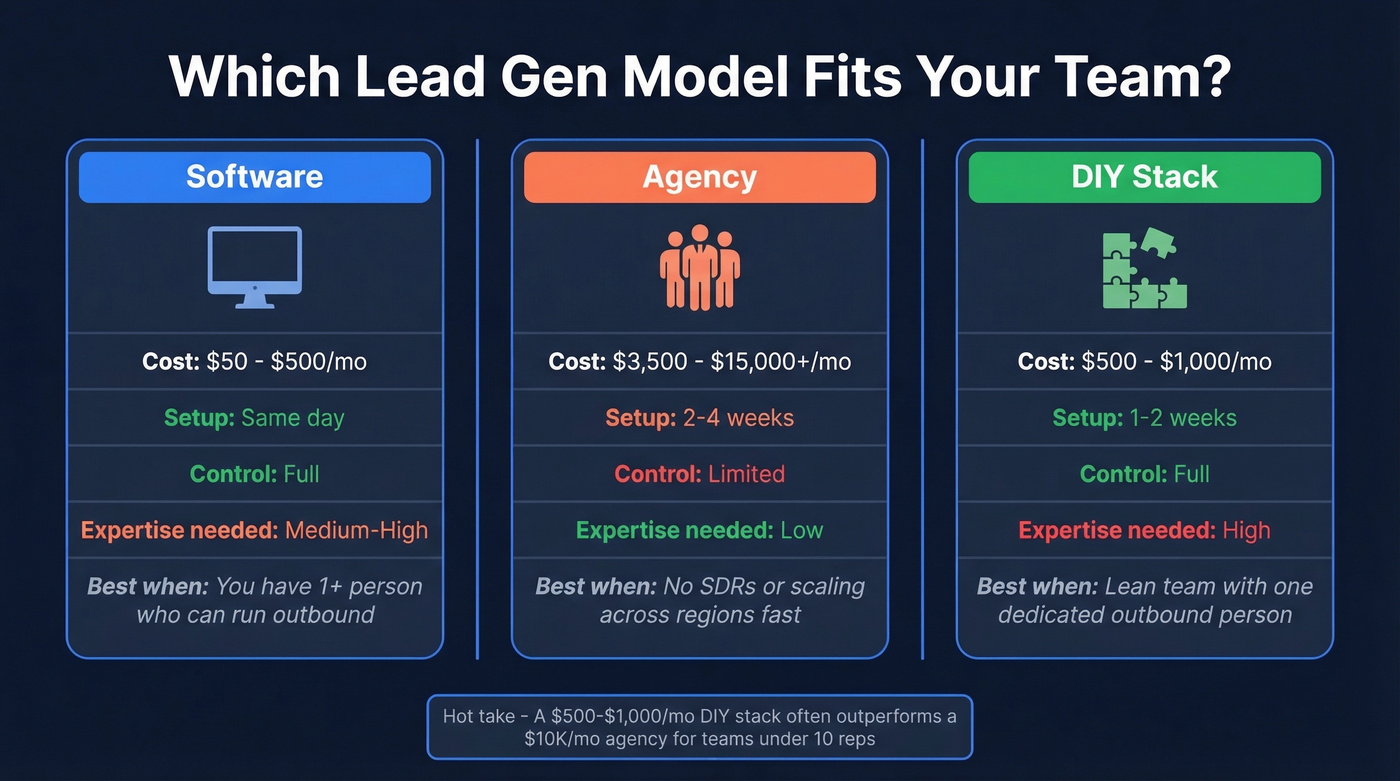
| Factor | Software | Agency | DIY Stack |
|---|---|---|---|
| Setup | Self-serve | Fully managed | You build it |
| Expertise needed | Medium-High | Low | High |
| Speed to launch | Same day | 2-4 weeks | 1-2 weeks |
| Monthly cost | $50-$500 | $3,500-$15,000+ | $500-$1,000 |
| Control | Full | Limited | Full |
Software gives you the data and tools to run outbound yourself. You need someone on your team who knows how to write sequences, manage deliverability, and iterate on targeting. The upside is cost and control - you own the process entirely.
Agencies handle execution end-to-end: SDRs, copywriters, deliverability infrastructure, and strategic guidance. The downside is cost, lock-in, and the fact that quality varies wildly by pod and account manager.
The DIY stack is the hybrid play gaining traction in 2026. Dedicated domains, warmed inboxes, deliverability monitoring, and an enrichment workflow - all for under $1K/month. We've seen this outperform agencies for lean teams that have even one person dedicated to outbound. AI-powered scoring and intent signals are table stakes now; most serious platforms offer them. The real differentiator is data quality underneath the AI layer, which is why the platform you pick matters more than the sequencer.
What Lead Generation Services Actually Cost
Agencies use four primary pricing models, and the range is wider than most buyers expect.
| Model | Typical Range | Best For |
|---|---|---|
| Pay-per-lead | $25-$500/lead | Predictable budgets |
| Monthly retainer | $3,500-$9,500/mo | Ongoing campaigns |
| Performance/commission | 10-20% of deal | Aligned incentives |
| Hybrid | Retainer + per-lead | Balanced risk |
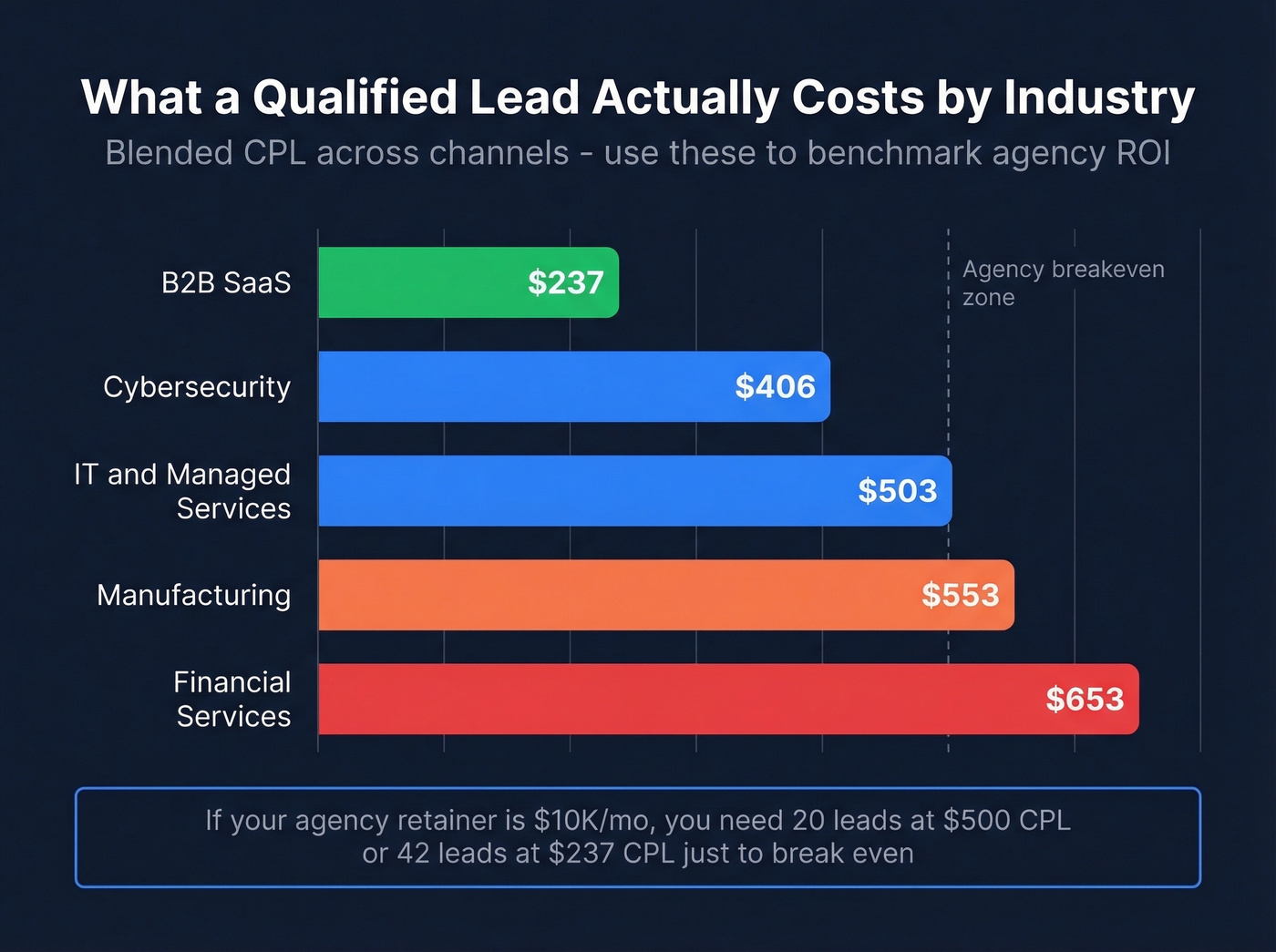
Per-lead costs vary enormously by industry. Here's what blended CPL looks like across verticals:
| Industry | Blended CPL |
|---|---|
| B2B SaaS | $237 |
| IT & Managed Services | $503 |
| Cybersecurity | $406 |
| Manufacturing | $553 |
| Financial Services | $653 |
If you're in financial services paying $653 per blended lead, a $10K/month agency retainer delivering 20 qualified leads is actually competitive math. If you're in B2B SaaS at $237 blended, that same retainer needs to deliver 40+ leads to beat what you'd get running outbound yourself.
One stat that should inform every decision here: 23% of email lists decay annually. Roughly a quarter of the contacts in any database go stale every year - people change jobs, companies get acquired, domains expire. The freshness of your data source directly impacts whether those CPL numbers work in your favor or against you.
Top Lead Generation Agencies
Belkins
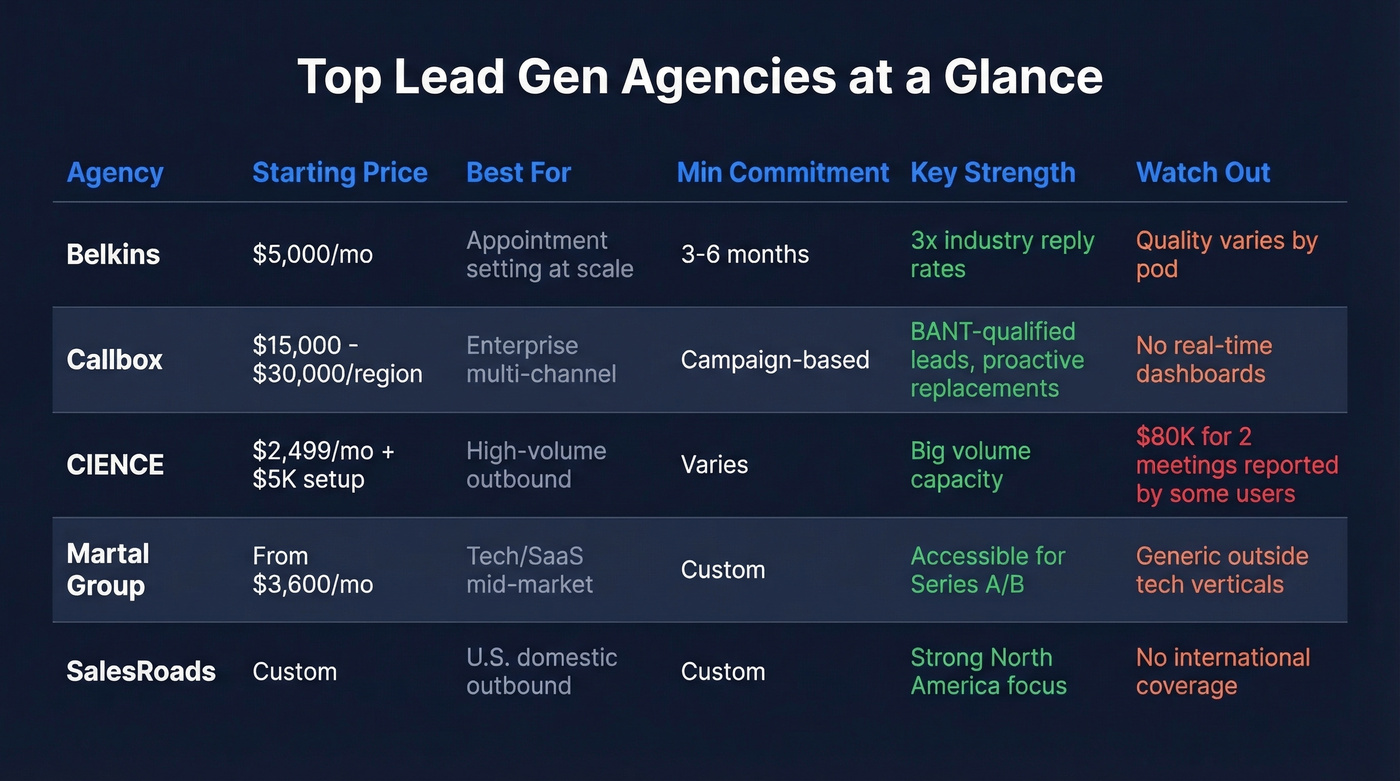
Use this if: You want a proven appointment-setting partner and can commit $5K+/month for 3-6 months.
Skip this if: Your budget is under $5K/month or you need results in 30 days. The ramp takes time, and the minimums are real.
Belkins typically runs $5,000 to $14,800/month, with setup fees of $2,000-$5,000 and 3-6 month minimums. They also offer pay-per-appointment pricing around $300-$800 per meeting. The performance numbers are strong: 50-70% open rates against an industry average of 36.7%-42.3%, and 15-19% reply rates versus a 5.8% industry standard. That's about 3x the reply rate - not a marginal improvement.
The watch-out is quality variance by pod. Your account manager and SDR team matter enormously. Get a strong pod, and Belkins delivers. Get a weaker one, and you'll spend weeks recalibrating. There's no public pricing page, so expect a sales conversation before you get numbers.
Callbox
Callbox earns a 4.5/5 on G2 with 91 reviews, and the praise centers on professionalism and consistent delivery of BANT-qualified leads. They're particularly strong at proactive lead replacements when contacts don't convert. Pricing typically runs $15,000-$30,000 for a Campaign Pod covering one region/language, scaling to $45,000-$90,000 for multi-region deployments - firmly an enterprise play.
The recurring complaints are payment required before project start and limited real-time dashboards. You'll get reports, but not the live visibility modern RevOps teams expect. If you're a startup or SMB, look elsewhere. For multi-channel, multi-region campaigns with BANT-qualified leads at scale, Callbox is built for exactly that.
CIENCE
CIENCE is the high-volume outbound machine - and the most polarizing agency on this list.
They charge a $5,000 one-time GTM setup plus $2,499+/month for campaign management. SDR add-ons run $1,500-$5,500/month per rep with a $1,000 onboarding fee. Most projects land in the $10,000-$50,000 range per Clutch, where they hold a 4.2/5 rating across 142 reviews. The variance story is real, though. One G2 reviewer reported spending $80,000 and getting 2 meetings in 7 months. That's an extreme case, but it's not isolated - B2B sales communities regularly flag agency ROI variance as the #1 risk with managed outbound. The pricing structure is complex, so make sure you understand exactly what's included before signing. CIENCE handles big volumes, but you need the budget to weather a ramp period and the stomach for uncertain early returns.
Martal Group
Best for: Tech or SaaS companies in the mid-market looking for agency support without Belkins/Callbox price tags.
Pricing is custom-quoted, but the $3,600/month floor makes Martal accessible for Series A and B companies that aren't ready for $10K+ retainers. Their tech-vertical focus is the strength - step outside it and you'll get generic execution. If you're in SaaS and want a lower-commitment agency test, Martal is the obvious starting point.
SalesRoads
SalesRoads is a U.S.-focused appointment-setting agency with strong marks for domestic outbound. The limited geographic scope means they're not the pick for international campaigns, but if your ICP is North America-only, they're worth a conversation.

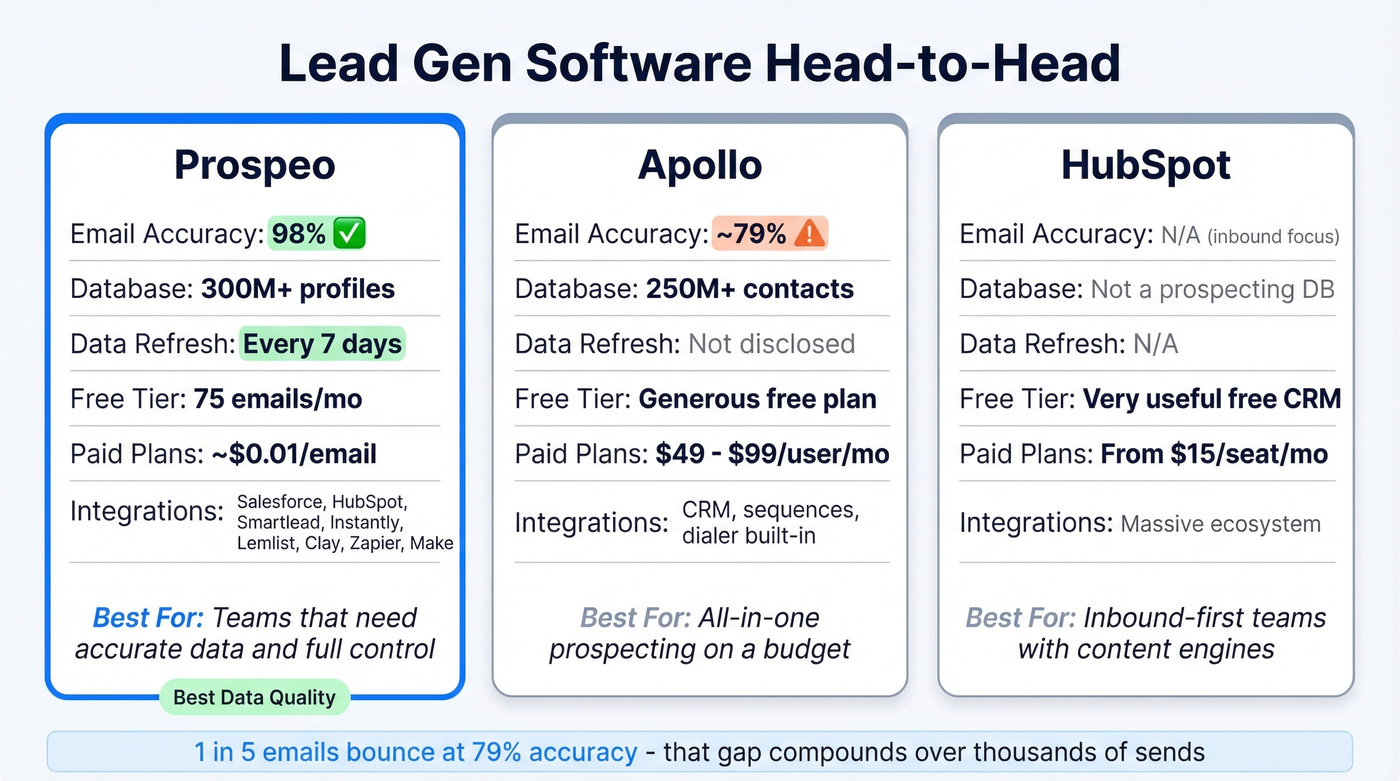
That DIY stack we mentioned? Prospeo is the data layer that makes it work. 300M+ profiles, 98% email accuracy, 125M+ verified mobiles - all refreshed every 7 days, not every 6 weeks. At ~$0.01/email, your $500/month budget buys 50,000 verified contacts. No agency retainer required.
Build the outbound machine that outperforms a $10K/month agency.
Top Lead Generation Software
Prospeo
Prospeo is the tool we'd hand to any team that says "we need better data." The database covers 300M+ professional profiles with 143M+ verified emails and 125M+ verified mobile numbers, all backed by 98% email accuracy through a proprietary 5-step verification process. The Chrome extension lets you pull verified contacts from any website or CRM in one click.
What separates Prospeo from the pack is the 7-day data refresh cycle versus the industry average of 6 weeks. The 30+ search filters include buyer intent powered by 15,000 Bombora topics, technographics, job changes, headcount growth, and funding signals. Snyk's 50-person AE team dropped bounce rates from 35-40% to under 5% and generated 200+ new opportunities per month after switching. At ~$0.01 per email with a free tier of 75 emails/month plus 100 Chrome extension credits, it runs 90% cheaper than ZoomInfo. Native integrations cover Salesforce, HubSpot, Smartlead, Instantly, Lemlist, Clay, Zapier, and Make.
23% of email lists decay annually - unless your data provider actually refreshes them. Prospeo runs a 7-day refresh cycle while the industry average sits at 6 weeks. That's the difference between a 4% bounce rate and a 35% one. 15,000+ companies already made the switch.
Stop paying agency prices for stale data you could own yourself.
Apollo
Apollo is the obvious starting point for teams that want prospecting and sequencing in one platform without spending a dollar. The free tier is genuinely generous - you get access to the database, basic sequencing, and enough credits to test whether outbound works for your ICP before committing budget.
Paid plans run around $49-$99/month per user, which is reasonable until you scale. A 10-person team on the $99 plan is paying $12K/year, and that number climbs fast with add-ons. The bigger issue is data quality - Apollo's email accuracy runs around 79%, which means roughly 1 in 5 emails bounces. That's workable for high-volume plays, but the deliverability gap compounds over thousands of sends. Apollo's strength is the all-in-one workflow: database, sequences, and dialer in a single tab. You're trading data precision for convenience.
HubSpot Marketing Hub
HubSpot is the default for inbound-first teams, and for good reason. The free plan is legitimately useful, and Marketing Hub layers on lead scoring, forms, landing pages, and email marketing starting at $15/seat/month. If your growth model is content-driven - blog traffic, webinars, gated assets - HubSpot's lead capture and nurture workflows are mature and well-documented.
The critical gap is that HubSpot isn't a prospecting database. It captures and nurtures leads, but it doesn't find them. You need a data source feeding it - pair it with a dedicated data platform so your inbound and outbound pipelines live in the same system. For teams already in the HubSpot ecosystem, adding another CRM would be insane. Just don't expect it to replace a dedicated data platform for outbound prospecting.
ZoomInfo
ZoomInfo is the enterprise incumbent, and the data quality for U.S. companies is genuinely strong - org charts, technographics, and intent signals that smaller platforms can't match in depth. Custom pricing typically runs $15K-$40K/year depending on seats and modules, with annual contracts that are notoriously hard to exit.
Here's the thing: ZoomInfo's email accuracy sits around 87%. That's fine for enterprise teams with dedicated deliverability ops, but for lean teams running cold outbound, the gap between 87% and 98% accuracy translates directly into bounced sequences and domain reputation damage. At roughly $1/lead versus $0.01, the cost differential is staggering. ZoomInfo makes sense for 200+ person sales orgs that need the full GTM suite. For everyone else, you're paying for features you'll never activate.
Dealfront / Leadfeeder
Leadfeeder, now part of Dealfront, solves a specific problem well: identifying which companies visit your website. It's a GDPR-compliant intent signal layer you can pair with sales intelligence and ABM workflows. Free and paid versions are available, plus a 14-day trial. Think of it as a targeting input that feeds your outbound, not a replacement for a contact data platform.
RocketReach
RocketReach starts at $59/month and does one thing: contact lookup. It's solid for one-off searches when you need a specific person's email or phone number, but it's not built for bulk prospecting or sequence-level workflows. Good supplement, not a primary tool.
UpLead
UpLead positions itself as a budget-friendly Apollo alternative with a smaller but often cleaner database. Plans start around $99/month. If Apollo's free tier isn't enough and you want tighter data without jumping to enterprise pricing, UpLead is worth a trial.
Intercom
Intercom starts at $29/seat/month and captures leads through conversational chat on your website. It's excellent for inbound visitor engagement - qualifying and routing leads in real time - but it's not an outbound tool. If your website gets meaningful traffic and you're not capturing it, Intercom fills that gap.
Why Data Quality Makes or Breaks Lead Gen
This is the variable most lead gen guides ignore, and it's the single biggest factor in whether your investment pays off - regardless of whether you hire companies that generate leads for you or run campaigns in-house.

Let's be honest about what we've watched play out repeatedly: a team hires an agency at $8K/month. The agency builds lists from a database that refreshes every 6 weeks or so. By the time those contacts hit a sequence, 10-15% of emails are already stale. Bounce rates spike. The sender domain takes reputation damage. Open rates crater. The team blames the agency's copy or targeting, but the root cause is data freshness.
That 23% annual email list decay isn't abstract - it means roughly 2% of your list goes bad every month. A 7-day refresh cycle catches job changes, domain migrations, and company closures before they become bounced emails. The industry-standard 6-week refresh doesn't.
The Meritt case study makes this tangible: bounce rates dropped from 35% to under 4%, and pipeline tripled from $100K to $300K per week. That's not a marginal improvement - it's the difference between a working outbound engine and a broken one.
Outreach Performance Benchmarks
Before you evaluate any vendor, calibrate your expectations. These benchmarks separate solid from world-class:
| Metric | Solid | Great | World-Class |
|---|---|---|---|
| Connection acceptance | 15-25% | 26-35% | 36-45% |
| Reply rate | 8-15% | 16-25% | 25-35% |
| Meetings per 100 invites | 3-6 | 7-12 | 12-20 |
| Cost per meeting (SMB) | $80-$250 | - | - |
| Cost per meeting (enterprise) | $250-$500 | - | - |
Any agency or tool promising results above "world-class" is either cherry-picking their best campaign or inflating numbers. Use these ranges as your baseline when evaluating lead generation services.
The bigger context matters too. The average B2B buying cycle runs 10.1 months, and the winning vendor lands on the buyer's Day One shortlist 95% of the time. By the time a buyer reaches out to vendors, they're already 61% through their decision process. Even more striking: 92% of buyers start their evaluation with at least one vendor already in mind.
Lead generation isn't just about booking meetings - it's about being known before the buying cycle starts. That reframes the ROI timeline. Don't expect pipeline impact in 30 days. Plan for 3-6 months of consistent outbound before the compounding effect kicks in.
How to Pick the Right Vendor
Run through these five checks before signing anything:
Budget reality check. Agencies start at $3,500-$5,000/month with 3-6 month commitments. Software runs $50-$500/month with monthly billing. If your total lead gen budget is under $3K/month, software is your only realistic option.
Team capacity. Do you have SDRs or an ops person who can run outbound sequences, manage deliverability, and iterate on targeting? If yes, software gives you better ROI. If no, an agency handles the execution - but make sure you're not just outsourcing a problem you don't understand, because you won't be able to evaluate whether the agency is performing.
Data quality questions. Ask every vendor: What's your data refresh cycle? How do you verify emails? What's your guaranteed bounce rate? If they can't answer specifically, that's your answer.
Contract terms. Avoid 12-month locks without a 90-day performance out clause. The best agencies are confident enough to offer quarterly commitments. The best software doesn't require contracts at all.
Start with a pilot. Run a 1-2 month test before committing annual budget. For agencies, negotiate a paid pilot at reduced scope. For software, use a free tier - 75 emails/month is enough to validate data quality against your ICP before scaling up.
If you want a tighter process for building lists and routing them into your stack, map your lead generation workflow before you buy anything.
FAQ
What's the difference between a lead generation agency and lead generation software?
Agencies run outbound campaigns for you - they provide SDRs, copywriters, and infrastructure for $3,500-$15,000+/month. Software gives you the tools to do it yourself for $50-$500/month. Agencies launch faster with less internal effort; software delivers more control and dramatically lower cost over time.
How much do lead generation companies charge per lead?
Pay-per-lead agencies charge $25-$500 per qualified lead depending on industry complexity and lead quality requirements. Software platforms operate on a completely different cost structure - dedicated data tools cost as little as $0.01 per verified email, making per-contact economics roughly 100x cheaper than agency-sourced leads.
How long before I see results from a lead gen vendor?
Agencies typically need 2-3 months to ramp - building lists, testing messaging, and optimizing targeting. The average B2B buying cycle is 10.1 months, so expect meaningful pipeline impact in 3-6 months, not 30 days. Anyone promising faster results is selling you a fantasy.
Can I do lead generation without an agency?
Yes. A DIY stack - a verified data platform, a sequencer like Instantly or Smartlead, and proper domain warmup - costs $500-$1,000/month and gives teams under 10 reps better ROI than most agencies. You need someone who understands deliverability, copy, targeting, and iteration.
What's a good cost per lead for B2B?
It varies dramatically by industry. B2B SaaS averages $237 blended CPL, IT & Managed Services runs $503, and Financial Services hits $653. Your ICP complexity, deal size, and sales cycle length matter more than hitting an industry average.