

Best Time to Call Customers: What 300,000+ Cold Calls Tell Us
You've blocked 4-5 PM on your calendar. Your connect rate is still hovering around 6%. One sales ops manager on r/sales put it bluntly: their 12-person SDR team averaged just 6% connect rates last year, a far cry from the 15-20% benchmarks they'd been promised.
Here's the problem: timing advice without data quality is like optimizing the route to a house that doesn't exist. The cold calling success rate dropped from 4.82% to roughly 2.3% between 2024 and 2025 - nearly cut in half. Knowing the best time to call customers still matters, but it isn't the whole story.
The Short Version
- Best windows: 10-11 AM and 4-5 PM in the prospect's local time, Tuesday through Thursday.
- Magic number: 3 call attempts capture 93% of conversations. After 5, you're wasting dials.
- The real lever: If 17% of your dials hit dead numbers, timing won't save you. Verify your list first.
Peak Calling Windows Based on 2026 Data
Three major studies, three slightly different answers. But the overlap is clear enough to act on.
What Three Major Studies Found
| Study | Sample Size | Best Window | Second Best | Avoid |
|---|---|---|---|---|
| CallHippo | 52K calls | 4-5 PM | 11 AM-12 PM | 1-3 PM, Mondays |
| Cognism | 204K calls | 10-11 AM | 2-3 PM | 7-9 AM, 12 PM, 5 PM |
| Revenue.io | 90-day internal | 4-5 PM | 3-4 PM | No single "avoid" window cited |
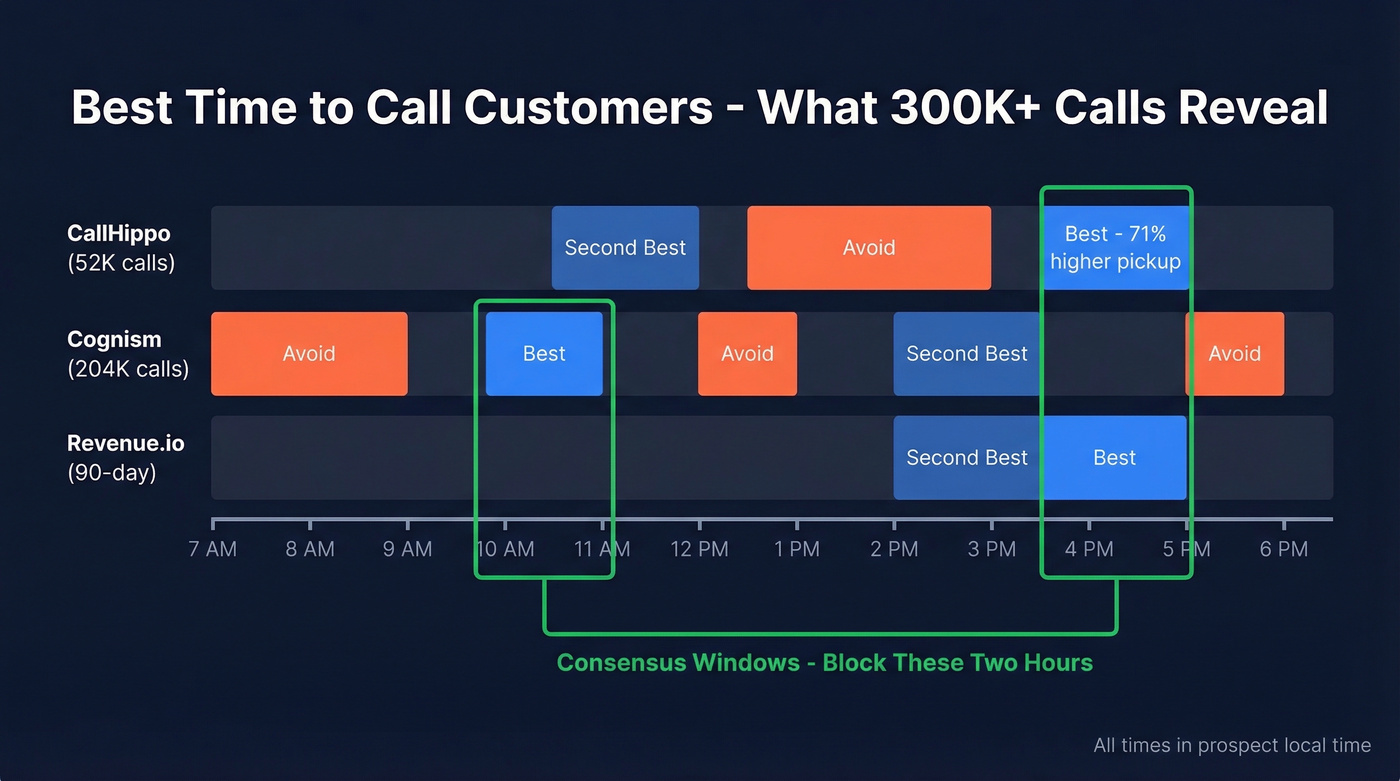
CallHippo found a 71% pickup-rate difference between the 4-5 PM window and the 11 AM-12 PM slot. That isn't a rounding error - it's a fundamentally different outcome depending on when you pick up the phone.
Revenue.io's internal data contradicts their own earlier broad-based study, which favored mornings. Their recent 90-day analysis shifted to late afternoon, which they tie to how remote and hybrid work has reshaped when decision-makers are actually at their desks. Makes sense - the 9 AM "settling in" period now happens at a kitchen table with Slack notifications piling up, not at a desk with a ringing phone.
Some articles suggest calling during off-hours - early mornings or late evenings - because there's less competition for attention. The data doesn't support this. Cognism's avoid windows of 7-9 AM and after 5 PM exist for a reason: 92% of consumers approach unknown numbers with suspicion, and that suspicion spikes when calls arrive outside normal hours.
The safe bet: block 10-11 AM for your first power hour, 4-5 PM for your second. In our experience, the 10-11 AM window outperforms late afternoon for enterprise prospects, while SMB decision-makers tend to be more reachable at 4-5 PM.
One note on B2B vs. B2C: This data is B2B-focused. B2C calls perform better in early evenings and weekends, but check state regulations before calling outside business hours.
Best Days to Reach Prospects
CallHippo says Wednesday. Cognism says Tuesday. Across every source we've reviewed, Tuesday through Thursday is the sweet spot. Mid-week wins.
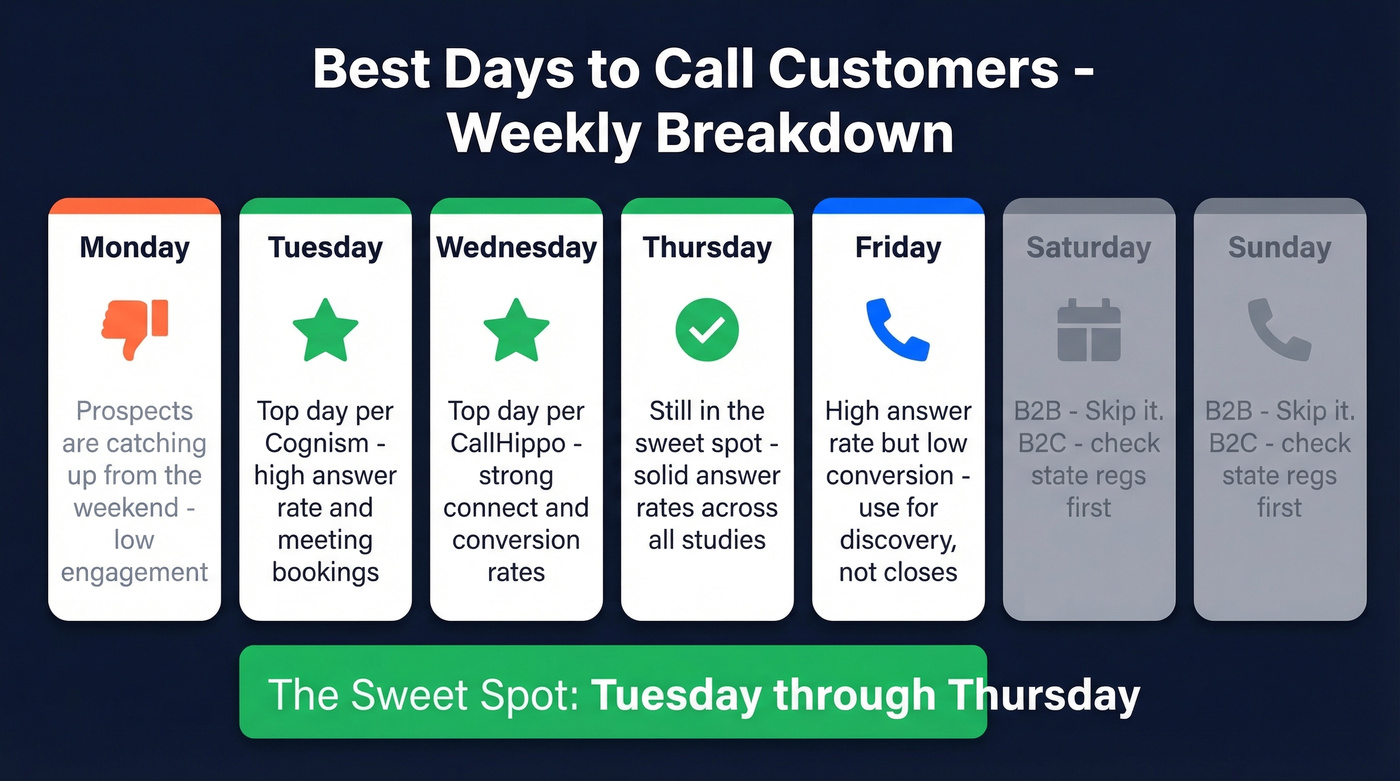
Now here's the Friday nuance most articles miss. Cognism found Fridays are among the worst days for booking meetings but one of the best for actually reaching people. Fewer internal meetings means more answered calls - but prospects are mentally checked out. Use Fridays for discovery conversations and relationship-building, not hard closes.
Regional rates vary too. UK teams booked meetings at 8% versus 6% in the US and Europe, so adjust expectations based on your market.
How Many Times Should You Call?
Three. That's the number.
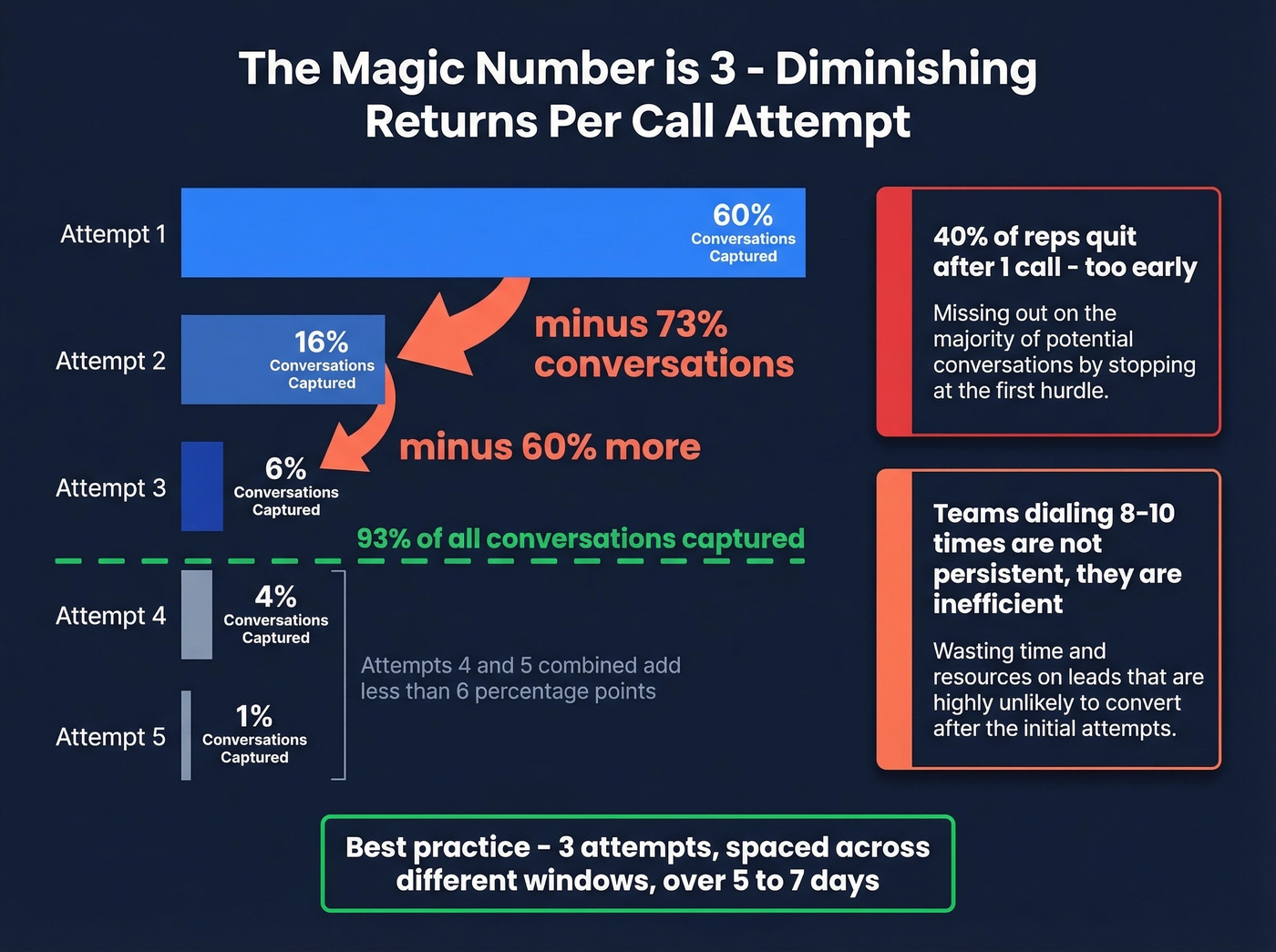
Cognism's diminishing-returns data is the most useful thing in their entire report. Conversations drop 73% from call 1 to call 2, then another 60% from call 2 to call 3. By the third attempt, you've captured 93% of all conversations you're ever going to have with that contact. CallHippo recommends up to 6 attempts and claims a 70% connect-rate increase, but the extra attempts yield marginal returns - push to five and you hit 98.6%, which means attempts four and five combined add less than 6 percentage points.
The real waste isn't calling too few times. It's calling too many. 40% of agents give up after the first call, which is too early. But teams dialing contacts eight or ten times aren't being persistent - they're being inefficient. Three attempts, spaced across different windows over 5-7 days, is where you want to land. And since 52% of calls go to voicemail, have a tight 30-second voicemail script ready for every attempt that doesn't connect.

You just learned that 3 attempts capture 93% of conversations. But if 17% of your numbers are dead, you're burning a quarter of those attempts on nothing. Prospeo gives you 125M+ verified mobile numbers with a 30% pickup rate - refreshed every 7 days, not every 6 weeks.
Stop optimizing call timing on a list full of dead numbers.
Why Data Quality Matters More Than Timing
Let's be honest: most teams obsessing over call timing are solving the wrong problem.
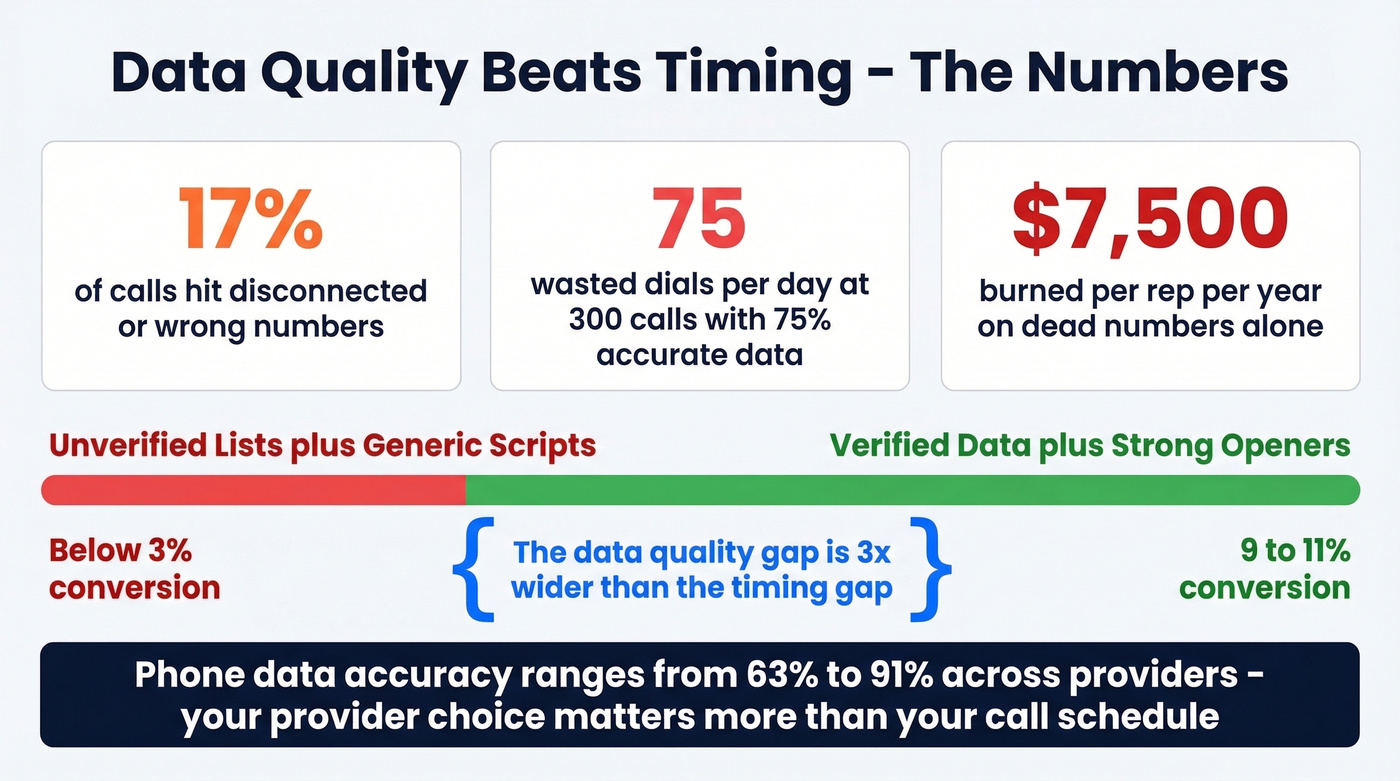
You can nail the perfect window - Tuesday at 10:15 AM - and still waste a third of your dials. CallHippo's study found that 17% of calls hit disconnected or incorrect numbers. That's nearly one in five dials going nowhere before timing even enters the equation.
A benchmark of 9 phone data providers tested against 307 verified contacts found accuracy ranging from 63% to 91%. At 300 dials per day, a rep working with 75% accurate data wastes 75 calls daily - roughly $7,500 per year in burned dial time per rep. And inbound leads called within 5 minutes have a 100x higher contact rate than those called after 30 minutes. Speed-to-lead matters as much as time-of-day.
Teams running verified data with strong openers convert at 9-11%. Unverified lists with generic scripts? Below 3%. The data quality gap is wider than the timing gap.
Legal Calling Hours: When Is It Too Late?
Federal TCPA compliance sets the baseline at 8 AM-9 PM in the prospect's local time. Several states go further.
| State | Hours | Max Attempts | Penalty | B2B Exempt? |
|---|---|---|---|---|
| FL | 8 AM-8 PM | 3/24 hrs | $500-$1,500 | Yes |
| MD | 9 AM-8 PM | 3/24 hrs | Up to $1,000+ | Yes |
| WA | 8 AM-8 PM | No state cap | $100/violation | Yes |
| NY | 8 AM-9 PM | No state cap | Up to $11,000 | No |
| OK | 8 AM-8 PM | 3/24 hrs | $500-$1,500 | Yes (existing relationship) |
New York's $11,000 per violation penalty is the one that should get your attention - and they don't offer a B2B exemption. If you're dialing into multiple states, default to the strictest window (9 AM-8 PM) and cap at 3 attempts per 24 hours. It isn't worth the risk.
Build Your Call Block in 5 Minutes
Skip this section if you already have a structured power-hour system. For everyone else:
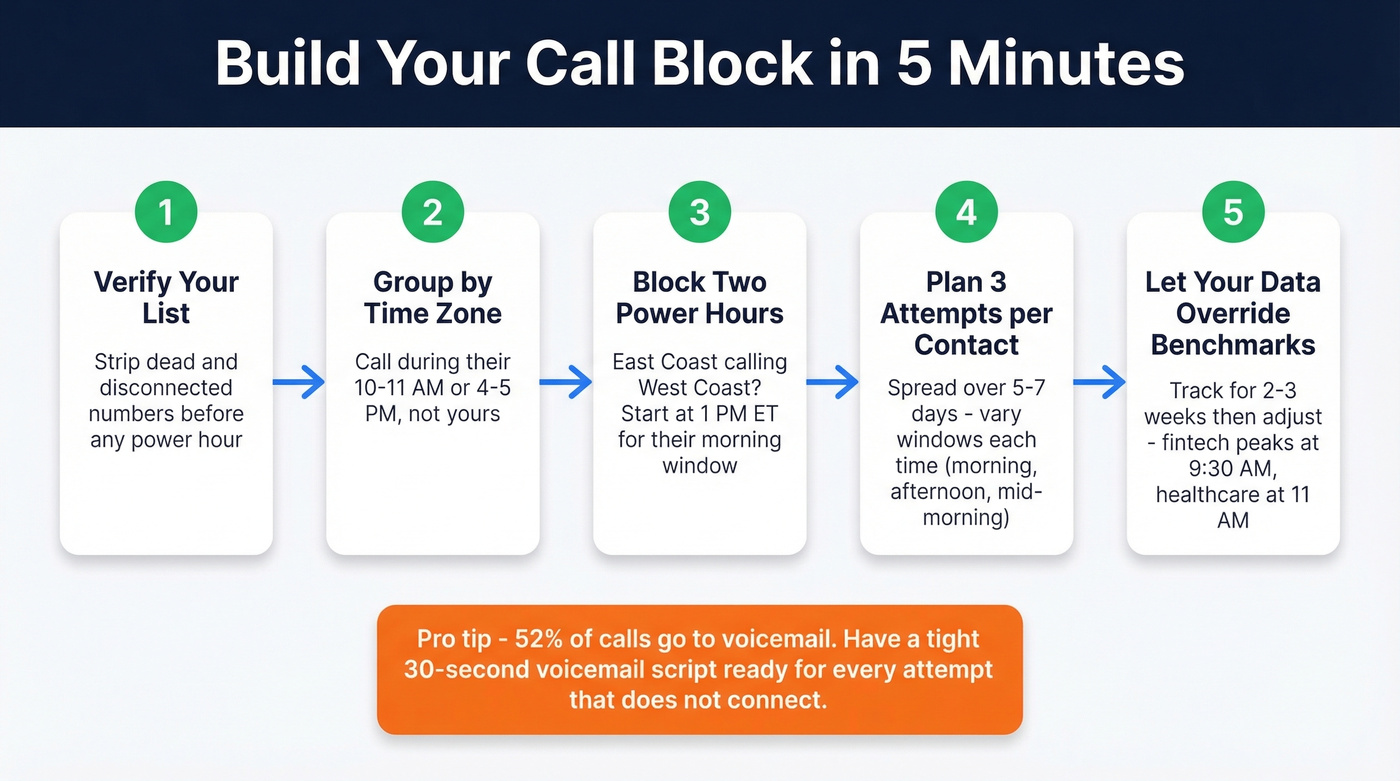
- Verify your list. Strip out dead and disconnected numbers before any power hour using a verification tool like Prospeo or a similar service.
- Group by time zone. Call during their 10-11 AM or 4-5 PM, not yours.
- Block two power hours. If you're East Coast calling West Coast, that means starting at 1 PM ET for their morning window.
- Plan 3 attempts per contact over 5-7 days. Vary windows - morning first, afternoon second, mid-morning third. (If you need a repeatable cadence, start with a simple cold calling cadence.)
- Let your data override benchmarks. Your industry and persona will shift the optimal window by 30-60 minutes. We've seen fintech prospects peak at 9:30 AM while healthcare admin picks up closer to 11. Adjust after 2-3 weeks of tracking.
At 300 dials per day, bad phone data wastes 75 calls and ~$7,500/year per rep. Prospeo's verified mobile numbers cost $0.10 each and deliver a 30% pickup rate - 2.5x the industry average. Your Tuesday 10 AM power hour actually works when every number is real.
Fix the data first. The timing wins follow.
FAQ
Does cold calling still work in 2026?
Yes, but the bar is higher. The average connect-to-meeting rate sits at roughly 2.3%. Reps who verify their data and call during peak windows (10-11 AM or 4-5 PM, Tuesday-Thursday) still book meetings consistently - top teams report 9-11% conversion rates with verified numbers and relevant openers.
Should I call prospects on Fridays?
Fridays are great for reaching people but terrible for booking meetings. Answer rates stay high while conversion drops. Use them for discovery conversations and rapport-building, not pushing for a commitment.
How do I improve my connect rate without changing call times?
Fix your data first. If 17% of your numbers are disconnected, verifying your list eliminates wasted dials and lifts connect rates immediately. Beyond data, lead with a relevant opener tied to something specific about the prospect's company - generic scripts convert below 3%.
What's the legal cutoff for business calls?
Federal TCPA allows calls between 8 AM and 9 PM in the prospect's local time zone. Some states like Maryland restrict to 9 AM-8 PM, and New York imposes fines up to $11,000 per violation with no B2B exemption. Default to 9 AM-8 PM if you dial across multiple states.