BounceBan Review 2026: Pricing, Pros, Cons, and What Users Actually Say
You just ran your first cold email campaign through Instantly, and 42% of your "verified" list bounced. That's not a deliverability problem - that's a verification tool problem. Here's everything we've found about BounceBan's pricing, reviews, pros and cons so you can decide whether it's the right fix or whether you need a fundamentally different approach to list quality.
30-Second Verdict
BounceBan carries a 4.8/5 on G2 from 306 reviews - 89% five-star. It specializes in catch-all and SEG-protected email verification, starting at $21.25/month with credits that never expire. The headline feature is its ability to turn a big chunk of "risky" catch-all results into usable outcomes: BounceBan claims it can reliably verify true deliverability for 85-95% of catch-all, greylisted, and SEG-protected emails.
The concern: one Reddit user reported a 42% bounce rate on a BounceBan-verified list. That's a single data point, but it's a loud one. If your real problem is bad source data - not just unverified emails - you're better off starting with cleaner contacts from the jump. Verification tools clean what you already have. Better source data means less cleaning.
What Is BounceBan?
BounceBan is an email verification service built for the hardest verification problem: catch-all and SEG-protected domains. Most verifiers flag catch-all emails as "risky" and leave you guessing. BounceBan aims to resolve those ambiguous addresses into actionable deliverable/undeliverable results, and its own positioning claims it can identify up to 40% more deliverable/undeliverable emails on these hard cases while achieving similar or better overall delivery rates than competitors.
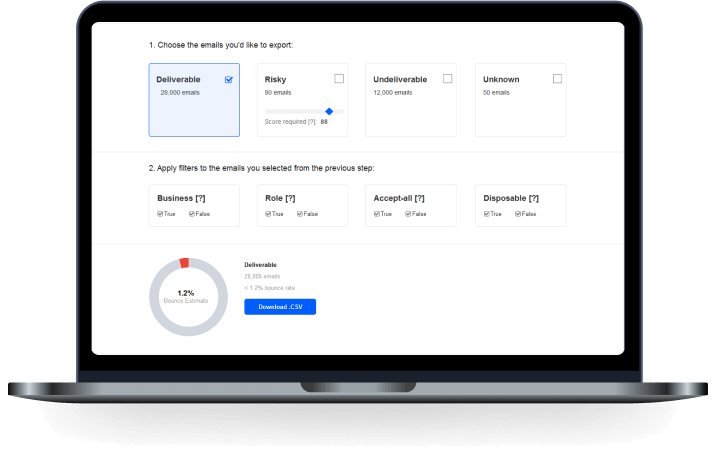
The platform is non-intrusive - it doesn't send emails during verification - and it's positioned as GDPR compliant. It covers Office 365, Google Workspace, and SEGs including Mimecast, Proofpoint, and Barracuda. Features include single email verification, bulk list processing, API access, and a CRM sync for automated daily verification.
Pricing Breakdown
BounceBan runs on a credit system with packages from 10,000 to 1,000,000+ credits. You can buy pay-as-you-go or subscribe monthly for a 15% discount. One credit equals one successful verification via Single, Bulk, or API. The starting price is $21.25/month.
Here's the thing: the pricing page uses a dynamic UI that doesn't show all dollar amounts until you interact with it. Frustrating for a tool that markets transparency. Based on typical verifier market tiers, expect roughly $0.003-$0.01 per verification depending on volume. Single email verifications in "Free Mode" are free forever and don't consume credits. Unused credits roll over without expiration.
The Sync product for CRM hygiene bills separately based on unique emails verified per month, with auto-upgrades and downgrades to the nearest tier.
| Tool | Cost/Email (100K) | Free Tier | Credit Expiry | Best For |
|---|---|---|---|---|
| BounceBan | ~$0.003-$0.01 | Free single verify | Never expires | Catch-all specialists |
| ZeroBounce | $0.0043 | 100 free/month | Varies by plan | All-around reliability |
| NeverBounce | $0.004 | 1,000 free | Varies by plan | Budget bulk |
| Emailable | $0.0042 | 250 free | Varies by plan | Simple bulk |
At higher volumes, BounceBan undercuts the competition. At lower volume tiers, the per-credit cost creeps up and the savings disappear.

Verification tools fix bad data after the fact. Prospeo gives you 98% accurate emails from the start - 143M+ verified addresses refreshed every 7 days. At $0.01/email, you spend less than BounceBan and skip the bounce risk entirely.
Stop paying to clean lists that should never have been dirty.
Pros and Cons
What BounceBan Gets Right
Catch-all resolution is the real differentiator. The platform claims 85-95% resolution rates on catch-all, greylisted, and SEG-protected emails, with 97%+ accuracy on resolved addresses. If you're sitting on thousands of "risky" results from another verifier, this is the specific problem BounceBan was built to solve.
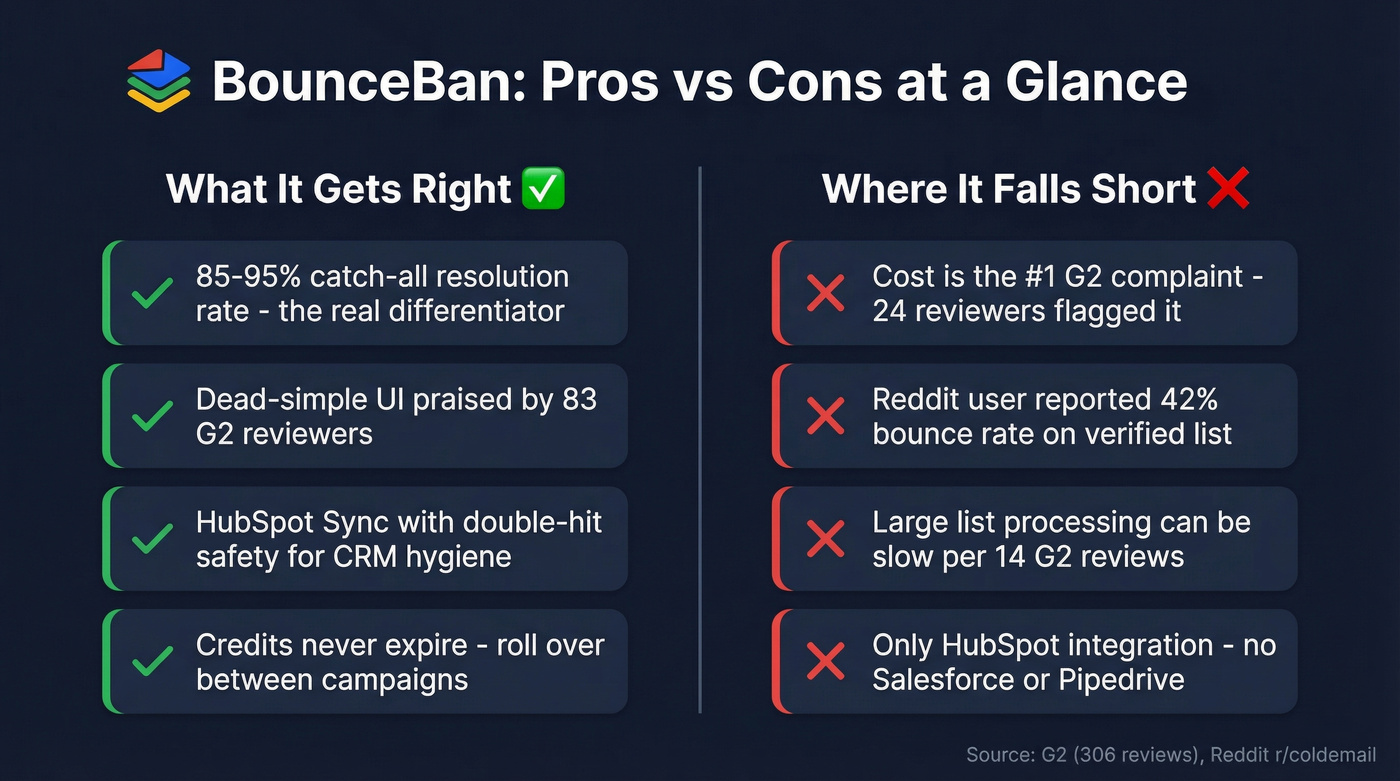
Dead-simple UI. 83 G2 reviewers called out usability, and 94 mentioned instant verification speed. It does one thing and makes it easy.
HubSpot Sync automates CRM hygiene. Daily verification with a "require double hits" safety feature that only triggers actions after two consecutive matching results. Smart design.
Credit rollover with no expiration. You won't lose unused credits between campaigns - though in our experience, this can actually discourage the frequent re-verification that modern email deliverability demands.
Where It Falls Short
Cost is the #1 complaint on G2. 24 reviewers flagged it as expensive, and 18 wanted more free credits. Costs compound fast if you're re-verifying large lists regularly.
That Reddit bounce rate report is hard to ignore. One user reported 42% and 31% bounce rates on verified lists. Industry benchmarks from Campaign Monitor say total bounces should stay below 2%. Even accounting for a new sending domain, those numbers are alarming.
Large list processing can be slow. 14 G2 reviewers mentioned sluggish processing on bigger jobs.
Integration ecosystem is thin. The only native CRM integration is HubSpot. Salesforce, Pipedrive, or anything else means API or Zapier workarounds.
What Real Users Say
The G2 picture is overwhelmingly positive: 4.8/5 from 306 reviews, with 89% five-star, 10% four-star, and essentially zero negative ratings. One reviewer called catch-all verification "priceless," and an API-focused user noted it works like more expensive competitors at a lower price.
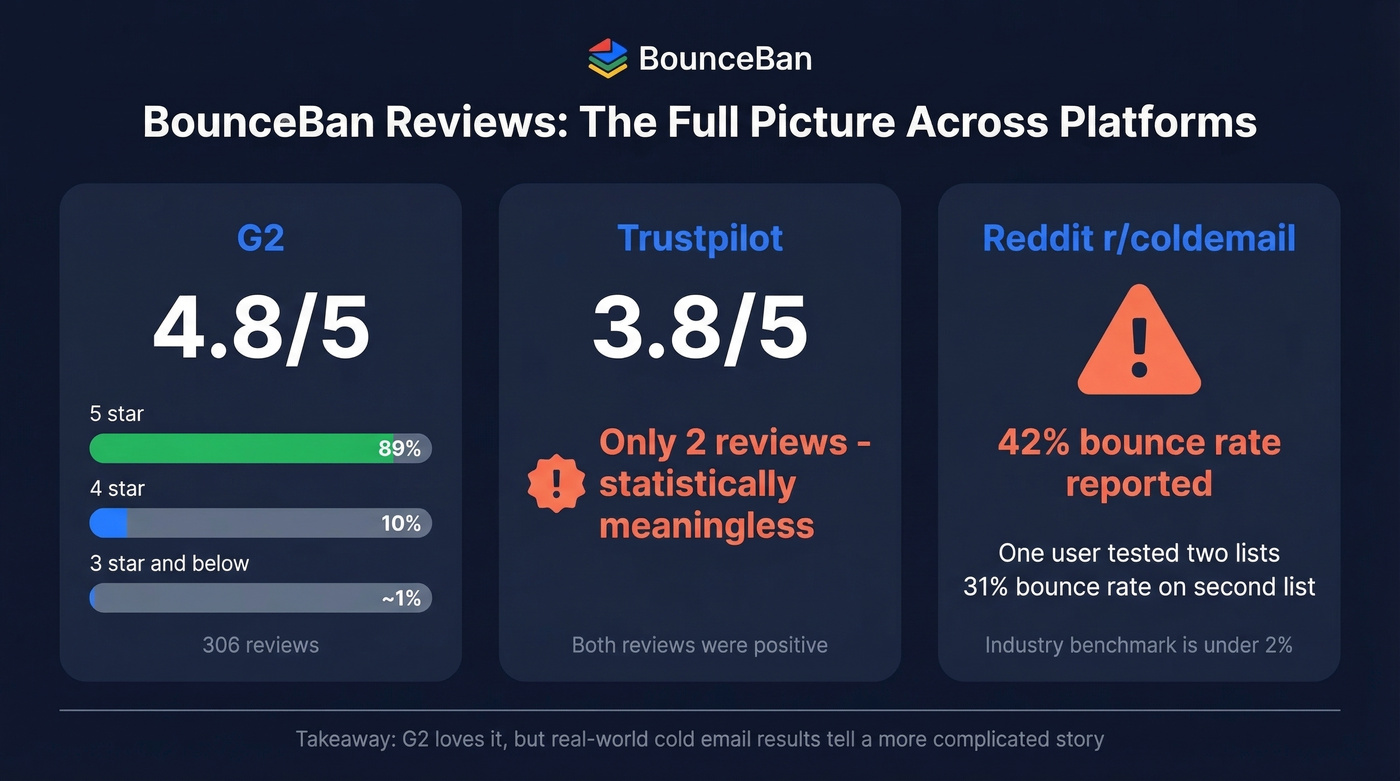
Trustpilot shows 3.8/5 - but that's based on exactly 2 reviews, both positive. Statistically meaningless next to G2's 306.
The r/coldemail thread paints a different picture. A user reported running verified lists through Instantly and hitting 42% bounce rates, then 31% on a second list. Their conclusion was blunt: something's wrong with the internal process. We'd recommend testing a batch of 500-1,000 emails before committing serious credits - the cost of a failed campaign far exceeds the cost of a cautious trial.
Who Should (and Shouldn't) Use It
Use BounceBan if you deal heavily with catch-all and SEG-protected domains where other verifiers just mark everything "risky," you want automated HubSpot CRM hygiene, or you prefer a PAYG model with no credit expiration.
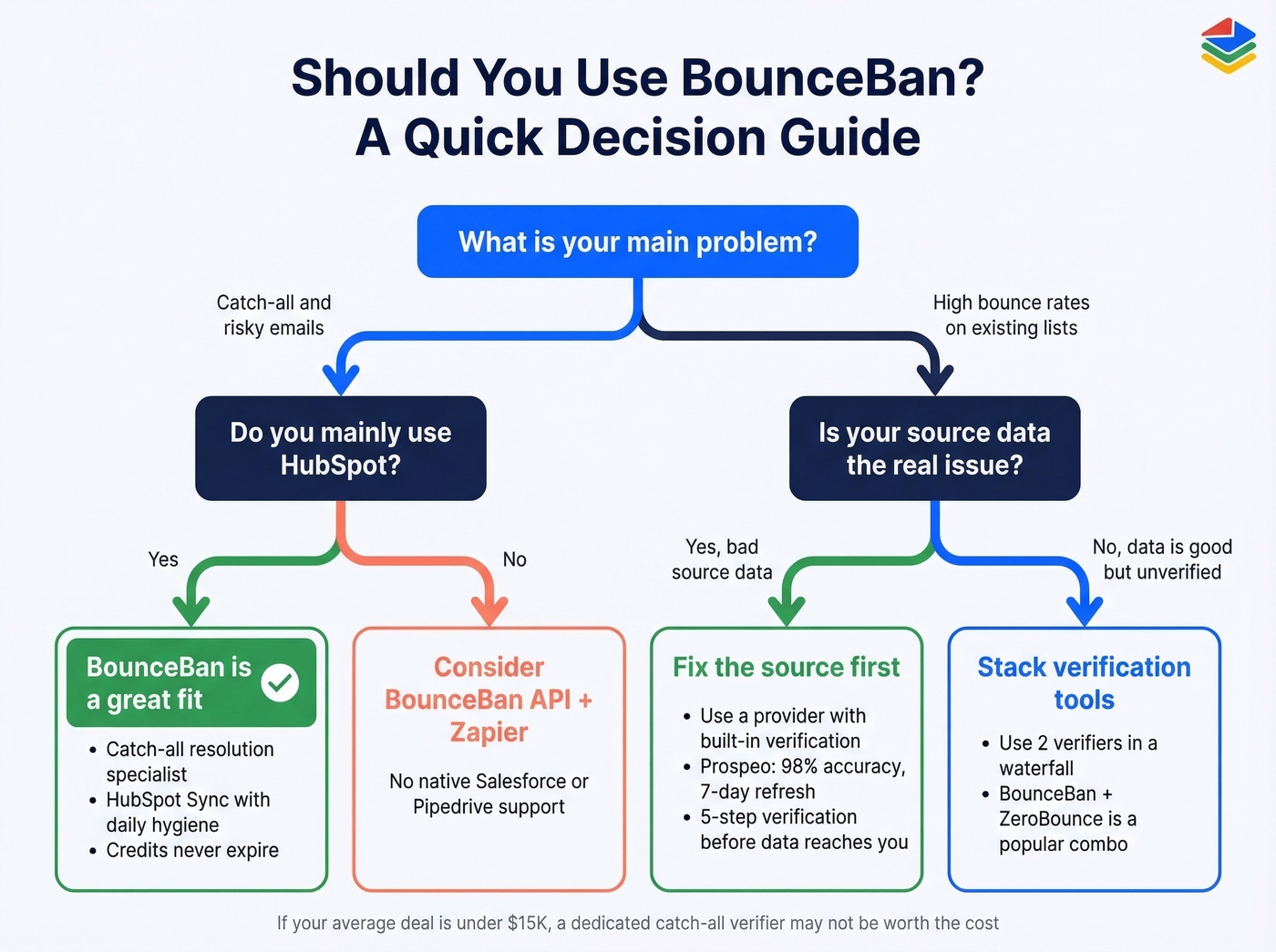
Skip it if you're on Salesforce or another CRM without native integration, your bounce issues stem from bad source data rather than unverified emails, or you need to re-verify large lists frequently at lower volume tiers where the per-credit cost isn't competitive.
Let's be honest: if your deals average under $15K, you probably don't need a dedicated catch-all verifier at all. The money is better spent on cleaner source data that doesn't need heavy verification in the first place.
Some practitioners use BounceBan as one layer in a multi-tool waterfall validation stack - a smart approach for high-volume outbound where the throughput-vs-safety tradeoff matters. The consensus on r/coldemail is that no single verifier catches everything, so stacking two tools often pays for itself in saved domain reputation.
Alternatives Worth Considering
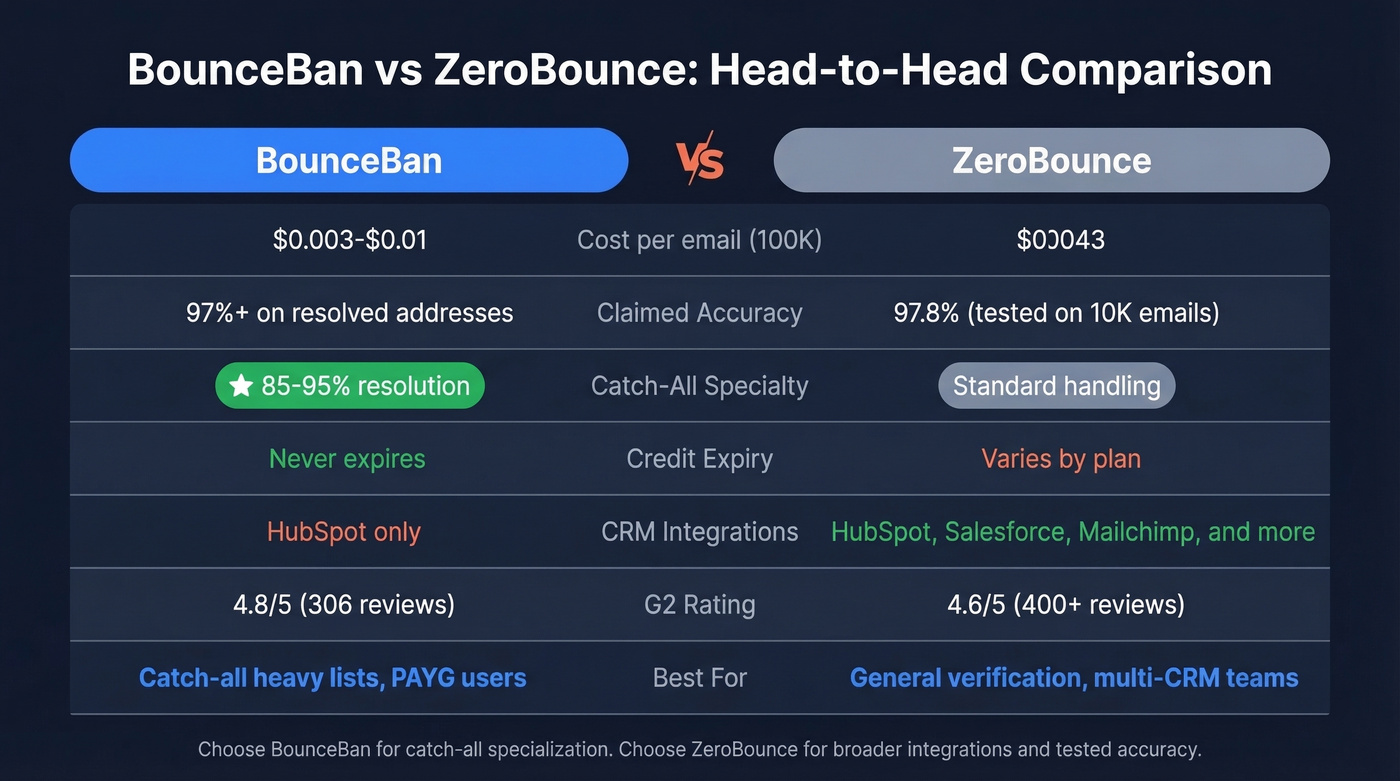
ZeroBounce is the established player - $0.0043/email at 100K volume, with 97.8% accuracy in a published 10K-email test. Broader integration ecosystem, though it doesn't specialize in catch-all resolution. A solid default if you want reliability over specialization.
Emailable is the budget option at $0.0042/email, starting around $15/month. Handles straightforward bulk verification well but lacks catch-all focus.
Fix the Source Data Instead

If you're spending hundreds monthly on verification credits, the real question is why your source data needs that much cleaning. Prospeo takes a different approach - 300M+ professional profiles with 98% email accuracy and a 7-day data refresh cycle. Every email goes through a 5-step verification process including catch-all handling, spam-trap removal, and honeypot filtering before it reaches your list. One of our customers, Stack Optimize, built to $1M ARR while maintaining 94%+ deliverability and sub-3% bounce rates across all their clients - without running a separate verification tool on top.
Native integrations with Salesforce, HubSpot, Instantly, Smartlead, Lemlist, and Clay mean you aren't stuck with a single CRM connector. Free tier gives you 75 emails/month, no contracts.
That 42% bounce rate on a "verified" list? It happens when source data is the problem, not verification. Prospeo's 5-step verification with catch-all handling, spam-trap removal, and honeypot filtering is built into every contact - before it ever reaches your CRM.
Start with data that doesn't need a second verifier to trust.
FAQ
Is BounceBan accurate for catch-all emails?
BounceBan claims 85-95% resolution rates on catch-all and SEG-protected emails, with 97%+ accuracy on those resolved addresses. That said, one Reddit user reported 42% bounce rates on verified lists. Test 500-1,000 emails before committing credits to a large campaign.
Does BounceBan offer a free plan?
Single email verifications are free forever and don't consume credits. Bulk verification starts at $21.25/month with credit packages from 10K to 1M+. Unused credits roll over without expiration - no pressure to use them immediately.
What's a good alternative if my emails still bounce after verification?
The issue is usually source data quality, not verification. Prospeo's 5-step verification pipeline with 98% email accuracy and a 7-day refresh cycle eliminates most bounce problems before they start. ZeroBounce with 97.8% tested accuracy is another strong option for post-collection cleaning.
How does BounceBan compare to ZeroBounce?
BounceBan specializes in catch-all domain resolution at roughly $0.003-$0.01/email with no credit expiration. ZeroBounce offers broader integrations and 97.8% tested accuracy at $0.0043/email. Choose BounceBan for catch-all-heavy lists; choose ZeroBounce for general-purpose verification with more CRM connectors.