

The 9 Best Business Email Address Search Tools in 2026
Your SDR just burned through 500 credits and 47 emails bounced. That's not a bad day - that's a bad tool. The difference between a business email address search tool that works and one that wastes your budget comes down to one thing most comparison articles ignore: deliverable accuracy, not database size. A tool with 300M verified profiles beats one with 700M unverified records every time.
You've probably got three or four tabs open right now comparing features and pricing. Good - that's exactly the right instinct. But most of those tabs are vendor pages telling you their database is the biggest. We've tested these tools against real prospect lists, dug through Reddit threads, and done the cost-per-email math so you don't have to. Let's cut through it.
Our Top Picks
| Tool | Best For | Starting Price | Free Tier |
|---|---|---|---|
| Prospeo | Email accuracy (98%) | ~$0.01/email | 75 emails/mo |
| Apollo.io | Biggest free database | ~$49/mo per user | 100 credits/mo |
| Snov.io | Finder + sequences | $29.25/mo (annual) | 50 credits/mo |
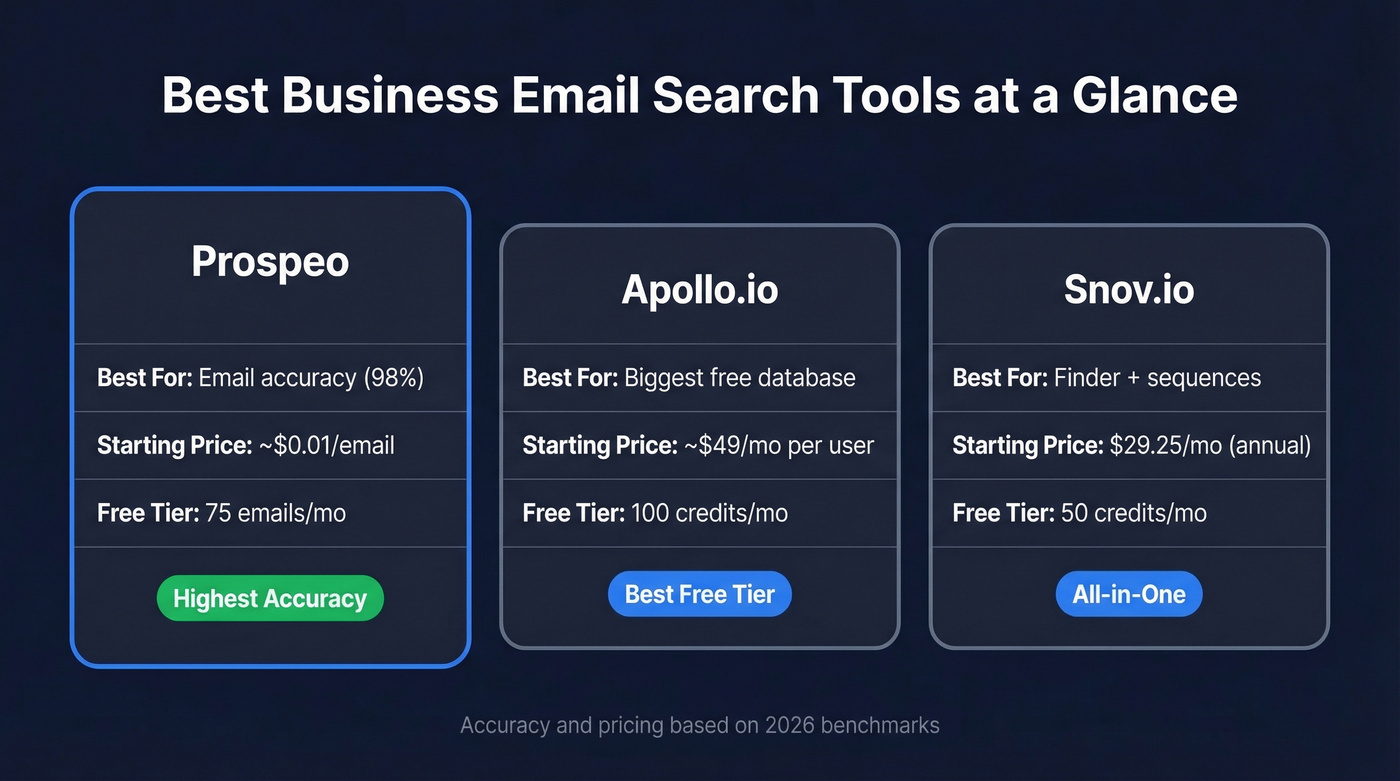
Stop comparing tools by database size. If you only need 50 emails a month, Hunter's free tier works - but don't rely on it as your primary source. The database is too small for sustained prospecting.
How Business Email Search Tools Actually Work
Three broad categories exist, and each works differently. Domain-based tools crawl the web for email patterns associated with a company domain. Extension-based tools pull data from professional profiles and company pages as you browse. Database-driven platforms maintain their own indexed records of verified contacts.

The verification layer is where tools diverge. Syntax-only checks confirm that an email address looks right - has an @ symbol, a valid domain structure. That's table stakes. SMTP verification goes further by pinging the mail server to confirm the mailbox exists without actually sending a message. This is the minimum standard you should accept from any tool you're paying for.
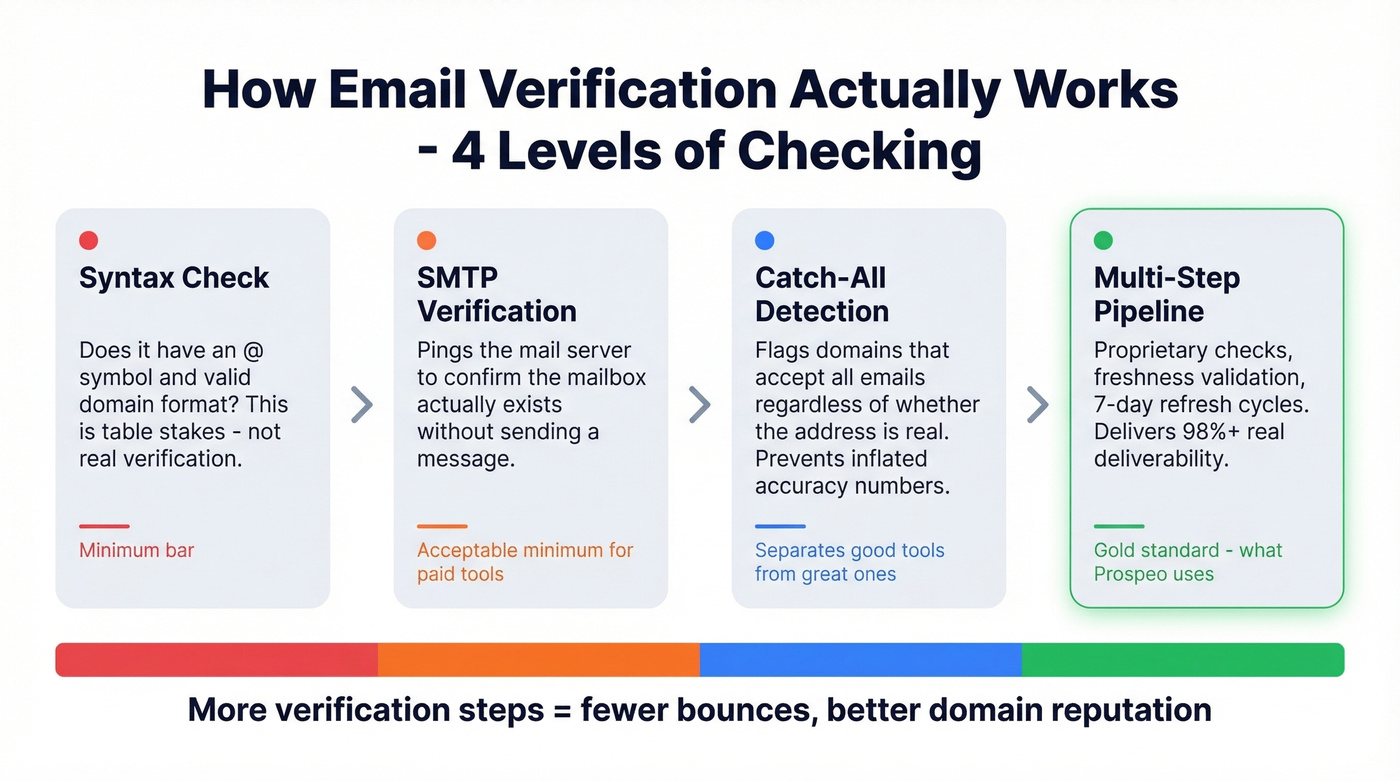
Then there's the catch-all problem. Some company mail servers accept all incoming email regardless of whether the specific address exists. A tool that marks catch-all addresses as "valid" is inflating its numbers. The best tools flag catch-all domains separately or run additional checks to estimate deliverability.
Data freshness matters more than most buyers realize. People change jobs, companies restructure, domains expire. A record that was accurate three months ago might bounce today. The industry average refresh cycle runs about six weeks; some tools refresh every 7 days. That gap compounds fast at scale.
One critical distinction: "found rate" isn't the same as "deliverable rate." A tool might find emails for 80% of your list, but if 15% of those bounce, your real enrichment rate is closer to 68%. That's the metric that actually matters for your campaigns.
Accuracy Benchmarks
Self-reported accuracy ranges from 79% to 98% depending on the vendor. Independent testing tells a different story. The Dropcontact benchmark, updated February 2026, tested 15 tools against 20,000 real contacts - split as 9,800 US, 9,700 Europe, and 500 rest of world - and measured results by actually sending emails to every address found. Their "real enrichment rate" accounts for hard bounces and wrong-domain errors, not just whether an email was returned.
Top performers from that benchmark:
| Tool | Real Enrichment Rate |
|---|---|
| Dropcontact | 54.9% |
| Enrow | 40.9% |
| Findymail | 39.9% |
The top performers clustered around 40-55%, meaning even the best tools couldn't find a deliverable email for nearly half the contacts. That's normal. No single tool covers everyone - which is exactly why waterfall enrichment exists.
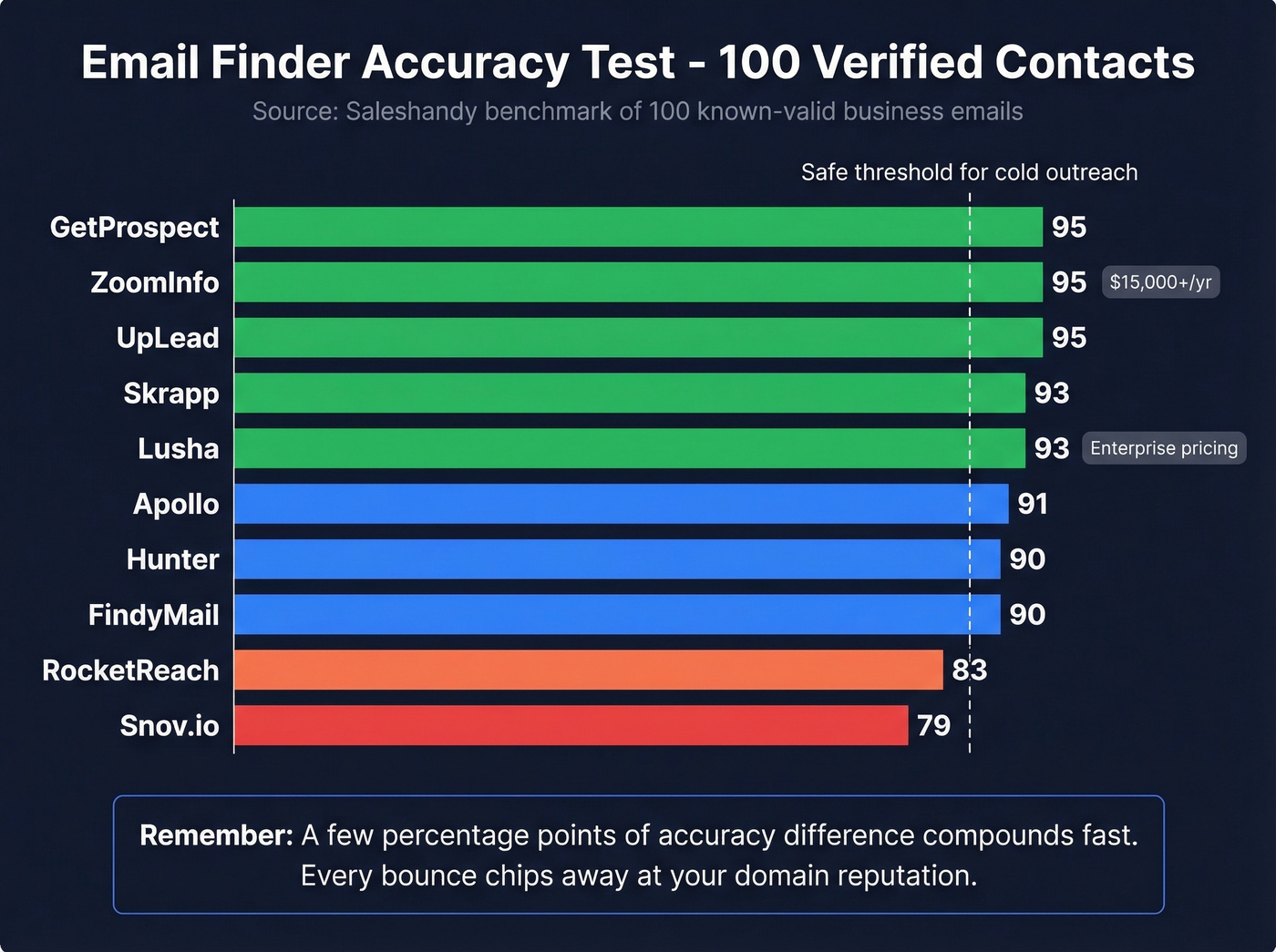
A separate Saleshandy test of 100 verified contacts produced these accuracy scores:
| Tool | Found (of 100) | Accuracy |
|---|---|---|
| GetProspect | 95 | 95% |
| ZoomInfo | 95 | 95% |
| UpLead | 95 | 95% |
| Skrapp | 93 | 93% |
| Lusha | 93 | 93% |
| Apollo | 91 | 91% |
| Hunter | 90 | 90% |
| FindyMail | 90 | 90% |
| RocketReach | 83 | 83% |
| Snov.io | 79 | 79% |
ZoomInfo and Lusha tested well but are enterprise-priced - ZoomInfo typically runs $15,000+/year. Saleshandy's analysis of 95,000 cold emails ties accuracy differences directly to wasted credits and deliverability risk.
Here's the thing: a few percentage points of accuracy difference might seem minor until you calculate the downstream cost. Every bounced email chips away at your domain reputation. Enough bounces and your entire outbound program enters a deliverability spiral that takes weeks to recover from.
If your average deal size sits below five figures, you probably don't need ZoomInfo-level data. A tool with 98% accuracy at $0.01/email will outperform a $15,000/year platform that your team only uses for email lookups.

You just saw the benchmarks - accuracy gaps cost you bounced emails, burned domain reputation, and wasted credits. Prospeo's 5-step verification pipeline delivers 98% email accuracy with a 7-day refresh cycle, so every business email you pull is current and deliverable.
Find verified business emails at $0.01 each - 75 free every month.
The 9 Best Tools for Business Email Lookup
1. Prospeo
Use this if: You need verified emails that actually land. Outbound agencies scaling client campaigns without burning domains. RevOps teams running enrichment workflows via API or CRM integrations.
Skip this if: You need built-in email sequences - pair with Smartlead, Instantly, or Lemlist instead.
Prospeo's database covers 300M+ professional profiles, 143M+ verified emails, and 125M+ verified mobile numbers. The 98% email accuracy comes from a 5-step verification pipeline built on proprietary infrastructure - no third-party email providers in the chain. Every record refreshes on a 7-day cycle, roughly six times faster than the industry average.
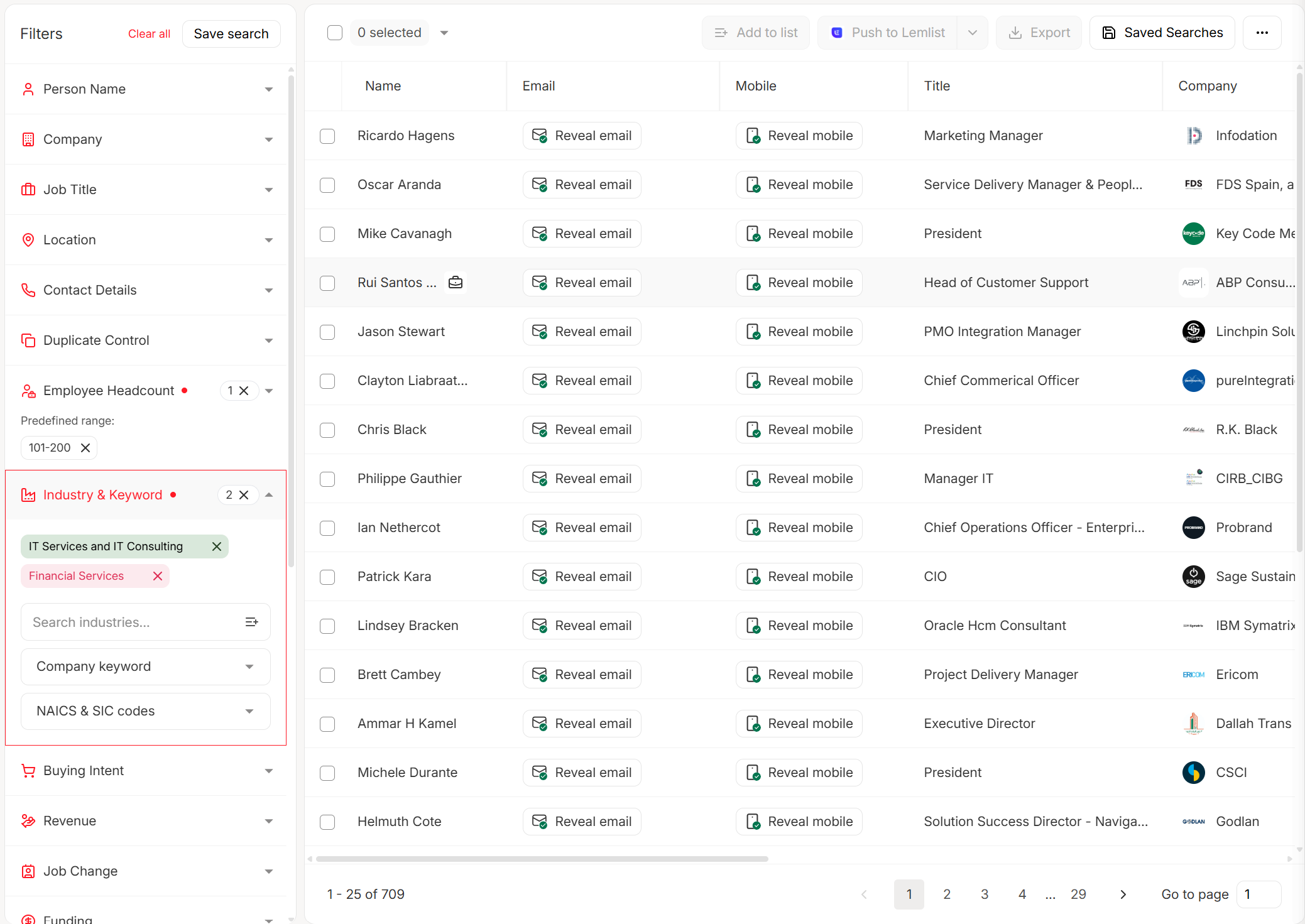
The search interface offers 30+ filters including buyer intent powered by Bombora, technographics, job changes, headcount growth, and funding data. The Chrome extension has 40,000+ users and works across company websites and CRMs. Native integrations push directly to Salesforce, HubSpot, Smartlead, Instantly, Lemlist, Clay, and Zapier.
Pricing runs about $0.01 per email with a free tier of 75 emails per month - no credit card, no contract. Stack Optimize built from $0 to $1M ARR using Prospeo as their primary data source, maintaining 94%+ deliverability and under 3% bounce rates across all clients with zero domain flags. In our experience, that kind of consistency at scale is rare.
2. Hunter.io
Use this if: Domain-based search is your primary workflow and you need a reliable verification layer on top of another database.
Skip this if: You need a large database for name-based prospecting at scale. The consensus on r/sales is that Hunter's database is "pretty small."
Hunter built its reputation on domain search - enter a company domain and get a list of associated email addresses with confidence scores. It's clean, fast, and the verification engine is solid. The free tier gives you 50 credits per month, and verification costs just 0.5 credits per check.

Paid plans start at $34/mo (annual) for 2,000 credits on Starter, scaling to $104/mo for 10,000 on Growth, and $209/mo for 25,000 on Scale. In the Saleshandy accuracy test, Hunter scored 90 out of 100 - respectable but not leading. The real limitation is coverage. Hunter works best when you already know the company domain and need to find a specific person's email within it. For broad prospecting across thousands of companies, you'll hit the database ceiling quickly.
3. Apollo.io
Apollo's 275M+ contact database across 73M+ companies makes it the largest self-serve option available, and the free tier - 100 credits per month - is one of the most generous in the market. Paid plans start around $49-99/mo per user. Apollo scored 91 out of 100 in the Saleshandy accuracy test, which is solid on paper.
The caveat is data freshness. Teams often pull lists from Apollo that look great on export but bounce more than expected on first send because the records haven't been updated recently. Reddit users in r/agency flag this pattern consistently. The built-in sequencing and CRM features are genuinely useful - if you're a startup that needs one tool for everything, Apollo is the obvious starting point. Just verify your lists before sending.
Best free tier in the market, but treat Apollo as a lead source, not a verified database. Always run a verification pass before hitting send.
4. Snov.io
Email finding, sequences, and warm-up in a single platform - that's Snov.io's pitch, and for lean teams juggling three subscriptions, it's compelling. The Starter plan runs $29.25/mo (annual) with 1,000 credits, 5,000 recipients, and 3 mailbox warm-ups. Pro at $74.25/mo bumps you to 5,000 credits with unlimited warm-ups.
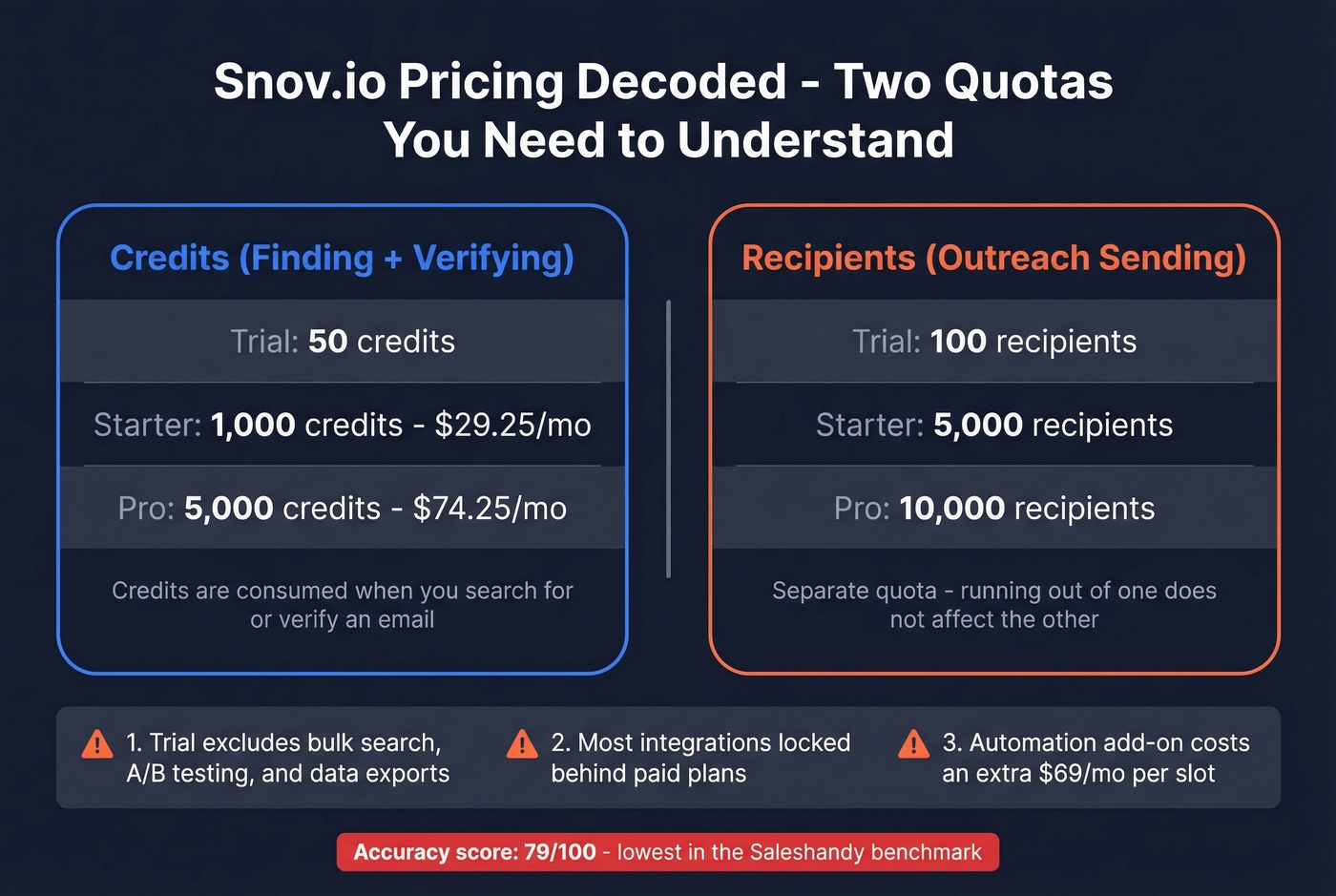
The pricing model is more complex than most. Credits cover finding and verification, while recipients are a separate quota for outreach. The trial tier is limited: 50 credits, 100 recipients, and it excludes bulk search, A/B testing, and data exports. Most integrations are locked behind paid plans.
The accuracy tradeoff is real - Snov.io's 79/100 score in the Saleshandy test was the lowest among the tools tested. Good for international leads and teams that want everything consolidated. The automation add-on costs $69/mo per slot if you need it.
5. GetProspect
95 out of 100 in the Saleshandy accuracy test. That's the number that matters here.
GetProspect quietly delivers some of the best email accuracy in its price range, and the Chrome extension-based workflow is smooth for daily prospecting. The free tier includes 50 valid emails and 100 verifications. Starter runs $49/mo for 1,000 valid emails, and Growth 5k is $99/mo for 5,000. The standout feature is verification credit packs - 10,000 verifications for $29, and they never expire. That's a smart model for teams with variable volume who don't want to waste monthly credits. The gap: no mobile numbers and no intent data.
6. RocketReach
$0.64 per email lookup at the entry tier. Let that sink in.
RocketReach's Essentials plan starts at $80/user/mo for 125 lookups - email only. Pro jumps to $150/user/mo for 375 lookups with phone numbers. Ultimate hits $833/user/mo. In the Saleshandy test, they scored 83 out of 100 - below average for a premium price point. Reddit sentiment on r/DigitalMarketing echoes this: users question whether it's "payworthy" given the alternatives. Enterprise teams with budget for combined phone and email data at scale may find value, but most teams have better options.
7. Anymail Finder
Use this if: You want the pay-for-valid-only guarantee and a low entry price for light usage.
Skip this if: You need scale. The Starter plan gives you 600 credits per year - roughly 50 emails a month if you're doing 1-credit name lookups.
Anymail Finder's model is unique: you only pay for valid emails. No result, no charge. A company domain search costs 1 credit and returns up to 20 valid emails, which is excellent value for account-based research. Verification costs just 0.2 credits. Pricing starts at $9/mo (annual) for Starter, $32/mo for Standard (12K credits/year), and $99/mo for Scale (60K credits/year). The free trial gives you 100 credits that expire in 7 days - enough to test, not enough to rely on.
8. Skrapp.io
Budget-friendly option with a free tier of 100 credits per month. Professional plans start at $30/mo with tiered credit options up to Enterprise at $262/mo for 50,000 credits. Skrapp reports 97%+ verification accuracy, but they charge for catch-all results - a cost that adds up fast on domains with catch-all configurations. If your ICP skews toward larger companies that tend to run catch-all servers, watch your credit burn rate closely.
9. Cognism
This is an enterprise play. Skip it if you want self-serve.
Reddit users praise Cognism's European coverage consistently - it's genuinely best-in-class for that market. Custom contracts typically run $1,000-3,000/mo for small teams. Not self-serve, not cheap, but if your ICP is European decision-makers, Cognism is worth the conversation. Finding corporate emails for EU prospects is notoriously difficult due to stricter data regulations, and Cognism handles that compliance layer natively.
Pricing Comparison
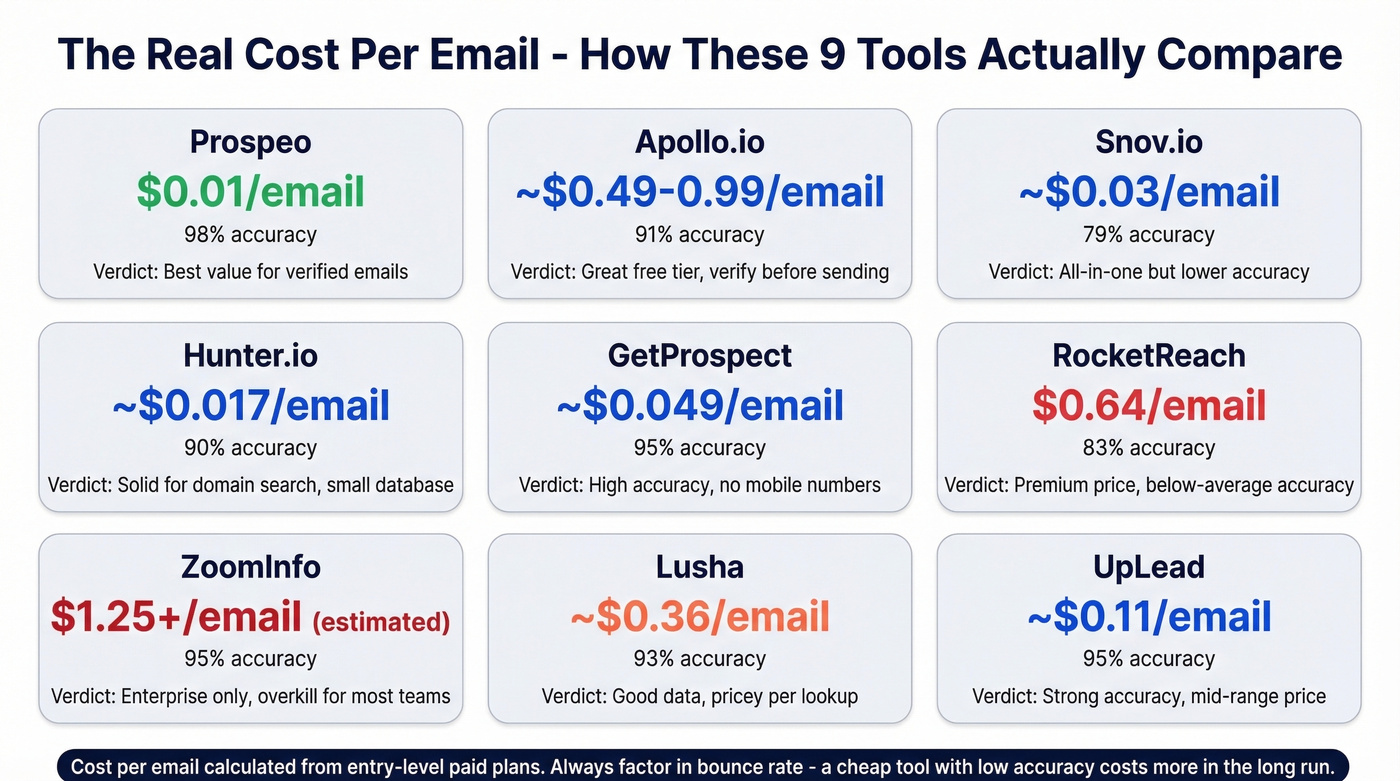
Credit models vary wildly across tools, so pay attention to what counts as a "credit" - some tools charge for verification separately, others bundle it.
| Tool | Free Tier | Entry Price | Model | ~Cost/Email |
|---|---|---|---|---|
| Hunter | 50 credits/mo | $34/mo (annual) | Credits/mo | ~$0.017 |
| Apollo | 100 credits/mo | ~$49/mo/user | Credits/mo | ~$0.05+ |
| Snov.io | 50 credits/mo | $29.25/mo (annual) | Credits + recipients | ~$0.03+ |
| GetProspect | 50 emails/mo | $49/mo | Credits/mo | ~$0.05 |
| RocketReach | None | $80/user/mo | Lookups/mo | ~$0.64 |
| Anymail | 100 (7-day trial) | $9/mo (annual) | Pay-for-valid | ~$0.18 |
| Skrapp | 100 credits/mo | $30/mo | Credits/mo | ~$0.03 |
| Cognism | None | ~$1,000+/mo | Custom contract | Varies |
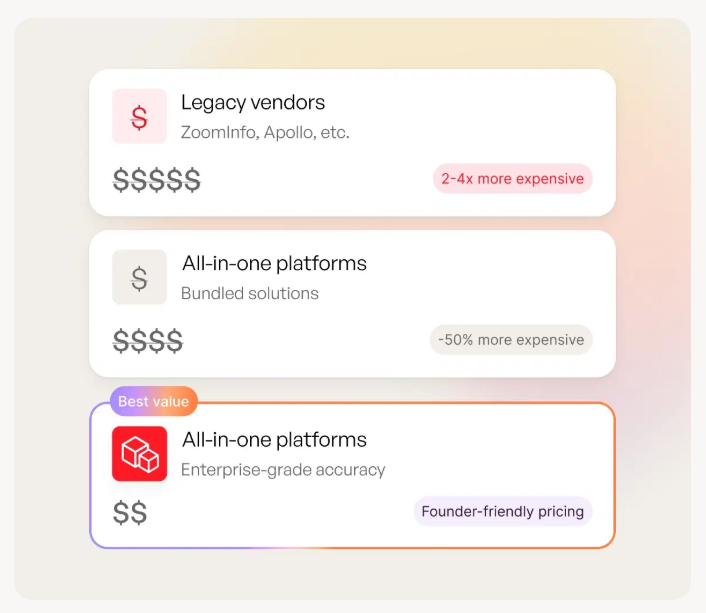
The spread is dramatic. The cheapest option at ~$0.01 per email versus RocketReach at ~$0.64 per lookup is a 64x difference. Snov.io's dual credit-plus-recipient model means your effective cost depends on how many unique contacts you're emailing, not just how many you're finding. Anymail Finder's pay-for-valid model sounds great until you realize the Starter plan caps you at 600 credits per year, though domain searches can return up to 20 valid emails for 1 credit. GetProspect's never-expiring verification packs are a smart add-on for bursty volume.
Watch for catch-all charges. Skrapp bills for catch-all results, while Anymail Finder doesn't charge unless the email is verified deliverable. When you're searching for company emails at scale, these hidden costs can quietly double your effective spend.
The Dropcontact benchmark proved no single tool finds every email. But starting with 98% accuracy and 143M+ verified addresses means fewer bounces, cleaner lists, and a domain reputation that stays intact at scale. Stack Optimize built a $1M agency on that foundation with under 3% bounce rates.
Search 300M+ profiles and only pay for emails that are verified to land.
Free Methods to Find Business Emails
Before you pay for anything, there are manual approaches worth trying - especially if you only need a handful of emails.
Search engine operators. Try site:companydomain.com "email" "contact" "person's name" in Google. DuckDuckGo actually handles "@" symbol searches better than Google, so try "full name" + "@companydomain.com" there.
Check professional profile contact sections. Many professionals list a work email in their public profile contact info. It's the simplest method and often overlooked.
Email permutation + verify. Most companies follow predictable patterns: first.last@domain.com, f.last@domain.com, firstl@domain.com. Generate the likely permutations and verify them with a free tool before sending. Never send to an unverified permutation - one wrong guess to a spam trap can torch your domain reputation.
Company "About" and "Team" pages. Smaller companies often list team emails directly. Larger companies sometimes publish department-level addresses you can use as a starting point.
Waterfall enrichment. Chain 2-3 tools together - run your list through one, take the misses, and run them through a second. This approach yields roughly 30% more valid emails than any single tool alone.
Look, free methods work for 10-20 emails. If you're prospecting at any real volume, the time cost of manual research exceeds the subscription cost of a dedicated tool within the first week.
How to Choose the Right Tool
The right business email address search tool depends on what you're optimizing for.
Biggest free tier: Apollo. 100 credits per month with a 275M+ contact database. Hard to beat for teams testing outbound before committing budget.
All-in-one platform: Snov.io. Finding, sequences, and warm-up in one subscription. The accuracy tradeoff is real, but the workflow simplification matters for lean teams.
Domain search specialist: Hunter. If your workflow starts with a company domain and you need pattern-based email discovery, Hunter's engine is purpose-built for it.
EU/UK data: Cognism. Enterprise pricing, but the European coverage and GDPR compliance are genuinely best-in-class.
Decision-maker targeting: Prioritize tools with title and seniority filters. Prospeo's 30+ filters include C-suite and VP-level targeting, and Cognism's Diamond Data product is built specifically for reaching senior decision-makers.
One approach we've seen work well for mid-market teams: use a primary tool for 80% of your list, then run the gaps through a second tool. Waterfall enrichment isn't just a free-method hack - it's how the best outbound teams maximize coverage without overpaying for a single expensive platform.
FAQ
How do I find business email addresses for free?
Use search operators like site:domain.com "email" "name" or check professional profile contact sections. Email permutation (first.last@domain.com) works if you verify before sending. Tools like Prospeo (75 emails/mo), Hunter (50 credits/mo), and Apollo (100 credits/mo) offer free tiers that cover light prospecting without manual guesswork.
What's the most accurate B2B email finder?
Independent benchmarks show accuracy varies from 79% to 98% across tools. The Dropcontact benchmark, which actually sends emails to measure deliverability, found real enrichment rates topping out around 55% - meaning even the best tools miss nearly half of contacts. Prospeo's 98% verified accuracy and 7-day refresh cycle produce the lowest bounce rates in head-to-head testing.
What's the difference between email finding and email verification?
Finding discovers an email address from a name and company. Verification checks whether that address is actually deliverable. The best tools do both in a single step. A found but unverified email is a bounce waiting to happen - and enough bounces will damage your sender reputation for weeks.
How many email finder tools should I use?
Waterfall enrichment - chaining 2-3 tools sequentially - can yield up to 30% more valid emails than any single tool. Start with one accurate tool as your primary source, then run unmatched contacts through a second. Diminishing returns kick in after three tools.
Do email finders work for small companies?
Coverage drops noticeably for companies under 50 employees. Domain-based tools struggle most because smaller companies have fewer indexed email patterns. Database-driven platforms with 300M+ profiles have better SMB coverage than domain-scraping approaches - but expect lower match rates than you'd get for enterprise targets.