

C-Level or C-Suite? Same Thing - Here's What Actually Matters
People on Reddit genuinely ask whether "C-suite" means middle management. That's not a dumb question - it's a symptom of corporate title inflation creating an alphabet soup nobody can parse. Whether you're looking up c-level or c-suite, you'll land on the same set of roles. And when CDO means Chief Data Officer and Chief Diversity Officer depending on who's talking, confusion is inevitable.
The Quick Version
C-level, C-suite, and CxO are interchangeable terms for a company's most senior executives - the ones with "Chief" in their title. The CEO reports to the board of directors. Every other chief reports to the CEO. That's the hierarchy.
What Does C-Suite Actually Mean?
The "C" stands for Chief. Whether you say C-level, C-suite, or CxO, you're referring to executives who hold ultimate authority over a major function. These roles carry signing authority, board-level visibility, and direct accountability for company performance. If someone has "Chief" in front of their title and sits in the top reporting layer, they're C-suite.
Core C-Suite Roles
| Role | What They Own | Reports To |
|---|---|---|
| CEO | Overall strategy, vision | Board |
| CFO | Finance, capital, risk | CEO |
| COO | Operations, execution | CEO |
| CTO | Technology, product dev | CEO |
| CIO | IT infrastructure, data | CEO |
| CMO | Marketing, brand, demand | CEO |
| CHRO | People, culture, talent | CEO |
| CLO (General Counsel) | Legal, compliance | CEO |
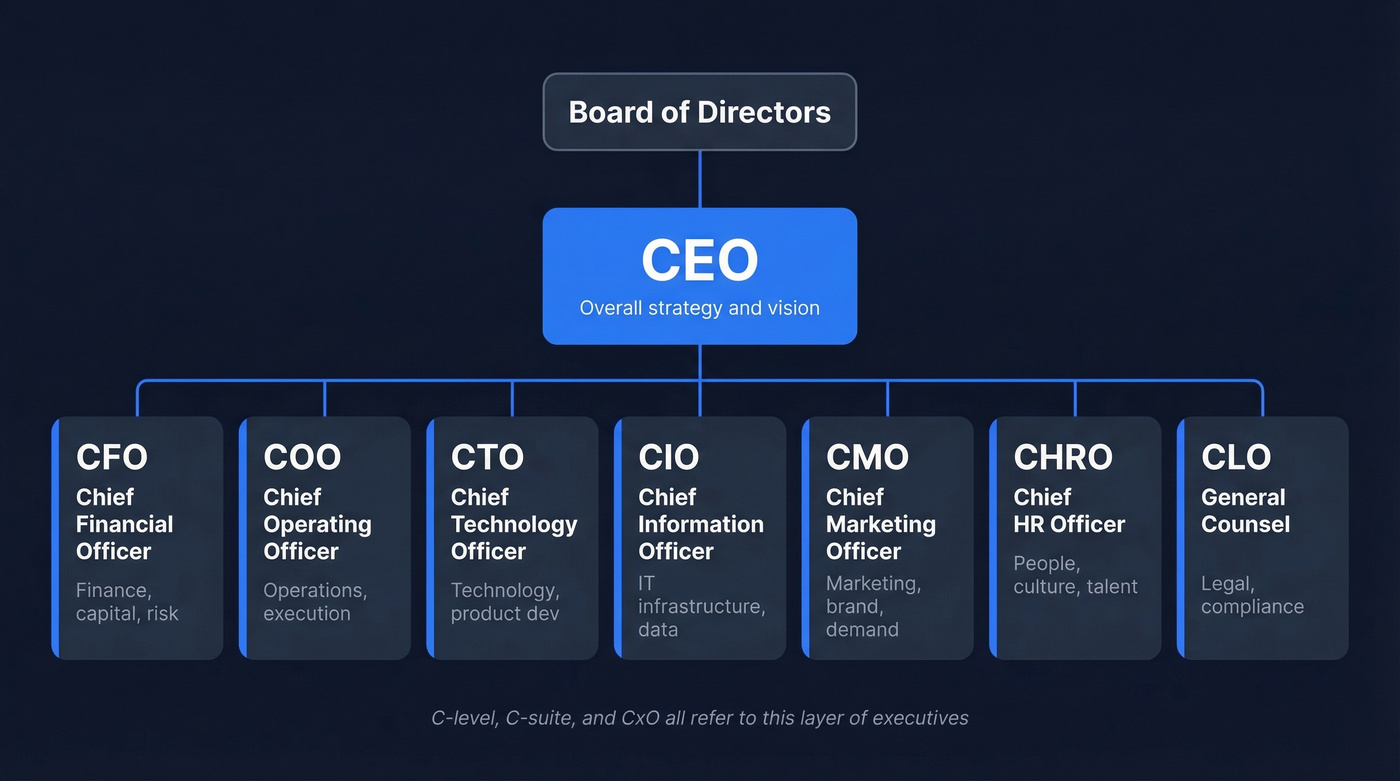
Major public companies typically staff several of these roles. A Series A startup might have a CEO and a head of finance - maybe a CTO if the founders aren't technical. The rest of the functions still exist; they're just handled by VPs or directors.
Watch for acronym collisions: CRO means Chief Revenue Officer at a SaaS company and Chief Risk Officer at a bank. Context matters every time.
As Business.com noted in early 2026, chief officer titles have exploded - but smaller companies often run with a very lean executive team. A 50-person startup with a Chief People Officer, Chief Growth Officer, and a Chief Experience Officer is usually playing dress-up, not building a real org chart.

You just learned what every C-suite role does. Now find the exact executives you need. Prospeo lets you filter 300M+ profiles by title, department headcount, funding stage, and buyer intent - so you're targeting 50 CFOs at Series B SaaS companies, not blasting a generic list. 98% email accuracy. 7-day data refresh.
Stop guessing which exec to email. Search by role and reach them today.
Emerging Roles in 2026
The Chief AI Officer is one of the most important new executive roles of the decade. The number of CAIOs has tripled in the past five years, and in late 2025 alone, UBS, Equinix, U.S. Cyber Command, Truist, and Teradata all made CAIO appointments. This isn't a fad. IBM research shows companies now use an average of 11 AI models and expect 16 by end of 2026, and 76% of CAIOs say other executives already consult them on AI decisions - which tells you how fast this role is becoming a power center.
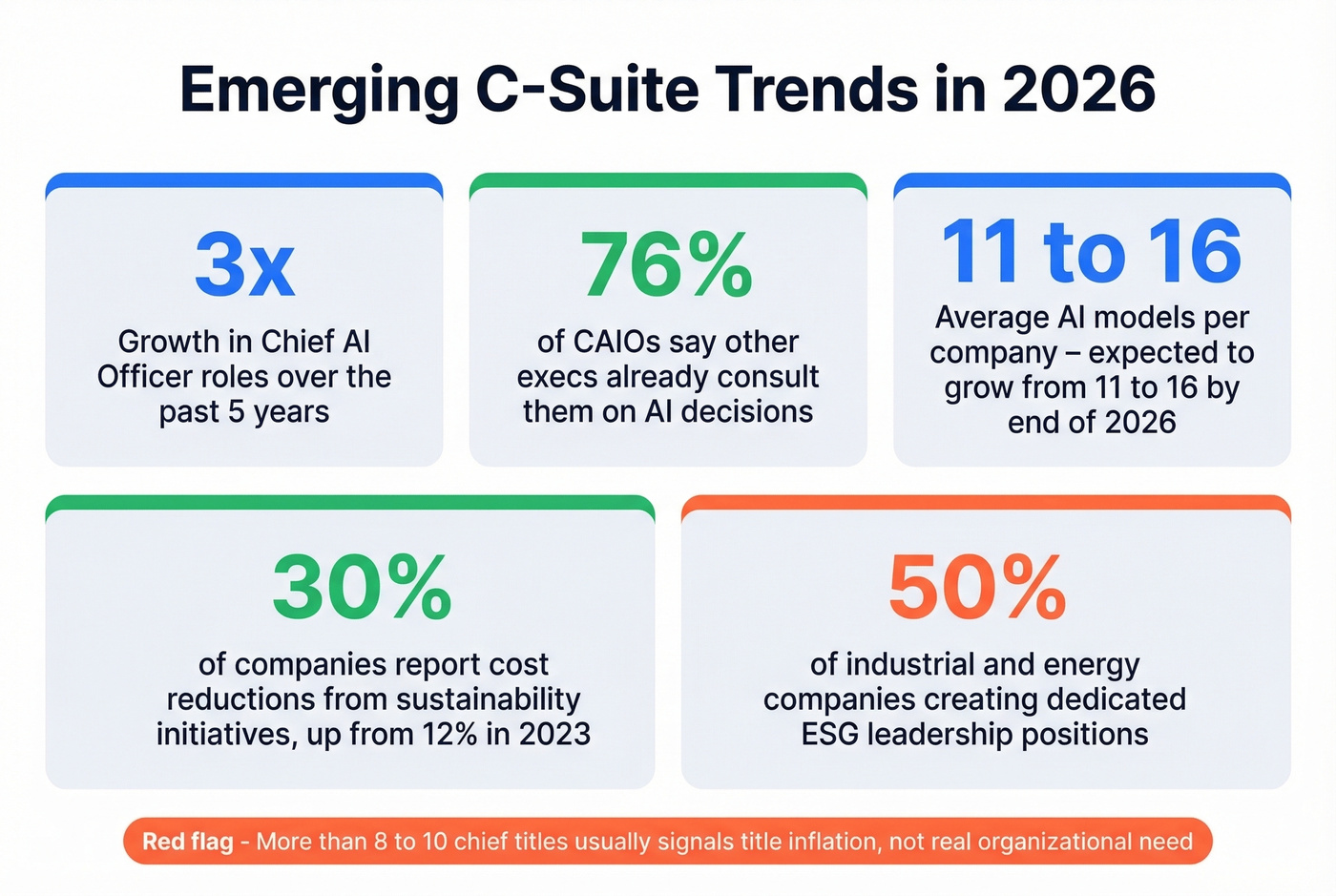
Half of companies now have four or more tech-focused chief officers. On the sustainability side, 92.7% of executives say sustainability is important to their business, and 30% report cost reductions from sustainability initiatives - up from just 12% in 2023. That's why 50% of industrial and energy companies are creating dedicated ESG leadership positions.
Here's the thing: having more than 8-10 chief titles is a red flag. Every new "chief" dilutes the authority of existing ones. A tighter executive team usually creates clearer ownership and faster decisions, while VPs can own plenty of critical functions without needing a "Chief" title. Not every emerging role deserves a board seat - IESE Business School points out that roles like Chief Wellbeing Officer don't generally have one, and for good reason.
What C-Level Executives Actually Do
The #1 question on Reddit about executives is some version of "what do they actually do all day?" Fair question. The work is strategy, stakeholder management, capital allocation, crisis response, and board-facing communication - sometimes all before lunch. One consultant who advised executives for 16 years estimated that roughly 65% of C-level decisions are never fully implemented by employees. The hardest part of the job isn't making decisions - it's getting an organization to execute them.
Most guides describe titles, not work. The real question isn't "what does CFO stand for" - it's "what does a CFO actually do on a Tuesday afternoon?" The answer is usually some combination of reviewing forecasts, negotiating with lenders, and telling the CEO what they can't afford.
C-Suite Compensation in 2026
Pay gaps within the executive ranks are wider than most people realize, and they're getting worse. In the Russell 3000, CFOs earn 37-39% of CEO pay. COOs do slightly better at about 42%. In the S&P 500, the gap is even larger: CFO pay sits around 35% of CEO pay and COO pay around 38%, reflecting a "ratchet effect" where CEO benchmarking pushes compensation up faster than everyone else's.
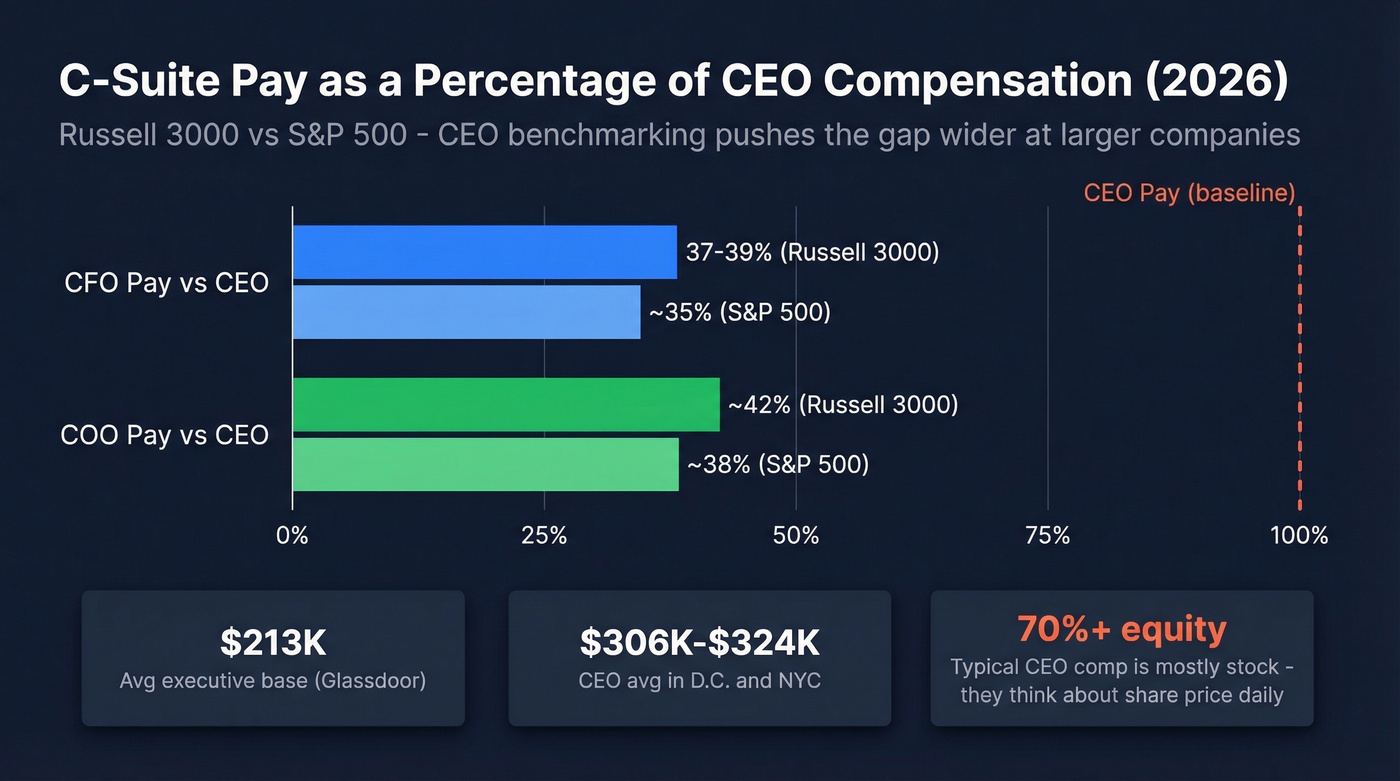
For context, Glassdoor data puts the average corporate executive at about $213K base and $249K total cash. CEO-specific averages vary dramatically by geography - $306K in D.C., $324K in New York, $275K in California. At Fortune 500 companies, total compensation can be multiples higher once bonuses and equity are included.
Let's be honest: if you're selling to executives, understanding their comp structure tells you something about their priorities. A CEO whose package is 70% equity thinks about stock price every single day. A CFO benchmarked at 37% of CEO pay is laser-focused on proving ROI to justify their seat.
How to Reach C-Level Decision-Makers
Understanding whether someone is c-level or c-suite is a moot distinction - the terms are identical. What actually matters is reaching the right person. We've seen outbound teams waste weeks chasing generic info@ addresses that never reach an executive's inbox. Skip that entirely. Tailor your messaging to role-specific KPIs instead: a CFO cares about margin impact, a CTO cares about scalability and integration risk, a CMO cares about pipeline contribution.
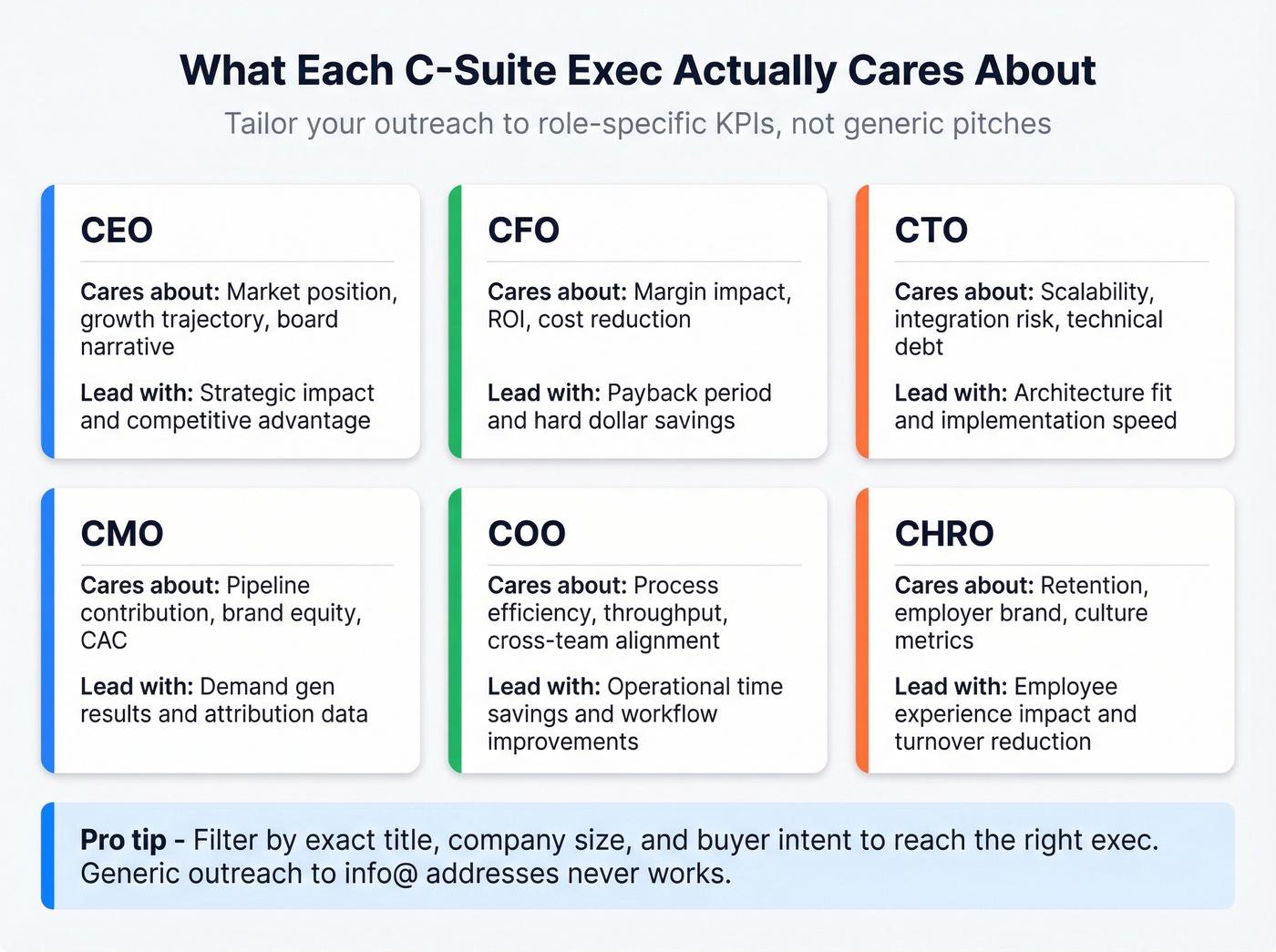
In our experience, the teams that book the most executive meetings combine tight role targeting with verified contact data. Prospeo's database covers 300M+ professional profiles with 98% email accuracy and 125M+ verified mobile numbers - search by title, company size, and 30+ filters to find the exact executive you need. Data refreshes every 7 days, so you're not emailing someone who changed roles six weeks ago.
One more thing: if your current data provider doesn't let you filter by department headcount, funding stage, or buyer intent signals, you're doing executive outreach with one hand tied behind your back. Those filters are the difference between "spray and pray" and a targeted list of 50 CFOs at Series B SaaS companies who are actively evaluating your category.
Your outbound to C-level buyers is only as good as your data. Teams using Prospeo book 26% more meetings than ZoomInfo users and 35% more than Apollo - because 98% verified emails and 125M+ direct dials actually connect you to the decision-maker. At $0.01 per email, bad data is no longer an excuse.
Verified executive contacts at 90% less than ZoomInfo. No contracts required.
FAQ
Is C-level the same as C-suite?
Yes - they're interchangeable. Both refer to executives with "Chief" in their title: CEO, CFO, CTO, CMO, and so on. CxO is a third synonym. Use whichever term you prefer; everyone in business understands all three.
What level is below C-suite?
The layer directly below is typically EVP or SVP, followed by VP, then Director. The exact structure depends on company size. VPs often handle functions that don't have a dedicated chief - a VP of Partnerships, for example, when there's no Chief Partnerships Officer.
How many C-suite roles does a company need?
Startups need one to three - a CEO plus a finance leader at minimum. Enterprise companies typically run seven to ten. More than ten often signals title inflation rather than real organizational need.
What's the fastest way to find verified contact data for executives?
Filter by exact title, company size, industry, and buyer intent to surface chief officers with verified emails and direct mobile numbers. Prospeo's free tier includes 75 email credits per month - enough to test outreach to a targeted executive list without any commitment.