

C-Suite Positions: What Every Role Actually Does, Earns, and How Long They Last
234 global CEO departures in 2025 alone - a 16% jump over the prior year, according to Russell Reynolds. Meanwhile, the average CEO earns 281 times what a typical worker makes. C-suite positions have never been more volatile, more scrutinized, or more confusing to decode from the outside.
The "C" stands for Chief. The "suite" refers to the cluster of top executives who collectively steer a company's strategy, finances, operations, and culture. The term comes from the physical corner offices these leaders historically occupied - though today, most of them are on Zoom calls from home offices like everyone else. What hasn't changed is the concentration of power, compensation, and accountability at this level.
Quick Reference Table
Bookmark this. It's the fastest way to compare scope, tenure, and pay across the core executive roles.
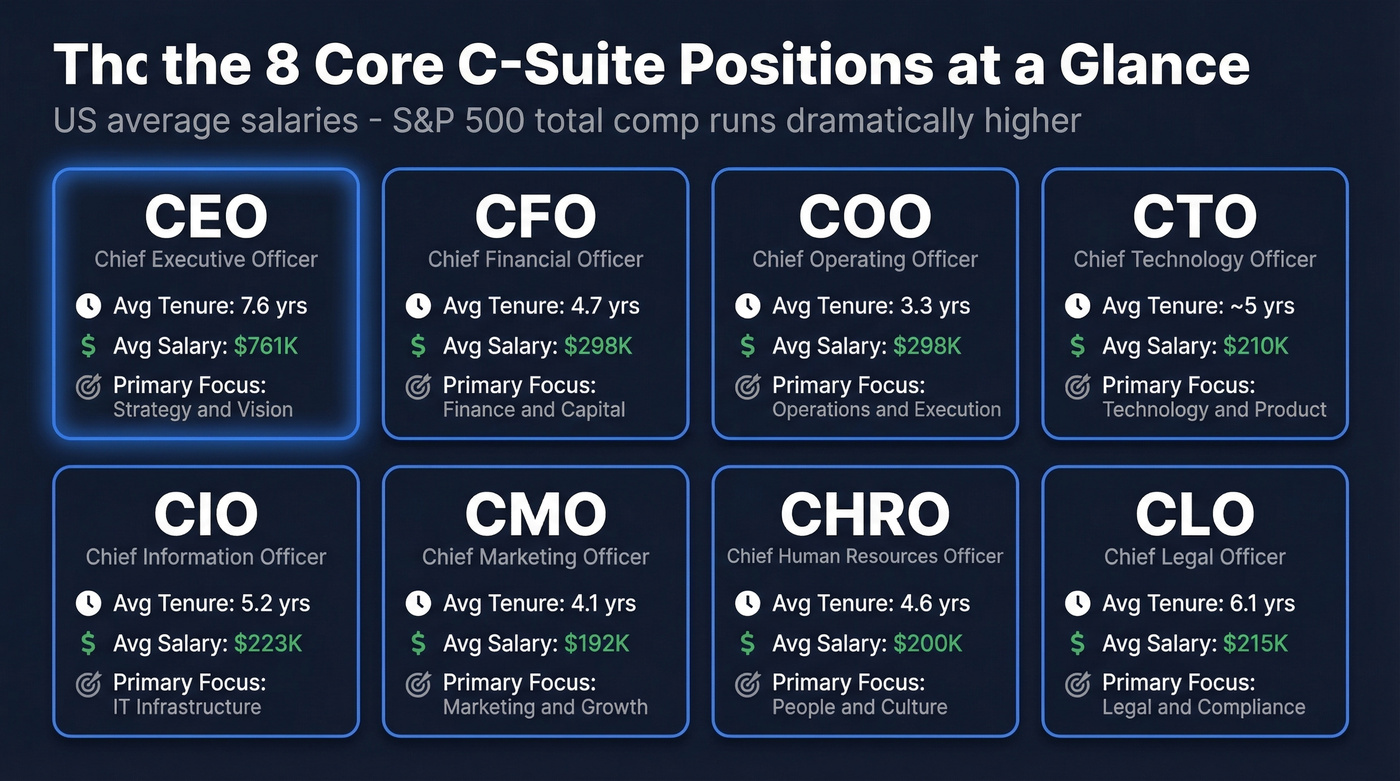
| Role | Reports To | Primary Focus | Avg Tenure | Avg US Salary |
|---|---|---|---|---|
| CEO | Board | Strategy & vision | 7.6 yrs | $761K |
| CFO | CEO | Finance & capital | 4.7 yrs | $298K |
| COO | CEO | Operations & execution | 3.3 yrs | $298K |
| CTO | CEO | Technology & product | ~5 yrs | $210K |
| CIO | CEO/COO | IT infrastructure | 5.2 yrs | $223K |
| CMO | CEO | Marketing & growth | 4.1 yrs | $192K |
| CHRO | CEO | People & culture | 4.6 yrs | $200K |
| CLO | CEO | Legal & compliance | 6.1 yrs | $215K |
Salary figures represent US averages. S&P 500 total comp - equity, bonuses, and long-term incentives included - runs dramatically higher. We'll get into that gap shortly.
Every Core Role Explained
CEO (Chief Executive Officer)
The CEO is the final decision-maker. Every other C-level executive ultimately reports here, and the CEO reports to the board of directors. Average tenure sits at 7.6 years - the longest in the suite - though that number is compressing fast: 8.3 years in 2021, 7.4 in 2024, and 7.1 years by 2025.
Here's what surprises people: 76% of S&P 500 CEOs are promoted from within. The "parachute in a turnaround artist" narrative makes headlines, but the data says most boards bet on insiders. A typical CEO week involves board prep, investor meetings, strategic planning sessions, and the constant triage of competing priorities from every other executive on this list. Everything else gets delegated - which is why the rest of these roles exist.
CFO (Chief Financial Officer)
The CFO controls the financial engine: budgeting, forecasting, capital structure, investor relations, and risk management. In public companies, the CFO is often the second-most visible executive after the CEO, especially during earnings calls.
Day-to-day, the CFO reviews cash flow projections, signs off on major expenditures, and meets with analysts and lenders. Compensation typically runs 34-39% of the CEO's total package. Average tenure is 4.7 years, and 64% are internal promotions. The modern CFO isn't just a bean counter - they're expected to model scenarios, evaluate M&A targets, and increasingly, quantify the ROI of AI investments.
COO (Chief Operating Officer)
Let's be honest: the COO is the most misunderstood role in the C-suite. There's no universal job description because the COO's scope is literally defined by whatever the CEO doesn't want to do - or isn't good at. In some companies, the COO runs day-to-day operations. In others, they're the heir apparent being groomed for the top job. In a few, the role doesn't exist at all.
Tenure is the shortest of any executive-level position at just 3.3 years, and a striking 24% of COOs are in their first year. Yet 80% are internal hires - the highest insider rate of any role. That combination tells you something: companies promote operational leaders fast, burn through them fast, and rarely look outside for the replacement. A recurring question on r/careeradvice and similar forums is whether the COO role is even necessary. The answer depends entirely on the CEO's weaknesses.
CTO (Chief Technology Officer)
The CTO owns the technology vision: what gets built, how it's architected, and where the product roadmap is heading. In product-led companies, the CTO is arguably the second-most important role after the CEO. In non-tech enterprises, the CTO often focuses on innovation and R&D while the CIO handles infrastructure.
On any given day, the CTO is reviewing architecture decisions, meeting with engineering leads on sprint priorities, and evaluating build-vs-buy tradeoffs. The key distinction from the CIO is outward vs. inward: the CTO builds what the company sells or uses to differentiate. The CIO keeps the lights on.
CIO (Chief Information Officer)
The CIO manages internal technology infrastructure - enterprise systems, cybersecurity posture, data architecture, and vendor relationships. Average tenure is 5.2 years, right at the S&P 500 functional C-suite average. A typical week involves vendor negotiations, security reviews, system uptime monitoring, and budget allocation across IT projects.
What's notable: 54% of CIOs are external hires, and 52% of those come from a different industry entirely. That's the highest cross-industry hire rate of any C-level role. Companies value fresh perspective in IT leadership more than institutional knowledge - because legacy systems breed legacy thinking.
CMO (Chief Marketing Officer)
The CMO owns brand, demand generation, customer acquisition, and increasingly, revenue attribution. Tenure is the second-shortest at 4.1 years. When growth stalls, the CMO is the first executive replaced.
Day-to-day, the CMO reviews campaign performance dashboards, aligns messaging with product launches, and defends the marketing budget in executive meetings. The 62% internal promotion rate is middling - boards want someone who understands the brand, but they're not afraid to bring in outside talent when the growth playbook needs rewriting. CMO compensation typically runs 22-28% of the CEO's total package, making it one of the lower-paid seats at the table.
CHRO (Chief Human Resources Officer)
The CHRO - sometimes called Chief People Officer - manages talent strategy, organizational design, compensation philosophy, DEI programs, and culture. This role gained significant strategic weight after 2020. The pandemic, remote work debates, and labor market volatility pushed people strategy from a support function to a board-level conversation.
Average tenure is 4.6 years, with 57% promoted internally. The CHRO increasingly has a seat in M&A discussions, since cultural integration is where deals die, and in technology decisions around workforce impact of AI.
CLO (Chief Legal Officer)
The CLO - also General Counsel in many organizations - oversees legal risk, regulatory compliance, IP protection, and governance. At 6.1 years, the CLO has the longest average tenure of any non-CEO role. That stability makes sense: legal institutional knowledge compounds, and switching legal leaders mid-litigation is painful.
A typical CLO week involves reviewing contracts, advising the board on regulatory exposure, and managing outside counsel relationships. The CLO is also the most externally hired role after the CIO, with 53% coming from outside the company. Many arrive from law firms or regulatory bodies, bringing specialized expertise that's hard to develop internally.
Emerging C-Suite Titles in 2026
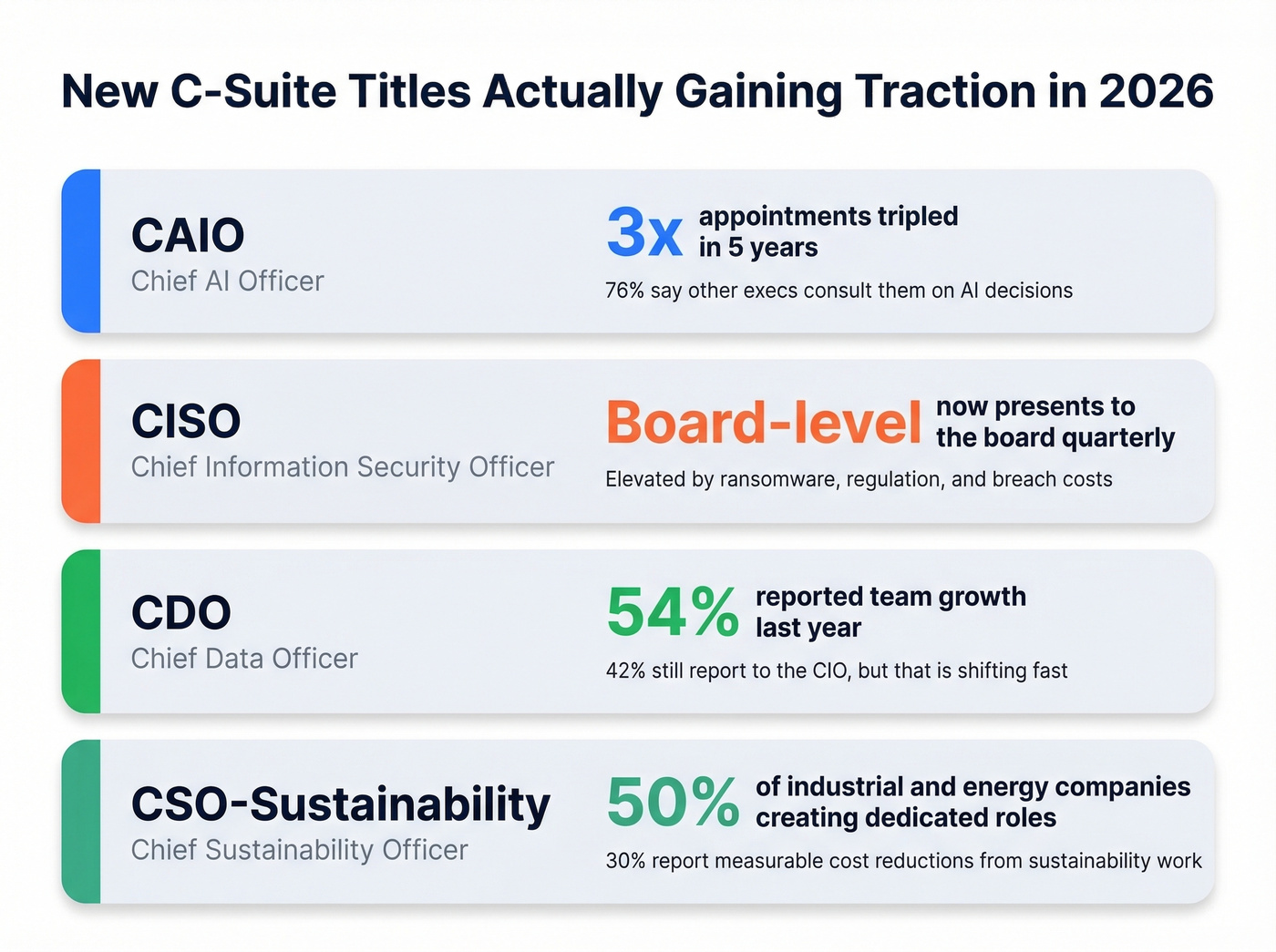
The C-suite is expanding. Deloitte's research shows half of companies now have four or more C-level technology roles alone. Here are the titles actually gaining traction - not just vanity labels on someone's profile.
CAIO (Chief AI Officer)
The fastest-growing title by adoption rate - CAIO appointments have tripled in five years. IBM research shows 76% of CAIOs say other executives consult them on AI decisions, which suggests the role carries real influence rather than being a figurehead appointment. Companies currently use 11 AI models on average and expect to run 16 by end of 2026. Someone needs to own that sprawl.
CISO (Chief Information Security Officer)
The CISO has moved from a technical niche to a board-level concern, particularly in tech and financial services. Ransomware, regulatory pressure, and the reputational cost of breaches have elevated this role from "reports to the CIO" to "presents to the board quarterly."
CDO (Chief Data Officer)
Expanding rapidly in financial services, where 54% of CDOs reported team growth last year and 35% saw significant budget increases. Currently, 42% of CDOs report to the CIO, but that reporting line is shifting as data strategy becomes distinct from IT operations.
CSO-Sustainability (Chief Sustainability Officer)
No longer a PR hire. In industrial and energy companies, 50% are creating dedicated ESG/sustainability roles - up from 34% with dedicated positions in 2023. And 30% report measurable cost reductions from sustainability initiatives, up from 12% two years prior. The ROI case is getting harder to ignore.
Companies like Salesforce, IBM, and Microsoft have also created Chief Ethics and Responsible AI Officer positions, though titles vary. We've seen this pattern before with the CDO a decade ago - it starts as a side responsibility, then gets its own budget and headcount. Expect this to consolidate as AI regulation tightens.
The Acronym Problem
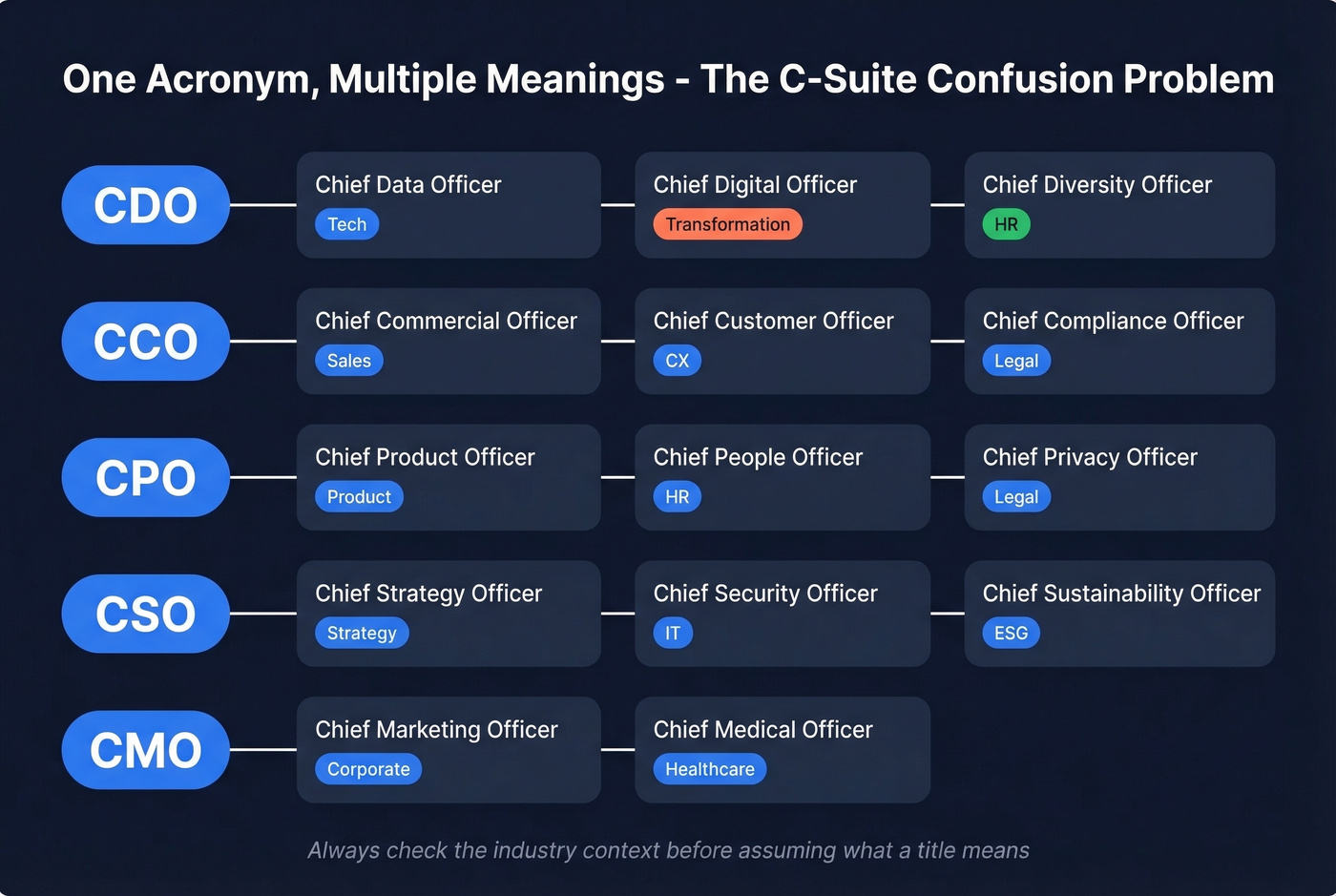
One of the genuinely frustrating things about executive titles is that the same three-letter acronym can mean completely different things depending on the industry.
| Acronym | Meaning 1 | Meaning 2 | Meaning 3 | Context |
|---|---|---|---|---|
| CDO | Chief Data Officer | Chief Digital Officer | Chief Diversity Officer | Tech vs. transformation vs. HR |
| CCO | Chief Commercial Officer | Chief Customer Officer | Chief Compliance Officer | Sales vs. CX vs. legal |
| CPO | Chief Product Officer | Chief People Officer | Chief Privacy Officer | Product vs. HR vs. legal |
| CSO | Chief Strategy Officer | Chief Security Officer | Chief Sustainability Officer | Strategy vs. IT vs. ESG |
| CMO | Chief Marketing Officer | Chief Medical Officer | - | Corporate vs. healthcare |
The CMO confusion is particularly common in healthcare, where Chief Medical Officer is the standard meaning and Chief Marketing Officer barely exists as a title. If someone in a hospital system tells you they report to the CMO, they're talking about a physician executive, not a brand strategist.
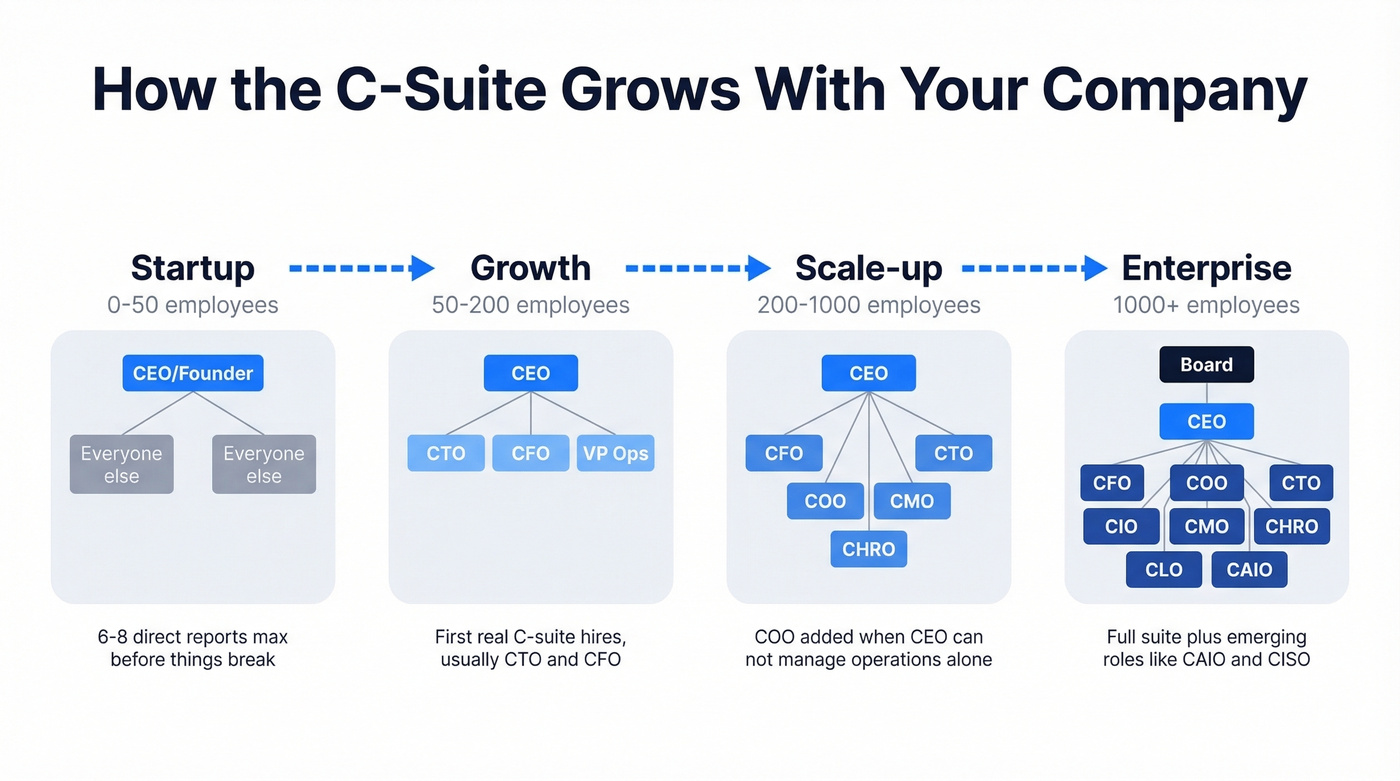
Org Chart by Company Stage
Stop memorizing 30 acronyms. Most companies need three to five chiefs, and the right number depends entirely on headcount and complexity.
Startup (0-50 Employees)
At this stage, the org chart is flat and the CEO is doing everything. Between 0 and 10 employees, everyone reports to the founder - maybe the founder plus one engineering lead. A single leader can handle roughly 6-8 direct reports before things start breaking.
By the time you hit 50 employees, you likely need heads of sales, engineering, product, people, and finance. Whether those people carry "Chief" titles depends on your fundraising stage and recruiting ambitions. A Series A company giving out C-titles to everyone will regret it at Series C when they need to hire above those people.
Mid-Market (50-500 Employees)
This is where the COO and CFO become essential. The CEO can't run operations and strategy simultaneously at this scale. Expect 4-8 C-suite roles, with specialized positions emerging based on industry - a CISO in fintech, a CMO in consumer brands, a CPO in product-led SaaS.
Fractional and interim C-suite hires are increasingly common here. A fractional CFO or interim CTO gives mid-market companies the expertise without the full-time salary commitment - and the talent pool for these arrangements has exploded since 2020.
This is also where the CTO vs. CIO split starts to matter. Below 50 employees, one person handles both. Above 200, you probably need separate leaders for product technology and internal systems. In our experience, this distinction trips up even seasoned executives who've only worked at one scale.
Enterprise (500+ / Public)
Large public companies typically staff 10-17+ executive-level positions, including the full complement of emerging roles. Spencer Stuart's Fortune 500 analysis shows the average S&P 500 company has added 3-5 new C-level positions over the past decade, driven by regulatory complexity, digital shifts, and stakeholder expectations.
At this scale, the org chart isn't just about who reports to the CEO - it's about which roles report to the COO, which report to the CFO, and which have dotted-line relationships to the board.

CEOs last 7.6 years. CMOs last 4.1. Every executive transition is a prospecting window - if you have the right contact data. Prospeo tracks 300M+ professionals with 98% email accuracy and 125M+ verified mobile numbers, so you reach the new decision-maker before your competitors even know they got the job.
Stop selling to last quarter's org chart. Get real-time C-suite contacts.
What C-Suite Executives Earn
Salary Ranges by Role
The gap between "average base salary" and "total compensation at a public company" is staggering, and most articles blur the two together. We wanted to separate them clearly.
| Role | US Avg Base | S&P 500 Total Comp | Private Co. Base | % of CEO Comp |
|---|---|---|---|---|
| CEO | $761K | ~$18.9M | $323,500 | 100% |
| CFO | $298K | ~$6-7M | ~$200-250K | 34-39% |
| COO | $298K | ~$5-7M | ~$200-250K | 30-38% |
| CIO | $223K | ~$3-5M | ~$175-220K | 25-30% |
| CTO | $210K | ~$3-5M | ~$170-210K | 22-30% |
| CLO | $215K | ~$4-6M | ~$175-215K | 25-33% |
| CHRO | $200K | ~$3-5M | ~$160-200K | 22-28% |
| CMO | $192K | ~$3-4M | ~$155-190K | 22-28% |
The private-company CEO median base of $323,500 versus the S&P 500 average total comp of $18.9M is roughly a 58x gap. That's the difference between "well-paid executive" and "generational wealth in a single year."
For context, UK CEO salaries are materially lower than US levels, and the gap widens further in continental Europe. The US remains the global outlier for executive compensation.
How Executive Comp Is Structured
Base salary is the smallest piece for public-company executives. The real money comes from equity grants, annual bonuses, long-term incentive plans, and performance-based payouts. CEO and executive pay at major US companies has increased over 30% since 2019, while inflation over the same period ran roughly 19%.
Clawback policies are increasingly standard - boards can recoup bonuses and equity if financial results are later restated or if executives engage in misconduct. For 2026, 68% of private-company CEOs expect a base salary increase, with 21% projecting raises above 5% - the highest proportion among all title levels.
The CEO Pay Ratio
Here's the number that puts everything in perspective. In 2024, CEOs at major US companies earned 281 times what a typical worker made. In 1965, that ratio was 21-to-1. It peaked at 408-to-1 in 2021, before declining as equity valuations normalized.
Look - if your company has fewer than 200 employees and average deal sizes under $50K, you don't need a CEO making $750K. The compensation benchmarks in this article reflect large-company norms. Most mid-market CEOs earn $200-350K base, and that's perfectly appropriate for the scale.
The long-term trend is striking: CEO compensation grew 1,094% between 1978 and 2024. Typical worker compensation grew 26% over the same period. That's not a typo. The AFL-CIO's independent analysis corroborates the scale, pegging the S&P 500 ratio at 285-to-1 with average CEO pay of $18.9M.
Tenure, Turnover, and Hiring Patterns
The average sitting S&P 500 C-suite leader has been in their role for 5.2 years. But that average masks enormous variation by function.
| Role | Avg Tenure | Internal Hires | External Hires | % External from Different Industry |
|---|---|---|---|---|
| CEO | 7.6 yrs | 76% | 24% | ~15% |
| CLO | 6.1 yrs | 47% | 53% | ~49% |
| CIO | 5.2 yrs | 46% | 54% | ~52% |
| CFO | 4.7 yrs | 64% | 36% | ~25% |
| CHRO | 4.6 yrs | 57% | 43% | ~46% |
| CMO | 4.1 yrs | 62% | 38% | ~30% |
| COO | 3.3 yrs | 80% | 20% | ~10% |
CEO turnover hit record levels in 2025. Challenger, Gray & Christmas tracked 446 public-company CEO exits - the highest since they began tracking in 2002. Russell Reynolds counted 234 global CEO departures, up 16% year-over-year and 21% above the eight-year average. Nearly 40% of departing CEOs left within their first five years.
The pattern is clear: boards are less patient, activist investors are more aggressive, and the "lifetime CEO" era is over.
Overall, 59% of S&P 500 functional C-suite leaders were promoted from within, but the insider/outsider split varies dramatically by role. COOs are almost always homegrown at 80%. CIOs and CLOs are more likely to come from outside - and often from entirely different industries. Chief Communications Officers are also heavily externally sourced, with 57% hired from outside the company.
Industry-Specific Variations
Healthcare
In healthcare, the C-suite looks fundamentally different. The CMO is the Chief Medical Officer - a physician executive overseeing clinical quality and patient safety. You'll also find a Chief Nursing Officer, Chief Experience Officer, and Chief Compliance Officer. The regulatory density in healthcare creates leadership positions that simply don't exist in other industries.
Financial Services
Financial services is where the CDO expansion is most visible. Deloitte's 2025 CDO survey found 54% of Chief Data Officers reported team growth, 35% saw significant budget increases, and 42% report directly to the CIO. The CRO - Chief Risk Officer - is also a mainstay in banking and insurance, a role that barely exists outside regulated industries.
Technology
Tech companies lead adoption of the CAIO, CISO, and Chief Ethics Officer roles. The CISO has become a board-level position at most major tech firms, and the CAIO is increasingly a standalone role rather than a hat worn by the CTO. Skip this section if you're not in tech - the titles above are what matter for most industries.
How to Reach the C-Suite
Most C-level executives have 15-25 years of progressive experience. There's no shortcut, but there are patterns that separate people who get there from people who plateau at VP.
Korn Ferry's research highlights a frustrating Catch-22: the best roles aren't posted publicly. They're filled through board networks, executive recruiters, and internal succession plans. If you're not building relationships with executive search firms by your late 30s, you're already behind.
A practical warning sign: if you've been in the same role for 3+ years without expanding your scope or acquiring new skills, you're likely stuck. The executives who reach the C-suite tend to move laterally across functions, take P&L ownership early, and volunteer for the messy transformation projects that nobody else wants.
The skills that matter most at this level aren't functional expertise - it's strategic vision, financial acumen, and increasingly, digital and AI literacy. Harvard Business Review's analysis of executive competencies consistently ranks cross-functional leadership and stakeholder management above deep domain knowledge. Reaching a senior business leadership role requires demonstrating you can think across the entire organization, not just within your function.
How to Contact C-Suite Executives
Understanding what each role does is one thing. Actually getting in front of these people is another problem entirely.
C-suite executives are shielded by executive assistants, generic contact forms, and layers of middle management. A cold email to info@company.com isn't reaching the CFO. I've watched sales teams burn weeks chasing generic inboxes when a verified direct email would have gotten a response in 48 hours.
The difference between getting through and getting ignored comes down to verified contact data. Whether you're a sales rep targeting CFOs or a recruiter filling a CTO role, you need direct emails and phone numbers - not guesses. Prospeo covers 300M+ professional profiles with 98% email accuracy and 125M+ verified mobile numbers, refreshed every seven days so you're not emailing someone who left the company two months ago. If you're building outbound motions, pair that with a repeatable sales prospecting system and a clean lead generation workflow.
76% of S&P 500 CEOs are promoted from within. That means your champion from last year could be tomorrow's budget holder. Prospeo's job change filters and 7-day data refresh catch these moves in real time - not six weeks later like other providers.
Track C-suite job changes the week they happen, not the month after.
FAQ
What does C-suite stand for?
The "C" stands for "Chief" and "suite" refers to the collective group of top executives - Chief Executive Officer, Chief Financial Officer, Chief Technology Officer, and so on. It's shorthand for the highest-ranking leadership team in a company, all sharing that "Chief" prefix.
What's the highest-ranking C-suite position?
The CEO. Every other chief officer reports to the CEO, who in turn reports to the board of directors. Average CEO tenure is 7.6 years, and 76% of S&P 500 CEOs are promoted from within rather than hired externally.
How many C-suite positions does a company need?
Startups under 50 employees typically need one to three C-suite roles. Mid-market companies (50-500 employees) usually staff four to eight. Large enterprises and public companies run 10-17+ positions, including emerging roles like CAIO, CISO, and CSO.
What's the difference between C-suite and VP?
C-suite executives set company-wide strategy and report to the CEO or board. VPs execute within a specific function and report to a C-level executive. The gap in scope, compensation, and accountability is significant - S&P 500 C-suite total comp averages $3-7M versus $300-600K for most VPs.
How do you find contact information for C-suite executives?
Most executives aren't reachable through generic company emails or contact forms. B2B data platforms provide verified emails and direct phone numbers for decision-makers. The key is data freshness - executive turnover is high, so weekly-refresh databases outperform those that update monthly or quarterly.