

The Channel Sales Enablement Playbook: From Strategy to Execution in 2026
Your CEO just came back from a conference and announced you're "going channel." Now you've got a Slack thread full of questions, zero foundation, and a revenue target that assumes partners will start selling next quarter. Sound familiar?
Welcome to channel sales enablement - where 71% of leaders expected partner revenue to climb more than 10% in Demand Gen Report's most recent benchmark, but most programs stall because nobody built the engine first. The average software company now runs 10.5 simultaneous GTM efforts. Channel is the one most likely to get bolted on without a plan. That's what this playbook fixes - from framework to tools to the mistakes that kill programs before they produce a single deal.
Quick Orientation
Starting from zero? Build onboarding and deal registration before you buy any platform. Process matters more than software.
Partners aren't selling? Diagnose with the Don't Know / Can't Do / Won't Do framework below. The fix depends on which bucket they fall into.
Need a tool? Start with Salesforce PRM ($25/user/mo) or Channeltivity ($1,899/mo) - not a $76K/year enterprise platform you'll use as a glorified SharePoint.
What Is Channel Sales Enablement?
Channel sales enablement is the practice of equipping external partners - resellers, VARs, MSPs, system integrators - with the training, content, tools, and deal support they need to sell your product effectively. It's not channel partner management, which focuses on the relationship itself: contracts, tiers, MDF. Enablement is specifically about making partners capable and confident sellers.
The core components fit in one sentence: onboarding, sales and technical training, co-branded content, deal registration and support, and co-selling workflows. Get those five right and partners sell. Miss any of them and you've got a partner page on your website and not much else.
Channel Enablement vs. Direct Enablement
The biggest mistake companies make is copying their internal sales enablement playbook for partners. It doesn't translate.
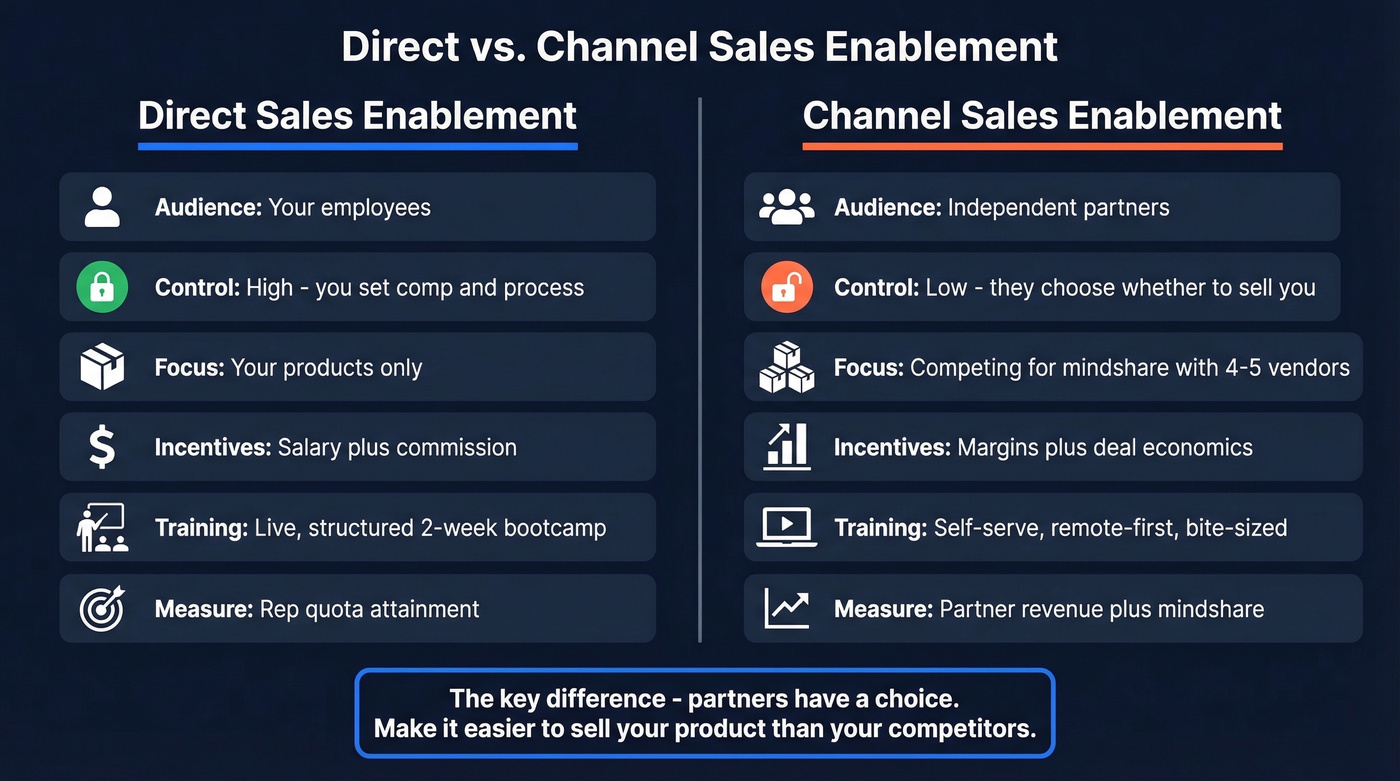
| Dimension | Direct Sales Enablement | Channel Enablement |
|---|---|---|
| Audience | Your employees | Independent partners |
| Control | High - you set comp | Low - they choose you |
| Competing priorities | Your products only | Multiple vendors |
| Incentives | Salary + commission | Margins + deal economics |
| Training delivery | Live, in-person | Self-serve, remote-first |
| Measurement | Rep quota attainment | Partner revenue + mindshare |
Internal reps get a structured two-week bootcamp with daily coaching. Partners get a portal login and a PDF. Then leadership wonders why partners aren't productive in 90 days.
Here's the thing: "partner mindshare" is the concept that matters most. Your partners represent multiple vendors. They'll shift focus to whichever vendor makes it easiest to sell and earn. If your enablement is harder to consume than your competitor's, you lose - regardless of product quality.
Why It Matters More in 2026
TSIA's research on channel partnerships identifies a concept they call "Channel Drift" - the widening gap between modern SaaS offerings and outdated partner structures built for the resale era. AI is accelerating this drift fast. Partners aren't just reselling licenses anymore; they're expected to drive adoption, integration, optimization, and expansion across the customer lifecycle.
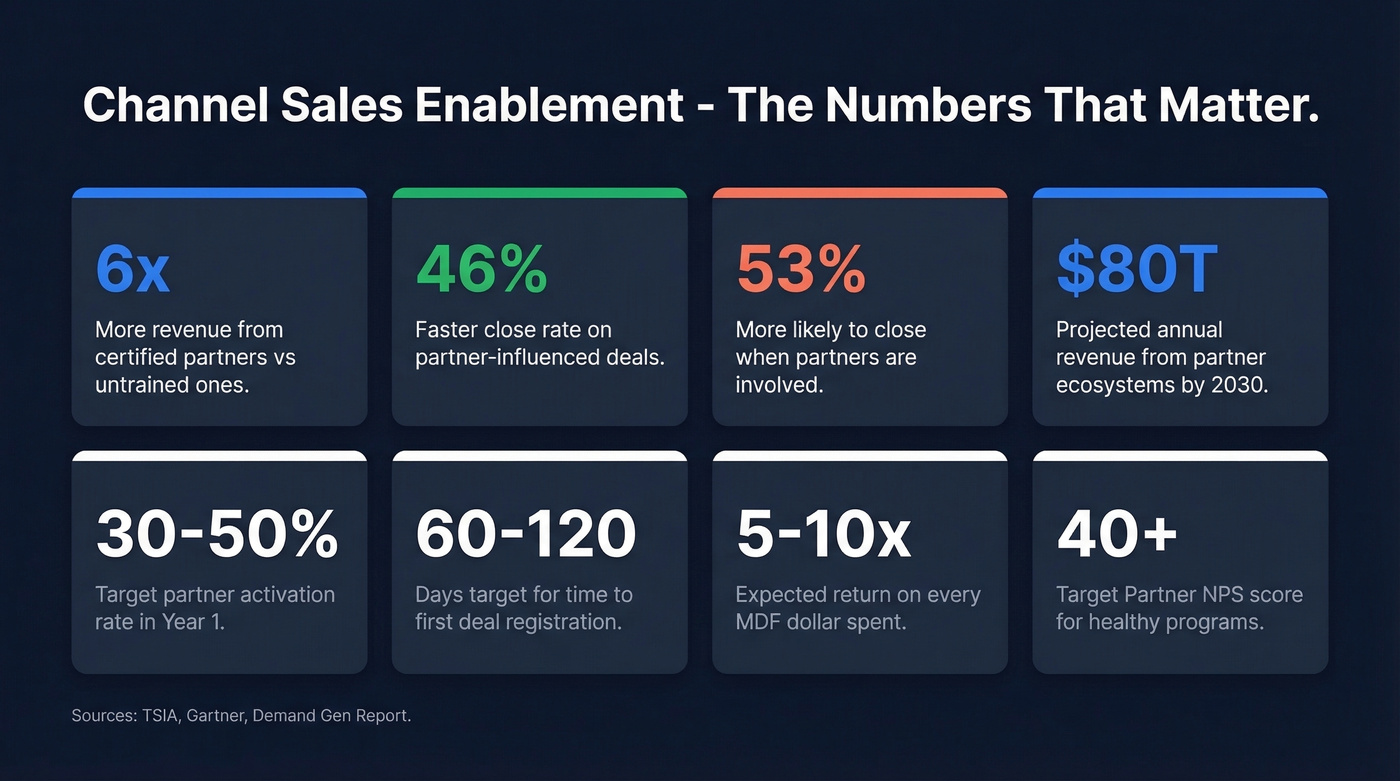
Gartner frames the payoff in four parts: more deals, bigger deals, faster deals, and better margins. Partner ecosystems are projected to drive $80 trillion in annual revenue by 2030. Mature partner programs drive 2x revenue growth and can contribute up to 28% of total company revenue. Companies with tailored sales playbooks see a 49% higher win rate on forecasted deals.
Let's be honest: most companies don't have a channel problem - they have an enablement problem. The partners are willing. The market is massive. But vendors hand partners a product PDF, point them at a portal, and call it a program. That's not enablement. That's abandonment with extra steps.
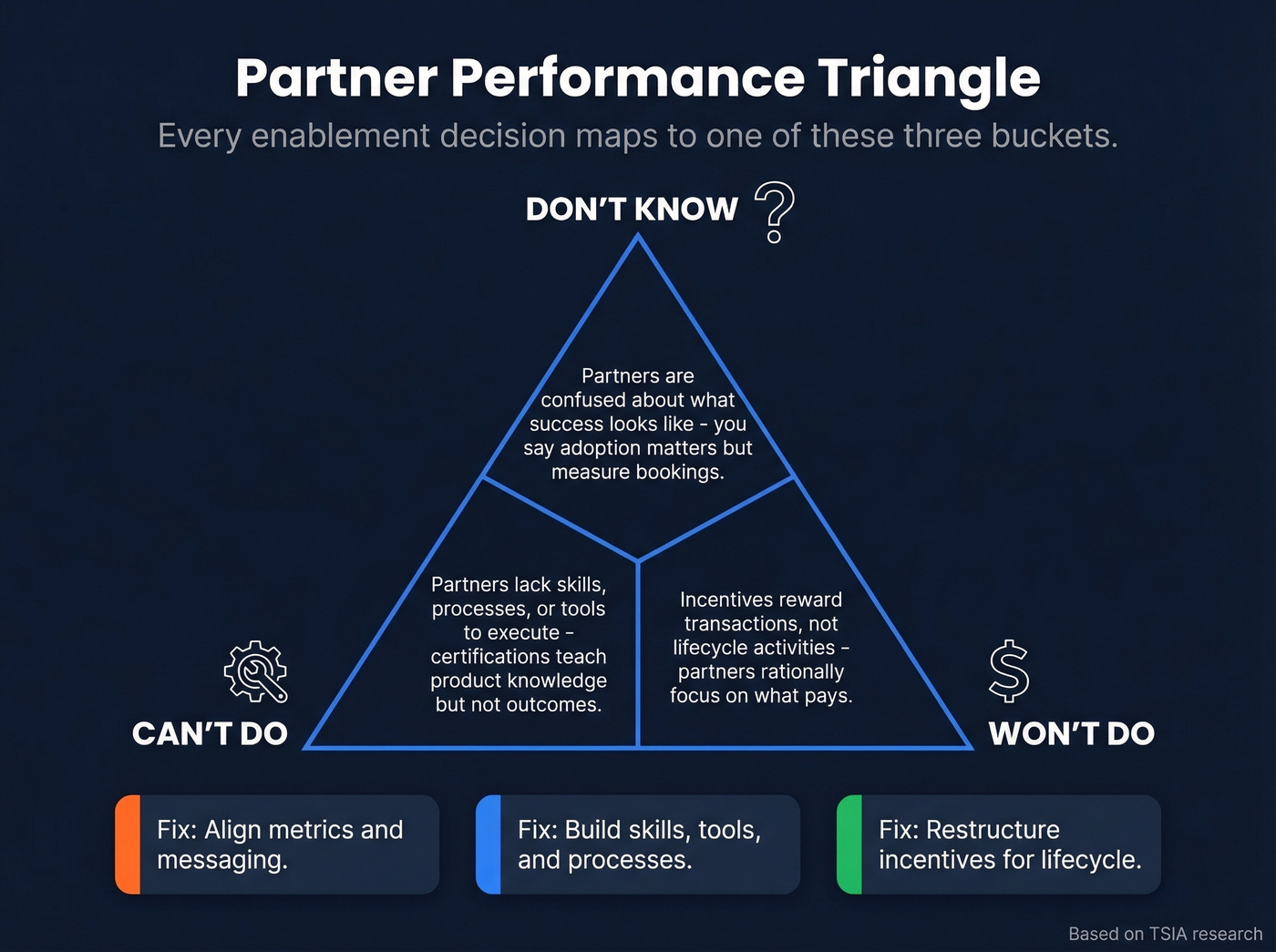
When partners underperform, the diagnosis almost always falls into TSIA's "Partner Performance Triangle":
- Don't Know: You tell partners that adoption and renewals matter, but you measure bookings. They're confused about what success looks like.
- Can't Do: Partners lack the skills, processes, or tools to execute post-sale motions. Traditional certifications teach product knowledge but don't equip for outcomes.
- Won't Do: Incentives reward transactions, not lifecycle activities. Partners rationally focus on what pays.
Every channel enablement decision you make should address one of these three buckets. If you can't map a program element to Don't Know, Can't Do, or Won't Do, it's probably not worth building.

Partners fall into "Can't Do" when they lack accurate contact data for target accounts. Prospeo gives your channel team 300M+ profiles with 98% email accuracy, 125M+ verified mobiles, and 30+ filters - so partners find decision-makers instead of bouncing emails.
Stop enabling partners with dead data. Give them contacts that connect.
Building the Program Step by Step
Partner Onboarding
Structure onboarding in four stages: Introduction, Initiation, Training, Transition. Each stage has clear milestones and a defined handoff to the next.
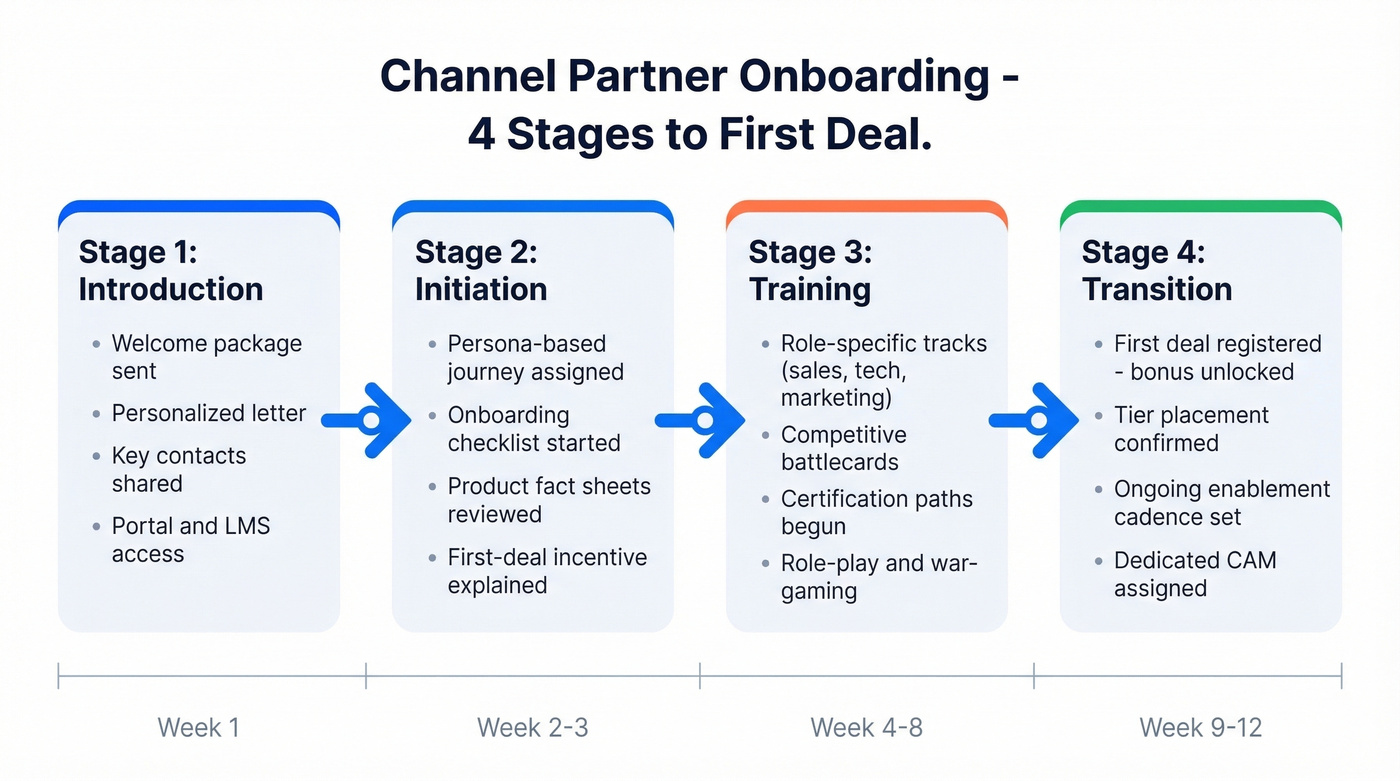
The welcome package sets the tone. Include a personalized letter, product fact sheets, an onboarding checklist, first-deal incentives, campaign examples, key contacts, and portal/LMS access. This isn't optional - it's the partner's first impression of whether you're organized enough to work with.
Build persona-based journeys. A sales rep at a partner needs deal registration and competitive battlecards. A technical resource needs integration docs and certification paths. A marketing contact needs co-branded templates and MDF guidelines. Don't dump everyone into the same track.
We've found that one of the best tests is to onboard yourself. Walk through the partner portal, register a deal, find a battlecard, submit an MDF request. Every friction point you hit, your partners hit ten times harder - because they're also doing this for four other vendors simultaneously. Tie incentives to milestones: first deal registration gets a bonus, first closed deal unlocks a higher tier. These early wins build momentum and signal that you're invested in partner success, not just partner recruitment.
Content and Training That Gets Used
Multimodal, bite-sized learning beats hour-long webinars every time. Partners are busy. They'll watch a 3-minute competitive positioning video. They won't sit through a 45-minute product deep-dive unless it's directly tied to a deal they're working right now.
For complex sales, include role-play scenarios and competitive war-gaming - partners need to practice objection handling for your product, not just read about it. Pilot with champion partners before full rollout. If your top 5 partners don't find the training useful, your bottom 50 definitely won't.
A practical cadence that works: biweekly product update webinars (15 minutes max), monthly hands-on workshops, quarterly certification cycles. Version everything, set sunset dates, and archive outdated materials. Nothing kills partner trust faster than sending a prospect a datasheet with last year's pricing.
Deal Registration and Conflict Rules
Keep deal registration forms short - five fields max. Clear rules, instant confirmation, visible acceptance SLAs (48 hours is common), and automatic deduplication. Every extra field or day of delay is a reason for partners to skip registration entirely.
Establish protection windows, typically 90-180 days. Define escalation paths for conflicts. Most importantly, put in writing that your direct sales team won't compete with partner-sourced opportunities. If partners suspect you'll steal their deals, they'll stop registering them. Period. Written rules of engagement aren't bureaucracy - they're trust foundations.
Co-Selling and Partner Outbound
Co-selling works when there's a mutual action plan maintained in CRM - not in a partner portal nobody logs into. Each opportunity gets defined owners, next steps, and dates. Joint pipeline reviews happen weekly or biweekly, depending on deal volume.
Meet partners where they work. That means Slack, email, and CRM - not a portal that requires a separate login. The "please log in to our partner portal" approach creates friction that kills deals.
None of this matters if the prospect lists you hand partners are garbage. Bad contact data kills partner pipeline before it starts. Before sharing any target account list, verify every contact through a platform like Prospeo - 98% email accuracy and a 7-day refresh cycle keep lists current when partners are working accounts over weeks, not hours. One bounced list erodes partner confidence fast.
Partner Tiering
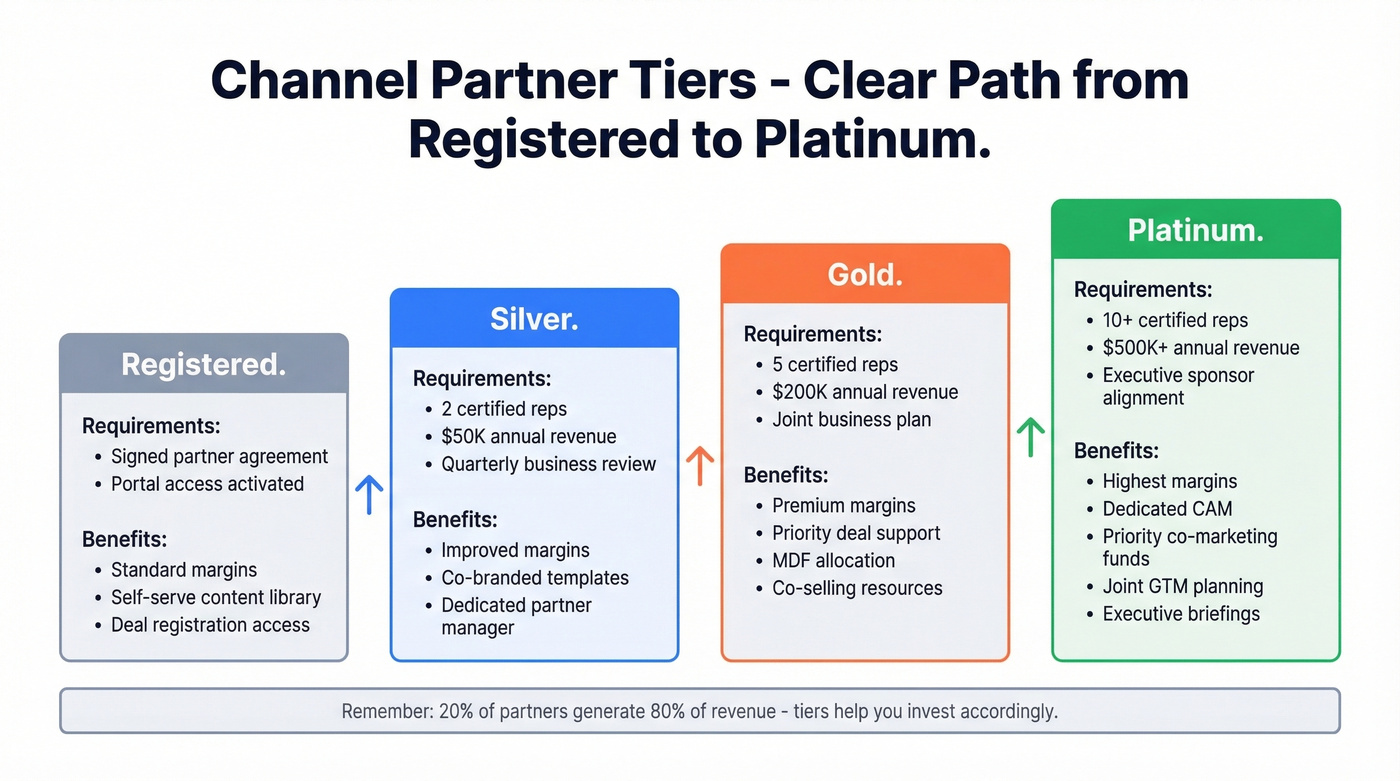
The 80/20 rule holds in channel: 20% of partners generate 80% of revenue. A standard model - Registered, Silver, Gold, Platinum - works when each tier has clear requirements (certifications, revenue thresholds, joint planning commitments) and clear benefits (higher margins, dedicated CAMs, priority deal support, co-marketing funds). Make the jump between tiers achievable and visible, so mid-tier partners have a reason to push harder.
KPIs and Benchmarks That Matter
Most channel programs measure the wrong things. Here's what actually drives performance:
| Metric | What It Measures | Target Range |
|---|---|---|
| Partner activation rate | % recruited to first deal reg | 30-50% (Yr 1) |
| Time-to-first-deal | Days from activation to first reg | 60-120 days |
| Partner-sourced pipeline | Pipeline from partners | 15-30% of total |
| Deal registration volume | Monthly deal regs | Trending up QoQ |
| Co-sell conversion | Win rate on joint deals | 25-40% |
| Partner NPS | Partner loyalty score | 40+ NPS |
| MDF ROI | Pipeline per MDF dollar | 5-10x return |
| Channel attrition | Annual inactive rate | Under 20% |
Two stats worth anchoring to: certified partners earn 6x more than untrained ones, and partner-influenced deals close 46% faster and are 53% more likely to close. If your program isn't producing those kinds of lifts, the Don't Know / Can't Do / Won't Do framework will tell you where to focus.
Tools and What They Cost
A reality check before you buy anything. We've seen a 10,000-person company with roughly 1,000 Highspot licenses using the platform as a content repository - essentially expensive SharePoint. The Reddit thread on r/ProductMarketing debating whether to replace Highspot with SharePoint + Copilot tells you everything about shelfware risk. The opposite trap is equally dangerous: cobbling together Google Drive + Salesforce + Loom creates a partner experience where nobody can find content and every demo takes 15+ hours of repeated effort.
The market costs less than most vendors want you to believe:
| Tool | Category | Starting Price | Best For |
|---|---|---|---|
| Salesforce PRM | PRM | $25/user/mo | SF-native orgs |
| Channeltivity | PRM + LMS | $1,899/mo | Mid-market PRM |
| Impartner | PRM | ~$2,000/mo min | Enterprise PRM |
| Allbound | PRM | ~$3,495/mo | Full-stack PRM |
| PartnerStack | Marketplace | ~3% of revenue | SaaS marketplaces |
| Introw | CRM-first PRM | Free; $669/mo paid | CRM-native teams |
| Highspot | Content enablement | ~$76K/yr | Large sales orgs |
| Seismic | Content enablement | ~$630/user/yr | Enterprise content |
| Showell | Content enablement | Free plan available | Field sales + offline |
| WorkRamp | Training/LMS | ~$25/user/yr | Partner training |
| TalentLMS | Training/LMS | Free tier | Budget LMS |
| Docebo | Training/LMS | Custom; typically $1,500+/mo | Enterprise LMS |
| Storylane | Demo platform | Free; $480/yr entry | Interactive demos |
| Super | Demo platform | $15/user/mo | Quick demo builds |
| Prospeo | Data + prospecting | Free (75 emails/mo); ~$0.01/email | Verified contacts for partner campaigns |

Skip the platform entirely if you don't have a documented onboarding process, deal registration rules, and at least 10 active partners. Build the process in spreadsheets and docs first. Automate second.
Co-selling only works when both sides reach the right buyer. Prospeo's CRM enrichment returns 50+ data points per contact at 92% match rate - so your partners close deals instead of chasing outdated records from last quarter's export.
Enrich your partner pipeline for $0.01 per email. No contracts required.
Mistakes That Kill Channel Programs
Treating channel like direct sales. Setting quota expectations without ramp time or marketing support burns out channel teams fast. The consensus on r/techsales is brutal - practitioners describe leadership expecting independent revenue from partners who still rely on internal teams for product expertise. Reality: it takes 6-12 months to build the engine.
Portal-centric enablement. Partners default to email, Slack, and CRM. Beamex abandoned their SharePoint-based partner extranet because field reps couldn't access it reliably - a pattern that repeats across the industry. If your enablement requires a separate login, adoption will flatline.
Enablement shelfware. Buying a $76K/year platform and using it as a document repository is a real pattern we've watched play out multiple times. Before purchasing, ask: do we have enough content, partners, and process to justify this? If any answer is no, start smaller.
One-size-fits-all enablement. Smaller partners lack marketing resources. Product-focused partners care about margins. Service-focused partners worry about certification requirements. Segmenting enablement by partner type and size is the difference between a program that scales and one that stalls.
No tracking setup. If you can't track partner activation rates, deal registration velocity, and co-sell conversion, you're flying blind. A well-instrumented spreadsheet beats an unmonitored PRM every time.
Case Studies Worth Studying
Parker Hannifin partnered with a channel enablement consultancy to build a structured outbound program for distributors - ICP discovery, calling scripts, BANT qualification, and structured SQL handoff. Their distributor enablement initiative produced 541 SQLs valued at roughly $25M in annual opportunity.
Digi International reported a 2,000% increase in partner adoption and 182% revenue growth after restructuring their enablement program around partner education and engagement. That's not a typo.
A $500M tech conglomerate with 50,000+ partners reported $500M in additional revenue after implementing a content-driven enablement strategy with MarketStar.
FAQ
How long does it take to produce revenue?
Expect 6-12 months for meaningful pipeline from a new channel enablement program. The first 90 days focus on onboarding documentation, deal registration setup, and content creation. Plan for first deals in 60-120 days from individually activated partners, not from program launch day. Set this expectation with leadership upfront or they'll pull the plug too early.
What's the difference between a PRM and an enablement platform?
A PRM manages deal registration, MDF, tiering, and portal access. An enablement platform manages content and training delivery. Tools like Channeltivity and Allbound blend both. Most teams need PRM functionality first and can layer enablement platforms once the partner base justifies the spend - typically around 25+ active partners.
How do I build accurate prospect lists for partners?
Use a verified B2B data platform to build target account lists before sharing with partners. Filter by buyer intent, technographics, and company growth signals, then export verified contacts and push directly to your CRM. One bounced list erodes partner confidence fast - 98% email accuracy and a 7-day refresh cycle prevent that.
What's the biggest channel enablement mistake?
Copying your internal sales enablement playbook for external partners. Partners juggle multiple vendors, have no salary from you, and won't sit through your two-week bootcamp. Build self-serve, bite-sized enablement that respects their time - 3-minute videos over 45-minute webinars, five-field deal registration over twelve-field forms.