

Channel Sales Management: The Operational Playbook for 2026
A channel manager can effectively oversee 40-60 partners. A direct sales rep costs $275K+ fully burdened and covers one territory. That leverage ratio is why channel sales management has become the highest-leverage discipline in B2B go-to-market - and why nearly 70% of B2B buyers purchase through indirect routes. The companies that run channel well outscale the ones that don't. But "running channel well" is where most programs fall apart.
Get These Three Things Right First
If you're managing a channel program, nail these before anything else. First, a deal registration workflow with a sub-48-hour approval SLA - anything slower trains partners to go around you. Second, a partner tiering framework that actually dictates resource allocation, not just badge colors. Third, a KPI dashboard tracking leading indicators like portal engagement and certification completions, not just lagging revenue numbers.
What Channel Sales Management Actually Is
This isn't another "what is channel sales?" explainer. This discipline covers the operational rigor of running a partner program - recruitment, enablement, governance, conflict resolution, and performance management. It's the difference between having partners and having a partner program.
Here's the thing: only about 20% of partners drive 80% of channel revenue. The rest are either ramping, coasting, or quietly disengaged. Your job as a channel sales manager isn't to recruit more partners. It's to shift that 80/20 split.
There's a perception on r/sales that channel is "where sales reps go to die" - a boring backwater for washed-out AEs. That's wrong. The median total comp for a channel sales manager is $208K per Glassdoor, and the role builds strategic muscles (P&L thinking, cross-functional leadership, ecosystem design) that translate directly to VP and CRO tracks. One manager influencing 40-60 partners creates more pipeline leverage than any single direct rep ever will.
Channel Sales vs. Direct Sales
| Dimension | Direct Sales | Channel Sales |
|---|---|---|
| Control | Full | Shared |
| Cost per rep | $275K+ fully burdened | Manager oversees 40-60 |
| Scale speed | Linear (hire more reps) | Exponential (recruit partners) |
| Speed to market | Slower in new geos | Faster via local partners |
| Customer ownership | Yours | Shared or partner-owned |
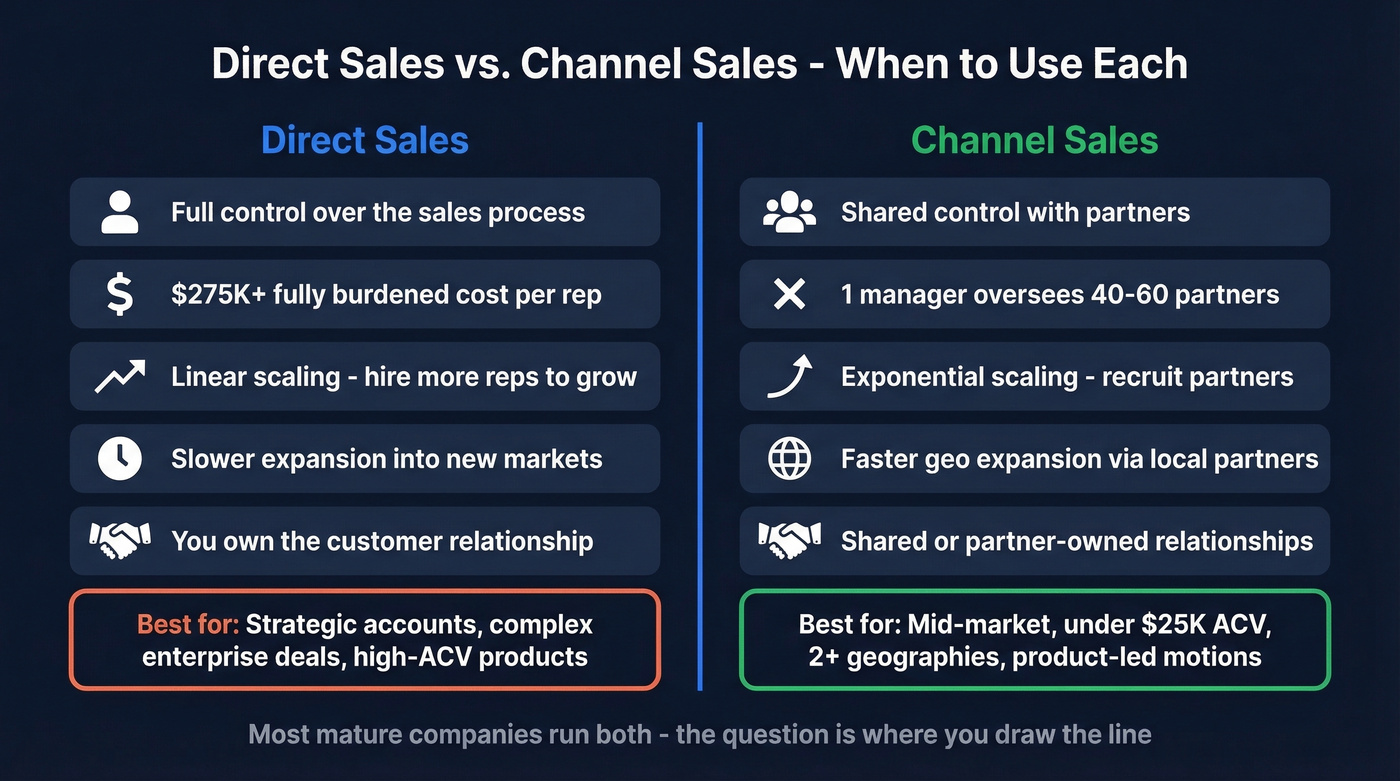
Direct sales makes sense for strategic accounts and complex enterprise deals where you need full control of the buying process. Channel wins for geographic expansion, mid-market scale, and product-led motions where partners already have the customer relationships. Most mature companies run both - the question is where you draw the line.
If your average deal size is under $25K and you're selling into more than two geographies, you probably can't afford not to run channel. The math on direct sales just doesn't work at that price point and scale.
Why Channel Programs Break
If 82% of channel managers are still tracking partner performance in spreadsheets, the bar for "good channel ops" is embarrassingly low. That manual data entry creates roughly a 12% margin of error in inventory reporting and incentive payouts. Spreadsheet-driven programs leak an estimated 15% of potential revenue through preventable data errors, channel conflict, and reconciliation gaps.
The visibility problem compounds everything else. Many manufacturers operate with POS data running 30 days behind, which means MDF allocation, rebate calculations, and inventory decisions are all based on stale information. You can't manage what you can't see - and most channel teams are flying blind on a monthly lag.
These aren't technology problems. They're governance problems. The tools exist. The willingness to standardize doesn't.
The Partner Program Lifecycle
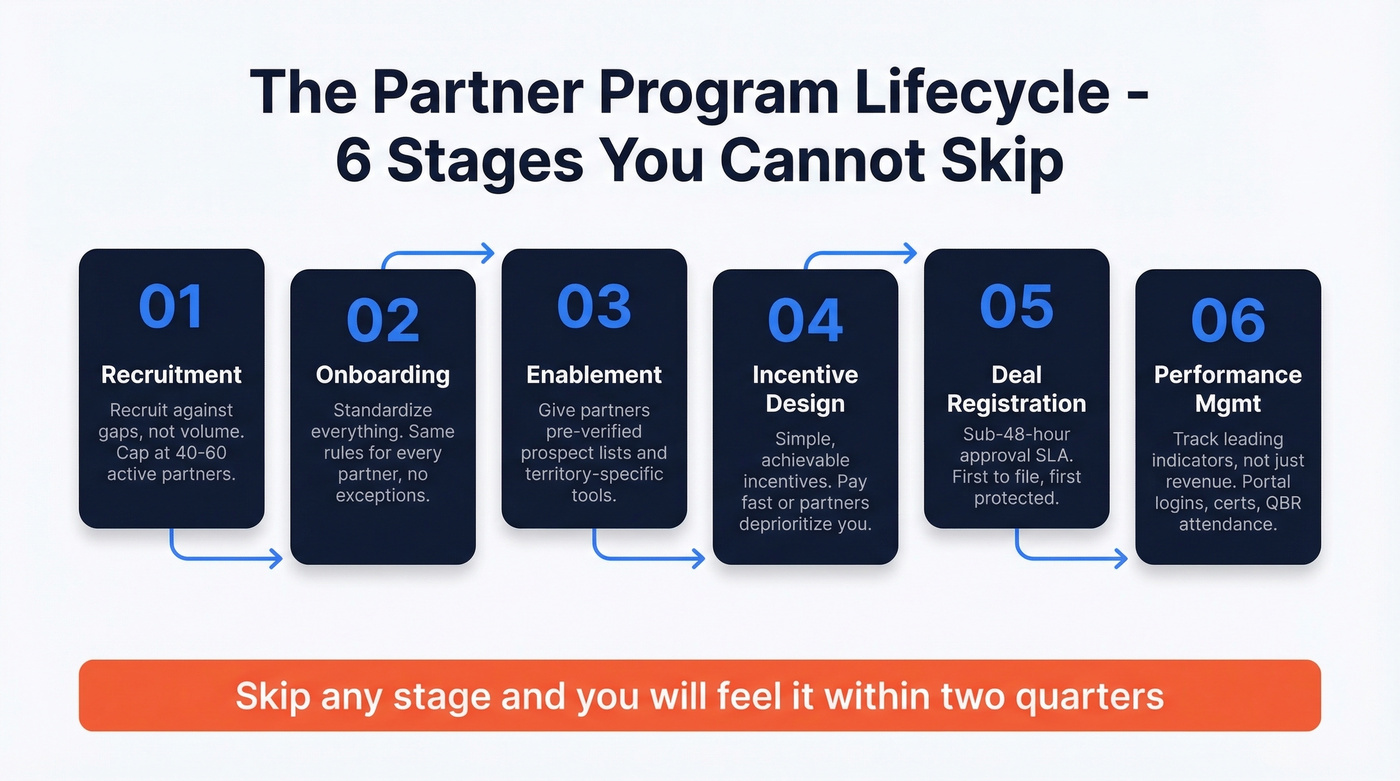
Every channel program runs through six stages. Skip any of them and you'll feel it within two quarters.
Partner Recruitment
Stop adding partners. Most channel programs fail because they're oversaturated, not understaffed. A channel manager can effectively manage 40-60 active partners - beyond that, you're spreading attention so thin that nobody gets what they need. Recruit against specific criteria: market coverage gaps, technical capability, existing customer base overlap, and cultural fit.
Partner Onboarding
Inconsistent onboarding is one of the top conflict drivers in channel programs. When Partner A gets a different set of rules than Partner B, you've built conflict into the foundation. Every new partner should receive the same onboarding package: portal access, product training schedule, brand guidelines, territory assignment, deal registration rules, and escalation paths. Channeltivity's research confirms that standardized onboarding SOPs are a primary conflict prevention mechanism.
Partner Enablement
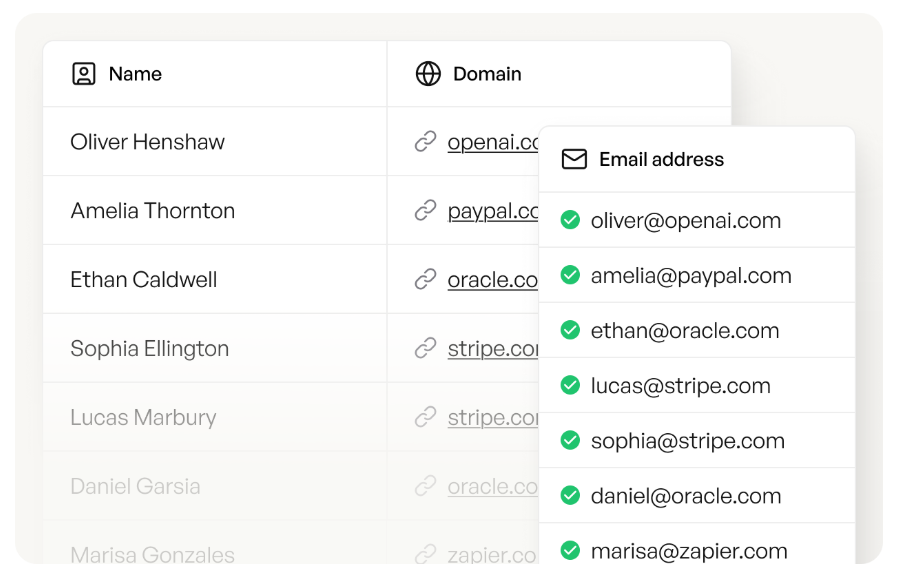
The highest-impact enablement move most channel teams overlook: give partners pre-verified prospect lists for their territory. Partners don't have time to build lists from scratch, and if you hand them stale data, they'll burn first impressions on bounced emails and disconnected numbers. Tools like Prospeo let you build targeted lists with 30+ filters and 98% email accuracy, then export verified contacts directly to partners on a 7-day refresh cycle - so the data you hand over on Monday is still good by Friday.
Incentive Design
Roughly half of vendors plan to improve their incentive management systems this year, per Channelnomics estimates. The trend is clear: partners want simpler, achievable incentives that represent a meaningful share of their margin. Broad rebate programs with complex qualification criteria are losing ground. And if your partners have to wait 90+ days for audit and compliance cycles to clear before they see incentive money, you're training them to deprioritize your products. Pay faster.
Deal Registration
Deal registration is the single most important operational mechanism in any partner program. It's how you prevent chaos, protect partner investment, and maintain trust across the ecosystem. We go deep on this in the dedicated section below.
Performance Management
If you're only tracking revenue, you're looking at a lagging indicator. The leading signals - portal logins, certification completions, QBR attendance - predict whether a partner is about to ramp up or quietly disengage. The KPI section below covers exactly what to measure and why.
Partner Tiering Done Right
If your tiers don't change how you allocate resources, they're decorative. A tiering framework should dictate margin structures, support levels, co-marketing budgets, and deal registration priority.
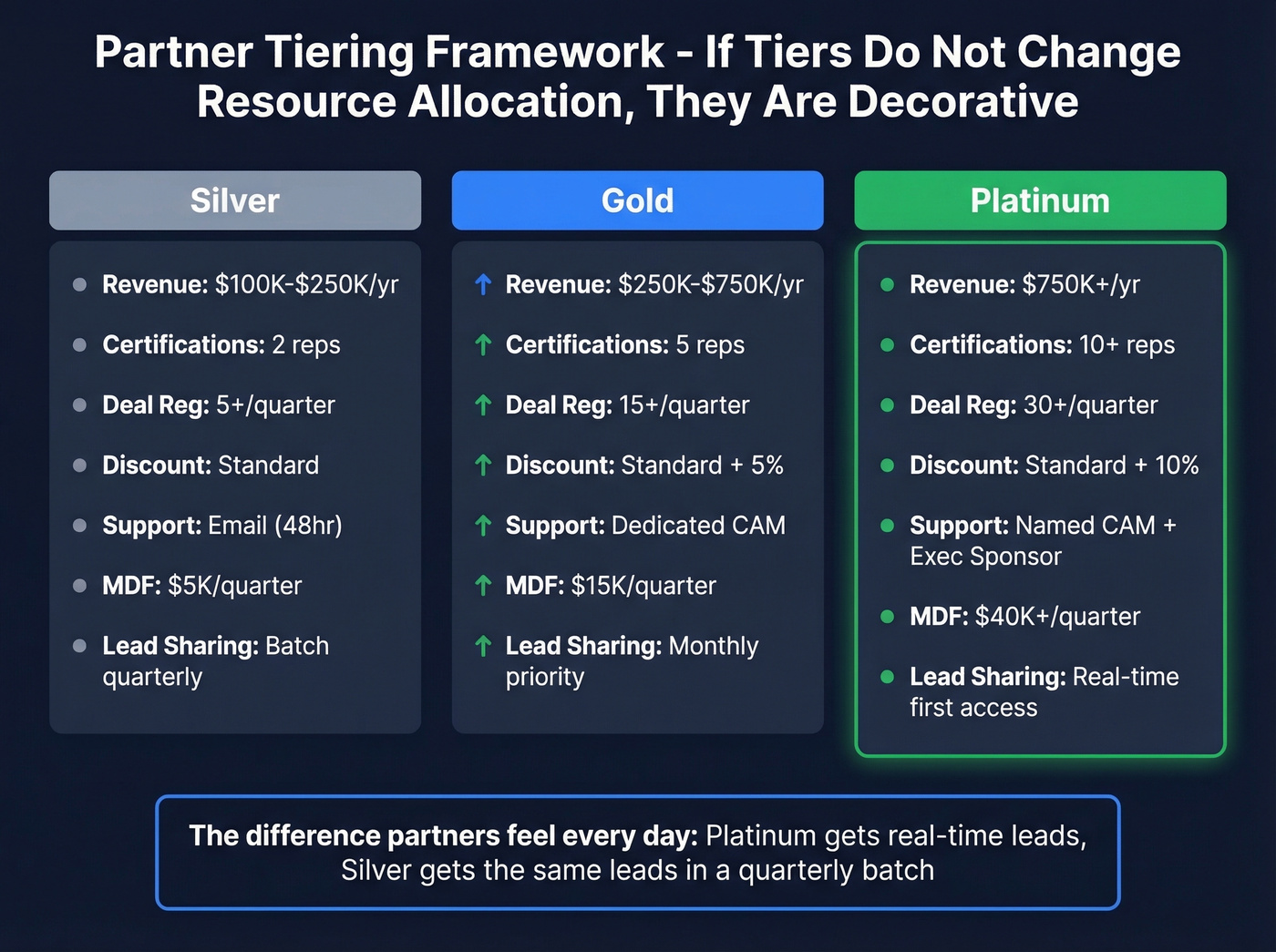
| Dimension | Silver | Gold | Platinum |
|---|---|---|---|
| Revenue threshold | $100K-$250K/yr | $250K-$750K/yr | $750K+/yr |
| Certifications | 2 reps certified | 5 reps certified | 10+ reps certified |
| Deal reg volume | 5+/quarter | 15+/quarter | 30+/quarter |
| Discount tier | Standard | Standard + 5% | Standard + 10% |
| Support SLA | Email (48hr) | Dedicated CAM | Named CAM + exec sponsor |
| MDF allocation | $5K/quarter | $15K/quarter | $40K+/quarter |
| Lead sharing | Batch quarterly | Monthly priority | Real-time first access |
The revenue thresholds here are illustrative - calibrate them to your ACV and market. What matters is that each tier unlocks meaningfully different resources. A Platinum partner gets real-time access to new leads; a Silver partner gets the same leads in a quarterly batch. That's a difference partners feel every day, and it's what makes tiering a motivator rather than a decoration.

The article nails it: the highest-impact enablement move is giving partners pre-verified prospect lists. Prospeo lets you build territory-specific lists with 30+ filters, export them with 98% email accuracy, and refresh every 7 days - so your partners never burn first impressions on bounced emails. At $0.01 per email, arming 40-60 partners costs less than one direct rep's monthly phone bill.
Stop handing partners stale data. Give them lists that actually connect.
Deal Registration - Preventing Chaos
Deal registration is a time-limited exclusivity mechanism. First to file, first to be protected. Without it, you get partner-on-partner conflict, direct sales poaching, and a trust deficit that takes years to repair. We've reviewed dozens of deal reg workflows, and the ones that work all share one thing: speed.
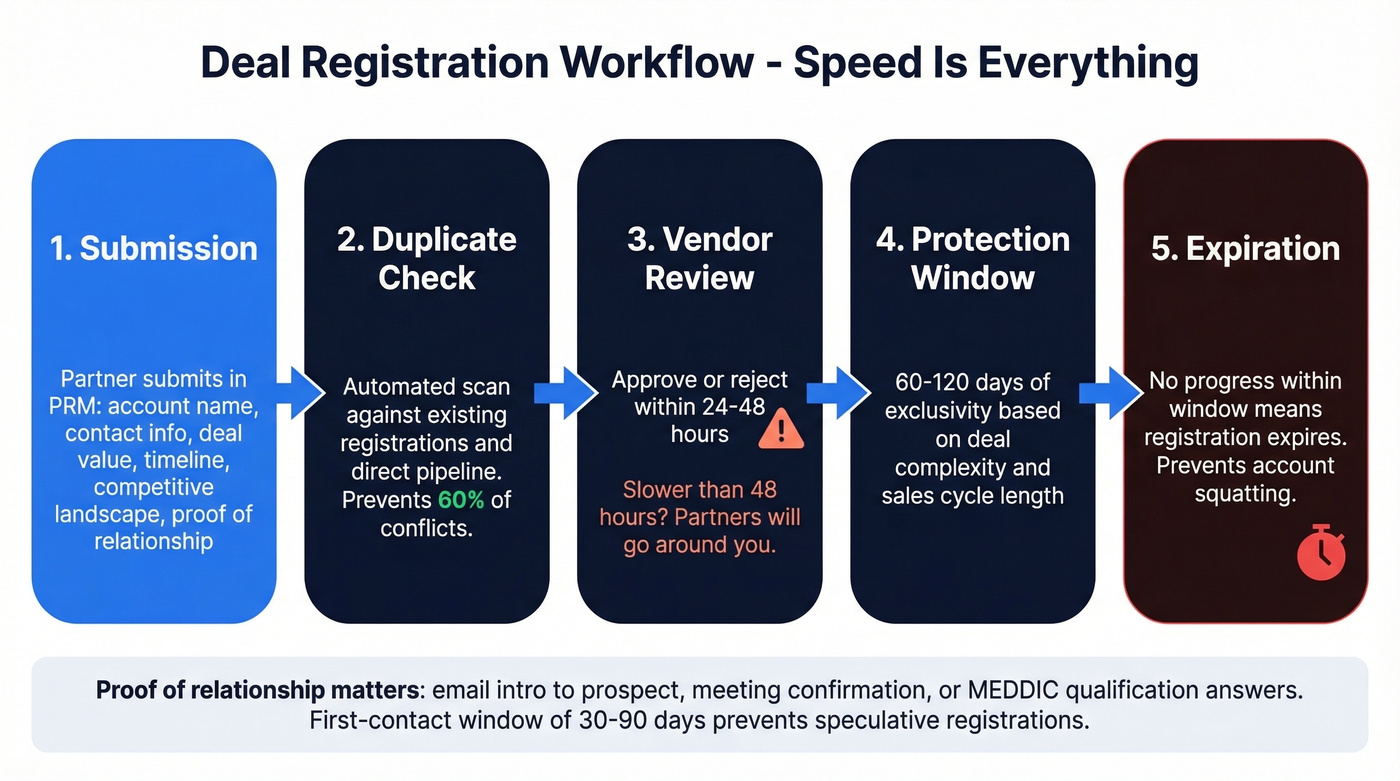
Here's the workflow:
Submission - Partner submits in PRM with required fields: account name, contact info, opportunity value, timeline, competitive landscape, and proof of relationship.
Duplicate check - Automated scan against existing registrations and direct pipeline. This step alone prevents 60% of conflicts.
Vendor review - Your team reviews and approves or rejects within 24-48 hours. If your deal registration takes more than 48 hours, you're training partners to go around you.
Protection window - Approved deals get 60-120 days of exclusivity, depending on deal complexity and sales cycle length.
Expiration - If the deal shows no progress within the protection window, registration expires. This forces pipeline hygiene and prevents partners from squatting on accounts.
"Proof of relationship" is the field most programs get wrong. Acceptable proof includes an email introduction to the prospect, a meeting confirmation, or MEDDIC qualification answers. A first-contact window of 30-90 days prevents speculative registrations - partners can't register an account they haven't actually engaged.
Channel Conflict - Types and Prevention
Your top partner just registered a deal, and your direct AE is already in the account. This scenario plays out weekly in most channel programs.
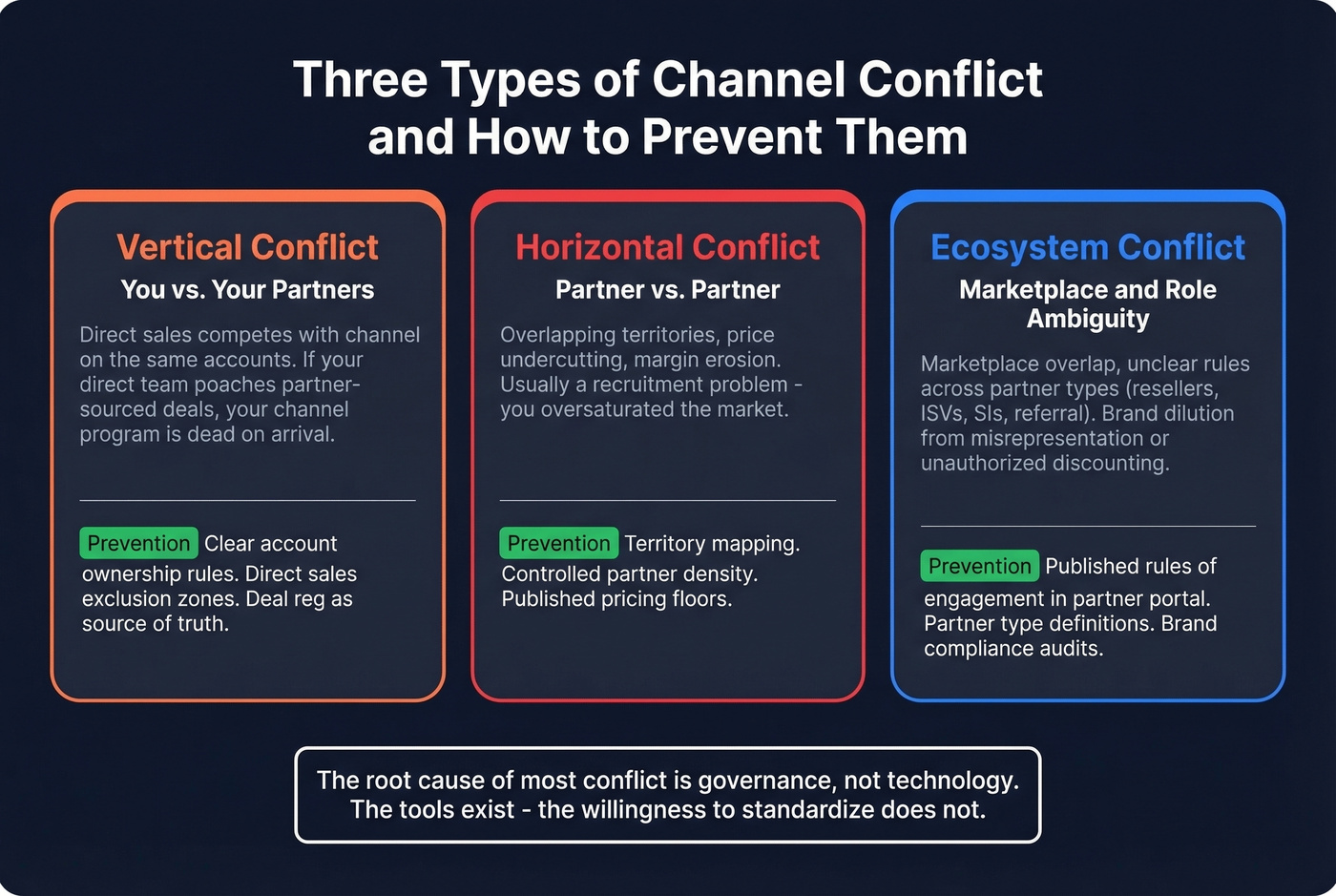
Vertical conflict happens between you and your partners - typically when direct sales competes with channel on the same accounts. If your direct sales team is poaching deals that partners sourced, your channel program is dead on arrival.
Horizontal conflict is partner vs. partner - overlapping territories, price undercutting, and margin erosion. This is usually a recruitment problem. You oversaturated the market.
Ecosystem conflict is the newest category - marketplace overlap, technology partner role ambiguity, and unclear rules of engagement across partner types like resellers, ISVs, SIs, and referral partners. Brand dilution falls here too: partners misrepresenting your product positioning or discounting outside approved guidelines erodes the brand equity you've built.
The prevention playbook is straightforward: don't oversaturate your partner roster, publish rules of engagement in your partner portal, standardize onboarding SOPs, and create explicit guardrails for your direct sales team. Internal clarity matters as much as external governance.
KPIs That Actually Matter
Most channel teams track revenue and call it a day. That's like driving by only looking in the rearview mirror.
Revenue metrics tell you what happened: revenue per partner per tier, revenue by geography, revenue mix by product line, new customer logos, and renewal rates.
Operational metrics tell you how the machine is running: deals registered per quarter, MDF effectiveness measured as leads generated per dollar spent, and channel attrition rate. If you're losing more than 15% of active partners per year, something's structurally wrong.
Leading indicators tell you what's about to happen: portal logins, content downloads, certification completions, and QBR attendance. We've seen programs where a drop in portal engagement predicted partner churn 90 days before it showed up in revenue numbers. In our experience, leading indicators are the most underinvested metric tier - and the one that saves the most money. Track these weekly, not quarterly.
The Channel Sales Tech Stack
Most PRM vendors hide pricing behind demo requests. Budget $15K-$60K/year for mid-market, $75K-$250K+ for enterprise implementations.
| Category | Tool | Starting Price | Best For |
|---|---|---|---|
| PRM | Impartner | ~$25K-$80K/yr | Mid-market to enterprise |
| PRM | PartnerStack | ~$15K-$50K/yr | Growth-stage |
| PRM | ZINFI | ~$30K-$100K/yr | Enterprise multi-module |
| PRM | Channeltivity | ~$1K-$3K/mo | Mid-market |
| PRM | Allbound | ~$15K-$40K/yr | Mid-market |
| PRM | Salesforce PRM | ~$10-$25/user/mo | Salesforce-native orgs |
| CRM | Salesforce Sales Cloud | Starts at $25/user/mo | Enterprise |
| CRM | HubSpot | $15/$90/$150 per user/mo | SMB to mid-market |
| Data | Prospeo | Free tier; ~$0.01/email | Verified partner lists |
| Analytics | Tableau | $15-$75/user/mo | Channel reporting |
Your PRM manages the relationship. Your CRM tracks leads, accounts, and opportunities across your sales pipeline. But if the contact data your partners are working is stale or inaccurate, none of it matters. A data enrichment layer that refreshes weekly - not monthly - is what separates partner enablement that works from partner enablement that wastes everyone's time.

Channel conflict starts with bad data - partners working the same contacts, bouncing off disconnected numbers, and losing trust in your program. Prospeo's 125M+ verified mobiles (30% pickup rate) and automatic deduplication across searches let you assign clean, non-overlapping prospect lists to every partner tier. Gold partners get enriched accounts with 50+ data points. Silver gets verified emails. Everyone gets data they can trust.
Fuel your tiering framework with data that matches your partners' investment level.
Mistakes That Kill Channel Programs
Building in isolation. Spending six months designing the "perfect" program before getting market feedback. Launch lean, iterate fast. Your first version will be wrong.
Letting direct sales manage partners. Direct reps optimize for their quota, not partner success. Channel needs dedicated management with its own incentive structure.
Chasing mega-partners. Teams spend years courting a single large partner while ignoring the productive mid-tier partners already generating revenue. The 80/20 rule works both ways - don't neglect the partners who are actually performing.
Expecting results without training. Partners won't sell your product just because they signed an agreement. Enablement - product training, competitive positioning, verified prospect lists - is the difference between a signed partner and a productive one.
Oversaturating the roster. Channel managers on r/sales consistently cite oversaturation as the #1 program killer. More partners doesn't mean more revenue. It means more conflict, thinner support, and lower per-partner productivity.
What's Changing in 2026
Here's what your partners are thinking right now: margin durability matters more than top-line growth. Partners are actively deprioritizing vendors with fragmented systems - if your PRM, quoting tool, and onboarding portal are three different logins, you're losing mindshare.
Nearly half of B2B channel leaders plan to expand their programs this year. But expansion without operational maturity just amplifies existing problems. Pricing and discounting governance is emerging as a major deal-velocity issue. Inconsistent discounting across partner tiers and complex SKU structures create quoting errors and higher cost-to-serve. The vendors who simplify this will win partner preference.
The incentive structure is shifting too. Broad rebate programs with complex qualification criteria are giving way to simpler, achievable incentives. Partners want to know exactly what they earn and when they'll get paid. Delayed payouts remain a structural risk that erodes trust faster than any competitive threat.
We're also seeing the emergence of specialized partner-facing roles - Partner Engagement Managers and Partner Solution Engineers - as programs mature beyond a single channel manager juggling everything. If you're running 50+ partners without dedicated enablement headcount, you're already behind.
Channel Sales Manager Salary
| Data Source | Base Salary | Variable Comp | Total Comp | Sample Size |
|---|---|---|---|---|
| Glassdoor | $87K-$145K | $72K-$134K | $208K median | 586 salaries |
| PayScale | $58K-$130K | $16K-$109K | $64K-$164K | 189 profiles |
The Glassdoor median of $208K reflects tech-heavy samples - Google pays $348K-$631K, Palo Alto Networks $323K-$541K, Splunk $325K-$540K. PayScale's $85,182 average base is closer to the broader market. Both confirm this is a six-figure role with significant upside tied to partner-sourced revenue performance.
FAQ
What does a channel sales manager do day-to-day?
A channel sales manager recruits and onboards partners, manages deal registration, resolves conflict, tracks KPIs, runs QBRs, and coordinates enablement. One manager typically oversees 40-60 active partners across multiple tiers and geographies.
Is channel sales a good career path?
Yes - median total comp is $208K/year per Glassdoor. The role builds strategic skills like partner ecosystem design, P&L ownership, and cross-functional leadership that translate directly to VP and CRO tracks.
What's the difference between a PRM and a CRM?
A CRM like Salesforce or HubSpot tracks leads, accounts, and pipeline opportunities. A PRM like Impartner or PartnerStack manages partner relationships - deal registration, MDF, co-marketing, portal access, and tiering. Most channel programs need both.
How do you measure channel program success?
Track revenue per partner per tier, deal registration volume, MDF effectiveness as leads per dollar, and channel attrition rate. Leading indicators like portal engagement and certification completions predict partner churn 90 days before revenue numbers show it.
What tools do channel teams need for partner enablement?
A PRM for program management, a CRM for pipeline tracking, and a data enrichment tool for building verified prospect lists partners can actually use. Stale contact data kills partner outreach - 98% email accuracy and verified mobile numbers aren't optional.