

Clay Enrichment: What It Costs and How to Use It in 2026
You just opened your Clay invoice and realized a single waterfall burned through half your monthly credits in three days. We've seen it happen to teams that are otherwise sharp operators. Clay is the most powerful enrichment orchestration tool on the market - and one of the easiest to overspend on if you don't understand the credit mechanics.
The Quick Version
Clay connects to 150+ data providers and checks them sequentially - "waterfall enrichment" - to find emails, mobile numbers, company data, and technographics. It's an aggregator, not a proprietary database.
After the March 2026 pricing overhaul, plans run Free ($0), Launch ($185/mo), Growth ($495/mo), and Enterprise (custom). Credits vary wildly by provider. The same mobile lookup can cost 5-25 credits depending on who fills it.
What Is Clay Enrichment?
Think of Clay as an enrichable spreadsheet sitting on top of the entire B2B data ecosystem. You feed it a list of companies or contacts, and it pulls missing data points - emails, direct dials, firmographics, technographics, job changes - from whichever providers you configure.
The key distinction is Clay's aggregator model. Unlike proprietary database providers such as ZoomInfo, or Prospeo with its own email-finding infrastructure and real-time verification, Clay is a middleware layer. It doesn't own the data. It orchestrates lookups across third-party sources. That gives you breadth, but data quality depends entirely on which sources you plug in and how you configure the waterfall. Roughly 25-30% of B2B data goes stale every year, so the freshness of your chosen providers matters enormously.
How Waterfall Enrichment Works
Waterfall enrichment is Clay's core mechanic:
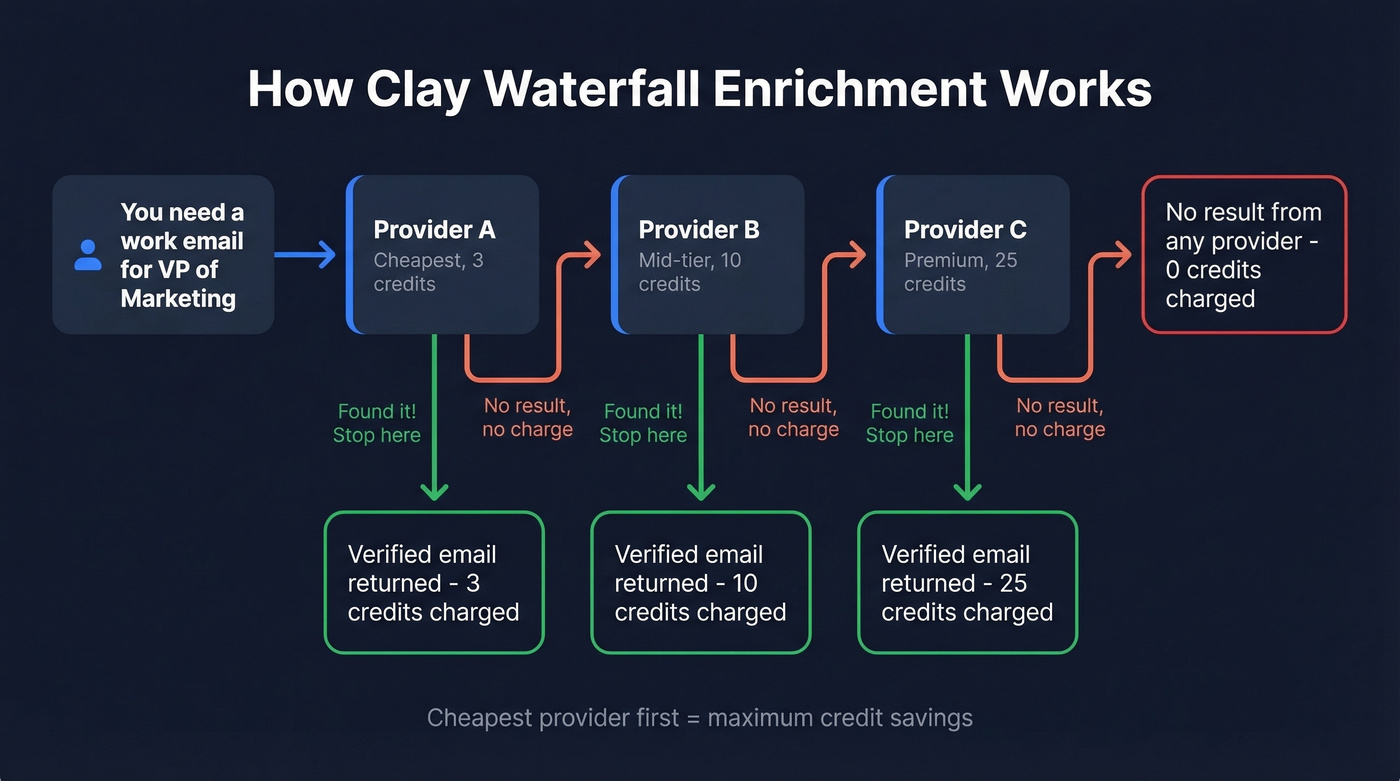
- You define a data point you need - say, a work email for a VP of Marketing.
- Clay queries Provider A first. If it finds a verified result, it stops and charges credits.
- If Provider A returns nothing, Clay moves to Provider B, then C, and so on.
- No result from any provider? You don't get charged.
The real power is conditional logic. You can build geo-specific waterfalls - route EMEA contacts through GDPR-compliant providers, US contacts through a different stack entirely. Teams that invest time tuning these waterfalls see dramatically better cost efficiency than those running a generic setup. Teams that don't tune them burn credits like kindling.

Your Clay waterfall is only as good as the providers inside it. Prospeo's proprietary email infrastructure delivers 98% accuracy with 7-day data refresh - no third-party email sourcing, no stale records inflating your bounce rate. Plug it in via BYOK and pay $0.01/email instead of burning 5-25 Clay credits per lookup.
Same waterfall, better data, fraction of the credits.
2026 Pricing Breakdown
Clay overhauled its pricing on March 11, 2026, replacing the old Starter/Explorer/Pro tiers with a simpler structure. The big change: separating Data Credits (third-party lookups) from Actions (platform operations like AI calls, CRM pushes, and exports). Clay also reduced marketplace data costs 50-90% and cut the top-up premium from 50% to 30%.
| Plan | Price/mo (Annual) | Data Credits | Actions | Key Feature Gate |
|---|---|---|---|---|
| Free | $0 | 100 | 500 | - |
| Launch | $185 ($167) | 2,500 | 15,000 | - |
| Growth | $495 ($446) | 6,000 | 40,000 | CRM, HTTP API, webhooks, intent |
| Enterprise | Custom | 100,000+ | 200,000+ | SSO, RBAC, warehouse sync |
Actions cost under $0.01, and Clay says 90% of customers won't hit their Actions limit. The real variable is Data Credits. A mobile number lookup costs 5 credits through People Data Labs, 15 through ContactOut, and 25 through Datagma - same data point, up to a 5x cost difference. Unused credits roll over up to 2x your monthly allocation.
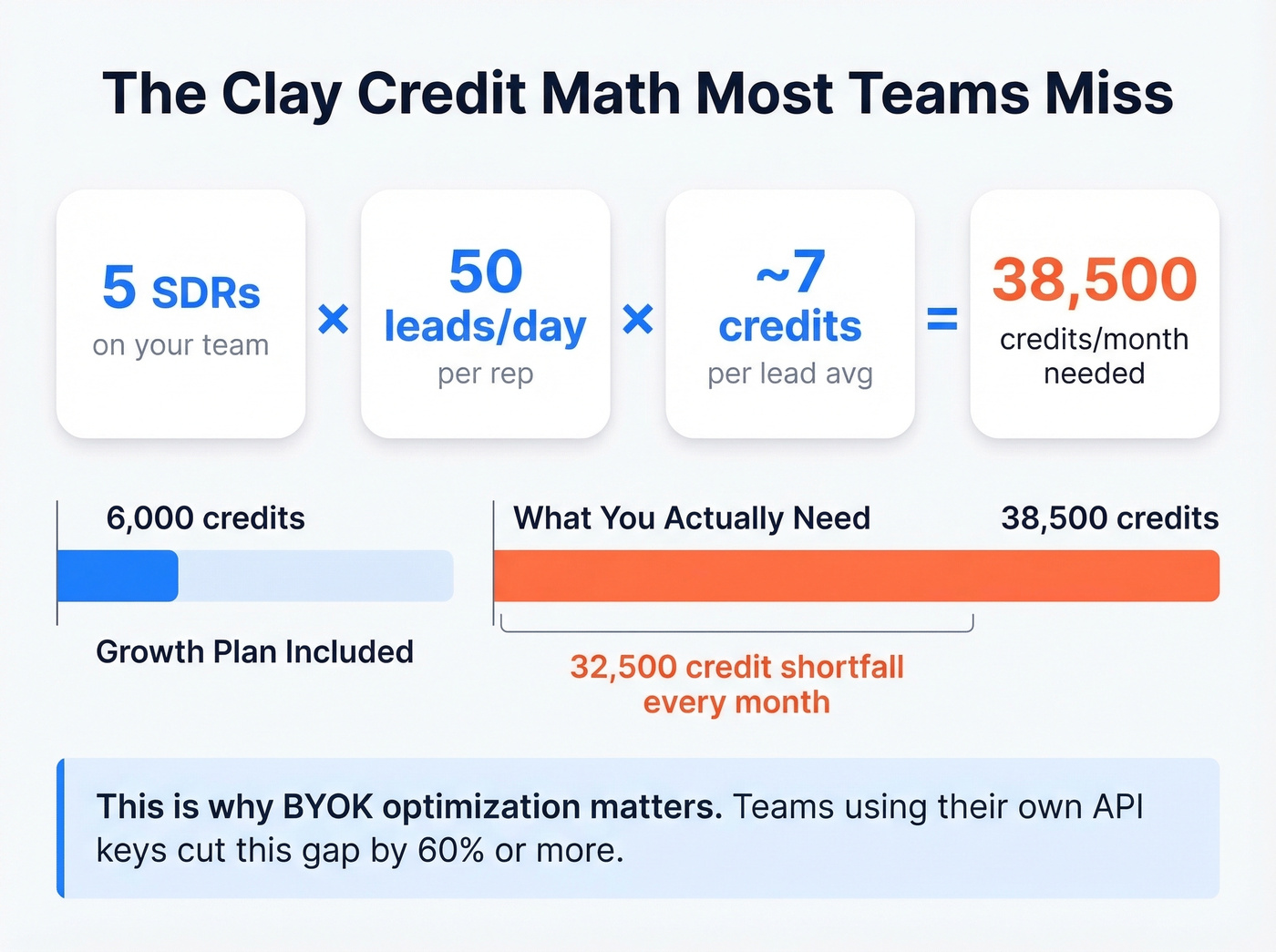
Here's the math that matters: 5 SDRs enriching 50 leads per day at roughly 7 credits per lead burns about 38,500 credits per month. That's well beyond the Growth plan's 6,000 credits - you'll need frequent top-ups or serious BYOK optimization to stay solvent.
Let's be honest: most teams don't need Clay. If you're running the same outbound playbook every month, you're paying orchestration-layer prices for what's essentially a database lookup. Clay earns its cost only when you're constantly experimenting with new segments, new data combinations, new GTM angles.
How to Optimize Credit Spend
Credit burn is the #1 complaint on r/coldemail, and it's almost always avoidable. We've seen teams cut their Clay spend by 60%+ just by implementing BYOK - using your own API keys for AI models runs 30-35x cheaper than Clay's bundled AI credits, and plugging in your own enrichment provider can be dramatically cheaper than burning high-credit marketplace steps.
Beyond BYOK, the biggest wins come from discipline:
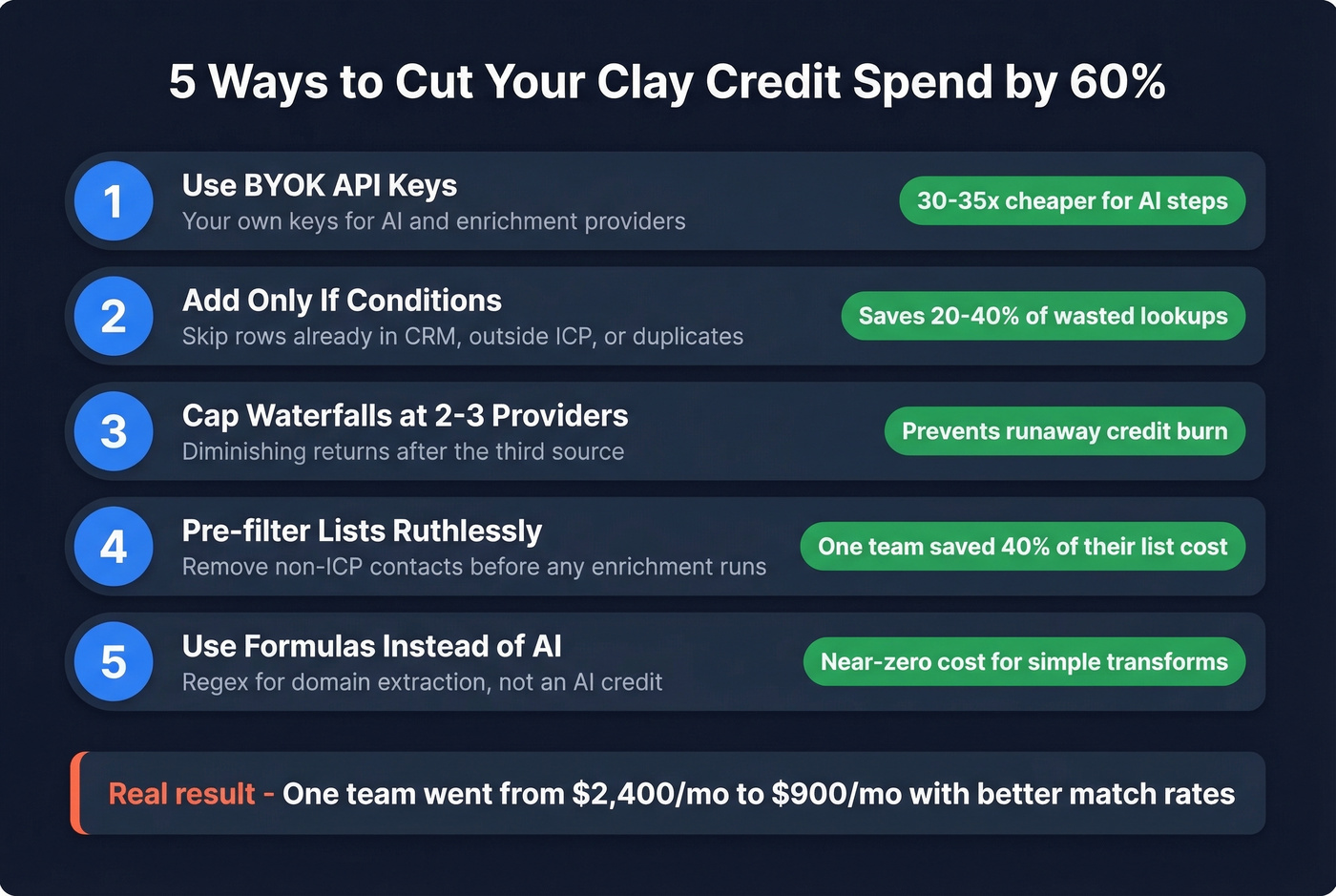
- Use "only run if" conditions so enrichments fire only on qualified rows. Don't enrich contacts already in your CRM, outside your ICP, or duplicates.
- Use Clay's built-in formulas for deterministic transforms like extracting a domain from a URL instead of burning an AI credit on something regex handles in milliseconds.
- Cap waterfalls at 2-3 providers. More providers means more credit spend with diminishing returns after the third source.
- Pre-filter ruthlessly. Every non-ICP row you remove before enrichment is credits saved. This sounds obvious, but we've watched teams enrich 10,000-row lists where 40% of contacts were outside their target market.
One team we spoke with was spending $2,400/month on Clay credits before they restructured their waterfalls with BYOK email verification and tighter pre-filtering. They dropped to $900/month with better match rates. The difference wasn't a better tool - it was better configuration.
When Clay Is (and Isn't) Worth It
Clay shines when you're testing new GTM hypotheses fast - new verticals, new personas, new messaging angles. Its breadth is unmatched for rapid experimentation, and the conditional logic handles complex, multi-step workflows that a simple database can't touch.
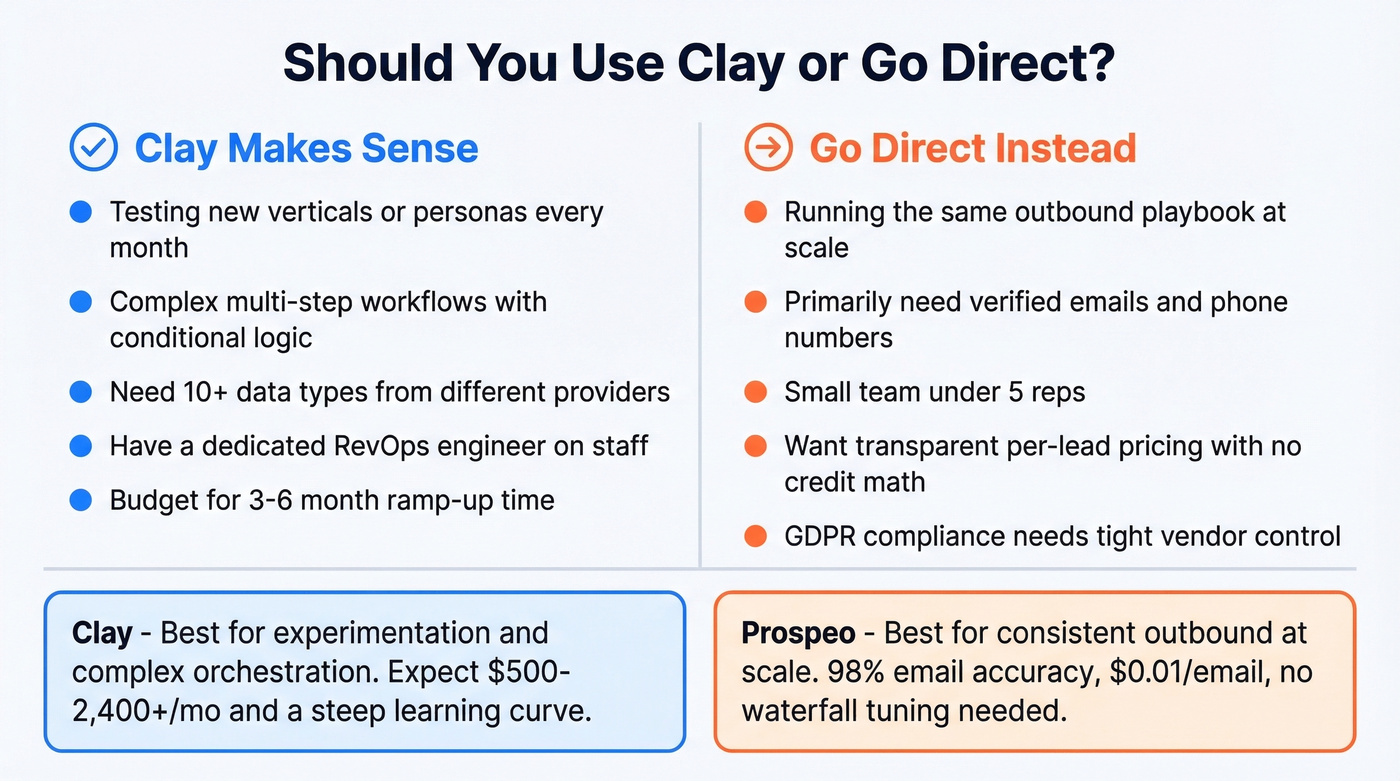
But the 3-6 month ramp to full proficiency is real. You need someone who thinks like a RevOps engineer, not just a salesperson clicking buttons.
Skip Clay when you're running the same playbook at scale. The consensus on Reddit is clear: prototype in Clay, then rebuild in n8n for a fraction of the ongoing cost. If you just need verified emails and direct dials without workflow complexity, a self-serve database with its own verification infrastructure gives you what you need without the credit math headaches.
And if GDPR compliance is non-negotiable, remember that Clay itself may be compliant, but the third-party vendors in your waterfall may not be. You're responsible for auditing every provider in the chain.
Running the same outbound playbook every month? Skip the orchestration tax. Prospeo gives you 300M+ profiles, 143M+ verified emails, and 125M+ mobile numbers with 30+ search filters - no credit math, no waterfall tuning, no 3-month ramp. Teams book 35% more meetings than Apollo users.
Get enterprise-grade data without the Clay credit anxiety.
FAQ
Does Clay charge credits for failed lookups?
No. Clay doesn't charge Data Credits or Actions when an enrichment returns no result. This saves meaningful spend, especially on phone lookups where match rates vary by provider and region. Structure waterfalls cheapest-first to maximize this benefit.
Can I use my own API keys inside Clay?
Yes. Clay supports BYOK for AI models and premium data sources. Using your own keys can cut per-lookup costs up to 30-35x for AI steps. For email enrichment, plugging in Prospeo via BYOK delivers 98% accuracy at roughly $0.01 per verified email - far cheaper than most marketplace options.
What's the difference between Data Credits and Actions?
Data Credits pay for third-party data lookups - the actual enrichment step. Actions cover platform operations: AI calls, CRM pushes, exports, and API requests. Most overspend comes from Data Credits, not Actions.
Is Clay worth it for small teams under 5 reps?
For teams under 5 reps running a consistent playbook, Clay's orchestration overhead rarely pays off. You'll spend more time configuring waterfalls than actually prospecting. A self-serve enrichment tool with transparent per-lead pricing covers most small-team needs at a fraction of the cost and complexity.