

Clay vs Common Room: An Honest Comparison for GTM Teams
Your VP of Sales came back from a conference raving about "signal-based selling." Now you're staring at Clay and Common Room trying to figure out which one actually fits your stack. Pick wrong and you'll burn a quarter building workflows nobody uses - or paying for signals your market never produces.
30-Second Verdict
Choose Clay if you're outbound-heavy and want a flexible enrichment/orchestration layer across tons of providers, with custom logic and AI research. It's powerful, but someone on RevOps has to own it.
Choose Common Room if you're PLG or community-led and you need to turn Slack, Discord, GitHub, and product activity into prioritized accounts and plays. It's expensive, but it's built for answering "who's showing intent right now?"
What Each Tool Actually Does
Clay is a workflow-first enrichment platform. Think of it as a programmable spreadsheet for CRM enrichment, list building, and outbound ops. You chain providers in a waterfall, add conditional logic, and use Claygent-style AI research to fill the gaps humans hate doing manually. It's popular for a reason: Clay is the closest thing GTM teams have to "Zapier for data," and it rewards builders who enjoy tinkering with systems until every field maps perfectly into Salesforce.
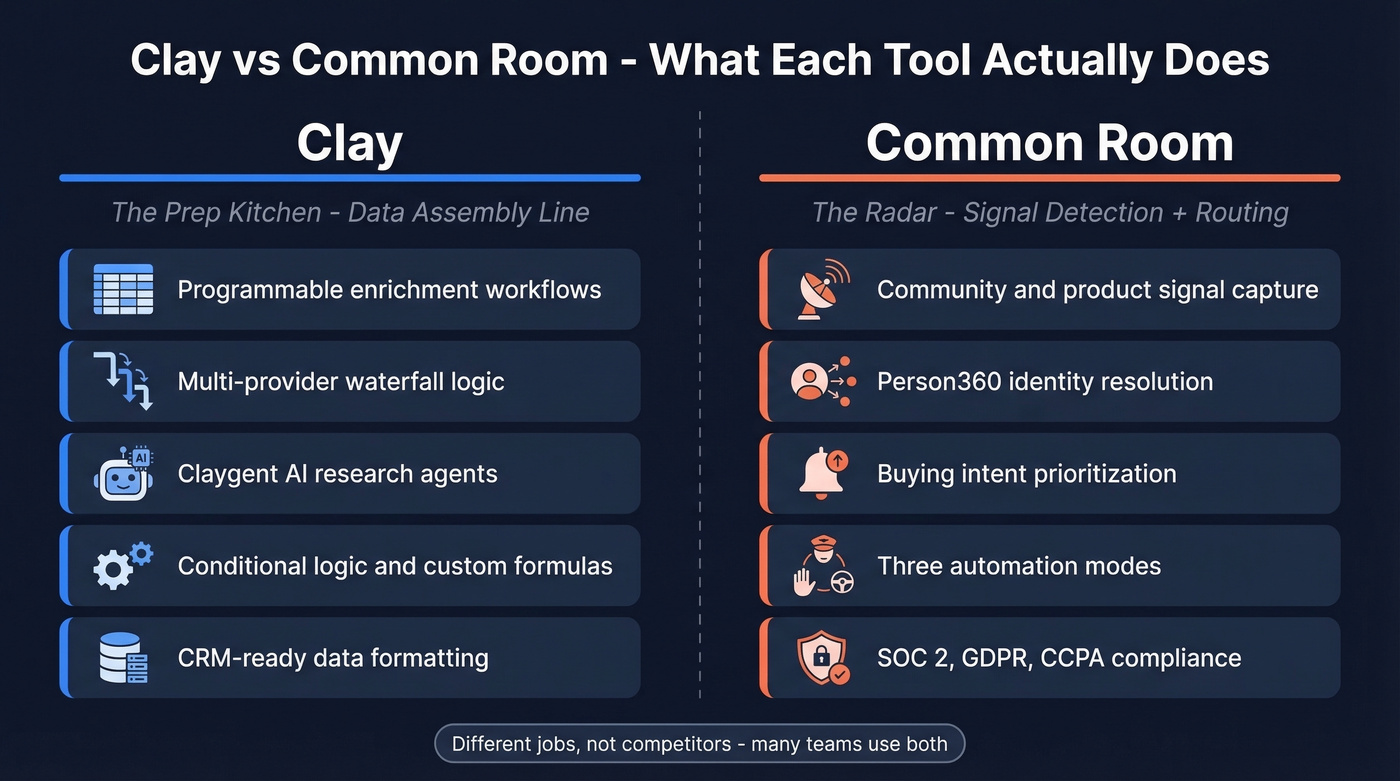
Common Room is customer intelligence built around capturing and activating buying signals. It pulls signals from community and product touchpoints, resolves identities into a Person360 view, and helps you activate those insights in outbound or ABM motions. One operational detail worth knowing: Common Room supports three automation modes - manual prioritized lists, a co-pilot "one-click" workflow, and full autopilot-style routing - so teams can start conservative and ramp up as they trust the data.
For enterprise buyers, Common Room also checks the usual compliance boxes (SOC 2, GDPR/CCPA alignment, AI controls with zero data retention), which is often the difference between "cool tool" and "approved vendor."
Feature Comparison
Both tools touch enrichment and workflows, but they're built for different jobs. Clay is the prep kitchen - the data assembly line. Common Room is the radar - signal detection plus routing.
| Category | Clay | Common Room |
|---|---|---|
| Best at | Enrichment + orchestration | Signal intel + activation |
| Integrations (G2-listed) | 10 | 25 (markets 50+ channels) |
| Signal sources | Integrations you connect | Community + product channels |
| Enrichment model | Credit-based waterfall | Included in subscription |
| AI capabilities | Research agents + prompts | Capture + routing automation |
| Outreach execution | Native sequencer | Pushes to your existing tools |
| Identity resolution | Workflow-based enrichment | Person360 merging |
G2 snapshot: Clay sits around 4.7/5, Common Room around 4.5/5. Ratings won't decide this - your motion will.

Clay and Common Room both depend on third-party data that decays fast. Prospeo's proprietary email infrastructure refreshes every 7 days - not 6 weeks - and delivers 98% email accuracy. Plug it directly into Clay, HubSpot, or Salesforce to close the verification gap before a single sequence fires.
Stop enriching leads that bounce. Verify them at $0.01 each.
Pricing Breakdown
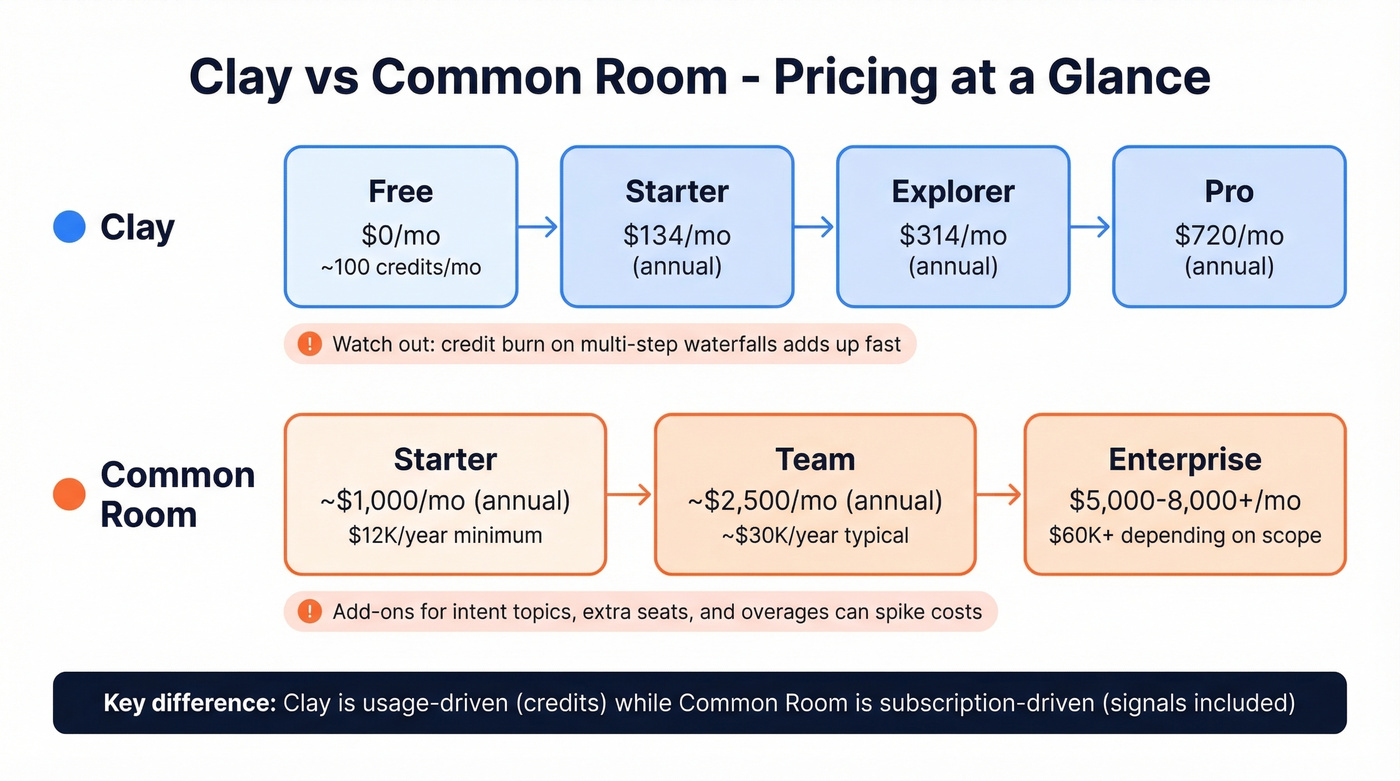
Here's the cleanest way to think about cost: Clay is usage-driven (credits), while Common Room is subscription-driven (signals and enrichment included).
| Clay | Common Room | |
|---|---|---|
| Entry tier | Free (~100 credits/mo) | Starter: ~$1,000/mo (annual) |
| Starter | ~$134/mo (annual) | - |
| Mid tier | Explorer: ~$314/mo (annual) | Team: ~$2,500/mo (annual) |
| Pro/upper tier | Pro: ~$720/mo (annual) | Enterprise: ~$5,000-8,000+/mo |
| Annual minimum | $0 | ~$12,000/year |
| Typical gotchas | Credit burn on waterfalls | Add-ons + overages for intent, topics, seats |
Clay's credit model is flexible but unpredictable once you run multi-step waterfalls at scale. If you're enriching thousands of rows weekly, you need a real budget owner - not vibes.
Common Room is a different kind of expensive: you're paying to instrument a signal engine. A Reddit user in r/CommunityManager called it "veryyy expensive (1K USD/month!)" - and that's the floor. Team plans commonly land around ~$30K/year, and enterprise can push $60K+ depending on scope.
Here's the thing: if your average deal size sits below five figures and you don't have a real community or product-signal motion, Common Room is usually the wrong spend. Put that money into better targeting, better offers, and cleaner data first.
When to Choose Which
Think about the pipeline in four stages: Signal → Enrichment → Verification → Outreach.
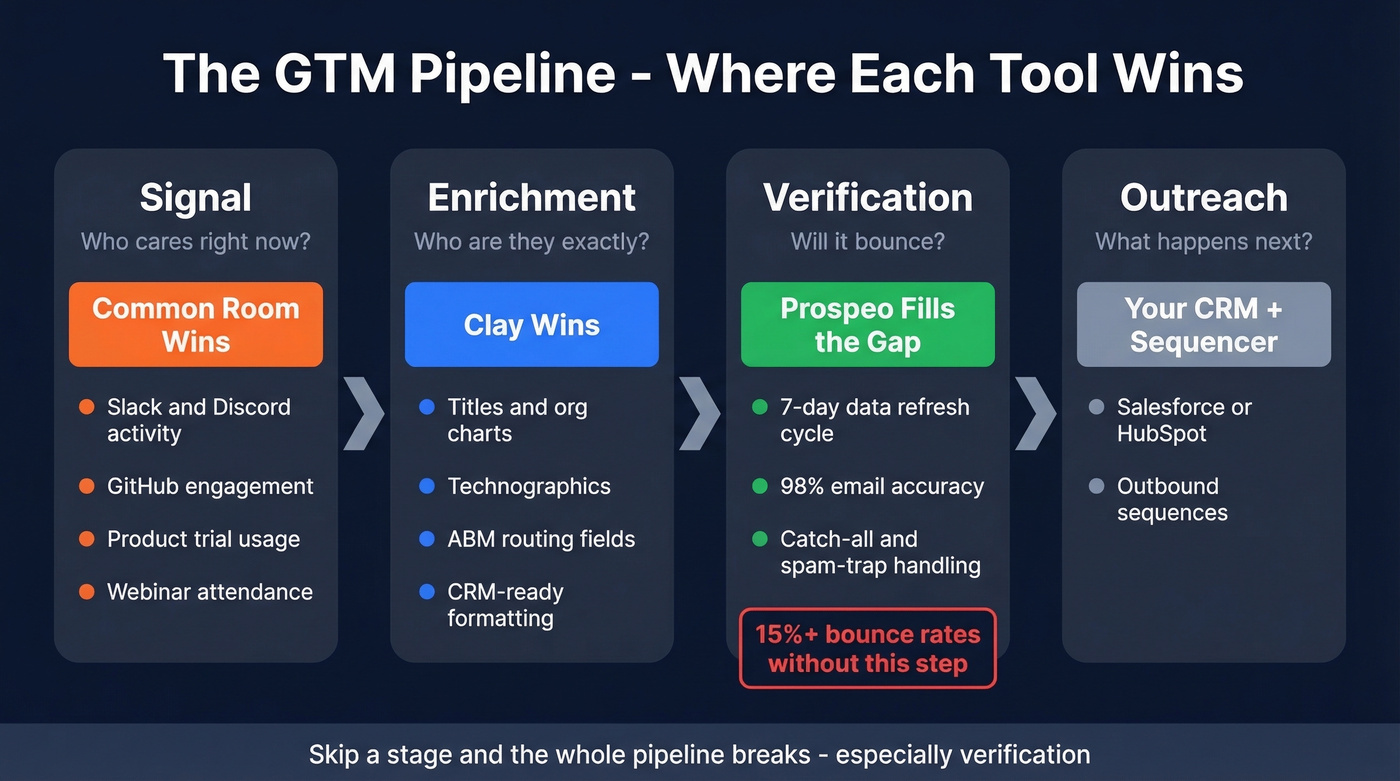
Signal (who cares right now?) - Common Room shines when intent is visible in community and product behavior. If your buyers live in Slack groups, Discord servers, GitHub repos, webinars, or free-tier usage, it'll surface accounts your outbound team would never find from firmographics alone.
Enrichment (who are they, exactly?) - Clay shines when you need to turn a list into a usable dataset: titles, org charts, technographics, ABM fields, routing rules, and CRM-ready formatting. It's the workhorse step.
Verification (will it bounce?) - This is the step most teams skip, then wonder why deliverability collapses. We've seen teams invest $3K/month in signal and enrichment tools, only to torch their sender reputation because 15% of emails were stale.
Outreach (what happens next?) - Both tools feed your CRM and sequencers. Neither replaces a disciplined outbound system.
A concrete example from our team: we ran a small test where Common Room flagged a cluster of engineers repeatedly engaging in a niche community, combined with a spike in product trial activity. That signal was the difference - without it, the account never would've hit our outbound list. Clay then did the heavy lifting: enrichment, routing fields, and pushing clean records into the CRM for an account-based sequence. The combo worked, but only because we verified every email before it hit a sequence.
Choose Clay when you need a configurable enrichment/orchestration layer and you have someone who enjoys building systems. Choose Common Room when you have real signal volume and you want your team spending time on accounts already leaning in. Skip Common Room if your buyers aren't active in trackable community or product channels - you'd be paying for a radar screen in an empty sky.
The Verification Gap
Both Clay and Common Room rely on third-party sources for contact accuracy, which means your enriched, signal-scored leads can still bounce. We've tested this repeatedly, and the gap is real.
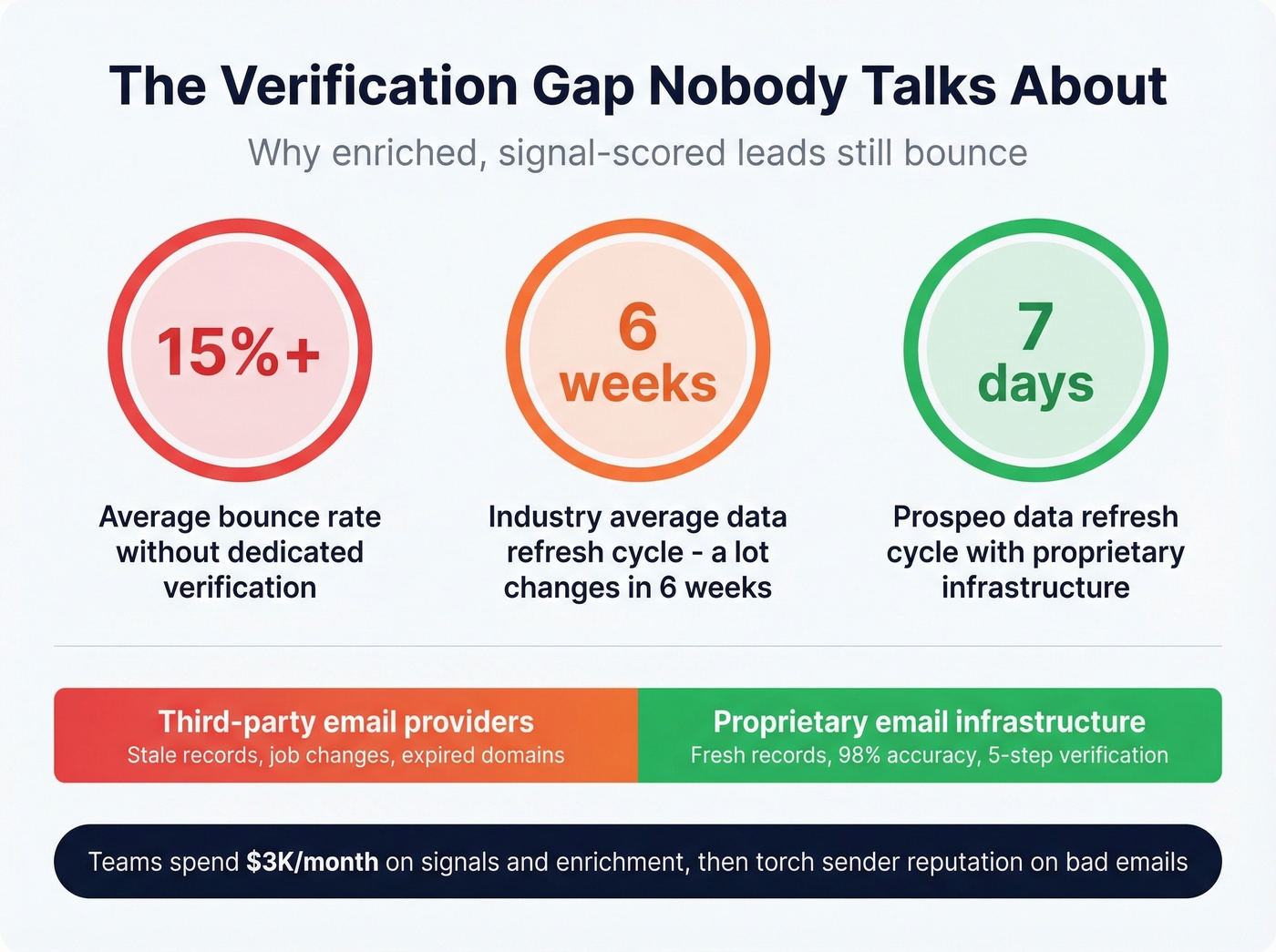
Prospeo fills that gap cleanly. Its proprietary email-finding infrastructure doesn't depend on third-party email providers, which means fewer stale records making it into your sequences. The 7-day data refresh cycle matters here - the industry average is six weeks, and a lot can change in six weeks (people switch jobs, companies restructure, domains expire).
If you want a direct path: use the email finder, plug it into your workflows via native integrations with Clay, Salesforce, HubSpot, and Zapier, and start on the free plan - 75 emails plus 100 Chrome extension credits per month, no contracts.
Your signal-to-outreach pipeline is only as strong as its weakest step. Teams using Clay + Common Room still see 15%+ bounce rates without a dedicated verification layer. Prospeo's 5-step verification with catch-all handling and spam-trap removal protects your sender reputation - 75 free emails per month, no contract required.
Fill the gap between enrichment and outreach with data you can trust.
FAQ
What's the difference between Clay and Common Room?
Clay is best for enrichment and orchestration - building workflows that turn messy lists into CRM-ready data across dozens of providers. Common Room is best for capturing buying signals from community and product activity, then routing prioritized accounts into your GTM motion. Many teams use both together, and that's often the right call.
Can you use both tools together?
Yes, and it's a common pattern. Common Room identifies and prioritizes accounts showing intent; Clay enriches contacts and formats data for CRM and outbound tools. Teams typically connect them through Salesforce or HubSpot sync plus automation (Zapier or Make) to keep handoffs clean.
Is Common Room worth $1,000/month?
It's worth it when you have real signal volume - PLG usage, active community, developer engagement - and you'll actually operationalize it into plays. If your buyers aren't active in those channels, the ROI falls apart fast. Teams with deal sizes under $15K often get better returns from enrichment-first tools and tighter targeting.
What's a good free option for contact data?
Prospeo offers a free tier with 75 email credits and 100 Chrome extension credits per month - enough to validate whether your targeting works before committing to a paid orchestration tool. Clay also has a free tier (~100 credits/mo), though it's more limited for pure contact discovery.