

Clay vs Unify: Which GTM Platform Actually Fits Your Team?
Your CEO saw a LinkedIn post about signal-based outbound and wants to know why you're still running Clay workflows piped into Smartlead. Meanwhile, the SDR lead just demoed Unify and says it can replace three tools. The Clay vs Unify decision is messier than either pitch deck suggests. Sacra estimates Clay at roughly $100M in ARR and Unify closer to $5.6M. That maturity gap matters - but it doesn't automatically make Clay the right pick.
30-Second Verdict
Pick Clay if you've got a GTM engineer who wants flexible data orchestration across 150+ providers and 100+ premium data sources. You'll build exactly the workflows you need, but you'll build them yourself.
Pick Unify if you want intent-triggered outbound running in days, not weeks, with managed deliverability baked in. You're trading flexibility for speed-to-launch.
Skip both if you're a team under 10 reps that isn't running signal-based plays yet. Get your data foundation right with a verified provider like Prospeo and a sequencer like Instantly or Smartlead - orchestration layers come later.
Quick Comparison
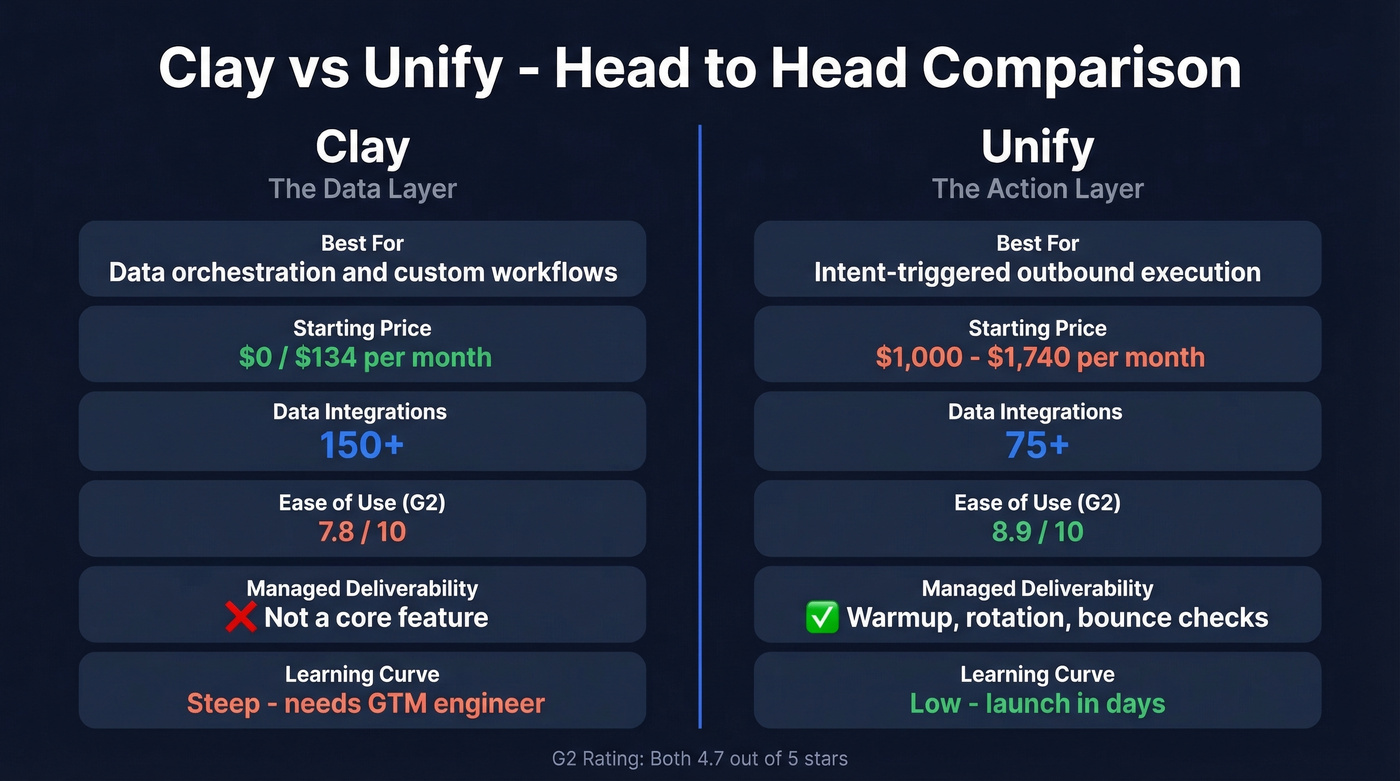
Sacra frames this split cleanly: Clay is the data layer, Unify is the action layer. That mental model holds up across every feature we compared.
| Category | Clay | Unify | Edge |
|---|---|---|---|
| Best For | Data orchestration | Intent-triggered outbound | Depends on team |
| G2 Rating | 4.7/5 (189 reviews) | 4.7/5 (42 reviews) | Tie |
| Ease of Use | 7.8/10 | 8.9/10 | Unify |
| Starting Price | Free / $134/mo (annual) | $1,000-$1,740/mo | Clay |
| Data Integrations | 150+ | 75+ | Clay |
| Native Sequencing | Yes (Sequencer) | Yes | Depends |
| Managed Deliverability | Not a core feature | Yes (managed mailboxes, warmup, rotation) | Unify |
| AI Agents | Yes (Claygent) | Yes | Tie |
| Named Customers | OpenAI, Canva | Perplexity, Cursor | - |
What Clay Does Best
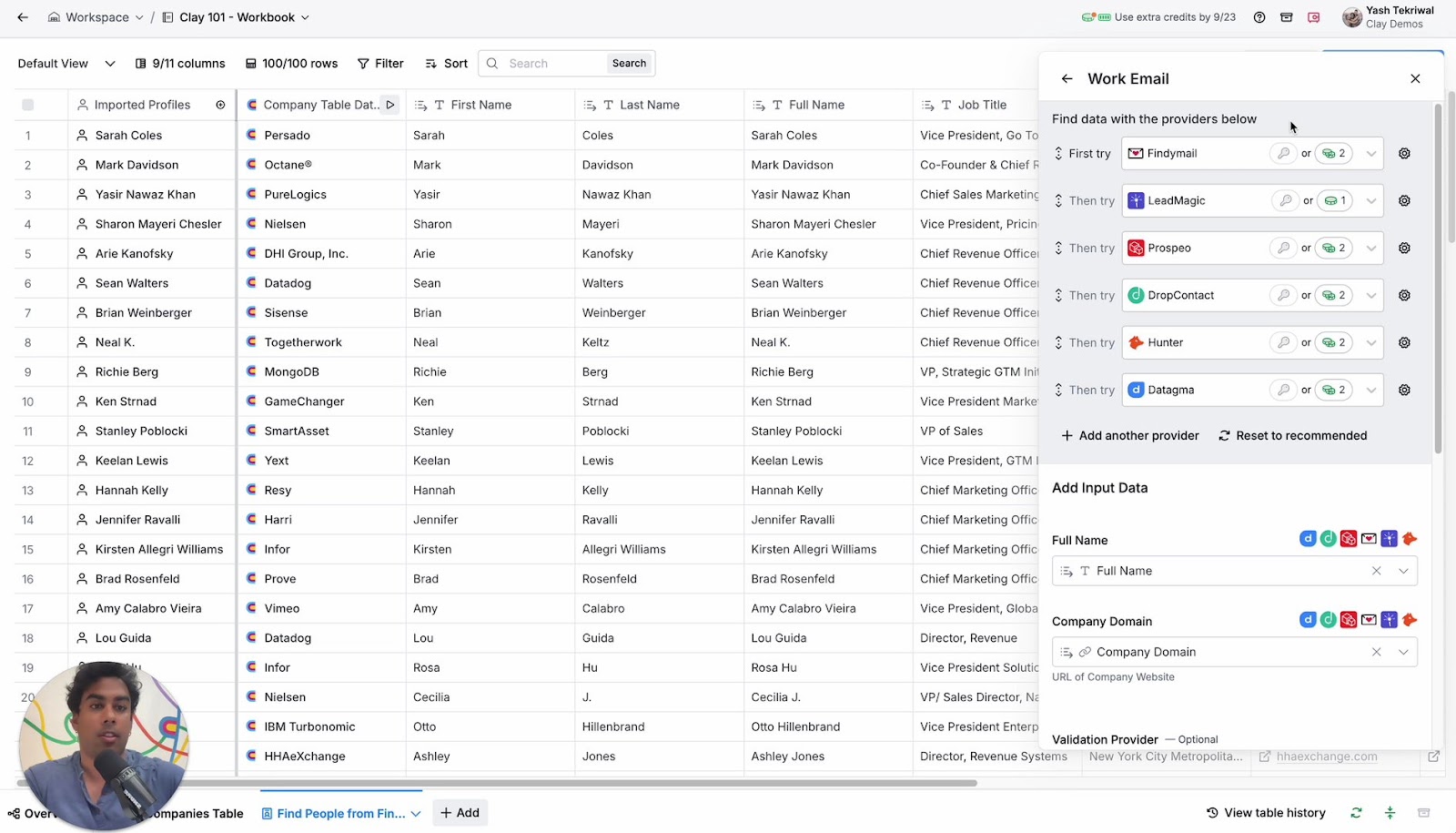
Clay is a workflow builder sitting on top of 150+ providers and 100+ premium data sources. Its real power is multi-provider enrichment waterfalls - you define the logic, chain providers together, and let Clay find the best data point from multiple sources in sequence. We've seen teams build plays in Clay that would require three separate tools anywhere else.
Guru's COO/CFO put it well on Unify's own customer page: "We use Clay for exploratory cold outbound campaigns." That's the sweet spot. Clay excels when you're building custom plays that don't fit a template.
The tradeoff is real, though. G2 reviewers flag learning curve and learning difficulty 16 times each, and Ease of Use scores just 7.8/10. If your team doesn't have someone comfortable building workflows, Clay will sit half-configured for months. We've watched it happen.
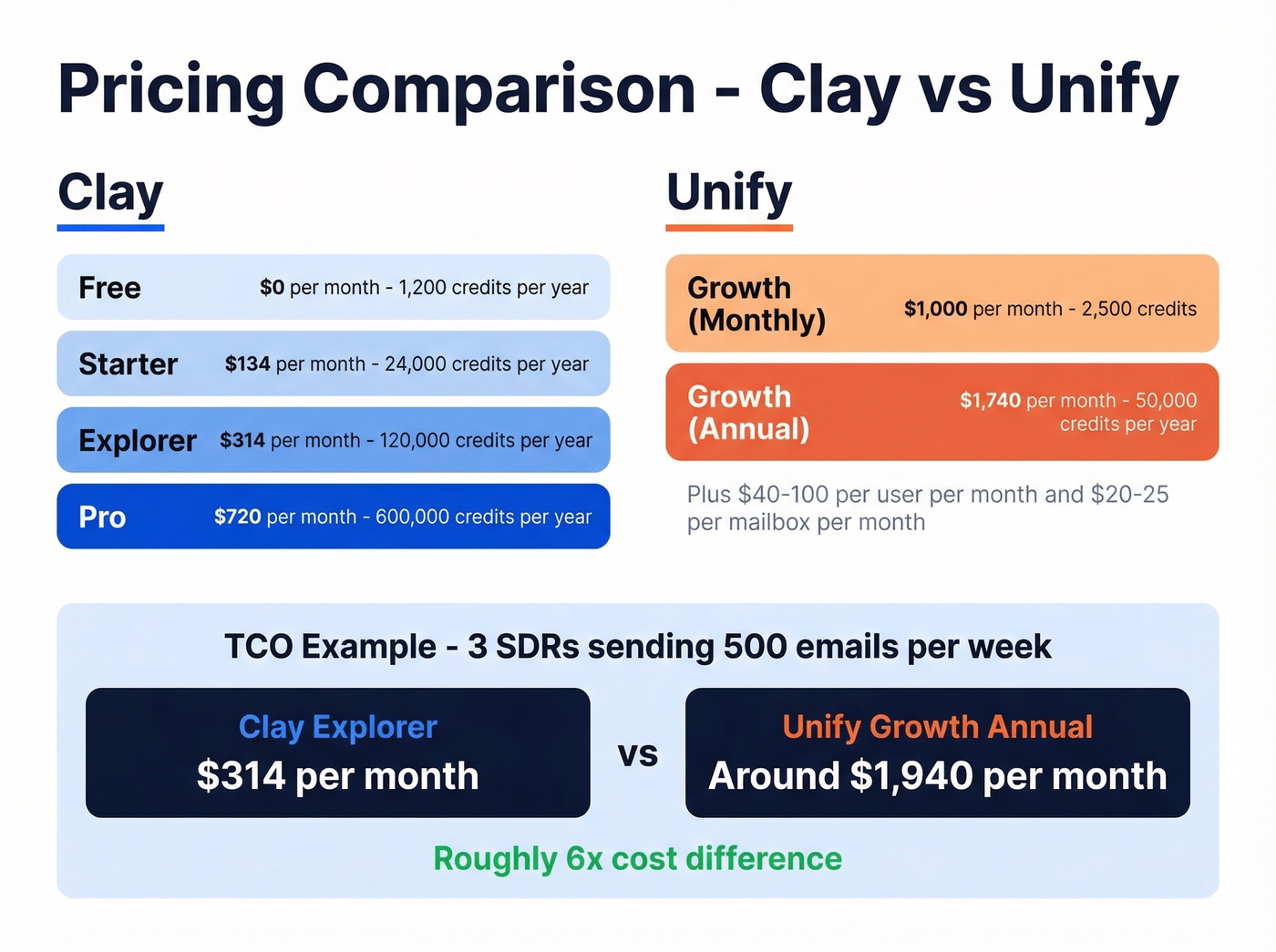
Pricing starts at $0 with 100 credits/month, scales to $134/mo for Starter, $314/mo for Explorer, and $720/mo for Pro (all billed annually). Clay also offers a 14-day Pro trial with 1,000 credits.

Clay's waterfall enrichment is powerful - but every provider in that chain still has accuracy issues. Prospeo integrates natively with Clay and feeds it 98% verified emails from proprietary infrastructure, not recycled third-party data. At $0.01/email with an 83% enrichment match rate, it costs less than one bad bounce costs your domain.
Fix the data layer before you orchestrate on top of it.
What Unify Does Best
Unify's pitch is the opposite: don't build, just run. It ingests intent signals from 6sense, Clearbit, G2, and Demandbase, then triggers automated outbound plays when buying signals fire. Its AI Agents handle research and personalization steps that would require manual Clay workflows. The managed deliverability layer - warmup, domain rotation, bounce checks, mailbox rotation - is the feature most teams undervalue until they've burned a domain.

The results can be impressive. Perplexity generated $1.7M in pipeline in three months with 75+ opportunities. Justworks reported a 6.8X ROI.
Here's the thing, though. Unify claims bi-directional CRM syncing every 15 minutes, but a validated G2 reviewer from February 2026 rated Unify 0.5/5, reporting a Salesforce integration that "created a mess" taking 3+ months to resolve, along with prospects who'd left their companies 3-5 years ago. One review - but the complaints are specific enough to take seriously.
Our take: If your average deal size is closer to SMB/mid-market and you don't have a dedicated ops person, Unify's speed-to-launch will generate more pipeline than Clay's flexibility. Most teams overestimate their willingness to build workflows.
Pricing Breakdown
Clay's tiers are straightforward:
| Plan | Monthly (Annual) | Credits/Year |
|---|---|---|
| Free | $0 | 1,200 |
| Starter | $134 | 24,000 |
| Explorer | $314 | 120,000 |
| Pro | $720 | 600,000 |
| Enterprise | Custom | Custom |
Unify's pricing is where things get confusing. The pricing page shows two different packaging structures. The annual view lists Growth starting from $1,740/mo billed annually with 50,000 credits issued annually. The monthly block shows Growth starting from $1,000/mo with 2,500 credits. Even third-party breakdowns conflict with Unify's own page.
Unify Pro is custom-priced, but for comparable mid-market GTM platforms it commonly lands around $3,000-5,000/mo depending on credits, seats, and mailbox volume.
Add-ons vary by packaging block too:
- Annual: $100/user/mo and $25/mailbox/mo
- Monthly: $40/platform user/mo, $100/email sending user/mo, and $20/mailbox/mo
TCO scenario: 3-person SDR team, 500 emails/week. On Clay Explorer ($314/mo), you'd have comfortable headroom for enrichment-heavy workflows. On Unify Growth annual, you're looking at $1,740/mo plus $200/mo for two additional users - roughly $1,940/mo before mailboxes. That's about a 6x cost difference. Demand a clear order form before your trial ends.
The Data Problem Neither Solves
Neither Clay nor Unify owns its contact data. Both aggregate from third-party providers, which means both inherit whatever accuracy issues those providers have. That reviewer finding prospects who left companies 3-5 years ago? That's the underlying data supply chain, not a bug unique to either platform.
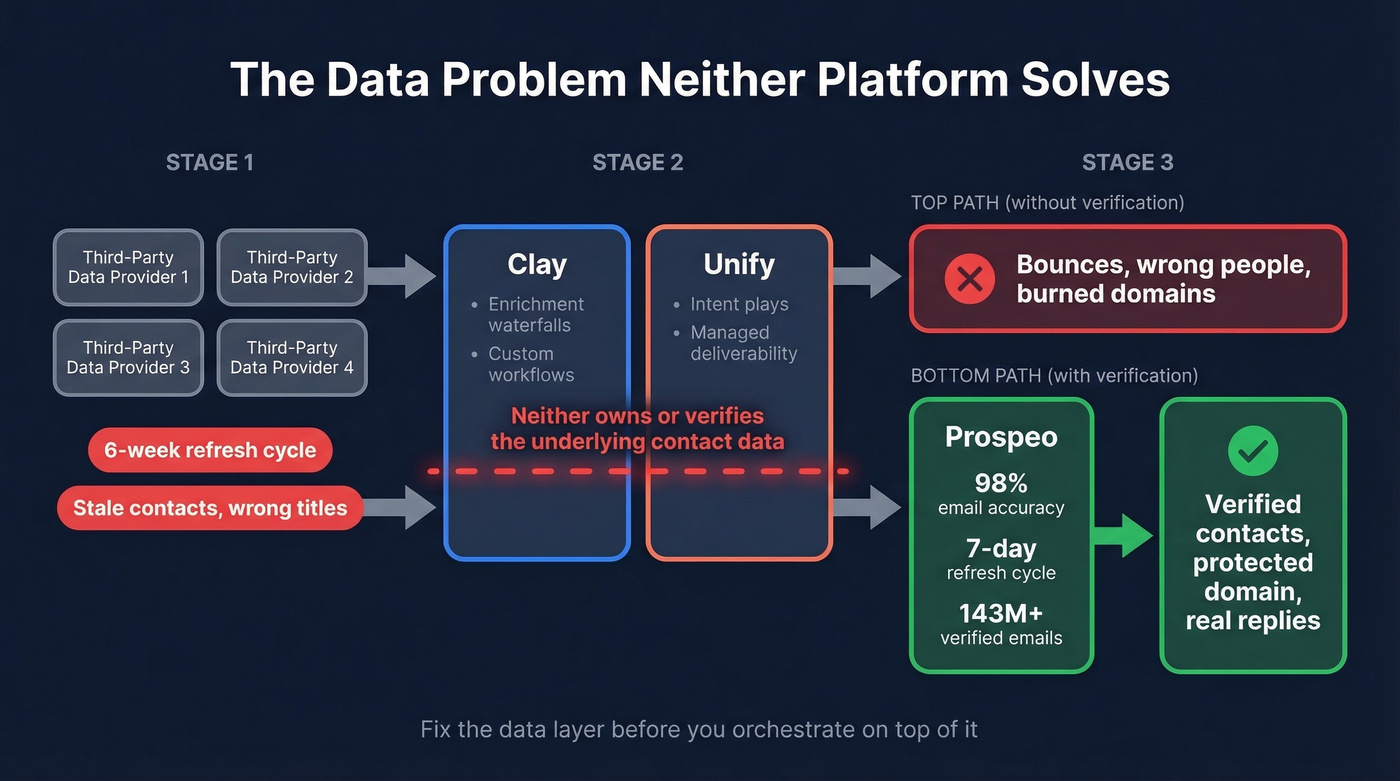
In our experience, the data accuracy gap is where most outbound campaigns actually fail - not the orchestration logic, not the sequencing, not the personalization. Bad data makes everything downstream look broken.
Prospeo runs proprietary email-finding infrastructure with 98% email accuracy and a 7-day refresh cycle versus the 6-week industry average. It integrates natively with Clay, so you can plug verified data into enrichment workflows without adding complexity. With 300M+ professional profiles, 143M+ verified emails, and 125M+ verified mobile numbers, plus an 83% enrichment match rate and 92% API match rate, it fills the gap that both platforms leave open.

That G2 reviewer found prospects who left companies 3-5 years ago. That's what happens when your data refreshes every 6 weeks - or never. Prospeo refreshes every 7 days across 300M+ profiles and 143M+ verified emails, so whether you run Clay workflows or Unify plays, the contacts are real and current.
Stop orchestrating stale data. Start with contacts that actually connect.
When to Pick Which
Pick Clay if:
- You have a GTM engineer or ops-savvy team member
- You need flexible enrichment across 150+ data sources
- You want custom plays that don't fit a template
- Budget is tight - the free tier and $134/mo Starter are real entry points
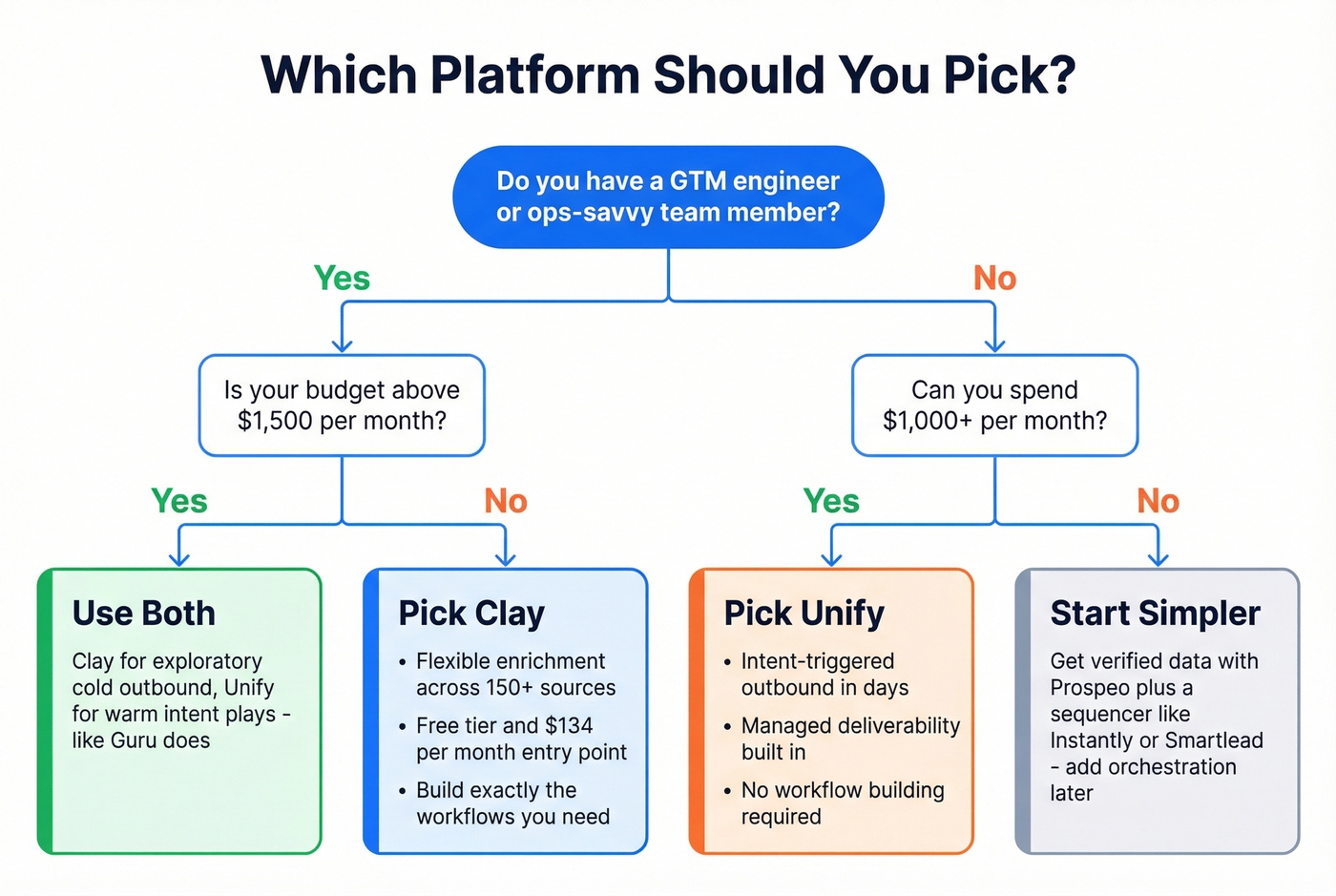
Pick Unify if:
- You want intent-triggered outbound running in days
- Managed deliverability matters more than workflow flexibility
- You don't have ops bandwidth to build and maintain workflows
- You're comfortable with $1,000-$1,740/mo as a starting point
Use both if you have the budget. Guru's approach - Clay for exploratory cold outbound, Unify for warm outbound automation - is a legitimate pattern for teams running both signal-based and discovery plays.
For teams not yet at that stage, the consensus on r/sales leans toward getting your data right before layering on orchestration. That tracks with what we've seen: the fanciest workflow in the world still bounces if the emails are stale.
FAQ
Can you use Clay and Unify together?
Yes. Many teams use Clay for exploratory list-building and enrichment, then run Unify for intent-triggered plays and execution. If you can afford both, this split typically reduces build time while keeping your workflows flexible for new segments.
Is Unify's data accurate enough for outbound?
It's good enough to launch, but you should still add a verification layer because both platforms rely on third-party data. One validated February 2026 review reported stale contacts - people who'd left 3-5 years ago - which is exactly how bounce rates and domain reputation get wrecked.
Which is cheaper for a small team?
Clay, by a wide margin. There's a free tier, and Starter runs $134/mo annually. Unify starts at $1,000-$1,740/mo before per-user and per-mailbox add-ons, so it's better justified when speed-to-launch and deliverability management are worth the premium.
What should you add first: orchestration or better data?
Fix data first. Bad inputs make both tools look broken in the same way - bounces, wrong titles, stale contacts. A verified data provider with high accuracy and frequent refresh cycles should come before any orchestration layer.
Summary
Let's be honest: the Clay vs Unify call isn't really about features. Clay rewards teams that can build and maintain enrichment logic. Unify rewards teams that want intent-triggered execution and managed deliverability fast. But neither platform fixes the underlying data quality problem, and that's where most outbound campaigns actually break down. Get the data right first - then pick the orchestration layer that matches your team's ops maturity.