

Clay vs ZoomInfo: Which One Do You Actually Need in 2026?
Finance just flagged the ZoomInfo line item. $38,000 for five seats, and your SDR manager says half the phone numbers ring front desks. Meanwhile, someone on the RevOps team keeps demoing Clay and talking about "waterfall enrichment" like it's going to solve everything.
The Clay vs ZoomInfo decision comes down to architecture, not features - and picking the wrong one wastes real money. Let's break it down.
30-Second Verdict
Pick ZoomInfo if you're enterprise (500+ employees), run 5,000+ leads/month, and need native intent data plus a single platform your RevOps team can own. You'll pay $15k-$45k+/year, but you get consolidation at scale.
Pick Clay if you're mid-market with a technical ops person who can build workflows. You'll get multi-source enrichment flexibility at $2,200-$6,000/year - but you'll need 2-4 weeks to deploy it properly and a separate sequencer.
Side-by-Side Comparison
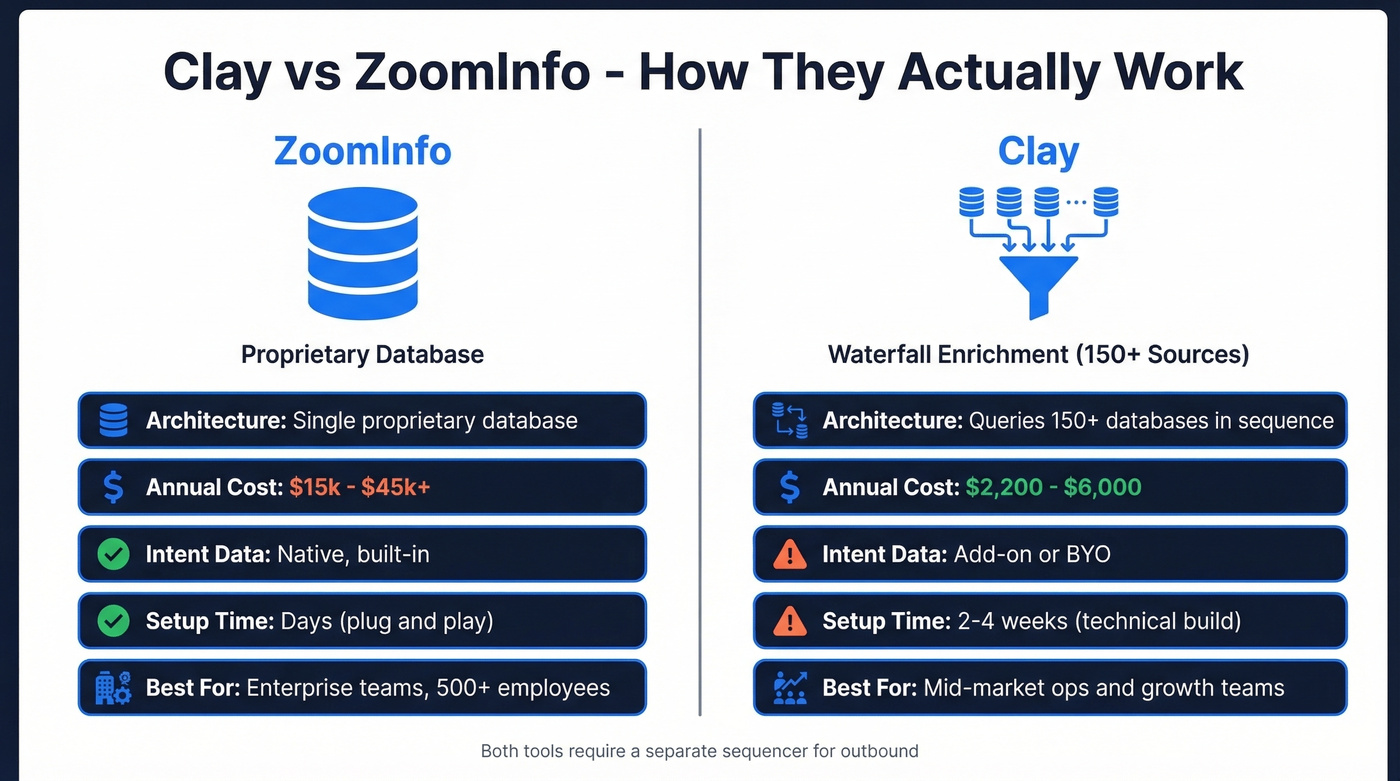
These two tools look like competitors on paper, but they're built completely differently. ZoomInfo owns a proprietary database and bolts platform features on top. Clay is a workflow orchestration engine that queries 150+ databases in sequence . That distinction matters more than any feature checklist.
| ZoomInfo | Clay | |
|---|---|---|
| Data model | Proprietary database | Waterfall (150+ databases) |
| Annual cost | $15k-$45k+ | ~$2,200-$6,000 |
| Intent data | Native | Add-on / BYO |
| Sequencing | BYO | BYO sequencer |
| Ideal user | Enterprise RevOps | Mid-market ops/growth |
| G2 rating | 4.5/5 (9,035 reviews) | 4.7/5 (188 reviews) |
How ZoomInfo Works and What It Costs
ZoomInfo is the incumbent. It's the tool most enterprise sales orgs default to, and for good reason - the database is massive, the intent signals are native, and the platform can cover a lot of your go-to-market stack in a single contract. The problem is that "single contract" can get expensive fast.
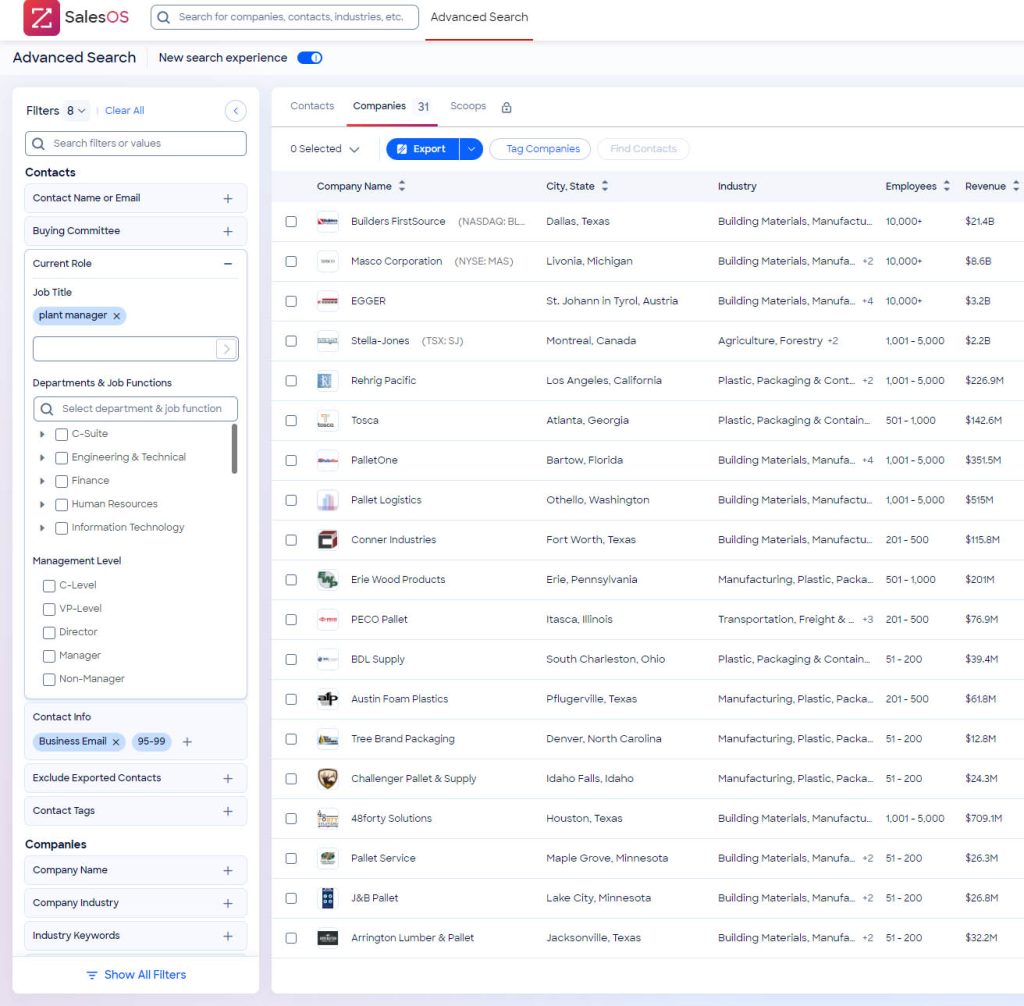
Tropic's procurement benchmarks break down the list pricing clearly:
| Tier | List Price/Year | Included |
|---|---|---|
| Professional+ | $14,995 | 3 seats, 5,000 credits |
| Advanced+ | $29,995 | More credits, intent |
| Elite+ | $35,995 | Full suite, 10k-20k credits |
Third-party estimates from Cognism and other procurement sources converge on similar ranges: $15k-$18k for Professional, $22k-$28k for Advanced, and $35k-$45k+ for Elite. Discounts of 30-65% are common if you negotiate, especially on multi-year deals. But here's where it gets tricky.
The Hidden Costs
Add-ons stack up fast. Additional users run $2,500 each at list price. Global Data costs $9,995. NeverBounce email verification adds ~$3,000. Need more credits? That's another ~$3,000 per 5,000. A mid-market team can easily land near $50,000/year all-in once add-ons are factored in.
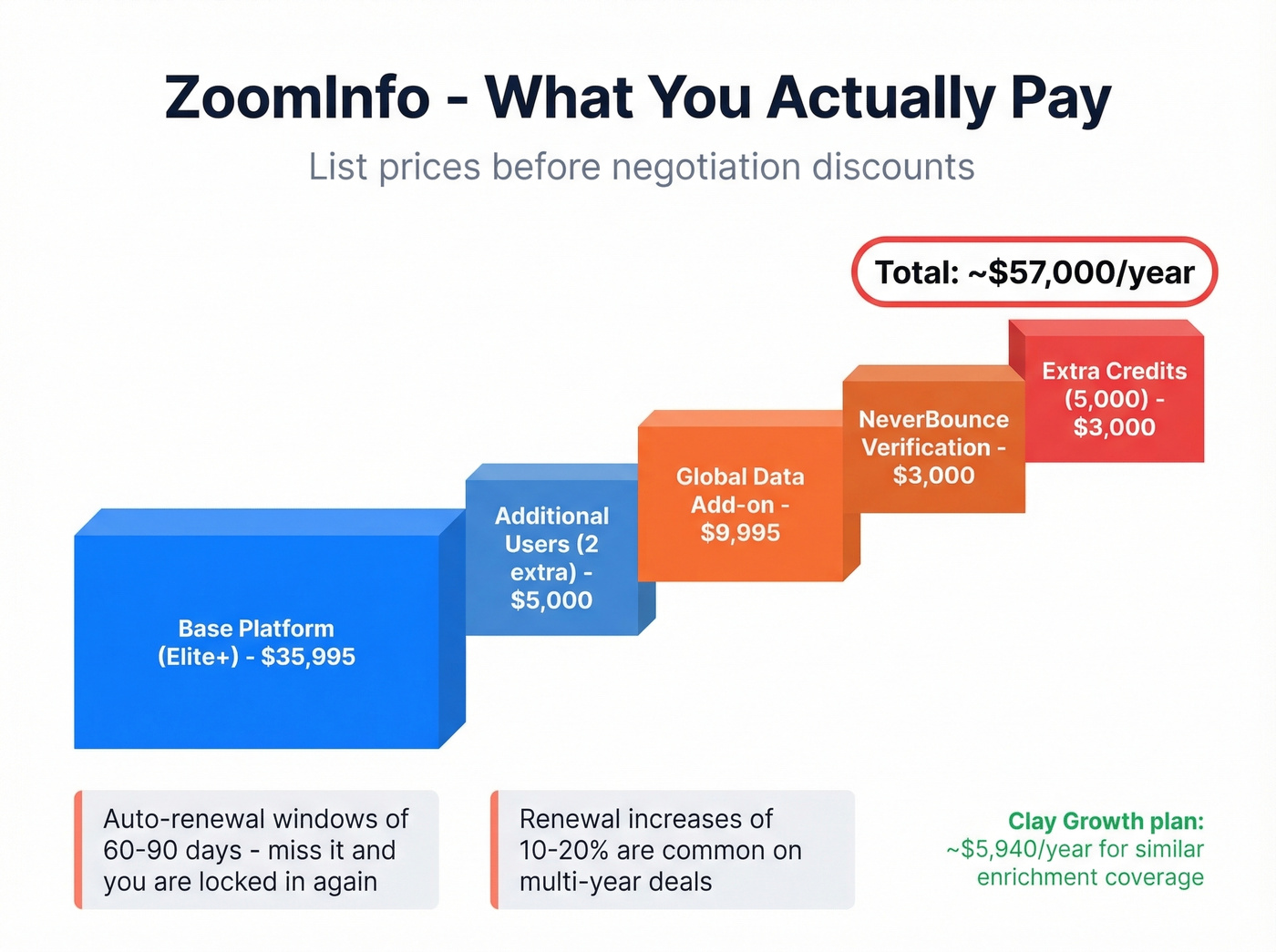
The contract structure is the real risk. ZoomInfo pushes 2-3 year agreements with auto-renewal windows of 60-90 days . Miss that window and you're locked in for another cycle - often with a 10-20% renewal increase baked in. A class-action lawsuit filed Sept. 4, 2024 in U.S. District Court for Western Washington alleged ZoomInfo misled investors, and separate investor-litigation materials have described allegations involving manipulative auto-renew policies. Regardless of the outcome, read those contract terms carefully before signing.
Here's the thing: ZoomInfo is a good product if you're big enough to use it fully. Most teams buy it for the database and end up paying for intent, chat, and workflow features they never activate. If your average deal size doesn't justify five-figure tooling, you almost certainly don't need ZoomInfo-level infrastructure.
How Clay Works and What It Costs
Clay doesn't own a database. Instead, it runs waterfall enrichment across 150+ databases - Prospeo, Hunter, Apollo, Lusha, PeopleDataLabs, Datagma, and dozens more. When you search for a contact's email, Clay queries providers sequentially until it finds a valid match. The result is broader coverage than any single database can deliver, and Clay's own waterfall enrichment page says the approach routinely triples coverage.
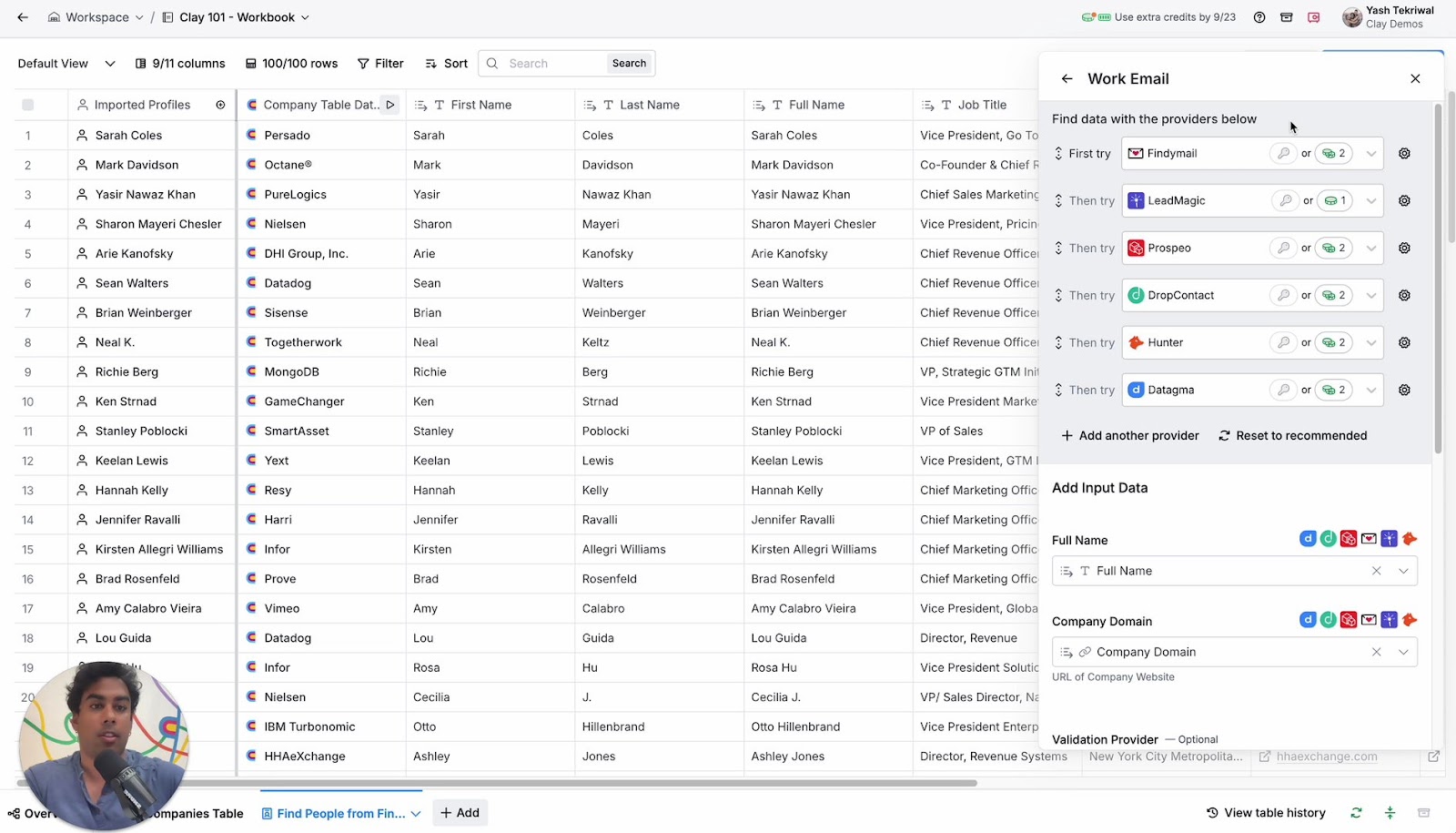
Clay overhauled its pricing on March 11, 2026, splitting costs into two currencies. Data Credits cover enrichment lookups. Actions cover workflow steps - CRM pushes, API calls, and Claygent queries.
| Plan | Monthly Cost | Data Credits | Actions |
|---|---|---|---|
| Launch | $185 | 2,500 | 15,000 |
| Growth | $495 | 6,000 | 40,000 |
| Enterprise | Custom | Custom | Custom |
The Growth plan replaced the old $800/mo Pro tier while keeping CRM integrations and HTTP APIs - a genuine price drop. Clay positions this as 2-3x coverage at 1/5th the cost versus ZoomInfo.
The community reaction on r/gtmengineering was mixed. Data costs dropped 50-90%, but the new Actions meter adds unpredictability. Enrichments that return no result don't cost you Data Credits or Actions - that's a nice touch. But CRM pushes, HTTP API calls, and Claygent queries all consume Actions, and it's not always obvious how fast you'll burn through them. Plan for 20-30% above listed price to cover overages until you've calibrated your workflows.
We've seen teams get Clay running beautifully - but it takes 2-4 weeks of setup and a person who genuinely enjoys building automations. If nobody on your team fits that description, Clay will collect dust.

ZoomInfo charges $15k+ for data users say they can't trust. Clay needs weeks of setup and a dedicated ops person. Prospeo delivers 98% email accuracy from a proprietary database refreshed every 7 days - at $0.01 per email, no contracts, no workflow engineering required.
Skip the $38k invoice and the 4-week Clay buildout. Start prospecting in minutes.
What 9,000+ Reviews Say
ZoomInfo: Loved for Depth, Dinged for Accuracy
ZoomInfo's G2 profile sits at 4.5/5 from 9,035 reviews - a massive sample size. The top pros tell a clear story: deep contact database (413 mentions), ease of use (403), and data accuracy (384). For enterprise teams, ZoomInfo works out of the box.
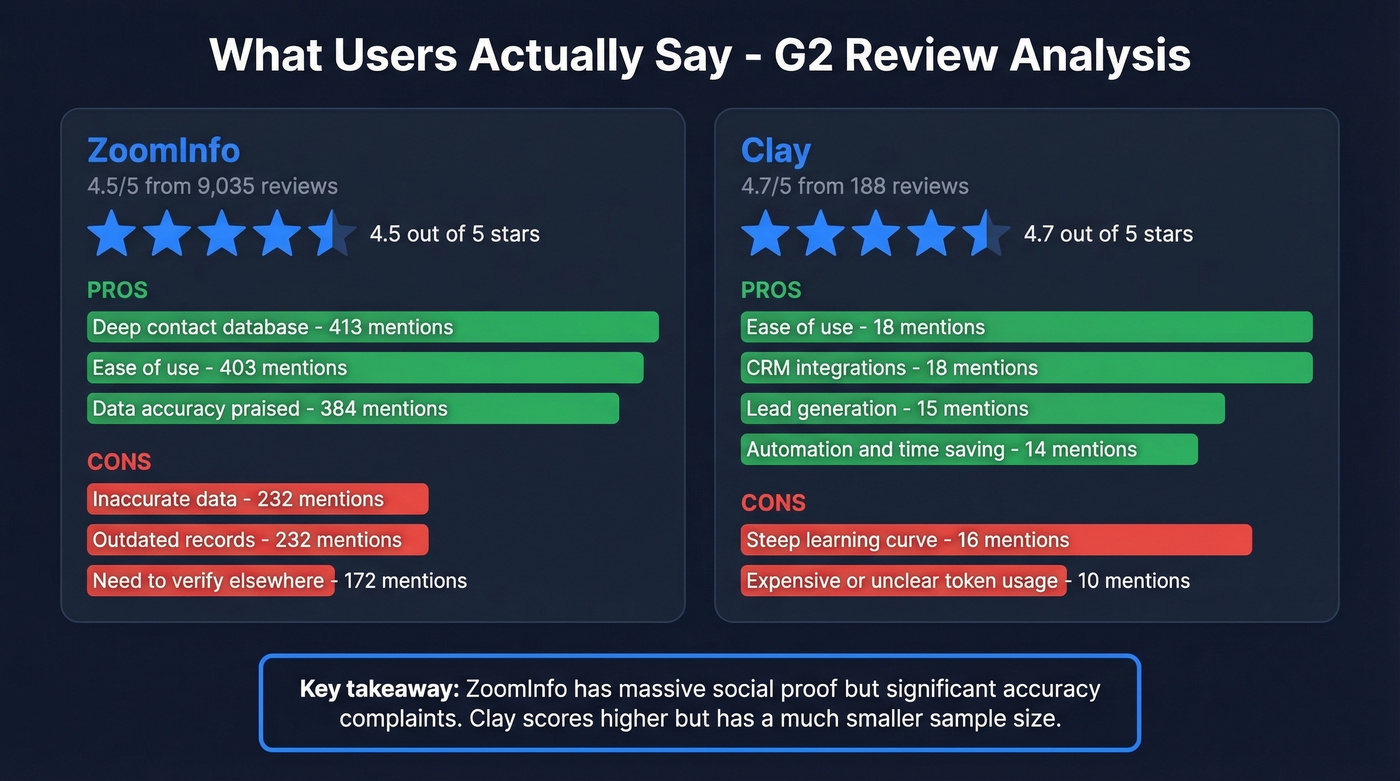
The cons tell an equally clear story. Across those 9,000+ reviews, 232 call out inaccurate data, another 232 flag outdated records, and 172 say they need to verify data elsewhere. That's a meaningful chunk of users who don't trust it as a single source of truth.
Reddit paints a rougher picture. Users report a buggy Chrome extension, phone numbers that route to general reception instead of direct dials, and costs running $15-20k for underwhelming results. The sales experience itself gets called out too - one poster described reps calling every two hours after they showed interest. The #1 complaint on Reddit? Price. Specifically, paying for modules you don't use.
Clay: Powerful but Demanding
Clay's G2 profile shows 4.7/5 from 188 reviews - a higher rating but a much smaller sample. Top pros include ease of use (18 mentions), CRM integrations (18), lead generation (15), and automation/time-saving (14).
The cons center on two themes: a steep learning curve (16 mentions) and expensive or unclear token consumption (10 mentions). Clay is powerful, but it demands a technical user willing to invest time upfront. If your team expects plug-and-play, this isn't it.
The Gap Neither Tool Fills
Here's what this comparison usually glosses over: the matchup itself is fundamentally flawed. ZoomInfo is a database with a platform bolted on. Clay is a workflow engine with databases plugged in. Comparing them head-to-head is like comparing a warehouse to a logistics network - they operate at different layers of your data stack.
The real gap is verification.
ZoomInfo has hundreds of user complaints about inaccurate data. Clay's accuracy depends entirely on whichever providers its waterfall queries on any given lookup. Neither tool guarantees that the email you pull will actually land in someone's inbox. This is the "data quality tax" most teams don't budget for. Bounced emails burn sender domains, burned domains tank deliverability, and tanked deliverability means your sequences - no matter how well-written - go to spam. The downstream cost of bad data dwarfs the subscription price of any tool.

Clay's waterfall enrichment queries 150+ providers - and Prospeo is one of them. But you can go direct. 300M+ profiles, 125M+ verified mobiles with 30% pickup rates, and 30+ search filters including intent data. No middleman markup, no Actions meter surprises.
Cut out the orchestration layer and get the data directly for a fraction of the cost.
Run Your Own Accuracy Test
No independent head-to-head benchmark between Clay and ZoomInfo exists. Anyone claiming one tool is definitively "more accurate" without data is guessing. So run your own test. It takes a day, and it'll save you months of regret.
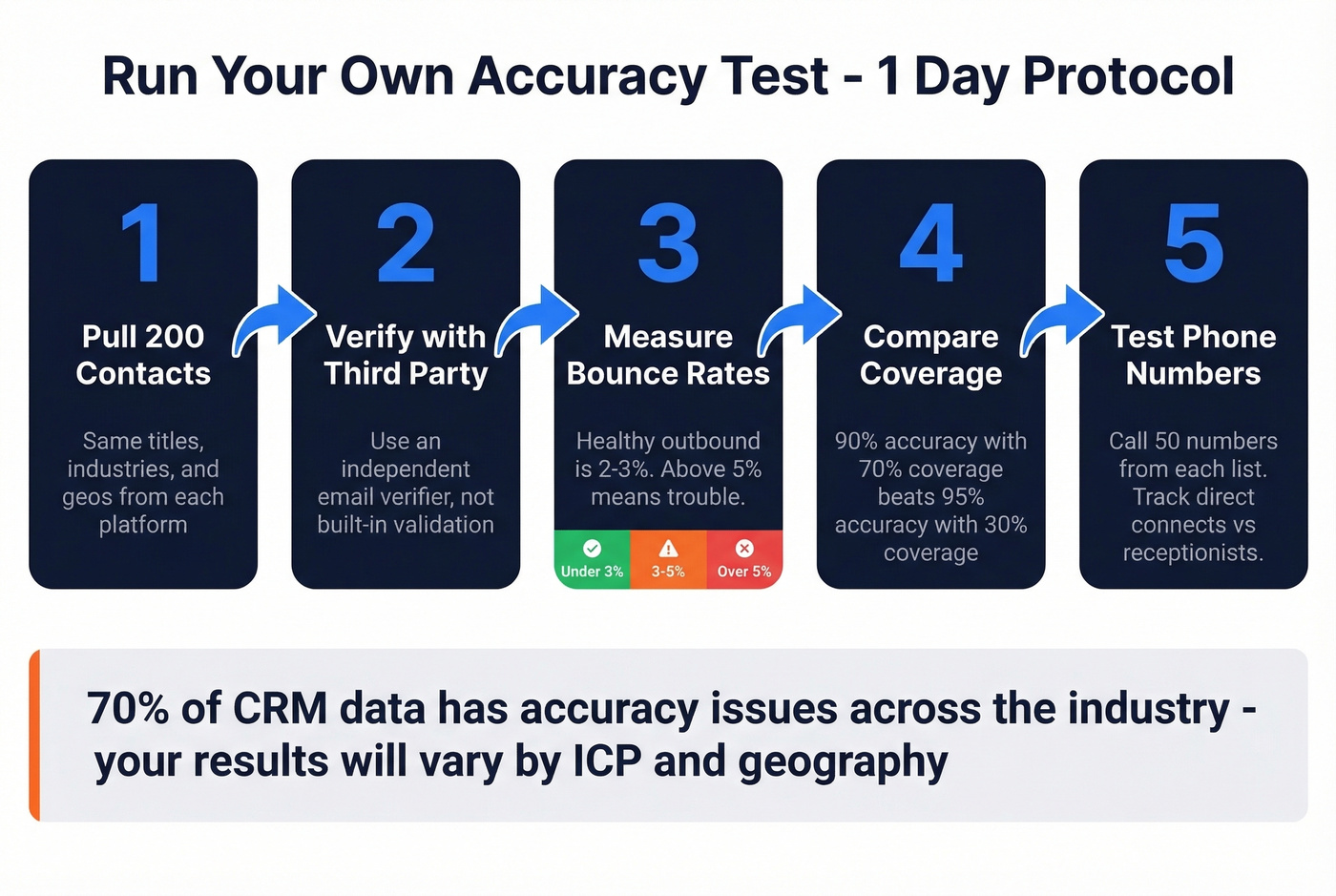
Here's the protocol we recommend:
- Pull 200 contacts matching your actual ICP from each platform. Same titles, same industries, same geographies.
- Run both lists through a third-party email verifier. Don't trust either tool's built-in validation - use an independent source.
- Measure bounce rates. Healthy outbound sits at 2-3%. Anything above 5% signals a deliverability problem.
- Compare coverage rates. What percentage of your ICP did each tool actually find? A tool with 95% accuracy but 30% coverage isn't better than one with 90% accuracy and 70% coverage.
- Check phone connect rates. Call 50 numbers from each list. Track how many reach the actual person vs. a receptionist or dead line.
For context, 70% of CRM data suffers from accuracy issues across the industry. Your results with any provider will vary by ICP, geography, and seniority level. The only way to know what works for your team is to test with your data.
Who Should Use Which
Pick ZoomInfo If...
You're enterprise - 500+ employees, dedicated RevOps team, processing 5,000+ leads/month. You need native intent data and the budget for $15k-$45k+/year, plus the ops capacity to manage a complex contract. ZoomInfo's strength is consolidation: one vendor, one login, one throat to choke when something breaks.
Pick Clay If...
You're mid-market (50-500 employees) with a technical ops person who enjoys building workflows. You're running 1,000-5,000 leads/month and want multi-source enrichment flexibility without a five-figure annual commitment. Budget $2,200-$6,000/year for Clay itself, plus whatever you spend on a sequence. Just know you're signing up for 2-4 weeks of setup and ongoing workflow maintenance.
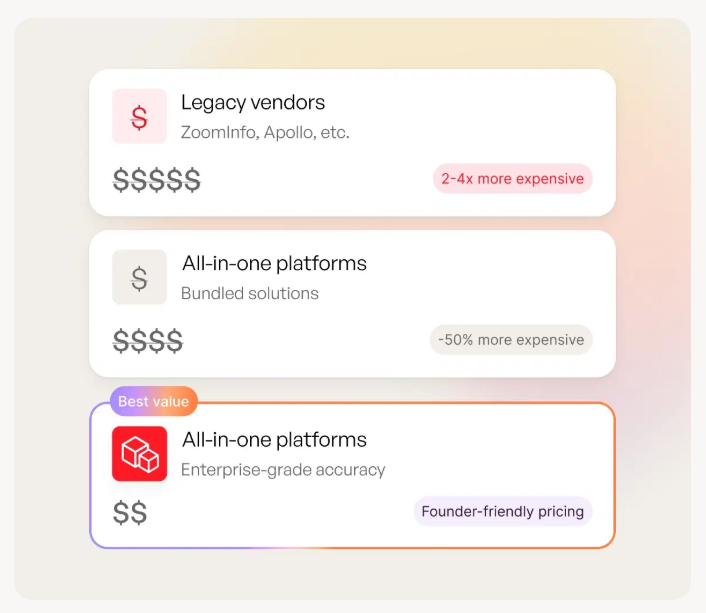
Skip Both If...
Apollo (free tier, paid from ~$49/mo per user) is another budget option worth testing.
FAQ
Can Clay replace ZoomInfo?
Not directly. Clay is a workflow orchestration layer that queries 150+ databases - it doesn't own a proprietary dataset. It can deliver similar or better coverage at lower cost, but you lose ZoomInfo's native intent signals and single-vendor simplicity. Think of Clay as a different architecture, not a drop-in swap.
Does Clay use ZoomInfo data?
No. Clay's waterfall queries providers including Prospeo, Hunter, Apollo, Lusha, and PeopleDataLabs. ZoomInfo isn't in Clay's provider network - the two are competitors, not partners. Clay's coverage advantage comes from aggregating many smaller providers rather than relying on one large database.
Is ZoomInfo worth the cost in 2026?
For enterprise teams running 5,000+ leads/month with dedicated ops staff, yes - the platform consolidation genuinely saves time. For mid-market or SMB teams, the $15k-$45k+ annual price is hard to justify when Clay or standalone data platforms deliver comparable data at a fraction of the cost.
How accurate is ZoomInfo data?
Across 9,000+ G2 reviews, 384 mention accuracy as a strength - but 232 flag inaccurate data and 232 flag outdated records. Accuracy varies significantly by ICP, geography, and seniority level. Always verify emails through a dedicated verification tool before launching outbound sequences.
What's the cheapest way to get B2B contact data?
Credit-based platforms like Prospeo start free (75 emails/month) and scale to roughly $0.01 per verified email. Clay Launch runs $185/month. ZoomInfo starts around $15,000/year. For pure contact data without workflow automation, a standalone provider is the most cost-effective option by a wide margin.