

35+ Closing Phrases for Sales, Organized by When to Actually Use Them
75% of sales reps missed quota last year. Not because they lacked closing phrases - because they used the right phrases at the wrong time. A sharp assumptive close during discovery sounds presumptuous. A soft micro-commitment at the contract stage sounds weak. Meanwhile, 34% of deals slipped past their expected close date and sales cycles stretched 20% longer year over year.
Timing is the variable most "closing phrases" articles ignore, and it's the one that actually matters.
35% of salespeople say closing is the hardest part of the sales process. That number drops fast when reps stop treating closing as a single moment and start treating it as a sequence of small commitments mapped to the deal stage. The best sales closing lines aren't clever tricks - they're the right words delivered at the right moment.
What You Need (Quick Version)
You don't need 30 phrases memorized. You need one for each stage of your sales cycle, and the discipline to match the phrase to the moment.
The three most versatile options across all stages:
- The either/or close: "Would Tuesday or Thursday work better for a kickoff?" Removes the yes/no binary and replaces it with a choice between two yeses.
- The "is that fair?" close: Top performers use this 1.7x per deal. It's disarming, collaborative, and works from discovery through negotiation.
- The stakeholder-surfacing question: "Who else should weigh in before we move forward?" Not a close in the traditional sense - it's a deal-acceleration move that prevents stalls at the 11th hour.
One phrase per stage. That's the framework.
What 519,000 Sales Calls Reveal
Gong analyzed 519,000+ B2B sales call recordings using NLP and machine learning. The findings are specific enough to be useful, and they've held up for years - which means most reps still haven't internalized them.
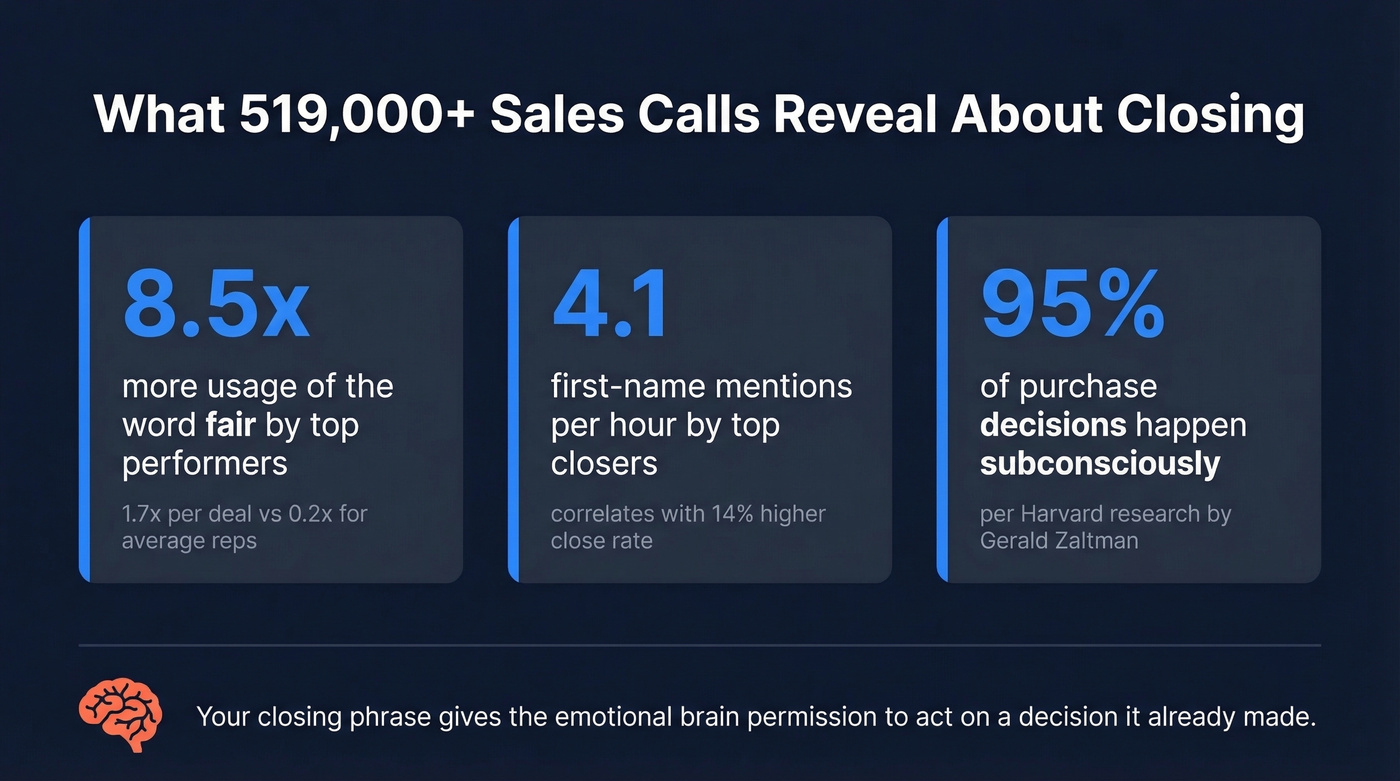
The word "fair" shows up 1.7x per deal among top performers versus 0.2x for everyone else. That's an 8.5x difference. "Is that fair?" works because it frames the ask as reasonable rather than aggressive, inviting agreement without pressure.
First-name usage matters more than most reps think. Top performers use the prospect's first name 4.1 times per hour, correlating with a 14% higher close rate. People pay more attention when they hear their own name - the Gong data shows correlation, not causation, but the pattern is consistent enough to act on.
Here's the thing: Harvard professor Gerald Zaltman's research shows roughly 95% of purchase decisions happen subconsciously. Your closing phrase isn't convincing the rational brain. It's giving the emotional brain permission to act on a decision it's already leaning toward. That's why tone, timing, and word choice matter more than whatever "technique" label you slap on it.
Sales Closing Lines by Deal Stage
The average B2B sales cycle runs 84 days. Enterprise deals with 6-10 decision-makers stretch longer. Each stage needs different language - micro-commitments early, value recaps in the middle, decisive asks at the end.
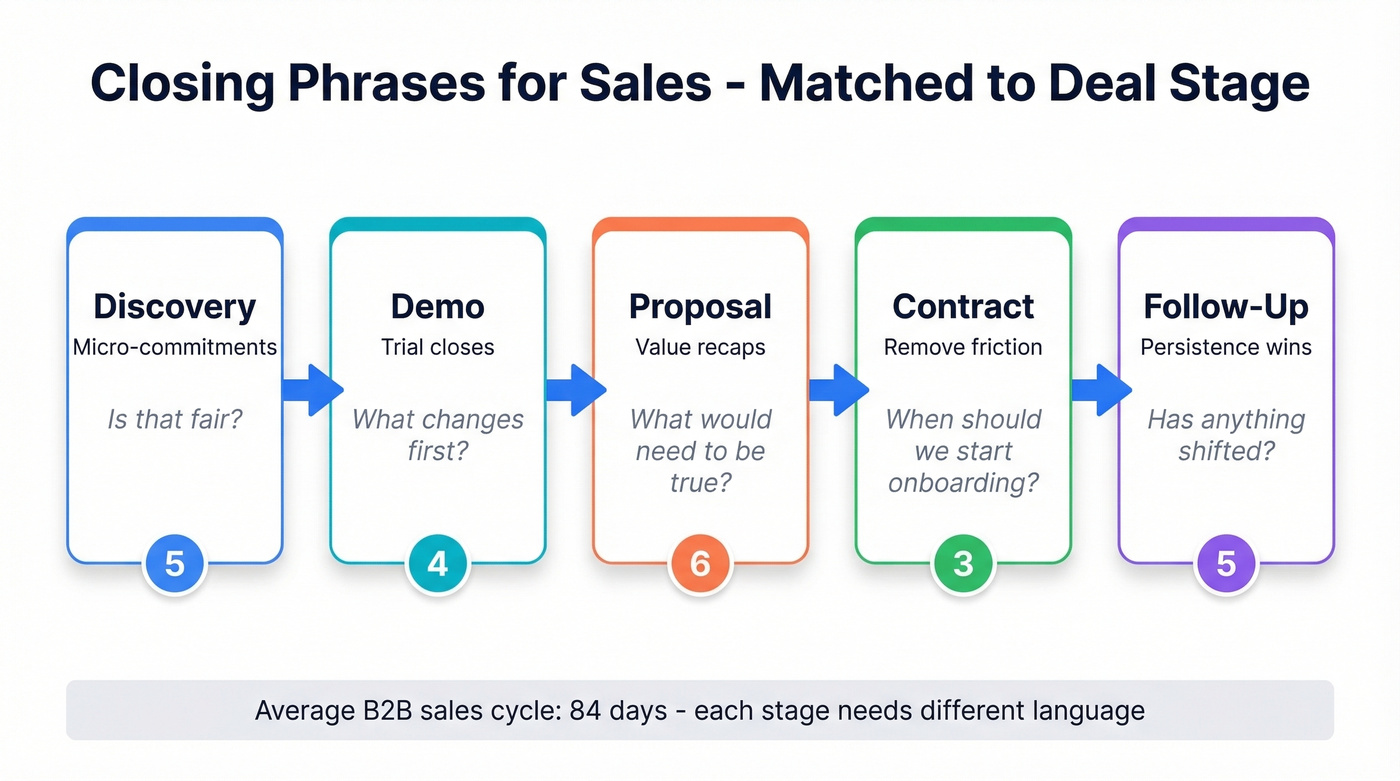
A quick note on B2B vs. B2C: Everything below is built for B2B, where you're navigating committees, long timelines, and risk-averse buyers. B2C closing leans on immediacy and emotion - "This is the last unit at this price" works at a car dealership. In B2B, that same line gets you ghosted. Keep that distinction sharp.
Discovery & Qualification
These aren't "closing" in the traditional sense. They're micro-commitments that qualify and advance simultaneously - BANT or MEDDIC checkpoints wrapped in conversational language.
- "Based on what you've shared, it sounds like [problem] is costing you [X]. Is that accurate?" - Confirms the pain in the prospect's own words.
- "Would it make sense to loop in [role] for our next conversation?" - Surfaces stakeholders early instead of discovering them at the proposal stage.
- "If we could solve [specific problem], what would that be worth to your team?" - Anchors value before pricing ever comes up. This is one of the best value-driven lines because it lets the prospect quantify the upside themselves.
- "Have I provided enough information for you to decide if this is worth exploring further?" - A low-pressure checkpoint that respects the buyer's autonomy.
- "Is that fair?" - The Gong-validated workhorse. Use it after proposing a next step: "Let's schedule 30 minutes with your VP of Ops to walk through the technical fit. Is that fair?"
Demo & Presentation
The demo is where trial closes earn their keep. You're testing buying temperature without asking for the deal.
- "Which of these features would have the biggest impact on your current workflow?" - Forces the prospect to self-select value, which is more persuasive than you telling them what matters.
- "Imagine your team using this daily - what changes first?" - "Imagine" is one of Gong's top-performing words. It shifts the prospect from evaluator to future user.
- "Should I walk through implementation, or do you want to see [specific feature] first?" - An either/or that assumes continued engagement.
- "On a scale of 1-10, how well does this solve the problem you described?" - Below 8 gives you an objection to address. Above 8 gives you permission to advance.
Proposal & Negotiation
This is where deals stall or accelerate. Value recaps and either/or framing dominate - these are the phrases that carry the most revenue impact.
- "Based on our conversations, here's what I'm recommending: [one-sentence summary]. Does that align with what you need?" - Recap before the ask. It shows you listened.
- "Would you prefer the annual plan with the discount, or the quarterly option for flexibility?" - Classic either/or. Both options are a yes.
- "What would need to be true for you to move forward this quarter?" - Surfaces hidden objections without sounding desperate.
- "If we can get [specific term] resolved, are you ready to sign?" - Isolates the last objection. If they say yes, you've got a conditional commitment.
- "I want to make sure this works for your budget. What range are we working with?" - Direct without being aggressive.
- "Do you see any reason not to proceed?" - Flips the burden of proof. The prospect has to articulate a reason to say no.
Look, if a prospect asks for a discount and your first instinct is to give one, you've already lost the negotiation. Never lead with price cuts. Lead with value-adds - faster onboarding, extended support, an extra seat. Discounting trains buyers to always ask for less. We've seen reps give up meaningful deal value simply because they flinched first.
Contract & Signature
Urgency without pressure. The deal is essentially done - your job is to remove friction, not add it.
- "I'll send the agreement over today. Any changes you'd need before signing?" - Assumptive, but with an escape valve.
- "When would you like to start onboarding - this week or next?" - Skips "will you sign?" entirely and jumps to implementation timing.
- "I've penciled in your kickoff for [date]. Does that work for your team?" - Creates gentle momentum without manufactured urgency.
Follow-Up Closes
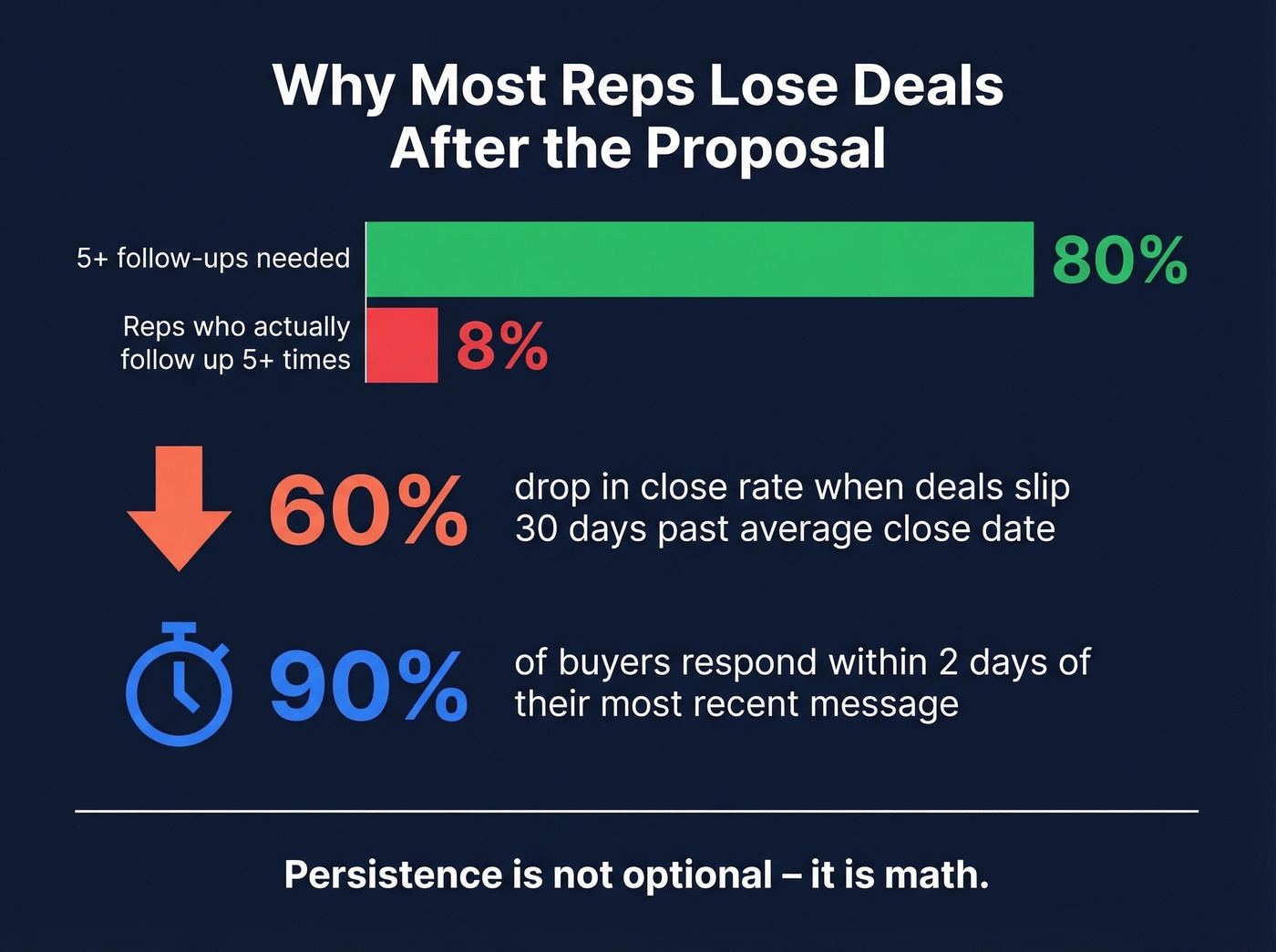
This is where most reps give up - and where most deals are won. 80% of sales require at least 5 follow-ups, yet only 8% of reps follow up more than five times. And deals that slip 30 days past their average close date see close rates drop by 60%. Persistence isn't optional - it's math. (If you want plug-and-play copy, use these follow-ups.)
- "I wanted to share a quick update - [relevant news/case study]. Does this change anything on your end?" - Adds value instead of just "checking in."
- "I know timing wasn't right last month. Has anything shifted?" - Respectful re-engagement that acknowledges their earlier decision.
- "I'm putting together our Q[X] onboarding schedule. Should I hold a spot for your team?" - Soft urgency tied to a real operational constraint.
- "Would it help if I put together a one-page summary for [other stakeholder]?" - Champion-arming language. You're making their internal sell easier.
- "I'll assume the timing isn't right and close out my notes. If anything changes, I'm here." - The breakup email. It works because 90% of buyers respond within two days of their most recent message, and sometimes that message is the one saying you're walking away.

The best closing phrase in the world won't save a deal if you're pitching the wrong person. Prospeo gives you 300M+ profiles with 30+ filters - buyer intent, job changes, department headcount - so every close targets an actual decision-maker with a 98% verified email.
Stop closing strangers. Start closing buyers who can actually sign.
How to Close a Sale Over Email
Email closes follow different mechanics than phone closes. The core rule: your closing question should be the final sentence. After the question, stop writing. No "looking forward to hearing from you." The question is the CTA - anything after it dilutes the ask.
A one-sentence price-plus-value recap right before the close reduces ambiguity: "At $X/month, you're getting [primary outcome] - here's the agreement."
- Post-demo: "Based on today's demo, would it make sense to schedule a technical review with your team this week?"
- Post-demo (stronger): "I've attached a summary of what we covered. What questions do you have before we move to a proposal?"
- Post-proposal: "I've outlined everything we discussed. Do you see any reason not to proceed?"
- Post-proposal (negotiation): "If we adjust [specific term], does the rest of the proposal work for you?"
- Contract sent: "The agreement is attached. Any changes needed, or should I schedule your kickoff for [date]?"
- Stalled deal: "I haven't heard back - totally understand if timing shifted. Would it help to revisit this next quarter?"
- Breakup email: "I'll close out my file on this. If priorities change, you know where to find me."
Each of these ends with a question or a clear next step. That's not an accident - it's the entire point of an email close.
Multi-Stakeholder Closing Tactics
Buying groups now include 8-13 stakeholders. You're not closing one person - you're building consensus across a committee where half the members you've never spoken to. Multi-threading - engaging multiple contacts within the buying group - lifts win rates by roughly 130%. That's not a marginal improvement. That's the difference between a mediocre quarter and a career year.
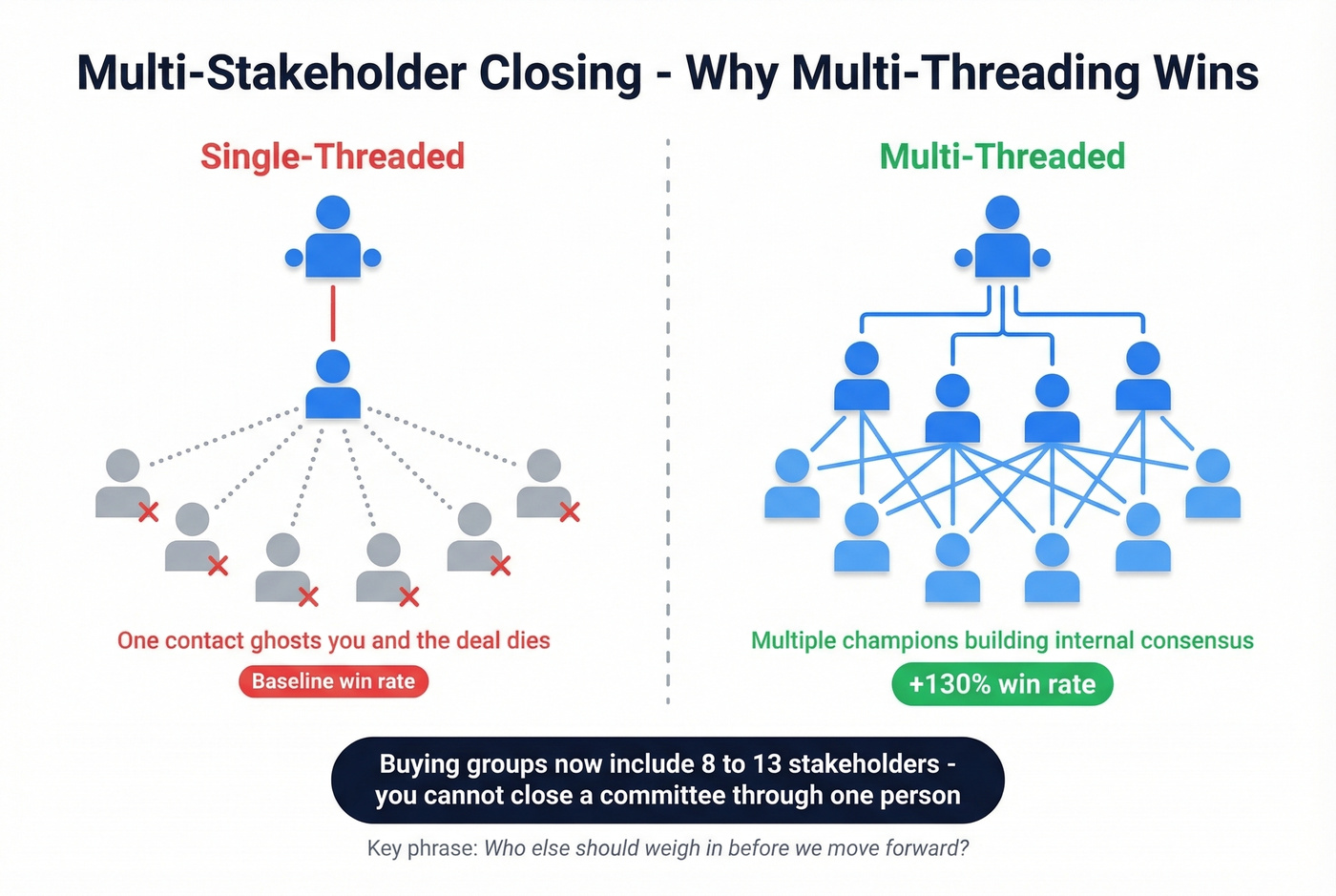
But you can't multi-thread if you don't know who's on the committee. That's a data problem before it's a sales problem, and it's where tools like Prospeo's 30+ search filters help you map out every stakeholder before your next follow-up.
Champion-arming and consensus-building phrases work best woven into your existing conversations rather than deployed as standalone tactics. When your champion says the CFO has concerns, respond with "What would make this an easy yes for your CFO?" or offer to build a one-pager their team can circulate internally. When you sense gaps in the committee, ask "We've heard from [Name] and [Name] - who else should weigh in before we finalize?" For procurement-heavy orgs, get ahead of the process: "I've attached a security questionnaire and compliance docs proactively. What else does procurement need?"
The incumbent-loyalty objection deserves its own mention. When a stakeholder says "We're happy with our current vendor," don't fight it. Try: "That makes sense - what would a new solution need to do differently to be worth the switch?" You're not attacking their choice. You're letting them articulate the gap.
Phrases That Kill Deals
Knowing what to say matters less if you don't know what to stop saying. HubSpot's research flags three patterns that trigger buyer skepticism: fake scarcity, exaggerated social proof, and aggressive urgency.
"This offer expires Friday." Unless there's a genuine operational reason - a pricing change, a capacity limit - manufactured deadlines erode trust. Buyers talk to each other. They know when scarcity is fake.
"Everyone in your space is using this." Vague social proof backfires. Nielsen research shows 89% of people trust recommendations from people they know, and 84% trust online reviews - but both require specificity. "Three companies in [their vertical] switched last quarter" is credible. "Everyone" is not.
"You need to act now." Bryan Vasquez, Head of Sales at LinkBuilder.io, replaced urgency-based language with data-backed proposals and tailored value maps. The result: a 20% win-rate increase over two quarters. The takeaway isn't that urgency never works - it's that manufactured urgency backfires while real operational deadlines still motivate action.
Say this instead:
- Replace "This price won't last" with "Here's the ROI breakdown based on your numbers."
- Replace "You need to decide soon" with "What's your timeline for making a decision?"
- Replace jargon-heavy pitches with plain language. NetSuite's research flags inaccessible language as a consistent deal-killer.
Real talk: we've seen deals die not because of a bad phrase, but because the rep was pitching someone who couldn't sign the contract. All the closing language in the world won't help if you're talking to the wrong stakeholder.
Build Your Closing Playbook
A closing phrase is the last 10% of a process that starts with discovery. Here's how to build a repeatable system.
Record and review your calls. Conversation intelligence tools like Gong, Chorus, or Clari show you which lines actually move deals in your specific pipeline. Look for patterns in what you say right before a prospect agrees to a next step.
Map one phrase to each stage. Don't memorize 35 phrases. Pick one per stage that fits your voice, practice it until it's natural, then iterate. In our experience, reps who commit to one phrase per stage outperform those who memorize entire scripts every single time.
Follow the micro-commitment sequence: Micro-commitment, value recap, specific next step, silence. The silence part is the hardest - after you ask, stop talking and let the prospect fill the space.
Verify your data before you close. The best closing phrase fails if it reaches a dead inbox. Prospeo's real-time email verification catches bad addresses before they bounce - 98% accuracy across 143M+ verified emails. The free tier gives you 75 verifications per month, enough to clean your active pipeline. (If you're tightening outbound too, start with email deliverability and sender reputation.)
"Who else should weigh in before we move forward?" is a great line - until you can't find that stakeholder's contact info. Prospeo surfaces verified emails and 125M+ direct dials so you reach every person in the buying committee, not just your first contact.
Reach the full buying committee before your deal stalls at the 11th hour.
FAQ
What's the best closing phrase for sales?
"Is that fair?" is the most versatile single line. Gong's analysis of 519,000+ calls shows top performers use it 1.7x per deal versus 0.2x for everyone else. It frames your ask as reasonable and invites collaboration rather than resistance.
How do you close a sale without being pushy?
Replace pressure with micro-commitments - ask for the next step, not the signature. "Would it make sense to schedule a quick call with your team?" moves the deal forward without triggering resistance. The best sales closing lines reduce friction rather than create it.
How many follow-ups does it take to close a B2B deal?
Most B2B deals require 5-12 touchpoints, yet only 8% of reps follow up more than five times. Each follow-up should include new information or a stakeholder-arming asset - never just "checking in."
Do closing phrases work differently in email vs. phone?
Yes. In email, your close must be the final sentence - anything after the ask dilutes it. On the phone, silence after the ask does the heavy lifting. Different channels, same principle: make the ask clear, then stop talking.
What are the most effective closing lines for B2B?
The most effective B2B closing lines combine a value recap with a clear next step. "Based on our conversations, does this align with what you need?" and "What would need to be true for you to move forward this quarter?" consistently outperform generic asks because they prove you listened and give the buyer a specific decision to make.