

CloudTalk vs RingCentral: Honest Comparison (2026)
Stop comparing these two as if they're the same product. CloudTalk is a sales dialer built for outbound teams. RingCentral is a unified communications suite that happens to have a contact center bolted on. The CloudTalk vs RingCentral decision comes down to one question: are you buying a dialer or a phone system?
The 30-second verdict: CloudTalk wins for outbound-heavy sales teams under 50 seats who need power and parallel dialing without the bloat. RingCentral wins if you need phone, video, and messaging unified under one vendor at enterprise scale. Skip both if your connect rates are tanking because you're dialing bad numbers - that's a data problem, not a dialer problem.
Which RingCentral Product Are You Actually Comparing?
RingCentral sells three distinct products, and the naming doesn't help:
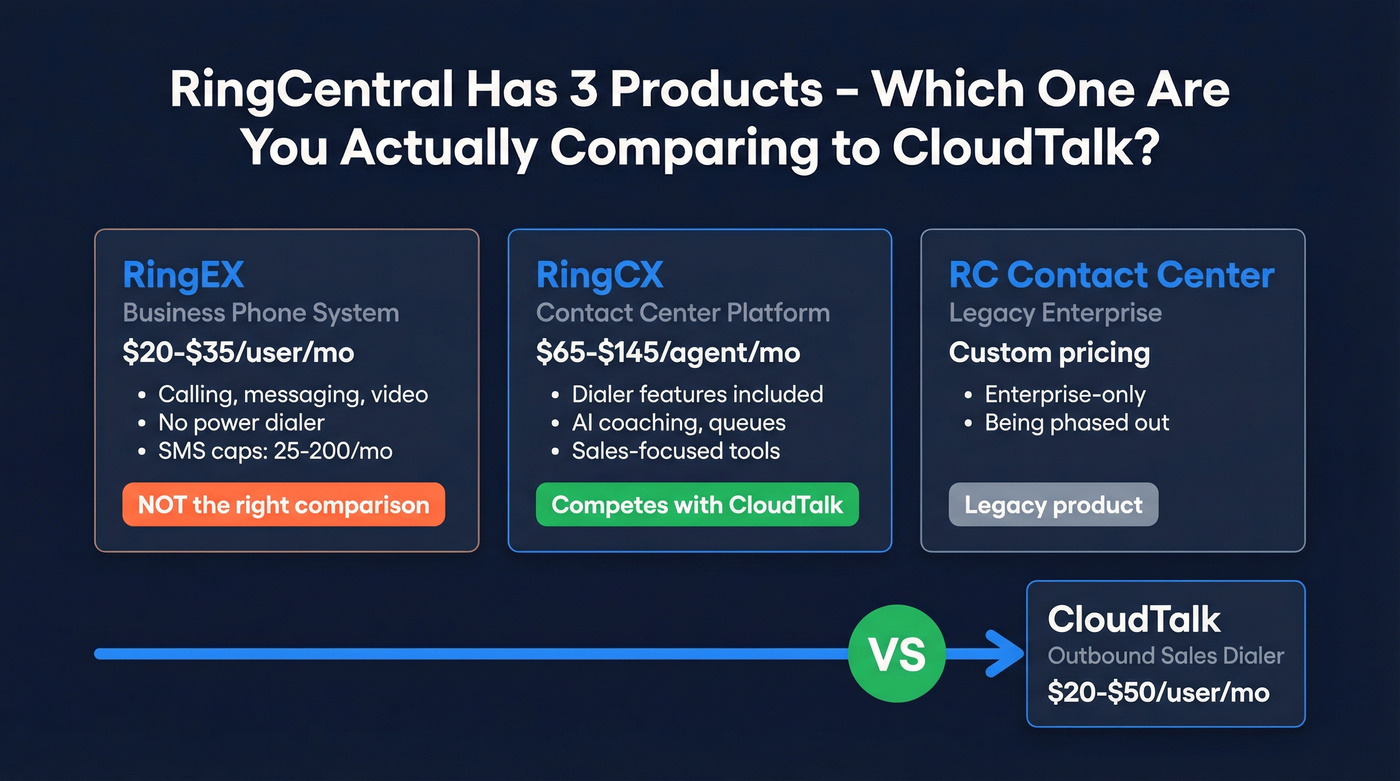
- RingEX - the business phone system. $20-$35/user/mo annually. Calling, messaging, video meetings.
- RingCX - the contact center platform. $65-$145/agent/mo annually. Dialer features, AI coaching, queue management.
- RingCentral Contact Center - the legacy enterprise offering with custom pricing.
CloudTalk competes with RingCX, not RingEX. Comparing CloudTalk's outbound-focused plans to RingEX's Core phone plan is apples to oranges. The fact that RingCentral's own support page explaining the difference returns a 404 says it all.
Pricing Side by Side
| Plan/Tier | CloudTalk | RingEX | RingCX |
|---|---|---|---|
| Entry (annual) | ~$20/user/mo (Lite) | $20/user/mo (Core) | $65/agent/mo (Standard) |
| Mid (annual) | ~$50/user/mo (Expert) | $25/user/mo (Advanced) | $95/agent/mo (Professional) |
| Top (annual) | Custom | $35/user/mo (Ultra) | $145/agent/mo (Elite) |
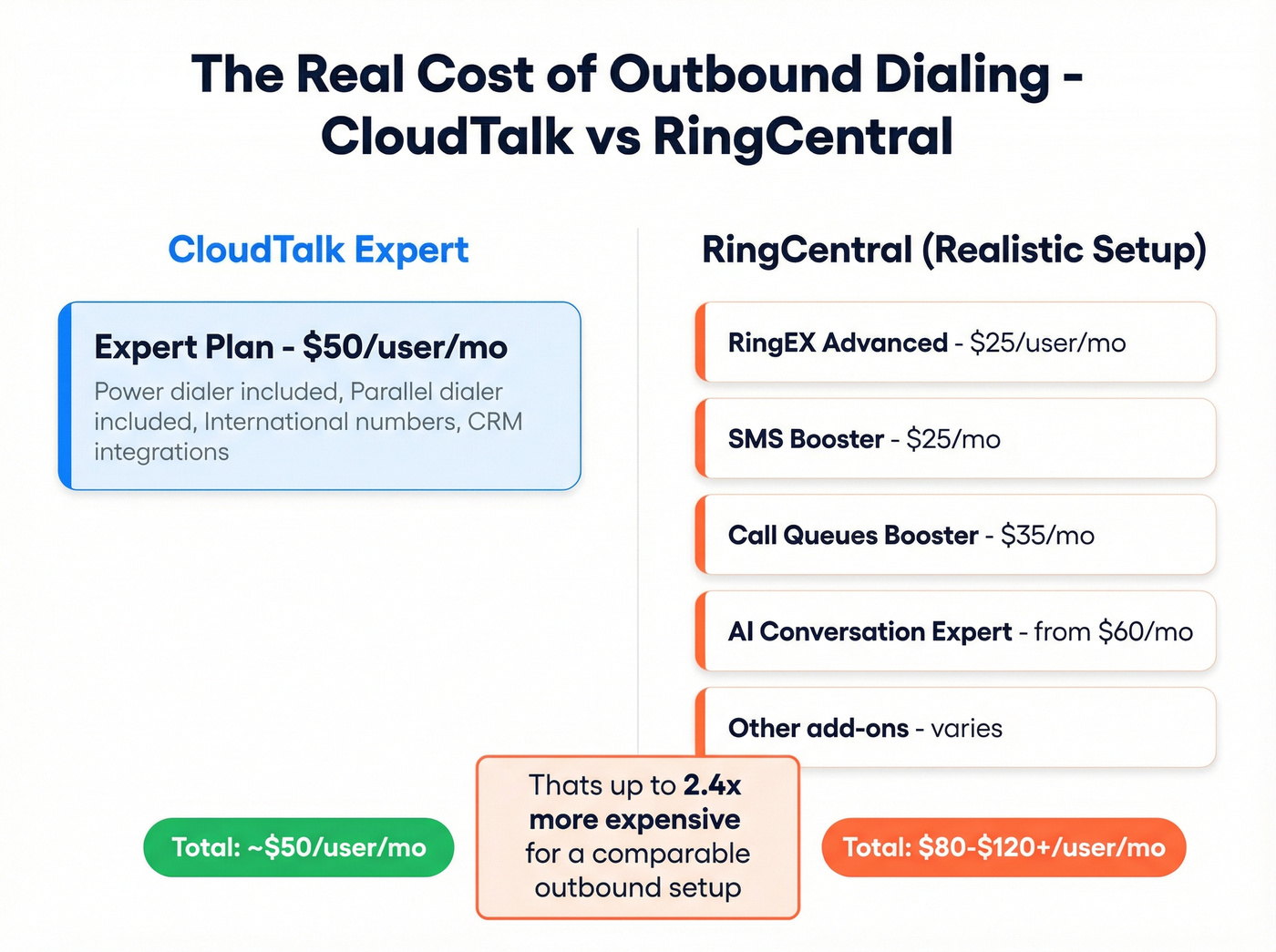
On paper, RingEX Core at $20/user/mo looks like a steal. But that's the business phone - no power dialer, no parallel dialer, no AI conversation intelligence. Here's the detail nobody highlights: RingEX Core caps you at 25 texts per user per month. Advanced bumps to 100, Ultra to 200. If your SDRs text prospects at all, those limits bite fast.
The hidden costs. RingCentral's add-on pricing stacks up quickly: SMS Booster ($25), Call Queues Booster ($35), AI Receptionist (from $39), AI Conversation Expert (from $60). A realistic outbound setup on RingCentral runs $80-$120/user/month once you layer in what sales teams actually need. That's a big gap from the $20 headline number.
CloudTalk's Lite plan is cheaper at ~$20/user/mo, but the power dialer and parallel dialer are add-ons at that tier. Budget for Expert if you're running outbound at any real scale. It's still meaningfully cheaper than a fully loaded RingCX seat.
Here's the thing: if your team is under 20 reps doing outbound, RingCentral is almost certainly overkill. You'll pay for a unified communications platform your SDRs will use as a phone. That's like buying a Swiss Army knife to open envelopes.
Feature-by-Feature Breakdown
| Feature | CloudTalk | RingCentral | Edge |
|---|---|---|---|
| Power dialer | Yes (add-on on Lite) | RingCX only | CloudTalk |
| Parallel dialer | Yes (up to 10 lines) | RingCX (varies by config) | CloudTalk |
| AI conversation intel | Add-on | Add-on (from $60) | CloudTalk (cheaper) |
| CRM integrations | Salesforce, HubSpot, Pipedrive + 30 more | 300+ pre-built integrations | RingCentral |
| International numbers | 160+ countries | Broad coverage | CloudTalk |
| Uptime claim | 99.999% | 99.9% | CloudTalk |
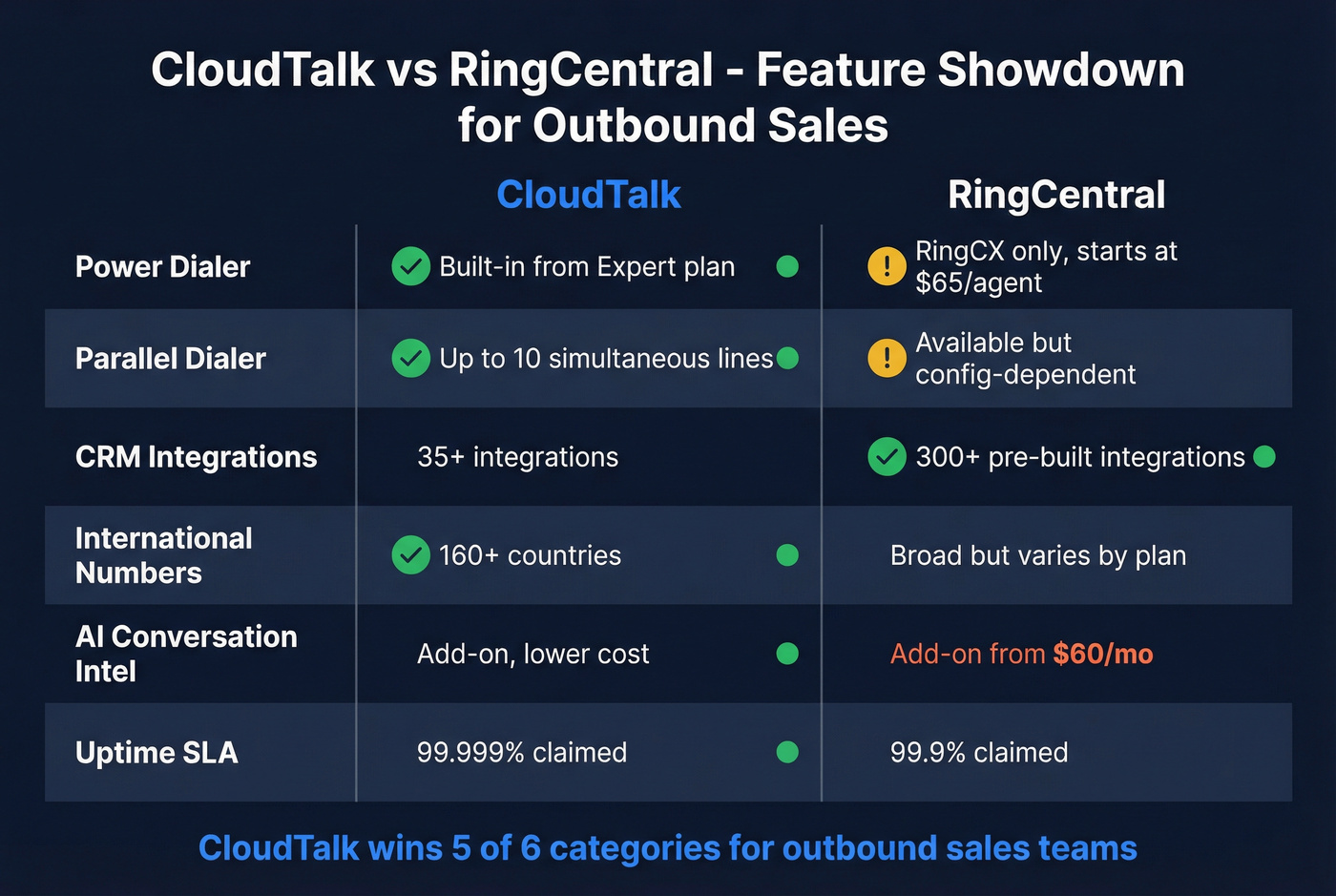
CloudTalk markets "80+ dials per hour" and "1.5s voicemail detection" - treat those as vendor benchmarks, not guarantees. RingCentral's 300+ pre-built integrations are genuinely impressive, but most sales teams use three or four.
We've seen this play out across dozens of teams: CloudTalk's dialer features are purpose-built for outbound, while RingCentral's are bolted onto a UCaaS platform. That difference shows up in setup time, workflow design, and how intuitive the daily experience feels for SDRs within the first week. It's not that RingCentral can't do outbound - it's that everything takes an extra click or two, and those clicks compound across hundreds of daily dials.

CloudTalk and RingCentral both dial whatever you give them. Neither verifies a single number. Prospeo gives your team 125M+ verified mobile numbers with a 30% pickup rate - that's 3x what most providers deliver.
Fix your data before you upgrade your dialer.
What Real Users Say
RingCentral's biggest landmine is contract auto-renewal. One r/sysadmin thread describes a 2-year contract that auto-renewed for another full two years without proactive notice. Reddit users on r/VOIP report painful SMS registration with repeated rejections and surprise fees. Call quality complaints - echo, dropped calls, low volume - surface across multiple threads. The consensus on r/VOIP is pretty clear: RingCentral works fine until you need to change something or leave.
If you're evaluating vendors based on real-world outcomes, it helps to zoom out and look at your full sales tech stack - not just the dialer.
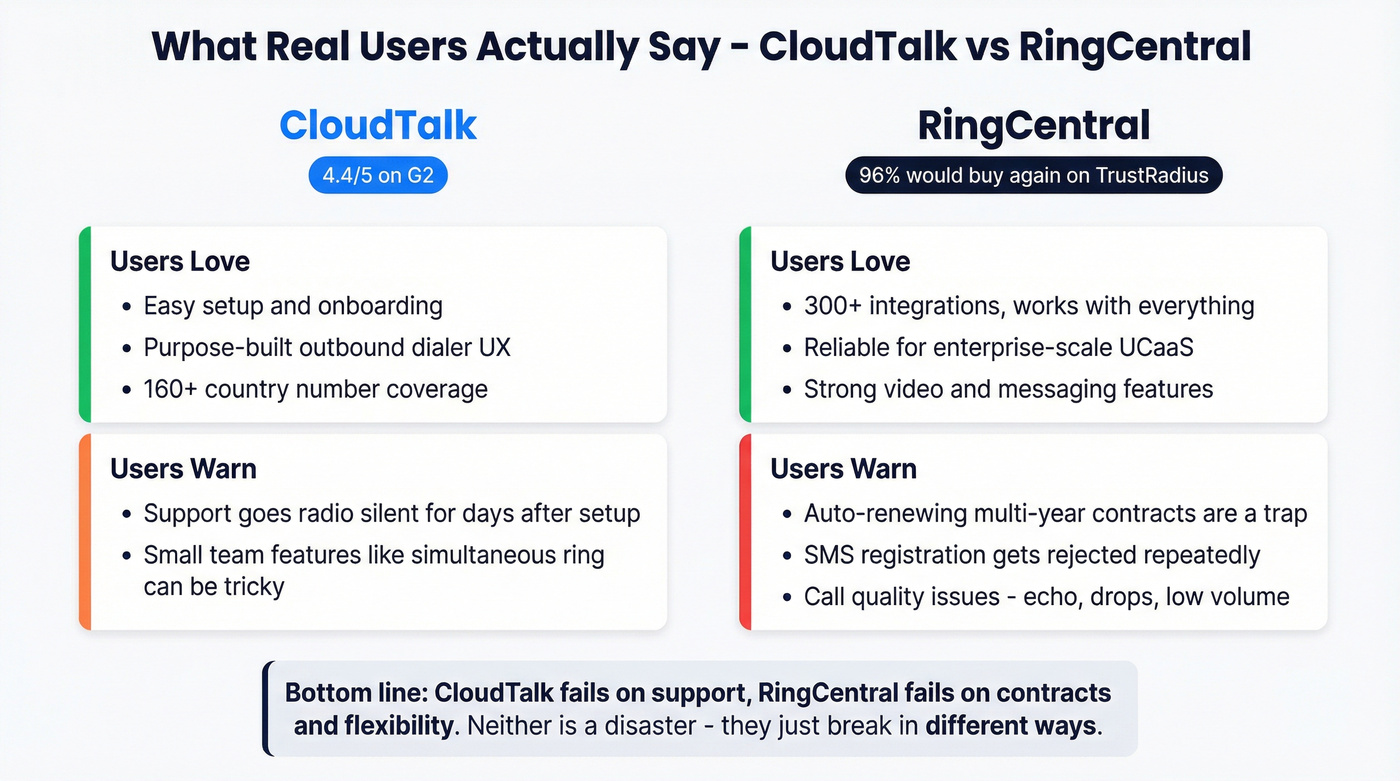
CloudTalk's weak spot is post-sale support. An r/sysadmin post describes support going "radio silence for days" after an easy setup. One r/smallbusiness user couldn't get both phones to ring simultaneously on inbound - a dealbreaker for a two-person office. If you're a small team that needs responsive support, that's worth factoring in.
TrustRadius "would buy again" scores sit at 93% for CloudTalk and 96% for RingCentral Contact Center. Neither is a disaster. They just fail in different ways.
Who Should Pick Which
Pick CloudTalk if you're running outbound with 5-50 reps, you want power and parallel dialing without enterprise pricing, and you need international numbers across 160+ countries. CloudTalk scores a 4.4/5 on G2 from 1,738 reviews with 63.7% from small businesses. It's built for teams that dial all day.
If you're also comparing other mid-market phone tools, see our Aircall vs CloudTalk breakdown.
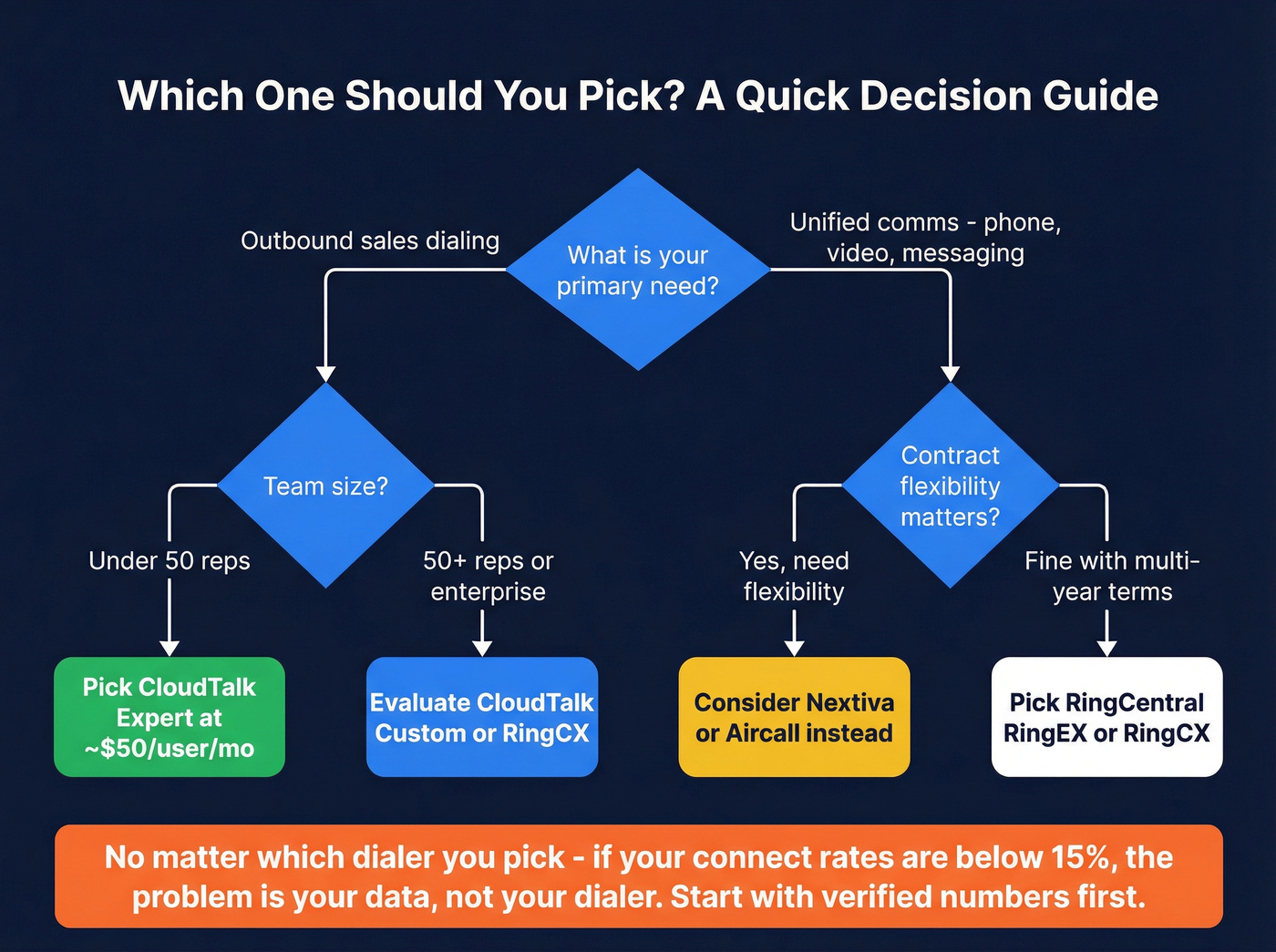
Pick RingCentral if you need unified communications under one vendor, your enterprise requires deep integrations across departments, or you're willing to pay for RingCX's full contact center capabilities. Just read the contract terms twice. Then read them again.
Skip both and look at Aircall (~$40-$50/user/mo) if you want a middle ground on international calling and UX. Nextiva is worth a look if UCaaS matters but RingCentral's contracts scare you.
Data Quality Matters More Than Dialer Choice
Let's be honest about something most dialer comparisons ignore entirely. Your SDRs make 80 dials a day but connect on 12% of them. Neither CloudTalk nor RingCentral provides verified contact data - they just dial whatever numbers you feed them. Garbage in, garbage out, no matter how slick the dialer UI is.
If you're trying to fix connect rates, start with data enrichment and a clean contact management process upstream.
We've watched teams agonize over dialer features for weeks, then load in a purchased list full of switchboard numbers and outdated mobiles. The dialer worked perfectly. The results didn't. Prospeo fills that gap with 125M+ verified mobile numbers delivering a 30% pickup rate, refreshed every 7 days instead of the 6-week industry average. Its 98% email accuracy means your multi-channel sequences don't bounce, either. Pair it with either dialer and connect rates improve before you change a single workflow.
If you're building lists from scratch, our guide to Clay list building is a solid starting point.
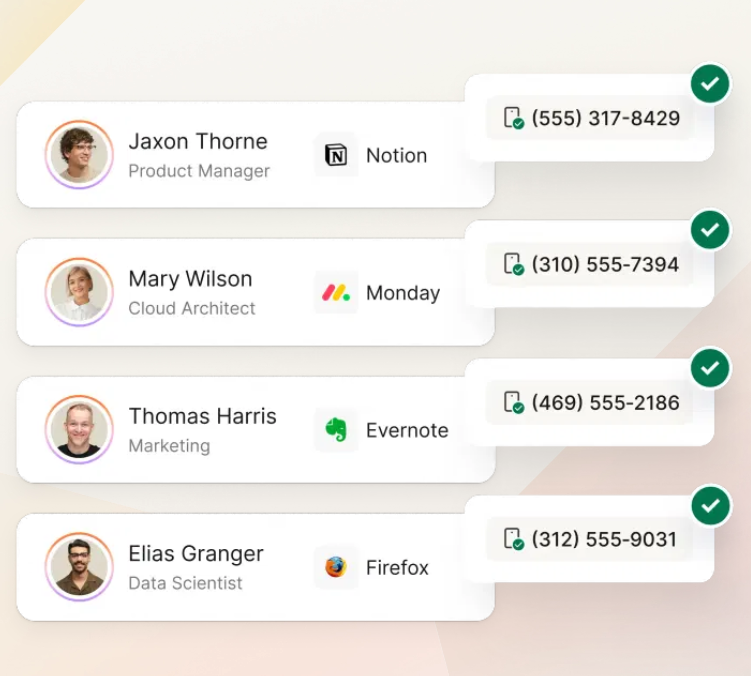
You're comparing dialers to squeeze out extra dials per hour. Meanwhile, your reps connect on 12% of calls because the numbers are wrong. Prospeo's verified mobiles refresh every 7 days - not every 6 weeks - so your team dials real people, not voicemail boxes.
Stop optimizing the dialer. Start fixing the data.
FAQ
Is CloudTalk cheaper than RingCentral for outbound?
For outbound sales teams, yes. CloudTalk Expert at ~$50/user/mo includes dialer features that cost $80-$120/user/mo on RingCentral once you add SMS boosters, AI tools, and queue management. For basic phone needs only, RingEX Core at $20/user/mo undercuts CloudTalk - but it's not an outbound dialer.
Does RingCentral lock you into long contracts?
Frequently, yes. Reddit users report multi-year contracts that auto-renew for the full original term without proactive notice. CloudTalk offers monthly billing on all plans. Always confirm cancellation and auto-renewal terms in writing before signing with RingCentral.
Can I use either dialer without a CRM?
Both work standalone, but you'll lose efficiency fast. CloudTalk integrates natively with Salesforce, HubSpot, and Pipedrive. RingCentral offers 300+ pre-built integrations. Either way, your dialer needs clean contact data upstream - that's where tools like Prospeo fit in, with 143M+ verified emails and 125M+ direct dials at 98% accuracy.
Which is better for international sales teams?
CloudTalk edges ahead with local numbers in 160+ countries and competitive per-minute rates. RingCentral offers broad international coverage but pricing varies by plan and region. For teams dialing across multiple geographies, CloudTalk's international number availability is a genuine differentiator.