

Cold Call Techniques That Actually Book Meetings in 2026
A RevOps lead we work with tracked every dial his team made last quarter. 11,519 cold calls. 335 meetings booked. 69.1% converted to SQLs, and the team closed $287K in new business directly from cold outreach. That's not theory - that's what disciplined cold call techniques produce when you combine clean data, tight scripts, and relentless follow-up.
Cold calling isn't dead. Your data is. It takes 306 emails to generate one B2B lead, while 82% of buyers say they've accepted meetings that started with a cold call. The phone still works. You just need the right playbook.
Here's what that playbook requires: clean data (verified mobile numbers so you actually connect), a 35-second framework (Who, Why, What), and five rehearsed objection responses. Everything else is optimization.
Cold Calling by the Numbers
The average cold calling success rate is 2.3%. Sounds brutal until you realize top performers convert up to 15% of conversations into meetings. Sopro's analysis of 151 million outreach data points confirms that gap - and it isn't talent. It's preparation, timing, and data quality. Even more telling: 81% of decision-makers engage with cold outreach when it's tailored to their situation.
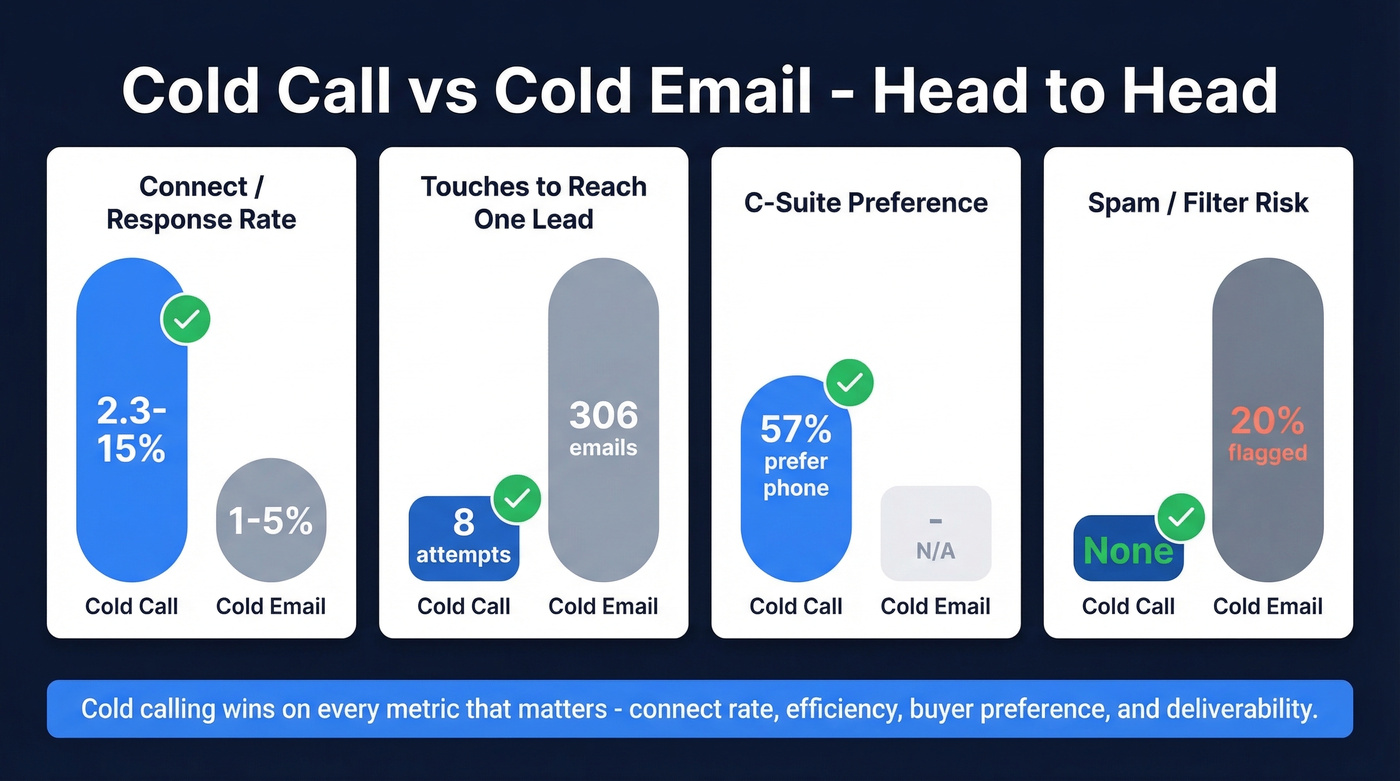
It takes an average of 8 call attempts to reach a prospect. Most reps give up after 2 or 3.
The buyer preference data should convince any skeptic: 49% of buyers prefer to be contacted by phone, and that number jumps to 57% for C-level executives and VPs. Your prospects want you to call. They just don't want you to waste their time.
| Metric | Cold Call | Cold Email | Winner |
|---|---|---|---|
| Connect/response rate | 2.3-15% | ~1-5% (avg ~5.1%) | Cold call |
| Touches to reach one lead | ~8 call attempts | ~306 emails sent | Cold call |
| Buyer preference (C-suite) | 57% prefer | - | Cold call |
| Spam/filter risk | None | ~20% flagged as spam | Cold call |
Best Time to Cold Call
ZoomInfo analyzed 1.4 million outbound calls and the data is unambiguous. Tuesday, Wednesday, and Thursday are your power days. Tuesday and Wednesday alone drive 44% of total demos booked. Friday? Dead. Lowest volume, lowest connection rates, lowest everything.
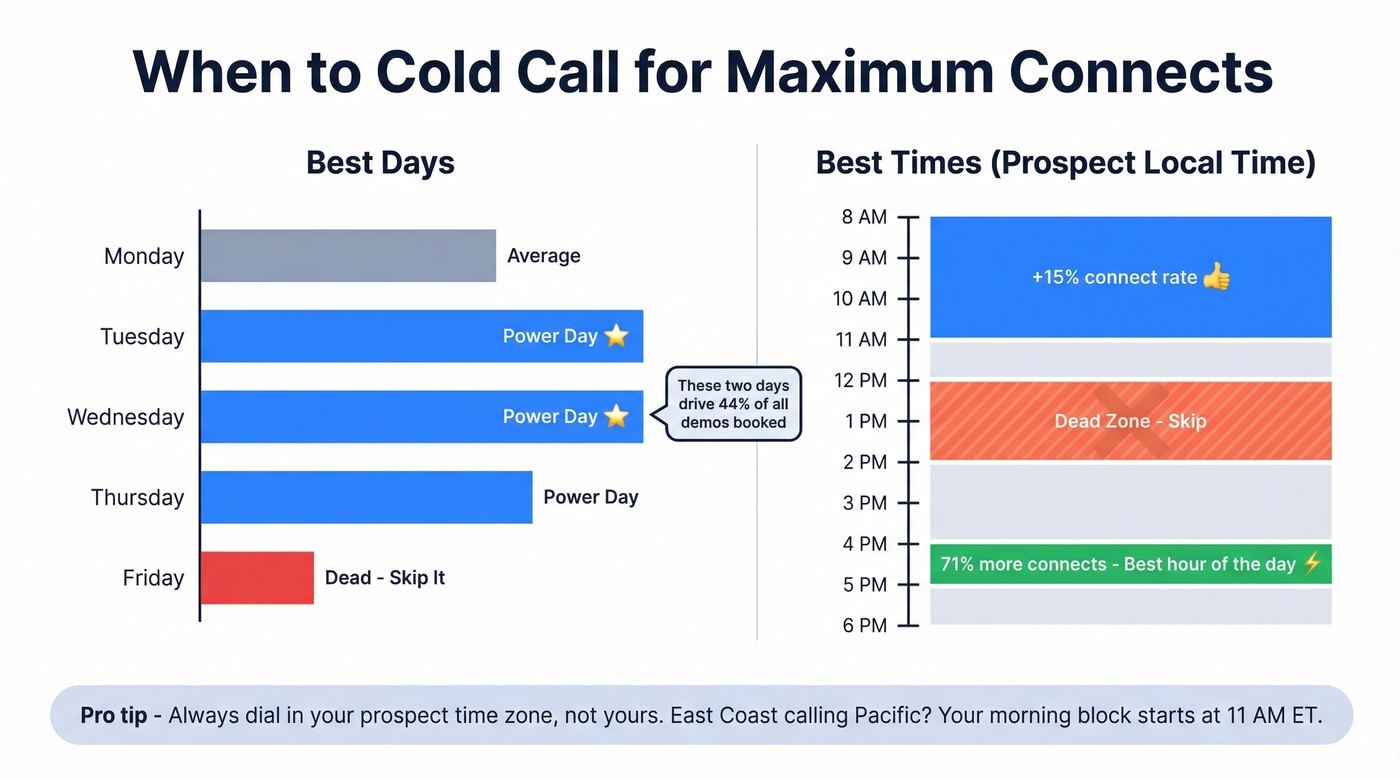
For time of day, you've got two windows. The morning block from 8-11 AM local time boosts connection rates by 15%. The late-afternoon power hour from 4-5 PM is 71% more likely to connect than early morning. In our experience, the 4-5 PM window outperforms morning consistently for enterprise prospects - people are wrapping up their day and more willing to talk.
The 12-2 PM dead zone? Skip it entirely.
Structure your day around your prospect's time zone, not yours. East Coast calling into Pacific? Your morning block starts at 11 AM ET.
| Time Block | Priority | Notes |
|---|---|---|
| 8-11 AM local | High | +15% connect rate |
| 12-2 PM local | Skip | Dead zone |
| 4-5 PM local | Highest | 71% more connects |
Before You Dial
"Do your research" is the laziest advice in sales. Here's what that actually means: spend 90 seconds per prospect checking three things.
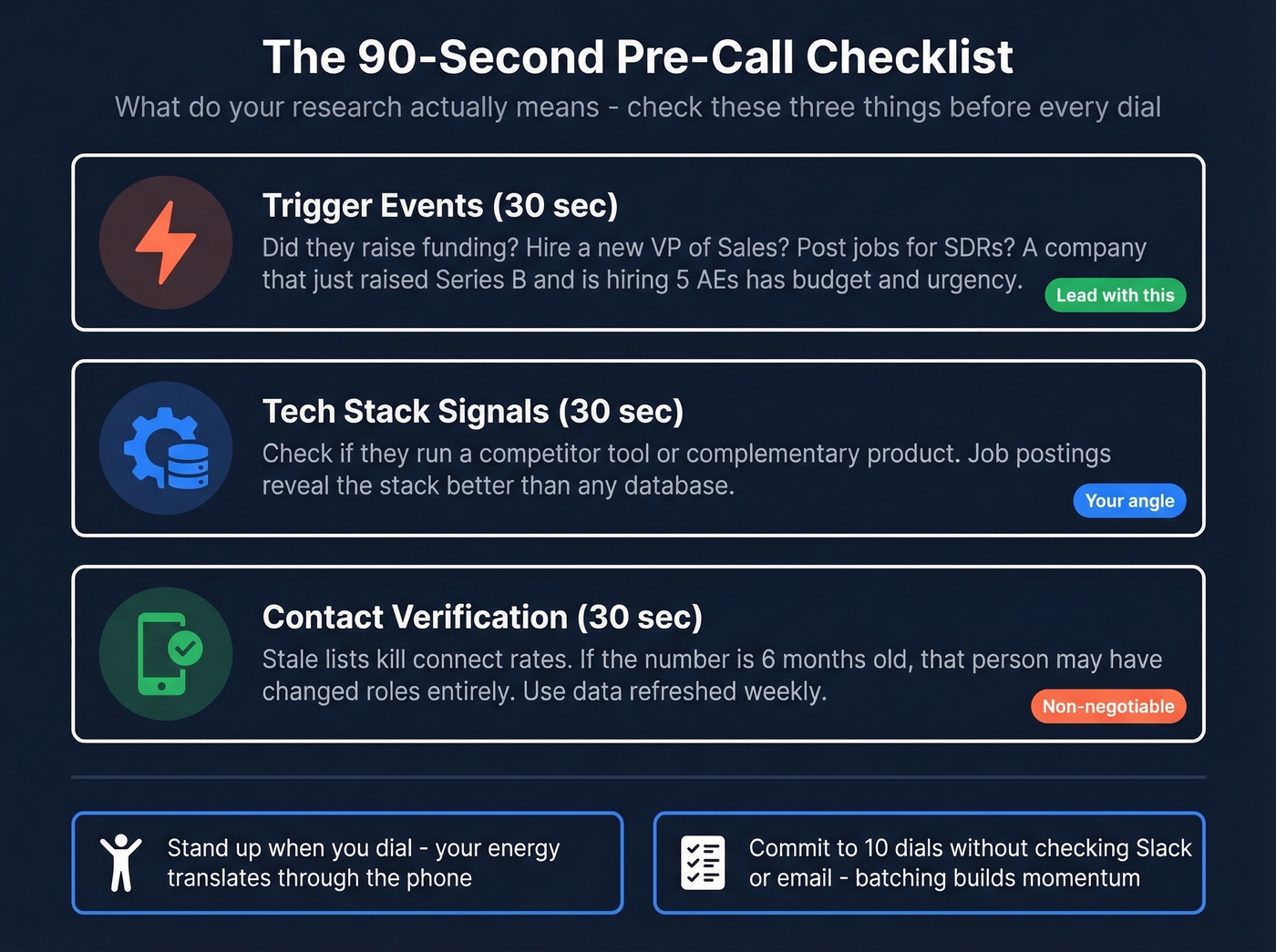
Trigger events. Did they just raise funding? Hire a new VP of Sales? Post a job for SDRs? A company that just raised a Series B and is hiring 5 AEs has budget and urgency. Lead with that.
Tech stack signals. If they're running a competitor's tool or a complementary product, that's your angle. Job postings often reveal the stack better than any database.
Contact verification. Stale lists kill connect rates. If the number you're dialing is 6 months old, there's a real chance that person has changed roles or companies entirely. Prospeo refreshes contact data every 7 days and returns 50+ data points per enrichment, so you're calling the right person with relevant context instead of dialing into a void.
One angle most guides miss: don't just call the VP. A bottom-up approach often works - talk to the end-users and individual contributors first. They'll tell you the real pain points, and when you eventually reach the decision-maker, you can say "I've been hearing from your team that..." That's infinitely more credible than a generic pitch.
Two more things before you pick up the phone. Stand up when you dial. Your energy translates through the phone - slouching in your chair produces a flat, disengaged tone that prospects pick up on instantly. And mentally commit to making the next 10 dials without checking Slack or email between them. Batching builds momentum.
The 35-Second Framework That Works
Every cold call needs to answer three questions in under 35 seconds: Who are you? Why are you calling? What do you want? The prospect decides whether to keep listening in the first 7 seconds, and you've got about 1 minute 8 seconds to get agreement to a meeting.
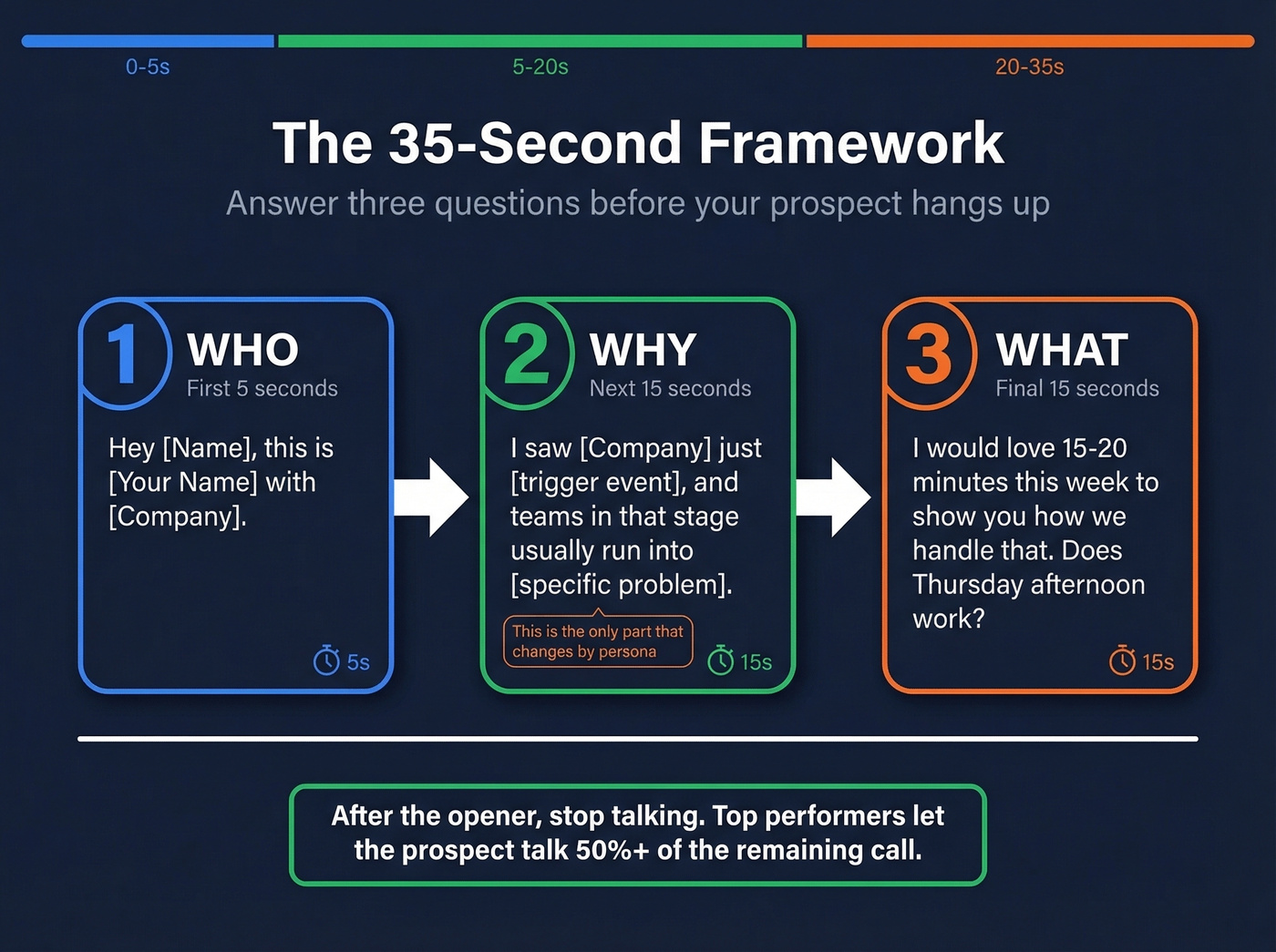
Here's the full script. Copy it, customize the "why" segment for your persona:
Who: "Hey [Name], this is [Your Name] with [Company]."
Why: "I'm reaching out because I saw [Company] just [trigger event - hired 3 AEs / raised Series B / posted for a RevOps lead], and teams in that stage usually run into [specific problem your product solves]."
What: "I'd love to set up 15 to 20 minutes this week to show you how we handle that. Does Thursday afternoon work?"
Only the "why" segment changes by persona. The structure stays identical - that consistency is what makes it repeatable across a team of 10 reps without quality dropping off.
Once you've delivered your opener, shut up. Top performers aim for the prospect to talk more than 50% of the remaining call. Your job after the opener is to listen, not pitch.
BANT Qualification
The classic IBM method - Budget, Authority, Need, Timeline. Use this when you're selling into enterprise and need to qualify hard before booking. After your opener lands, weave in questions like:
"Is this something you've allocated budget for this quarter, or would we be building a case together?"
Don't run through BANT as a checklist. Embed the questions naturally into conversation.
Problem-Solution-Benefit
Lead with a relevant problem, present your solution, state the benefit. One B2B team using PSB-style scripts saw a 34% increase in demo bookings. The script pattern:
"Most [title] I talk to are losing 15-20% of pipeline because [problem]. We built [solution] specifically for that - our customers typically see [benefit] within [timeframe]. Worth 15 minutes?"
Confirm the problem resonates before you pitch the solution. If they say "that's not really our issue," pivot - don't bulldoze.
Curiosity Gap
Open with an insight or stat that creates a knowledge gap the prospect wants to close:
"We analyzed 200 companies your size and found they're typically leaving $X on the table because of [specific issue]. I'd love to share what we're seeing - do you have 2 minutes?"
This works best on analytical buyers who respond to data.

It takes 8 attempts to reach a prospect - unless the number is wrong, then it takes infinity. Prospeo delivers 125M+ verified mobile numbers refreshed every 7 days, so every dial reaches a real person. 30% pickup rate across all regions.
Stop burning dials on dead numbers. Start connecting.
10 Openers That Book Meetings
Let's be honest: delivery and energy matter more than the exact words you use. The consensus on r/sales backs this up - confidence, friendliness, and genuine interest will carry a mediocre opener further than a perfect script read in monotone. That said, here are 10 patterns worth rehearsing.
Research-based: "I noticed [Company] just [specific event]. That usually means [relevant challenge] - is that on your radar?"
Pain-point: "Most [title] I talk to are dealing with [specific problem]. Is that something you're seeing too?"
Pattern interrupt: "Can I have 27 seconds to tell you why I'm calling, and you can decide if it's worth continuing?"
Direct intention: "I'm not sure if I'm reaching the right person - are you the one handling [specific function] at [Company]?"
Opinion seeker: "I'm curious - how's your team currently handling [process]? I've been hearing mixed things from other [industry] leaders."
Metrics drop: "We helped [similar company] cut [metric] by [X%] in [timeframe]. I'd love to see if the same approach fits your team."
Competitor reference: "A lot of teams using [competitor tool] have been switching because of [specific limitation]. Is that something you've run into?"
Friendly check-in: "Hey [Name], how have you been?" - Gong data shows this simple opener hits up to a 10.01% success rate. It works because it's disarming.
Solution differentiator: "We do [X] differently than most - instead of [common approach], we [unique method]. Worth 15 minutes to show you?"
Classic intro: "Hi [Name], this is [Your Name] from [Company]. We help [persona] with [outcome]. Do you have a quick minute?"
Chris Beall's research suggests you've got 7 seconds to establish trust - a warm, human opening buys you those seconds.
Handling Objections Like a Pro
60% of cold calls hit "I'm not interested" before you've said anything meaningful. Here's the thing: knowing how to respond is what separates reps who book meetings from those who stall at the first pushback.
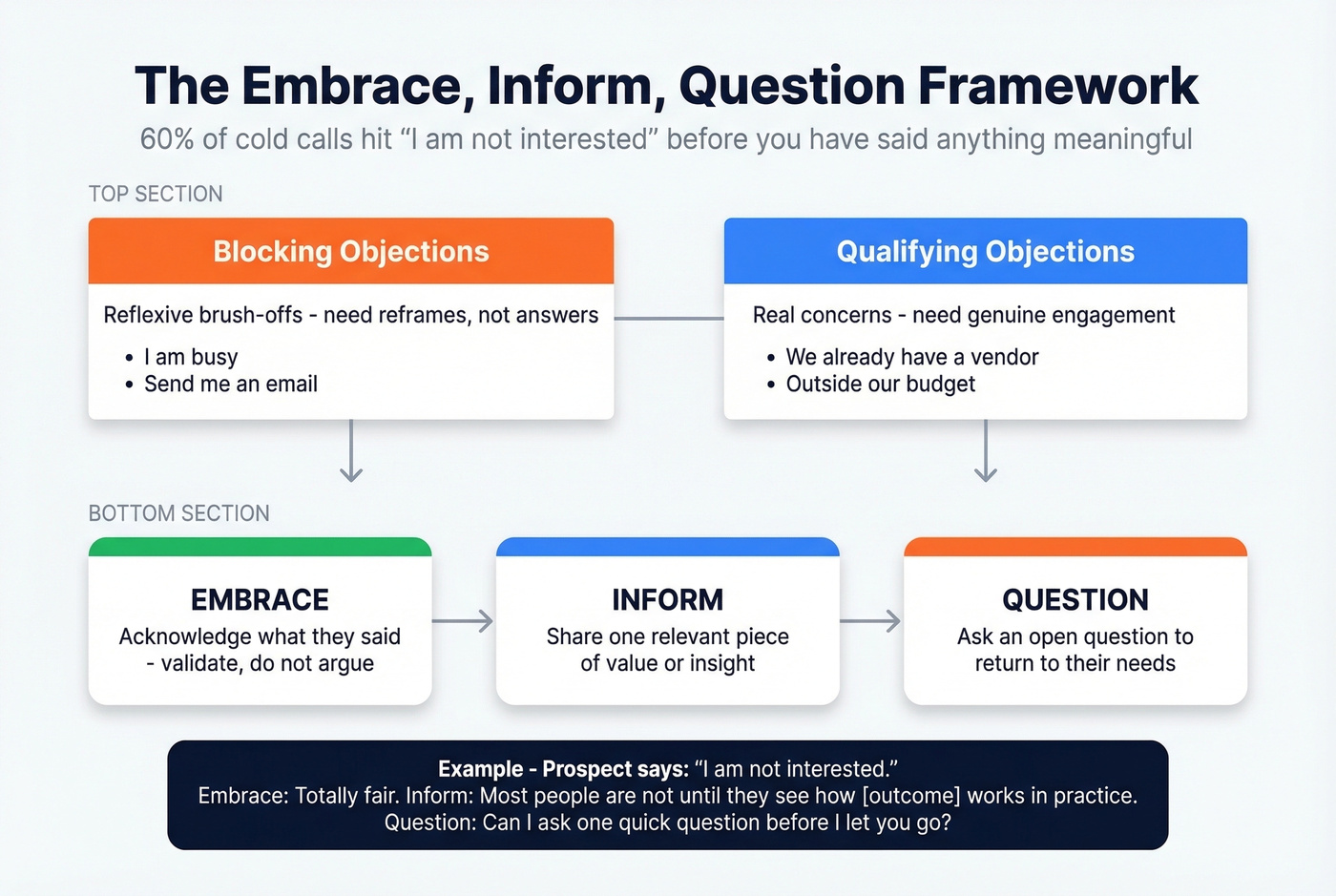
Not all objections are equal. Blocking objections are reflexive brush-offs like "I'm busy" or "send me an email." Qualifying objections are real concerns like "we already have a vendor" or "it's outside our budget." Blocking objections don't need answers - they need reframes. Qualifying objections need genuine engagement.
Use the Embrace, Inform, Question framework: acknowledge what they said, provide a relevant piece of information, then ask an open question to return to their needs.
We've seen the "just send me an email" brush-off convert into meetings more than any other objection when handled correctly. Here are word-for-word responses for the five you'll hear most:
"I'm not interested." "Totally fair - most people aren't until they see how [specific outcome] works in practice. Can I ask one quick question before I let you go?"
"I'm too busy right now." "I respect that. I'll keep this to 30 seconds - [deliver value statement]. If it's relevant, we can find 15 minutes that works better. If not, I'll never call again."
"Just send me an email." "Happy to. So I send you something relevant and not generic - what's the biggest challenge your team's dealing with on [topic] right now?"
"We already have a vendor for that." "Good - that means you already see the value. Most teams I talk to aren't looking to replace, they're looking to compare. Would a 15-minute benchmark conversation be useful?"
"I'm not the decision maker." "No worries - who on your team would be the right person for this?"
The isolating technique is your secret weapon for qualifying objections: "If we could resolve [X], is there anything else preventing us from moving forward?" It forces the real objection to the surface.
Skip the Gatekeeper
If you're still strategizing about how to "get past the gatekeeper," you're solving a 2015 problem. The hybrid and remote workforce killed the front-desk gatekeeper for most B2B companies. The modern solution is simple: call the mobile.
On average, only about 28% of cold calls are answered. Verified mobile numbers deliver a 30% pickup rate across all regions - that's the difference between reaching roughly 1 in 4 and 1 in 3. When Meritt switched to verified mobiles from Prospeo, their connect rate tripled to 20-25% and weekly pipeline jumped from $100K to $300K.
For the rare cases where you do hit a receptionist, keep it simple and confident:
"Hey, this is [Your Name] - could you connect me with [First Name] in [Department]?"
Use the prospect's first name. Don't explain why you're calling. Don't sell to the gatekeeper.
Your 35-second framework falls flat without trigger events and fresh data. Prospeo returns 50+ data points per contact - funding rounds, job changes, tech stack, headcount growth - so your "why" segment actually resonates.
Arm every cold call with real-time buyer context for $0.01 per lead.
After the Call
The call ended well. Now don't lose the meeting. Send a follow-up email fast with the subject line "Thanks for the conversation today" - this phrasing is 14x more likely to be opened than a generic subject.
Three rules for preventing no-shows:
Book same-week. Show rates drop when meetings are scheduled too far out. Thursday call into a Friday meeting is ideal.
Send the agenda immediately. A calendar invite with a 3-bullet agenda right after hanging up. Not later. Now.
Confirm the invite live. Before you hang up, say "I'm sending the invite right now - can you accept it while we're on the phone?" This sounds aggressive. It works.
Log everything in your CRM the moment you hang up - disposition, next steps, objections raised, personal details mentioned. Your future self will thank you. And here's a habit we've seen separate good reps from great ones: score yourself 1-10 after every call. Were you energized? Did you listen enough? Did you handle the objection cleanly? Self-scoring creates a feedback loop that compounds over weeks.
Your Cold Calling Tech Stack
You don't need 15 tools. You need a dialer, a conversation intelligence platform, and a data provider.
| Dialer | Starting Price |
|---|---|
| Close | $9/seat/mo |
| RingCentral | $20/user/mo |
| CloudTalk | $25/user/mo |
| JustCall | $29/user/mo |
| PhoneBurner | $140/user/mo |
For conversation intelligence, Gong is the gold standard and typically runs ~$100-150/user/mo. Fireflies.ai is a solid budget option starting free with paid plans from around $10/seat/mo. Chorus is part of ZoomInfo's ecosystem and typically sold on enterprise plans. The capability to watch for: live coaching prompts that surface keyword-triggered suggestions mid-call. If your platform supports it, turn it on - it's like having a manager whispering in your ear during every dial.
For data providers, you need verified contact data - we covered that in the research and gatekeeper sections above. If you're evaluating vendors, start with a shortlist of data enrichment options and compare accuracy, refresh rates, and coverage.
Hot take: If your average deal size is under $10K, skip the $150/seat conversation intelligence tool. Record your calls with Fireflies, review the best and worst one each week, and invest the savings in better data. Data quality moves the needle more than call analytics at that price point.
One thing most guides skip: caller ID reputation matters. If your number gets flagged as spam, your connect rates crater regardless of how good your data is. Rotate numbers, keep call duration reasonable, and don't hammer the same area code 200 times in a day. Most modern dialers handle rotation automatically - make sure yours does.
FAQ
What's a good cold call success rate?
The average is 2.3%, but top performers convert up to 15% of conversations into meetings. The gap comes down to data quality, timing, and having a rehearsed framework - not raw talent. Mastering even one approach consistently will put you ahead of most reps who wing every dial.
How many dials to book a meeting?
It takes an average of 8 attempts to reach a single prospect. Depending on list quality and your sales motion, expect 50-150 dials per meeting booked for most B2B teams. Better data - like verified mobiles with a 30% pickup rate - compresses that range significantly.
Is cold calling still effective in 2026?
Yes. 57% of C-level executives prefer phone over any other outreach channel, and 82% of buyers have accepted meetings that started with a cold call. Email inboxes are noisier than ever - the phone cuts through.
What's the best time of day to cold call?
The 8-11 AM window in the prospect's local time boosts connection rates by 15%. The 4-5 PM power hour is 71% more likely to connect than early morning. Avoid the 12-2 PM dead zone entirely.
How do I get direct phone numbers for prospects?
Use a verified data provider with fresh mobile numbers. Prospeo's database includes 125M+ verified mobiles refreshed every 7 days, delivering a 30% pickup rate. Calling mobiles directly bypasses gatekeepers and dramatically outperforms dialing switchboards.