

How to Build a Cold Calling Database That Doesn't Waste Your Reps' Time
Your reps are dialing. Half the numbers ring out to disconnected lines, wrong departments, or people who left the company eight months ago. That's not a prospecting problem - it's a data problem. Reps lose 27.3% of their productive time to bad contact data, and up to 70% of phone numbers on purchased cold call lists are incorrect or outdated. The cold calling database you build - or buy - determines whether your team books meetings or burns hours.
What You Need (Quick Version)
Here's the short answer based on what we've tested:
- Verified mobile numbers on a budget - Prospeo. 300M+ profiles, 125M+ verified mobiles, 30% pickup rate, free tier to start. Data refreshes every 7 days, which matters more than most teams realize.
- Free tier with broad data - Apollo.io. Largest free plan in the space. Phone accuracy is inconsistent, but you can't beat the price for getting started.
- Enterprise budget, need everything - ZoomInfo. Deepest US dataset, intent data, workflow tools. Expect to pay $15k-$45k+/year and negotiate hard on renewals.
Keep reading for accuracy benchmarks, real pricing breakdowns, and the compliance rules that could cost you $50,120 per violation.
What Your Database Should Include
At minimum, every record needs four fields: full name, job title, company, and a mobile phone number. Not a switchboard. Not a general office line. Cell numbers outperform direct dials on connect rate - Cognism's research backs this up, and our experience confirms it. Phone-centric reps average 6.8 quality conversations per day compared to 3.3 for email-centric reps, and that gap alone justifies paying for verified cells rather than settling for generic office lines.
But minimum fields get you minimum results. The databases worth paying for layer on enrichment data that helps reps prioritize who to call first. Buyer intent signals tell you whether a prospect is actively researching your category. Technographics reveal what tools their company already runs. Sales triggers - recent funding rounds, leadership changes, headcount growth - give your reps a reason to call that isn't "I found your name on a list." These fields turn a cold call into a warm one.
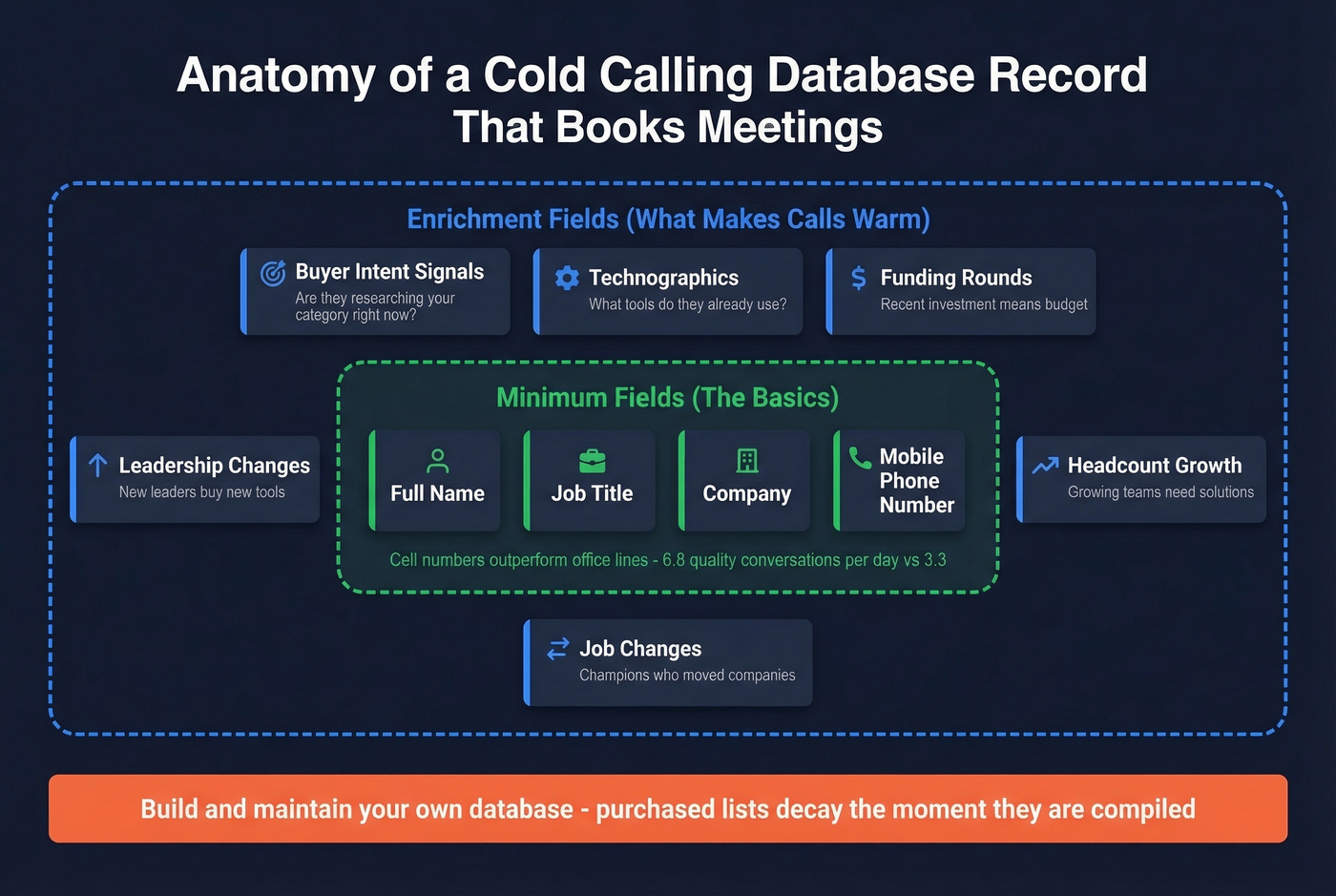
This is also why building a targeted list through a contact database beats purchasing generic cold call lists. Purchased lists decay the moment they're compiled. A database you build and maintain stays accurate because you control the refresh cycle.
How Accurate Are These Databases, Really?
Here's the thing: no single provider is both highly accurate and highly comprehensive. A Salesfinity benchmark-accuracy-coverage-real-results) tested 307 verified contacts across 9 providers and found accuracy ranged from 63% to 91%, while coverage ranged from 26% to 92%. The providers with the best accuracy often had the worst coverage, and vice versa.

That's why waterfall enrichment - layering two or three data sources - has become the standard approach for serious outbound teams. You run your list through one provider, then fill gaps with a second. The cost goes up, but so does your connect rate.
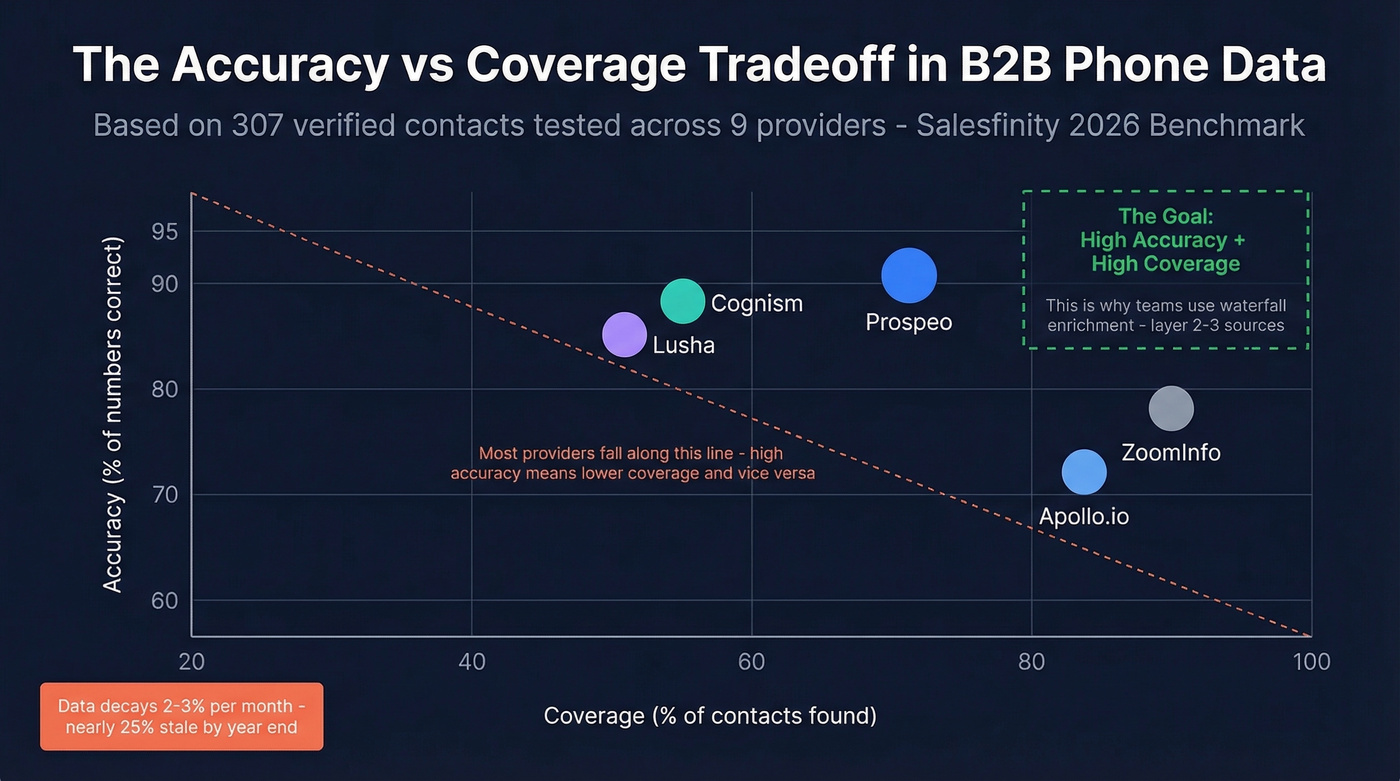
The bigger issue is decay. B2B contact data decays at roughly 2-3% per month. By year's end, nearly a quarter of your database is stale. Poor data quality costs companies an average of $12.9M per year - and that's not just a big-company problem. Even a 10-rep team burning 200 dials a day on bad numbers is losing thousands in rep productivity every month.
Cold Calling Benchmarks to Know
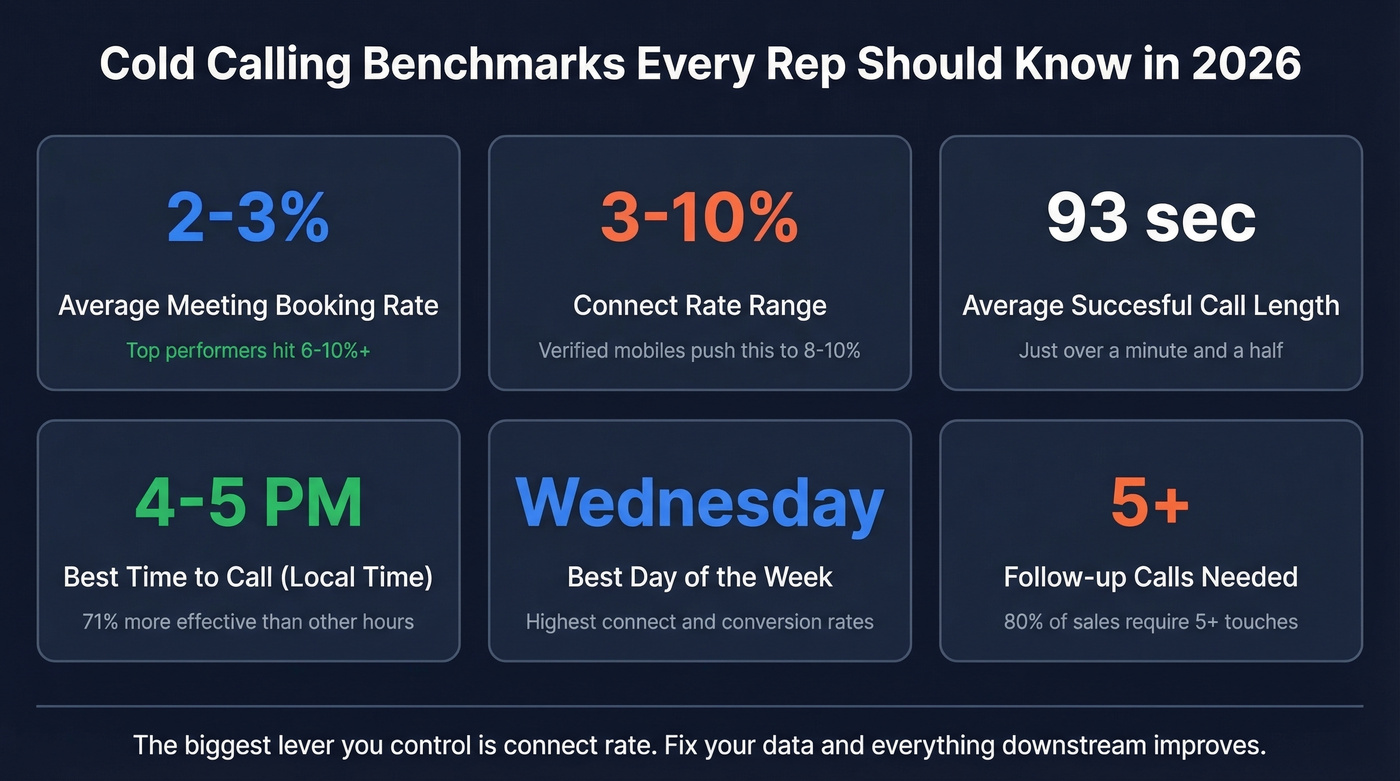
Before you invest in a database, calibrate your expectations. These numbers from ZoomInfo's benchmark data and industry research set the baseline:
| Metric | Average | Top Performers |
|---|---|---|
| Meeting-booking rate | 2-3% | 6-10%+ |
| Connect rate | 3-10% | Higher w/ mobiles |
| Successful call length | 93 seconds | - |
| Best time to call | 4-5 PM local | 71% more effective |
| Best day | Wednesday | - |
| Follow-ups needed | 5+ calls | 80% of sales |
The connect rate is the number that should drive your database decision. If you're getting 3% connects on office lines and could get 8-10% on verified mobiles, that's a 2-3x improvement in conversations per day - without changing anything about your pitch, your sequencing, or your reps' skill level. Fix the data and everything downstream improves.
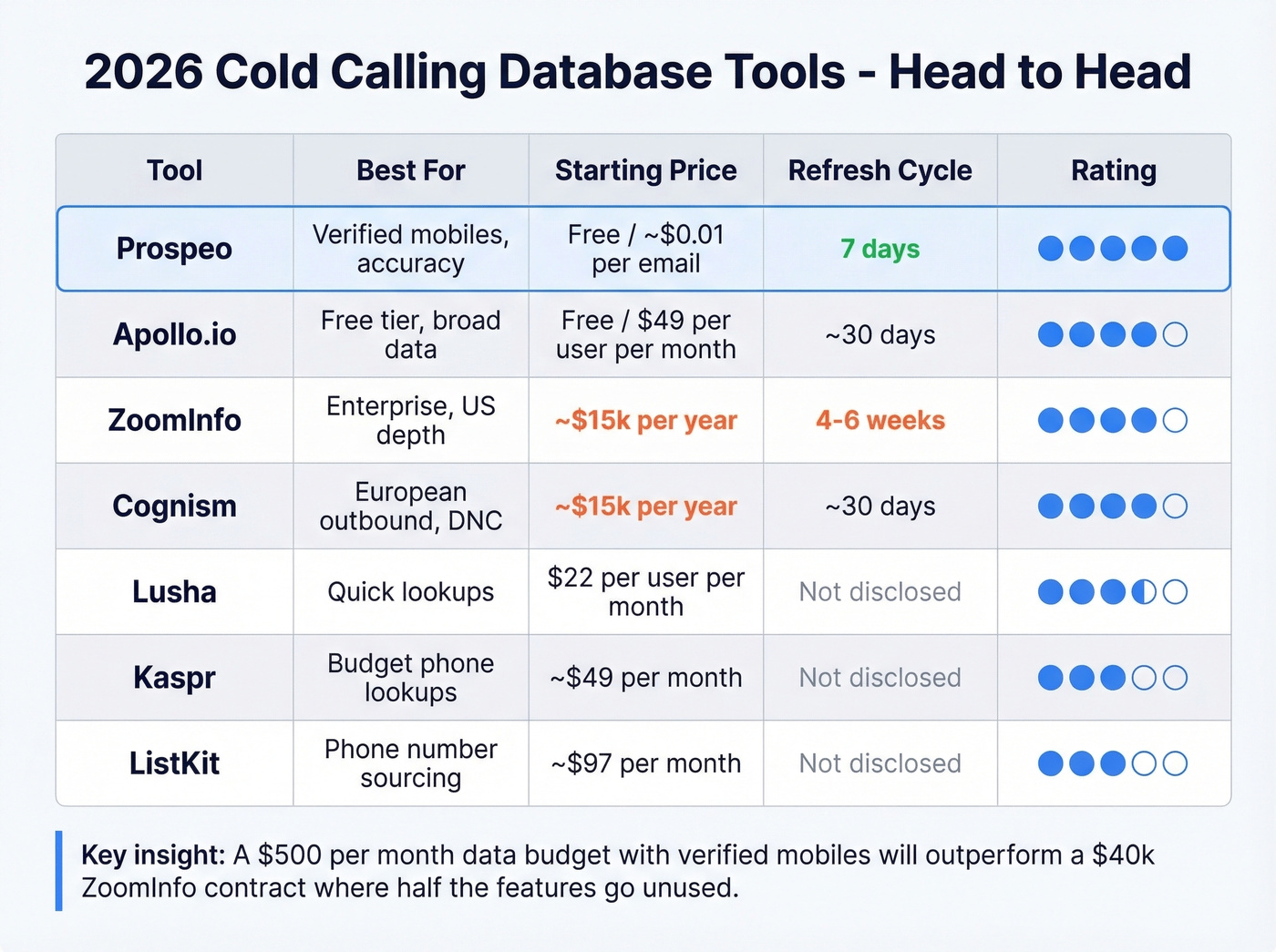
Let's be honest: if your average deal size is under $10k, you probably don't need a $15k+/year data platform. A $500/month data budget with verified mobiles will outperform a $40k ZoomInfo contract where half the features go unused. Spend on data quality, not data quantity.

Your reps lose 27% of their time to bad numbers. Prospeo's 125M+ verified mobiles deliver a 30% pickup rate - 3x higher than ZoomInfo or Apollo. Data refreshes every 7 days, so your cold calling database never goes stale.
Stop burning dials on dead numbers. Start connecting.
Best Cold Calling Database Tools in 2026
| Tool | Best For | Data Quality | Starting Price | Refresh Cycle |
|---|---|---|---|---|
| Prospeo | Verified mobiles + accuracy | 125M+ mobiles, 98% email | Free / ~$0.01/verified email | 7 days |
| Apollo.io | Free tier + broad data | Large but inconsistent | Free / $49/user/mo | ~30 days |
| ZoomInfo | Enterprise + US depth | Extensive, ~87% email | ~$15k/yr | 4-6 weeks |
| Cognism | European outbound + DNC | Strong EMEA mobiles | ~$15k/yr | ~30 days |
| Lusha | Quick lookups | Good mobiles, good email | $22/user/mo | Not disclosed |
| Kaspr | Budget phone lookups | Moderate | ~$49/mo | Not disclosed |
| ListKit | Phone-number sourcing | Growing | ~$97/mo | Not disclosed |
Prospeo
Use this if you need verified mobile numbers that people actually answer, without signing an annual contract or talking to a sales rep. Prospeo's 300M+ professional profiles and 125M+ verified mobiles deliver a 30% pickup rate - that's what teams like Meritt experienced when their connect rate tripled to 20-25% after switching. The 98% email accuracy means your sequences don't bounce, either. Snyk's team of 50 AEs dropped their bounce rate from 35-40% to under 5%.

The database includes 30+ search filters, buyer intent powered by Bombora across 15,000 topics, technographics, job changes, funding signals, and headcount growth. You're not just getting phone numbers - you're getting prioritized phone numbers. The free tier gives you 75 verified emails and 100 Chrome extension credits per month. Paid plans run about $0.01 per verified email and 10 credits per mobile number, with no contracts and no minimum commitment. Pair it with your existing dialer or sequencer like Outreach, Salesloft, or Instantly for the calling workflow.
Apollo.io
Use this if you're bootstrapping and need the largest free tier in the market. Apollo's free plan gives you access to their database with limited credits, and paid plans start at $49/user/month (Basic), then $79/user/month (Professional), up to $119/user/month (Organization) on annual billing. The dataset is broad - they cover a huge number of companies and contacts globally.
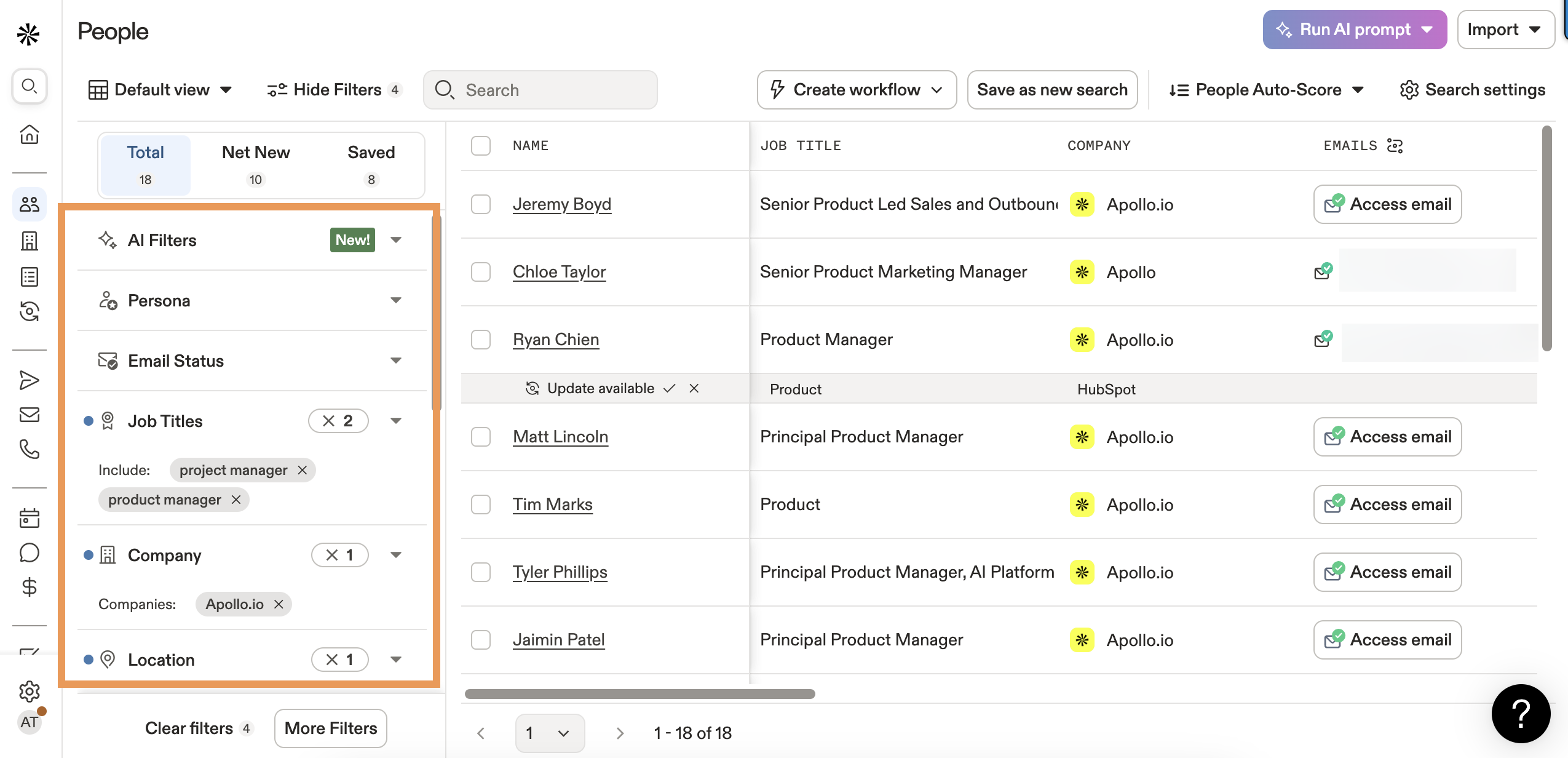
The catch: phone accuracy is inconsistent, especially for director+ roles outside the US. Email accuracy sits around 79%, which means you'll see more bounces than with a verification-first platform. Apollo is a great prospecting starting point, but serious calling teams usually layer another source on top. The consensus on r/sales is that Apollo's phone data works fine for high-volume, lower-ACV outbound but falls short when you need every dial to count.
ZoomInfo
ZoomInfo has the deepest US B2B dataset available, and their intent data, org charts, and workflow tools are best-in-class for large sales orgs. The Professional tier starts around $15k-$18k/year, Advanced runs $25k-$28k, and Elite pushes $40k-$45k+. Extra seats add $1,500+/year each.
A common complaint is price - especially paying for modules you don't use. Renewal increases of 10-20% are typical.
The data refresh cycle of 4-6 weeks means your exported lists decay faster than you'd expect from a premium provider. For teams under 20 reps or budgets under $15k, the ROI math rarely works out. Skip this if you're a small team that doesn't need intent data or advanced org chart mapping.
Cognism
If you're calling into Europe, Cognism is the obvious pick. They scrub numbers against DNC lists in 12+ countries and take a GDPR-first approach that matters when you're dialing UK, German, or French prospects. Their Diamond Data verified mobiles are strong for EMEA coverage. Pricing runs ~$15,000-$100,000+/year depending on team size and tier. The US database doesn't match ZoomInfo's depth, so if your entire TAM is North America, look elsewhere.
Lusha
Lusha starts at ~$22/user/month (Pro) and $52/user/month (Premium) on annual billing. The interface is dead simple - search, click, get the number.
But here's the math that trips people up: Lusha charges 5 credits for a direct dial phone number versus 1 credit for an email. That 5:1 ratio means phone-heavy teams burn through credits fast. We ran the numbers for a 5-rep team doing 100 dials a day, and the monthly credit cost was roughly 3x what the subscription page suggests. Do the math on your monthly dial volume before committing.
Kaspr
Credit-based phone lookup tool starting around $49/month. Similar model to Lusha with a focus on European data. Decent for individual reps doing targeted outreach, but not built for high-volume list building.
ListKit
Newer entrant focused specifically on phone number sourcing for cold calling teams. Starts around $97/month. Worth watching if phone data is your only need, but we haven't tested it deeply enough to recommend it over the established options.
What This Actually Costs
The subscription price is just one layer. A 5-rep cold calling operation actually costs more than most teams budget for:
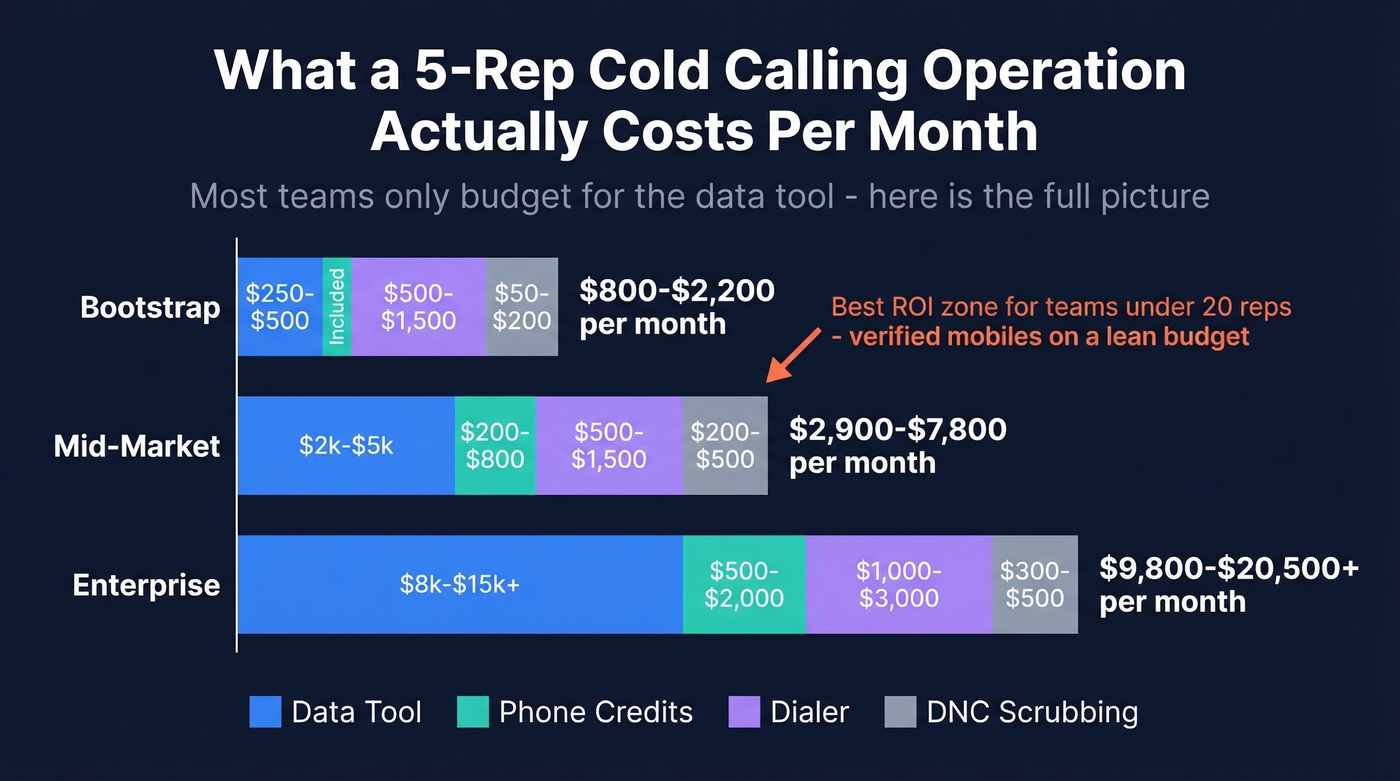
| Cost Layer | Bootstrap | Mid-Market | Enterprise |
|---|---|---|---|
| Data tool | $250-$500/mo | $2k-$5k/mo | $8k-$15k+/mo |
| Phone credits* | Included | $200-$800/mo | $500-$2,000/mo |
| Dialer | $500-$1,500/mo | $500-$1,500/mo | $1,000-$3,000/mo |
| DNC scrubbing | $50-$200/mo | $200-$500/mo | $300-$500/mo |
| Total | $800-$2,200/mo | $2,900-$7,800/mo | $9,800-$20,500/mo |
*Phone credits are sometimes bundled in the data tool cost, sometimes separate. Check your plan.
The dialer cost - $100-$300/seat/month for tools like Orum, Nooks, or ConnectAndSell - is unavoidable if you're doing parallel dialing. DNC scrubbing adds another $50-$500/month depending on volume and jurisdiction coverage.
Phone credits are the hidden budget killer. Across most platforms, revealing a mobile number costs 5-10x what an email costs. Factor this into your total cost of ownership before signing anything.
If you're considering outsourcing entirely, expect to pay $75-$300 per booked meeting or $3,000-$15,000/month on retainer. That math only works if your average deal size justifies it.
Meritt tripled their connect rate to 20-25% after switching to Prospeo. Snyk's 50 AEs cut bounce rates from 35% to under 5%. At $0.01 per verified email and no annual contracts, you get enterprise-grade cold calling data at 90% less than ZoomInfo.
Triple your connect rate without tripling your data budget.
Compliance: TCPA, DNC, and State Laws
A great database is worthless if it gets you sued. These are the rules that matter for cold calling in 2026.
Federal frameworks and penalties:
- TCPA: $500-$1,500 per violation. Covers autodialed calls, prerecorded messages, and - as of the February 2024 FCC ruling - AI-generated voices count as "artificial/prerecorded" under TCPA
- TSR (Telemarketing Sales Rule): Up to $50,120 per violation. Now covers B2B telemarketing misrepresentation
- National DNC Registry: Up to $50,120 per violation
Operational requirements:
- Call only between 8 AM-9 PM in the prospect's local time zone
- Scrub your lists against the DNC registry at least every 31 days
- Honor consent revocation within 10 business days
State-level rules that catch people off guard:
- Connecticut: Up to $20,000 per violation, with a tighter 9 AM-8 PM calling window
- Texas SB 140: Texts now treated as solicitation - requires bond/fee compliance
- Virginia SB 1339: 10-year text opt-out period
The per-violation penalties mean a single bad list can generate six-figure liability. Scrub your outreach lists before every campaign, not just when you remember.
How to Keep Your Database Clean
A cold calling database isn't a one-time purchase - it's an ongoing system. Data decays at 2-3% per month, so a list that was 95% accurate in January drops below 88% by April. Here's how to stay ahead of the rot.
Set a refresh cadence. Use CRM enrichment or API syncs to keep records current automatically rather than relying on quarterly manual exports. The difference between weekly and monthly refreshes compounds fast over a full quarter.
Layer your sources. Waterfall enrichment with 2-3 providers catches what any single source misses. Run your primary list through one tool, then fill gaps with a second.
Dedup before import. Every new list import should be deduplicated against your existing CRM records. Duplicate contacts create confusion, inflate metrics, and annoy prospects who get called twice.
Assign CRM lifecycle stages. Tag contacts as "new," "contacted," "qualified," or "disqualified" so reps don't re-dial dead leads. This sounds basic, but I've seen teams with 40% of their CRM marked as "new" six months after import.
Re-verify quarterly at minimum. Even with a good primary source, run a bulk verification pass every 90 days. This is non-negotiable hygiene, not a nice-to-have.
FAQ
What's the difference between a direct dial and a mobile number?
A direct dial rings a specific desk phone or extension - it bypasses the switchboard but still lands on a landline. A mobile number reaches the person's cell phone, which they carry everywhere. Mobile numbers consistently deliver higher connect rates, especially with remote work now standard.
How often should I refresh my cold calling database?
Quarterly at minimum, since B2B data decays 2-3% per month and a six-month-old list has lost 12-18% accuracy. The gold standard is continuous enrichment through API syncs or CRM integrations on a weekly cycle.
Is it legal to cold call cell phones in the US?
Yes, manual cold calls to cell phones are legal under federal law without an autodialer or prerecorded message. Scrub against the National DNC Registry every 31 days, call between 8 AM-9 PM local time, and honor opt-outs within 10 business days.
How many dials should an SDR make per day?
With a parallel dialer, 200-300 dials per day is standard; manual dialing lands at 60-80. The number matters less than the connect rate - 3-10% of cold calls reach a live person, so better data directly means more conversations without more dials.