

Cold Calling Outsourcing: What It Costs, What Goes Wrong, and How to Make It Work
Your VP of Sales just said "scale outbound." Hiring takes four months. Your pipeline target is next quarter. So you start looking into cold calling outsourcing - and immediately drown in vendor pages that all say the same thing. Connect rates have dropped from 4.82% to roughly 2.3% over the past two years, which means the margin for error on an outsourced engagement is razor-thin. Bad data, bad provider, or bad contract structure, and you're lighting $5,000 a month on fire.
What You Need (Quick Version)
- Budget $3,000-$7,000/month for a US-based outsourced SDR. Offshore runs $2,000-$5,000/month depending on the model and provider. Anything significantly cheaper is a red flag.
- Define deliverables before signing anything. Daily dial minimums, meeting qualification criteria, reporting cadence - get it in writing.
- Verify your prospect data before handing it to any agency. Bad phone numbers are one of the biggest silent ROI killers in outsourced calling.
Here's our honest take: most outsourced cold calling fails because of bad data, not bad callers. We'll come back to this - it's the single biggest variable most buyers ignore.
What These Services Actually Include
The terminology is sloppy across the industry. You're generally buying one of three service tiers.
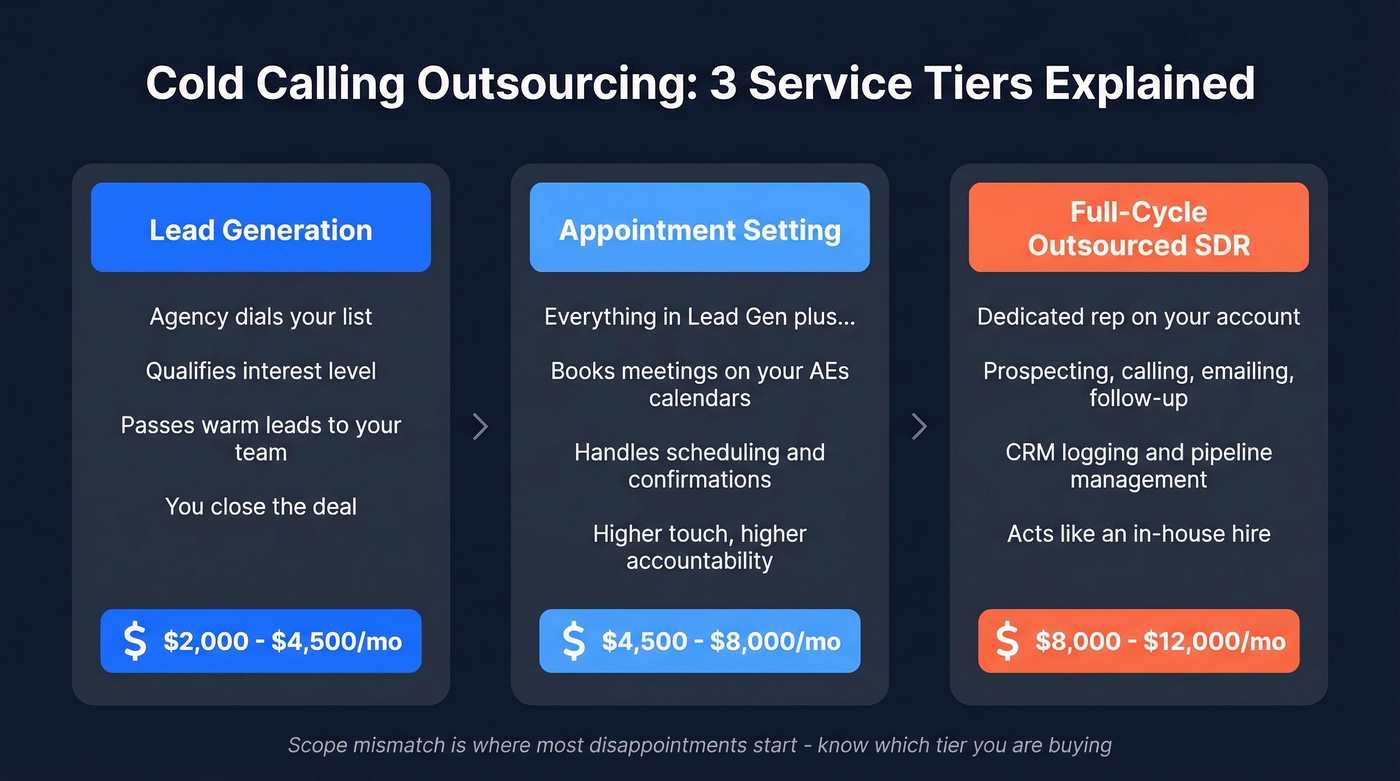
Lead generation is the lightest touch - the agency dials, qualifies interest, and passes warm leads to your team. Appointment setting goes further: they book meetings directly on your AEs' calendars. Full-cycle outsourced SDR means a dedicated rep handling prospecting, calling, emailing, follow-up, and CRM logging as if they were on your payroll.
The price gap between tiers is significant. A lead gen service runs $2,000-$4,500/month. A dedicated full-cycle SDR with phone and email is often $8,000/month for one SDR, and can reach $12,000/month at the high end when you're effectively buying more coverage. Know which tier you're buying - scope mismatch is where most disappointments start, and different vendors define these tiers differently.
Outsource or Hire In-House?
The math is more lopsided than most people realize.
A fully-loaded in-house SDR - base salary, benefits, employer taxes, tools, management overhead, enablement, and ops support - runs $9,800-$14,200 per month. That's after they're productive, which takes 3-4 months of recruiting, onboarding, and ramp. The tool stack alone eats budget fast: sales engagement platform, Sales Navigator, CRM seat, data tools, conversation intelligence, dialer, and enrichment add-ons. Blended, that's $475-$1,000 per SDR per month just in software.
| Factor | In-House SDR | Outsourced SDR |
|---|---|---|
| Monthly cost | $9,800-$14,200 | $3,000-$6,500 |
| Time to pipeline | 3-4 months | 1-3 weeks |
| Tool stack included | No (add ~$475-$1K/mo) | Usually yes |
| Management overhead | High | Low |
| Institutional knowledge | Builds over time | Limited |
Outsourcing wins on speed and cost. In-house wins on product knowledge and long-term pipeline quality. For most teams testing a new market, vertical, or outbound motion, outsourced sales calls are the smarter first move. Hire once you've proven the channel works.
How Much Does It Cost?
Five pricing models you'll encounter:
| Model | Typical Range | Best For |
|---|---|---|
| Monthly retainer | $2,000-$5,000/mo | Predictable budgets |
| Dedicated SDR | $4,500-$12,000/mo | Full-time coverage |
| Per appointment | $75-$500/meeting | Testing before commit |
| Per qualified lead | $50-$250/lead | Top-of-funnel volume |
| Hourly (US-based) | ~$16/hr | Supplemental capacity |
SalesHive publishes their pricing openly - refreshing in a space where most vendors hide behind "book a demo." Their US-based Starter package (one SDR, phone only, 150+ touches/day) runs $7,000/month month-to-month or $6,300/month annual. Their Growth tier adds email for $8,000/month.
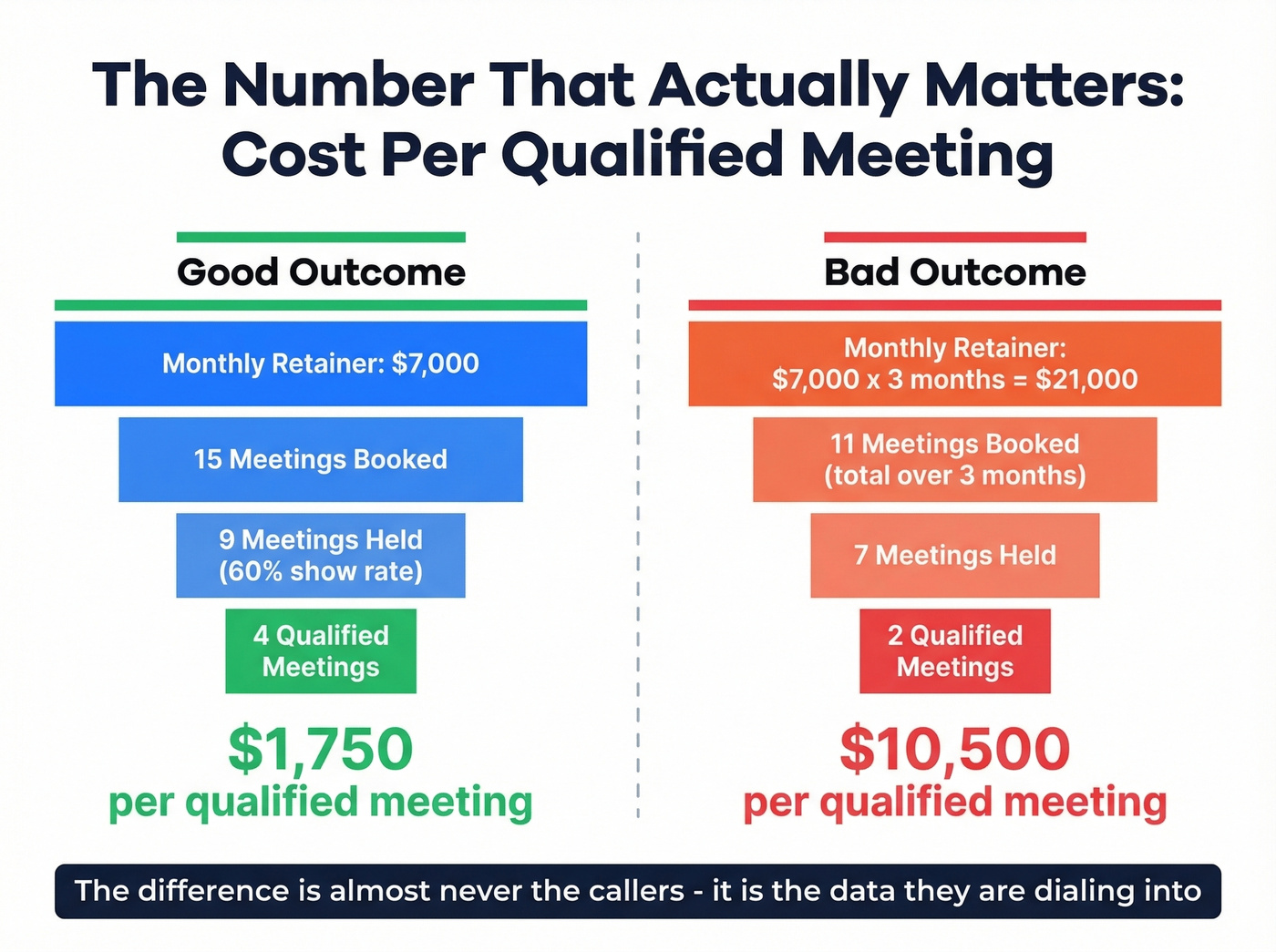
The number that actually matters is cost per held meeting - not booked. If your agency books 15 meetings a month at $7,000/month and 60% show up, that's 9 held meetings at ~$778 each. If only 2 of those 9 are truly qualified, you're paying $3,500 per qualified meeting.
We've seen worse. Three months into a $7K/month contract, 11 meetings booked, 2 qualified - that's $10,500 per qualified meeting. That math gets ugly fast, which is why retainer models with defined KPIs beat pay-per-appointment for most B2B teams. Pay-per-appointment incentivizes volume over quality.

Bad phone data is the #1 silent killer of outsourced cold calling ROI. Prospeo gives you 125M+ verified mobile numbers with a 30% pickup rate - 3x the industry average. Hand your agency a list that actually connects.
Stop lighting $5K/month on fire dialing dead numbers.
US-Based vs. Offshore Providers
The Philippines IT-BPM industry runs $38 billion in revenue with 1.82 million workers. This isn't a scrappy freelancer market - it's a mature, professionalized industry. A US-based SDR costs $95,000-$120,000/year fully loaded, while a Philippines-based SDR through a specialist vendor runs $24,000-$48,000/year. That's 40%+ in labor savings.
SalesHive's Philippines packages illustrate this clearly: their offshore Starter tier is $4,500/month versus $7,000/month for US-based - same touch volume and the same CRM integration options, with a US-based strategist overseeing the campaign.
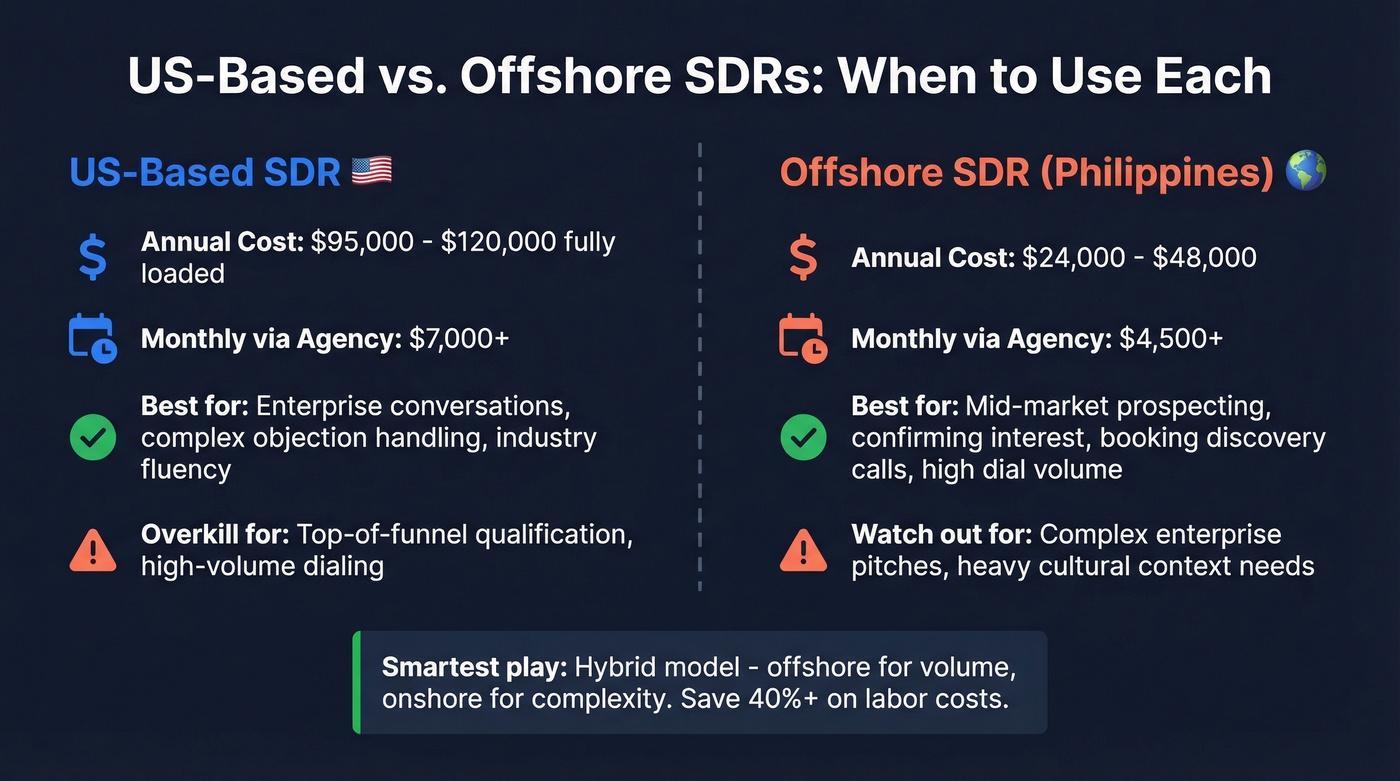
Look, offshore SDRs are underrated for top-of-funnel work. If you're dialing into mid-market accounts to confirm interest and book discovery calls, accent and cultural context matter less than dial volume and script adherence. Save your US-based reps for complex enterprise conversations where industry fluency and real-time objection handling make or break the call. The hybrid model - offshore for volume, onshore for complexity - is the smartest play for most teams we've talked to.
When budget is tight, go offshore but confirm your provider complies with the Philippines Data Privacy Act and can sign DPAs mapping to GDPR/CCPA requirements.
How to Evaluate Providers
You shouldn't sit through a 45-minute discovery call just to find out if an agency costs $3,000 or $15,000 a month. The providers who hide pricing are usually the most expensive. Here's the checklist:
- Do they publish pricing? If not, red flag.
- What are the daily dial minimums? Get a specific number.
- How do they report? Daily activity reports - dials, conversations, meetings, disposition codes. Weekly summaries aren't enough.
- What's the contract term? Avoid annual commitments upfront. A 90-day pilot with month-to-month after is reasonable.
- What does "qualified meeting" mean? Define this in the contract - title, company size, budget authority.
- Where does their data come from? If they can't answer, bring your own verified list.
- Can you listen to call recordings? Non-negotiable.
One cautionary example: a Trustpilot reviewer claimed they were paying $86,000/year and their SDR was making calls for roughly one hour a day. That's extreme, but it highlights why daily activity reporting and dial minimums aren't optional. The best B2B cold calling companies welcome this level of scrutiny. The worst ones dodge it.
The Data Problem Nobody Talks About
This is the part that frustrates us the most. We've seen teams burn through $20K+ in agency fees before realizing their prospect list was 40% dead numbers. The difference between a $4,500/month agency and a $7,000/month agency often isn't the callers - it's the data they're dialing into.
Think about it: if 30-50% of your prospect list has bad phone numbers - disconnected, wrong person, outdated - your agency spends half its dial time listening to voicemail and "this number is no longer in service" recordings. You're paying $7,000/month for someone to discover that your data is stale.
This is where data verification pays for itself before the first call happens. Prospeo covers 300M+ professional profiles with 98% email accuracy and 125M+ verified mobile numbers delivering a 30% pickup rate - on a 7-day refresh cycle versus the roughly 6-week industry average. For outsourced calling, that mobile number accuracy determines whether your agency books 5 meetings or 15 in a month.
The cost comparison is absurd. Verifying a 5,000-contact list at ~$0.01 per email costs around $50. Wasting time dialing dead numbers can easily burn hundreds of dollars in retainer time. Real results back this up: Meritt cut their bounce rate from 35% to under 4% after switching their data source, and GreyScout saw the same drop - 38% to under 4%.
Bring your own verified list if: you're handing off prospects to an outsourced team and want to guarantee they're dialing live numbers.
Skip this step if: your agency provides their own verified data and can prove accuracy rates above 90%. Ask them - most can't.
Compliance Risks That Can Bankrupt You
Outsourcing the calls doesn't outsource the liability. If your agency violates TCPA or DNC regulations, you're on the hook too.
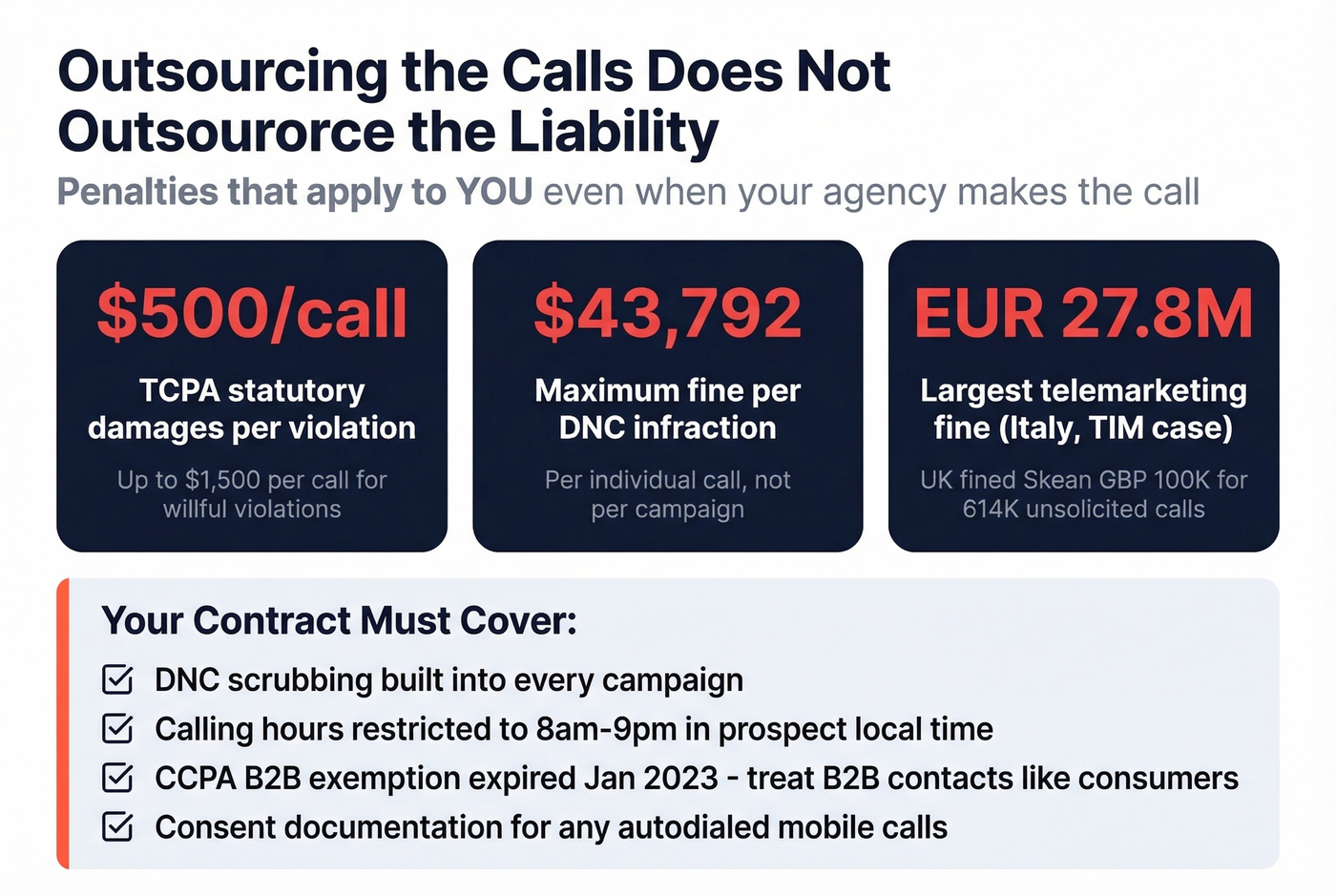
The penalties are severe. TCPA violations carry statutory damages of $500 per call, scaling to $1,500 per call for willful violations. DNC infractions can hit up to $43,792 per infraction. These aren't theoretical - Italy's DPA fined TIM EUR 27.8 million for unsolicited calls, and the UK's ICO fined Skean GBP 100,000 for 614,342 unsolicited calls.
B2B-specific nuances that trip teams up: calling hours are restricted to 8am-9pm in the prospect's local time zone under TCPA, autodialed calls to mobile numbers still require consent even in B2B contexts because mixed-use lines are often treated as consumer lines, and the CCPA B2B exemption expired January 1, 2023, meaning B2B contacts now have consumer-like data rights. These rules apply equally whether you're running cold calling services in-house or through a third party.
Your outsourcing contract should explicitly address DNC scrubbing, calling-time compliance across time zones, and consent documentation. If your provider doesn't have DNC.com integration or equivalent scrubbing built into their workflow, walk away. A single compliance incident dwarfs a year of outsourcing fees.
Making It Work
Let's be honest about what separates the teams that get ROI from outsourced calling and the ones that don't. It comes down to three habits: they verify data before handing it off, they define "qualified meeting" in the contract with specific criteria, and they treat the first 90 days as a calibration period rather than a pass/fail test.
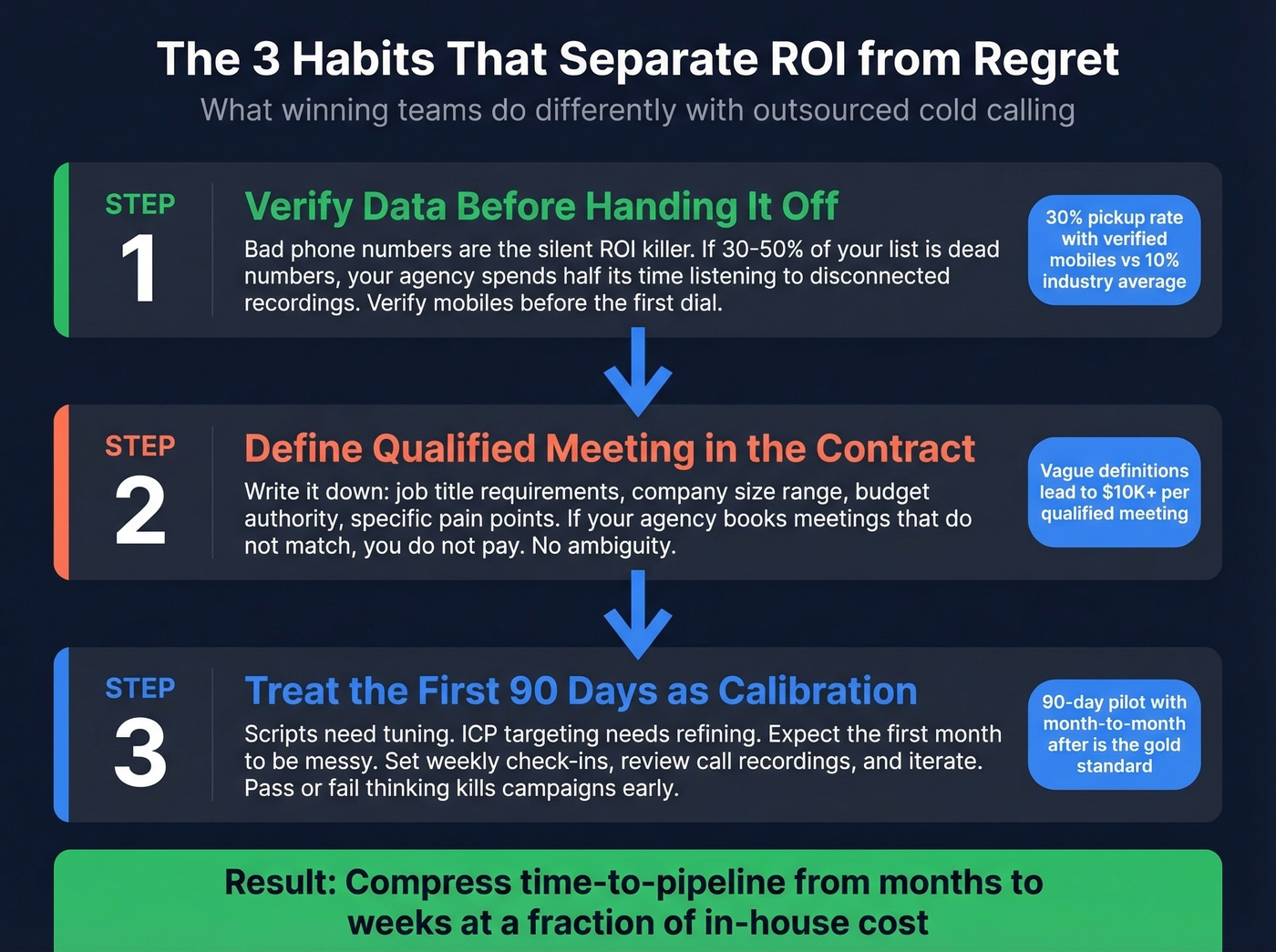
Combine a reputable agency with clean, verified prospect data, and you'll compress your time-to-pipeline from months to weeks - at a fraction of the cost of hiring in-house. If you need a tighter outbound motion, start with a repeatable cold calling system and a clear ideal customer profile before you outsource.
Whether you're outsourcing offshore or onshore, your agency is only as good as the data you feed them. Prospeo's numbers are refreshed every 7 days - not 6 weeks - so your SDRs reach real people at current companies. At $0.01/email and 10 credits per mobile, verified data costs less than one wasted hour of agency time.
Fix your data before you fix your agency.
FAQ
How long does it take to launch an outsourced campaign?
Most providers onboard in 1-3 weeks. Some can start dialing within 5-7 business days if you provide a ready prospect list and clear ICP criteria. Budget an extra week if the agency is sourcing data on your behalf.
What's a realistic cost per qualified meeting?
Expect $250-$1,000 per held meeting depending on your ICP. Enterprise C-suite targets push toward the high end; SMB campaigns targeting directors and VPs typically land closer to $250-$400.
Should I provide my own prospect list?
Yes, whenever possible. Agencies using stale databases waste dials on disconnected numbers. Verifying a 5,000-contact list costs about $50 - trivial compared to hundreds of dollars in wasted agency retainer hours.
Is outsourced cold calling legal in the US?
Yes, but heavily regulated. TCPA and DNC rules apply to outsourced calls the same as in-house, with penalties up to $43,792 per infraction. Your contract should require DNC scrubbing and calling-hour compliance.
What's the minimum budget to test this?
$3,000-$5,000/month gets you a dedicated US-based SDR on a month-to-month retainer. Commit to at least 90 days before judging results - the first month is calibration, not a verdict.