

Cold Email Campaign Management: The 2026 Ops Playbook
Your reply rate dropped to 0.8%. You've rewritten the subject line four times. You've tried humor, pain points, case studies, and a version that's just two sentences. Nothing moves.
The problem almost certainly isn't your copy - it's your infrastructure, your data, or your sending math. No amount of wordsmithing fixes a deliverability problem.
Cold email campaign management is 80% infrastructure, data quality, and operations. The remaining 20% is messaging, and it only matters once the foundation is solid. Let's build that foundation.
What You Actually Need to Get Started
You don't need 18 tools. You need three:
- A sending platform with inbox rotation and warmup support - Instantly or Smartlead.
- Properly configured Google Workspace accounts on secondary domains. Not your primary domain. Never your primary domain.
Everything else - CRM, enrichment layers, intent signals - is optimization on top of a working foundation. Get these three right first.
Start With the Offer, Not the Infrastructure
Before you buy a single domain or warm up a single inbox, answer one question: does anyone want what you're selling?
The consensus on r/coldemail is clear - the #1 determinant of cold email success is the offer, not SPF records or spintax. If your offer doesn't resonate when you pitch it cold via DMs, Twitter, or in communities, infrastructure won't save it. Validate the offer first. Then build the machine.
Once you've confirmed the offer works, here's the prioritization hierarchy experienced operators use, ranked from most to least impact on reply rate: deliverability, list quality, relevance, offer, personalization. Most teams spend 80% of their time on personalization, which sits at the bottom of the stack. Flip that.
Here's the thing: if your average deal size is under $5K, you probably don't need a $15K/year data platform or a 12-tool stack. A sending tool, verified data at $0.01/email, and disciplined campaign operations will outperform a bloated tech stack every time.
The Backward Planning Framework
Campaign management starts with the end. How many meetings do you need per month? Work backward from there.
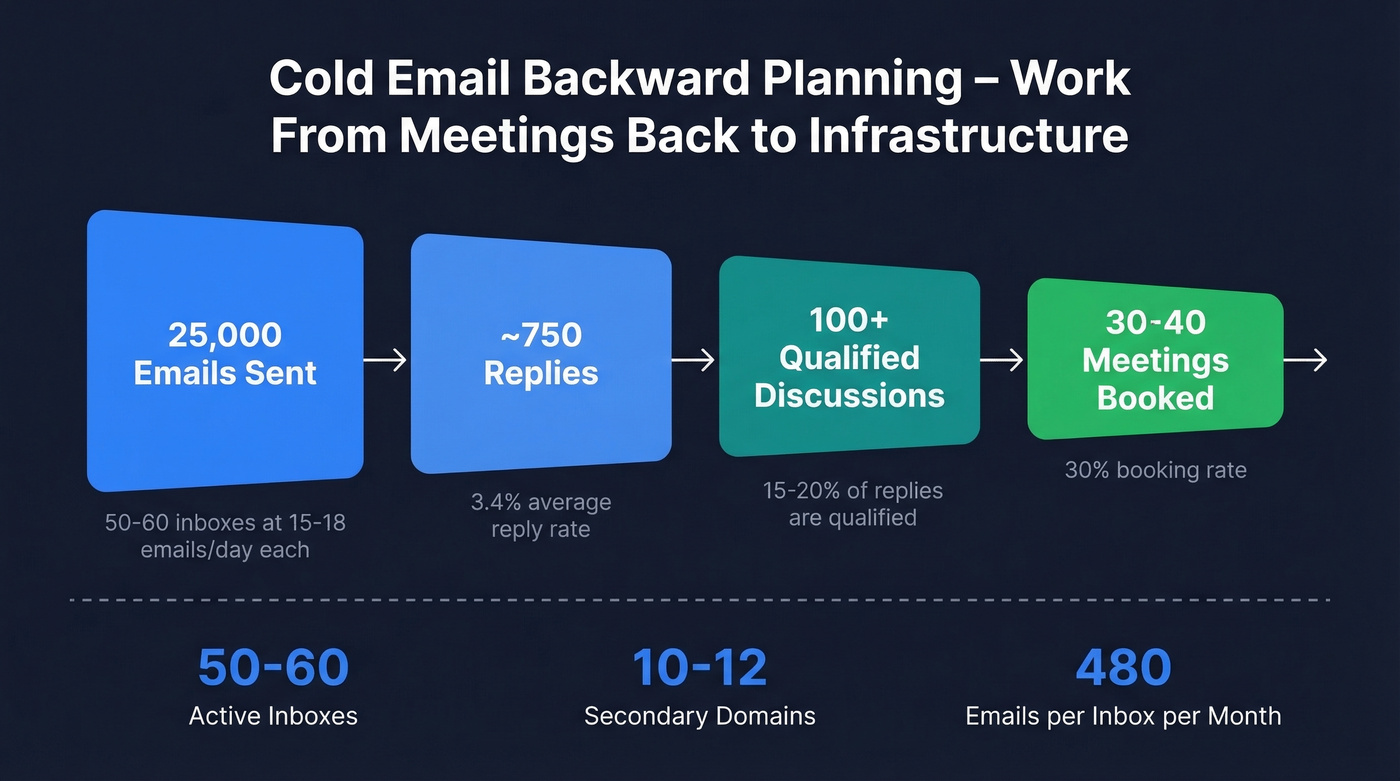
Let's say you need 30-40 meetings per month. At a 3.43% average reply rate, 25,000 emails per month generates roughly 750 replies. Fifteen to twenty percent of those are qualified, giving you 100+ sales discussions. At a 30% booking rate, that's 30-40 meetings.
Now reverse-engineer the infrastructure. Each inbox safely handles 15-18 cold emails per day - about 480 emails per month per inbox. To hit 25,000 sends, you need 50-60 active inboxes.
| Input | Number | How It's Calculated |
|---|---|---|
| Monthly sends | 25,000 | Target volume |
| Emails/inbox/day | 15-18 | Safe sending ceiling |
| Inboxes needed | 50-60 | 25K / 480 per inbox per month |
| Domains needed | 10-12 | 2-3 accounts per domain |
| Expected replies | ~750 | 25K x ~3.4% reply rate |
| Qualified discussions | 100+ | 750 x 15-20% |
| Meetings booked | 30-40 | 100 x 30% |
The numbers are straightforward. What trips teams up is the infrastructure required to support them.
Infrastructure Setup SOP
Domains and Inboxes
Buy secondary lookalike domains - variations of your primary domain. If your company is acme.com, register acmetech.com, getacme.com, tryacme.com. Never send cold email from your primary domain. One spam flag and you've torched your entire company's email reputation.
Set up Google Workspace or Microsoft 365 on each domain. Configure SPF, DKIM, and DMARC for every single one - no exceptions. Each domain gets 2-3 email accounts max.
One warning that comes up repeatedly on Reddit: avoid ultra-cheap inbox resellers offering $3/inbox deals. They pack hundreds of accounts onto shared IPs, and when one sender gets flagged, everyone on that IP suffers.
Warmup Schedule
Don't launch campaigns the day you create inboxes. Warmup isn't optional.
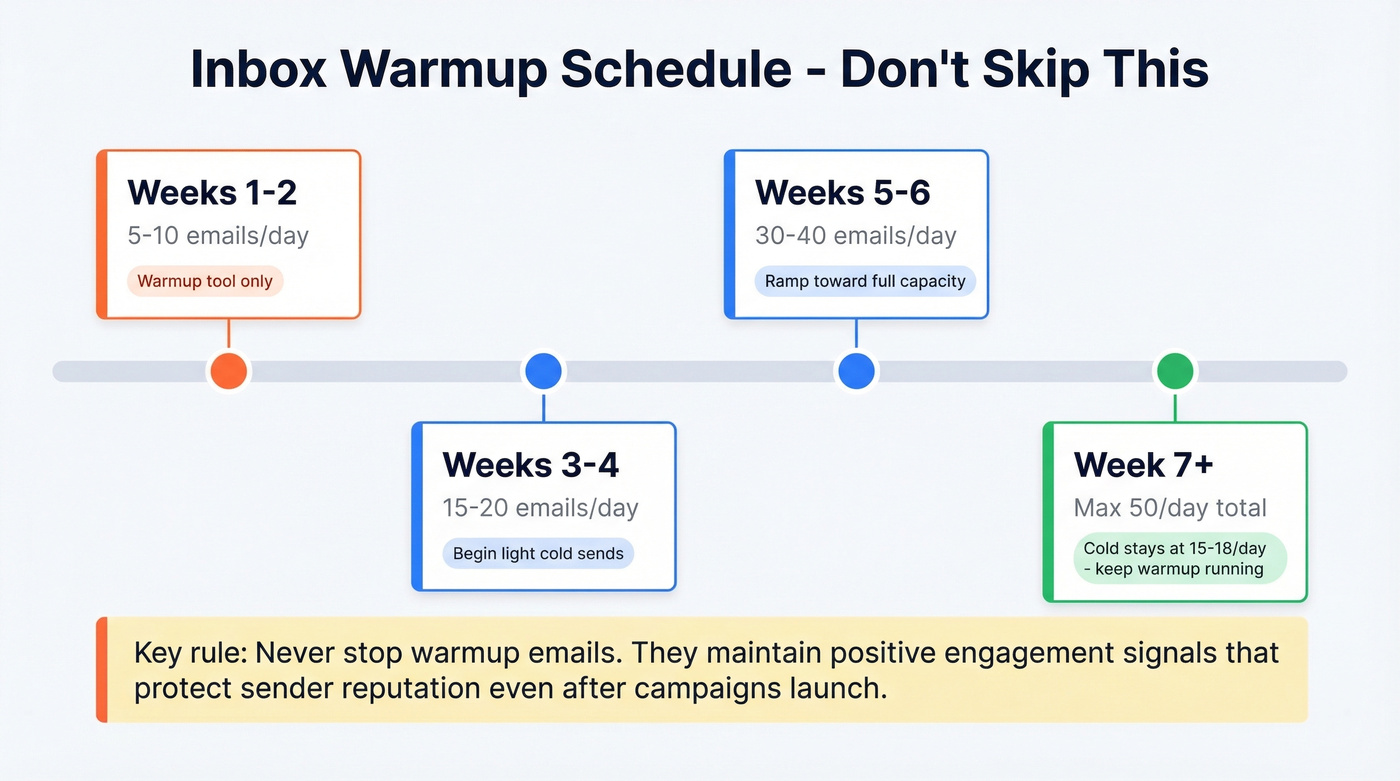
| Week | Daily Volume | Notes |
|---|---|---|
| 1-2 | 5-10 emails | Warmup tool only |
| 3-4 | 15-20 emails | Begin light sends |
| 5-6 | 30-40 emails | Ramp toward capacity |
| 7+ | Max 50/day | Total (warmup + cold combined); cold stays at 15-18/day |
Fourteen days is the minimum warmup period. Twenty-one is safer. Keep warmup running even after you launch campaigns - the warmup emails maintain positive engagement signals that protect your sender reputation.
Inbox Rotation and Pool Management
At 50+ inboxes, round-robin rotation isn't enough. Treat your inboxes as a portfolio with three pool states. Primed inboxes are healthy and at full volume. Ramping inboxes are warming up or recovering. Resting inboxes have been pulled from rotation for cooldown.
Monitor via Google Postmaster Tools and Microsoft SNDS. The thresholds that matter: Gmail's spam complaint ceiling is 0.3% - cross it and you're in trouble. Bounce rates above 2% signal a data quality problem. When an inbox's metrics drift, move it to Resting before it damages the pool.

List Quality: The Silent Campaign Killer
At 25,000 sends per month, a 2% bounce rate means 500 hard bounces hitting your domains every month. That's not a rounding error - it's a compounding problem that degrades sender reputation across your entire inbox pool.
We've seen this pattern destroy campaigns with great copy and solid infrastructure. Stack Optimize built a cold email operation from scratch to $1M ARR, and the foundation was data quality: 94%+ deliverability, bounce rates under 3%, zero domain flags across all clients. That doesn't happen by accident.
Verification is the operational fix. Prospeo runs 5-step verification with catch-all handling and spam-trap removal, delivering 98% email accuracy on a 7-day refresh cycle versus the 6-week industry average. Meritt switched and watched their bounce rate drop from 35% to under 4%, which tripled their pipeline from $100K to $300K per week. At roughly $0.01 per email, verification is the cheapest insurance in your entire stack - upload a CSV, get results in minutes, and push verified contacts directly to Instantly, Smartlead, or Lemlist via native integrations.
An ICP filter that works well for targeting: US SaaS companies with 25-120 employees, $3-20M revenue, that hired 2+ SDRs in the last 60 days. That "pipeline stress" signal dramatically improves relevance before a single email goes out.
Skip verification if: you enjoy rebuilding sender reputation from scratch every quarter.
One more operational stance worth adopting: don't track open rates. Tracking pixels hurt deliverability, and Apple's Mail Privacy Protection has inflated open rates to meaninglessness. Track replies and positive reply rate instead.

At 25,000 sends/month, every percentage point of bounce rate compounds into domain damage. Prospeo's 5-step verification delivers 98% email accuracy with catch-all handling and spam-trap removal - refreshed every 7 days, not 6 weeks. Push verified lists directly to Instantly, Smartlead, or Lemlist.
Verified emails at $0.01 each - the cheapest insurance in your cold email stack.
Sequence Structure and Benchmarks
Writing Sequences That Convert
Keep sequences simple. One opener plus 2-3 follow-ups, spaced 3-5 days apart. Plain text, under 75 words. Send Tuesday through Wednesday for peak engagement - Wednesday consistently outperforms other days.
Instantly's 2026 benchmark report analyzed billions of cold email interactions and found that 58% of all replies come from the first email. The remaining 42% come from follow-ups, which means skipping follow-ups leaves nearly half your replies on the table. The sweet spot is 4-7 touchpoints total.
Here's what a top-performing first email looks like in the commercial cleaning vertical, which hits 9-11% reply rates with 51-word emails:
Hi {{firstName}}, noticed {{companyName}} just opened a second location on {{street}}. Most multi-site teams we work with spend 6-8 hours a week managing cleaning crews across locations. We handle that for about what you'd pay one part-time employee. Worth a quick chat?
Fifty-one words. No fluff, no "I hope this finds you well." A/B test subject lines and openers weekly, but don't overthink it. Brevity wins.
2026 Reply Rate Benchmarks
The average cold email reply rate in 2026 is 3.43%. Top 25% of senders hit 5.5%+. Top 10% exceed 10.7%.
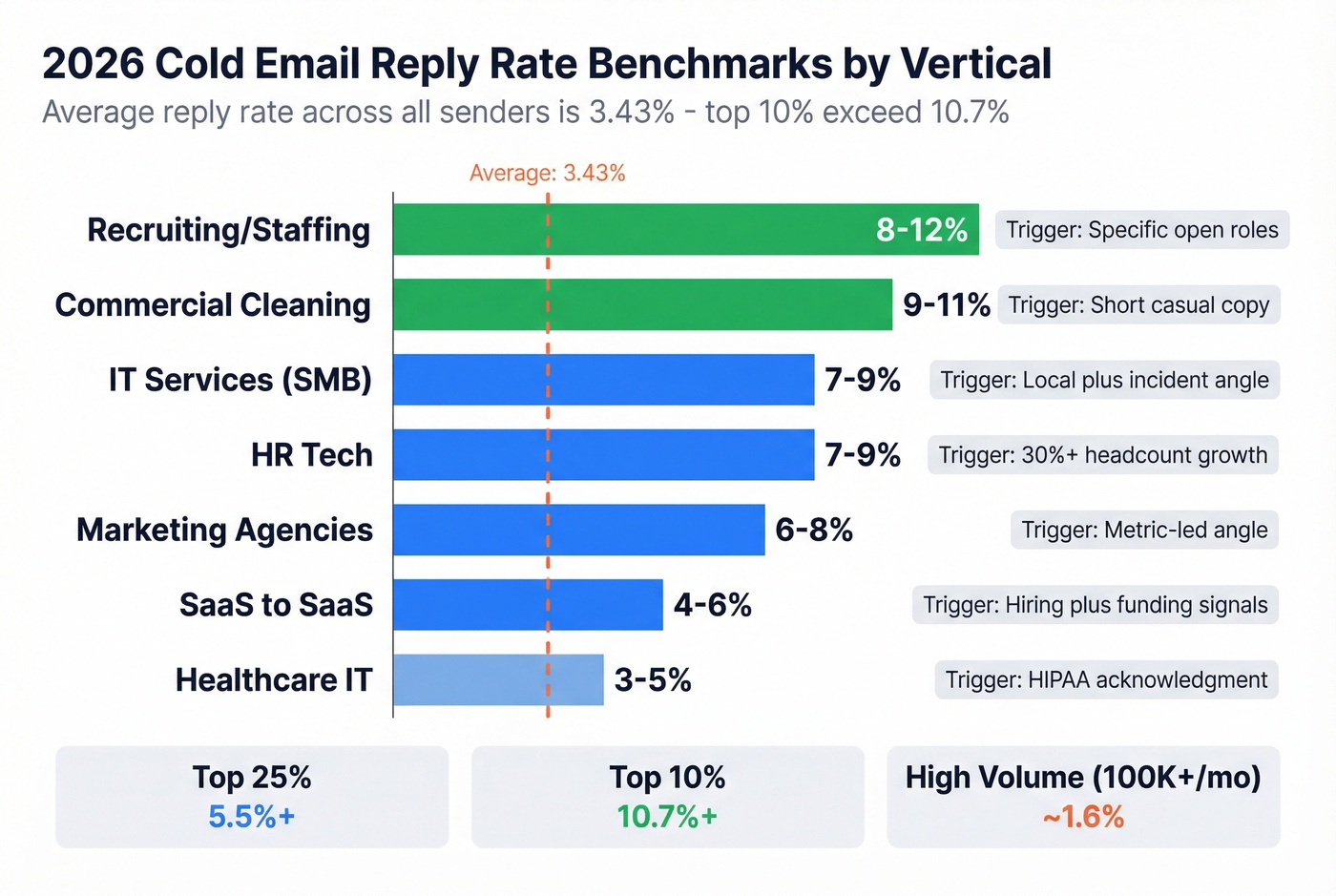
Those top-tier numbers come from small, hyper-targeted lists. Operators running 100K+ sends per month report closer to 1.6% reply rates. In our experience, teams running 25,000+ sends per month should target 2-4% and consider anything above that a bonus. Stop comparing micro-campaigns to high-volume programs - they're different sports.
| Vertical | Reply Rate | Key Trigger |
|---|---|---|
| IT services (SMB) | 7-9% | Local + incident angle |
| SaaS to SaaS | 4-6% | Hiring + funding signals |
| Commercial cleaning | 9-11% | Short, casual copy |
| Recruiting/staffing | 8-12% | Specific open roles |
| Marketing agencies | 6-8% | Metric-led angle |
| HR tech | 7-9% | 30%+ headcount growth |
| Healthcare IT | 3-5% | HIPAA acknowledgment |
Diagnosing Declining Reply Rates
When reply rates drop below 2%, resist the urge to rewrite copy. Follow this audit sequence instead:
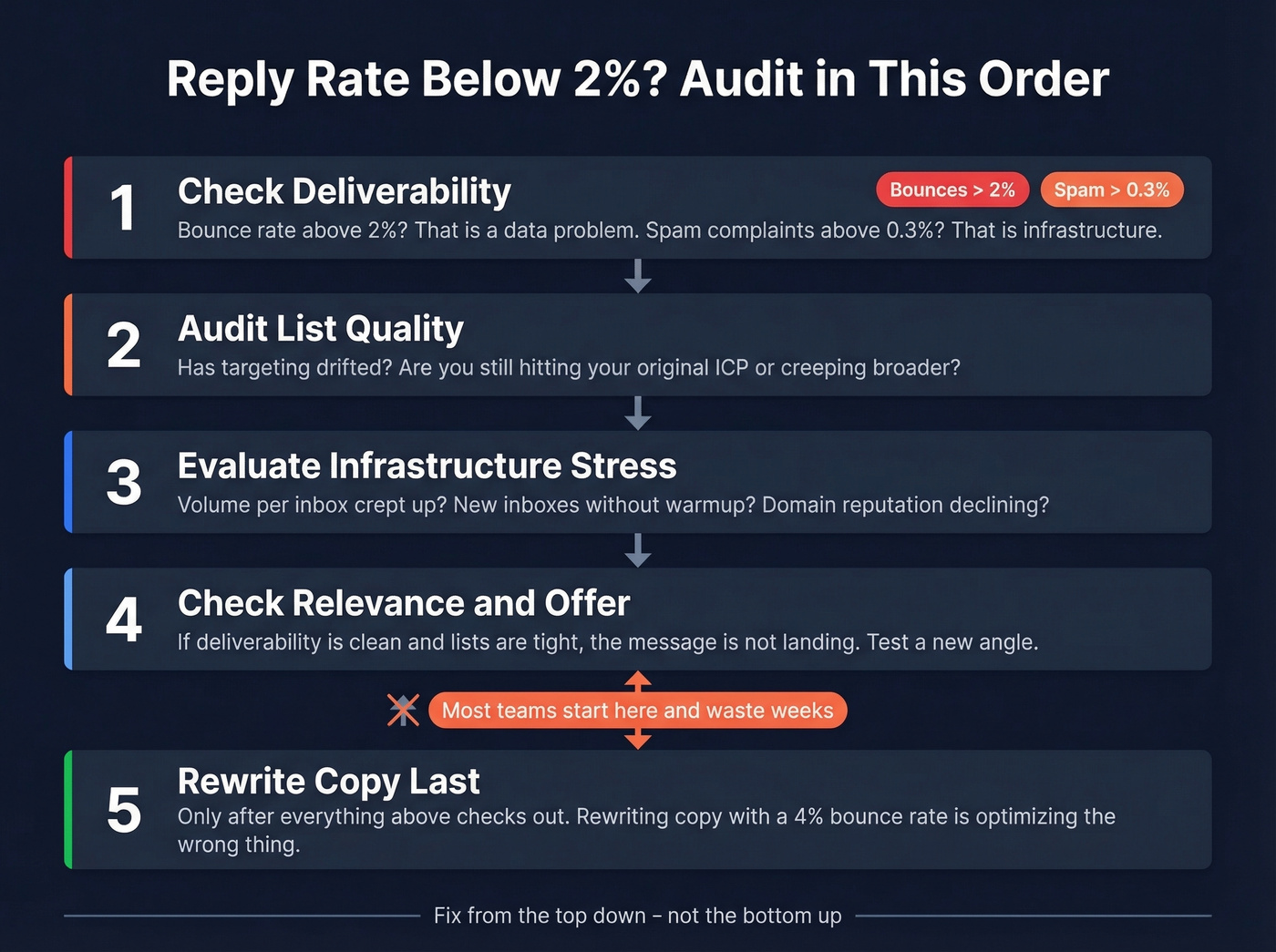
- Check deliverability first. Bounce rates above 2%? That's a data problem. Spam complaints above 0.3%? That's an infrastructure problem. Fix these before touching anything else.
- Audit list quality. Has your targeting drifted? Are you hitting the same ICP, or has segmentation crept toward broader, less relevant audiences?
- Evaluate infrastructure stress. Has send volume per inbox crept up? Have you added inboxes without proper warmup? Are any domains showing reputation decline in Postmaster Tools?
- Then check relevance and offer. If deliverability is clean and lists are tight, the message isn't landing. Test a different angle or trigger.
- Copy is last. Only rewrite after everything above checks out. If you're rewriting copy with a 4% bounce rate, you're optimizing the wrong thing.
Most teams audit in reverse order and waste weeks on subject line tests when the real problem is 600 hard bounces per month.
Campaign Economics
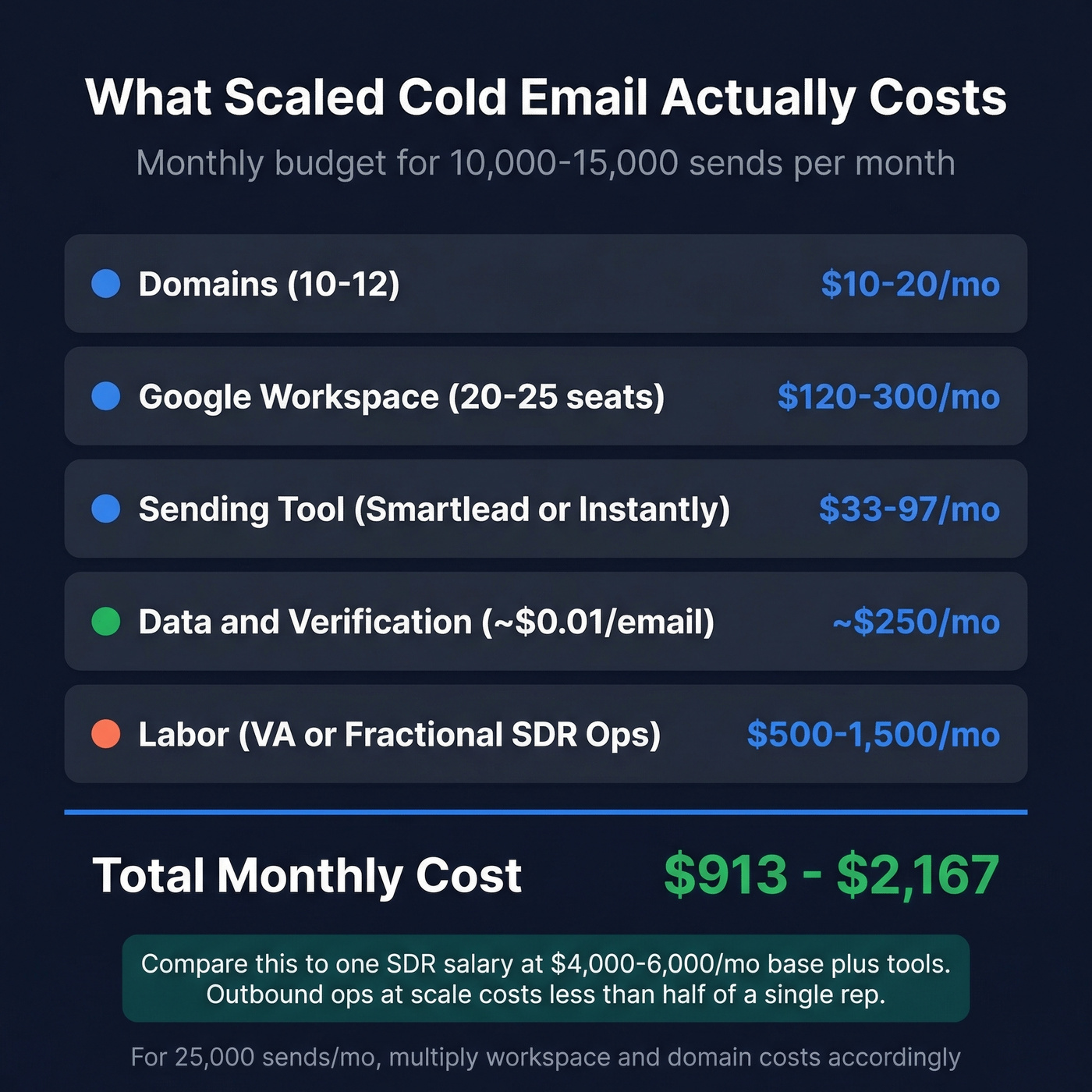
Here's what a scaled outbound program actually costs. This models a 10,000-15,000 sends/month operation - for the 25,000/month example above, multiply workspace and domain costs accordingly.
| Line Item | Monthly Cost | Notes |
|---|---|---|
| Domains (10-12) | ~$10-20 | Amortized annually |
| Google Workspace (20-25) | $120-300 | $6-12/user/month |
| Sending tool | ~$33-97 | Smartlead or Instantly |
| Data & verification | ~$250 | ~$0.01/email |
| Labor (VA or fractional SDR ops) | $500-1,500 | List building + monitoring |
| Total | $913-2,167 |
At 30-40 meetings per month, that's $25-65 per meeting. For teams selling five-figure deals, the unit economics are hard to beat. The infrastructure investment is front-loaded - once domains are warmed and inboxes are healthy, marginal costs drop fast.
Recommended Tool Stack
When evaluating sending tools, prioritize inbox rotation, warmup support, blacklist monitoring, reply classification, and team inbox support. The ability to manage prospects across campaigns from a single dashboard - including tagging, status tracking, and suppression - separates scalable tools from basic senders. Pick one tool from each category and build from there.
| Tool | Category | Starting Price | Free Tier? | Key Strength |
|---|---|---|---|---|
| Instantly | Sending | ~$37.9/mo | No | Inbox rotation + warmup |
| Smartlead | Sending | ~$32.5/mo | No | Multi-channel drips |
| Saleshandy | Sending | $25/mo | No | Budget-friendly scale |
| Lemlist | Sending | ~$32/user/mo | No | Personalization engine |
| Woodpecker | Sending | ~$20/mo per email slot | No | Agency-friendly |
| Reply.io | Sending | $49/user/mo | No | AI reply classification |
| Prospeo | Data/Verification | Free tier | Yes | 98% accuracy, 7-day refresh |
| Apollo | Data | $59/user/mo | Yes | Large database + sequences |
| Hunter | Verification | ~$49/mo | Yes | Domain search |
| Close | CRM | $9/mo | No | Built for outbound |
| HubSpot | CRM | Free tier | Yes | Ecosystem breadth |
| Google Workspace | Infrastructure | $6-12/user/mo | No | Deliverability baseline |
The sending tools are increasingly commoditized. The real differentiation in your stack is data quality and infrastructure discipline. Pick a sender you like, verify every email before it touches a sequence, and monitor your domains weekly.
If you're comparing verification vendors, start with bounce-rate mechanics and catch-all handling - see email bounce rate benchmarks and fixes.
Compliance Checklist
Cold email is legal in most jurisdictions, but the rules differ and violations are expensive. Proper recipient management - knowing exactly who's in your sequences, who's opted out, and who should be suppressed - is the operational backbone of staying compliant at scale.
CAN-SPAM (US): Include a physical mailing address, provide a working unsubscribe mechanism, use truthful subject lines, and honor opt-outs within 10 business days. No prior opt-in required for B2B, but penalties run $51,744-$53,088 per violation.
GDPR (EU/UK): Cold B2B outreach can use legitimate interest, but you must document a Legitimate Interest Assessment. Professional emails that identify a person count as personal data. Maximum penalty: EUR 20M or 4% of global revenue.
CASL (Canada): Consent-first jurisdiction with narrow implied consent conditions. Honor unsubscribe requests within 10 business days and keep opt-out records for a minimum of 3 years.
Build suppression list management into your workflow from day one. It isn't optional.
If you're unsure about list sourcing, read Is It Illegal to Buy Email Lists? before scaling volume.
The backward planning math only works when your data holds up at scale. Meritt hit 25K+ monthly sends and tripled pipeline to $300K/week after switching to Prospeo - bounce rate dropped from 35% to under 4%. Stack Optimize built an entire agency to $1M ARR on the same data foundation.
Build the infrastructure right - start with data that won't wreck your sender reputation.
FAQ
What does cold email campaign management actually involve?
It's an operations discipline covering domain infrastructure, data verification, warmup scheduling, inbox pool management, deliverability monitoring, and compliance. Segmenting lists, tracking recipient status, and maintaining suppression records takes more daily time than writing copy. Messaging matters only after the infrastructure is solid.
How many emails can I safely send per inbox per day?
Fifteen to eighteen cold emails per day is the safe ceiling. Scale by adding inboxes, not raising per-inbox volume. After full warmup, the absolute max is 50/day total including warmup - but most operators stay well below that to protect sender reputation.
What's a realistic reply rate in 2026?
The average is 3.43%, and top 10% hit 10.7%+ on small, hyper-targeted lists. At 25,000+ sends per month, 2-4% is strong performance. Anything above that at volume is exceptional - context matters more than the raw number.
How do I keep my bounce rate under 2%?
Verify every email before sending using a provider that handles catch-all domains and removes spam traps. Re-verify any list older than a week, because stale data is the fastest path to domain damage.
Should I track open rates on cold emails?
No. Tracking pixels hurt deliverability, and Apple's Mail Privacy Protection inflates open rates to meaninglessness. Track replies and positive reply rate instead - those are the metrics that actually correlate with pipeline.