

Cold Email vs Cold Call: What the Data Actually Says
A SaaS founder posted on r/SaaS about sending 2,000 cold emails and getting 6 replies. Zero customers. He declared cold outreach dead and pivoted to SEO. The comments were split - half agreed, half said his list was garbage. Both sides were right. The cold email vs cold call debate is a distraction. The real variable is the data feeding each channel.
The 30-Second Verdict
Cold email scales better and costs less per meeting booked. Cold calling converts higher per live conversation, especially with executives. The best outbound teams don't pick one - they run both in sequence.
But neither channel works if your contact data is bad. Bounced emails destroy sender reputation. Wrong phone numbers waste dials. That's the variable most guides ignore, and it's the one that matters most.
Quick pick by team type:
- SMB / lean teams: email-first, calls as follow-up
- Enterprise / high-ACV: call-first, email for nurture
- Best-in-class SDR orgs: both in a structured cadence, powered by verified data
Here's the thing: if your average deal closes under five figures, you almost certainly don't need a phone-heavy motion. Email-first with occasional calls will outperform a full SDR dialing operation at a fraction of the cost.
Head-to-Head Comparison
| Metric | Cold Email | Cold Call | Edge |
|---|---|---|---|
| Avg reply / success rate | 3.4-4.5% reply rate | 2.3% meeting-booking rate | |
| Top performers | 10%+ reply | 6-10%+ meetings | Tie |
| Daily volume per SDR | 20-49 sends/day per sending account | 40-80 dials | |
| Cost per month | ~$420 (tools) | $5,000-$8,000 (SDR) | |
| Scalability | High | Low | |
| Best day | Wednesday | Tuesday | - |
| Legal complexity | Moderate | High (TCPA) | |
| Personalization | Medium | Very high | Call |
| Trackability | Opens, clicks, replies | Connect rate, talk time, disposition | Tie |
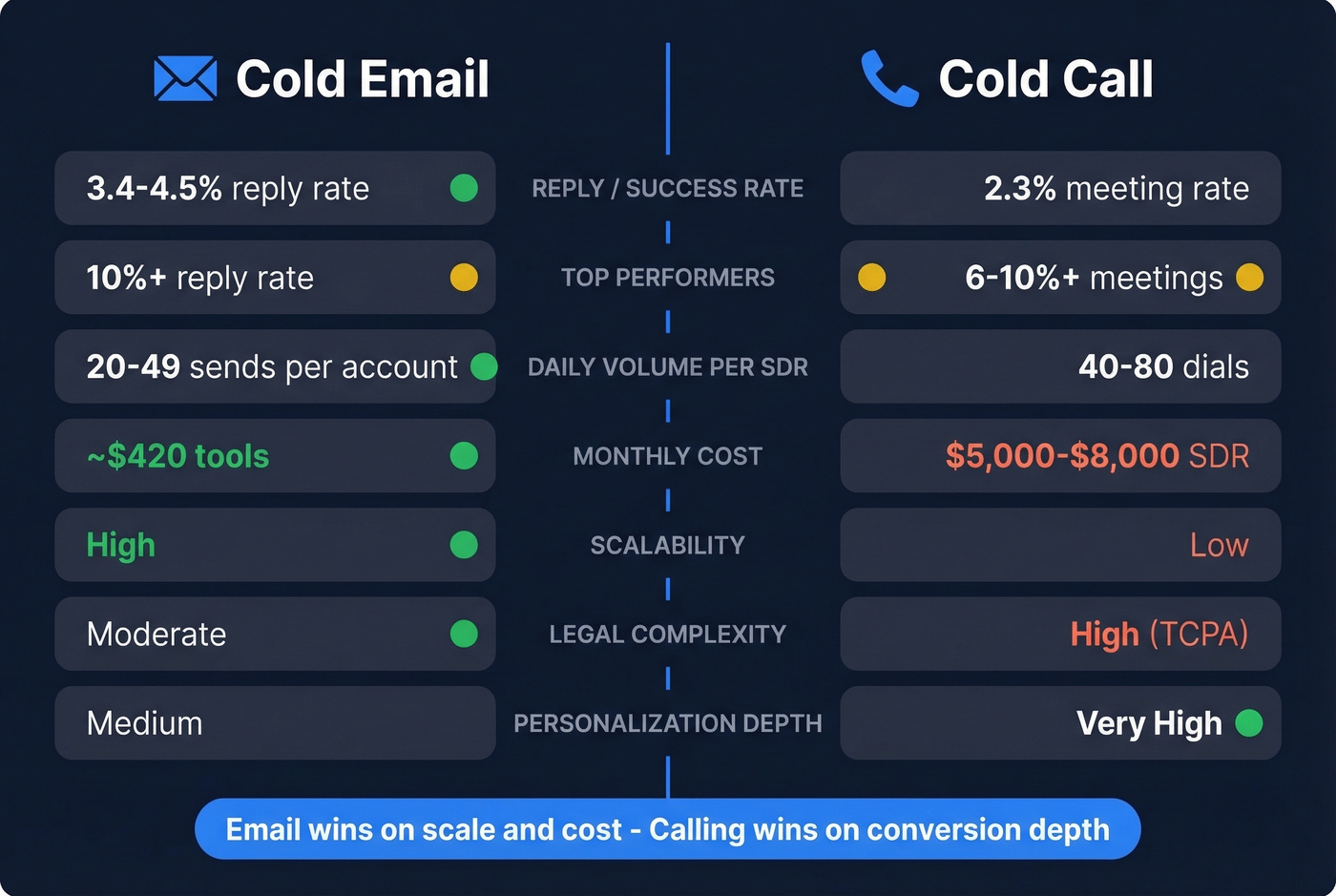
The numbers come from Instantly's billion-email dataset, Hunter's 31M-email report, and Cognism's 204,000-call study. Different methodologies, but the directional picture is clear: email wins on volume and cost, calling wins on conversion depth.
Think of it as scale vs. depth. Email is a net; calling is a spear.
Cold Email Benchmarks in 2026
The average cold email reply rate sits at 3.43% according to Instantly's 2026 benchmark report, which analyzed billions of interactions. Hunter's 31M-email dataset paints a slightly rosier picture at 4.5% with a 30% average open rate - likely because Hunter users skew toward smaller, more targeted lists. Top performers in both datasets crack 10%+.

What separates the top quartile from everyone else isn't magic copywriting. It's mechanics. Campaigns without open tracking see a 68% higher reply rate - 7.4% vs 4.4% - because open-tracking pixels trigger spam filters. Turning off the vanity metric actually improves the metric that matters. Custom sending domains outperform freemail by 108% on reply rate, another mechanical win that costs almost nothing.
List size is the other lever most teams ignore. Sequences sent to 21-50 recipients pull a 6.2% reply rate. Sequences blasted to 500+ recipients? Just 2.4%. That's a 158% difference from the same channel, same copy - just tighter targeting.
A few more numbers worth knowing: emails under 80 words outperform longer ones, sending 3 messages instead of 1 increases replies by 106%, and 58% of all replies come from the first email in a sequence. If your opener doesn't land, follow-ups are fighting uphill.
Here's why most cold emails actually fail: Hunter surveyed decision-makers and found 65% say cold emails are too sales-focused, while 61% say they're irrelevant to their role. Both problems trace back to list quality and targeting, not channel choice.
One Reddit practitioner rebuilt his entire stack - scaled from 3 to 7 domains, capped sends at 26/day per domain, cut copy to under 56 words, and verified every address. Reply rate doubled from 3% to 6%. The infrastructure matters as much as the message.
Cold Calling Benchmarks in 2026
Cold calling got harder. The 204,000-call study shows the average success rate - conversations resulting in a booked meeting - at 2.3%, down from 4.82% the prior year. Nearly half.
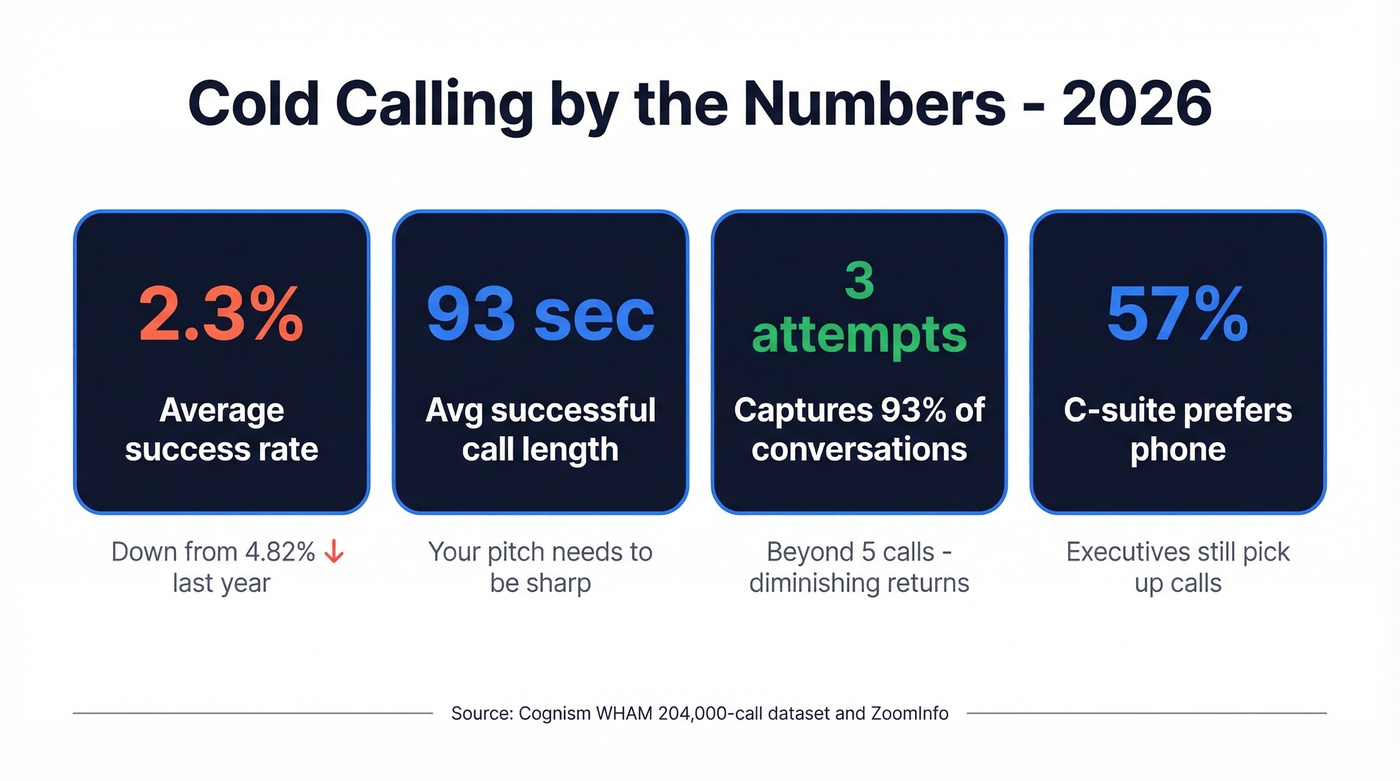
The average successful cold call lasts 93 seconds. That's not a lot of time, which means your opener and value prop need to be razor-sharp. Gong data suggests the right opener can push success rates to 10%+ - specifically, asking "how have you been?" outperforms generic openers by a wide margin. There's no room for "How are you doing today?" but there is room for familiarity.
Diminishing returns are stark: 93% of all conversations happen by the third call attempt. By the fifth, you've captured 98.6%. Three attempts is the practical optimum. Beyond that, you're burning dials that should go toward fresh contacts.
The timing debate is genuinely unresolved. ZoomInfo's data says 4-5 PM is 71% more effective than late morning. The WHAM data says 10-11 AM wins. Test your own ICP's timezone rather than trusting either benchmark blindly.
Buyer preference still favors the phone more than most email evangelists admit: 49% of buyers overall prefer phone contact, and that number jumps to 57% among C-level executives and VPs. Professional networks are the preferred channel for 50.5% of decision-makers, but they don't scale the way email and phone do - and it's a different playbook entirely.

The article makes it clear: list quality is the #1 variable in both cold email and cold calling. Prospeo's 98% email accuracy keeps your bounce rate under 4%, and 125M+ verified mobile numbers mean your SDRs actually reach someone when they dial.
Stop debating channels. Fix the data feeding them.
The Real Cost: Email vs Call
Email-first stack: That Reddit practitioner spent ~$420/month on domains, sending tools, and verification - and generated 16 qualified leads per month. Even if only a quarter convert to meetings, that's roughly $105 per meeting. Scale it with more domains and the unit economics get better, not worse.
Call-first motion: A fully loaded SDR runs $5,000-$8,000/month. At a 2.3% success rate and 60 dials per day, that SDR books roughly 25-28 meetings per month on a good month. Cost per meeting: $170-$320. Higher than email, but the meetings tend to be warmer.
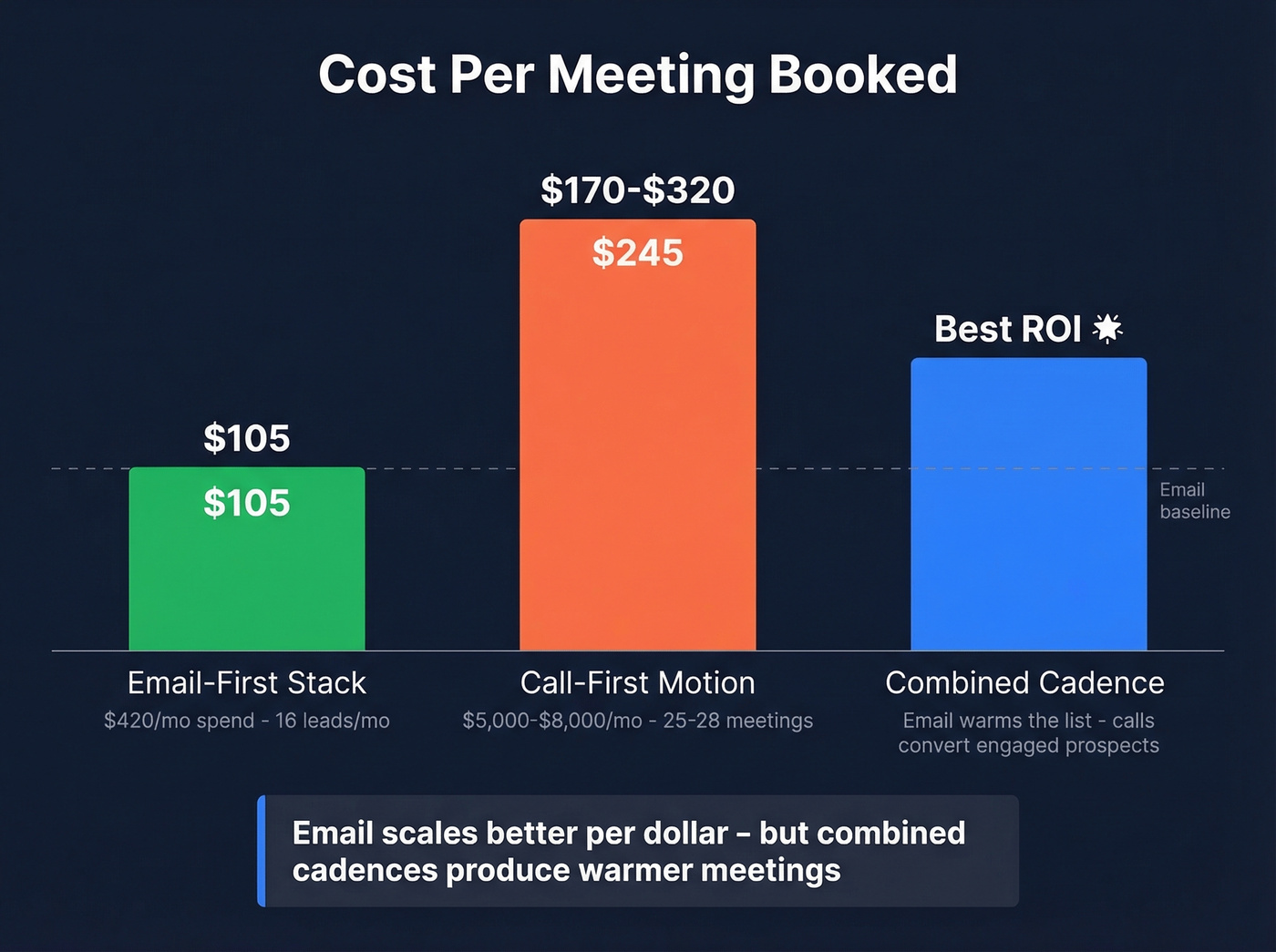
Combined cadence: Add $300-$500/month in email infrastructure to the SDR cost. Email warms up the calling list, and calls convert better when you're following up on real engagement instead of dialing completely cold.
When to Use Which Channel
Email earns its keep when the math doesn't justify phone time:
- Your average deal size is under five figures
- You're targeting SMB or mid-market where gatekeepers are rare
- You need to scale outreach without adding headcount
- Your product has a self-serve or low-friction buying motion
- Initial outreach to build awareness before a warmer touchpoint
Calling earns its keep when the stakes justify the cost:
- Enterprise deals north of $50k where 57% of decision-makers prefer phone
- C-suite targets who delete cold emails but pick up calls
- Complex products that need a conversation to explain
- Follow-up after a prospect engages with your email
- Industries where phone culture is strong - financial services, manufacturing, healthcare
Skip cold calling entirely if you're a two-person startup selling a $29/month product. The ROI math simply doesn't work. Put that energy into tighter email targeting instead.
The Combined Cadence That Works
The data points to one conclusion: multichannel outreach outperforms single-channel every time. Here's a sequence structure that maps to the benchmarks.
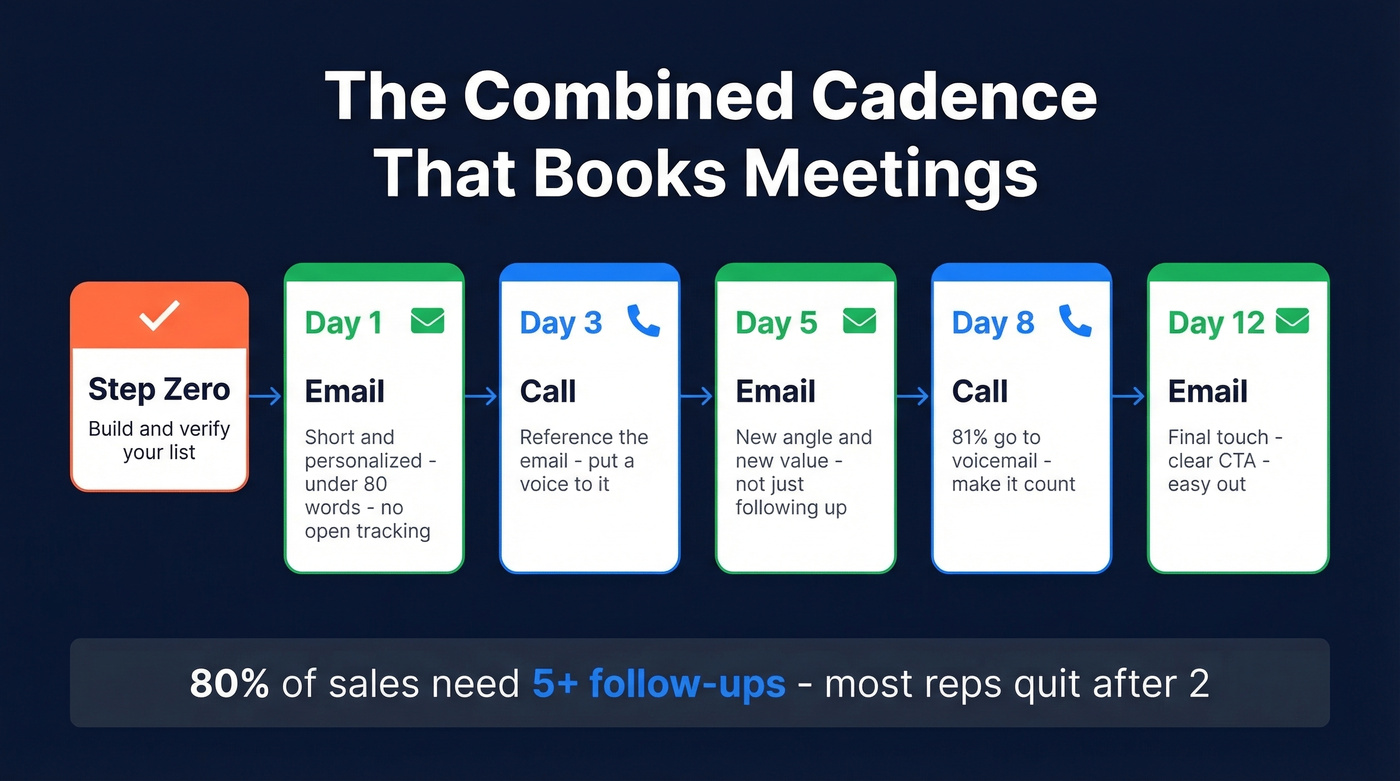
Step zero: Build and verify your list. Bad data poisons both channels - bounced emails tank your domain reputation, wrong numbers waste dials. We've seen teams cut bounce rates from 35% to under 4% just by switching to verified contact data with tools like Prospeo before sending a single message.
- Day 1 - Email: Short, personalized, under 80 words. No open tracking.
- Day 3 - Call: Reference the email. "I sent you a note Tuesday about X - wanted to put a voice to it."
- Day 5 - Email: New angle, new value. Not a "just following up" rehash.
- Day 8 - Call: Voicemail is fine. 81% of calls go to voicemail anyway - make it count.
- Day 12 - Email: Final touch. Clear CTA, easy out.
This maps to the 4-7 touchpoint sweet spot. 80% of sales require 5+ follow-ups. Most reps give up after two.
Legal Risk Comparison
| Regulation | Channel | Model | Penalty |
|---|---|---|---|
| CAN-SPAM (US) | Opt-out | Up to $53,088/email | |
| TCPA (US) | Phone | Consent | $500-$1,500/violation |
| GDPR (EU/UK) | Both | Legitimate interest | 4% revenue or EUR 20M |
| CCPA (California) | Both | Opt-out | $2,663-$7,988/violation |
| CASL (Canada) | Consent-first | Up to $10M CAD |
CAN-SPAM is the most permissive framework for cold email. It's opt-out, meaning you can email someone without prior consent as long as you include an unsubscribe mechanism and honor it within 10 business days. GDPR allows B2B cold email under Article 6(1)(f) legitimate interest, but you need to document your reasoning. CASL is consent-first, full stop.
Cold calling carries heavier per-violation risk under TCPA. A thousand non-compliant calls can mean $500k-$1.5M in exposure. The FCC tightened consent requirements in 2024, making this even more serious for US-focused teams.
Why Data Quality Decides the Winner
Let's be honest: every benchmark in this article assumes your contact data is accurate. Most teams' data isn't. 43% of salespeople say data quality is their biggest challenge, and the downstream effects are brutal.
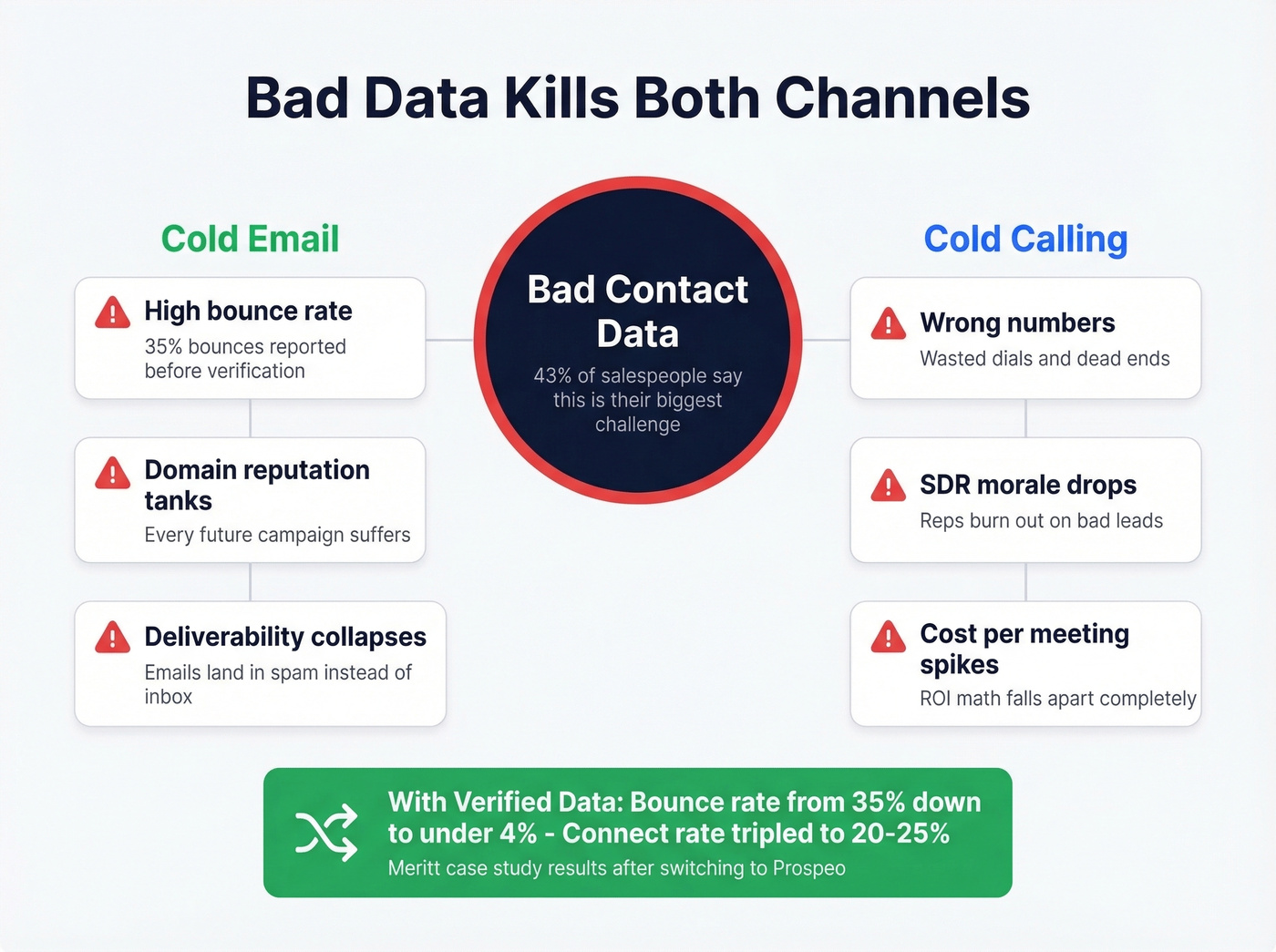
Bounced emails don't just waste sends - they damage your sender domain's reputation, dragging down deliverability for every future campaign. Wrong phone numbers don't just waste dials - they burn SDR morale and inflate your cost per meeting. We've watched teams blame their messaging, their timing, their SDRs, when the real problem was a 35% bounce rate rotting their domain from the inside.
The proof is in the turnarounds. Meritt was bouncing 35% of emails before switching to verified data - they got that under 4%, and their connect rate tripled to 20-25%. Snyk had 50 AEs prospecting 4-6 hours per week with bounce rates of 35-40%. After cleaning up their data pipeline, bounces dropped under 5% and AE-sourced pipeline jumped 180%.
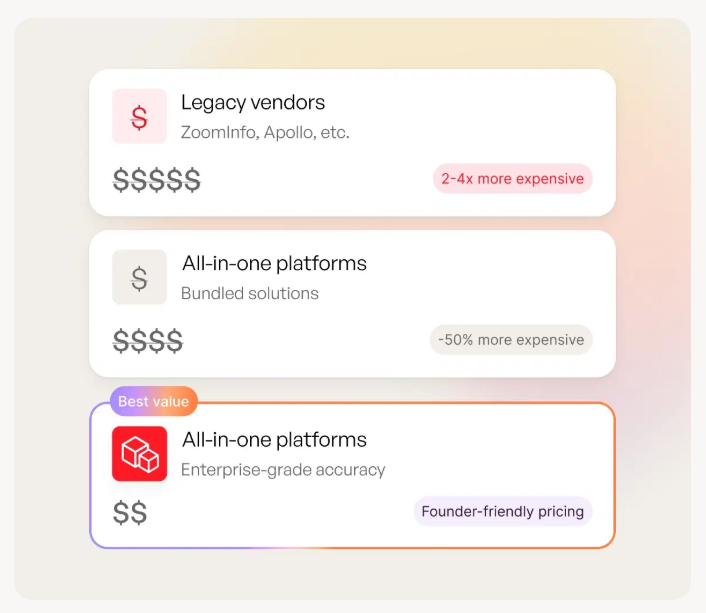
Running a combined email-and-call cadence? You need contacts with both verified emails and direct dials. Prospeo returns 50+ data points per contact at $0.01/email - 90% cheaper than ZoomInfo - with a 7-day refresh cycle so your lists never go stale.
Teams using Prospeo book 26% more meetings than ZoomInfo users.
FAQ
Is cold email or cold calling more effective in 2026?
Neither universally wins. Cold email averages 3.4-4.5% reply rates and scales cheaply across hundreds of prospects per day. Cold calling books meetings at a 2.3% rate but converts higher per live conversation, especially with C-level executives who prefer phone contact (57%). The best teams combine both in a structured cadence.
What's a good cold email reply rate?
The average sits at 3.4-4.5% based on 2026 benchmark reports from Instantly and Hunter. Top performers hit 10%+. Keep emails under 80 words, send 20-49 per day per account, skip open tracking, and target lists of under 50 recipients to maximize replies.
How many cold call attempts should I make?
Three is the practical optimum. The 204,000-call WHAM dataset shows 93% of conversations happen by the third attempt, and pushing to five captures 98.6%. Beyond that, redirect those dials toward fresh contacts for better ROI.
Is cold calling dead?
No, but it's harder - success rates dropped from 4.82% to 2.3% in one year. It still works best for enterprise deals and C-level targets where 57% of executives prefer phone over other channels. Teams that succeed pair calling with email engagement signals rather than dialing completely cold.
What tools help improve both cold email and cold call results?
Start with a verified data provider. Prospeo offers 98% email accuracy and 125M+ verified mobile numbers with a 30% pickup rate at roughly $0.01 per lead. Pair that with a sending tool like Instantly or Smartlead for email and a dialer for calls. The data layer matters more than the sending layer - bad contacts sink both channels regardless of tooling.