

The Best Cold Outreach Tools for 2026: What Actually Books Meetings
You launched 2,000 cold emails last month. 180 bounced. Another 400 landed in spam. Your reply rate came in at 1.2%, and your SDR is blaming the copy. The copy isn't the problem - the cold outreach tools powering your infrastructure are.
The average cold email reply rate sits at 3.43%, and the top 10% of senders hit 10.7%+. The gap between those numbers isn't talent or timing - it's the stack. Most outbound campaigns fail before the first email opens because bad contact data triggers bounces, which tanks your sender reputation, which routes future emails to spam. No amount of clever subject lines fixes that cascade. The teams booking meetings consistently in 2026 are running a 5-layer stack where data quality, verification, and inbox infrastructure do the heavy lifting before a single email sends.
Here's what actually works, what it costs, and which tools are worth your time.
Our Picks (TL;DR)
| Pick | Tool | Best For | Starting Price |
|---|---|---|---|
| Best data accuracy | Prospeo | Clean data that protects your domain | Free (75 emails/mo) |
| Best email volume | Instantly | Scaling sends across unlimited inboxes | $37/mo (sending only) |
| Best multichannel | Lemlist | Email + LinkedIn + calls in one sequence | ~$59/mo/user |
| Best budget option | Saleshandy | Budget-friendly cold email scaling | $25/mo (annual) |
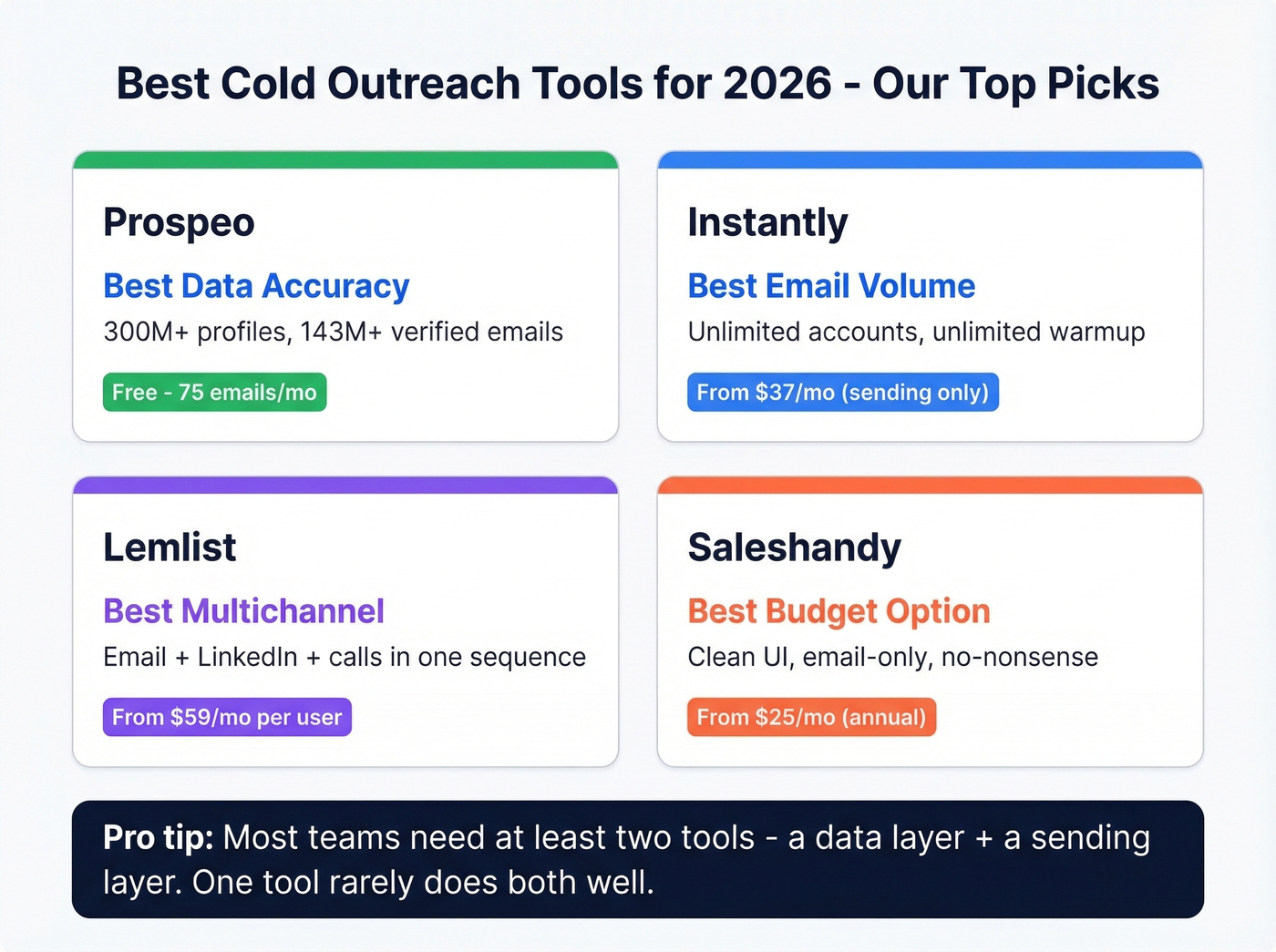
Most teams need at least two of these - a data layer and a sending layer. Trying to do everything in one tool is how you end up with 8% bounce rates and a burned domain.
The 5-Layer Outreach Stack
Cold outreach isn't one tool. It's five layers, and the teams that treat it like a single purchase are the ones burning domains and wondering why nothing works.
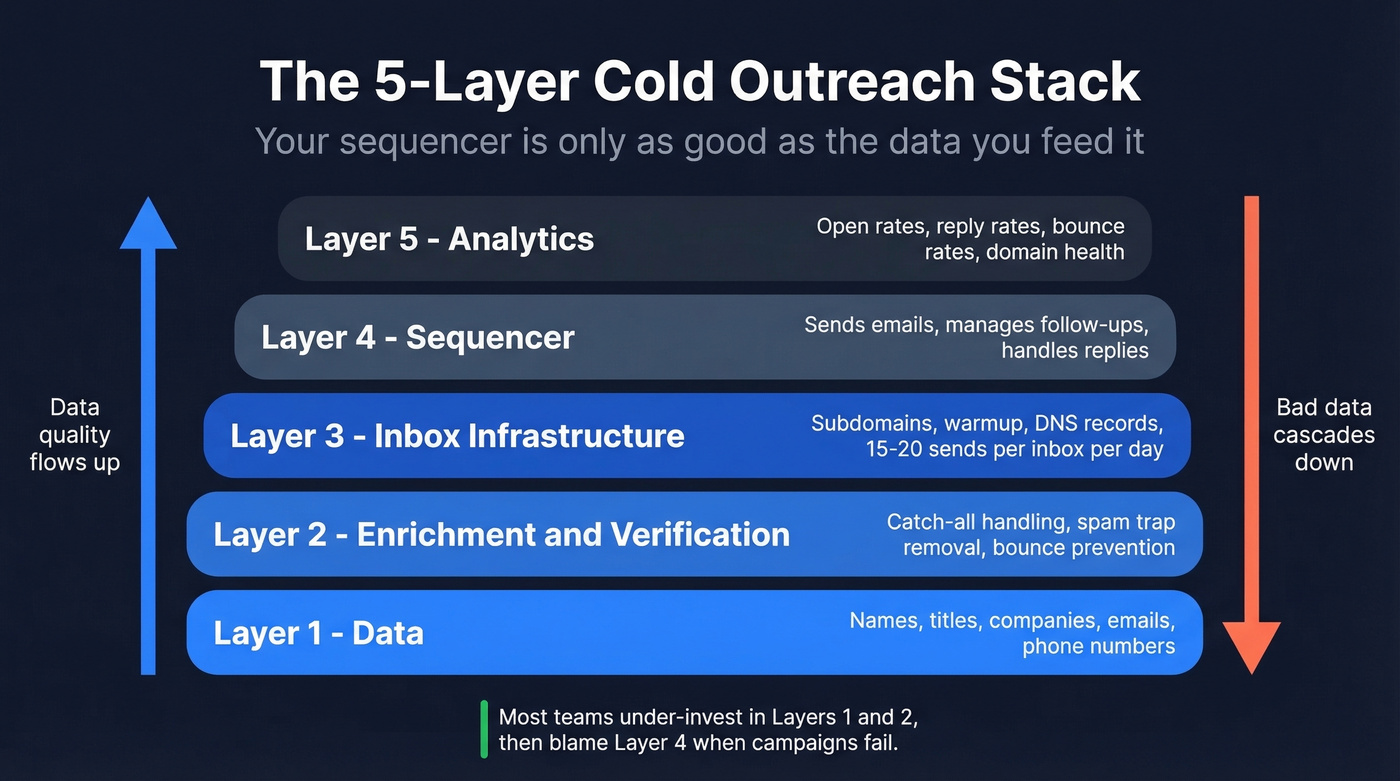
Layer 1 - Data. Where you source contacts. Names, titles, companies, emails, phone numbers. This is the foundation, and it's the most under-invested layer by far.
Layer 2 - Enrichment and verification. Raw data decays fast. People change jobs, companies rebrand, emails go stale. Verification before anything hits an inbox is non-negotiable - bounce rates above 1.5% erode your domain reputation.
Layer 3 - Inbox infrastructure. Dedicated subdomains, warmed-up inboxes, proper DNS records. The consensus on r/coldemail is clear: keep sends to 15-20 per inbox per day. Scale by adding inboxes, not by cranking volume.
Layer 4 - Sequencer. The tool that actually sends your emails, manages follow-ups, and handles replies. This is what most people think of when they hear "outreach tool," but it's really just one piece.
Layer 5 - Analytics. Open rates, reply rates, bounce rates, domain health. Without visibility, you're flying blind.
Your sequencer is only as good as the contacts you feed it. Start with clean data and the rest of the stack performs dramatically better.
How We Evaluated
Zapier's framework evaluates cold email tools on automation, deliverability, analytics, and integrations. That's a solid starting point, but it misses the criterion that matters most - data quality.
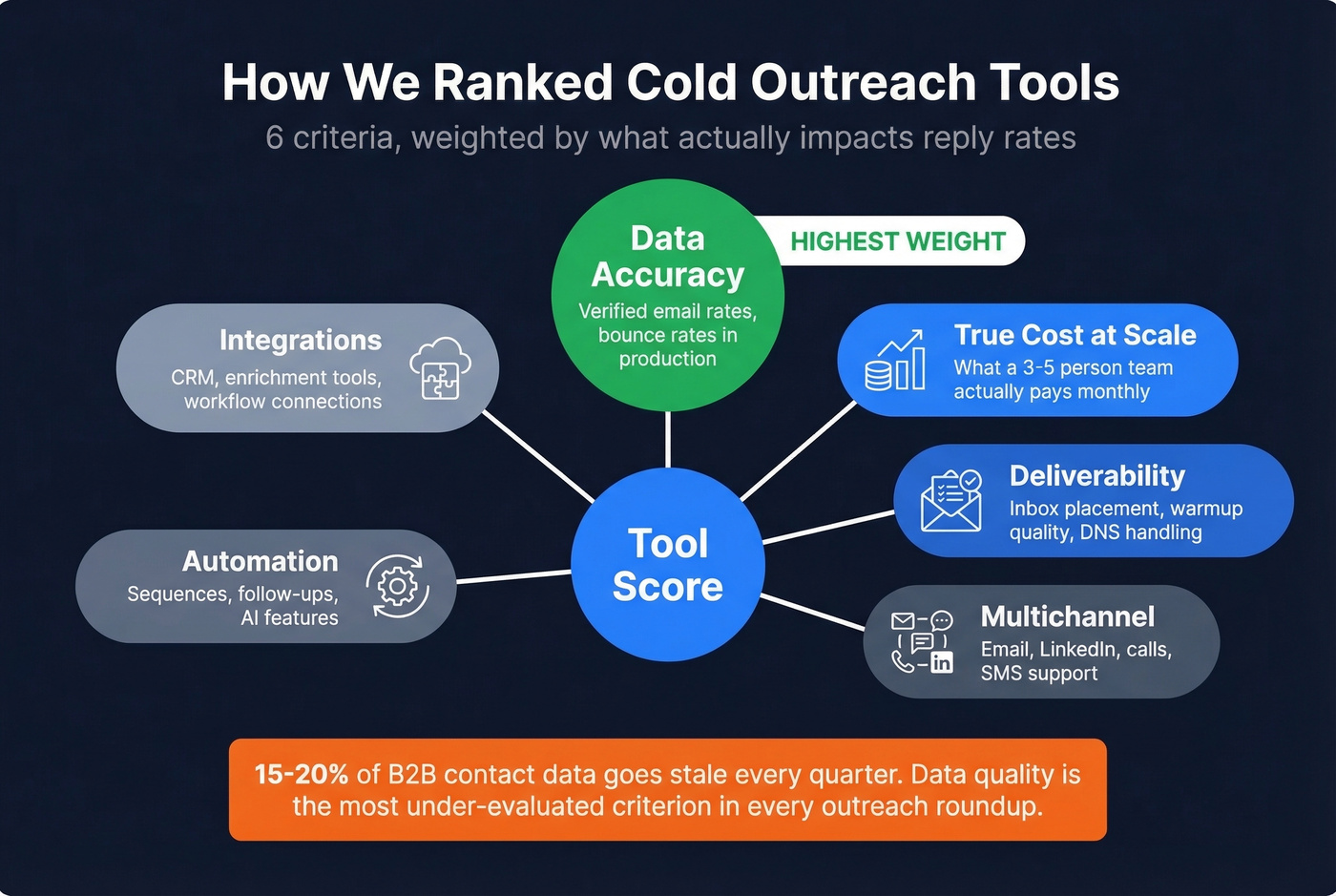
We added three dimensions: data accuracy (verified email rates, bounce rates in production), true cost at scale (what a 3-5 person team actually pays monthly, not the landing page number), and multichannel capability. Here's the thing: data quality is the most under-evaluated criterion in every outreach tool roundup we've read. Everyone obsesses over sequencer features and ignores the fact that 15-20% of B2B contact data goes stale every quarter. If your data layer is weak, nothing downstream matters.

Bad data is the #1 reason cold outreach fails - not your copy, not your sequencer. Prospeo's 5-step verification and 7-day refresh cycle keep bounce rates under 3%, so every email you send actually lands. At $0.01 per verified email, fixing your data layer costs less than a single bounced campaign.
Stop blaming your copy. Start with data that doesn't bounce.
The Best Cold Outreach Tools for 2026
Prospeo - Best for Data Accuracy
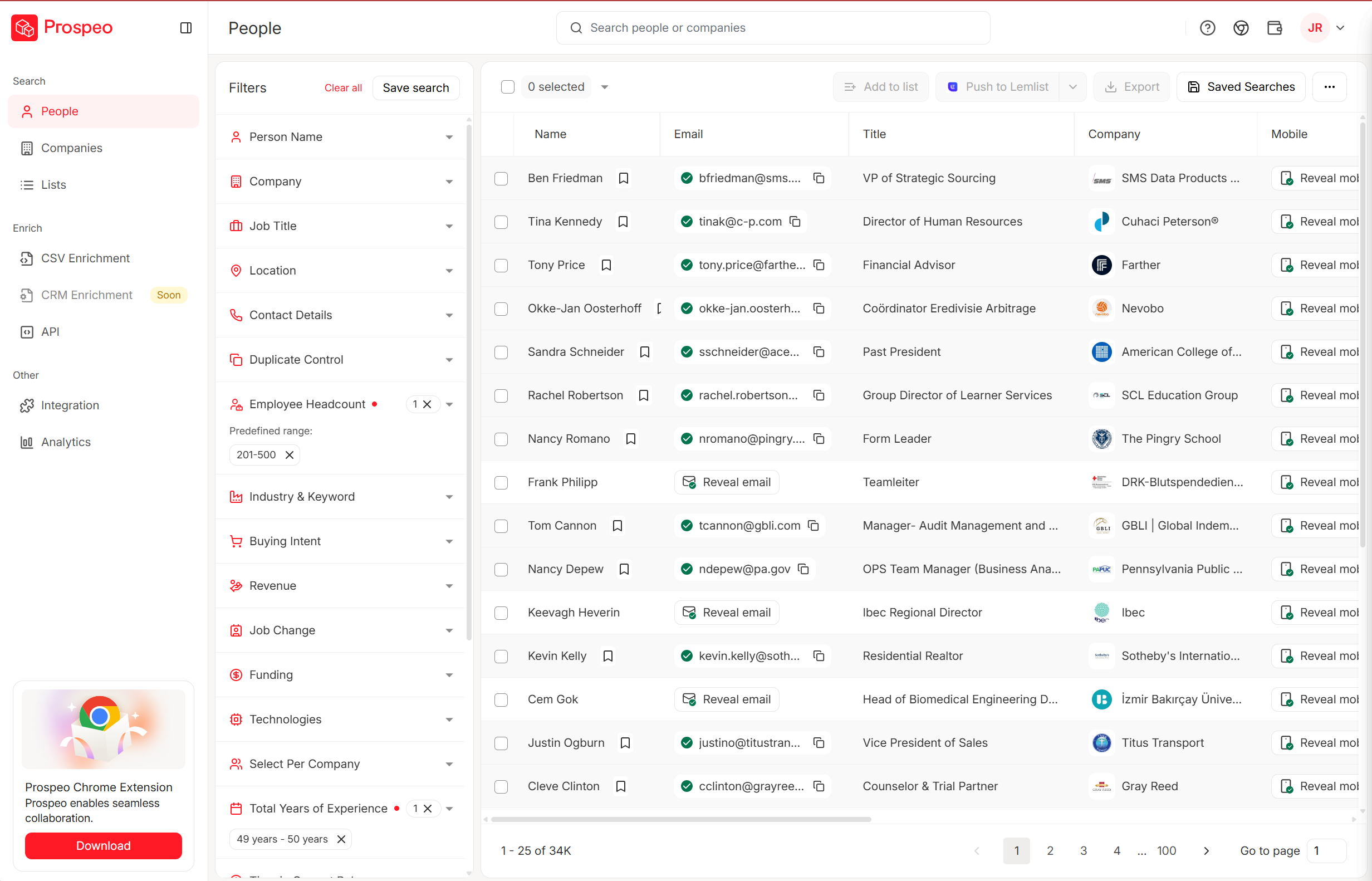
Need to find VPs of Sales at Series B companies actively hiring SDRs? Prospeo's 30+ search filters - including Bombora intent data across 15,000 topics, technographics, job changes, and funding signals - let you build that list in minutes. The database covers 300M+ professional profiles, 143M+ verified emails, and 125M+ verified mobile numbers, all running through a 5-step verification process that handles catch-all domains, removes spam traps, and filters honeypots.
The 7-day data refresh cycle is the real differentiator. Most B2B databases refresh around every 6 weeks, and by then a meaningful chunk of your list has changed jobs. Weekly refresh means you're working with current data, not last month's org chart. Stack Optimize used this approach to build from $0 to $1M ARR - bounce rates stayed under 3% and zero domains were flagged across all clients. Snyk's 50-person AE group cut bounce rates from 35-40% to under 5% after switching, generating 200+ new opportunities per month.
Pricing starts free - 75 emails/month on the free tier, then roughly $0.01 per email on paid plans. No contracts, no sales calls required. Native integrations with Instantly, Smartlead, Lemlist, and Clay mean verified contacts flow straight into your sequencer.
Pairs with: Instantly, Smartlead, or Lemlist for the sending side of your stack.
Instantly - Best for Volume
Instantly's strength is simplicity: unlimited email accounts, unlimited warmup, inbox rotation. The UI is clean, setup takes minutes, and the warmup network is solid.
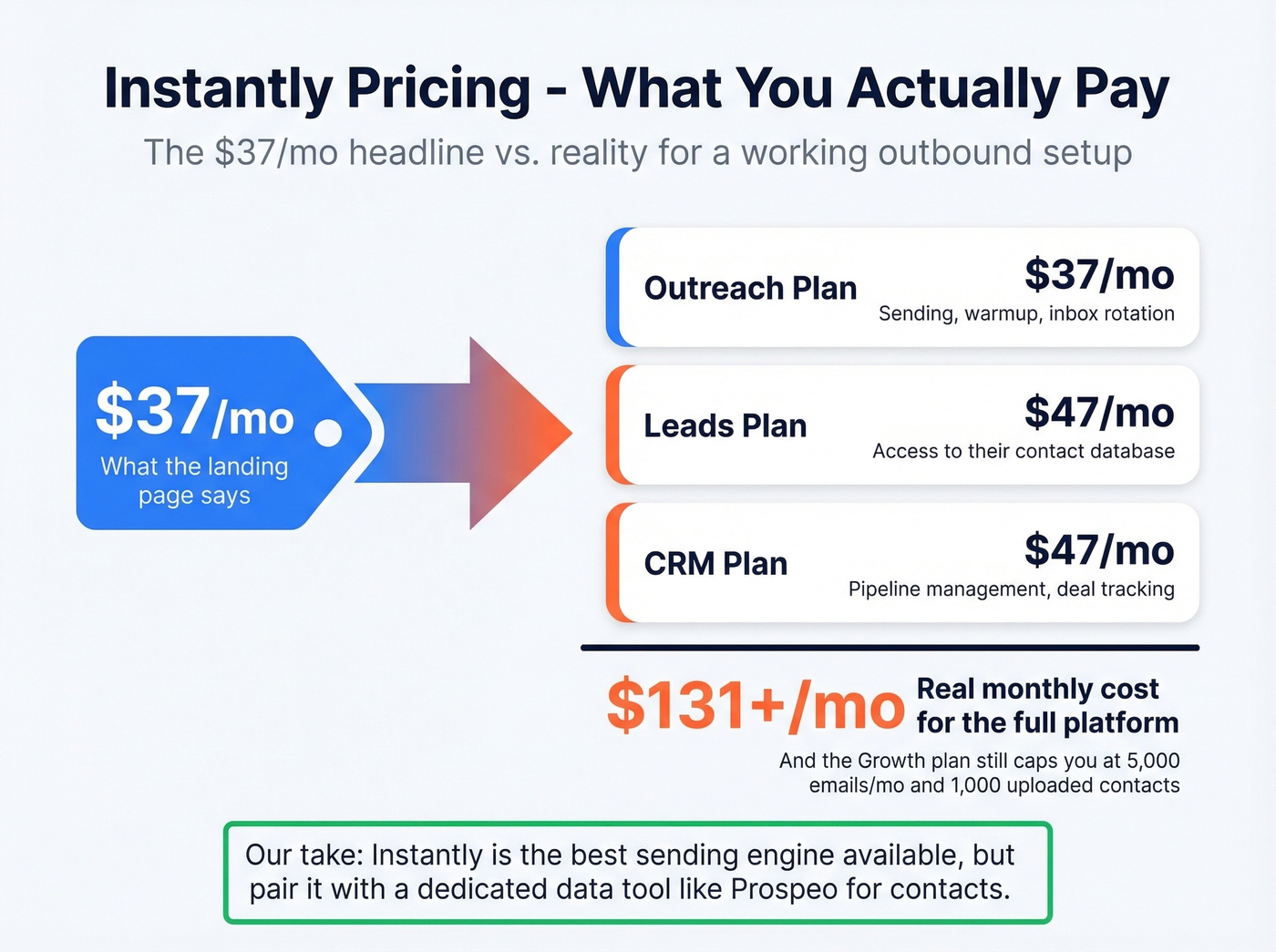
The pricing is where teams get burned. That "$37/mo" headline? It's the monthly Outreach plan - sending only. Want leads from their database? That's a separate plan starting at $47/mo. CRM? Another $47/mo. A realistic monthly bill for the full platform runs $131+. The Growth Outreach plan caps you at 5,000 emails/month and just 1,000 uploaded contacts, which most teams outgrow within weeks.
Instantly is the best sending engine available if you already have a reliable data source. It's not an all-in-one platform, no matter what the pricing page implies. Expect to pair it with a dedicated sales prospecting database.
Smartlead - Best for Deliverability
Your SDR manager just showed you the Smartlead invoice and it's three times what you budgeted. This happens constantly. The base plan starts at $39/mo, but a real deployment needs SmartSenders for mailbox provisioning (~$225/mo for 50 mailboxes across 10 domains), SmartDelivery for inbox placement testing ($49/mo), and SmartServers for dedicated infrastructure ($39/server/mo). A realistic estimate for a 5-person SDR team lands around $603/mo.
The deliverability controls justify the cost if inbox placement is your primary concern. Dedicated servers, pre-send inbox placement testing, and fine-grained warmup settings give you visibility that Instantly doesn't match.
Skip this if you want predictable monthly costs. The add-on pricing makes budgeting feel like guesswork.
Lemlist - Best for Multichannel
Lemlist has the best multichannel UX on the market. You build one sequence that touches prospects across channels in a logical order - LinkedIn connection first, wait 2-3 days, then email, then a call task. Reddit threads consistently report 2-3x conversion lifts from multichannel versus email-only campaigns, and Lemlist makes that workflow accessible without a steep learning curve.
Pricing runs approximately $59/mo per user, with multichannel features on the higher-tier plan around $79/mo. Extra email accounts cost $9/mo each. For a 3-person team on the multichannel plan, budget $237/mo - reasonable if your deal sizes justify the investment.
Skip this if you're running a 5+ SDR team on a tight budget. Per-seat pricing compounds fast.
Apollo - Best Free Starting Point
Apollo's free plan gives you 100 credits/month, a built-in sequencer, and access to a massive database. Paid plans start at $49/user/mo, and the Professional plan unlocks 15 sending inboxes. The Organization plan ($119/user/mo, minimum 3 seats) unlocks the most complete feature set.
The downsides are real, though. Credits don't roll over - use them or lose them. Mobile numbers cost 8 credits each, which burns through allocations fast. In our experience, data accuracy outside the US drops to the 60-72% range. Free and Basic plans limit you to 1 sending inbox, capping your volume. By the time you're on Organization with 3 seats, you're at $357/mo and still dealing with credit anxiety.
Reply.io - Widest Channel Spread
Reply.io covers email, LinkedIn, calls, SMS, and WhatsApp in one platform. If you need every possible touchpoint, it's the most complete option. Email-only plans start around $59/mo, multichannel at $89/user/mo.
The tradeoff is setup complexity - configuring all channels takes time, and the AI SDR add-on starts at $259/mo, which is steep for what amounts to automated follow-up logic. Lemlist's multichannel UX is more intuitive for most teams.
Saleshandy - Best Budget Scaling
Saleshandy is the cheapest way to run cold email at scale. Plans start at $25/mo on annual billing with a 7-day free trial. Clean, no-nonsense UI. The limitation is obvious: email-only. No LinkedIn, no calls, no multichannel sequences. For teams that just need straightforward email outreach software doing one thing well, Saleshandy fits.
Woodpecker, GMass, and Mailshake
Woodpecker starts at $20-29/mo per email slot, with extra warmup at $5/inbox/mo. Straightforward, no-frills cold email for SMBs.
GMass runs inside Gmail - literally inside your inbox tab. From $25/mo for individuals, $120/mo for a 5-user team. The Spam Solver tool tests inbox placement before you send. Best for solopreneurs already living in Google Workspace.
Mailshake starts at $25-29/user/mo for email, with Sales Engagement plans at $85-99/user/mo that add a built-in dialer. No free trial, which is frustrating at this price point.
We also evaluated Snov.io (~$29-$39/mo), Klenty (~$60/mo), and Hunter but didn't include them in the main list - they overlap heavily with tools already covered.
What You'll Really Pay
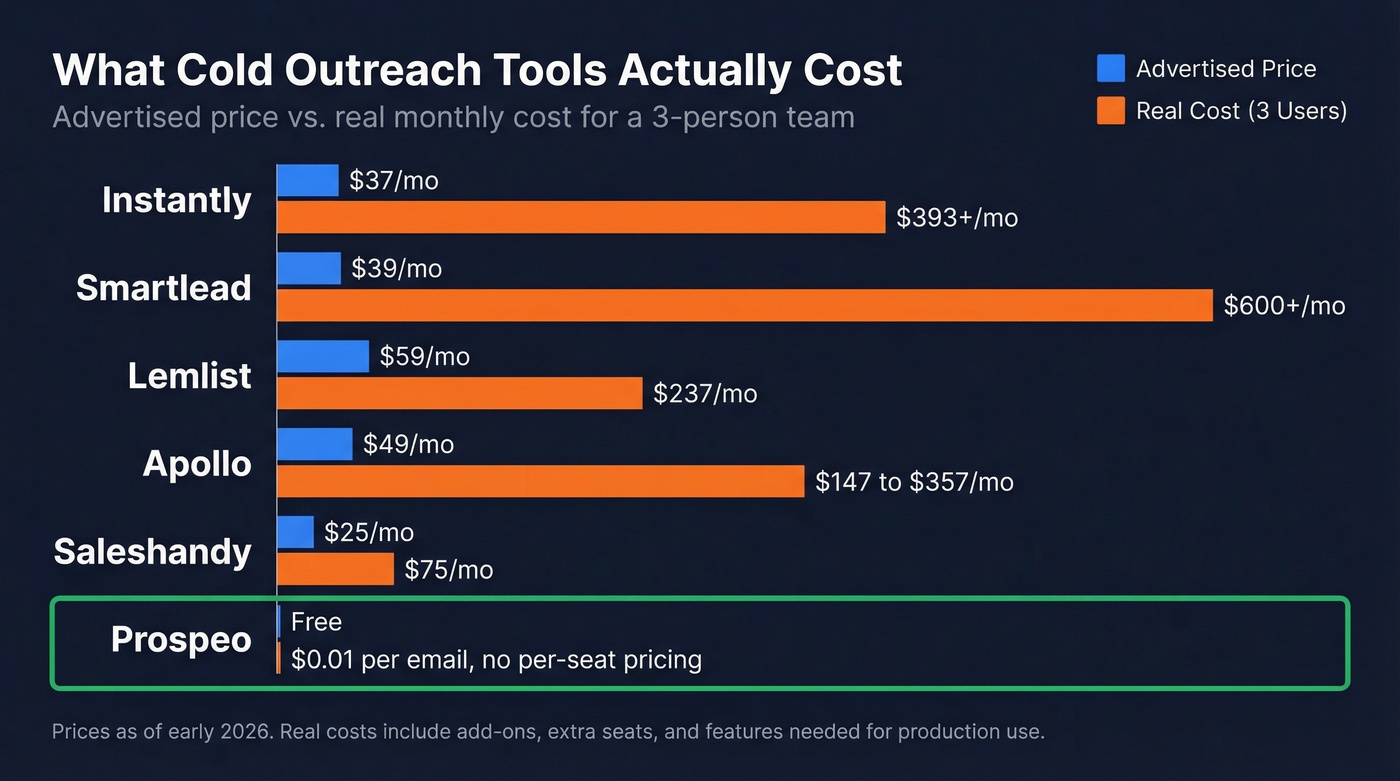
Let's be honest: cold outreach tool pricing is designed to look cheap on the landing page and expensive on the credit card statement. Here's what a 3-person team actually pays monthly:
| Tool | Advertised | Real Monthly Cost (3 users) | What's Included |
|---|---|---|---|
| Instantly | $37/mo | $393+ | Outreach + Leads + CRM |
| Smartlead | $39/mo | ~$600+ | Pro + senders + delivery |
| Lemlist | ~$59/mo | $237 | Multichannel plan x 3 |
| Apollo | $49/mo | $147-$357 | Basic x 3 to Org x 3 |
| Saleshandy | $25/mo | $75 | 3 users |
| Prospeo | Free-$0.01/lead | Usage-based | Scales with leads, not seats |
The gap between advertised and real cost is largest with Instantly and Smartlead, where modular pricing and add-ons multiply the base number. For a team sourcing 5,000 contacts/month, the difference between $0.01/email and Apollo's credit system - where a single mobile number costs 8 credits - compounds fast.
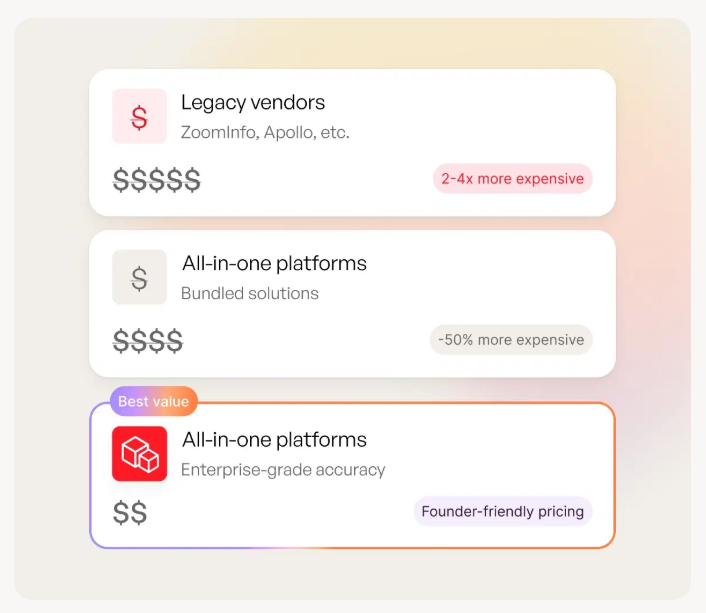
Stack Optimize built a $1M agency with zero domain flags. Snyk's 50 AEs cut bounce rates from 35% to under 5% and generated 200+ opportunities per month. The difference wasn't the sequencer - it was 300M+ profiles verified weekly and fed directly into Instantly, Smartlead, or Lemlist.
Plug 98% accurate data into your sending tool today.
Why Your Emails Aren't Landing
Global inbox placement averages around 84% according to Validity - meaning roughly one in six emails never reaches the inbox. Cold outreach performs worse.
The numbers by provider are sobering. GlockApps' Q4 2025 data breaks it down:
| Provider | Inbox Rate |
|---|---|
| Office 365 | 67.95% |
| Gmail | 56.97% |
| Google Workspace | 49.98% |
| Outlook | 45.06% |
If half your prospect list uses Outlook, nearly half your emails are going to spam or getting blocked entirely. That's not a copy problem. That's an infrastructure problem.
The technical checklist that separates teams landing in the inbox from teams landing in spam:
- Dedicated subdomain for cold outreach (never use your primary domain)
- SPF, DKIM, and DMARC properly configured
- Custom tracking domain (shared tracking domains are spam triggers)
- One-click unsubscribe header
- Spam complaint rate below 0.3%
- Bounce rate below 1.5%
Stale data is the silent killer. You can nail every technical requirement and still land in spam if 8% of your list bounces. No sending platform compensates for bad contact data upstream.
Sequence Benchmarks
58% of replies come from the first email. Follow-ups contribute the remaining 42%, but with diminishing returns after step 4. The sweet spot is 4-7 touchpoints.
Keep first-touch emails under 80 words. Tuesday and Wednesday are peak reply days, with Wednesday slightly ahead. Monday is the best day to launch a new sequence - your first email lands Tuesday morning.
For multichannel sequences, start LinkedIn slow at 20-30 connections per day max, and don't hit both channels on the same day. LinkedIn connection on day 1, email on day 3, follow-up email on day 6. That cadence feels natural rather than aggressive.
FAQ
What's the best free cold outreach tool?
Apollo's free plan (100 credits/month) is the strongest starting point for beginners who want data and sending in one tool. For data and verification specifically, Prospeo offers 75 free emails/month with 98% accuracy - enough to test your first campaigns without risking your domain on unverified contacts.
Do I need separate tools for data and sending?
Yes. Most sequencers like Instantly and Smartlead are built for sending, not sourcing accurate contacts. Using a dedicated data tool for verified emails, then feeding them into your sequencer, dramatically reduces bounce rates and protects domain reputation. Think of it as the difference between a kitchen and a grocery store - you need both.
How many emails per inbox per day?
Keep it to 15-20 sends per inbox per day. Going higher triggers spam filters and damages sender reputation. Scale by adding more warmed-up inboxes, not by increasing volume per inbox. A 3-person team running 10 inboxes each at 15 sends/day hits 450 emails daily - plenty for most pipelines.
Why are my cold emails going to spam?
The most common causes: missing SPF/DKIM/DMARC records, using your primary domain instead of a dedicated subdomain, shared tracking domains, bounce rates above 1.5%, and spam complaint rates above 0.3%. Fix infrastructure first, then optimize copy.
Is multichannel outreach worth the extra cost?
Teams running coordinated email + LinkedIn sequences report 2x+ higher conversion rates than email-only campaigns. If your average deal size exceeds $5K, multichannel platforms like Lemlist ($79+/user/mo) or Reply.io ($89+/user/mo) pay for themselves quickly. For smaller transactions, email-only tools like Instantly or Saleshandy deliver better ROI.